Vol. 47, No. 2, pp. 282 - 286, 2006
We evaluated the enhancing effect of structured treatment interruptions (STIs) on HIV-specific immunity in chronically HIV-1 infected Korean patients. A prospective case-control study was done with a total of 10 subjects for a period of 26 weeks. Six subjects were on STIs and four subjects were on continuous HAART for comparison. The STI subjects underwent four periods of STIs. For those on STIs, HAART was stopped at week 0 for two weeks, and resumed thereafter for six weeks. Viral load and CD4+/CD8+ T cells were mea-sured by HIV RNA RT-PCR and flow cytometry, and HIV-specific immunity was measured by an ELISPOT assay. HIV-specific cytotoxic T cell immunity was more pro-nounced in the STI subjects than in the continuous HAART subjects after 26 weeks (p= 0.011). The difference in cyto-toxic T cell response in the STI group was more prominent than in the continuous HAART group (p= 0.011). Viral load after 26 weeks was higher in the STI subjects than in the continuous HAART subjects (p= 0.008). An HIV-specific cellular immune response can be stimulated by STIs in chronically HIV-infected Koreans. A larger study is war-ranted in order to further characterize viral and immunolo-gical parameters of treatment with STIs in cases of chronic HIV infection.
Key Words: HIV, HIV infection, immunotherapy, cellular immunity
Highly active antiretroviral therapy (HAART) is associated with both virological and immunologi-cal benefits in human immunodeficiency virus (HIV) infection and acquired immunodeficiency syndrome (AIDS). HAART has also been known to reduce AIDS-related mortality.1 Despite these benefits, when used alone HAART has proven insufficient to completely eliminate viral reser-voirs, even after decades of treatment.2Structured treatment interruptions (STIs) have been inves-tigated as a means of improving viral control via the augmentation of HIV-1-specific cellular im-mune responses, with the additional potential benefits of reduced drug exposure and lower costs.
Results have thus far been encouraging for patients who undergo STIs following HAART when initiated during the period of acute infection.3,4However, the benefits of STIs in those chronically infected is less clear. Studies indicate that only a minority of chronically infected indi-viduals are able to maintain viral suppression after STIs without HAART, although most patients exhibit increased antiviral cellular im-mune responses.5 Furthermore, rapid declines in peripheral CD4+ T-cell counts have been observed during STIs.6,7 These CD4+ T-cell declines are inversely proportional to increases in plasma HIV-1 RNA levels during STIs, and are generally followed by a return to pre-interruption CD4+ T-cell levels after the re-initiation of HAART.7
To date, there has been no study conducted regarding the effects of STIs in HIV infected
HIV-Specific Cellular Immune Responses Are Stimulated by
Structured Treatment Interruption in Chronically HIV-1
Infected Koreans
Jun Yong Choi,1,2 Young Goo Song,1,2 Yoon Seon Park,1,2 Hee Jung Yoon,1,2 Myung Soo Kim,1,2 Young Keun Kim,1,2 So Youn Shin,1,2 and June Myung Kim1,2,3
1AIDS Research Institute,2Department of Internal Medicine, and3Brain Korea 21 Project for Medical Sciences, Yonsei University
College of Medicine, Seoul, Korea.
Received July 25, 2005 Accepted December 2, 2005
This work was supported by the Molecular and Cellular BioDiscovery Research Program grant from the Ministry of Science and Technology, South Korea.
Koreans. Therefore, in this report we have eval-uated the effect of STIs with respect to the augmentation of HIV-specific immunity and con-trolling viral replication in chronically HIV-1 in-fected Korean patients.
A prospective case-control study was per-formed with a total of 10 patients. Six were on STIs and four were on continuous HAART for comparison purposes. Study subjects were en-rolled in the study if they met the following criteria: chronically HIV-1 infected Koreans between the ages of 18 and 50 years old; having a viral load (RT-PCR) in plasma < 25 copies/mL for 12 months after HAART; and CD4+ cell counts 300 cells/ l. Informed consent was obtainedμ from all subjects.
The STI subjects underwent four periods of STI. For those subjects on STIs, HAART was stopped at week 0 of the study for two weeks, and was resumed thereafter for six weeks (week 2 to week 8). This cycle was repeated four times. Antiretroviral therapy for all study subjects con-sisted of a protease inhibitor and two nucleoside
reverse-transcriptase inhibitors (standard doses of lamivudine and zidovudine). The protease in-hibitors were indinavir or nelfinavir. After each interruption, medical visits were scheduled at day 0 and were continued weekly thereafter. Viral load and CD4+/CD8+ T cell levels were assessed via a HIV RNA RT-PCR and flow cytometry. HIV-specific cellular immunity was measured by an interferon-γ ELISPOT assay. The interferon-γ ELISPOT assay, as described pre -viously, was performed on frozen PBMCs (peri-pheral blood mononuclear cells) from all 10 subjects.8,9 Cells in triplicate were stimulated by pools of 9-11 synthetic 15-mer peptides over-lapping by 11 amino acids, which spanned the entire HIV-1 gag sequence (each peptide, 2 g/μ mL). Negative and positive controls were admi-nistered medium alone and phytohemagglutinin (1 g/mL), respectively. Results are expressed asμ the number of spot-forming cells (SFC) per 106 PBMCs. The number of HIV-1 specific interferon-producing CD8+ T-cells was calculated by sub
γ
[image:2.595.63.538.450.721.2]-tracting the number of spot-forming cells in the
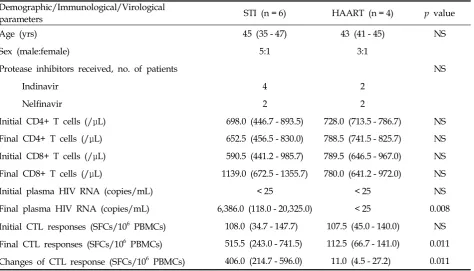
Table 1.Baseline Characteristics and Immunological and Virological Parameters in the Structured Treatment Interruption (STI) and Continuous Highly Active Antiretroviral Therapy (HAART) Subjects
Demographic/Immunological/Virological
parameters STI (n = 6) HAART (n = 4) p value
Age (yrs) 45 (35 - 47) 43 (41 - 45) NS
Sex (male:female) 5:1 3:1
Protease inhibitors received, no. of patients NS
Indinavir 4 2
Nelfinavir 2 2
Initial CD4+ T cells (/ L)μ 698.0 (446.7 - 893.5) 728.0 (713.5 - 786.7) NS
Final CD4+ T cells (/ L)μ 652.5 (456.5 - 830.0) 788.5 (741.5 - 825.7) NS
Initial CD8+ T cells (/ L)μ 590.5 (441.2 - 985.7) 789.5 (646.5 - 967.0) NS
Final CD8+ T cells (/ L)μ 1139.0 (672.5 - 1355.7) 780.0 (641.2 - 972.0) NS
Initial plasma HIV RNA (copies/mL) < 25 < 25 NS
Final plasma HIV RNA (copies/mL) 6,386.0 (118.0 - 20,325.0) < 25 0.008
Initial CTL responses (SFCs/106 PBMCs) 108.0 (34.7 - 147.7) 107.5 (45.0 - 140.0) NS Final CTL responses (SFCs/106 PBMCs) 515.5 (243.0 - 741.5) 112.5 (66.7 - 141.0) 0.011 Changes of CTL response (SFCs/106 PBMCs) 406.0 (214.7 - 596.0) 11.0 (4.5 - 27.2) 0.011
NS, not significant.
negative control from the peptide-stimulated cells.
We then compared the HIV-specific immunity response, immunological parameters, and virolo-gical parameters between the STI and the con-tinuous HAART subjects. Concon-tinuous variables were compared using the Mann-Whitney U test. A p-value < 0.05 was considered to be statistically significant. The SPSS (version 11.0) software pack-age was used for all analyses. Data were expressed as the ‘median value (interquartile range)’.
There were no statistically significant differ-ences between the STI subjects and the continuous HAART subjects with respect to age, sex, or
dura-tion of known HIV-1 infecdura-tion. No patient had conditions defining AIDS during the study.
[image:3.595.69.531.102.494.2]Table 1 displays the immunological and virolo-gical parameters in both the STI subjects and the continuous HAART subjects. Final CD4+ T cell counts were lower in STI subjects than in the continuous HAART subjects, but this difference was not significantly different (652.5 (456.5-830.0) / L vs. 788.5 (741.5-825.7)/ L). Plasma HIV RNAμ μ levels after 26 weeks were higher in the STI sub-jects than in the continuous HAART subsub-jects (6,386.0 (118.0-20,325.0) copies/mL vs. < 25 copies/ mL, p= 0.008). HIV-specific cytotoxic T cell im-munity after 26 weeks, as measured by the
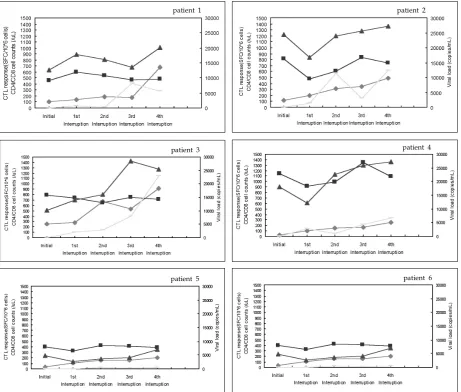
Fig. 1.Changes of immunological and virological parameters after treatment interruption schedules in the STI group. ( , CD4 cell counts (/ L);μ , CD8 cell counts (/ L);μ , Cytotoxic T lymphocyte responses (SFC/106PBMC); , Viral load (copies/mL))
patient 1 patient 2
patient 3 patient 4
ELISPOT assay, was more pronounced in the STI subjects than in the continuous HAART subjects (515.5 (243.0-741.5) SFCs/106PBMC vs. 112.5 (66.7-141.0) SFCs/106 PBMC, p= 0.011). The changes of CTL (cytotoxic T lymphocyte) response in the STI group were more prominent than in the con-tinuous HAART group (406.0 (214.7-596.0) SFCs/ 106 PBMC vs. 11.0 (4.5-27.2) SFCs/106 PBMC, p= 0.011).
Fig. 1 shows the changes of immunological and virological parameters after each scheduled STI. After STIs, cytotoxic T lymphocyte (CTL) res-ponses were stimulated, CD8 + T cell counts in-creased, and the viral load gradually increased in most patients.
It has been hypothesized that cyclical inter-ruptions of antiretroviral therapy may boost HIV-1-specific immune responses, reset viral loads, and might constitute a novel modality of immune-based therapy in cases of HIV-1 infection, but only when initiated at the period of acute infection.3 However, these immune-specific responses seem to be weaker when STIs were performed during a chronic HIV infection. Moreover, there is con-tradictory evidence regarding the possibility of an association between these immune responses and the reset of the viral load set-point, which occurs in a low proportion of patients (approximately 20% of patients with chronic HIV infection).5
This study demonstrates that HIV-1 specific cellular immune responses were augmented fol-lowing cycles of STIs in chronically HIV-1 infected Koreans. Chronically HIV-infected Korean in-dividuals exhibited similar immunological re-sponses to STIs as reported in other studies, which suggests that race may not be involved in the factors influencing an STI response.3-5,7 Recently, a prospective, randomized trial of STIs for chronically HIV-1 infected Thai patients was reported.10 This STI trial demonstrated that adequate immunological function could be pre-served by the use of a CD4 cell count-guided method or a week-on/week-off approach to therapy withdrawal and reintroduction, compared with the continuous antiretroviral therapy in Thai patients. The study found that the week-on/ week-off therapy was associated with a higher virological failure rate.
There are several important safety issues
in-herent in the STI protocols.11 One concern is the potential development of drug resistance. We did not assess drug resistance by genotyping, and so are unaware of any mutations known to be asso-ciated with resistance to reverse transcriptase or protease inhibitors in the study population. Another concern was the possibility that viremia would not be re-suppressed upon the re-initiation of therapy. Viral loads dropped below 25 copies/ mL in all patients within one month of re-intro-duction of the same antiretroviral regimen. These findings are consistent with the observations in other previous studies on antiretroviral therapy interruption.12 Another safety concern associated with the STI protocols tested in this study was the potential drop in total CD4 T-cell counts after the viral load rebound. In another study, the CD4+ T-cell count decline was inversely proportional to increases in plasma HIV-1 RNA levels during STIs, and were generally followed by a return to pre-interruption CD4+ T-cell levels after the reinstatement of HAART.7 In our study, final CD4+ T cell counts were lower in STI subjects than in continuous HAART subjects, but this difference was not significant.
Chronically HIV-1 infected subjects are charac-terized by a significantly higher degree of immu-nosuppression than primary HIV-1 infected sub-jects, and they also tend to harbor more diverse viral sequences, requiring broader immune re-sponses for viral control.13,14 Therefore, strategies designed to stimulate broader immunity and potentiate sufficient helper T cell functions are necessary for immune-based therapies, such as STIs, in terms of controlling viral replication in these chronically HIV-infected patients.
Our study has some limitations, the most im-portant of which is the small number of patients enrolled. In addition, we interrupted HAART according to the duration of HAART, but took neither CD4+ T cell counts nor the viral load into consideration.
ACKNOWLEDGEMENTS
We are grateful to YC Sung, Pohang University of Science and Technology, Korea, for introducing laboratory methods to us.
REFERENCES
1. Palella FJ Jr, Delaney KM, Moorman AC, Loveless MO, Fuhrer J, Satten GA, et al. Declining morbidity and mortality among patients with advanced human im-munodeficiency virus infection. HIV Outpatient Study Investigators. N Engl J Med 1998;338:853-60.
2. Pomerantz RJ. Reservoirs of human immunodeficiency virus type 1: the main obstacles to viral eradication. Clin Infect Dis 2002;34:91-7.
3. Rosenberg ES, Altfeld M, Poon SH, Phillips MN, Wilkes BM, Eldridge RL, et al. Immune control of HIV-1 after early treatment of acute infection. Nature 2000;407: 523-6.
4. Lori F, Lewis MG, Xu J, Varga G, Zinn DE Jr, Crabbs C, et al. Control of SIV rebound through structured treatment interruptions during early infection. Science 2000;290:1591-3.
5. Ortiz GM, Wellons M, Brancato J, Vo HT, Zinn RL, Clarkson DE, et al. Structured antiretroviral treatment interruptions in chronically HIV-1-infected subjects. Proc Natl Acad Sci USA 2001;98:13288-93.
6. Davey RT Jr, Bhat N, Yoder C, Chun TW, Metcalf JA, Dewar R, et al. HIV-1 and T cell dynamics after inter-ruption of highly active antiretroviral therapy (HAART) in patients with a history of sustained viral suppression. Proc Natl Acad Sci USA 1999;96:15109-14.
7. Youle M, Janossy G, Turnbull W, Tilling R, Loveday C, Mocroft A, et al. Changes in CD4 lymphocyte counts after interruption of therapy in patients with viral failure on protease inhibitor-containing regimens. Royal Free Centre for HIV Medicine. AIDS 2000;14:1717-20. 8. Sun Y, Iglesias E, Samri A, Kamkamidze G, Decoville
T, Carcelain G, et al. A systematic comparison of methods to measure HIV-1 specific CD8 T cells. J Immunol Methods 2003;272:23-34.
9. Carcelain G, Tubiana R, Samri A, Calvez V, Delaugerre C, Agut H, et al. Transient mobilization of human immunodeficiency virus (HIV)-specific CD4 T-helper cells fails to control virus rebounds during intermittent antiretroviral therapy in chronic HIV type 1 infection. J Virol 2001;75:234-41.
10. Cardiello PG, Hassink E, Ananworanich J, Srasuebkul P, Samor T, Mahonotharit A, et al. A prospective, randomized trial of structured treatment interruption for patients with chronic HIV type 1 infection. Clin Infect Dis 2005;40:594-600.
11. Carpenter CC, Cooper DA, Fischl MA, Gatell JM, Gazzard BG, Hammer SM, et al. Antiretroviral therapy in adults: updated recommendation of the International AIDS Society-USA panel. JAMA 2000;283:381-90. 12. Harrigan PR, Whaley M, Montaner JS. Rate of HIV-1
RNA rebound upon stopping antiretroviral therapy. AIDS 1999;13:F59-62.
13. Autran B, Carcelain G, Li TS, Blanc C, Mathez D, Tubiana R, et al. Positive effects of combined antiretro-viral therapy on CD4+ T cell homeostasis and function in advanced HIV disease. Science 1997;277:112-6. 14. Plana M, Garcia F, Gallart T, Tortajada C, Soriano A,