ASSOCIATED HERMITE FORMS AND APPLICATIONS
G. DATTOLI AND M. MIGLIORATIReceived 3 April 2006; Accepted 3 April 2006
We discuss the properties of the truncated exponential polynomials and develop the the-ory of new form of Hermite polynomials, which can be constructed using the truncated exponential as a generating function. We derive their explicit forms and comment on their usefulness in applications, with particular reference to the theory of flattened beams, used in optics.
Copyright © 2006 Hindawi Publishing Corporation. All rights reserved.
1. Introduction
In a previous paper, Dattoli et al. [5] have discussed the properties of families of Hermite polynomials, defined through the generating function (g.f.)
∞
n=0 tn
n!Φn(x,y)= f
xt+yt2. (1.1)
The function f(x), called the support function, is assumed to be infinitely differentiable, to admit the series expansion
f(x)= ∞
r=0 fr
r!x
r (1.2a)
and the “semigroup” property
f(x+y)= f(y)f(x). (1.2b)
The operator functionf(y) is defined as
f
(y)= ∞
r=0 f r
+ r!y
r (1.2c)
Hindawi Publishing Corporation
International Journal of Mathematics and Mathematical Sciences Volume 2006, Article ID 98175, Pages1–10
withfr
+acting on fsin such a way that
f r
+fs=fs+r. (1.2d)
Under these assumptions, the polynomialsΦn(x,y) can explicitly be written as
Φn(x,y)=n!
[n/2]
r=0
fn−rxn−2ryr
(n−2r)!r!. (1.3)
In this paper, we will discuss a particular case of the polynomials (1.3), having as support the polynomials of the truncated exponential (TEP), namely,
∞
n=0 tn
n!Hn
x,y|m=em(xt+yt2), (1.4)
where
em(x)= m
r=0 xr
r!, (1.5)
are the PTE, according to the definition of [1]. The reason of the interest for this family of polynomials stems from the fact that they currently appear in the theory of the so-called flattened beams, which plays a role of paramount importance in optics and in particular in the case of super-Gaussian optical resonators (see, e.g., [6]).
A comprehensive theory of the TEP has been developed in [4], where different gener-alizations have been proposed and we will take some advantages from that general treat-ment.
The PTE can also be defined by means of the g.f.
∞
n=0 tne
n(x)=exp(1−xtt), |t|<1, (1.6a)
satisfying the recurrences
d
dxen(x)=en−1(x), en+1(x)=
1 + x
n+ 1
1− d dx
en(x)
(1.6b)
which can be combined to obtain the relevant second-order differential equation [1]
xen−(n+x)en+nen=0. (1.7)
For future convenience, we will write the PTE in the form
en(x)= ∞
r=0
θ(n−r) r! x
whereθ(x) denotes the Heaviside step function, defined in such a way that
θ(x)=
⎧ ⎨ ⎩
1, x≥0,
0, x <0. (1.9)
By comparing (1.2) and (1.8), it is evident that in the case of PET fr=θ(n−r). We can
therefore obtain the explicit form of the Hermite polynomials of the truncated exponen-tial (THP), as it will be shown in the forthcoming section.
2. Hermite polynomials of the truncated exponential
According to the previous discussion, the THP can explicitly be written as
Hn
x,y|m=n! [n/2]
r=0
θm−(n−r)xn−2ryr
(n−2r)!r! (2.1)
and we can use (1.5) and (1.6) to establish the relevant recurrences. By keeping the deriva-tives of both sides of (1.5) with respect tox, y,t, we obtain three recurrences, involving the continuous variables and the discrete indices, namely,
∂
∂xHn(x,y|m)=nHn−1(x,y|m−1), ∂
∂yHn(x,y|m)=n(n−1)Hn−2(x,y|m−1), Hn+1(x,y|m)=xHn(x,y|m−1) + 2ynHn−1(x,ym−1
.
(2.2)
We can combine the first two recurrences to infer that the HPTE satisfy the “heat” type equation
∂
∂yF(x,y)= f
+ ∂2
∂x2F(x,y), F(x, 0)=θ(m−n)xn,
(2.3)
where f+is an operator, defined in such a way that f
r
±θ(m)=θ(m±r). (2.4)
(A kind of ambiguity seems to arise in the definition of the operatorsf±. Strictly speaking,
according to the definition given in the previous section, we should have fr
±θ(m−n)=
θ(m−(n±r)) and the operator should therefore act on the indices where the summa-tion series is running. We prefer, for practical reasons, the definisumma-tion given in (2.4), which induces discrete variations on the indexm; it is however evident that f±= f∓.) We can
handle (2.3) to obtain the following operational definition for the TEP: a proper combi-nation of the last recurrence in (2.2) with the first yielding the identity
Hn+1(x,y|m)=M
mHn(x,y|m),
Mm=x f
−+ 2y∂x∂ ,
which, together with the first recurrence of (2.2), leads to the following second-order differential equation (see [5]):
x f−∂x∂ Hn(x,y|m) + 2y ∂
2
∂x2Hn(x,y|m)−n f
−Hn(x,y|m)=0. (2.6)
(According to the formalism of monomiality (see [4]), we can define a multiplicative operator (in this case provided byMm) and a derivative operatorP
=∂/∂x; the THPs are easily seen to satisfy the identityMmP
Hn(x,y|m)=nHn(x,y|m), which yields (2.6).)
Needless to say, all the previous relations reduce to those of the ordinary Hermite for
y= −1
2, fn=1. (2.7)
( Note thatHn(x,−1/2) can be identified with the polynomialsHen(x), defined by the
generating function exp(xt−t2/2).) Let us now consider the problem of finding a simple formula yielding the successive derivatives, with respect tot, of the right-hand side of (1.5). Using the previous definitions, we get
∂p
∂tpem
xt+yt2=H
p(x+ 2yt,y|m)em
xt+yt2, (2.8)
whereH(x,y|m) should be understood as an operator, defined as follows:
Hn
x,y|m=n! [n/2]
r=0 f n−r
− xn−2ryr
(n−2r)!r! . (2.9)
The proof of the previous relations can be achieved in a fairly direct way. By multiplying, indeed, the right-hand side of (2.8) byξp/ p! and then summing overp, we get
∞
p=0 ξp
p! ∂p
∂tpem
xt+yt2=exp
ξ∂ ∂t
em
xt+yt2
=em
xt+yt2+ (x+ 2yt)ξ+ξ2,
(2.10)
and thus, using the semigroup property (1.2b), we easily end up with (2.8). In alternative, (2.8) can also be written as
∂p
∂tpem
xt+yt2=p!
p/2
r=0
(x+ 2yt)p−2ryr
(p−2r)!r! em−p−r
xt+yt2. (2.11)
The results obtained in this section provide the backbone of the topics we will discuss in the forthcoming sections.
3. Some applications of TEP and THP
reproduced by a simple Gaussian, but by a function exhibiting a quasi constant flat top as, for example,
S(x,p)=exp− |x|p, p >2. (3.1)
Unlike the ordinary Gaussian beams, the super-Gaussians do not have transparent prop-agation properties, which can easily be exploited in the design of an optical resonator.
The flattened beams defined as
F(x,m)=em
x2exp−x2 (3.2)
provide a good tool of approximation of a super-Gaussian, and their paraxial evolution can be treated using straightforward analytical tools.
A super-Gaussian can be reproduced according to the relationS(x,p)∼=F(ax,m), with a,mconveniently chosen in correspondence of the orderpof the super-Gaussian. An ex-ample is shown inFigure 3.1, where we have made the comparison betweenF(4.76x, 20) and a super-Gaussian of orderp=10.
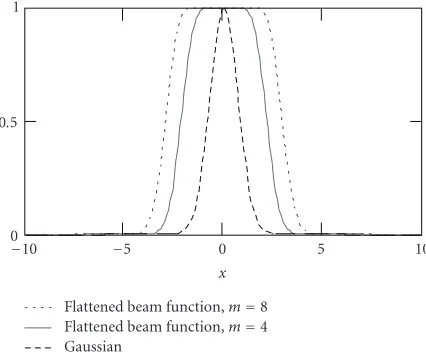
InFigure 3.2, we also report a comparison between a flattened beam function (FBF) and an ordinary Gaussian.
A first useful information characterizing the FBF can be obtained by deriving the dif-ferential equation they satisfy. By noting indeed that
em(x2)=exp
x2F(x,m), (3.3)
we find from (1.7) that
Tm
expx2F(x,m)=0,
Tm=ξ
d
dξ 2
−(m+ξ)d dξ+m, ξ=x2,
(3.4)
which explicitly yield the fairly simple form
xF(x,m) + 2
x2−m−1
2
F(x,m)=0. (3.5)
The use of the rules which we have established in Section 2allows the derivation of a simple formula yielding the successive derivatives of the FBF. By noting indeed that
d
dx s
em
x2=Hs(2x, 1|m)em
x2=s!
[s/2]
r=0
(2x)s−2r
(s−2r)!r!em−s−r
x2 (3.6)
and that
d
dx s
exp−x2=(−1)sHs(2x,−1) exp
Super-Gaussian Flattened beam function
−3 −2 −1 0 1 2 3
x 0
[image:6.468.126.342.74.243.2]0.5 1
Figure 3.1. Comparison between a super-Gaussian withp=10 (dotted curve) and a flattened beam functionF(bx,m),b=4.76,m=20 (solid curve); the two curves are undistinguishable.
Flattened beam function,m=8 Flattened beam function,m=4 Gaussian
−10 −5 0 5 10
x 0
0.5 1
Figure 3.2. Flattened beam (dotted:m=8, continuous:m=4) and Gaussian (dashed).
(note that Hn(2x,−1)=Hn(x)=n!r=[n/02]((−1)r(2x)n−2r/(n−2r)!r!) are the ordinary Hermite defined by the g.f. exp(2xt−t2)), we obtain
d
dx p
F(x,m)=
p
r=0
p r
(−1)rHp−r(2x, 1|m)Hr(2x,−1)F(x,m). (3.8)
[image:6.468.127.340.297.477.2]We therefore consider the following heat-type equation: ∂
∂tY(x,t)= ∂2 ∂x2Y(x,t), Y(x, 0)=F(x,m),
(3.9)
whose formal solution can be written as
Y(x,t)=exp t ∂ ∂x 2
F(x,m). (3.10)
To get an explicit solution, we should recall some rules of operational nature. The use of the well-known identity
exp b ∂ 2 ∂x2
xng(x)=
exp b ∂ 2 ∂x2
xnexp
−b ∂ 2 ∂x2 exp b ∂ 2 ∂x2
g(x)
=
x+ 2b ∂
∂x n exp b ∂ 2 ∂x2
g(x)
(3.11) yields exp t ∂ ∂x 2
F(x,m)= m
r=0
x+ (2t)∂/∂x 2r
r! exp
t
∂
∂x 2
exp−x2; (3.12)
making therefore a combined use of the modified Burchnall formula (see, e.g., [3])
x+ 2b ∂ ∂x n = n r=0
2br
n r
Hn−r(x,b)
∂
∂x r
(3.13)
of the identity (some times referred to as the Gleisher operational rule (see [8]))
exp t ∂ ∂x 2
exp−x2=√ 1
1 + 4texp
− x2
1 + 4t
(3.14)
and of the following properties of the Hermite polynomials: anH
n(x,y)=Hn
ax,a2y,
n s=0 n s
Hn−s(x,y)Hs(x,y)=Hn(x+x,y+y),
∂
∂x n
expax2=H
n(2ax,a) exp
ax2,
(3.15)
we end up with
Y(x,t)=√ 1
1 + 4tΩm x
1 + 4t, t 1 + 4t|2
exp
− x2
1 + 4t
t=2 t=0 t=8
−20 −10 0 10 20
x 0
[image:8.468.125.341.71.241.2]0.5 1
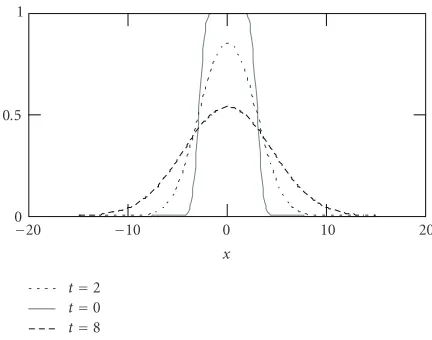
Figure 3.3. FBF evolutionm=8 at different times (continuous:t=0; dotted:t=2; dashed:t=8).
where we have defined
Ωm(x,y|p)= m
r=0
Hpr(x,y)
r! (3.17)
which is a Hermite-based polynomial of the truncated exponential, whose properties have been studied in [4]. An example of evolution at different times of theY(x,t) function is given inFigure 3.3.
Analogous results can be obtained for the case of the free paraxial (Schr¨odinger) equa-tion
i∂
∂tY(x,t)= − ∂2 ∂x2Y(x,t), Y(x, 0)=F(x,m)
(3.18)
whose solution is omitted for the sake of conciseness.
4. Concluding remarks
Before closing the paper, let us add some comments aimed at better framing the obtained results.
We therefore go back to the definition of FBF and consider the evaluation of average quantities like
xp=
∞
−∞x
pF(x,m)dx. (4.1)
To perform such a calculation, we consider the following integral:
Σp,m(a,b,c)=
∞
−∞x pH
n(ax,by) exp
The explicit evaluation of this integral can be done using the generating function method (1.7), thus we get
Σp,m(a,b,c)=
π
cHm,p
0,a 2+ 4bcy
4c ; 0, 1 4c|
a 2c
, (4.3)
where
Hm,n(x,y;z,w|ζ)=m!n!
[m,n]
r=0
ζrHm−r(x,y)Hn−r(z,w)
r!(n−r)!(m−r)! (4.4)
are two index Hermite polynomials (see [2,3]). It is easily checked that in the case of (4.3) the odd indices are zero. It is therefore evident that the FBF root mean square at different times can be written as
x2=√π
m
r=0 H2r,2
0, (x2+ 4t)/4(1 + 4t); 0, (1 + 4t)/4|x/2
(r)! (4.5)
which can be exploited to study the behavior of transverse section of a flattened beam. The function
g(x,m)=em−x2 (4.6)
can be considered a kind of truncated Gaussian and can be exploited in the theory of approximation; it shares interesting properties with the ordinary Gaussian and indeed we get
(−1)s d
dx s
em
−x2=Hs(2x,−1|m)em
−x2 (4.7)
and also the Gleisher type formula
exp
t
∂ ∂x
2 em
−x2=
Hem
−x2,t, (4.8)
where
Hen(−x2,y)= n
r=0 (−1)r
r! H2r(x,y). (4.9)
The properties of the THPE and of their applications go far beyond the topics we have discussed in this paper. In forthcoming investigations, we will extend the present analysis and discuss the importance of THPE in combinatorics.
References
[1] L. C. Andrews, Special Functions for Engineers and Applied Mathematicians, Macmillan, New York, 1985.
[2] P. Appell and J. Kamp´e de F´eriet, Fonctions hyp´ergeom´etriques et Hyp´erspheriques; polin`omes d’Hermite, Gauthier-Villars, Paris, 1926.
[3] G. Dattoli, Hermite-Bessel and Laguerre-Bessel functions: a by-product of the monomiality princi-ple, Advanced Special Functions and Applications (Melfi, 1999) (D. Cocolicchio, G. Dattoli, and H. M. Srivastava, eds.), Proc. Melfi Sch. Adv. Top. Math. Phys., vol. 1, Aracne, Rome, 2000, pp. 147–164.
[4] G. Dattoli, C. Cesarano, and D. Sacchetti, A note on truncated polynomials, Applied Mathematics and Computation 134 (2003), no. 2-3, 595–605.
[5] G. Dattoli, H. M. Srivastava, and D. Sacchetti, The Hermite polynomials and the Bessel functions from a general point of view, International Journal of Mathematics and Mathematical Sciences
2003 (2003), no. 57, 3633–3642.
[6] F. Gori, Flattened Gaussian beams, Optics Communications 107 (1994), no. 5-6, 335–341. [7] A. Siegman, Lasers, University Science Books, California, 1986.
[8] H. M. Srivastava and H. L. Manocha, A Treatise on Generatine Functions, Ellis-Horwood Series: Mathematics and Its Applications, John Wiley & Sons, New York, 1984.
G. Dattoli: ENEA, UTS Tecnologie Fisiche Avanzate, Centro Ricerche Frascati, Via Enrico Fermi 45, 00044 Frascati, Rome, Italy
E-mail address:[email protected]
M. Migliorati: Dipartimento di Energetica, Universit`a degli Studi di Rome “La Sapienza,” 14 Via A. Scarfa, 00161 Rome, Italy