R E S E A R C H
Open Access
A note on
(
p
,
q
)
-Bernstein polynomials
and their applications based on
(
p
,
q
)
-calculus
Erkan Agyuz
*and Mehmet Acikgoz
*Correspondence:
[email protected] Department of Mathematics, Faculty of Arts and Science, University of Gaziantep, Gaziantep, Turkey
Abstract
Nowadays (p,q)-Bernstein polynomials have been studied in many different fields such as operator theory, CAGD, and number theory. In order to obtain the
fundamental properties and results of Bernstein polynomials by using (p,q)-calculus, we give basic definitions and results related to (p,q)-calculus. The main purpose of this study is to investigate a generating function for (p,q)-Bernstein polynomials. By using an approach similar to that of Goldman et al. in (SIAM J. Discrete Math.
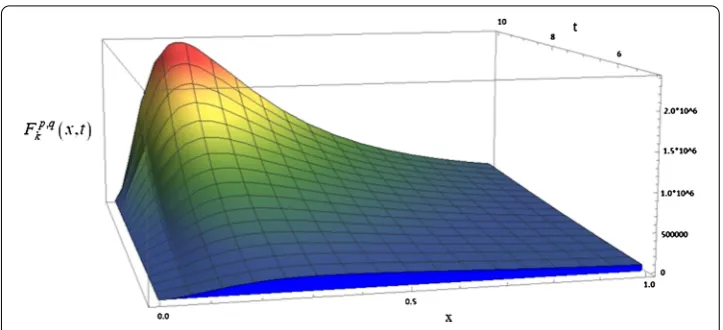
28(3):1009-1025, 2014), we derive some new identities, relations, and formulas for the (p,q)-Bernstein polynomials. Also, we give a plot generating function of
(p,q)-Bernstein polynomials for some selectedpandqvalues.
MSC: Primary 05A15; 05A30; secondary 11B65; 65Q20
Keywords: (p,q)-calculus; (p,q)-Bernstein polynomials; Generating function; Functional equations
1 Introduction
The generating functions are the key tool in analytic number theory for defining and ob-taining properties to special polynomials such as Bernoulli, Euler, Hermite, and Genocchi polynomials. The idea behind the generating functions are that we can effectually trans-form problems about sequences into problems about functions. The generating functions have many advantages. For instance, we can apply various operations on generating func-tions such as scaling, addition, product, integration, and differentiation.
The Bernstein polynomials, which are called by the name of their creator [2], have many applications in mathematics, engineering, CAGD, and statistics. The reason for the emer-gence of Bernstein polynomials is the study of the existence of polynomials that are con-stantly approaching each function at [0, 1]. Many useful and important studies have been carried out in approximation theory with the definition of Bernstein polynomials (see [3] and [4]). Phillips obtained Bernstein polynomials that depend onq-integers [5]. Oruc and Phillips definedq-Bernstein polynomials and Bezier curves and showed useful results for these polynomials and curves [6]. Lewanowicz and Wozny obtained some applications and found interesting formulae for Bezier representations and coefficients [7]. Khan and Lobiyal studied Lupaş type (p,q)-Bernstein operators and Lupaş type (p,q)-Bezier curves and surfaces [8]. Perez and Palacin proposed an estimation for a quantile function by us-ing the Bernstein polynomials as smooth weight functions [9]. Esi et al. studied statistical
convergence and derived new theorems for Bernstein polynomials [10]. In recent years, (p,q)-calculus has been progressed rapidly by many researchers in [11–13], and [14].
In analytic number theory, Bernstein polynomials are an important polynomials family because they have very close relations with special numbers and polynomials such as Stir-ling numbers, Bernoulli polynomials, Euler polynomials, and so on. Obtaining the gener-ating function for the Bernstein polynomials [15] has led to an increase and acceleration of studies in this area. For instance, Araci and Acikgoz derived some combinatorial relations and properties between Bernstein and Frobenius–Euler polynomials by using the concept of generating function and fermionicp-adic integral onZp[16]. Acikgoz et al. obtained a new forming betweenq-Bernoulli numbers and polynomials andq-Bernstein polynomials (see [17] and [18]). Kim proposed newq-Bernstein polynomials and showed some of their representations by using the fermionicp-adic integral [19]. Bayad and Kim found some theorems and corollaries related toq-Bernoulli,q-Euler, and Bernstein polynomials [20]. Simsek et al. gave some new results for Bernstein andq-Bernstein polynomials by using some special functions, polynomials, and numbers ([21, 22], and [23]).
In this article, our main goal is to obtain a generating function of (p,q)-Bernstein poly-nomials by using the (p,q)-calculus tools as (p,q)-derivative operator, (p,q)-exponential functions, and (p,q)-hypergeometric functions. After that, we present some theorems and identities by using the mathematical operators on a generating function of (p,q)-Bernstein polynomials.
2 Miscellaneous definitions and notations
In this part, we give definitions and notations related to (p,q)-calculus and use some of them in the subsequent chapters.
Let 0 <q<p≤1 andn∈Z. Then the (p,q)-analogue ofnis defined by
[n]p,q=
pn–qn
p–q . (2.1)
Some (p,q)-integers are shown as follows:
[1]p,q= 1,
[2]p,q=p+q,
[3]p,q=p2+pq+q2,
and so on,
(2.2)
see [24, 25], and [26].
The (p,q)-Binomial coefficients are defined as follows:
n k
p,q
= [n]p,q! [k]p,q![n–k]p,q!
, (2.3)
where
[n]p,q! = ⎧ ⎨ ⎩
1, n= 0,
[n]p,q·[n– 1]p,q· · ·[1]p,q, n= 0,
The (p,q)-derivative operator is determined as (2.4)
Dp,q
f(x)=f(px) –f(qx)
(p–q)x , (2.4)
wheref :R→Randx∈R(cf. [24, 25], and [26]).
We have two types of (p,q)-exponential functions as in theq-calculus. These functions are defined as follows:
ep,q(x) =
∞
n=0
p(n2) x n ((p,q); (p,q))n
,
Ep,q(x) =
∞
n=0
q(n2) x n ((p,q); (p,q))n
,
(2.5)
where
(p,q); (p,q)n:= n–1
k=1
pk–qk
is called a (p,q)-analog ofq-shifted operator (cf. [24, 25], and [26]). This operator is de-scribed by the following identity:
(1,a); (p,q)n=(1,a); (p,q)kpk,aqk; (p,q)n–k. (2.6)
The hypergeometric series concept has moved to (p,q)-calculus and was studied in de-tail by researchers (see [24] and [25]). The (p,q)-hypergeometric series are given by the following equation:
rs
(a1p,a1q), . . . , (arp,arq), (b1p,b1q), . . . ,
(bsp,bsq)
, (p,q),z
=
∞
n=0
((a1p,a1q), . . . , (arp,arq), (p,q))n
((p,q), (b1p,b1q), . . . , ((bsp,bsq)), (p,q))n((p,q), (p,q))n
×
(–1)n
q p
(n 2)1+s–r
, (2.7)
where
(a1p,a1q), . . . , (arp,arq), (p,q)
n= r
j=1
(a1p,a1q), (p,q)
n.
By using the definition of (2.6), we obtain (p,q)-Binomial coefficients by means of (p,q )-hypergeometric series as follows:
rs
(a,b), –, (p,q),z=((p,bz); (p,q))∞
Substituting (a,b) = (1, 0) and (0, 1) into (2.7), we have (p,q)-exponential functions by aid of (p,q)-hypergeometric series in the following theorem:
ep,q(x) =rs
(1, 0), –, (p,q),z (2.9)
and
Ep,q(x) =rs
(0, 1), –, (p,q),z. (2.10)
Now, we give a (p,q)-exponential function by using (p,q)-factorial in the following iden-tity:
εp,q(x) =
∞
n=0 p(n2) x
n [n]p,q!
. (2.11)
We have some results between (2.5) and (2.11) as follows:
εp,q(x) =ep,q
(p–q)x, 0 <q<p≤1,
εq
p(x) =Ep,q
(p–q)x, q
p
< 1.
(2.12)
Remark1 (cf. [27]) q- and (p,q)-integers are a good bit similar. However, they have an important difference. One may obtain an equality by using the definition of (p,q)-integer as follows:
[n]p,q=pn–1[n]q
p. (2.13)
If we takep= 1 in (2.13), [n]p,qreduces to [n]q, but the opposite is not true. That is, we cannot obtain [n]p,qby using [n]q. Therefore, we can describe thatq-integers are a special case of (p,q)-integers.
3 Main results
In this section, we start with definition for (p,q)-Bernstein polynomials by means of (p,q )-analog ofq-shifted operator. Thanks to this definition, we give the generating function for (p,q)-Bernstein polynomials. An important application of this function is a method for representing (p,q)-Bernstein polynomials in different ways.
We begin by giving a definition of (p,q)-Bernstein polynomials in the following equation.
Definition 1(cf. [28]) Letkandnbe arbitrary positive integers. The (p,q)-Bernstein poly-nomial of degreenis given by
Bk,n(x;p,q) =p( k 2)–(n2)
n k
p,q
xk(1 –x)pn–,qk, k≤n, (3.1)
We note that whenp= 1, Definition 1 reduces to the results of Goldman et al. [1] and Oruc and Philips [6].
These polynomials are given as follows:
Bk,n(x;p,q) =
p(k2)–(2n)((1,x); (p,q))k((pk,qk+1); (p,q))n–kxk ((p,q); (p,q))n–k
. (3.2)
3.1 Generating function of (p,q)-Bernstein polynomials
So far we have mentioned (p,q)-calculus and Bernstein polynomials. We turn our atten-tion now to the concept of the generating funcatten-tion of these polynomials based on (p,q )-calculus.
By using an approach similar to that of Goldman et al. [1], we arrive at the following theorem.
Theorem 1 For0 <q<p≤1,
p,q
k (x,t) =p( k 2)–(
n 2) (xt)
k [k]p,q!
εp,q(t) εp,q(xt)
=
∞
n=k
Bk,n(x;p,q)
tn
[n]p,q!
. (3.3)
Proof The proof of this theorem is similar to those of Goldman et al. [1] and [22]. Let p,q
k (x,t) and F p,q
k (x,t,c) be generating functions of (p,q)-Bernstein polynomials. So we have the following formal definitions, respectively:
p,q k (x,t) =
∞
n=k
Bk,n(x;p,q)
tn [n]p,q!
(3.4)
and
Fpk,q(x,t,c) =
∞
n=k
Bk,n(x;p,q)
tn ((1,c); (p,q))n
. (3.5)
By substituting the right-hand side of (3.2) into (3.5), we have
Fpk,q(x,t,c)
=
∞
n=k
p(k2)–(2n)((1,x); (p,q))k((pk,qk+1); (p,q))n–kxk ((p,q); (p,q))n–k
tn ((1,c); (p,q))n
= x ktkp(k2) ((1,c); (p,q))k
∞
n=k
p–(n2)((1,x); (p,q))k((pk,qk+1); (p,q))n–k ((p,q); (p,q))n–k((pk,cqk); (p,q))n–k
tn–k
=21
(1,x),pk+1,qk+1;pk,cqk, (p,q),t x
ktkp(k 2)–(n2)
((1,c); (p,q))k
. (3.6)
From (3.4) and (3.5), we have the following equality:
p,q k (x,t) =
∞
n=k
Bk,n(x;p,q)
=
∞
n=k
Bk,n(x;p,q)
(p–q)ntn
((p,q); (p,q))n
= Fpk,q(1,x), (p–q)t, (p,q). (3.7)
From the right-hand side of (3.7), we get
Fpk,q(1,x), (p–q)t, (p,q)
=
∞
n=k
p(k2)–( n
2)((1,x); (p,q))k((pk,qk+1); (p,q))n–kxk ((p,q); (p,q))n–k((p,q); (p,q))n–k
(p–q)ntn ((p,q); (p,q))n
=p (k
2)(x(p–q)t)k ((p,q); (p,q))k
∞
n=k
((1,x); (p,q))n–k((pk,qk+1); (p,q))n–ktn–k ((p,q); (p,q))n–k((pk+1,qk+1); (p,q))n–k
=10
(1,x), –; (p,q), (p–q)tp
(k2)–( n
2)(x(p–q)t)k ((p,q); (p,q))k
by using the definition of (p,q)-hypergeometric functions
=p (k2)–(
n
2)(x(p–q)t)k ((p,q); (p,q))k
((p,x(p–q)t), (p,q))∞
((p, (p–q)t), (p,q))∞
=p(k2)–(n2) (xt) k [k]p,q!
((p,x(p–q)t), (p,q))∞
((p, (p–q)t), (p,q))∞
=p(k2)–(n2) (xt) k [k]p,q!
ep,q((p–q)t)
ep,q((p–q)xt) .
From (2.12), we obtain that
p,q
k (x,t) =p( k 2)–(
n 2) (xt)
k [k]p,q!
εp,q(t) εp,q(xt)
.
Therefore, we arrive at the desired result.
Remark 2 The above defined function can be called a generating function of (p,q )-Bernstein polynomials because whenp= 1, the generating function reduces to the gener-ating function ofq-Bernstein polynomial in [1]. However, the (p,q)-Bernstein polynomi-als are related toεp,q(x). We say thatεp,q(x) converges by using the ratio test, and also this function is well defined for all|x|<| 1
1–qp|if| q p|< 1.
3.2 The graph of a generating function of (p,q)-Bernstein polynomials
In this section, by using a similar method to that of the work of Kucukoglu and Simsek [29], in which a simulation for the extension of unification of Bernstein type basis func-tions is provided, we provide a simulation for a generating function of the (p,q)-Bernstein polynomials with their graph for some special values in Fig. 1.
3.3 Some properties for the generating function of (p,q)-Bernstein polynomials
Figure 1The generating function of (p,q)-Bernstein polynomials
Thus we give the following theorem.
Theorem 2 For0 <q<p≤1and k∈N∪ {0},
∞
k=0
p,q
k (x,t)zk=
εp,q(xtz)εp,q(t) εp,q(xt)
p–(n2). (3.8)
Proof By using a similar method to that of Goldman et al. [1], we can prove this theo-rem. By using the series expansion for (3.3) depending onkandz, we have the following equality:
∞
k=0
p,q k (x,t)z
k=
∞
k=0
(xtz)k [k]p,q!
p(k2)
εp,q(t) εp,q(xt)
p–(n2)
=εp,q(xtz)εp,q(t) εp,q(xt)
p–(n2).
Corollary 1
n
k=0
Bk,n(x;p,q) = 1. (3.9)
Proof If we takez= 1 in (3.8), we obtain the following identity:
∞
k=0
p,q
k (x,t) =p
–(n 2)ε
p,q(t). (3.10)
If we expand both sides of (3.3) to a series depending onk, we have
∞
k=0
p,q k (x,t) =
∞
k=0
∞
n=k
Bk,n(x;p,q)
tn [n]p,q!
By applying the Cauchy product to the above equation, we get
∞
n=0 tn [n]p,q!
n
k=0
Bk,n(x;p,q) =
∞
n=0 tn [n]p,q!
. (3.11)
By equating the coefficients of [nt]np,q! in (3.11), the desired result is obtained.
Remark3 Whenp= 1, Corollary 1 is reduced to Corollary 4.2 in [1].
Corollary 2
n–k
l=0
n l
p,q
xlp(2l)Bn–l
k (x;p,q) =p( k 2)
n k
p,q
xk.
Proof We give an alternative form of the generating function for (p,q)-Bernstein polyno-mials as follows:
εp,q(xt)kp,q(x,t) =p( k
2)–(n2)(xt) kε
p,q(t) [k]p,q!
. (3.12)
By using the definition of a generating function and Taylor series for (p,q)-exponential functions, we obtain
∞
n=0
p(n2) (xt) n [n]p,q!
∞
n=k
Bk,n(x;p,q)
tn [n]p,q!
=p(k2)–(n2) (xt) k [k]p,q!
∞
n=0 p(n2) t
n [n]p,q!
.
By applying the Cauchy product to the above equation, we get
∞
n=0
⎛ ⎝n–k
l=0
n l
p,q
xlp(l2)Bn–l k (x;p,q)
⎞ ⎠ tn
[n]p,q! =
∞
n=0 xkp(k2)
n k
p,q
tn [n]p,q!
. (3.13)
Comparing the coefficients of tn
[n]p,q! in (3.13), we arrive at the desired result. Remark4 Whenp= 1, Corollary 2 is reduced to Corollary 4.3 in [1].
3.4 Recurrence relations and derivative ofBk,n(x;p,q)
In this section, we obtain not only the derivative operator to a generating function of
Bk,n(x;p,q) but also some relations and properties forpk,q(x,t).
Corollary 3 Let0 <q<p≤1.Then we have
Dp,q,x
p,q k (x,t)
=p(k2)–(n2)t kεp
,q(t) [k]p,q!
(px)kεp,q(pxt) + 1 εp,q(qxt)
[k]p,qxk–1
, (3.14)
wheremax{|q/p|,|x|,|y|}< 1 and|t|< 1/|1 –q/p|.
Bk,n(x;p,q) with respect tox, we have
Dp,q,x
p,q k (x,t)
=Dp,q,x
p(k2)–(n2) (xt) k [k]p,q!
εp,q(t) εp,q(xt)
=p(k2)–( n 2)t
kε p,q(t) [k]p,q!
Dp,q,x
xk
εp,q(xt)
.
From the division property of (p,q)-derivative, we obtain
Dp,q,x
p,q k (x,t)
=p(k2)–(n2)t kεp
,q(t)xk [k]p,q!
(px)kDp,q,x
1 εp,q(xt)
+ 1
εp,q(qxt)
[k]p,qxk–1
.
After some basic calculations based on (p,q)-calculus in the above equation, we arrive at
the desired result.
Corollary 4
Dp,q,t
p,q k (x,t)
=p
k–1ε
p,q(pt)x εp,q(qt)
p,q
k–1(x,qt) +
qkεp,q(pt) εp,q(qt)
p,q k (x,qt)
–εp,q(xpt) εp,q(xqt)
p,q
k (x,qt). (3.15)
Proof Multiplying both sides of the generating function forBk,n(x;p,q) in (3.3) byεp,q(xt), we have
εp,q(xt)kp,q(x,t) =p( k
2)–(n2) (xt) k [k]p,q!
εp,q(t). (3.16)
By differentiating the equation in (3.16) with respect tot, we obtain
Dp,q,t
εp,q(xt)pk,q(x,t)
=Dp,q,t
p(k2)–(n2) (xt) k [k]p,q!
εp,q(t)
=p(k2)–(n2) x k [k]p,q!
Dp,q,t
tkεp,q(t)
. (3.17)
By applying the product rule of (p,q)-derivative in (3.17), we get
p,q
k (x,pt)εp,q(xpt) +εp,q(xqt)Dp,q,t
p,q k (x,t)
=p(k2)–(n2) x k [k]p,q!
εp,q(pt)[k]p,qtk–1+ (qt)kεp,q(pt)
. (3.18)
Applying the definition ofpk,q(x,t) in (3.18), we complete the proof of the corollary. Corollary 5 Let0 <q<p≤1.Then we have
p,q
k (xy,t) =p( n 2)–(
s 2)–(
l
2)[l]p,q![s]p,q! [k]p,q!
xk–l–syk–stk–l–slp,q(x,t)sp,q(x,yt), (3.19)
Proof Now, we re-considerpk,q(xy,t) in the following equation:
p,q
k (xy,t) =p( k
2)–(n2)(xyt) k [k]p,q!
εp,q(t) εp,q(xyt)
=p(k2)–(n2)(xyt) k [k]p,q!
εp,q(t) εp,q(xt)
εp,q(xt) εp,q(yxt)
=p(n2)–( s 2)–(
l
2)[l]p,q![s]p,q! [k]p,q!
xk–l–syk–stk–l–s
×
p(2l)–( n 2)(xt)
l [l]p,q!
εp,q(t) εp,q(xt)
p(2s)–( n 2)(xt)
s [s]p,q!
εp,q(t) εp,q(xt)
=p(n2)–(2s)–(2l)[l]p,q![s]p,q! [k]p,q!
xk–l–syk–stk–l–slp,q(x,t)sp,q(x,yt). (3.20)
From the above equation, we arrive at the desired result. Corollary 6
Bk,n(xy;p,q) = n–k
j=0
p–(2j)Bn–j,n(x;p,q)Bk,n–j(y;p,q). (3.21)
Proof By using (3.3) fork= 0, we obtain the following equality:
p,q
0 (x,t) =
∞
n=0
B0,n(x;p,q)
tn [n]p,q!
=
∞
n=0 p–(n2)
n–1
l=0
pl–xql t
n [n]p,q!
. (3.22)
By using (3.3) again in the following equations, we have
p,q k (xy,t) =
∞
n=0
Bk,n(xy;p,q)
tn [n]p,q!
,
p,q k (y,xt) =
∞
n=0
Bk,n(y;p,q) (xt)n [n]p,q!
.
(3.23)
By substituting (3.22) and (3.23) into (3.19), after some calculations, we arrive at the
de-sired result.
Corollary 7
p–(n2) n–1
l=0
pl–xtql= n
j=0 p–((2j)+(
n–j
2))Bj,n(x;p,q) j–1
l=0
pl–tql. (3.24)
Proof Using (3.21) and (3.1) fork= 0 andy=t, we get
B0,n(xt;p,q) = n
j=0
and
B0,n(x;p,q) =p–( n 2)
n–1
j=0
pj–xqj.
After replacingjbyn–jin (3.25) and some basic calculations, the proof of the corollary
is completed.
3.5 (p,q)-analogue of Marsden’s identity
In this section, we construct (p,q)-Marsden’s identity by using (p,q)-Bernstein polynomi-als.
Corollary 8
p–(n2) n–1
l=0
tpl–xql
= n
j=0 p–((2j)+(
n–j
2))(–1)jq( j 2)
Bj,n(x;p,q)Bn–j,n(t;pq)
n j
p q
, p
q
> 1.
Proof By using the same method as that of Corollary 4.15 in Goldman et al. [1] on the interval [0, 1], we can prove this corollary. By replacingtby 1/tin (3.24), we have
p–(n2) n–1
l=0
pl–xt–1ql= n
j=0 p–((2j)+(
n–j
2))Bj,n(x;p,q) j–1
l=0
pl–t–1ql, (3.26)
and then multiplying both sides of (3.26) bytn, we get
p–(n2) n–1
l=0
tpl–xql= n
j=0 p–((2j)+(
n–j
2))Bj,n(x;p,q) j–1
l=0
tpl–qltn–j. (3.27)
By using (3.1), we obtain
tn–j
j–1
l=0
tpl–ql= (–1)jq(2j)tn–j j–1
l=0
1 –t
q p
–l
= (–1)jq(2j)
Bn–j,n(t;pq) n
j
p q
. (3.28)
By combining (3.27) and (3.28), we derive a (p,q)-analogue of Marsden’s identity on the [0, 1]. Thus, the proof of the corollary is completed.
4 Conclusion
Acknowledgements
The first author is thankful to the Scientific and Technological Research Council of Turkey (TUBITAK) for their support with the Ph.D. scholarship (BIDEB 2211).
Competing interests
The authors declare that they have no competing interests.
Authors’ contributions
The authors declare that the study was realized in collaboration with the same responsibility. All authors read and approved the final manuscript.
Publisher’s Note
Springer Nature remains neutral with regard to jurisdictional claims in published maps and institutional affiliations.
Received: 12 February 2018 Accepted: 3 April 2018
References
1. Goldman, R., Simeonov, P., Simsek, Y.: Generating functions for theq-Bernstein bases. SIAM J. Discrete Math.28(3), 1009–1025 (2014)
2. Bernstein, S.: Demonstration du théoréme de Weierstrass fondeé sur la calcul des probabilités. Comm. Math. Soc. Charkow.13(2), 1–2 (1912)
3. Ostrovska, S.:q-Bernstein polynomials and their iterates. J. Approx. Theory123, 232–255 (2003) 4. Ostrovska, S.: The convergence ofq-Bernstein polynomials. Math. Nachr.282(2), 243–252 (2009) 5. Phillips, G.M.: Bernstein polynomials based on theq-integers. Ann. Numer. Math.4, 511–518 (1997) 6. Oruc, H., Phillips, G.M.:q-Bernstein polynomials and Bézier curves. J. Comput. Appl. Math.151(1), 1–12 (2003) 7. Lewanowicz, S., Wozny, P.: Bezier representation of the constrained dual Bernstein polynomials. Appl. Math. Comput.
218(8), 4580–4586 (2018)
8. Khan, K., Lobiyal, D.K.: Bézier curves based on Lupa¸s (p,q)-analogue of Bernstein polynomials in CAGD. J. Comput. Appl. Math.317, 458–477 (2017)
9. Perez, J.M., Palacin, A.F.: Estimating the quantile function by Bernstein polynomials. Comput. Stat. Data Anal.5, 391–397 (1987)
10. Esi, A., Araci, S., Acikgoz, M.: Statistical convergence of Bernstein operators. Appl. Math. Inf. Sci.6, 2083–2086 (2016) 11. Mursaleen, M., Ansari, J.A., Khan, A.: Some approximation results by (p,q)-analogue of Bernstein–Stancu operators.
Appl. Math. Comput.264, 392–402 (2015)
12. Mursaleen, M., Nasiuzzaman, N., Nurgali, A.: Some approximation results on Bernstein-Schurer operators defined by (p,q)-integers. J. Inequal. Appl.2015, 249 (2015)
13. Mursaleen, M., Al-Abied, A.A.H., Alotaibi, A.: On (p,q)-Szász–Mirakyan operators and their approximation properties. J. Inequal. Appl.2017, 196 (2017)
14. Kanat, K., Sofyalıoglu, M.: Some approximation results for Stancu type Lupa¸s–Schurer operators based on (p,q)-integers. Appl. Math. Comput.2018(317), 129–142 (2018)
15. Acikgoz, M., Araci, S.: On the generating function of the Bernstein polynomials. Num. Anal. Appl. Math. Amer. Inst. Phys. Conf. Proc.CP1281, 1141–1143 (2010)
16. Araci, S., Acikgoz, M.: A note on the Frobenius–Euler numbers and polynomials associated with Bernstein polynomials. Adv. Stud. Contemp. Math.22(3), 399–406 (2012)
17. Acikgoz, M., Erdal, D., Araci, S.: A new approach toq-Bernoulli numbers andq-Bernoulli polynomials related to
q-Bernstein polynomials. Adv. Differ. Equ.2010, Article ID 951764 (2010)
18. Araci, S., Acikgoz, M.: A note on the values of the weightedq-Bernstein polynomials and weightedq-Genocchi numbers. Adv. Differ. Equ.2015, 30 (2015)
19. Kim, T., Jang, L.C., Yi, H.: A note on the modifiedq-Bernstein polynomials. Discrete Dyn. Nat. Soc.2010, Article ID 706483 (2010)
20. Bayad, A., Kim, T.: Identities involving values of Bernstein,q-Bernoulli, andq-Euler polynomials. Russ. J. Math. Phys.18, 133 (2011)
21. Simsek, Y., Acikgoz, M.: A new generating function ofq-Bernstein-type polynomials and their interpolation function. Abstr. Appl. Anal.2010, Article ID 769095 (2010)
22. Simsek, Y.: Functional equations from generating functions: a novel approach to deriving identities for the Bernstein basis functions. Fixed Point Theory Appl.2013, 80 (2013)
23. Simsek, Y.: On parametrization of theq-Bernstein basis functions and their applications. J. Inequal. Spec. Funct.8(1), 158–169 (2017)
24. Chakrabarti, R., Jagannathan, R.: A (p,q)-oscillator realization of two-parameter quantum algebras. J. Phys. A, Math. Gen.24, L711 (1991)
25. Jagannathan, R., Rao, K.S.: Two-parameter quantum algebras, twin-basic numbers and associated generalized hypergeometric series. arXiv:math/0602613 [math.QA]
26. Sadjang, P.N.: On the fundamental theorem of (p,q)-calculus and some (p,q)-Taylor formulas. arXiv:1309.3934 [math.QA]
27. Gupta, V., Aral, A.: Bernstein Durrmeyer operators based on two parameters. Facta Univ.31(1), 79–95 (2016) 28. Mursaleen, M., Ansari, K.J., Khan, A.: On (p,q)-analogue of Bernstein operators. Appl. Math. Comput.266, 874–882
(2015)