LINKAGE OF PERFORMANCE MANAGEMENT SYSTEM AND
HUMAN RESOURCE DEVELOPMENT
Parveen Ahmed Alam
Associate Professor, Department of Management & Business Administration Aliah University, IIA/27 New Town Kolkata 700156
ABSTRACT
Performance Management System (PMS) is linked to the various sub-systems of Human Resource Management like Target Setting, Performance Appraisal, Human Resource Development (HRD) and Reward & Recognition. The stress of PMS is on development instead of evaluation of past work. The study was conducted in 8 major power utilities in West Bengal covering state, central and private sectors to assess how far the current PMS is linked to HRD. The research methodology included data collection through a structured questionnaire. The respondents were very senior people in the organizations who could shed light on the PMS as a system as this was not a study based on perception. Data analysis was done through descriptive statistical tools like Mean and Standard Deviation. The company’s
surveyed were ranked based on their Mean score to show how far PMS was linked to HRD in each of them.
Key words: PMS HRD Power sector West Bengal Linkage .
Introduction
Performance Management (PM) is an on-going process of identifying, measuring and developing human performance in organizations. The purpose is to measure progress, differentiate between levels of performance, pinpoint training needs, validate rewards and identify employees for promotion (Grote, 1996). According to Roberts (2001), PM involves the setting of corporate, departmental, team and individual objectives; performance appraisal
International Research Journal of Human Resources and Social Sciences ISSN(O): (2349-4085) ISSN(P): (2394-4218) Impact Factor- 5.414, Volume 4, Issue 10, October 2017 Website- www.aarf.asia, Email : [email protected] , [email protected]
plans; feedback, communication and coaching; individual career planning; mechanisms for monitoring the effectiveness of PMS and interventions and even management of culture. Thus, PM involves the day-to-day management as well as the support and development of people.
Literature Review
The term Performance Management System (PMS) was first used in 1976 by Beer and Ruh while referring to a system implemented by them at Corning Glass to ―manage, measure, and improve the performance and potential for advancement‖. Performance is about how things are done as well as what is done, covering competency levels and achievements as well as objective setting and review (Hartle, 1995). However, PMS did not become a recognized process until the latter half of 1980s.
McConnell (2004) has stressed that Performance Management (PM) ―is a vital management technique, which, when incorporated into a manager‘s everyday behavior, is invaluable in identifying, evaluating and correcting employee performance problems‖. Bredrup and Bredrup (1995) have seen PM as comprising three main processes – planning, improving and reviewing. Ainsworth and Smith (1993) have proposed a three-step cycle – performance planning; assessment of performance; and corrective and adaptive mutual action via mutual feedback discussions. Torrington and Hall (1995) have also suggested three stages – planning, supporting and reviewing performance. The common thread here is that the manager and managed should have a shared view of what is expected of the employee which may be achieved through involvement and participation of a direct kind. Supporting performance is seen as a responsibility of the line manager who also has a particular part to play in reviewing performance. Most organizations follow this 4-stage model now-a-days, which can be further detailed as – Setting Individual Business Roles and relating them to the job objectives of work groups and business through Performance Planning, Performance Measurement and Review, Rewards and Performance Development (Armstrong and Baron, 2007). These integrated sub-processes create the performance-driven behavior of employees that is needed to become and stay as a high-performance organization.
PMS and its linkage with Human Resource Development
Sacht (2002) has showed that PM is used to establish and reinforce the competencies
training, in-house training and support for continuing education, each reduced the probability
of employees being dissatisfied with the performance appraisal process (Spears and Parker,
2002). Gabris and Ihrke (2000) have concluded from the results of a survey that attitudes
change from before to after implementation of PMSs.
Brumback and McFee (1982), Fahenstock (1984), Mumford and Buley (1988),and
Schneier et al. (1987) havementioned training and development as a part of PMS and have
suggested that information gathered in the appraisal process could be used in making training
decisions. Schneier et al. (1986) have suggested that information gathered in the appraisal
process should be used to do training needs analysis and to develop employee towards
improved performance. Fierstein (1988) has felt that the Performance Management
Department should be responsible for training function and the training department should be
disbanded.
Flynn (2007) has emphasized on the learning and improvement process of PM.
Majeed (2009) has demonstrated the importance of training and employee participation
vis-à-vis organizational performance. In order to increase organizational performance, the HR
department should ‗enhance the number of training activities‘ and empower the employees to
take decisions regarding their jobs.
The issue of coaching the employee to accomplish performance goals and
Performance Counselling are commonly found in the relevant literature (Adams and
Embley, 1988). The IPD Performance Management Survey, conducted in 1997 in the UK, found the commonest link was between performance management and career progression or development of skills and capabilities. Johnson and Bell (1987) have emphasized on career planning and development in conjunction with succession planning as part of PMS.
The Career Concept Model, originally developed by Michael Driver (1979), has made specific linkages between operational HR appraisal and reward systems, organizational strategy and structure, and the career concepts and motivations of co-workers, managers and executives (Driver and Coombs, 1983; Brousseau et al., 1996; and Larsson et al., 2003).
performance and career advancement prospects. Pope (2003) suggests that the combined processes of career development and succession planning can give any organization – public or private – a snapshot of available talent for meeting current and future needs.
According to Gardiner et al. (2001), continuous development of all employees
throughout the organization is a key element of competitiveness, which includes increased
satisfaction and a view that development opportunities can be regarded as a reward. Buhler
(1998) agrees that a critical component of retention is the traning and development of
employees and stresses that it needs to be a part of an entire package that includes career
planning, job enrichment, and empowerment.
Objective
To analyse the linkage of Executive Performance Management System with HRD: Training and Development and Career Planning to be specific.
Research Methodology
The study covers the power generation and supply utilities based in West Bengal, comprising the state and central utilities as well as the private players.
The study is based on both primary and secondary data. Primary data were collected by administering a structured questionnaire followed by interview. The respondents belonged to the ranks of Director (HR), General Manager (HR), Deputy General Manager (HR), and Joint Secretary. As these individuals are part of the policy-making structure and are also responsible for its implementation, it was assumed that they would be able to give a candid view about their PMSs and future plans without bias. Secondary data were sourced from the internet and published documents, reports, journals, etc.
The Questionnaire
The instrument used for the survey is a questionnaire specially designed to establish if PMS being followed in the organization has any linkage with HRD or not. The questionnaire has 22 statements using a 5-point Likert scale, in which
The 22 statements have been designed with a view to assessing whether the organization has structured Training and Development and Career Planning programme or not. Thereafter, some statements are there to assess the ‗structured‘ aspects like process for Training Needs Assessment, SMART (Specific, Measurable, Achievable, Result-oriented and Time Bound) objectives for Training and Development, feedback, type of training programmes (skill-based or sponsored), budget, linkage with relevant HR processes, etc. Under Career Planning, focus is on challenging jobs, structured Career Planning, Succession Planning, etc.
Moreover, to ensure, not to sensitise the respondent, the statements have been deliberately jumbled. There are a few statements where Strongly Disagree (1) or Disagree (2) is more preferable than Strongly Agree (5) or Agree (4), i.e., having a score of 5 is less preferable than having a score of 1. In the context of the overall score of the company, the scores with respect to such statements have been reversed, i.e., those who have marked 1 have been allotted a score of 5 and like wise. The other direct statements have been assigned the score in the usual manner. In 10 statements out of 22, the scoring pattern has been reversed.
While designing the questionnaire, attempt has been made to cross check the responses of the respondent to eliminate bias(es) and ensure consistency in their responses.
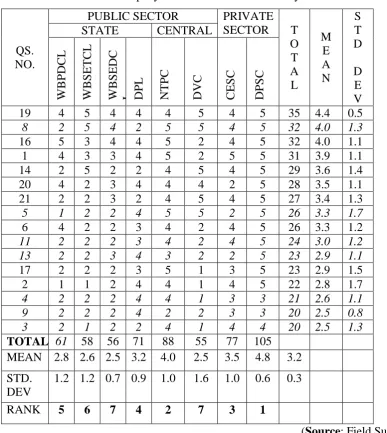
Descriptive statistical tool like Mean has been used for data analysis. Company-wise and statements-wise Mean has been worked out which have been used as a basis for analysis. Comparison has been made between the highest and the lowest Mean — both question-wise and company-wise — respectively. Consistency in responses has been checked.
Scope of the Study
In order to make the study an intensive one, the researcher has deliberately decided to focus on a particular state, i.e., West Bengal. The scope of this work is confined to study the Executive Performance Management System of the thermal power plants in West Bengal because the contribution of hydel and other non-conventional energy sources is negligible in West Bengal. In the case of the central public sector utilities, their regional offices in Kolkata have been covered. The target group is the senior executives of the power utilities functioning in West Bengal.
Why Power Sector?
The reason for choosing the power sector is the thrust the government is giving to this sector in terms of friendly policies, huge investments, infrastructural support, etc.
Contribution of the Study
This study has attempted to find out the linkage of the Executive PMS in power sector in West Bengal with HRD. The findings are also expected to lay the foundation for extending the understanding to other sectors.
Data Analysis
It is important to have an understanding of the current status of PMS in the power sector utilities in West Bengal before analyzing the linkage of PMS and HRD in each of them. Table I provides a glimpse of the status of PMS in the power utilities under study.
Table I: Genesis of PMS in Power Sector Utilities in West Bengal
Company
Appraisal Instrument Year of
Implement -ation
Comment
Previous Current
Private Sector DPSC Confidential Report Performance
Planning and Appraisal
2004 900 Feedback System based on monitoring, development plan and competency assessment CESC Competency-based
Appraisal
PMS System 2005-06 KRA-cum-Competency Public Sector (Central)
NTPC Confidential Rating PACE – Performance And
Competence for Excellence
2004 KPA-based Appraisal System
Confidential Report Confidential Report inception Public Sector (State)
WBSETCL, WBSEDCL
and WBPDCL
Performance Appraisal Report and Self- Appraisal Report – Technical & Non- Technical
Performance Appraisal Report and Self-Appraisal Report – Technical & Non- Technical
Since inception
Grading System
DPL Performance
Appraisal System
Annual Confidential Rating
Since inception
Grading System (Source: Field Survey) From the above table it is clear that a few companies have changed from the traditional appraisal tools to PMS. Organisations like DPSC has focused on Monitoring, Development, Competency Assessment, KRAs, Targets and Results Achieved. Competency Appraisal is done on both Organizational Competencies and Level-wise Competencies. Training, specially, Identification of Training Needs is given a lot of stress. Developmental inputs like Career Design and Potential Assessment indicate the ‗Performance Planning and Appraisal‘ for the following year which will help retain employees in the long run. The current PMS of CESC has seen a transition from a competency-based appraisal to a competency-cum-KRA-based one with comprehensive guidelines including scoring guidelines. This structured PMS, monitored by a PMS Committee, headed by a PMS Convener who is in the rank of General Manager, ensures transparency and credibility. NTPC also has a modern PMS approach with focus on competencies and KPAs and is available online. It uses a highly quantitative approach with marks and weights varying according to various grades.
The table also shows that there are certain utilities that are still following the old ACR format like DVC and the state utilities.
Table II: Company-Wise/Statement-Wise Analysis
QS. NO.
PUBLIC SECTOR PRIVATE
SECTOR T
O T A L M E A N S T D D E V
STATE CENTRAL
W B P DCL W B S ETCL W B S EDC
L DPL NTPC DVC CESC DPS
C
19 4 5 4 4 4 5 4 5 35 4.4 0.5
8 2 5 4 2 5 5 4 5 32 4.0 1.3
16 5 3 4 4 5 2 4 5 32 4.0 1.1
1 4 3 3 4 5 2 5 5 31 3.9 1.1
14 2 5 2 2 4 5 4 5 29 3.6 1.4
20 4 2 3 4 4 4 2 5 28 3.5 1.1
21 2 2 3 2 4 5 4 5 27 3.4 1.3
5 1 2 2 4 5 5 2 5 26 3.3 1.7
6 4 2 2 3 4 2 4 5 26 3.3 1.2
11 2 2 2 3 4 2 4 5 24 3.0 1.2 13 2 2 3 4 3 2 2 5 23 2.9 1.1
17 2 2 2 3 5 1 3 5 23 2.9 1.5
2 1 1 2 4 4 1 4 5 22 2.8 1.7
4 2 2 2 4 4 1 3 3 21 2.6 1.1
9 2 2 2 4 2 2 3 3 20 2.5 0.8
3 2 1 2 2 4 1 4 4 20 2.5 1.3
TOTAL 61 58 56 71 88 55 77 105 MEAN 2.8 2.6 2.5 3.2 4.0 2.5 3.5 4.8 3.2 STD.
DEV
1.2 1.2 0.7 0.9 1.0 1.6 1.0 0.6 0.3
RANK 5 6 7 4 2 7 3 1
(Source: Field Survey) A. Statement-wise Analysis
and NTPC. In DVC and DPSC only enhanced qualification(s) are updated. This may be one of the reasons why TNA is not done effectively barring in private sector. Hence, when employees are sponsored to training programmes, it is need-specific only in private sector, NTPC and WBPDCL. In state utilities, line managers do not take training seriously. However, in both private sector and central utilities, line managers play a crucial role in Training & Development. Feedback on progress is given from time to time and not kept aside to be discussed only at the year end. This is true for all the organizations barring DPL and WBPDCL. Personal Development Plans exist only in the private sector and NTPC. Low performance is highlighted and development support is defined. Only DPSC and DPL generates reports to analyse overall development needs of the whole organization. However, except in the private sector utilites and DPL, no other organizations have any direct link to other relevant HR processes like Succession Planning, Job Evaluation, etc.
With respect to the statements relating to Career Planning, it is found that barring CESC and WBSETCL (WBSEDCL has remained non-committal), all other companies like DPSC, NTPC, DPL, WBPDCL and DVC agreed that the organization has well laid out career paths. Barring DPSC and NTPC, no other company felt that their employees have challenging careers. CESC and DPL remained non-committal on this issue. Both the private sector and the public sector (central) utilities agreed that Succession Planning is an integral part of Career Planning. Except WBSETCL, no other company in the state power sector agreed on this issue. Again, in case of companies like DPSC, NTPC, CESC and WBSETCL, employees interested in advancement have access to Job Description of the next grade. It is found that organizations like DPSC and NTPC agreed/strongly agreed with respect to all the aspects relating to Career Planning, while the others like CESC, DVC and WBSETCL agreed to only a few of those.
Based on the Mean score, the companies can be ranked as follows: Table III: Ranking
Sector Company Group D Rank
Private DPSC 1
Public (Central) NTPC 2
Public (State) DPL 4
Public (State) WBPDCL 5
Public (State) WBSETCL 6
Public (State) WBSEDCL 7
Public (Central) DVC 7
(Source: Field Survey) Responses to the statement: Employees are sponsored to training programmes based on their needs (D6) have a very high correlation (0.9) with responses to the statement: the organization has a structured training and development system.
B. Company-wise Analysis DPSC
This organization belonging to the private sector has scored the highest (4.8 Mean with the 2nd highest scoring a Mean of 4). DPSC need to continue with its strong linkage of PMS with HRD and other organizations in the power sector may benchmark it.
CESC
CESC has a Mean of 3.5 in its linkage with HRD. Areas of Improvement
There is need for mentoring/coaching.
Facility for generating reports to analyse developmental need of the entire organization needs to be improved.
Career Aspirations, Career Recommendations and Development Needs, and Succession Planning are an integral part of the current PMS but properly laid out career path for its employees needs to be drawn. It also does not take into account progress made towards qualification.
NTPC
NTPC has scored a Mean of 4 in its linkage with HRD – the second highest among the target group companies.
Areas of Improvement
Whenever there is a change in personal objectives because of change(s) in business needs, relevant Form must be updated.
DVC
Overall, it is seen that DVC has a lot of scope of improvement in the area of Training and Development. DVC uses an attribute-based form. With proper training and guidance, employees can be made aware of the benefits of a competency-based system. Professional attitude seems to lack in the employees. Time management and proper training on the importance of Performance Appraisal should be given to the employees. This will benefit the company in slowly moving towards PMS.
Areas of Improvement:
Targets should not be imposed. The appraisee and the immediate supervisor must do it mutually.
Assessment of training and development needs should be made for the senior-level officers also.
Recommendations regarding training given in the Performance Appraisals should be implemented.
There is need to make the career of an employee challenging.
Feedback is important for making the employee perform more effectively..
WBPDCL, WBSETCL, WBSEDCL and DPL
Table IV: Mean-Wise Ranking For Public Sector (State) Utilities State
Mean
WBPDCL WBSETCL WBSEDCL DPL
3.2 5 (2.8) 6 (2.6) 7 (2.5) 4 (3.2)
A look at the response pattern shows that even on the issue of development, most of the state power utilities, barring DPL, have more than 50% response coming under the category: disagree/strongly disagree.
DPL and WBPDCL have a structured Training and Development system though all the organizations have adequate training budget. It is found that DPL does proper Training Needs Analysis before imparting training and setting SMART objectives for Training and Development. It takes into account changes in skills and academic qualifications. Along with WBPDCL and WBSETCL, DPL also includes comments from the mentors/coaches before making an assessment of training needs. It generates reports to analyse overall development needs of the whole organization. Again, it is only in DPL (WBPDCL remained non-committal) where Training and Development is linked to other HR processes like Career Planning, etc.
At DPL and WBPDCL, implementation of suggestions given in the last review meeting is done. In both these organizations, there is well laid out career paths. In WBSETCL, WBPDCL and DPL, comments from the mentors/coaches are included. WBSETCL also agreed that Succession Planning is an integral part of Career Planning which is not done in any other organization. Employees interested to know the Job Description of the next grade for advancement can do so in WBSETCL. In both WBSETCL and WBSEDCL, feedback on performance — progress or otherwise — is not postponed till the end of the year. At WBPDCL, low performance is highlighted and development support is also indicated and employees are even sponsored to various training programs.
In all the organizations, except WBSETCL, training is provided to develop the skills required for advancement. However, in none of the organizations has the importance of training percolated down to the level of line managers.
Area of Improvement
Setting KRAs/targets and identifying training and development needs must be made an integral part of the system.
more proactive to make the employees understand the importance of PMS from the developmental perspective and orient them to take keen interest in it.
Conclusion
It is encouraging to note that the companies which have not done too well, in terms of the study, have already taken measures to improve. The Government of West Bengal has already engaged reputed consultancy organizations for advising appropriate ‗capacity building‘ measures for the Department of Power, WBPDCL, WBSEDCL and WBSETCL. The project is currently on and the final suggestions are yet to be tabled. DPL has made changes in its current format and is awaiting approval for adoption and implementation. CESC is continuously monitoring and developing its PMS. DVC needs to wake up to the requirements of the day and make changes. Being a public sector (central) utility, it can benchmark NTPC‘s PACE and start with bringing about attitudinal changes among its employees first to accept the change.
The study has identified the following key parameters to make any PMS effective: Setting KRAs mutually
Scope for mid-year review Competency-based assessment Quantitative rating
Aligning potential assessment with career aspirations
Providing support with proper training and development programmes
Promotion and rewards/recognition must be based on appraisal, reflected through quantitative assessment
Once these parameters are implemented, employees will have faith on the transparency and fairness of PMS and understand its linkage with all the sub-systems of Human Resource Management.
Limitations of the Study
A single respondent from each organization provided information on PMS of the organization and enough care was taken in selecting a knowledgeable respondent from the HR area in that organization. However, the respondent‘s bias, if any, might have influenced his/her response.
purposes, these could not be incorporated in the thesis and specifically commented upon.
Scope for farther Research
Comparative study between the power sector of a state vis-a-vis the country would reflect the status of PMS in the power sector better.
It can be examined if there is any relationship between business performance (results) and Executive Performance Management System.
Bibliography
1. Adams, H. and Embley, K. (1988), Corporate Performance Communication Systems: From Strategic Planning to Employee Productivity, Personnel, April
2. Ainsworth, M. and Smith, N. (1993), Making it Happen: Managing Performance at Work, Prentice Hall, Sydney
3. Armstrong, M. and Baron, A. (2007), Performance Management: A Strategic and Integrated Approach to Achieve Success, Jaico Publishing House, New Delhi
4. Beer, M. and Ruh, R. A. (1976), Employee Growth Through Performance Management, Harvard Business Review, 77 (2), pp. 59-66
5. Bredrup, H. and Bredrup, R. (1995), Performance Planning to Ensure Business Achievements. In: Rolstadas, A. (Ed.) Performance Management: A Business Process Benchmarking Approach, Chapman and Hall, London
6. Brousseau, K. R., Driver, M. J. Eneroth, K. & Larsson, R. (1996), Career Pandemonium: Re-aligning Organizations and Individuals, Academy of Management Executive, 10(4), pp. 52-66
7. Brumback G. B., McFee T. S. (1982), Public Administration Review, July-August, 42(4), pp. 363-71
8. Buhler, P. (1998), Managing in the 90‘s: Meeting the Challenges of Retaining Employees, Supervision, 59(4), pp. 22-24
9. Driver, M. (1979), Career Concepts and Career Management in Organizations, In: Behavioral Problems in Organizations, Prentice Hall, Englewood Cliffs, NJ, pp 5-17 10. Driver, M. and Coombs, M. (1983), Fit Between Career Concepts, Corporate Culture
11. Fahenstock, C. M. (1984), One utility‘s System in Management Planning and Performance Review, Public Utilities Fortnightly, 114(2), pp. 33-36
12. Fierstein, J. (1988), Let‘s Get Rid of the Training Department, Training, 25(6), pp. 63-66
13. Flynn, N. (2007), Public Sector Management, 5th Edition, Sage Publications Ltd., London
14. Gabris, G. T. & Ihrke, D. M.(2000), Improving Employee Acceptance Toward Performance Appraisal & Systems: The Role of Leadership Credibility, Review of Public Administration, 41
15. Gardiner, P., Leat, M., & Sadler-Smith, E. (2001), Learning in Organizations: HR Implications and Considerations. Human Resource Development International, 4(3), pp. 391-405
16. Grote, D. (1996), The Complete Guide to Performance Appraisal, American Management Association, New York
17. Hartle, F. (1995), Transforming the Performance Management Process, Kogan Page, London
18. http://www.emeraldinsight.com/0309-0590.htm/13.7.2010/Majeed, Z. (2009), A review of HR practices in knowledge-intensive firms and MNEs: 2000-2006/ last accessed on 12.7.2010
19. Igbaria, M. and Baroudi, J. J. (1995), The Impact of Job Performance Evaluations on Career Advancement Prospects: An Examination of Gender Differences in the IS Workplace, MIS Quarterly, 19(1), p. 107
20. IPD Performance Management Survey (1997), IPD Research Institute of Personnel and Development, London
21. Johnson, P. and Bell, C. (1987), Focused Vision for Focused Performance, Training and Development Journal, 41(12), pp. 56-59
22. Larsson R., Brousseau, K., Driver, M., Holmqvist, M., Tarnovskaya, V. (2003), International Growth through Cooperation: Brand-Driven Strategies, Leadership, and Career Development in Sweden, Academy of Management Executive, 17 (1), pp.7-24 23. McConnell, C. R. (2004), Managing Employee Performance, The Health Care
Manager, 23(3)
24.Mumford, J. and Buley, T. (1988), Rewarding Behavioral Skills as part of
25. Pope, M. L. (2003), Linking Employee Assessments to Succession Planning, Public Personnel Management, December
26. Roberts, I. (2001), Rewards and Performance Management. In: Beardwell, I. and Holden, L. (Eds.) Human Resource Management: A Contemporary Approach, 3rd Edition, Pearson, Edinburgh
27.Sacht, J. (2002), Critical Success Factors to Support the Management of Performance in Public and Private Sector Organisations, Development Dimensions International, Pennsylvania. In: Rao, A. S. (2007), Effectiveness of Performance Management Systems: An Empirical Study in Indian Companies, International Journal of Human
Resource Management, 18(10)
28. Schneier, C. E. and Beatty, R. W. (1986), How to Construct a Performance Appraisal System, Training and Development Journal, 40(4), pp. 38-42
29. Schneier, C. E., Geis, A. and Wert, J. A. (1987), Performance Appraisals: No Appointment Needed, Personnel Journal, 66(11), pp. 80-87
30. Spears, M. C. and Parker, D. F. (2002), A Probit Analysis of the Impact of Training on Performance Appraisal Satisfaction, American Business Review, 20(2), pp. 12-16 31. Torrington, D. and Hall, L. (1995), Personnel Management: HRM in Action, 3rd