Two-Round Multiparty Secure Computation
from Minimal Assumptions
∗Sanjam Garg
University of California, Berkeley [email protected]
Akshayaram Srinivasan University of California, Berkeley
Abstract
We provide new two-round multiparty secure computation (MPC) protocols assuming the minimal assumption that two-round oblivious transfer (OT) exists. If the assumed two-round OT protocol is secure against semi-honest adversaries (in the plain model) then so is our two-round MPC protocol. Similarly, if the assumed two-two-round OT protocol is secure against mali-cious adversaries (in the common random/reference string model) then so is our two-round MPC protocol. Previously, two-round MPC protocols were only known under relatively stronger com-putational assumptions.
1
Introduction
Can a group of n mutually distrusting parties compute a joint function of their private inputs without revealing anything more than the output to each other? This is the classical problem of secure computation in cryptography. Yao [Yao86] and Goldreich, Micali and Wigderson [GMW87] provided protocols for solving this problem in the two-party (2PC) and the multiparty (MPC) cases, respectively.
A remarkable aspect of the 2PC protocol based on Yao’s garbled circuit construction is its simplicity and the fact that it requires only two-rounds of communication. Moreover, this pro-tocol can be based just on the minimal assumption that two-round 1-out-of-2 oblivious transfer (OT) exists. Two-round OT can itself be based on a variety of computational assumptions such as the Decisional Diffie-Hellman Assumption [AIR01, NP01, PVW08], quadratic residuosity assump-tion [HK12, PVW08] or the learning-with-errors assumpassump-tion [PVW08].
In contrast, much less is known about the assumptions that two-round MPC can be based on (constant-round MPC protocols based on any OT protocol are well-known [BMR90]). In partic-ular, two-round MPC protocols (for an arbitrary polynomial number of parties) are only known under assumptions such as indistinguishability obfuscation [GGHR14, GGH+13] (or, witness en-cryption [GLS15, GGSW13]), LWE [CM15, MW16, BP16, PS16], or bilinear maps [GS17, BF01, Jou04].1 In summary, there is a significant gap between assumptions known to be sufficient for two-round MPC and the assumptions that known to be sufficient for two-round 2PC (or, two-round OT). This brings us to the following main question:
∗
This is a full version of the work that appears in EUROCRYPT 2018 [GS18]
1The work of Boyle, Gilbova and Ishai [BGI17] provides a construction of two-round MPC for a constant number
What are the minimal assumptions under which two-round MPC can be constructed?
1.1 Our Result
In this work, we give two-round MPC protocols assuming only the necessary assumption that two-round OT exists. In a bit more detail, our main theorem is:
Theorem 1.1 (Main Theorem) Let X ∈ {semi-honest in plain model, malicious in common random/reference sting model}. Assuming the existence of a two-roundX-OT protocol, there exists a compiler that transforms any polynomial round, X-MPC protocol into a two-round, X-MPC protocol.
Previously, such compilers [GGHR14, GLS15, GS17] were only known under comparatively stronger computational assumptions such as indistinguishability obfuscation [BGI+01, GGH+13], witness encryption [GGSW13], or using bilinear maps [GS17, BF01, Jou04]. Additionally, two-round MPC protocols assuming the learning-with-errors assumptions were known [MW16, PS16, BP16] in the CRS model satisfying semi-malicious security.2 We now discuss instantiations of the above compiler with known protocols (with larger round complexity) that yield two-round MPC protocols in various settings under minimal assumptions.
Semi-Honest Case. Plugging in the semi-honest secure MPC protocol by Goldreich, Micali, and Wigderson [GMW87], we get the following result:
Corollary 1.2 Assuming the existence of semi-honest, two-round oblivious transfer in the plain model, there exists a semi-honest, two-round multiparty computation protocol in the plain model.
Previously, two-round plain model semi-honest MPC protocols were only known assuming indis-tinguishability obfuscation [BGI+01, GGH+13], or witness encryption [GGSW13] or bilinear maps [GS17]. Thus, using two-round plain model OT [NP01, AIR01, HK12] based on standard number theoretic assumptions such as DDH or QR, this work yields the first two-round semi-honest MPC protocol for polynomial number of parties in the plain model under the same assumptions.
Malicious Case. Plugging in the maliciously secure MPC protocol by Kilian [Kil88] or by Ishai, Prabhakaran and Sahai [IPS08] based on any oblivious transfer, we get the following corollary:
Corollary 1.3 Assuming the existence of UC secure, two-round oblivious transfer against static, malicious adversaries, there exists a UC secure, two-round multiparty computation protocol against static, malicious adversaries.
Previously, all known two-round maliciously secure MPC protocols required additional use of non-interactive zero-knowledge proofs. As a special case, using a DDH based two-round OT protocol (e.g., [PVW08]), this work yields the first two-round malicious MPC protocol in the common random string model under the DDH assumption.
2
Concurrent Work. In a concurrent work and independent work, Benhamouda and Lin [BL18] also construct two-round secure multiparty computation from two-round oblivious transfer. Their construction against semi-honest adversaries is proven under the minimal assumption that two-round, semi-honest oblivious transfer exists. However, their construction against malicious ad-versaries additionally requires the existence of non-interactive zero-knowledge proofs. In the plain model, they also provide a construction of 5-round maliciously secure MPC from 5-round maliciously secure oblivious transfer. In another concurrent and independent work, Boyle et al. [BGI+18] obtain a construction of two-round multiparty computation based on DDH in the public key infrastructure.
2
Technical Overview
Towards demonstrating the intuition behind our result, in this section, we show how to squish the round complexity of a very simple “toy” protocol to two. Additionally, we sketch how these ideas extend to the general setting and also work in the malicious case. We postpone the details to later sections.
Background: “Garbled Circuits that talk.” The starting point of this work is a recent work of Garg and Srinivasan [GS17] that obtains constructions of two-round MPC from bilinear maps. Building on [GGHR14, GLS15], the key idea behind [GS17] is a new method for enabling “garbled circuits to talk,” which the authors call “garbled protocols.” It is natural to imagine how “garbled circuits that can talk” might be useful for squishing the round complexity of any protocol. By employing this technique, a party can avoid multiple rounds of interaction just by sending a garbled circuit that interacts with the other parties on its behalf. At a technical level, a garbled circuit can “speak” by just outputting a value. However, the idea of enabling garbled circuits to “listen” without incurring any additional interaction poses new challenges. A bit more precisely, “listen” means that a garbled circuit can take as input a bit obtained via a joint computation on its secret state and the secret states of two or more other parties.
In [GS17], this idea was implemented by constructing a special purpose witness encryption [GGSW13, BH15, GOVW12, CDG+17, DG17] using specific algebraic properties of non-interactive zero-knowledge (NIZK) proofs by Gorth, Ostrovsky and Sahai [GOS06]. The key contribution of this work is a realization of the intuition of “garbled circuits that talk” using any two-round OT pro-tocols rather than a specific NIZK proof system. In particular, we avoid using any specialized algebraic properties of the underlying primitives. At the heart of our construction is the following novel use of two-round OT protocols: in our MPC protocol multiple instances of the underlying two-round OT protocol are executed and the secret receiver’s random coins used in some of these executed OT instances are revealed to the other parties. As we explain later, this is done carefully so that the security of the MPC protocol is not jeopardized.
A “toy” protocol for successive ANDs. Stripping away technical details, we highlight our core new idea in the context of a “toy” example, where a garbled circuit will need to listen to one bit. Later, we briefly sketch how this core idea can be used to squish the round complexity of any arbitrary round MPC protocol to two. Recall that, in one round, each party sends a message depending on its secret state and the messages received in prior rounds.
Consider three partiesP1, P2andP3with inputsα, β,andγ (which are single bits), respectively.
more? Can we realize a two-round protocol for the same task? Here is a very simple three-round information theoretic protocol Φ (in the semi-honest setting) for this task: In the first round,P1
sends its inputαtoP2 and P3. In the second round,P2 computesδ =α∧β and sends it toP1 and
P3. Finally,in the third round,P3 computes γ∧δ and sends it toP1 and P2.
Compiling Φ into a two-round protocol. The key challenge that we face is that the third party’s message depends on the second party’s message, and the second party’s message depends on the first party’s message. We will now describe our approach to overcome this three-way dependence using two-round oblivious transfer and thus squish this protocol Φ into a two-round protocol.
We assume the following notation for a two-round OT protocol. In the first round, the receiver with choice bit β generates c =OT1(β;ω) using ω as the randomness and passes c to the sender.
Then in the second round, the sender responds with its OT response d= OT2(c, s0, s1) where s0
and s1 are its input strings. Finally, using the OT response dand its randomness ω, the receiver
recovers sβ. In our protocol below, we will use a circuit C[γ] that has a bit γ hardwired in it and
that on input a bit δ outputsγ∧δ. At a high level in our protocol, we will have P2 and P3 send
extra messages in the first and the second rounds, respectively, so that the third round can be avoided. Here is our protocol:
• Round 1: P1 sends α toP2 and P3. P2 prepares c0 =OT1(0∧β;ω0) andc1 =OT1(1∧β;ω1)
and sends (c0, c1) to P2 and P3.
• Round 2: P2 sends (α∧β, ωα) to P1 and P3. P3 garbles C[γ] obtaining ˜C and input labelslab0
and lab1. It computesd=OT2(cα,lab0,lab1) and sends (˜C, d) to P1 and P2.
• Output Evaluation: Every party recovers labδ where δ = α∧β from d using ωα. Next, it
evaluates the garbled circuit ˜C using labδ which outputs γ∧δ as desired.
Intuitively, in the protocol above P2 sends two first OT messages c0 and c1 that are prepared
assumingα is 0 and assumingα is 1, respectively. Note thatP3 does not knowα at the beginning
of the first round, but P3 does know it at the end of the first round. Thus, P3 just uses cα
while discardingc1−α in preparing its messages for the second round. This achieves the three-way
dependency while only using two-rounds. Furthermore, P2’s second round message reveals the
randomness ωα enabling all parties (and not just P2 and P3) to obtain the label labδ which can
then be used for evaluation of ˜C. In summary, via this mechanism, the garbled circuit ˜C was able to “listen” to the bit δ that P3 did not know when generating the garbled circuit.
The above description highlights our ideas for squishing round complexity of an incredibly simple toy protocol where only one bit was being “listened to.” Moreover, the garbled circuit “speaks” or outputs γ∧δ, which is obtained by all parties. In the above “toy” example, P3’s garbled circuit
computes a gate that takes only one bit as input. To compute a gate with two bit inputs,P2 will
need to send four first OT messages in the first round instead of two.
Squishing arbitrary protocols. Our approach to enable garbled circuits to “listen to” a larger number of bits with complex dependencies is as follows. We show that any MPC protocol Φ between parties P1,· · ·Pn can be transformed into one satisfying the following format. First, the parties
execute a pre-processing step; namely, each party Pi computes some randomized function of its
input xi obtaining public value zi which is shared with everyone else and private value vi. zi is
bits that will be used as one-time pad to encrypt bits sent later byPi. Second, each party sets its
local statesti = (z1k. . .kzn)⊕vi. That places us at the beginning of the protocol execution phase.
In our transformed protocol Φ can be written as a sequence of T actions. For each t∈[T] thetth actionφt= (i, f, g, h) involves partyPi computingone NANDgate; it setssti,h=NAND(sti,f,sti,g)
and sendsvi,h⊕sti,hto all the other parties. Our transformed protocol is such that for any bitsti,h,
the bit vi,h is unique and acts as the one-time pad to hide it from the other parties. (Some of the
bits in vi are set to 0. These bits do not need to be hidden from other parties.) To complete this action, each partyPj forj 6=isetsstj,h to be the received bit. After all the actions are completed,
each party Pj outputs a function of its local statestj. In this transformed MPC protocol, in any
round only one bit is sent based on just one gate (i.e., the gate obtained asvi,h⊕NAND(sti,f,sti,g)
with inputssti,f andsti,g, wherevi,h is hardwired inside it) computation on two bits. Thus, we can
use the above “toy” protocol to achieve this effect.
To squish the round complexity of this transformed protocol, in the first round, we will have each party follow the pre-processing step from above along with a bunch of carefully crafted first OT messages as in our “toy” protocol. In the second round, parties will send a garbled circuit that is expected to “speak” and “listen” to the garbled circuits of the other parties. So when φ1 = (i, f, g, h) is executed, we have that the garbled circuit sent by party Pi speaks and all the
others listen. Each of these listening garbled circuits uses our “toy” protocol idea from above. After completion of the first action, all the garbled circuits will have read the transcript of communication (which is just the one bit communicated in the first action φ1). Next, the parties need to execute
action φ2 = (i, f, g, h) and this is done like the first action, and the process continues. This
completes the main idea of our construction. Building on this idea, we obtain a compiler that assuming semi-honest two-round OT transforms any semi-honest MPC protocol into a two-round semi-honest MPC protocol. Furthermore, if the assumed semi-honest two-round OT protocol is in the plain model then so will be the resulting MPC protocol.
Compilation in the Malicious Case. The protocol ideas described above only achieve semi-honest security and additional use of non-interactive zero-knowledge (NIZK) proofs [BFM88, FLS90] is required to upgrade security to malicious [AJL+12, MW16]. This has been the case for all known two-round MPC protocol constructions. In a bit more detail, by using NIZKs parties can (without increasing the round complexity) prove in zero-knowledge that they are following protocol specifi-cations. The use of NIZKs might seem essential to such protocols. However, we show that this can be avoided. Our main idea is as follows: instead of proving that the garbled circuits are honestly generated, we require that the garbled circuits prove to each other that the messages they send are honestly generated. Since our garbled circuits can “speak” and “listen” over several rounds without increasing the round complexity of the squished protocol, therefore we can instead use interactive zero-knowledge proof system and avoid NIZKs. Building on this idea we obtain two-round MPC protocols secure against malicious adversaries. We elaborate on this new idea and other issues involved in subsequent sections.
3
Preliminaries
negligible function and poly(·) to denote an unspecified polynomial function.
For a probabilistic algorithm A, we denote A(x;r) to be the output ofA on input x with the content of the random tape being r. When r is omitted,A(x) denotes a distribution. For a finite set S, we denote x← S as the process of sampling x uniformly from the set S. We will use PPT to denote Probabilistic Polynomial Time algorithm.
3.1 Garbled Circuits
Below we recall the definition of garbling scheme for circuits [Yao86] (see Applebaum et al. [AIK04, AIK05], Lindell and Pinkas [LP09] and Bellare et al. [BHR12] for a detailed proof and further discussion). A garbling scheme for circuits is a tuple of PPT algorithms (Garble,Eval). Garble is the circuit garbling procedure and Evalis the corresponding evaluation procedure. More formally:
• (Ce,{lblw,b}w∈inp(C),b∈{0,1})←Garble 1λ, C
: Garbletakes as input a security parameter 1λ, a
circuitC, and outputs a garbled circuit eC along with labels lblw,b where w∈inp(C) (inp(C) is the set of input wires ofC) andb∈ {0,1}. Each label lblw,b is assumed to be in {0,1}λ.
• y ← Eval
e
C,{lblw,xw}w∈inp(C)
: Given a garbled circuit Ce and a sequence of input labels
{lblw,xw}w∈inp(C) (referred to as the garbled input),Eval outputs a stringy.
Correctness. For correctness, we require that for any circuit C and input x ∈ {0,1}|inp(C)| we have that:
Pr h
C(x) =Eval
e
C,{lblw,xw}w∈inp(C) i
= 1
where (eC,{lblw,b}w∈inp(C),b∈{0,1})←Garble 1λ, C
.
Security. For security, we require that there exists a PPT simulatorSimsuch that for any circuit C and input x∈ {0,1}|inp(C)|, we have that
e
C,{lblw,xw}w∈inp(C) c
≈Sim
1|C|,1|x|, C(x)
where (Ce,{lblw,b}w∈inp(C),b∈{0,1}) ← Garble 1λ, C
and ≈c denotes that the two distributions are computationally indistinguishable.
Authenticity of Input labels. We require for any circuitC and inputx∈ {0,1}|inp(C)|and any PPT adversary A, the probability that the following game outputs 1 is negligible.
e
C,{labw}w∈inp(C) ← Sim
1|C|,1|x|, C(x)
{lab0w}w∈inp(C) ← A(C,e {labw}w∈inp(C))
y = Eval(C,e {labw0 }w∈inp(C)) ({labw}w∈inp(C)=6 {lab0w}w∈inp(C))
V
(y 6=⊥)
3.2 Universal Composability Framework
We work in the the Universal Composition (UC) framework [Can01] to formalize and analyze the security of our protocols. (Our protocols can also be analyzed in the stand-alone setting, using the composability framework of [Can00a], or in other UC-like frameworks, like that of [PW00].) We refer the reader to Appendix A for a brief overview of the model and to [Can00b] for details.
3.3 Oblivious Transfer
In this paper, we consider a 1-out-of-2oblivious transfer protocol (OT), similar to [CCM98, NP01, AIR01, DHRS04, HK12] where one party, the sender, has input composed of two strings (s0, s1)
and the input of the second party, thereceiver, is a bitβ. The receiver should learnsβ and nothing
regarding s1−β while the sender should gain no information aboutβ.
Security of the oblivious transfer (OT) functionality can be described easily by an ideal func-tionality FOT as is done in [CLOS02]. However, in our constructions the receiver needs to reveal the randomness (or a part of the randomness) it uses in an instance of two-round OT to other parties. Therefore, defining security as an ideal functionality raises issues require care and issues similar to one involved in defining ideal public-key encryption functionality [Can05, Page 96] arrise. Thus, in our context, it is much easier to directly work with a two-round OT protocol. We define the syntax and the security guarantees of a two-round OT protocol below.
Semi-Honest Two-Round Oblivious Transfer. A two-round semi-honest OT protocolhS, Ri
is defined by three probabilistic algorithms (OT1,OT2,OT3) as follows. The receiver runs the
algorithm OT1 which takes the security parameter 1λ, and the receiver’s input β ∈ {0,1} as input
and outputsots1 andω.3 The receiver then sendsots1to the sender, who obtainsots2by evaluating
OT2(ots1,(s0, s1)), where s0, s1 ∈ {0,1}λ are the sender’s input messages. The sender then sends
ots2 to the receiver who obtainssβ by evaluatingOT3(ots2,(β, ω)).
- Correctness. For every choice bit β ∈ {0,1} of the receiver and input messages s0 and
s1 of the sender we require that, if (ots1, ω) ← OT1(1λ, β), ots2 ← OT2(ots1,(s0, s1)), then
OT3(ots2,(β, ω)) =sβ with overwhelming probability.
- Receiver’s security. We require that
n
ots1: (ots1, ω)←OT1(1λ,0) o c
≈nots1 : (ots1, ω)←OT1(1λ,1) o
.
- Sender’s security. We require that for any choice ofβ ∈ {0,1}, overwhelming choices ofω0 and any strings K0, K1, L0, L1∈ {0,1}λ with Kβ =Lβ, we have that
n
β, ω0,OT2(1λ,ots1, K0, K1) o c
≈nβ, ω0,OT2(1λ,ots1, L0, L1) o
where (ots1, ω) :=OT1(1λ, β;ω0).
Constructions of semi-honest two-round OT are known in the plain model under assumptions such as DDH [AIR01, NP01] and quadratic residuosity [HK12].
3We note thatωin the output ofOT
1 need not contain all the random coins used byOT1. This fact will be useful
Maliciously Secure Two-Round Oblivious Transfer. We consider the stronger notion of oblivious transfer in the common random/reference string model. In terms of syntax, we supple-ment the syntax of semi-honest oblivious transfer with an algorithm KOT that takes the security
parameter 1λ as input and outputs the common random/reference string σ. Also, the three al-gorithms OT1,OT2 and OT3 additionally take σ as input. Correctness and receiver’s security
properties in the malicious case are the same as the semi-honest case. However, we strengthen the sender’s security as described below.
- Correctness. For every choice bitβ∈ {0,1} of the receiver and input messagess0 ands1 of
the sender we require that, ifσ←KOT(1λ), (ots1, ω)←OT1(σ, β),ots2←OT2(σ,ots1,(s0, s1)),
thenOT3(σ,ots2,(β, ω)) =sβ with overwhelming probability.
- Receiver’s security. We require that n
(σ,ots1) :σ ←KOT(1λ),(ots1, ω)←OT1(σ,0) o c
≈
n
(σ,ots1) :σ ←KOT(1λ),(ots1, ω)←OT1(σ,1) o
- Sender’s security. We require the existence of PPT algorithm Ext= (Ext1,Ext2) such that
for any choice ofK0, K1 ∈ {0,1}λ and PPT adversary Awe have that
Pr[IND REAL
A (1λ, K0, K1) = 1]−Pr[INDIDEALA (1λ, K0, K1) = 1] ≤
1
2 +negl(λ).
Experiment INDREALA (1λ, K0, K1):
σ←KOT(1λ) ots1 ← A(σ)
ots2 ←OT1(σ,ots1,(K0, K1))
OutputA(ots2)
Experiment INDIDEALA (1λ, K0, K1):
(σ, τ)←Ext1(1λ)
ots1 ← A(σ)
β:=Ext2(τ,ots1)
L0 :=Kβ and L1 :=Kβ
ots2 ←OT2(σ,ots1,(L0, L1))
OutputA(ots2)
Constructions of maliciously secure two-round OT are known in the common random string model under assumptions such as DDH, quadratic residuosity, and LWE [PVW08].
Equivocal Receiver’s Security. We also consider a strengthened notion of malicious receiver’s security where we require the existence of a PPT simulatorSimEq such that the for anyβ ∈ {0,1}:
n
(σ,(ots1, ωβ)) : (σ,ots1, ω0, ω1)←SimEq(1λ)
o c
≈n(σ,OT1(σ, β)) :σ←KOT(1λ)
o .
Using standard techniques in the literature (e.g., [CLOS02]) it is possible to add equivocal receiver’s security to any OT protocol. We sketch a construction in Appendix B for completeness.
4
Conforming Protocols
4.1 Specifications for a Conforming Protocol
Consider annparty deterministic4MPC protocol Φ between partiesP1, . . . , Pnwith inputsx1, . . . , xn,
respectively. For each i∈[n], we letxi∈ {0,1}m denote the input of partyPi. A conforming
pro-tocol Φ is defined by functionspre,post, and computations steps or what we callactions φ1,· · ·φT.
The protocol Φ proceeds in three stages: the pre-processing stage, the computation stage and the output stage.
• Pre-processing phase: For eachi∈[n], partyPi computes
(zi, vi)←pre(1λ, i, xi)
where pre is a randomized algorithm. The algorithm pre takes as input the index i of the party, its input xi and outputs zi ∈ {0,1}`/n and vi ∈ {0,1}` (where `is a parameter of the
protocol). Finally, Pi retains vi as the secret information and broadcasts zi to every other
party. We require thatvi,k = 0 for all k∈[`]\ {(i−1)`/n+ 1, . . . , i`/n}.
• Computation phase: For eachi∈[n], partyPi sets
sti:= (z1k · · · kzn)⊕vi.
Next, for eacht∈ {1· · ·T} parties proceed as follows:
1. Parse actionφt as (i, f, g, h) wherei∈[n] and f, g, h∈[`].
2. PartyPi computes one NANDgate as
sti,h=NAND(sti,f,sti,g)
and broadcasts sti,h⊕vi,h to every other party.
3. Every party Pj forj6=iupdatesstj,h to the bit value received fromPi.
We require that for all t, t0 ∈ [T] such that t 6= t0, we have that if φt = (·,·,·, h) and
φt0 = (·,·,·, h0) then h6=h0. Also, we denote Ai ⊂[T] to be the set of rounds in with party
Pi sends a bit. Namely,Ai={t∈T |φt= (i,·,·,·)}.
• Output phase: For eachi∈[n], party Pi outputspost(sti).
4.2 Transformation for Making a Protocol Conforming
We show that any MPC protocol can made conforming by making only some syntactic changes. Our transformed protocols retains the correctness or security properties of the original protocol.
Lemma 4.1 Any MPC protocol Π can be written as a conforming protocol Φwhile inheriting the correctness and the security of the original protocol.
4
Proof Let Π be any given MPC protocol. Without loss of generality we assume that in each round of Π,one party broadcastsone bit that is obtained by computing a circuit on its initial state and the messages it has received so far from other parties. Note that this restriction can be easily enforced by increasing the round complexity of the protocol to the communication complexity of the protocol. Let the round complexity (and also communication complexity) of Π be p. In every roundr ∈[p] of Π, a single bit is sent by one of the parties by computing a circuit. Let the circuit computed in roundr be Cr. Without loss of generality we assume that (i) these existsq such that
for each r ∈ [p], we have that q = |Cr|, (ii) each Cr is composed of just NAND gates with fan-in
two, and (iii) each party sends an equal number of bits in the execution of Π. All three of these conditions can be met by adding dummy gates and dummy round of interaction.
We are now ready to describe our transformed conforming protocol Φ. The protocol Φ will have T =pqrounds. We let `=mn+pqand `0 =pq/n and depending on`the compiled protocol Φ is as follows.
• pre(i, xi): Sample ri ← {0,1}m and si ← ({0,1}q−1k0)p/n. (Observe that si is a pq/n bit
random string such that itsqth,2qth· · · locations are set to 0.) Outputzi :=xi⊕rik0` 0
and vi:= 0`/nk. . .kriksik. . .k0`/n.
• We are now ready to describe the actions φ1,· · ·φT. For each r ∈[p], round r in Π party is
expanded intoq actions in Φ — namely, actions{φj}j wherej∈ {(r−1)q+ 1· · ·rq}. LetPi
be the party that computes the circuitCr and broadcast the output bit broadcast in roundr
of Π. We now describe theφj forj∈ {(r−1)q+ 1· · ·rq}. For each j, we setφj = (i, f, g, h)
where f and g are the locations in sti that the jth gate of Cr is computed on (recall that
initially sti is set to zi ⊕vi). Moreover, we set h to be the first location in sti among the
locations (i−1)`/n+m+ 1 to i`/nthat has previously not been assigned to an action. (Note that this is`0 locations which is exactly equal to the number of bits computed and broadcast by Pi.)
Recall from before than on the execution of φj, party Pi sets sti,h := NAND(sti,f,sti,g) and
broadcastssti,h⊕vi,h to all parties.
• post(i,sti): Gather the local state ofPi and the messages sent by the other parties in Π from
sti and output the output of Π.
Now we need to argue that Φ preserves the correctness and security properties of Π. Observe that Φ is essentially the same as the protocol Π except that in Φ some additional bits are sent. Specifically, in addition to the messages that were sent in Π, in Φ parties sendziin the preprocessing
step andq−1 additional bits per every bit sent in Π. Note that these additional bits sent are not used in the computation of Φ. Thus these bits do not affect the functionality of Π if dropped. This ensures that Φ inherits the correctness properties of Π. Next note that each of these bits is masked by a uniform independent bit. This ensures that Φ achieves the same security properties as the underlying properties of Π.
Finally, note that by construction for allt, t0 ∈[T] such thatt6=t0, we have that ifφt= (·,·,·, h)
5
Two-round MPC: Semi-Honest Case
In this section, we give our construction of two-round multiparty computation protocol in the semi-honest case with security against static corruptions based on any two-round semi-semi-honest oblivious transfer protocol in the plain model. This is achieved by designing a compiler that takes any conforming arbitrary (polynomial) round MPC protocol Φ and squishes it to two rounds.
5.1 Our Compiler
We give our construction of two-round MPC in Figure 1 and the circuit that needs to be garbled (repeatedly) is shown in Figure 2. We start by providing intuition behind this construction.
5.1.1 Overview
In the first round of our compiled protocol, each party runs the preprocessing phase of the protocol Φ and obtains zi and vi and broadcasts zi to every other party. In the second round, each party
sends a set of garbled circuits that “non-interactively” implement the entire computation phase of the protocol Φ. In other words, any party with the set of garbled circuits sent by every other party, can use them to compute the entire transcript of the computation phase of the protocol Φ. This allows each party to obtain the output of the protocol Φ. In the following paragraphs, we give more details on how this is achieved.
To understand the main idea, let us concentrate on a particular round (let us say the tth round) of the computation phase of the conforming protocol Φ and see how this step is implemented using garbled circuits. Recall that before starting the computation phase, each party locally computes
sti := (z1k. . .kzn)⊕vi using the first round messages sent by the other parties. This local state is
updated (recall that only one bit location is updated) at the end of each round based on the bit that is sent in that round. We start with some notations.
Notations. Let us say that the party Pi∗ is the designated party in round t. Let stti be the
updated local state of partyPi at the beginning of thetth round of the computation phase. In the
tth round, the designated partyP
i∗ computes γ :=NAND(stt
i∗,f,stti∗,g), writes this bit to position h
of stti∗ and broadcasts γ⊕vi∗,h to every other party. Every other party Pi (where i6=i∗) updates
its local state by writing the received bit at positionh in its statestti.
Implementing the Computation Phase. The tth round of the computation phase is imple-mented by the tth garbled circuit in each of these sequences. In a bit more details, the garbled
circuit of party Pi takes as input stti which is the state of the party Pi at the beginning of the
t-th round and outputs or, aids the process of outputting the labels corresponding to the updated local state at the end of the tth round. These labels are then used to evaluate the garbled circuit
corresponding to the (t+ 1)thround of the computation phase and this process continues. Finally, at the end each party can just compute output function on the final local state to obtain its output. Next, we describe how the tth garbled circuits in each of then sequences can be used to complete
thetth action of the computation phase.
Thetthgarbled circuit of partyPi∗ is executed first and is the most natural one as in this round
party Pi∗ is the one that sends a bit to the other parties. Starting with the easy part, this garbled
outputs the labels corresponding to its updated state. However, the main challenge is that this garbled circuit needs to communicate the bitγ⊕vi∗,hto other garbled circuits of the other parties.
Specifically, those garbled circuits also need to output the correct labels corresponding to the their updated local state. Note that only the hth bit of each of their local state needs to be updated. This was achieved in [GS17] by using specific properties of Groth, Ostrovsky and Sahai proofs and in this work, we only rely on oblivious transfer. This is our key new idea and we provide the details next.
Relying on Oblivious Transfer. In addition to broadcasting the encoded input zi in the first
round, the party Pi sends a set of 4 OT messages (acting as the receiver) for every round in
the computation phase where Pi is the designated party. Thus, if the number of rounds in the
computation phase wherePi is the designated party isai, then the party Pi sends 4ai receiver OT
messages. Specifically, in our running example from above Pi∗ will generate 4 first OT messages
to help intth round of Φ. In particular, for each value of α, β ∈ {0,1},Pi∗ generates the first OT
message withvi∗,h⊕NAND(vi∗,f⊕α, vi∗,g⊕β) as its choice bit. Every other partyPifori6=i∗ acts
as the sender and prepares four OT responses corresponding to each of the four OT messages using labels corresponding to the h-th input wire (say (labeli,th,0+1,labeli,th,1+1)) of its next (i.e., (t+ 1)th) garbled circuit. However, these values aren’t sent to anyone yet! Because sending them all to Pi∗ would lead to complete loss of security. Specifically, for every choice of vi∗,f, vi∗,g, vi∗,h there
exists different choices ofα, β such that vi∗,h⊕NAND(vi∗,f ⊕α, vi∗,g⊕β) is 0 and 1, respectively.
Thus, if all these OT responses were reveled to Pi∗ then Pi∗ would learn both the input labels
labeli,th,0+1,labeli,th,1+1 potentially breaking the security of garbled circuits. Our key idea here is that party Pi hardcodes these OT responses in its tth garbled circuit and only one of them is revealed
toPi∗. We now elaborate this.
Thet-th garbled circuit of partyPi (wherei6=i∗) outputs the set of labels corresponding to the
state bits{stti,k}k∈[`]\{h} (as these bits do not change at the end of thet-th round) and additionally outputs the sender OT response forα=stti,f andβ =stti,g with the messages being set to the labels corresponding to h-th bit of stti. It follows from the invariant of the protocol, that the choice bit in this OT1 message is indeed γ⊕vi∗,h which is exactly the bit Pi∗ wants to communicate to the
other parties. However, this leaves us with another problem. The OT responses only allow Pi∗ to
learn the labels of the next garbled circuits and it is unclear how a partyj6=i∗ obtains the labels of the garbled circuits generated by Pi.
Enabling all Parties to Compute. The partyPi∗’stthgarbled circuit, in addition to outputting
the labels corresponding to the updated state of Pi∗, outputs the randomness it used to prepare
the first OT message for which allPi fori6=i∗ output OT responses; namely, α=stti∗,f⊕vi∗,f, β=
stti∗,g⊕vi∗,g. It again follows from the invariant of the protocol Φ that this allows every party Pj
with j 6= i∗ to evaluate the recover labeli,th,γ+1⊕v
i∗,h which is indeed the label corresponding to the correct updated state. Thus, using the randomness output by the garbled circuit of Pi∗ all other
parties can recover the label labeli,th,γ+1⊕v
i∗,h.
We stress that this process of revealing the randomness of the OT leads to complete loss of security for the particular instance OT. Nevertheless, since the randomness of only one of the four OT messages ofPi∗ is reveled, overall security is ensured. In particular, our construction ensures
underlying protocol Φ. Thus, it follows from the security of the protocol Φ that learning this message does not cause any vulnerabilities.
Theorem 5.1 Let Φbe a polynomial round, n-party semi-honest MPC protocol computing a func-tion f : ({0,1}m)n→ {0,1}∗,(Garble,Eval) be a garbling scheme for circuits, and(OT
1,OT2,OT3) be a semi-honest two-round OT protocol. The protocol described in Figure 1 is a two-round,n-party semi-honest MPC protocol computing f against static corruptions.
This theorem is proved in the rest of this section.
5.2 Correctness
In order to prove correctness, it is sufficient to show that the label computed in Step 2.(d).(ii) of the evaluation procedure corresponds to the bitNAND(sti∗,f,sti∗,g)⊕vi∗,h. Notice that by the
assump-tion on the structure ofvi∗(recall thatvi∗is such thatvi∗,k = 0 for allk∈[`]\ {(i∗−1)`/n+ 1, . . . , i∗`/n})
we deduce that for every i 6=i∗,sti,f =sti∗,f ⊕vi∗,f and sti,g =sti∗,g⊕vi∗,g. Thus, the label
ob-tained by OT2 corresponds to the bit NAND(vi∗,f ⊕sti∗,f ⊕vi∗,f
| {z }
α
, vi∗,g ⊕sti∗,g⊕vi∗,g
| {z }
β
) ⊕vi∗,h =
NAND(sti∗,f,sti∗,g)⊕vi∗,h and correctness follows.
Via the same argument as above it is useful to keep in mind that for everyi, j∈[n] andk∈[`], we have that sti,k⊕vi,k =stj,k⊕vj,k. Let us denote this shared value by st∗. Also, we denote the
transcript of the interaction in the computation phase by Z∈ {0,1}t.
5.3 Simulator
Let A be a semi-honest adversary corrupting a subset of parties and let H ⊆ [n] be the set of honest/uncorrupted parties. Since we assume that the adversary is static, this set is fixed before the execution of the protocol. Below we provide the simulator.
Description of the Simulator. We give the description of the ideal world adversary S that simulates the view of the real world adversary A. S will internally use the semi-honest simulator
SimΦ for Φ and the simulator SimG for garbling scheme for circuits. Recall that A is static and
hence the set of honest parties H is known before the execution of the protocol.
Simulating the interaction withZ. For every input value for the set of corrupted parties that
S receives fromZ,S writes that value to A’s input tape. Similarly, the output ofA is written as the output on S’s output tape.
Simulating the interaction withA: For every concurrent interaction with the session identifier
sidthat Amay start, the simulator does the following:
• Initialization: S uses the inputs of the corrupted parties {xi}i6∈H and output y of the
functionality f to generate a simulated view of the adversary.5 More formally, for each
i ∈ [n]\ H S sends (input,sid,{P1· · ·Pn}, Pi, xi) to the ideal functionality implementing
5For simplicity of exposition, we only consider the case where every party gets the same output. The proof in the
Let Φ be an n-party conforming semi-honest MPC protocol, (Garble,Eval) be a garbling scheme for circuits and (OT1,OT2,OT3) be a semi-honest two-round oblivious transfer protocol.
Round-1: Each partyPi does the following: 1. Compute (zi, vi)←pre(1λ, i, xi).
2. For eacht such thatφt= (i, f, g, h) (Ai is the set of such values oft), for each α, β∈ {0,1}
ots1,t,α,β ←OT1(1λ, vi,h⊕NAND(vi,f⊕α, vi,g⊕β);ωt,α,β).
3. Send zi,{ots1,t,α,β}t∈Ai,α,β∈{0,1}
to every other party. Round-2: In the second round, each partyPi does the following:
1. Setsti:= (z1k. . .kzi−1kzikzi+1k. . .kzn)⊕vi.
2. Setlabi,T+1:={labi,T+1k,0 ,labi,T+1k,1 }k∈[`] where for eachk∈[`] and b∈ {0,1} lab i,T+1 k,b := 0
λ. 3. foreacht fromT down to 1,
(a) Parseφtas (i∗, f, g, h).
(b) If i=i∗ then compute (wherePis described in Figure 2)
e
Pi,t,labi,t
←Garble(1λ,P[i, φt, vi,{ωt,α,β}α,β,⊥,lab i,t+1
]).
(c) If i 6= i∗ then for every α, β ∈ {0,1}, set otsi
2,t,α,β ← OT2(ots1,t,α,β,labi,t+1h,0 ,lab i,t+1 h,1 ) and compute
e
Pi,t,labi,t←Garble(1λ,P[i, φt, vi,⊥,{otsi2,t,α,β}α,β,lab i,t+1
]).
4. Send {ePi,t}t∈[T],{labi,1k,sti,k}k∈[`]
to every other party.
Evaluation: To compute the output of the protocol, each partyPi does the following: 1. For eachj∈[n], letlabf
j,1
:={labj,1k }k∈[`] be the labels received from partyPj at the end of round 2.
2. foreacht from 1 toT do: (a) Parseφtas (i∗, f, g, h). (b) Compute ((α, β, γ), ω,labf
i∗,t+1
) :=Eval(ePi ∗,t
,labf
i∗,t ). (c) Setsti,h:=γ⊕vi,h.
(d) foreachj6=i∗ do:
i. Compute (ots2,{labj,t+1k }k∈[`]\{h}) :=Eval(Pej,t,labf
j,t ). ii. Recoverlabj,t+1h :=OT3(ots2, ω).
iii. Setlabf
j,t+1
:={labj,t+1k }k∈[`]. 3. Compute the output aspost(i,sti).
P
Input. sti.
Hardcoded. The index i of the party, the action φt = (i∗, f, g, h), the secret value vi, the strings {ωt,α,β}α,β,{ots2,t,α,β}α,β and a set of labelslab={labk,0,labk,1}k∈[`].
1. if i=i∗ then:
(a) Computesti,h:=NAND(sti,f,sti,g),α:=sti,f⊕vi,f,β:=sti,g⊕vi,g andγ:=sti,h⊕vi,h. (b) Output ((α, β, γ), ωt,α,β,{labk,sti,k}k∈[`]).
2. else:
(a) Output (ots2,t,sti,f,sti,g,{labk,sti,k}k∈[`]\{h}).
Figure 2: The program P.
f and obtains the output y. Next, it executes SimΦ(1λ,{xi}i6∈H, y) to obtain {zi}i∈H, the
random tapes for the corrupted parties, the transcript of the computation phase denoted by
Z∈ {0,1}t where Z
t is the bit sent in thetth round of the computation phase of Φ, and the
value st∗ (which for each i∈ [n] and k ∈ [`] is equal to sti,k ⊕vi,k). S starts the real-world
adversaryA with the inputs{zi}i∈H and random tape generated bySimΦ.
• Round-1 messages from S to A: Next S generates the OT messages on behalf of honest parties as follows. For each i ∈ H, t ∈ Ai, α, β ∈ {0,1}, generate ots1,t,α,β ←
OT1(1λ,Zt;ωt,α,β). For each i ∈ H, S sends (zi,{ots1,t,α,β}t∈Ai,α,β∈{0,1}) to the adversary
Aon behalf of the honest party Pi.
• Round-1 messages from A to S: Corresponding to everyi∈[n]\H,S receives from the adversaryA the value (zi,{ots1,t,α,β}t∈Ai,α,β∈{0,1}) on behalf of the corrupted party Pi.
• Round-2 messages from S to A: For each i∈ H, the simulator S generates the second round message on behalf of partyPi as follows:
1. For eachk∈[`] set labi,Tk +1 := 0λ. 2. foreach tfrom T down to 1,
(a) Parse φt as (i∗, f, g, h).
(b) Setα∗ :=st∗f,β∗ :=st∗g, and γ∗ :=st∗h. (c) If i=i∗ then compute
e
Pi,t,{labi,tk }k∈[`]
←SimG
1λ,(α∗, β∗, γ∗), ωt,α∗,β∗,{labi,t+1 k }k∈[`]
.
(d) Ifi6=i∗ then setotsi2,t,α∗,β∗←OT2(ots1,t,α∗,β∗,labi,t+1 h ,lab
i,t+1
h ) and compute
e
Pi,t,{labi,tk }k∈[`]
←SimG
1λ,
ots2i,t,α∗,β∗,{labki,t+1}k∈[`]\{h}
3. Send {ePi,t}t∈[T],{labi,k1}k∈[`]
to every other party.
• Round-2 messages fromAtoS: For everyi∈[n]\H,Sobtains the second round message from Aon behalf of the malicious parties. Subsequent to obtaining these messages, for each i∈H,S sends (generateOutput,sid,{P1· · ·Pn}, Pi) to the ideal functionality.
5.4 Proof of Indistinguishability
We now show that no environment Z can distinguish whether it is interacting with a real world adversary A or an ideal world adversary S. We prove this via an hybrid argument with T + 1 hybrids.
• HReal: This hybrid is the same as the real world execution. Note that this hybrid is the same
as hybrid Htbelow with t= 0.
• Ht(wheret∈ {0, . . . T}): HybridHt(fort∈ {1· · ·T}) is the same as hybridHt−1 except we
change the distribution of the OT messages (both from the first and the second round of the protocol) and the garbled circuits (from the second round) that play a role in the execution of thetthround of the protocol Φ; namely, the actionφt= (i∗, f, g, h). We describe the changes
more formally below.
We start by executing the protocol Φ on the inputs and the random coins of the honest and the corrupted parties. This yields a transcript Z∈ {0,1}T of the computation phase. Since
the adversary is assumed to be semi-honest the execution of the protocol Φ with A will be consistent with Z. Letst∗ be the local state of the end of execution. Finally, let α∗ := st∗f, β∗ :=st∗g and γ∗ :=st∗h. In hybridHt we make the following changes with respect to hybrid
Ht−1:
– If i∗ 6∈ H then skip these changes. S makes two changes in how it generates messages on behalf of Pi∗. First, for all α, β ∈ {0,1},S generates ots1,t,α,β asOT1(1λ,Zt;ωt,α,β)
(note that only one of these four values is subsequently used) rather thanOT1(1λ, vi,h⊕
NAND(vi,f ⊕α, vi,g⊕β);ωt,α,β). Second, it generates the garbled circuit
e
Pi∗,t,{labki∗,t}k∈[`]
←SimG
1λ,
(α∗, β∗, γ∗), ωt,α∗,β∗,{labi ∗,t+1 k,sti,k}k∈[`]
,
where {labik,∗,tst+1
i,k}k∈[`] are the honestly generates input labels for the garbled circuit e
Pi∗,t+1.
– S makes the following two changes in how it generates messages for other honest par-ties Pi (i.e., i ∈ H \ {i∗}). S does not generate four otsi2,t,α,β values but just one of
them; namely, S generates otsi2,t,α∗,β∗ as OT2(ots1,t,α∗,β∗,labi,t+1 h,Zt ,lab
i,t+1
h,Zt ) rather than
OT2(ots1,t,α∗,β∗,labi,t+1 h,0 ,lab
i,t+1
h,1 ). Second it generates the garbled circuit
e
Pi,t,{labi,tk }k∈[`]
←SimG
1λ,
otsi2,t,α∗,β∗,{labi,tk,st+1
i,k}k∈[`]\{h}
,
where{labi,tk,st+1
i,k}k∈[`]are the honestly generated input labels for the garbled circuiteP
Indistinguishability betweenHt−1 and Ht is proved in Lemma 5.2.
• HT+1: In this hybrid we just change how the transcriptZ,{zi}i∈H, random coins of malicious
parties and valuest∗ are generated. Instead of generating these using honest party inputs we generate these values by executing the simulatorSimΦ on input{xi}i∈[n]\H and the outputy
obtained from the ideal functionality.
The indistinguishability between hybridsH0T and HT+1follows directly from the semi-honest
security of the protocol Φ. Finally note that HT+1 is same as the ideal execution (i.e., the simulator described in the previous subsection).
Lemma 5.2 Assuming semi-honest security of the two-round OT protocol and the security of the garbling scheme, for all t∈ {1. . . T} hybrids Ht−1 and Ht are computationally indistinguishable.
Proof Using the same notation as before, let φt= (i∗, f, g, h),sti∗ be the state of Pi∗ at the end
of roundt, andα∗:=sti∗,f⊕vi∗,f,β∗ :=sti∗,g⊕vi∗,gandγ∗ :=sti∗,h⊕vi∗,h. The indistinguishability
between hybrids Ht−1 and Ht follows by a sequence of three sub-hybrids Ht,1,Ht,2, andHt,3.
• Ht,1: HybridHt,1is same as hybridHt−1 except thatS now generates the garbled circuitsPei,t for each i∈ H in a simulated manner (rather than generating them honestly). Specifically, instead of generating each garbled circuit and input labels Pei,t,{labi,tk }k∈[`]
honestly, they are generated via the simulator by hard coding the output of the circuit itself. In a bit more details, parseφt as (i∗, f, g, h).
– Ifi=i∗ then
e
Pi,t,{labi,tk }k∈[`]
←SimG
1λ,
(α∗, β∗, γ∗), ωt,α∗,β∗,{labi,t+1 k,sti,k}k∈[`]
,
where{labi,tk,st+1
i,k}k∈[`]are the honestly generates input labels for the garbled circuiteP
i,t+1.
– Ifi6=i∗ then
e
Pi,t,{labi,tk }k∈[`]
←SimG
1λ,otsi2,t,α∗,β∗,{labi,tk,st+1
i,k}k∈[`]\{h}
,
where{labi,tk,st+1
i,k}k∈[`]are the honestly generated input labels for the garbled circuiteP
i,t+1.
The indistinguishability between hybridsHt,1 andHt−1 follows by|H|invocations of security
of the garbling scheme.
• Ht,2: Skip this hybrid if there does not exist i 6= i∗ such that i ∈ H. In this hybrid,
we change how S generates the otsi2,t,α,β on behalf of every honest party Pi such that i ∈
H\ {i∗} for all choices of α, β ∈ {0,1}. More specifically,S only generates one of these four values; namely,otsi2,t,α∗,β∗ which is now generated asOT2(ots1,t,α∗,β∗,labi,t+1
h,Zt ,lab
i,t+1
h,Zt ) instead of OT2(ots1,t,α∗,β∗,labi,t+1
h,0 ,lab i,t+1 h,1 ).
Indistinguishability between hybridsHt,2 and Ht,1 follows directly from the sender’s security
• Ht,3: Skip this hybrid, if i∗ 6∈ H. This hybrid is same as Ht,2 except that we change how
S generates the Round-1 message on behalf of Pi∗. Specifically, the simulator S generates
ots1,t,α,β as is done in the Ht. In a bit more detail,
for all α, β ∈ {0,1}, S generates ots1,t,α,β as OT1(1λ,Zt;ωt,α,β) rather than OT1(1λ, vi,h⊕
NAND(vi,f ⊕α, vi,g⊕β);ωt,α,β).
Indistinguishability between hybrids Ht,2 and Ht,3 follows directly by a sequence of 3 sub-hybrids each one relying on the receiver’s security of underlying semi-honest oblivious transfer protocol. Observe here that the security reduction crucially relies on the fact that Pei,t only containsωt,α∗,β∗ (i.e., does not haveωt,α,β forα6=α∗ orβ 6=β∗).
Finally, observe that Ht,3 is the same as hybrid Ht.
5.5 Extensions
The protocol presented above is very general and can be extended in different ways to obtain several other additional properties. We list some of the simple extensions below.
Multi-Round OT. We note that plugging in any multi-round (say, r-round) OT scheme with semi-honest security we obtain anr-round MPC for semi-honest adversaries. More specifically, this can be achieved as follows. We run the firstr−2 rounds of the protocol as a pre-processing phase with the receiver’s choice bits set as in the protocol and the sender’s message being randomly chosen labels. We then run the first round of our MPC protocol with the (r−1)th round of OT from the
receiver and run the second round using the last round message from the sender hardwired inside the garbled circuits. The proof of security follows identically to proof given above for a two-round OT. A direct corollary of this construction is a construction of three round MPC for semi-honest adversaries from enhanced trapdoor permutations.
Reducing the Communication Complexity. Finally, we note that in our two-round protocol each party can reduce the communication complexity
[Gen09, BGI16, CDG+17] of either one of its two messages (with size dependent just on the security parameter) using Laconic Oblivious Transfer (OT) [CDG+17]. Roughly, laconic OT allows one party to commit to a large message by a shorthashstring (depending just on the security parameter) such that the knowledge of the laconic hash suffices for generating a garbled circuit that can be executed on the large committed string as input. Next, we give simple transformations using which the first party in any two-round MPC protocol can make either its first message or its second message short, respectively. The general case can also be handled in a similar manner.
We start by providing a transformation by which the first party can make its first message short. The idea is that in the transformed protocol the first party now only sends a laconic hash of the first message of the underlying protocol, which is disclosed in the second round message of the transformed protocol. The first round of messages of all other parties in the transformed protocol remains unchanged. However, their second round messages are now obtained by sending garbled circuits that generate the second round message of the original protocol using the first round message of the first party as input. This can be done using laconic OT.
Using a similar transformation the first party can make its second message short. Specifically, in this case, the first party appends its first round message with a garbled circuit that generated its second round message given as input the laconic OT hash for the first round messages of all the other parties. Now in the second round, the first party only needs to disclose the labels for the garbled circuit corresponding to laconic OT hash of the first round messages of all the other parties. The messages of all the other parties remain unchanged.
6
Two-round MPC: Malicious Case
In this section, we give our construction of two-round multiparty computation protocol in the malicious case with security against static corruptions based on any two-round malicious oblivious transfer protocol (with equivocal receiver security which as argued earlier can be added with need for any additional assumptions) This is achieved by designing a compiler that takes any conforming arbitrary (polynomial) round MPC protocol Φ and squishes it to two rounds.
6.1 Our Compiler
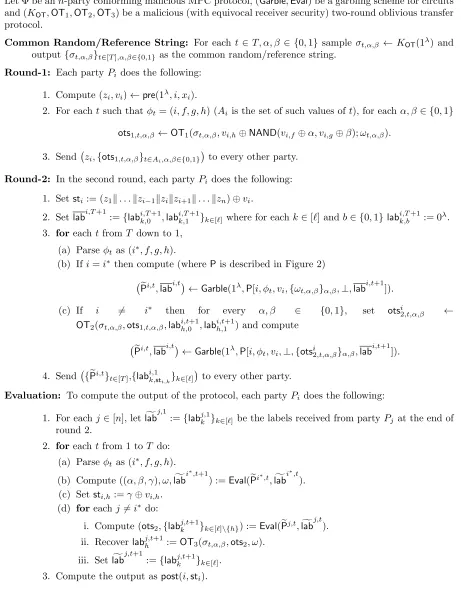
We give our construction of two-round MPC in Figure 3 and the circuit that needs to be garbled (repeatedly) is shown in Figure 2 (same as the semi-honest case). We start by providing intuition behind this construction. Our compiler is essentially the same as the semi-honest case. In addition to the minor syntactic changes, the main difference is that we compile malicious secure conforming protocols instead of semi-honest ones.
the malicious adversary’s effective input.
Theorem 6.1 LetΦbe a polynomial round,n-party malicious MPC protocol computing a function
f : ({0,1}m)n→ {0,1}∗,(Garble,Eval) be a garbling scheme for circuits, and(K
OT,OT1,OT2,OT3) be a maliciously secure (with equivocal receiver security) two-round OT protocol. The protocol described in Figure 3 is a two-round, n-party malicious MPC protocol computing f against static corruptions.
We prove the security of our compiler in the rest of the section. The proof of correctness is the same as for the case of semi-honest security (see Section 5.2).
As in the semi-honest case it is useful to keep in mind that for every i, j ∈[n] and k∈[`], we have that sti,k ⊕vi,k = stj,k ⊕vj,k. Let us denote this shared value by st∗. Also, we denote the
transcript of the interaction in the computation phase by Z∈ {0,1}t.
6.2 Simulator
Let A be a malicious adversary corrupting a subset of parties and let H ⊆ [n] be the set of honest/uncorrupted parties. Since we assume that the adversary is static, this set is fixed before the execution of the protocol. Below we provide the notion of faithful execution and then describe our simulator.
Faithful Execution. In the first round of our compiled protocol,Aprovideszifor everyi∈[n]\H
and ots1,t,α,β for everyt ∈ ∪i∈[n]\h and α, β ∈ {0,1}. These values act as “binding” commitments
to all of the adversary’s future choices. All these committed choices can be extracted using the extractor Ext2. Let bt,α,β be the value extracted from ots1,t,α,β. Intuitively speaking, a faithful
execution is an execution that is consistent with these extracted values.
More formally, we define an interactive procedure Faithful(i,{zi}i∈[n],{bt,α,β}t∈Ai,α,β) that on input i ∈ [n], {zi}i∈[n], {bt,α,β}t∈Ai,α,β∈{0,1} produces protocol Φ message on behalf of party Pi (acting consistently/faithfully with the extracted values) as follows:
1. Setst∗ :=z1k. . .kzn.
2. Fort∈ {1· · ·T}
(a) Parseφt= (i∗, f, g, h).
(b) If i 6= i∗ then it waits for a bit from Pi∗ and sets st∗
h to be the received bit once it is
received.
(c) Setst∗ :=bt,st∗f,st∗
g and output it to all the other parties.
We will later argue that any deviation from the faithful execution by the adversary A on behalf of the corrupted parties (during the second round of our compiled protocol) will be be detected. Additionally, we prove that such deviations do not hurt the security of the honest parties.
Description of the Simulator. We give the description of the ideal world adversary S that simulates the view of the real world adversary A. S will internally use the malicious simulator
SimΦ for Φ , the extractorExt = (Ext1,Ext2) implied by the sender security of two-round OT, the
simulator SimEq implied by the equivocal receiver’s security and the simulator SimG for garbling
Let Φ be ann-party conforming malicious MPC protocol, (Garble,Eval) be a garbling scheme for circuits and (KOT,OT1,OT2,OT3) be a malicious (with equivocal receiver security) two-round oblivious transfer protocol.
Common Random/Reference String: For each t ∈T, α, β ∈ {0,1} sample σt,α,β ←KOT(1λ) and
output{σt,α,β}t∈[T],α,β∈{0,1} as the common random/reference string.
Round-1: Each partyPi does the following: 1. Compute (zi, vi)←pre(1λ, i, xi).
2. For eacht such thatφt= (i, f, g, h) (Ai is the set of such values oft), for each α, β∈ {0,1}
ots1,t,α,β←OT1(σt,α,β, vi,h⊕NAND(vi,f⊕α, vi,g⊕β);ωt,α,β).
3. Send zi,{ots1,t,α,β}t∈Ai,α,β∈{0,1}
to every other party. Round-2: In the second round, each partyPi does the following:
1. Setsti:= (z1k. . .kzi−1kzikzi+1k. . .kzn)⊕vi.
2. Setlabi,T+1:={labi,T+1k,0 ,labi,T+1k,1 }k∈[`] where for eachk∈[`] and b∈ {0,1} lab i,T+1 k,b := 0
λ. 3. foreacht fromT down to 1,
(a) Parseφtas (i∗, f, g, h).
(b) If i=i∗ then compute (wherePis described in Figure 2)
e
Pi,t,labi,t←Garble(1λ,P[i, φt, vi,{ωt,α,β}α,β,⊥,lab i,t+1
]).
(c) If i 6= i∗ then for every α, β ∈ {0,1}, set otsi
2,t,α,β ←
OT2(σt,α,β,ots1,t,α,β,lab i,t+1 h,0 ,lab
i,t+1
h,1 ) and compute
e
Pi,t,labi,t
←Garble(1λ,P[i, φt, vi,⊥,{otsi2,t,α,β}α,β,lab i,t+1
]).
4. Send {ePi,t}t∈[T],{lab i,1
k,sti,k}k∈[`]
to every other party.
Evaluation: To compute the output of the protocol, each partyPi does the following: 1. For eachj∈[n], letlabf
j,1
:={labj,1k }k∈[`] be the labels received from partyPj at the end of round 2.
2. foreacht from 1 toT do: (a) Parseφtas (i∗, f, g, h). (b) Compute ((α, β, γ), ω,labf
i∗,t+1
) :=Eval(ePi ∗,t
,labf
i∗,t ). (c) Setsti,h:=γ⊕vi,h.
(d) foreachj6=i∗ do:
i. Compute (ots2,{labj,t+1k }k∈[`]\{h}) :=Eval(Pej,t,labf
j,t ). ii. Recoverlabj,t+1h :=OT3(σt,α,β,ots2, ω).
iii. Setlabf
j,t+1
Simulating the interaction withZ. For every input value for the set of corrupted parties that
S receives fromZ,S writes that value to A’s input tape. Similarly, the output ofA is written as the output on S’s output tape.
Simulating the interaction withA: For every concurrent interaction with the session identifier
sidthat Amay start, the simulator does the following:
• Generation of the common random/reference string: S generates the common ran-dom/reference string as follows:
1. For each i ∈ H, t ∈ Ai, α, β ∈ {0,1} set (σt,α,β,(ots1,t,α,β, ωt,α,β0 , ω1t,α,β)) ← SimEq(1λ)
(using equivocal simulator).
2. For each i∈[n]\H, α, β ∈ {0,1} and t∈Ai generate (σt,α,β, τt,α,β) ← Ext1(1λ) (using
the extractor of the OT protocol).
3. Output the common random/reference string as {σt,α,β}t,α,β.
• Initialization: S executes the simulator (against malicious adversary’s)SimΦ(1λ) to obtain
{zi}i∈H. Moreover, S starts the real-world adversary A. We next describe how S provides
its messages toSimΦ and A.
• Round-1 messages from S to A: For eachi∈H,S sends (zi,{ots1,t,α,β}t∈Ai,α,β∈{0,1}) to the adversaryA on behalf of the honest partyPi.
• Round-1 messages from A to S: Corresponding to everyi∈[n]\H,S receives from the adversaryAthe value (zi,{ots1,t,α,β}t∈Ai,α,β∈{0,1}) on behalf of the corrupted partyPi. Next, for each i∈[n]\H, t∈Ai, α, β ∈ {0,1} extract bt,α,β :=Ext2(τt,α,β,ots1,t,α,β).
• Completing the execution with the SimΦ: For each i∈ [n]\H,S sends zi to SimΦ on
behalf of the corrupted party Pi. This starts the computation phase of Φ with the simulator
SimΦ. S provides computation phase messages to SimΦ by following a faithful execution.
More formally, for every corrupted partyPiwherei∈[n]\H,S generates messages on behalf
ofPi forSimΦ using the procedureFaithful(i,{zi}i∈[n],{bt,α,β}t∈Ai,α,β). At some point during the execution,SimΦ will return the extracted inputs{xi}i∈[n]\H of the corrupted parties. For
eachi∈[n]\H,S sends (input,sid,{P1· · ·Pn}, Pi, xi) to the ideal functionality implementing
f and obtains the output y which is provided to SimΦ. Finally, at some point the faithful
execution completes.
Let Z ∈ {0,1}t where Z
t is the bit sent in the tth round of the computation phase of Φ be
output of this execution. And letst∗ be the state value at the end of execution of one of the corrupted parties (this value is the same for all the parties). Also, set for each t ∈ ∪i∈HAi
and α, β∈ {0,1} set ωt,α,β :=ωZt,α,βt .
• Round-2 messages from S to A: For each i∈ H, the simulator S generates the second round message on behalf of partyPi as follows:
(a) Parse φt as (i∗, f, g, h).
(b) Setα∗ :=st∗f,β∗ :=st∗g, and γ∗ :=st∗h. (c) If i=i∗ then compute
e
Pi,t,{labi,tk }k∈[`]
←SimG
1λ,
(α∗, β∗, γ∗), ωt,α∗,β∗,{labi,t+1 k }k∈[`]
.
(d) If i 6= i∗ then set otsi2,t,α∗,β∗ ← OT2(σt,α∗,β∗,ots1,t,α∗,β∗,labi,t+1 h ,lab
i,t+1
h ) and
com-pute
e
Pi,t,{labi,tk }k∈[`]
←SimG
1λ,
ots2i,t,α∗,β∗,{labki,t+1}k∈[`]\{h}
.
3. Send {ePi,t}t∈[T],{labi,k1}k∈[`]
to every other party.
• Round-2 messages from A to S: For every i ∈ [n]\H, S obtains the second round message from Aon behalf of the malicious parties. Subsequent to obtaining these messages,
S executes the garbled circuits provided by A on behalf of the corrupted parties to see the execution of garbled circuits proceeds consistently with the expected faithful execution. If the computation succeeds then for each i∈ H, S sends (generateOutput,sid,{P1· · ·Pn}, Pi)
to the ideal functionality.
6.3 Proof of Indistinguishability
We now show that no environment Z can distinguish whether it is interacting with a real world adversary A or an ideal world adversary S. We prove this via an hybrid argument with T + 3 hybrids.
• HReal: This hybrid is the same as the real world execution.
• H0: In this hybrid we start by changing the distribution of the common random string. Specifically, the common random string for the corrupted parties is generated as is done in the simulation. More formally,S generates the common random/reference string as follows:
1. For each i∈[n]\H, α, β ∈ {0,1} and t∈Ai generate (σt,α,β, τt,α,β) ← Ext1(1λ) (using
the extractor of the OT protocol).
Corresponding to everyi∈[n]\H,Asends (zi,{ots1,t,α,β}t∈Ai,α,β∈{0,1}) on behalf of the corrupted party Pi as its first round message. For each i∈[n]\H, t ∈Ai, α, β ∈ {0,1}
in this hybrid we extract bt,α,β :=Ext(τt,α,β,ots1,t,α,β).
Note that this hybrid is the same as hybridHt below with t= 0.
The indistinguishability between hybridsHReal andH0follow from a reduction to the sender’s
security and the equivocal receiver’s security of the two-round OT protocol.
• Ht(wheret∈ {0, . . . T}): HybridHt(fort∈ {1· · ·T}) is the same as hybridHt−1 except we
change the distribution of the OT messages (both from the first and the second round of the protocol) and the garbled circuits (from the second round) that play a role in the execution of thetthround of the protocol Φ; namely, the actionφt= (i∗, f, g, h). We describe the changes
For eachi∈[n]\H, in this hybrid S (in his head) completes an execution of Φ using honest party inputs and randomness. In this execution, the messages on behalf of corrupted parties are generated via faithful execution. Specifically,S sends{zi}i∈[n]\H to the honest parties on
behalf of the corrupted partyPi in this mental execution of Φ. This starts the computation
phase of Φ. In this computation phase, S generates honest party messages using the inputs and random coins of the honest parties and generates the messages of the each malicious partyPi by executingFaithful i,{zi}i∈[n]\H,{bt,α,β}t∈Ai,α,β
. Letst∗ be the local state of the end of execution. Finally, let α∗ := st∗f,β∗ := st∗g and γ∗ := st∗h. In hybridHt we make the following changes with respect to hybrid Ht−1:
– Ifi∗ 6∈H then skip these changes. S makes two changes in how it generates messages on behalf of Pi∗. First, for all α, β ∈ {0,1}, S computes (σt,α,β,(ots1,t,α,β, ω0
t,α,β, ω1t,α,β))←
SimEq(1λ) (using equivocal simulator) and setsωt,α∗,β∗asωZt
t,α∗,β∗rather thanω
vi,h⊕NAND(vi,f⊕α∗,vi,g⊕β∗)
t,α∗,β∗
(note that these two values are the same when using the honest party’s input and ran-domness). Second, it generates the garbled circuit
e
Pi∗,t,{labki∗,t}k∈[`]
←SimG
1λ,(α∗, β∗, γ∗), ωt,α∗,β∗,{labi ∗,t+1 k,sti,k}k∈[`]
,
where {labik,∗,tst+1
i,k}k∈[`] are the honestly generates input labels for the garbled circuit e
Pi∗,t+1.
– S makes the following two changes in how it generates messages for other honest parties Pi (i.e., i ∈H\ {i∗}). S does not generate four otsi2,t,α,β values but just one of them;
namely, S generates otsi2,t,α∗,β∗ as OT2(σt,α∗,β∗,ots1,t,α∗,β∗,labi,t+1 h,Zt ,lab
i,t+1
h,Zt ) rather than
OT2(σt,α∗,β∗,
ots1,t,α∗,β∗,labi,t+1 h,0 ,lab
i,t+1
h,1 ). Second it generates the garbled circuit
e
Pi,t,{labi,tk }k∈[`]
←SimG
1λ,otsi2,t,α∗,β∗,{labi,tk,st+1
i,k}k∈[`]\{h}
,
where{labi,tk,st+1
i,k}k∈[`]are the honestly generated input labels for the garbled circuiteP
i,t+1.
Indistinguishability betweenHt−1 and Ht is proved in Lemma 6.2
• H0
T : In this hybrid, we modify the output phase of the computation to execute the garbled
circuits provided by Aon behalf of the corrupted parties and see if the execution of garbled circuits proceeds consistently with the transcriptZ. If the computation succeeds then for each i∈H, we instruct the parties inH to output y (which is the output obtained by all parties in the execution of Φ); else, we instruct them to output ⊥. This hybrid is computationally close toHT from the authenticity property of the input labels.
• HT+1: In this hybrid we just change how the transcriptZ,{zi}i∈H, random coins of malicious
parties and value st∗ are generated. Instead of generating these using honest party inputs in execution with a faithful execution of Φ, we generate it via the simulator SimΦ (of the
maliciously secure protocol Φ). In other words, we execute the simulatorSimΦwhere messages