© Associated Asia Research Foundation (AARF)
A Monthly Double-Blind Peer Reviewed Refereed Open Access International e-Journal - Included in the International Serial Directories.
Page | 52
DEVELOPING SELF-LEARNING MATERIALS
BASED ON ASEAN TOOLBOXES FOR TOURISM STUDENTS
Ni Nyoman Yunike Kurniarini
Tourism Department, West Lombok State Community Academy, Indonesia English Education Department,Mataram University, Indonesia
ABSTRACT
This study focuses on developing learning materialsfor tourism students based on
ASEAN Toolbox. The objectives are to collect and analyse data for developing English
self-learning materials for the students of the hotel and the tourism departments as a way of
responding to the policies on standard English competencies mutuallyrecognized and agreed
upon by the ministries of tourism among member countries of ASEAN. The study was
conducted at the State Community Academy of West Lombok. Data for the study were
collected in the form of documents (ASEAN Toolboxes, English syllabi, and lesson plans) and
interviews with the students on learning needs and with the teachers on methodological
needs. The products of data analyses were self-learning materials. Interviews with students
proved that the materials were essential for student self-development. Interviews with the
teachers urged the need for more inter-student materials. In general, however, thelearning
materialssufficiently providedthe expected competencies represented in the ASEAN Toolbox,
but the effect might need further studies.
KEYWORDS: ASEAN Toolboxes, Self-Development, Self-Learning Material, State Community Academy, Tourism.
1. INTRODUCTION
Tourism is an important factor to promote mutual understanding among people & expand
social, economic, cultural and scientific cooperation in many countries. By 2020, tourism will International Research Journal of Human Resources and Social Sciences
ISSN(O): (2349-4085) ISSN(P): (2394-4218) Impact Factor- 5.414, Volume 5, Issue 11, November 2018 Website- www.aarf.asia, Email : [email protected] , [email protected]
© Associated Asia Research Foundation (AARF)
A Monthly Double-Blind Peer Reviewed Refereed Open Access International e-Journal - Included in the International Serial Directories.
Page | 53 be main earning for Indonesian foreign exchange. However, there are several main problems
that appear during its ‘journey’ being the main income source, and the biggest one is low
tourism service quality. The problem is closely related to human resources as professional
worker in this field. Indonesian human resources take place the 53rd position of 141 based on
the travel and tourism competitiveness index.
In order to provide the tourism professional in Indonesia, the government tries to build
many educational institutions in tourism field, for example West Lombok State Community
Academy that not only carries out educational missions but also implements: the
development of comprehensive emphasis on professional development in human resources,
by providing education based on market and industry needs. The institution has three (3)
concentration focused on hospitality industry; hotel accommodation, food and beverages, and
hotel engineering.
In the broader area, the policy in tourism field also have been upgraded day by day. As
the ASEAN member state, Indonesia also tries to join in the mutual recognition arrangement
for professional qualification in tourism industry by stating the ASEAN Toolbox on
November 09 2012. Further, this arrangement refers to the minimum requirement of
competency standard in hotel and travel services which aim to upgrade tourism service and
facilitate the development between ASEAN member states, we known as ACCSTP (ASEAN
Common Competency Standard for Tourism Professional).
The vocational education curriculum is prepared with professional communities and
professional organizations responsible for the quality of their professional services in order to
qualify their professional competence, thereby educating their profession. This curriculum
often applies student-centered approach in its teaching and learning process. The self-study
learning is one choice to support ‘special’ learning process in vocational college like
Community Academy. It will change the role of the trainer/trainee by placing greater
responsibility for the learning process on the trainee.
This paper aims the development self-learning material based on ASEAN Toolbox that is
done in West Lombok State Community Academy. Then, it will also presents the discussion
of students’ learning needs and teacher’s methodological needs in achieving the tourism
professional qualification of ASEAN standard. These needs are essential in the development
© Associated Asia Research Foundation (AARF)
A Monthly Double-Blind Peer Reviewed Refereed Open Access International e-Journal - Included in the International Serial Directories.
Page | 54 2. REVIEW OF LITERATURE
Materials Development
The triangular relationship between learner, learning and material is always important.
One can create a particular learning environment only through a balanced handling of these
three elements. Materials could refer to anything used to help to teach language learners.
Material development refers to any activities performed by materials writers, teachers, or
learners to provide sources of language input and to exploit those sources in ways which
maximise the likelihood of intake. In other words, materials development can be defined as
the supplying of information about and/or experience of the language in ways designed to
promote language learning1. These materials can be in the form of textbooks, workbooks,
cassettes, CD-ROMs, videos, photocopiable handouts, newspaper cut-outs, paragraphs
written on whiteboards or anything which present or informs about the language being
learned2.
In Indonesia, where English is aforeign and not a second language, the use of materials
hasmore or less shaped different points of view of teaching and in the ways teaching has been
practiced. In order to fullfil specific purposes of teaching like in English for tourism, the
materials then plays a crucial role in exposing the learners to the language. Thus, the
materials need to present real language as it is used in the speech community and the full
range of language competencies that the learners require in the communities of practice. As a
learning support, materials need to be reliable, that is, to work, to be consistent and to have
some perceivably recognizable patterns. Thus, it needs notonly a rigid unit structure but also
e a fixed format. To enhance learning, materials must involve learners in thinking about and
using the language. The activities need to stimulate cognitive not mechanical processes. The
learners also need a sense of progression. To stimulate and motivate, materials need to be
challenging yet achievable, to offer new ideas and information whilst being grounded in the
learners’ experience and knowledge; to encourage fun and creativity3
. The input must contain
concepts and/or knowledge that are familiar but it must also offer something new, a reason to
communicate, to get involved. The exploitation needs to match how input would be used
outside the learning situation and take account of learning needs. The purpose and te
connection to the learners’ reality need to be clear. Many ESP learners have little time for
1
Tomlinson, B. (ed.) 1998. Material Development in Language Teaching. Cambridge: Cambridge University Press. Page 2.
2
Tomlinson, B. (ed.) 1998. Material Development in Language Teaching. Cambridge: Cambridge University Press. Page 2.
© Associated Asia Research Foundation (AARF)
A Monthly Double-Blind Peer Reviewed Refereed Open Access International e-Journal - Included in the International Serial Directories.
Page | 55 class contact and rely on a mix of classes, self-study and references materials. For self-study
or reference purposes, materials need to be complete, well laid out and self-explanatory. The
learners will want explanations, examples and practice activities that have answer and
discussion keys.
Self - Learning Materials
Innovative ways are constantly required in the effort to solve the problems in education.
As a result and outcome of such research, a shift occurs in understanding from
teacher-centered instruction towards learner-based learning. Self learning materials (SLMs) are
basically learner-centered materials. This materials are different from other learning materials
in a number of ways. Firstly, they can make the learners think by setting questions thus
encourage to stop and think for a while before moving to the next step. Secondly, they can
make the learners writeand help them consolidate what they have learnt. Finally, they can
make learners do something practical in learning and develop their skills. SLMs enable
learners to be open in what they learn and to be flexible in the time and the place of learning
although when they are distant from the teachers and fellow students.
SLMs have specials features. Derek Rowntree proposes numerous special features of
SLMs, but for reasons of space only relevant and applicable ones are listed here: they have
clearly stated objectives; advice about how to study the materials, user-friendly; shortish;
manageable chunks of learning, fewer words than usual per page; helpful with plenty of
examples, and referentialto the learners’ experience. In addition, SLMs are self-explanatory,
self-contained, self-directed; self-motivating, and self-evaluating4. SLMsfor a foreign
language for special purposes, like tourism are very important but they can become an urgent
problem when they are not available. When they are available, they can help learners attain
the required standard of competency.
Competency Standard of Learning Achievement
Competency standards are descriptions of skills, knowledge and attitude required to
perform tasks/activitiesto a defined standard in industry. Learning standard are concise,
written description of what learners are expected to know and be able to do at a specific stage
of their education. A standard is defined as an expectation that indicates what students should
be able to understand or do. In tourism field, there are several learning standards that should
4
© Associated Asia Research Foundation (AARF)
A Monthly Double-Blind Peer Reviewed Refereed Open Access International e-Journal - Included in the International Serial Directories.
Page | 56 be achieved by the professional in order to fullfil the needs of industry, called ASEAN
Common Competency Standard for Tourism Professional (ACCSTP) and its implementation
in the form of toolboxes in each focus study.
ASEAN Toolboxes as a standard of learning achievement in Tourism.ASEAN Toolboxes
are the implementation of ASEAN Common Competency Standard that support Mutual
Recognition Agreement for Tourism Professional. The purpose of this mutual recognition
mechanism is to facilitate mobility of tourism professionals within ASEAN based on
competence-based tourism qualifications/certificates, and at the same time, improve the
quality of services delivered by tourism professionals. There are 32 job titles covered under
this MRA, ranging from housekeeping, front office, food and beverages services, and food
production for hotel division, to travel agencies and tour operator for travel division include
the skill of English. The Indonesian National Qualification Framework is a framework for the
inclusion of competency qualifications that can match, integrate and integrate between the
field of education and the field of vocational training and work experience in the framework
of providing job competence recognition in accordance with the structure of work in various
sectors. In this
3. METHOD
This study was a research and development which adapted from Borg and Gall model5.
The target population in this study arethe 2ndsemester students in the academic year
2017/2018 at West Lombok State Community Academy. The instrument used in this study is
a structured questionnaire constructed to measure the variable (i.e. learners’ learning need).
The instrument consists of two parts. The questionnaire consists of two parts learning needs
that support the learning methods; the first questionnaire involved discussion, presentation,
games, role play, and simulation. Then, the second questionnaire involved the method
choices how the learners like to learn the material; individually, in pairs (two students), and
in group (more than 2 students).
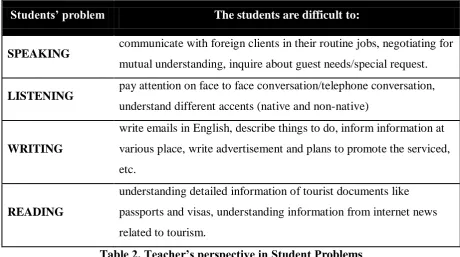
Next, the teachers’ perspective also measured by interviewing the English teachers and
practitioner of tourism field. The interview will investigate about the students’ problem based
on the teacher point of view. The question of interview is about four skill in mastering
English, speaking, listening, writing, and reading. By interviewing, we can investigate the
specific problem that lies in each skill.
© Associated Asia Research Foundation (AARF)
A Monthly Double-Blind Peer Reviewed Refereed Open Access International e-Journal - Included in the International Serial Directories.
Page | 57 4. FINDINGS
Language Needs
In this research, the language needs is investigated by the document analysis of ASEAN
toolboxes that represent ASEAN Common Competency Standard for Tourism Professional
(ACCSTP); English syllabi in the academny; and lesson plan by the teachers itself. There are
11 (eleven) competency that should be achieved by the learners for tourism field in the
following:
(English Language Proficiency) based on ACCSTP
Converse in English at a basic operational level.
Respond effectively to instructions given in English.
Start conversation and develop good relations with guests.
Communicate effectively in English on a telephone.
Use oral English to convey a complex exchange of ideas.
Deliver a short oral presentation in English.
Read and write at an advance level.
(Reading)
Read and interpret basic instructions, direction and/or diagram.
Read general information texts or media.
(Writing)
Write a short message in English
Prepare a business letter in advanced English
From the competency above, it can be analyze into specific skill for each proficiency, for
example:
Converse English at a basic operational level Ability to:
distinguish formal and informal expressions in English.
initiate conversations
respond to opening conversation remarks
keep a conversation going on familiar topics
talk about past events using sequence markers and correct tense
close a conversation politely
© Associated Asia Research Foundation (AARF)
A Monthly Double-Blind Peer Reviewed Refereed Open Access International e-Journal - Included in the International Serial Directories.
Page | 58
make polite requests
explain routine work procedures
make suggestions
discuss likes, dislikes and preferences
Learning Needs
In this research, the learners’ learning needs is measured by the students’ responses to
items in the questionnaire. There are two parts of the learning needs that represent the
activities in the learning process. Firstly, we investigated what activities that the learners’
want to do while achieving the English competency in tourism field. There are five
dimensions of learning needsare presented, such as discussion; presentation; games; role
plays; and simulation.Based on the findings in the Table 1, simulation has the highest
frequency (28%), followed by games (24%). In the third rank is role plays (20%) that higher
than discussion (15%) and presentation (13%).
Secondly, the way they can doing the learning process. There are three typessuch as
individually; in pairs; and in group (more than 2 students).Based on the findings in the Table,
working in pairs has the highest frequency (40%), followed by working in group (33%). In
the last rank is individually (27%).
The findings indicate that the simulations and in pairs activity are the most favourite ones
by the learners in their learning process.
Learners’ Learning Needs Frequency
Discussion 15%
Presentation 13%
Games 24%
Role plays 20%
Simulation 28%
Table 1.Frequency of Learner’s Learning Needs
Teacher’s perspective
In this research, the teachers’ perspective is investigated by the interviewing the English
instructor and the practitioner of tourism field. There are four dimensions of the
teacher’perspective based on the skill that should be mastered by the learners, speaking,
listening, writing, and reading.Based on the findings in the Table 2, speaking is the most
Learners’ Learning Needs Frequency
Individually 27%
In pairs 40%
In group
© Associated Asia Research Foundation (AARF)
A Monthly Double-Blind Peer Reviewed Refereed Open Access International e-Journal - Included in the International Serial Directories.
Page | 59 difficult skill that learners achieved followed by listening, writing, and reading as the last
[image:8.595.66.527.140.397.2]skill.
Table 2. Teacher’s perspective in Student Problems
5. DISCUSSION
In order to develop learning materials for specific purposes, one thing that should become
the starting point is the learners’ needs. This is in line with the first step of developing
learning materials for general purposes as well as that for English as a specific purposes
(ESP) proposes by Hutchinson and Waters6 which states that ESP based on designing courses
to meet learners’ needs. Learners’ needs have been formulated by the institution where the
learners are learning in the form of learning objectives.
Hutchinson and Waters also proposes four approaches of course design process: a
language-centered approach, a skill-centered approach, a learning-centered approach, and the
post hoc approach.In a learning centered-approach, there are three chain of procedures: (1)
analyzing learning situation, creating interesting and enjoyable materials, and checking
language and skill content of materials and making necessary adjusments; (2) analyzing
6
Hutchinson, T. and Waters, A. 1989. English for Specific Purposes: A learning-centred Approach. Cambridge: Cambridge University Press.
Students’ problem The students are difficult to:
SPEAKING communicate with foreign clients in their routine jobs, negotiating for mutual understanding, inquire about guest needs/special request.
LISTENING pay attention on face to face conversation/telephone conversation, understand different accents (native and non-native)
WRITING
write emails in English, describe things to do, inform information at
various place, write advertisement and plans to promote the serviced,
etc.
READING
understanding detailed information of tourist documents like
passports and visas, understanding information from internet news
© Associated Asia Research Foundation (AARF)
A Monthly Double-Blind Peer Reviewed Refereed Open Access International e-Journal - Included in the International Serial Directories.
Page | 60 target situation, establishing general syllabus of topics and tasks; creating interesting and
enjoyable materials, and checking language and skill content of materials and making
necessary adjusments
The procedure of developing learning materials which consists of the design,
implementation, and evaluation has to be implemented as well in order to produce more
accurate learning materials. The design steps include the formulation of the first draft of
learning materials which have considered the sylabus, the target needs, the choice of the
suitable nature of learning materials, and the principles of developing learning materials.
Having the complete draft of learning materials, a teacher has to implement the materials to
the target learners in the real teaching-learning situation. Any weaknesses found in the try-out
or in the implementation of the materials have to be considered to revise the learning
materials. This is what is called the evaluation step in the materials development.
6. CONCLUSION
The development of English self-learning materials is necessary to respond the policy on
standard English competencies, especially for vocational college. There will be never be
perfect teaching/learning self-learning materials that can be used anywhere, anytime for the
same level of learners. The teachershave to develop his/her ownself-learning materials for
their own specific target learners by analyzing the language and learning needs.The language
needs can be identified in the document that involved the competency standard, like syllabus,
The Indonesian National Qualification Framework, and ACCSTP (ASEAN Toolboxes).
There are 11 competencies in English proficiency that should be achieved by the students.The
learning needs can be analyzed from students’ needs for their learning process and teachers’
perspective. The most popular activities in learning process are simulation by working in
pairs. And among four skills, speaking is regarded as the main problem for tourism students,
followed by listening, writing, and reading.
REFERENCES
Journal Paper
1. Dorababu, K.K, Jayaram, K. 2015. Self Learning Materials In Distance Education
System. International Journal for Current Research.
© Associated Asia Research Foundation (AARF)
A Monthly Double-Blind Peer Reviewed Refereed Open Access International e-Journal - Included in the International Serial Directories.
Page | 61
3. Tomlinson, B. (ed.) 1998. Material Development in Language Teaching. Cambridge:
Cambridge University Press. Page 2.
Books
4. Hutchinson, T. and Waters, A. 1989. English for Specific Purposes: A