5
VIII
August 2017
578
©IJRASET (UGC Approved Journal): All Rights are ReservedMinutiae Based Fingerprint Authentication System
Laya K Roy
Student, Department of Computer Science and Engineering Jyothi Engineering College, Thrissur, India
Abstract: Fingerprint is the most promising biometric form that is used for person identification and verification. Several fingerprint authentication systems are used for verification and identification of persons and this relies on the fact that the uniqueness of fingerprints can be measured by analyzing the features of fingerprint such as valleys, ridges, minutiae and singular points. Proposed system of fingerprint verification introduces the concept of minutiae. The system is the combination of four stages. The acquisition stage where the fingerprint images are obtained by online and offline technique. Second is the pre-processing stage where the unwanted data such as noise, reflections are removed from the image by undergoing enhancement, binarization, and thinning stages. Feature extraction stage is where the system extracts the features of fingerprint images. These features are used for the identification and verification.
Keywords: Fingerprint, Minutiae, Feature Extraction, Thinning.
I. INTRODUCTION
The process of identification and verification of people is a challenging method in all authentication systems. In the present world it is significant to verify people’s based on their identity and it has to be done in a secured way. Different recognition system offers the service to verify their identity but they are not sufficient enough to ensure the security. Biometric authentication system was the turning point in the history of authentication systems. They provide the enhanced option of verifying people’s identity based on their biological characters such as voice, fingerprints, iris, retina, and DNA. Biometric authentication system promises a unique way to authenticate people based on their characteristic features. Among the class of biometric recognition system, the fingerprint based authentication system is the most challenging one but it is highly promising when compared to the other systems. The features such as ease of capture, highly distinctive, and low cost for the optical fingerprint sensors made the system more user friendly.
The impression left by the friction ridges of a human finger is characterized as the fingerprint. Two people’s having the same fingerprint is less than one in a billion and this is considered as the key concept behind the fingerprint authentication systems for person identification and verification. There exist several features in a single fingerprint image and are pores, ridges, valleys, singular points, minutiae and bifurcation. The uniqueness of a fingerprint image can be usually defined by analyzing these features. The automated method of verifying the similarity between two fingerprint images is known as the fingerprint authentication system or the fingerprint recognition system. The fingerprint authentication system undergoes three different stages for achieving the aim and is enrollment stage, identification stage and finally the verification stage. Enrollment is the process of collecting fingerprint images by online and offline techniques. Online methods usually collect the fingerprint images by using optical sensors. Offline way of collecting fingerprints is an old technique that use the help of ink and a white paper. During the stage of enrollment we are actually registering the images of fingerprints in a database so that we may able to measure the similarity of that image with respect to another one. The verification stage is where the person’s fingerprint image is verified from the database with the help of certain matching algorithms. The process of verification also known as 1:1 matching because one single image is verified with all images in the database. The final stage is the identification where fingerprint acquired from one person is compared with all the images in the database. The system introduces a new method of fingerprint recognition based on the minutiae feature extraction. The concept of Support Vector Machine (SVM) is used to classify the extracted features.
II. RELATEDWORK
579
©IJRASET (UGC Approved Journal): All Rights are ReservedIII.PROPOSEDSYSTEM
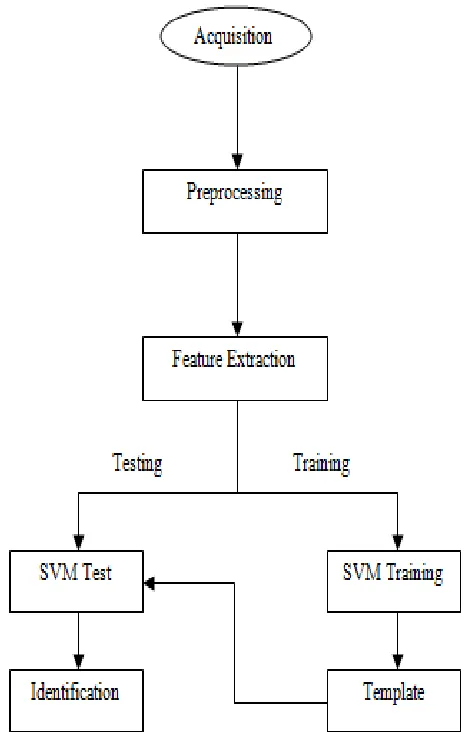
[image:3.612.176.408.209.575.2]The proposed system of fingerprint authentication consists of four stages that are acquisition stage, fingerprint image pre-processing, feature extraction and the matching stage. Matching stage is where both the identification and verification of fingerprints take place. Each stage consist of several steps such as Binarization, thinning, FFT enhancement through which the process of fingerprint identification is taking place. The method of using minutiae for fingerprint verification is widely applied because of the uniqueness of the features in fingerprint. The proposed system is considering factors such as ridge endings and bifurcations as minutiae. Ridges are curved lines in the fingerprint image and they are represented using black lines. Ridge endings are terminations. Both the concept of terminations and bifurcations are considered as minutiae.
Fig 1. Flow of Proposed Model
A. Acquisition Stage
580
©IJRASET (UGC Approved Journal): All Rights are ReservedB. Pre-processing Stage
The second stage of fingerprint authentication system is pre-processing which is the process of removing unwanted data’s such as noise, reflections from the fingerprint image. Pre-processing stage further classified into three and is enhancement, binarization and thinning. Enhancement stage is a collection of processes where ridge segments, ridge orientations, ridge frequency are obtained and the filters were applied. Histogram equalization a process that adjusts the image intensities to enhance contrast and Fast Fourier Transform (FFT) enhancement is carried out in the fingerprint images. Binarization and thinning are two other steps of pre-processing stage. Binarization is the process to transform the image from 256 levels to two levels that is (0, 1) levels usually refer to black and white levels. Thinning also known as skeletonization and is used to reduce the ridges of fingerprint image.
C. Algorithm of Binarization
1) First the given image is divided into blocks with size 16 X 16. 2) For each block, calculate mean intensity value.
3) For each pixel a rule is applied.
Pixel = 1; if intensity value> mean intensity Pixel = 0; if intensity value<mean intensity
D. Algorithm of Thinning
1) Clean up the image by, removing single isolated regions, H-breaks and spikes.
2) Eliminate the connected regions at the boundary regions.
E. Feature Extraction Stage
A fingerprint image is a combination of several features such as ridges, pores, valleys, singular points, minutiae and bifurcations. These features are used to identify the uniqueness of the fingerprint images. Feature extraction stage is the third stage in the system where the system identifies the features of the fingerprint images. They are used for identification and verification purpose. False minutiae are removed from the image by using false minutiae removing algorithms.
F. Algorithm to Obtain Minutiae
1) Obtain the size of the thinning image.
2) Select the label connected component from the image which gets the ridge and ridge map.
3) Scan the thinning image to extract the minutiae. Ridge endings, ridge orientations and ridge frequencies are optimized. 4) The details extracted from the thinning image are stored in mat lab file.
5) End the process.
Minutiae of the fingerprint image are extracted using the algorithm and the next stage of feature extraction is the removal of false minutiae points from the figure.
G. Matching Stage
This is the final stage in the fingerprint recognition system which includes the identification and verification processes. The proposed system is using the technique of SVM classifier to classify the features extracted from the fingerprint image and it is stored in the matrix format to check the similarity between the input fingerprint image and the template fingerprint image. Multiple support vector machine classifiers are also used to generate the character matrices.
IV.EXPERIMENTALEVALUATION
This section describes the working of the proposed model of fingerprint authentication system using minutiae matching.
581
©IJRASET (UGC Approved Journal): All Rights are ReservedFig.3. (a) Input image (b) Ridge segment (c) Histogram equalization (d) Bifurcations
V. APPLICATIONS
A. Banking and ATM Secure Transactions
Secured banking and ATM transaction applications are offered by the fingerprint recognition system.
B. Voting
Fingerprint is unique for each individual so the system of fingerprint authentication is widely used for voting applications.
C. Passport Control
Fingerprint based authentication system also have wide range of applications in airport.
D. Identification of Criminals
Identification of criminals using fingerprint is a famous technique. The uniqueness of fingerprint is the key concept behind this application.
VI.CONCLUSIONS
582
©IJRASET (UGC Approved Journal): All Rights are Reservedimportant aspect of the algorithm as the presence of these areas would prove to be extremely harmful for the extraction of minutiae points.
VII. ACKNOWLEDGMENT
I take this opportunity to express my sincere gratitude to all respected personalities who had guided, inspired and helped me in the successful completion of this paper. First and foremost, I express my thanks to The Lord Almighty for guiding me in this endeavour and making it a success
.
REFERENCES
[1] D. Maltoni, D. Maio, A. K. Jain, S. Prabhakar, Handbook of Fingerprint Recognition (Second Edition), Springer, London, 2009.
[2] J.Ravi,K.B.Raja,K.R.Venugopal,“Fingerprint Recognition Using Minutia Score Matching”,International Journal of Engineering Science and Technology, Vol.1 (2), pp. 35-42, 2009.
[3] Haiyun Xu, Raymond N.J.Veldhuis, Tom A.M.Kevenaar and Ton A.H.M.Akkermans,“A Fast Minutiae-Based Fingerprint Recognition System”,in IEEE system Journal ,Volume 3,No.4,Decmber 2009.
[4] Ashwini R. Patil, Mukesh A. Zaveri, “Novel Approach for Fingerprint Matching using Minutiae”, in Fourth Asia Int. Conference on Mathematical/Analytical Modelling and Computer Simulation 2010 IEEE 978-0-7695-4062-7/10. 2010.
[5] Chitresh Saraswat, Amit Kumar, “An Efficient Automatic Attendance System using Fingerprint Verification Technique”, International Journal on Computer Science and Engineering(IJCSE), Volume (2) : Issue (2) pp. 264-269, 2010.
[6] S. Mazumdar, V. Dhulipala, "Biometric Security Using Finger Print Recognition”, University of California, San Diego. 7 pages, Retrieved 30 August 2010. [7] Gabriel I,Oluwole A, Boniface A, Olatubosun O, “Fingerprint image enhancement:segmentation to thinning”, Department of Computer Science. Int J Adv