5
VIII
August 2017
Reviewing the effect of magnetization of fuel over
the efficiency of I.C. Engine
Krishna Kant Dixit1, Himanshu Sharma2, Amrit Kumar Jha3, Shivam Shridhar4
1,2,3,4 Department of Mechanical Engineering, University of Petroleum & Energy Studies
Abstract: The finite oil reserves and stringent emission norms have caused vehicle manufacturers to face a huge challenge to research, develop and produce even cleaner and more fuel-efficient vehicles. Over the last few decades, levels of emission have drastically reduced, and this has largely been attained using of exhaust gas treatment systems. Instead of using alternate fuel to decrease the emission and increase the efficiency of an engine, in this study the literature review made on the magnetization of fuel and its effect on engine performance characteristics.
Diesel is an unstable fluid consisting of different heterogeneous constituents. These constituents are mainly responsible for improper combustion of fuel and results in loss of engine efficiency, carbon deposition. Polar particles are difficult to burn, and Nitrogen and Sulphur containing compounds cause soot and darken the fuel. Magnetizing the fuel before its combustion can reduce these problems by rearranging the fuel particles and altering its geometry. Polar constituents produce magnetic dipoles which are manipulated by strong magnetic fields. The stereochemistry of the fuel is altered, weak bonds broke, and proper chemical reaction between Oxygen and fuel particles takes place. Designing the apparatus with proper fuel line design, air gap measurement, and magnetic strength identification has remained key challenges which need to overcome. Fuel flowing through the pipeline should be streamlined such that magnetic fields can attack perpendicular to the particles. Representative papers and books are chosen here that provide examples of developments and direction.
It is seen that there is a positive change in engine thermal efficiency and reduction in CO and UHC emission, but on the other hand, there is an increment in the NOx emission.
Keywords: magnetic fuel conditioning, emissions, neodymium, streamline, efficiency.
I. INTRODUCTION
In a tidy world where the utmost importance of fuel is understood equally by a rich as well as a developing country/society/person, where diesel, petrol and secondary fuels are the backbone of today’s industrial and automotive era. The ultimate result of fuel is energy, either mechanical, electrical or chemical. The process by which fuel converts into energy is combustion. Higher the amount of energy output, better is the fuel. Not all the fuel converts into energy, loss in many forms occur during combustion. Hence the term thermal efficiency; indicates the extent to which the energy added by heat is converted to work output.
Increasing the efficiency of an engine (thermal efficiency) is a topic of research worldwide, as more work output means more fuel economy (mileage) and fewer emissions of air pollutants (COx, NOx). A petrol engine will give an efficiency of 25% - 30%, after considering losses due to friction, noise, electrical equipment and fuel turbulence[1].
The above losses cannot be lower due to design constraints, so will be trying to increase the combustion of the fuel with a magnetic apparatus around the fuel line. Fuels like petroleum and its products mainly consist of hydrocarbons. On implying a magnetic effect on the fuel particles, the electrons get re-aligned to give better combustion.
Aromatics present in fuel oxidize to form high molecular weight deposits –gum and sludge. Sulfur and nitrogen-containing aromatics cause fuel to darken and results in poor burning[1, 2]. Various parameters such as the magnetic strength of magnets around the fuel line, its position, polarity, the length of the apparatus, magnetic flux, must be observed carefully to get the desired outcome. The dispersed fuel will also result in fewer emissions of smog and other air pollutants which will fulfill the non-focused objective. On analyzing mathematically, one may find out that it will increase the efficiency of an S.I engine.
II. GENERAL PROBLEMS IN I.C ENGINES
The typical problems faced in CI engines are pre-ignition, turbulence, detonation and knocking, dopes, delay period and impure fuel (containing wax). Other challenges are Low-power complaints which are the result of the loose throttle linkage or dirty fuel filters, excessive lubrication oil use caused by leaking gaskets or connections and black smoke caused by the imbalance in air-fuel ratio. Diesel fuel is an unstable fluid containing thousands of constituents. Most of these constituents are heterogeneous in nature. Different sizes of fuel particles are forming. Due to the physical size of the particles and the chemical characteristics filterability, stability and combustion efficiency of the fuel are affected. Incomplete combustion of fuel leads to air pollution adding soot and other harmful gases to the atmosphere. When the size of the molecular clusters increases, the intermolecular spacing is affected which further results in lost engine efficiency, engine wear, deposits of carbon on fuel injectors, rings, piston and components that emit exhaust, slime and varnish are forming in the fuel system, hazardous emissions, the formation of various sediments.
Particle-like wax gets deposit along flow lines and production tubing which cause plugging of flow lines, and it usually hikes the viscosity of the crude oil and also makes the surface of walls rough. A combination of different paraffinic hydrocarbons (usually between C18-C70), resins, asphaltic materials, and gums is known as wax. Wax formation commences when the temperature falls
below Wax Appearance Temperature. Wax forms due to pressure changes, evaporations, and loss of dissolved gases[3]. This tends to increase pumping cost as well as decrease production rates. Its accumulation in vessels (storage and process) causes system changes and may lead to fracture of storage vessels. The general estimation of economics cost calculated as in the order of millions of dollars every year[6].
III. CAUSES OF POOR COMBUSTION IN DIESEL
West Virginia University researchers found out that at above 500 degrees Celsius, fuel particles are mainly carbon clusters. However, at temperatures below this, higher molecular weight hydrocarbons condense to clumps. Emission tests performed on dynamometer and comparison of the treated and untreated fuel point that magnetic treatment can significantly increase combustion of the fuel. Objectionable emissions in diesel fuel are mainly due to the presence of polar constituents[7]. For example, in catalytic cracking, aromatics compounds are produced in large numbers. These aromatics compound are polar and unstable. Nitrogen and Sulphur containing aromatic compounds darken the fuel and do not combust properly hence produce deposits of carbon and soot. Further formation of Gel like slime and sedimentation of various types is generally due to instability and oxidation of molecules which takes place during transportation and storage[1].
IV. EFFECT OF MAGNETIZATION ON DIESEL FUEL
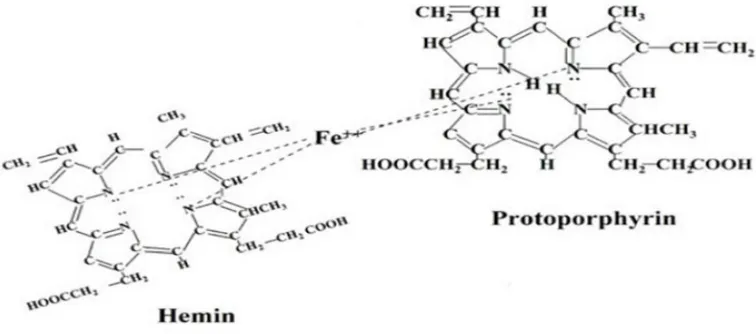
[image:3.612.117.495.531.698.2]The advantage of polarity is that it generates dipoles of the magnet which under strong magnetic fields can manipulate. This reduces slime and produces a greater efficiency of fuel. Becker observed that protoporphyrin which is a constituent of many substances and imparts a red color to oil and blood contains atoms of iron caged together. These iron quantities however small they maybe make many substances susceptible to influence from magnetic fields[8]. Figure 1 shows the Caged iron atoms in Protoporphyrin Molecule.
Magnetization can move outer electron of a hydrocarbon chain into a state of the higher quantum number. Moving to higher quantum number breaks fixed valence electrons which participate in the process of bonding of fuel compounds. By doing so, the condition of freer association can be achieving. Hence hydrocarbon fuel becomes more aligned and directional. This magnetic alignment allows oxygen to combine rapidly to hydrogen and complete burning with fewer pollutants can be achieved[4, 9].
When passed through high-intensity magnetic fields, Hydrocarbons de-cluster and form smaller particles which have more exposure of surface area for reacting with oxygen which leads to better combustion[10]. According to van der walls discovery of weak cluster forces, the oxygen binds with hydrogen strongly which ensures proper burning in the combustion chamber and reduces fuel consumption as well as increases power output of engine[2, 5].
Theoretically, carbon dioxide, nitrogen, and water vapor since they do not participate in the combustion are main constituents of exhaust gas, but practically exhaust gases contain carbon monoxide, hydrogen, NOx, and oxygen also. In real, complete combustion
cannot achieve which further can observe in the form of HC, CO. Hydrocarbon fuel molecule after treatment with magnetic energy creates smaller particles which allow oxygen to penetrate readily, thus leads to improved combustion than before[11].
A. Forces Acting On Diesel Fuel Particles
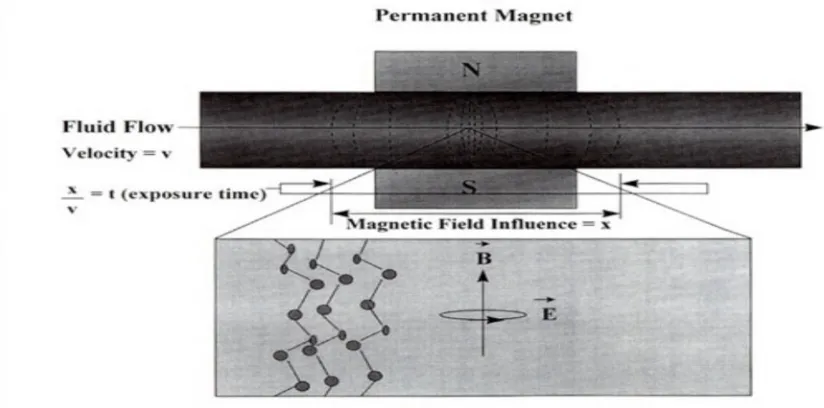
London forces which arise due to the effect of electron motion between polar and non-polar molecules raises temporary dipole moments. Figure 2 shows the Becker’s model which explains how a magnetic field can disrupt the sheath of asphaltene-maltene. The same model applies to diesel fuel molecules. Now according to Lorentz,
F=QVB
[image:4.612.83.495.361.565.2]Here, F= Lorentz force, Q= particle charge, V= velocity of the particle, and B= applied a magnetic field. Fuel is passing through magnetic field experiences a Lorentz force which shifts charge distribution and creates changes in weak intermolecular forces[1].
Figure 2. Effect of magnetic field on aggregated molecules B. Effect on Stereochemistry
Stereochemistry of the fuel molecules changes when fuel fluid passes through certain alteration and successions of the magnetic field which leads to better combustion and reduction in NOx.
In normal form (at standard pressure and temperature) hydrogen (in gas form) contains 25% & 75% of para & ortho form respectively. At different temperatures hydrogen has different equivalence ratio of ortho and para form but as ortho form have parallel spin moment due to which they have high energy and are more unstable. Due to this, they are more reactive to oxygen molecules. Certain researchers verify that due to magnetization (through resonance) parahydrogen converts into ortho hydrogen which increases the overall energy of atom and reaction with oxygen greatly results in better combustion of fuel[12].
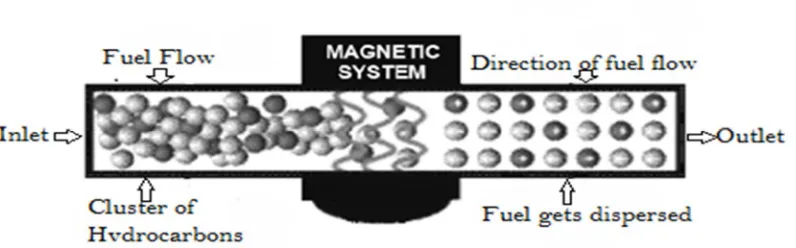
Above can relate as applied magnetic field reduces the energy between bonds of C-C and C-H ions as shown in figure 3 and disperse them into fine particles. This increases the affinity of these molecules from other ions in proximity to highly paramagnetic oxygen which facilitates the oxidation by accessing the methane centered carbon which is hard to access in fuel which is not magnetized [12].
The technology of magnetic fuel treatment offers a viable and low-cost technique of emission reduction[1].The percentage of fuel saving varies from (9-14) %. HC and CO decreases about (30-40) % and CO2 and NOX increases by 10% and 18% respectively[13,
[image:5.612.101.499.271.395.2]14]
Figure 3. De-cluster of hydrocarbon molecules
V. DESIGN CONSIDRATION FOR FUEL CONDITIONING
As per the apparatus is concerned while making a magnetic system, a magnetic field produced in alternate direction by using magnets. Along with this, the fuel must have laminar flow in the area influenced by flux. This laminar stream obtained by setting the entire setup upstream with relation to the burner[14]. Simulation software is used to determine the size of the fuel pipe and to ensure the perpendicularity of field lines on the laminar fluid flow. The simulation will then give an idea of a specific geometry which provides even magnetic field crosswise the entire section of fuel pipe[15].
Through circuit design, the idea of alternate polarization of the magnetic waves obtained so that they act perpendicular to the fuel fluid. Through simulation, the amount of magnetic power around the circuit and its characterization compared to the experimental mensuration carried out on the circuit. Considering various factors like remanence, coercivity, Currie temperature after simulation the most economical form of magnets taken for the circuit design[16]. Similarly, for electromagnets, different outlines for the electromagnetic device were analyzed to investigate the effect of some coils, the source of electricity, material and some other parameters on engine performance. Electromagnetic coil relies on upon creating the magnetic field from power utilizing distinctive circuit design. Magnetic field strength is entirely controlled depending on the different operating conditions[17].
After the circuit design, some major concerns are dealt with, such as adjustment of the magnetic network, maximum magnetic field, a minimum volume so that the inexpensive magnets do not become a disadvantage. These properties relate to each other, so the change in one of them affects the other. To get an optimal solution, use of general multiple objectives optimization is there for defined intervals[16].
confirm across the width of the pipe on the length of magnets. Acceptable uniformity is when the minimum magnetic field over the flow area is about 80-90% of the highest magnetic field produced[16].
Working temperature is an important factor which needs to be kept in mind as it deviates the amount of magnetic field. With an acceptable variation in a magnetic field, the type of magnet selected which has less effect on varying temperatures[18].
A. Need of Air Gaps In Apparatus
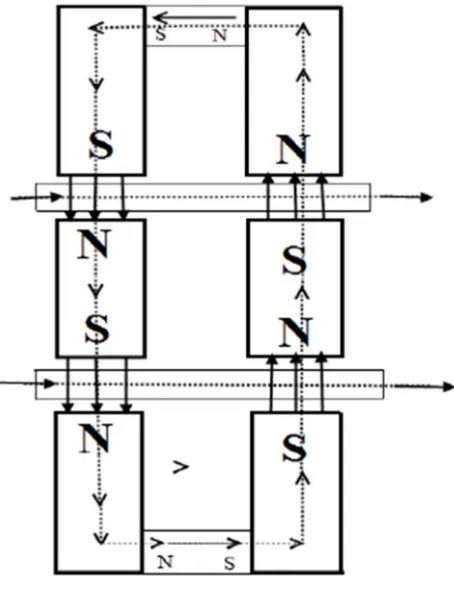
Some systems have magnets situated radially or laterally the pipeline which forms an unchanging magnetic field or other similar devices having the magnets at an angle of 120 to 180 degrees in the radial section of the pipeline. These magnetic fields do not work on the entire fuel mass, keeping a circular flow of these in the range of the magnetic treatment device and sometimes need electrical energy to work. Because of above disadvantages, the magnetic system should have the permanent magnets positioned in such a way that it forms positive sequences. They also must change the rise of the magnetic fields (A magnetic field gradient is defined as the variation in the magnetic field on location) that applies to the fuel liquid. This way of setting them increases, even more, the changing process of the stereochemistry of the fuel molecules.
[image:6.612.200.427.331.630.2]Hence, there will appear gaps that lead to an increment of the representative magnetic moment. Figure 4 shows these gaps in apparatus. These changes hence lead to an increase in the surrounding of the fuel’s constituents compared with further molecules and ions. The reaction between oxygen and air ensures that the fuel is burning and will take place at higher constraints. The ability of oxygen to be strong paramagnetically makes it combed by hydrocarbon breaking after being treated in the magnetic field. This results in complete combustion of the fuel, intermingling with a higher heating yield and with a reduction in the fumes[14].
Figure 4. MFC Apparatus air gaps
VI. CONCLUSION AND RECOMMENDATION
provides a pathway to eradicate pollutants like CO2, CO, before getting emitted in the atmosphere and also eliminates the wax
present in fuel before treating. The considerations for the selection of magnet, material, and design of pipe, air gap size for designing the apparatus are major concerns that can affect the pattern of the process.
Currently used at large offshore projects as MFCs, if adapted for vehicles with a most appropriate design can change the ongoing fuel economics. Between cost and effectiveness, this process fits perfectly to be successful. These MFCs are used for power plants and small capacity burners with the changes they require.
Change in the parameters of amount of combustibles and after-products will provide a stairway for a scope for further advancement. In the next paper, experimental analysis on these topics will be done to give a thorough explanation of the results.
REFERENCES
[1] W. Lisseveld, "Magnetic Treatment of Diesel Fuel," 1996. [2] R. Z. Hricak, "Air Fuel Magnetizer," U.S. Patent 5,331,807, 1994
[3] A. Aiyejina, D.P Chakrabarti, A. Pilgrim, M.K.S. Sastry, "Wax Formation in Oil Pipelines: A Critical Review," International Journal of Multiphase Flow, vol. 37, no. 7, pp. 671-694, 2011.
[4] I. Pera, P. Pines, "Magnetizing Hydrocarbon Fuels and Other Fluids," U.S Patent 4716024, 1987.
[5] P. a. S. D. Govindasamy, "Experimental Investigation of Cyclic Variation of Combustion Parameters in Catalytically Activated and Magnetically Energized Two-stroke SI Engine," Journal of Energy & Environment, vol. 6, pp. 45-59, 2007.
[6] W. W. Frenier, M. Zainuddin and R. Venkatesan Organic Deposits in Oil and Gas Production. Society of Petroleum Engineers, 2010, p. 362. [7] G. Mushrush, Petroleum Products: Instability And Incompatibility. Bristol: Taylor and Francis Applied Energy Technology Series, 1995, p. 390.
[8] J. R. Becker, Crude Oil Waxes, Emulsions, and Asphaltenes. South Sheridan,Tulsa: PennWell, 1997, p. 276. C. A. Okoronkwo, C. C. Nwachukwu, L.C. Ngozi and J.O. Igbokwe, "The Effect of Elecromagnetic Flux Density on the Ionization and the Combustion of Fuel (An Economy Design Project)," American Journal of Scientific and Industrial Research, 2010.
[9] H. Guo, Z. Liu, Y. Chen and R. Yao, "A Study of Magnetic effects on the Physicochemical Properties of Individual Hydrocarbons," Logistical Engineering College, Chongqing 400042, P.R China, pp. 216-220, 1994.
[10] R. R. Bowker, "Permanent Magnet Design Guide," Magnet Sales and Manufacturing & Co, 2000.
[11] C. Robert, G. Charalampides, Octavian DONTU, Daniel Besnea, Iulian avarvarei, c. Pop, "System With Special Geometry Used For Magnetostatic Treatment Of Fuel Fluids Before Burner," U.P.B. Sci. Bull., vol. 73, no. 2, 2011.
[12] A. S. Farisa, Saadi K. Al-Naserib, Nather Jamal, Raed Isse, Mezher Abed, Zainab Fouad, Akeel Kazim, Nihad Reheem, Ali Chaloob, Hazim Mohammad, Hayder Jasim, Jaafar Sadeq, Ali Salim, Aws Abas, "Effects of Magnetic Field on Consumption and Exhaust Emissions in Two-Stroke Engine," Energy Procedia, vol. 18, pp. 327-338, 2012.O. Dontu, "Patent of invention," 2003.
[13] M. a. F. T. Repetto, "Global formulation of 3D magnetostatics using flux and gauged potentials," Int. J. Numerical Methods in Engineering, vol. 60, pp. 755-772, 2004.
[14] C. Robert, O. Dontu, G. Gheorghe, L. Avarvarei, D. Besnea, "System with permanent magnets used for magnetic treatment of fuel fluids," presented at the Proceedings of International Conference On Innovations, Recent Trends And Challenges In Mechatronics, Mechanical Engineering And New High-Tech Products Development – MECAHITECH’11, Bucharest, Romania, 2011.
[15] A. A. Abdel-Rehim, Ramadan Abdel-Aziz, Khairy H. El Nagar, Hamdy H. Maarouf, , "An Experimental Investigation of the Effect of Magnetic Fuel Treatment on SI Engine Performance," Engineering Research Journal 123, 2009.