5
VIII
August 2017
A Research Review on Segmentation Techniques
Anamika Sharma
Sri Sai University, Palampur, H.P
Abstract: Wireless Sensor Network is made up of a large number of inexpensive nodes that are networked via low power wireless communications. Recent technological advances in microelectronics, sensing, signal processing, wireless communications and networking have enabled the realization of a dense network of inexpensive wireless sensor nodes, each having sensing, computational and communication capabilities. Proposed applications of sensor networks include environmental monitoring, natural disaster prediction, smart homes, health care, manufacturing, transportation, home appliances and entertainment. In this manner, vitality assets for remote sensor systems ought to be overseen carefully to amplify the lifetime of systems. There are a few number of vitality proficient protocols which have been utilized to draw out the system lifetime of the remote sensor systems. These conventions can further be enhanced to accomplish better results. WSN has a design trade-off between energy and communication overhead which forms the nerve center of the routing techniques.
Keywords: Clustering, network lifetime, routing protocols, wireless sensor networks, cluster heads (CHs), cluster members (CMs), forward transmission area (FTA)
I. INTRODUCTION
With the faster growing in electronics industry, small inexpensive battery-powered wireless sensors have made an impact on the communications with the physical world. From the last few years, the routing protocol in WSN has become one of the research field [1]. There are number of research achievements which have been existed in this field.
WSN consists of spatially conveyed self-governing gadgets utilizing sensors to helpfully screen physical or ecological conditions, for example, temperature, sound, vibration, weight, movement or poisons, at distinctive areas [2]. The improvement of WSN was originally motivated by military applications for battlefield surveillance. Thereafter, WSN works are utilized as a part of numerous civilian application areas, including environment and living space observing, human services, health care applications, home automation, and traffic control.
Each sensor node is battery powered and equipped with integrated sensors, data processing capabilities and short-range radio communications [3]. This network contains a large number of nodes which sense data from an impossibly inaccessible area and send their reports towards a processing centre which is called "sink". Since, sensor nodes are power-constrained devices, frequent and long-distance transmissions should be kept to minimum in order to prolong the network lifetime [4]. Thus, direct communications between nodes and the base station are not encouraged. Because the large part of energy in the network is consumed in wireless communication in a WSN, several communication protocols have been proposed to realize power-efficient communication in these networks [5]. There are still more issues and challenges which need to be solved in the sensor networks. The main issues are:-
Security: - how to secure the WSN and guarantee the data which have transmitted and about eavesdroppers. Effectiveness: - how to effectively utilize the bandwidth and energy for specific application.
The following steps can be taken to save energy caused by communication in wireless sensor networks. To schedule the state of the nodes (i.e. transmitting, receiving, idle or sleep).
Changing the transmission range between the sensing nodes. Using efficient routing and data collecting methods.
Avoiding the handling of unwanted data as in the case of overhearing.
time support if and only if, it is fast and reliable in its reactions to the changes prevailing in the network. It should provide redundant data to the base station. The base station or sink use the data that is collected among all the sensing nodes in the network. The delay in transmission of data from the sensing nodes to the sink should be small, which leads to a fast response.
II. FORWARD AWARE FACTOR–ENERGY BALANCED ROUTING METHOD (FAF-EBRM)
A remote sensor system (WSN) comprises of an extensive number of remote sensor hubs. Since remote sensor hubs are battery controlled gadgets, they have constrained preparing and transmission power. To transmit detecting information to recipient viably, it is imperative to outline routing protocol for WSNs [7]. Since vitality preservation is a key issue in WSNs, information collection ought to be abused to spare vitality. For this situation, repetitive information can be totaled at middle hubs diminishing the size and number of traded messages and, accordingly, diminishing correspondence expenses and vitality utilization. Remote sensor systems comprise of sensor hubs that have restricted handling ability, little memory and low vitality source. These hubs are conveyed haphazardly and regularly thickly in nature [8]. In checking applications, sensor hubs sense information from the earth occasionally and afterward transmit them to a base station which is called sink hub. Consequently information transmission devours hub's vitality taking into account transmission separation. In many remote sensor organizes, the vitality wellspring of the hub is constrained and can't be minimized.
Clustering is an effective technique to reduce energy consumption in WSNs [9]. In clustering algorithm, a number of nodes in a network will be chosen as the cluster heads (CHs) and the remaining nodes will be regarded as the cluster members (CMs). CMs will form connections with the CHs. A CH will collect data from its CMs. In WSN clustered hierarchical routing protocols, sometimes CMs are closer to the sink than CH, but it should transmit data to CH first. This backward transmission result in waste of energy.
In WSN clustered hierarchical routing protocol, sometimes cluster members in a cluster are nearer to the sink than the CH, but it should transmit data to CH first. It results backward transmission of data and thus leads to waste of energy [10]. In this method, an energy-balanced routing protocol is designed that uses forward transmission area (FTA) based on position of sink and final data flow direction. In other words, FTA define forward energy density which constitutes forward-aware factor with link weight, and propose a new communication protocol based on forward-aware factor, thus balancing the energy consumption and prolonging the network function lifetime[11].
Thus, in forward aware factor [12],we measure the forward transmission area, by defining forward energy density, which constitutes forward-aware factor with link weight that balancing the energy consumption and increases the network lifetime. It has some key aspects such as a reduced number of messages for setting up a routing tree, maximized number of overlapping routes, high aggregation rate, and reliable data aggregation and transmission. According to data transmission mechanism of WSN, it quantify the forward transmission area, define forward energy density which constitutes forward-aware factor with link weight. For energy efficient transmission in event-driven WSN, Data should be reduced. It requires proper routing method for reliable transmission of aggregated data to sink from the source nodes.
In this method, the next-hop node is selected according to the awareness of link weight and forward energy density. Including this, a spontaneous reconstruction mechanism for local topology is designed additionally. Nodes can vary transmission power according to the distance to its receiver. The sink node can broadcast message to all sensor nodes in the sensing field. The distance between the signal source and receiver can be computed based on the received signal strength. Regional central nodes are not selected at the beginning, on the contrary, they spring up during the topology evolution [13].
III. PROPOSED SCHEME
A. Design the network with a given number of nodes
B. Design FAF based network communication
C. Start the transmission of the data between the sender and receiver
D. The simulation will dependent on the reserve energy calculation of node to node battery life
E. The forward aware will keep track of the energy of forward node and forward neighbor nodes
F. Selection of best nodes using data length
IV. RESULTS
Figure shows the output of the FAF routing and proposed system using total throughput
Figure shows the output of the FAF routing and proposed system using dead node monitoring
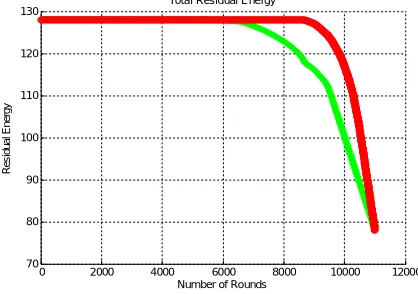
Figure shows the output of the FAF routing and proposed system using residual energy monitoring
V. CONCLUSION
The WSN network is important for scientific study and has adapted a special role wireless communication because of its flexibility and less tedious work procedure, but with increasing demands the network has to cooperate with the challenge of high interferences and energy demands by the users, this issue as previously dealt with many technique is optimized with the current system of FAF routing and has added to the advantage of data forwarding reliability and less breakage in communication increasing the lifetime and
0 2000 4000 6000 8000 10000 12000
0 0.1 0.2 0.3 0.4 0.5 0.6 0.7 0.8 0.9 1
Total ThroughPut of Nodes
Number of Rounds
T h ro u g h P u t V a lu e s
0 2000 4000 6000 8000 10000 12000
0 10 20 30 40 50 60 70 80 90 100
Total Number of Dead Nodes
Number of Rounds
T o ta l D e a d N o d e N u m b e r
0 2000 4000 6000 8000 10000 12000
70 80 90 100 110 120 130
Total Residual Energy
Number of Rounds
REFERENCES
[1] Jun Zheng and Abbas Jamalipour, “Wireless Sensor Networks: A Networking Perspective”, a book published by A John & Sons, Inc, and IEEEE, 2009. [2] F. Akyidiz, Y. Sankara subramaniam W. Su, and E. Cayirci, "A survey on sensor networks", IEEE Communication Magzine, pp 102-114. 2002.
[3] Sonam Palden Barfunga and Prativa Rai, “Energy Efficient Cluster Based Routing Protocol for Wireless Sensor Networks,” International Conference on Computer and Communication Engineering, pp. 603-607, 2012.
[4] Luis Javier García Villalba, Ana Lucila Sandoval Orozco, Alicia Triviño Cabrera, and Cláudia Jacy Barenco Abbas, “Routing Protocol in Wireless Sensor Networks”, Sensors 2009, vol. 9, pp. 8399- 8421.
[5] M. Golsorkhtabar, F. K. Nia, M. Hosseinzadeh, Y. Vejdanparast, “The Novel Energy Adaptive Protocol for heterogeneous wireless sensor networks”, Computer Science and Information Technology (ICCSIT), 2010 3rd IEEE International Conference on (Volume:2), 9-11 July 2010, Page no. 178 – 182, DOI: 10.1109/ICCSIT.2010.5563781
[6] M. Qin, R. Zimmermann: VCA, “An energy- efficient voting-based clustering algorithm for sensor networks”, Journal of Universal Computer Science 13(1), 2007.
[7] Y. He, Y. Zhang, Y. Ji, X.S. Shen, “A new energy efficient approach by separating data collection and data report in wireless sensor networks”, Proceedings of the International Conference on Communications and Mobile Computing, 2006.
[8] C. Li, M. Ye, G. Chen, J. Wu, “An energy-efficient unequal clustering mechanism for wireless sensor networks”, Proceedings of the 2nd IEEE International Conference on Mobile Ad-hoc and Sensor Systems MASS’05, 2005.
[9] C. T. Cheng, C. K. Tse, and F. C. M. Lau, ―A clustering algorithm for wireless sensor networks based on social insect colonies,‖ IEEE Sensors J., vol. 11, no. 3, pp. 711–721, Mar. 2011.
[10] W. B. Heinzelman, A. P. Chandrakasan, and H. Balakrishnan, ―An application- specific protocol architecture for wireless sensor networks,‖ IEEE Trans. Wireless Commun., vol. 1, no. 4, pp. 660–670, Oct. 2002.
[11] Ming Liu, Jiannong Cao, Guihai Chen, and Xiaomin Wang, “An Energy-Aware Routing Protocol in Wireless Sensor Networks”, Sensors 2009, vol. 9, pp. 445-462.
[12] Zhang, Degan, Guang Li, and Ke Zheng. "An energy-balanced routing method based on forward-aware factor for wireless sensor network."(2013): 1-1. [13] Degan Zhang, Guang Li, Ke Zheng, Xuechao Ming, and Zhao-Hua Pan, “An EnergyBalanced Routing Method Based on ForwardAware Factor for Wireless