5
III
March 2017
Technology (IJRASET)
©IJRASET: All Rights are Reserved
929
Efficient Video Watermarking Scheme for
Secure Transmission
C. H. Meeravali1, U. Vikas2, N. Moses Samuel3, M. Ashok4, R. Rasheed Basha5 1,3,4,5
Department of ECE, JNTUA
Abstract: Here we proposed an efficient video watermarking technique for secure transmission is presented. We use discrete wavelet transform for this watermarking process. Here the input video sequence is segmented and partitioned into number of frames using shot segmentation technique. After this the frames are converted in to YUV. The watermark image is inserted into various parts of the source video frames using DWT scheme which is watermark embedding process. The watermark image extracted using watermark extraction process. The current scheme allows algorithm design, evaluation, experimentation, and robustness.
Keywords: Content protection, watermarking, Discrete wavelet transform, Shot segmentation, video watermarking.
I. INTRODUCTION
In digital form video watermarking is widely used in authentication, content protection, and copyright protection. The process of embedding data into multimedia images, audios, and videos is called watermarking. In modern days digital image and watermarking methods mainly focuses on image and video copyright protection. For hiding the watermark information bits in host video watermarking methods can be classified into two types as spatial domain watermarking and transform domain watermarking. In spatial domain watermarking by modifying the spatial pixel values like luminance, chrominance, color space of the entire video frame the embedding and detection of watermark is done. In transform domain, by using predetermined transform techniques like DCT, DWT we modify the spatial pixel values of host video are modified.
II. LITERATURE SURVEY
A digital video watermarking scheme based on scrambling and then embedding the watermark into different parts of the source video according to its scene change. Proposed algorithm is strong against various attacks like dropping of frames, averaging, and mixing. The work is started with a thorough examination of current watermarking technologies, and saw that none of the standing arrangements is capable of resisting all the assaults. Hence we propose the thought of embedding different parts of a lone watermark into different scenes of a video. A novel video watermarking system operating in the three-dimensional wavelet transform is here presented. Specifically the video sequence is partitioned into spatial-temporal units and the single shots are projected onto the 3D wavelet domain. First a gray- scale watermark image is decomposed into a series of bit planes that are preprocessed with a random location matrix. After that the preprocessed bit planes are adaptively spread spectrum and added in 3D wavelet coefficients of the video shot. In present work, an efficient video watermarking scheme for secure transmission using discrete wavelet transform is presented. A watermarking is introduced to embed a grayscale image into digital video. Initially by using shot segmentation technique the input video sequence is segmented into shots. These segmented shots are partitioned into limited number of frames. The YUV components of the frames are extracted. The grayscale image is utilized as a watermark to embed into the digital video sequence. Initially, the grayscale image is sliced into bit planes. Subsequently, the sliced bit plane images are permuted to enhance the security of the watermark image. The permuted images are embedded into each frame of the segmented shots with the aid of the watermark embedding process. Subsequently, the recovery of the watermark is achieved requirements is to use this document as a template and simply type your text into it. The results obtained from the experimentation shows that the proposed video watermarking techniques provide better results with higher visual quality. The organization of the paper is as follows: The proposed efficient video watermarking technique using discrete wavelet transform is detailed in Section III. The experimental results and discussion is provided in Section IV. Finally, the conclusions are summed up in Section V.
III. PROPOSED METHODOLOGY FOR VIDEO WATERMARKING
Technology (IJRASET)
©IJRASET: All Rights are Reserved
930
Watermark Extraction phase
A. Watermark Embedding Phase
Before inserting watermark pixels into the info video arrangements, the accompanying procedure ought to did to upgrade the security of the concealing data and in addition to enhance the effectiveness of our proposed approach. The procedure incorporates, 1) Shot Division of Video Groupings: The first information video grouping is initially divided into non-covering units, called shots
that delineate diverse activities. Each shot is portrayed by no critical changes in its substance which is dictated by the foundation and the articles exhibit in the scene. Here, proposed technique utilizes Discrete Cosine Transform and relationship measure to distinguish the quantity of casings required in each shot.
2) Bit Plane Cutting Of YUV Picture: Bit-Plane Slicing is a method in which the picture is cut at various planes. Rather than highlighting yuv level pictures, highlighting the commitment showed up by particular bits may be fancied.
3) Pixel Stage: After the bit plane cutting procedure, the cut pictures are permitted to permute every pixel incentive to upgrade the security of the concealing data.
4) Decomposition of Picture Utilizing DWT: Wavelets are capacities characterized over a limited interim and having a normal estimation of zero. The essential thought of the wavelet change is to speak to any discretionary capacity as a superposition of an arrangement of such wavelets or premise capacities. The figure 1 demonstrates the watermarking inserting process as demonstrated as follows.
Fig: 3.1Watermark Embedding
Step1: Segment the first information video succession into number shots utilizing shot division strategy. At that point, recognize the quantity of casings required in each portioned shots for inserting reason.
Step2: Yuv picture. Cut the yuv watermark picture into cut pictures utilizing bit plane cutting. Step3: Permute the cut pictures utilizing pixel stage procedure to get the permuted yuv picture.
Step4: Deompose the segments of each parceled outline into four sub-groups, for example, HH, HL, LH and LL with the guide of the DWTto accomplish the changed casings.
Step5: Choose the low recurrence sub-groups (HL, LH) from the changed edges to insert the permuted
Step6: Find the closeness framework of the permuted picture to install into the picked sub-groups. The upper piece of the comparability lattice is installed into the HL sub-band and the lower some portion of the similitude network into the LH sub-band. Step7: The HL and LH sub-groups used to implant the permuted watermark picture are separated into four sections according to the likeness network. The lower part implanting some portion of the similitude network of the HL and LH groups is decided for installing the two comparable parts of the watermark picture.
Technology (IJRASET)
©IJRASET: All Rights are Reserved
931
MeanEP)=
Step9: Embed the watermark pixels 0 or 1 in a crisscross way in the picked installing part, since the watermark is the grayscale picture.
Step10: Similarly, the lower part Lp of the similitude framework is implanted into the LH sub-band. Additionally, each permuted picture is inserted into every one of the casings of each shot.
Step11: Divide all the installed outlines with the implanting quality to improve the nature of the picture. Step12: Map the adjusted sub-groups into its unique position and apply the opposite discrete
B. Watermark Extraction Phase
Fig: 3.2 watermarking extraction
The figure 2 demonstrates the watermarking extraction handle as demonstrated as follows.
C. Watermark Extraction Process
Step1: Extract the segments of all the apportioned edges for removing Segment the non-covering shot utilizing the shot division strategy. At that point, distinguish the quantity of edges required in each sectioned shots for the extraction procedure.
Step2: Extract the segments of all the apportioned casings for extricating the installed watermark pixels.
Step3: Decompose the segments of the casings with the guide of the discrete wavelet change into four sub-groups HH, HL, LH and LL.
Step4: Select the low recurrence sub-groups (HL, LH) from the changed edges to remove the watermark grayscale picture.
Step5: Extract the watermark pixels from the installing part in a crisscross way from the HL and the LH sub-groups with the guide of the accompanying strides. On the off chance that the implanted pixel esteem is more noteworthy than the mean pixel esteem, then the separated pixel esteem is one. On the off chance that it is lesser, then the extricated pixel is zero.
Step6: Form the grid with the extent of the watermark picture and the separated pixels are set in it to accomplish the watermark picture.
Step7: Obtain the watermark picture WI [i', j'] by applying the turnaround procedure of stage and bit plane cutting.
IV. SIMULATION RESULTS
The test consequences of the proposed computerized video watermarking plan utilizing discrete wavelet change are introduced. The watermarked video arrangements have better Peak Signal than Noise Ratio (PSNR) and visual quality for grayscale watermark pictures.
Technology (IJRASET)
©IJRASET: All Rights are Reserved
932
Fig3. (a) Input football video sequence, (b) Watermark image, (c) Frame Claire Watermarked video, (d) Extracted watermark image
A. Watermark Image
Fig4. (a) Input train video sequence, (b) Watermark image, (c) Frame train Watermarked video, (d) Extracted watermark image
B. Evaluation Results
To demonstrate the viability of the proposed conspire the outcomes are contrasted and the current technique.
Technology (IJRASET)
©IJRASET: All Rights are Reserved
933
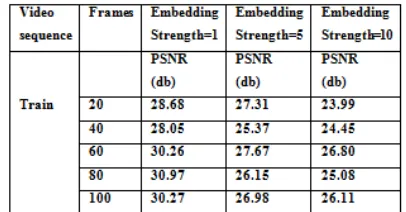
Table-I
PSNR values with different Frame number (PSNR in db)
[image:6.612.205.408.268.374.2]PSNR values with different Frame number (PSNR in db)
Table 3 shows the performance evaluation in terms of PSNR for Football and Claire video sequence. The results of the comparative data clearly demonstrate the efficacy of the present methodology as evidenced from the PSNR value.
V. CONCLUSION
This paper proposes an Efficient video watermarking plan for secure transmission. In the present examination a productive video watermarking plan utilizing DWT to ensure the substance of advanced video succession is illustrated. This is accomplishing by watermark installing and watermark extraction prepare. Test comes about demonstrated that the proposed plan is effective by methods for indistinctness and vigor.
REFERENCES
[1] Santi P. Maity and Malay K. Kundu, "An Image Watermarking Scheme using HVS Characteristics and Spread Transform" in proceedings of 17th International Conference on Pattern Recognition (ICPR'04), Vol. 4, pp.869-872, 2004.
[2] Soroosh Rezazadeh and Mehran Yazdi, "A Non-oblivious Image Watermarking System Based on Singular Value Decomposition and Texture Segmentation", in Proceedings of World Academy of Science, Engineering And Technology, Vol. 13, May 2006.
Technology (IJRASET)
©IJRASET: All Rights are Reserved
934
[4] Xiang-Yang Wang and Hong Zhao, "A Novel Synchronization Invariant Audio Watermarking Scheme Based on DWT and DCT", IEEE Transactions on Signal Processing, Vol. 54, No. 12, pp. 4835-4840, 2006. D. Mukherjee, S. Maitra, and S. Acton, "Spatial Domain Digital Watermarking of Multimedia Objects for Buyer Authentication", IEEE Trans. Multimedia, vol.6, pp. 1-15, 2004.
[5] Reyes R., Cruz C., Nakano-Miyatake M. and Perez-Meana H., "Digital Video Watermarking in DWT Domain Using Chaotic Mixtures‖, IEEE Latin America Transactions, Vol. 8, No.3., pp. 304 - 310, 2010.
[6] Reyes R., Cruz C., Nakano-Miyatake M. and Perez-Meana H., "Digital Video Watermarking in DWT Domain Using Chaotic Mixtures‖, IEEE Latin America
Transactions, Vol. 8, No.3., pp. 304 - 310, 2010.
BIBLIOGRAPHIES
C. Meeravali, M.Tech, working as Assistant Professor in BITS-KNL. His area of interest is image processing, signal processing, communications.
U. Vikas, pursuing B. tech from BITS- KNL, DEPT. OF ECE, Kurnool
N. Moses Samuel pursuing B.tech from BITS-KNL, DEPT. OF ECE, Kurnool
M. Ashok ,pursuing B. tech from BITS-KNL,DEPT. OF ECE ,Kurnool