Cloud Computing Service and Deployment Models
A. M. Chandrashekhar1
,
Shashikumar21 Assistant Professor, Department of Computer Science & Engineering, Sri Jayachamarajendra College of Engineering(SJCE), JSS
S&T University Campus, Mysore, Karnataka, India
2 M. Tech 2nd Semester, Department of Computer Science & Engineering, Sri Jayachamarajendra College of
Engineering(SJCE), JSS S&T University Campus, Mysore, Karnataka, India
Abstract- Cloud computing is a new era it started after the development of parallel computing, grid computing and distributed computing. Many organizations have been started to use cloud computing store their data and provide security to their data. In this paper we discuss about different cloud services and deployment models used in the cloud computing. The aim of the paper is to understand the service models and deployment models of cloud computing in detail.
Keyword’s: SaaS, PaaS, Iaas, Public, Private, Hybrid.
I. INTRODUCTION
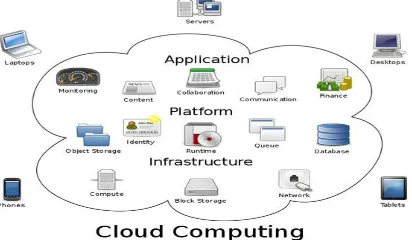
Cloud computing is a computing model where resources, data and other devices can be provided over the internet via on demand service. The user can request resources like computer networks, storage, services, servers and application as shown in Fig 1. These resources can be easily available to user, the resources can be released after the completion of work/use(Fig 1). Using cloud computing you can go with Pay-per-use or Pay-As-u-go Model. Cloud computing do not require up-front commitments. Cloud Services can be measured larger or smaller and according to the use cloud service or resources customers are billed. Cloud has become highly demanded because of its advantages of high computing power, high performance, scalability, availability and accessibility[1]. In cloud computing we are using different types of cloud service models like SaaS, PaaS, and IaaS. Cloud provides the different deployment models for the user like Public, Private and hybrid models. Some examples of clouds are Google App-Engine, Amazon, Salesforce.com. A cloud computing platform configures, reconfigures the
resources dynamically servers as needed. Servers in the cloud can be virtual or physical machines. Virtualization is used in cloud for providing the single resource to multiple users at a time.
A. Reasons for adoption of cloud
Now a day’s cloud computing has become more the cloud services. There are some reasons to adopt the cloud computing in the organization. they are mentioned below:
1) On-demand service.
2) Pay-per-use or Pay-as-u-go.
3) Reliability.
4) Cost efficient.
5) Quick deployment.
6) No long term commitments.
[image:2.612.223.429.585.705.2]7) No software and hardware installation.
A. Grid computing
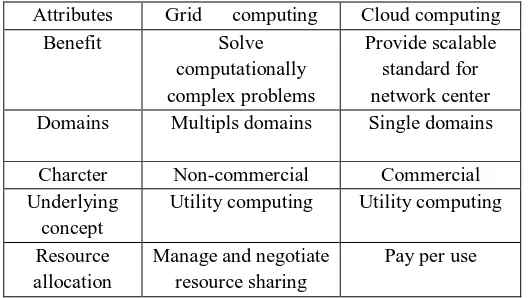
it is a computer network where each computer resources are shared with all computers. Grid computing is similar to the concept of distributed system where in grid collection of all computer which running under same os. We have some difference between grid computing and cloud computing, they are listed in the below Table 1.
Attributes Grid computing Cloud computing Benefit Solve
computationally complex problems
Provide scalable standard for network center Domains Multipls domains Single domains
Charcter Non-commercial Commercial Underlying
concept
Utility computing Utility computing
Resource allocation
Manage and negotiate resource sharing
[image:3.612.175.439.161.310.2]Pay per use
Table 1: Comparison between cloud and grid computing.
III. CLOUD COMPUTING SERVICE MODELS
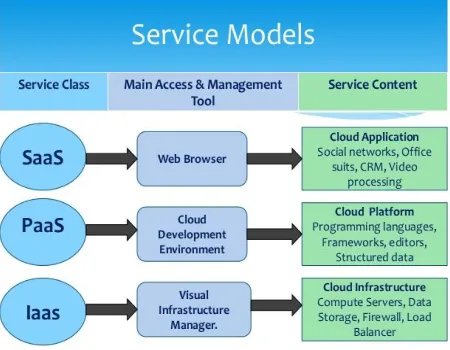
Cloud computing provide many services to users over the internet. Service provided by the cloud are IaaS, PaaS and SaaS[2]. The Fig 2 shows the different services provided by the cloud.
A. Infrastructure-as-a-service (IaaS)
IaaS is the foundation for every computing infrastructure. it is a service provider to the clients[6]. Clients can hire these services from cloud and they can use virtualization, grid and cluster servers, storage, networks, data protection and other fundamental resources clients can able to deploy cloud models and run software tools without installing operating system[3]. IaaS is the open source platform they support wide range of operating system and framework. IaaS provide these services/resources to clients from the data center where pool of resources installed/stored these can be provided on-demand access. Resource billing can be done according to the allocated and used resources or pay as you go[7].Example: Amazon EC2,Go grid
B. Cloud include the fallowing Services of IaaS 1) Platform virtualization.
2) Cloud software.
3) Network and internet connectivity.
4) Computer hardware.
5) Utility computing.
6) Service level agreements.
C. Platform-as-a-service (PaaS)
Fig 2: Cloud service model.
Software-as-a-service (SaaS): SaaS is top layer of the cloud computing model. SaaS users are independent of their own resources. In this traditional model of software are purchased and installed on the personal computers, it is known as the Software-as-a-service. SaaS software distribution model applications are hosted by cloud service providers for the use of clients over the internet. SaaS applications can be accessed from various client interface like web browser or programming interface. Clients cannot manage and control the resources or indivisual application capabalities. Saas sometime referred as on-demand software and usually billing done pay-per-use, pricing model can be monthly, yearly for the clients. SaaS saves the cost of clients by removing the effort of developing, maintenance and delivary of a software and eliminate the up-front commitment[2].Examples: Salesforce.com, Google Mail, Google Docs.
D. Cloud include the fallowing services of SaaS 1) Data managed by provider.
2) Reusability.
3) Availability.
4) Scalability.
5) Pay-per-use.
6) Service customizability.
IV. CLOUD DEPLOYMENT MODELS
Cloud provide the different deployment models to user. User can use the different deployment models according to their needs like security, control, data privacy and scalabilty. Different types of deployment models are: Public, Private And Hybrid.
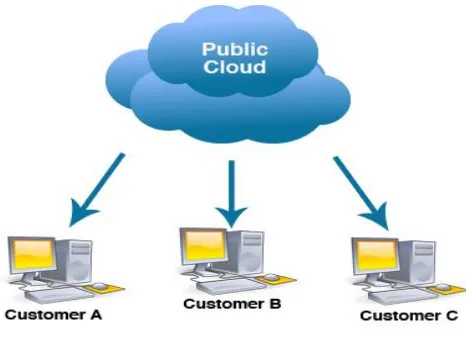
Public cloud: Public cloud services are available to customer via third party Service provider via internet. when the services is available to the clients over the network known as public cloud. Public clouds are free but clients has to fallow some SLA(service level agreements). This enables the customers to deploy and develop a service in the cloud without capital investment. Third party owner deliver each services to individual customer at attractive low cost and pay-as-you-go or pay-per-use[10]. All customers share the same infrastructure with limited security protection and configuration. This model is best suited for the business requirements where required manage load and host SaaS applications. Organisation can be used this service on demand like utility consumption. Example: Amazon EC2, Sun Cloud,IBM blue cloud.
A. Applications of public cloud 1) Online storage.
2) Online backup and restore process.
3) Batch processing jobs with limited security.
4) Public blogs, wiki’s.
Fig 3: Public cloud.
1) Private cloud: Private clouds are owned by a single company and provides high security, flexibility and scalability to the clients. To satisfy some traditional needs like security and confidentiality organizations uses the private cloud. Under the private cloud the cloud the pool of resource is only accessible by (restricted to) a single organization providing that organization with greater control and privacy[11]. Privare clouds can be expensive compared to public cloud. Private cloud provide more control in security. There are two types of private cloud:
2) On-premise private cloud: These type of cloud known as internal cloud hosted within the organisation with own dat center.
3) Externally hosted private cloud: These type of cloud hosted externally from cloud service provider. Cloud service provider will responsible for the security of data and control.
B. Service provided by the private clouds are: 1) Multi-tenancy.
2) Consistent deployment.
3) Security.
4) Access control.
5) Virtualization.
6) Chargeback and pricing.
C. Private cloud consume some services by public cloud, they are: 1) Data privacy.
2) Security.
3) Speed and availability.
4) Easy access.
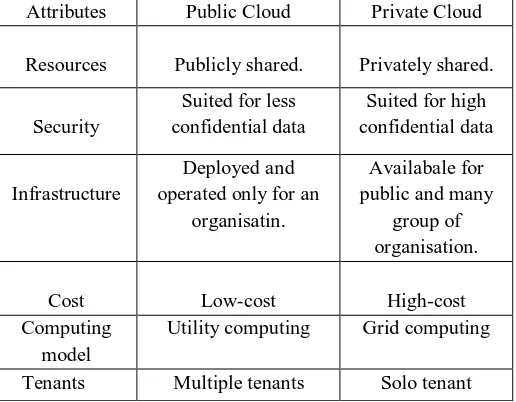
Difference between Public and Private cloud:
We have discussed about the public and private cloud now Table 2 shows the some difference between public and private cloud. Attributes Public Cloud Private Cloud
Resources Publicly shared. Privately shared.
Security
Suited for less confidential data
Suited for high confidential data
Infrastructure
Deployed and operated only for an
organisatin.
Availabale for public and many
group of organisation.
Cost Low-cost High-cost Computing
model
Utility computing Grid computing
[image:6.612.179.437.110.311.2]Tenants Multiple tenants Solo tenant Table 2:Difference between public and private cloud.
1) Hybrid cloud: Combination of two or more (public, private and community) clouds are known as hybrid cloud. Hybrid storage cloud are often useful for archiving and backup functions[3]. It will increase the flexibility of cloud. The use of physical hardware and virtualized cloud server instances together to provide a single common service. This type of cloud is also capable of providing scalability and on-demand services to users[12]. Adoption of the hybrid cloud depend on number of factors like data security, level of control needed over data and compliance requirements.
D. Other cloud deployment models
We have some other different cloud cloud deployment models. They are community cloud, dynamic private cloud and distributed cloud [4].
1) Community cloud: community cloud used and controlled by a group of organization for some common concerns weather managed by third party or internally. It is a multi-tenant infrastructure shared among multiple organisations from a specific group with common computing concerns.
2) Dynamic private cloud: dynamic private cloud allows clients workloads are dynamically migrated from and to cloud as required. It delivers the ultimate value of cloud.
V. CONCLUSION
Cloud computing is an emerging computing environment that is popularly increasing. Many organizations like Microsoft, IBM, Amazon and Google have providing the cloud services to customers. Customers are using different deployment models to secure their organization still there are many issues related to the cloud security. Many IT organization technicians working with the security challenge. Several groups in organization have recently been formed, such as the Cloud Security or the Open Cloud Consortium, with the goal of exploring the possibilities offered by cloud computing and to establish a common language among all different providers.
New technologies and capabilities may result in a further evolution of the cloud computing model. Companies presently considering such a move must weigh the advantages against the potential drawbacks, and decide if they are ready to launch their data into the cloud.
REFERENCES
[1] Rao, C.C., Leelarani, M. and Kumar, Y.R., 2013. Cloud: Computing Services and Deployment Models. International Journal Of Engineering And Computer Science, 2(12), pp.3389-3390.
[2] www.summitbiz.net “cloud computing roadmap”.
[5] https:://en.m.wikipidea.org/wiki/Cloud_computing
[6] A. M. Chandrashekhar and K. Raghuveer, “Confederation of FCM Clustering, ANN and SVM Techniques of Data mining to Implement Hybrid NIDS Using Corrected KDD Cup Dataset”, Communication and Signal Processing (ICCSP) IEEE International Conference,2014, Page 672-676
[7] AM. Chandrashekhar and K. Raghuveer , “Improvising Intrusion detection precision of ANN based NIDS by incorporating various data Normalization Technique – A Performance Appraisal”, IJREAT International Journal of Research in Engineering & Advanced Technology, Volume 2, Issue 2, Apr-May, 2014
[8] A. M Chandrashekhar A M and K. Raghuveer, “Diverse and Conglomerate modi-operandi for Anomaly Intrusion Detection Systems”, International Journal of Computer Application (IJCA) Special Issue on “Network Security and Cryptography (NSC)”, 2011
[9] A. M Chandrashekhar A M and K. Raghuveer, “Hard Clustering Vs. Soft Clustering: A Close Contest for Attaining Supremacy in Hybrid NIDS Development”, Proceedings of International Conference on Communication and Computing (ICCC - 2014), Elsevier science and Technology Publication [10] A. M. Chandrashekhar and K. Raghuveer, “Amalgamation of K-means clustering algorithem with standard MLP and SVM based neural networks to
implement network intrusion detection system”, Advanced Computing, Networking, and Informatics –Volume 2(June 2014), Volume 28 of the series Smart Inovation, Systems and Technologies pp 273-283
[11] A. M. Chandrashekhar and K. Raghuveer, “Fusion of Multiple Data Mining Techniques for Effective Network Intrusion Detection – A Contemporary Approach”, Proceedings of Fifth International Conference on Security of Information and Networks (SIN 2012), 2012, Page 178-182
[12] A. M. Chandrashekhar, Jagadish Revapgol, Vinayaka Pattanashetti, “Big Data Security Issues in Networking”, International Journal of Scientific Research in Science, Engineering and Technology (IJSRSET), Volume 2, Issue 1, JAN-2016.
[13] Puneeth L Sankadal, A. M Chandrashekhar, Prashanth Chillabatte, “Network Security situation awareness system” International Journal of Advanced Research in Information and Communication Engineering(IJARICE), Volume 3, Issue 5, May 2015
[14] P. Koushik, A.M.Chandrashekhar, Jagadeesh Takkalakaki, “Information security threats, awareness and cognizance” International Journal for Technical research in Engineering(IJTRE), Volume 2, Issue 9, May 2015
[15] A.M.Chandrashekhar, Yadunandan Huded, H S Sachin Kumar, “Advances in Information security risk practices” International Journal of Advanced Research in data mining and Cloud computing (IJARDC), Volume 3, Issue 5, May 2015
[16] A. M. Chandrashekhar,Muktha G, Anjana D, “Cyberstalking and Cyberbullying: Effects and prevention measures”, Imperial Journal of Interdisciplinary Research (IJIR), Volume 2, Issue 2, JAN-2016
[17] A.M.Chandrashekhar, Syed Tahseen Ahmed, Rahul N, “Analysis of Security Threats to Database Storage Systems” International Journal of Advanced Research in data mining and Cloud computing (IJARDC), Volume 3, Issue 5, May 2015
[18] A.M.Chandrashekhar, K.K. Sowmyashree, RS Sheethal, “Pyramidal aggregation on Communication security” International Journal of Advanced Research in Computer Science and Applications (IJARCSA), Volume 3, Issue 5, May 2015
[19] A.M.Chandrashekhar, Rahil kumar Gupta, Shivaraj H. P, “Role of information security awareness in success of an organization” International Journal of Research(IJR), Volume 2, Issue 6, May 2015.
[20] A.M.Chandrashekhar, Huda Mirza Saifuddin, Spoorthi B.S, “Exploration of the ingredients of original security” International Journal of Advanced Research in Computer Science and Applications(IJARCSA), Volume 3, Issue 5, May 2015.