Enhancing Assembly Line Efficiency Using RPW
Method and Kw Method in Eicher Tractor Limited
Mahendra Singh1, Prof. (Dr.) Archana Nema2
1M. Tech (IEM) Student, BIST, RGPV, Bhopal (M.P) 2GUIDE M. Tech, Asst. Professor, Dept. Of ME, BIST, Bhopal (M.P.)
Abstract: assembly lines are special flow lines production systems which are of great importance in industrial production of high quality standardized commodities. Assembly line balancing is a classic problem in any business. The line balancing problem is to arrange the individual processing and assembly task at the workstations, so that the total time required at each station should approximately same for smooth production flow. Assembly line balancing problem have been conventionally classified into two types that is type-1 focuses on minimizing the number of workstations for a given cycle time and type -2 is minimizing the cycle time for a fixed number of workstations. The present work study is based on comparative analysis of two heuristic methods for assembly line balancing problem. In the current case type -1 problem has been taken into consideration .a simulation software tecnomatix plant simulation is also used for simulation purpose. This software shows satisfactory result when run on the given data. The results show that by using the rpw method, there is a reduction in the number of workstations thereby reducing the requirement of human resources and improvement in line efficiency by increase in the throughput.
Keywords: assembly line problem, rpw method, kw method, plant simulation, line efficiency, cycle time
I. INTRODUCTION
A. Assembly Line & Efficiency
An assembly line is a sequence of workstations connected together by mechanical material handling equipment in which a dedicated group of tasks are performed in predetermined sequence The total work content to be performed by the production system is split– up into economical individual work elements which are called task and among the set of tasks there exist technological precedence relations The assignment of these tasks to workstation along an assembly line to achieve same or close to same working time at each workstation The goal of this assignment of task is to create a smooth and continuous flow of product through the assembly line for maximum productivity and minimum idle time at each workstation A well-balanced assembly line has the advantage of high personnel and facility utilization and equity among the employees work loads. Assembly lines are flow-oriented production systems which are typical in the industrial production of high quality standardized commodities and even gain importance in low volume production of customized products among the decision problems which arises in managing such systems, assembly line balancing problems are important tasks in medium–term production planning The measurement of the capacity utilization of the line. The idle capacity is reflected by the balance delay time. It is expressed as: Efficiency = Total task time / (no. of work station × Max. assignable cycle time)Delay = 100% - Efficiency The fundamental of line balancing problems is to assign the tasks to an ordered sequence of stations, such that the precedence relations are satisfied and some measurements of effectiveness are optimized. (e.g. minimize the balance delay or minimize the number of work stations; etc) The first published paper of the assembly line balancing problem (ALBP) was made by Salveson (1955) who suggested a linear programming solution. Since then, the topic of line balancing has been of great interest to researchers.
B. Objective of the Work
II. METHODOLOGY USED
There are number of heuristic methods but two methods have been used-RPW & KW as follows
A. Ranked Positional Weights (RPW) method
The Ranked Positional Weights approach used to be introduced by Helgeson and Bernie. This approach assigns operations to the stations in an order that corresponds to the length of time every control by way of the rest of the network. All succeeding operations are considered in the ranking. The sum of the occasions of those operations controlled in this manner by means of a certain operation is defined as the positional weight. Ranking operation in decreasing sequence in step with their positional weights leads to the technical designation of ranked positional weight process. The venture of aspect to work stations is then carried out within the following manner.
1) The work with the easiest positional weight is selected and assigned it to the primary work-station.
2) The unassigned time is calculated for the work-station by means of calculating the cumulative time of all works items assigned to the station and this sum is subtracted from the cycle time.
3) The work unit is chosen with the next best positional weight and tried to assign it to the work-station after making the next investigate.
a) The list of already assigned work items. If the instantaneous precedent Work unit has been assigned, precedent will not be
violated, we proceed to step 4(b). If the instant precedent has not been assigned proceed to step 4.
b) The work models time is when put next with unassigned time .If the work unit time is not up to the work-station unassigned time assigns the work unit and recalculates unassigned time. If the work unit time is bigger than the unassigned time, proceed to step 4.
4) Picking out, checking and assigning is continued to if feasible unless one of the vital two stipulations is met.
a) A combination is acquired where the remainder unassigned is less then, or equals the slack units on hand (5 is to proceeded).
b) No unassigned work unit stays that can satisfy each the 'precedence' and ' unassigned time' specifications.
5) Unassigned work unit is assigned with the very best positional weight to the 2D work-station, and preceded through the previous step in the identical method.
B. Kilbridge and Wester (KW) method
This method has acquired a great deal of attention on account that its introduction in 1961 by means of Kilbridge and Wester This technique has been applied to a few complicated line balancing issues with just right success Kilbridge and Wester proposed a heuristic process that assigns a number to each and every operation describing how many predecessors. This is complete via referring to precedence diagram. The operations are rank ordered in keeping with the quantity of predecessors each and every. The first operation assigned to station with the bottom predecessor quantity. The operations are assigned to stations so as of the least number of predecessors. The place ties exist a different rule applies first the longest operation time that can be used. When an operation with the next smallest number of predecessors has too tremendous an operation time to be incorporated in the station, we select the operation with the subsequent smallest quantity of predecessor that matches within the station time. On this heuristic method, work detail:-
1) Priority diagram is constructed Column- I is made where include all work detail and wouldn't have a precedence work element. Column II is made checklist all factors which follow factors in column I and are persisted till all work elements are exhausted.
2) To examine cycle time (Tc) by discovering all combinations of the primes of summation of all undertaking time, this is the total elemental time. A viable cycle time is chosen. Number of station would be: J = total task time / cycle time
3) To assign the work factors within the work-station in order that total station time is the same as or slightly not up to the
cycle time.
4) Step 3 is repeated for unassigned work elements.
III.OBSERVATIONS & SOLUTION
In this research work, the predominant object to scale back the quantity of stations or to discover premiere number of stations this is also known as Type-1 problem. Simulation software TECNOMATIX PLANT SIMULATION also used for visualize the whole method what alterations takes location when distinctive approaches observe on that data. The simulation software used for discover most suitable answer or checking purpose for the reason that all these methods offers the results in mathematical method and this software effect in useful method. This software indicates adequate effect when run on given data via given the most effective solution to the present meeting line work station for the product there via reducing the human resources, work place require for existing set up. Heuristic RPW and KW approaches are used by taking actual data from EICHER TRACTOR Ltd. and information is taking from the study paper.
IV. RESULTS ANALYSIS
Results have been taken by applying all methods, describe below:
A. Results from current method
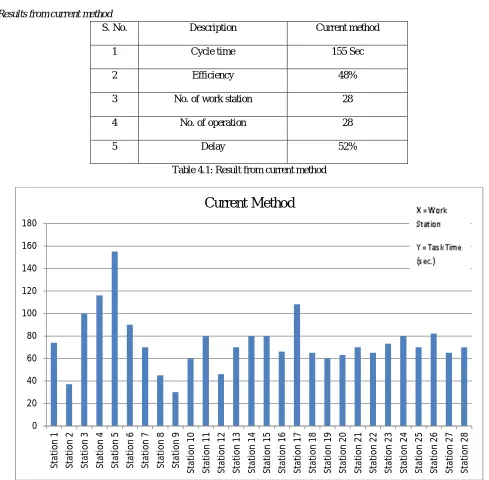
S. No. Description Current method
1 Cycle time 155 Sec
2 Efficiency 48%
3 No. of work station 28
4 No. of operation 28
[image:4.612.57.546.234.714.2]5 Delay 52%
Table 4.1: Result from current method
Fig. 4.1: Current Method
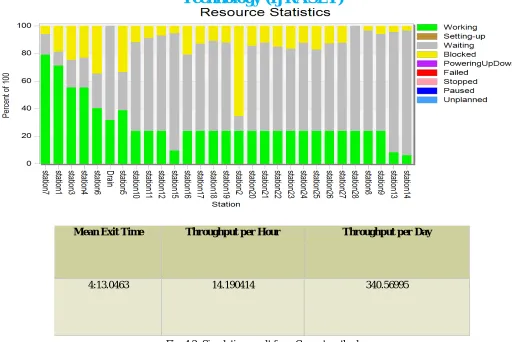
Fig. 4.2: Simulation result from Current method
B. Result from RPW Method
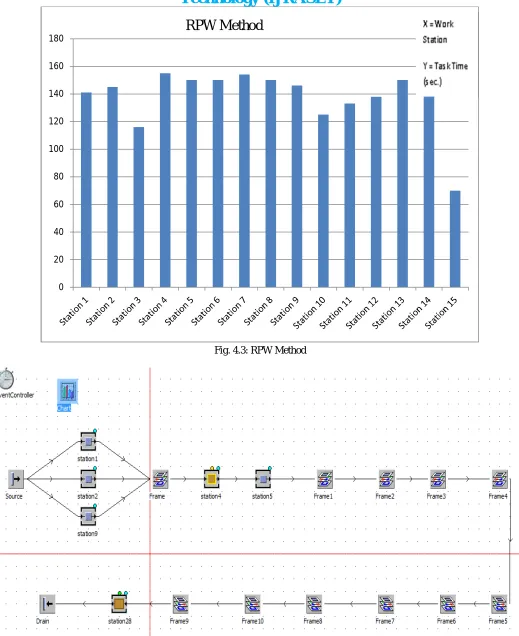
S. No. Description RPW method
1 Cycle time 155 Sec
2 Efficiency 89%
3 No. of work station 15
4 No. of operation 28
5 Delay 11%
Table 4.2: Results from RPW Method
Mean Exit Time Throughput per Hour Throughput per Day
[image:5.612.75.470.439.704.2]Fig. 4.3: RPW Method
0 20 40 60 80 100 120 140 160 180
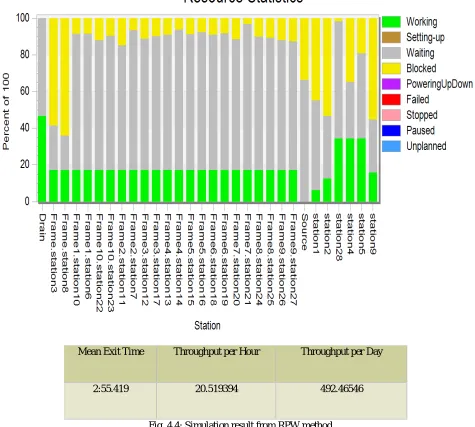
Mean Exit Time Throughput per Hour Throughput per Day
2:55.419 20.519394 492.46546
Fig. 4.4: Simulation result from RPW method
C. Results from KW Method
S. No. Description KW method
1 Cycle time 155 Sec
2 Efficiency 74.2%
3 No. of work station 18
4 No. of operation 28
[image:7.612.66.541.91.518.2]5 Delay 25.8%
Fig. 4.5: KW Method
0 20 40 60 80 100 120 140 160 180
Mean Exit Time Throughput per Hour Throughput per Day
[image:9.612.68.534.38.719.2]3:59.999 14.999681 359.99235
D. Comparison of results
S. No. Description Current Method RPW Method KW Method
1 Cycle time 155 155 155
2 Line efficiency 48% 89% 74.2%
3 No. of work station 28 15 18
4 No. of operation 28 28 28
5 Delay 52% 11% 25.8%
[image:10.612.70.544.308.696.2]6 Throughput 340 492 359
Table 4.4: Comparison of results
Comparison Graph between above Methods
Fig. 4.7: Comparison Graph
0 20 40 60 80 100 120 140 160 180
Current Method
RPW Method
E. Result Analysis
Keeping the same cycle time the objective here is to reduce the number of workstations by using the RPW method and KW method. It can be seen that the line efficiency enhances from 48% to 89% and also delay reduces from 52% to 11%. Simulation software named “Tecnomatix Plant Simulation” is also used to visualize whole process of assembly line which gives throughput from current method – 340, KW method – 359 and RPW method – 492 products per day. After analyzing the result that the RPW method is more efficient than all of the other methods
V. CONCLUSION
From the present analysis it is concluded that all two method gives better results than the present method which is using by the EICHER TRACTOR Ltd. But if we compare Ranked positional method and kilbridge & wester method so found that RPW gives the better result in present industry EICHER TRACTOR Ltd. RPW Heuristic approach shown better results as compared with present traditional method. In EICHER TRACTOR Ltd. whole process for assembly or subassembly is preset and all work take place according to that preset procedure. From beginning to till now procedure is going on without any change in assembly line. Any approach is not adopted by them for productivity improvement. But now the day’s competition is increases each company wants to manufacture a product with good quality, minimum time and in minimum cost. This research work concentrate on maximize the production efficiency so the major role of this study is to look all these problems and introducing the heuristic approach to minimize delay. Whole research work summarized into some important points described below-
A. This research work totally based on TYPE-1 problem in which cycle time will constant and workstation may vary.
B. Data is taken from EICHER TRACTOR Ltd.
C. To solve the problem of line balancing two methods RPW and KW are used.
D. Results are represented in the form of EFFICIENCY, DELAY and THROUGHPUT.
E. Simulation software named "TECNOMATIX PLANT SIMULATION" is also used to visualize whole process of Assembly Line in practical manner which cross check mathematical calculation too.
F. Got throughput from RPW-492 product per day, KW-359 and current method-340 product per day.
G. It is concluded that RPW method is more efficient than all of other methods.
REFERENCES
[1] Abdolmajid Yolmeh, Najmeh Salehi An outer approximation method for an integration of supply chain network designing and assembly line balancing under
uncertainty Computers & Industrial Engineering 83 (2015) PP 297–306
[2] Alena Otto, Armin Scholl “Incorporating ergonomic risks into assembly line balancing” European Journal of Operational Research 212 (2011) PP 277–2
[3] Abdullah-.Al-Mamun and Mohammad Mamun. Chowdhury a Heuristic Approach for Balancing Mixed-Model Assembly Line of Type-I using Genetic
Algorithm International Conference on Mechanical, Production and Automobile Engineering (ICMPAE'2011) Pattaya Dec 2011
[4] Din-Horng Yeh a Hsiu-Hsueh Kao a new bidirectional heuristic for the assembly line balancing problem Computers & Industrial Engineering 57 (2009) PP
1155–1160.
[5] Evgeny Gurevsky, Olga Battaïa, Alexandre Dolgui “Stability measure for a generalized assembly line balancing problem” Discrete Applied Mathematics 161
(2013) PP 377–39
[6] Johannes Sternatz “Enhanced multi-Hoffmann heuristic for efficiently solving real world assembly line balancing problems in automotive industry” European
Journal of Operational Research 235 (2014) PP 740–75
[7] Md. Mominul Islam, H.M. Mohiuddin, Syimun Hasan Mehidi & Nazmus Sakib an Optimal Layout Design in an Apparel Industry by Appropriate Line