5
IV
April 2017
Technology (IJRASET)
A Fuzzy Logic-Based Decentralized Clustering
Algorithm for WSN to Extend the Network
Lifetime
Mr. K. Manikannan1, M. Priya2 1,2
Department of Computer Science and Engineering, Adhiparasakthi Engineering College, Melmaruvathur
Abstract: Low Energy Adaptive Clustering Hierarchy (LEACH) is the most famous hierarchical routing protocol, where the Cluster Head (CH) is elected in revolution basis based on a probabilistic threshold value and only CH are allowed to send the information to the base station (BS). The proposed fuzzy logic clustering protocol to enhance the following 1) single hop communication using false data detection 2) multi hop-cluster scheme association 3) k-hop neighbor using fuzzy logic. The fuzzy logic used to choose a tentative CH in the group of CH by using spanning tree approach based on the information transmitted to each cluster head. All the CHs are Acknowledge and then send the information to the mobile BS by choosing suitable fuzzy descriptors, such as remaining battery power, mobility of BS, and centrality of the clusters.
Keywords: Cluster Head (CH); Wireless Sensor Network (WSN); Low Energy Adaptive Clustering Hierarchy (LEACH)); Super Cluster Head (SCH); Fuzzy Logic.
I. INTRODUCTION
Wireless Sensor Network considered as real time embedded system deployed in a particular region to sense various types of environmental parameters such as temperature, pressure, gas, humidity etc. The huge applications of WSN like habitant monitoring,
forest fire detection, surveillances, transport monitoring etc. They created a lot of interest among the researcher community in recent
past. Generally, WSN are dimly disposed in insecure vicinity where battery recharge or recovery is infeasible nearly but human monitoring scheme is exceptionally endangered. Wireless connectivity makes the sensor nodes injured many times, there are various descriptive contention such as fixed calculate contents, power necessity, open environment. Some limitations of the sensor nodes in feature of energy source, Bandwidth, Computational capacity in the Wireless sensor network. Once the network is fixed, all nodes accumulate on observe the data and the battery power life goes exponentially. The nodes send the information to other nodes or to the base station whenever they detect any event. The network makes inefficient, consistently it arrive that the corresponding acquired information by the neighboring sensor nodes and can be acquired similar information by the base station
Cluster based routing protocol is one of these powerful ideas, in which all sensor nodes are divided into number of gangs and each gang is called cluster. One gang controller is elected in each cluster that is called as Cluster Head (CH). All nodes send the information to the CHs
Technology (IJRASET)
In the proposed model, attempt has been made to improve the performance of LEACH protocol in view of electing an appropriate Super Cluster Head (SCH) among the CHs based on energy by applying suitable fuzzy descriptors. Only SCH is allowed to send the message to the BS by reducing the number of message retransmissions performed by the CHs. Fig 1.the system all the group of CH is choose a tentative CH as a SCH.
II. RELATED RESEARCH
Daljeet kaur, Garima Malik have introduced a new method to select the super cluster head among the cluster head. using fuzzy logic descriptor such as to remaining a battery power, mobility and centrality[1].Increase the network lifetime significantly by the idea of sink Mobility along with the fuzzy logic.
P. Nayak, D. Anurag introduced a concept of the centralized algorithm; base station has the global view of the overall networks [2]. Fuzzy logic is chosen to elect the suitable cluster head. The base station is more powerful than the sensor nodes in term of computation power, enough memory, unlimited power and storage.
H. Taheri, P. Neamatollahi to introduced and provides a energy distribution and saving methods. It decreases overhead by performing the setup phase on demand instead of in each round. In Steady state Residual energy based CH collect the information to send information to BS.
III. PROBLEM DEFINITION
The main drawback of LEACH-C protocol is that when mobility increases or decreases, the lifetime of the network remains constant. Because, mobility indirectly relative to the distance to base station. The base station is mobile. So, to improve the energy consumption, maintain the battery power, better stability and better network lifetime.
[image:3.612.197.397.357.575.2]IV. SYSTEM DESIGN
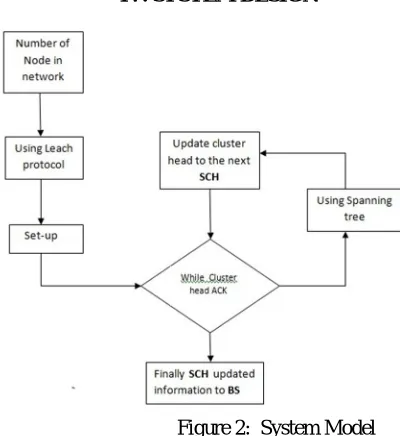
Figure 2: System Model
The Decentralized Low Energy Adaptive Clustering Hierarchy (LEACH-D) to each sensor node to formed a group of Cluster at centralized based. Using leach protocol CH is elected based on energy and elected CH collect the information at each sensor node. They using spanning tree approach CH collected information another CH and acknowledged. All CH are acknowledged finally send into BS.
V. ALGORITHM
A. Hierarchical Routing Protocols based on Clustering
Technology (IJRASET)
The nodes form of the cluster in set up phase and actual data is transmitted in steady state phase. Each node selects a random number between 0 and 1 to become CH. For current round the nodes gets chance to be the cluster head if the number is less than threshold value T (n) is defined in equation (1).
p
( ) = 1− ∗ 1 ,
0, otherwise
Where r is the round, p is the probability of nodes to be cluster head; G is the set of nodes which have never been CH in the end 1/p rounds. LEACH depends only on stochastic model so elected cluster heads may be very close each other. If the elected CH node is placed near to the edge of the network, message transfer to CH by another nodes dispel more energy. In each round one random number is induce and calculate the threshold value so more CPU cycles are consumed.
2) Leach-D: Decentralized approach used in LEACH-D to elect the CHs by BS, each node location information and energy known by BS. They each CH collects the information. The main limitation of LEACH-D is that the location of all nodes essential be known by BS.
3) Spanning Tree Approach: Each CH collects the location information of each sensor node. All CH are Scheduled based on energy and using spanning tree approach to collect the each CH information and the finally CH also called super CH that send the information to BS.
B. Fuzzy Based Clustering Protocol
Many researchers have spring up with many different ideas how Fuzzy Logic (FL) can be exploit to elect the proper and able CH so that worthwhile life time can be proficient. Some of the FL based clustering algorithms are discussed below:
1) CHEF: In CHEF [13] elected CH is based on two criterions which are contiguity range and energy. The fuzzy based passage elects the node to be the CH with huge energy and regionally perfect node. The three Fuzzy parameters such as energy, concentration and centrality to determine the chance to be the CHs. But main limitations of this protocol all nodes are not assembled with GPS receivers and they ability not be able to contain locus information in little places.
2) F-MCHEL: In F-MCHEL elected CH based on Fuzzy rules used criterions energy and contiguity of distance. Among CHs which node has more energy to elect the Master Cluster Hear (MCH) and only responsible to gather the data and send to the BS. In the proposed protocol to elect the Super Cluster Head (SCH) among CHs by used Fuzzy descriptors such as remaining power, mobility and Centrality. The network remains constant when mobility increase or decrease that is the limitation of this protocol. To overcome this drawback has been examined BS Route as the fourth input parameter in Fuzzification module in this proposed protocol.
VI. TRADING MODEL
A. Network Formation
Except the base station all the sensor nodes are static, means there is no movement of nodes once they are deployed .Cluster based routing protocol is used to each sensor nodes are divided into number of groups and each group is called as a cluster. One group leader is elected in each cluster known as Cluster Head (CH). Data aggregation is obtained at the leader node. The CH is only responsible for sending the message to the BS. Homogeneous network have been examined such that all the nodes are same and have the same initial energy at the beginning. The base station is mobile.
B. Hierarchical Routing Protocols Based on
1) Clustering: Cluster based routing protocol is used to each sensor nodes are divided into number of groups and each group is called as a cluster. One group leader is elected in each cluster known as Cluster Head (CH). Data aggregation is obtained at the leader node. The CH is only responsible for sending the message to the BS.
C. Fuzzy Logic based Clustering Protocol
Technology (IJRASET)
VII. CONCLUSION
A fuzzy logic based clustering algorithm use to proposed Wireless Sensor Network. CHs collects information send data to hop by hop (cluster head) using spanning tree based on energy. By selecting suitable fuzzy descriptors one Super Cluster Head is elected among the cluster heads who is the representative for delivering the message to a mobile base station. The idea of sink mobility along with the fuzzy logic increases the network life time dramatically. It’s used in health care, military application and provides security.
VIII. FUTURE WORK
In future, the system Simulate the result to show that the proposed protocol performs better than LEACH protocol in terms of first node dies, half nodes alive, last node dies, better stability and better network lifetime.
REFERENCES
[1] Daljeet kaur, Garima Malik “Enhanced Fuzzy Logic-Based Clustering Algorithm ,“IEEE Sensors Journal, Vol. 16, No. 1, Aug , 2016 .
[2] P. Nayak, D. Anurag, and V. V. N. A. Bhargavi, “Fuzzy method based super cluster head election for wireless sensor network with mobile base station (FM-SCHM),” in Proc. 2nd Int. Conf. Adv. Comput. Methodol., pp. 422–427, 2013.
[3] V. Nehra, R. Pal, and A. K. Sharma, “Fuzzy-based leader selection for topology controlled PEGASIS protocol for lifetime enhancement in wireless sensor network,” Int. J. Comput. Technol., vol. 4, no. 3, pp. 755–764, Mar/Apr. 2013.
[4] T. Sharma and B. Kumar, “F-MCHEL: Fuzzy based master cluster head election Leach protocol in wireless sensor network,” Int. J. Comput. Sci. Telecommun., vol. 3, no. 10, pp. 8–13, Oct. 2012.
[5] H. Taheri, P. Neamatollahi, O. M. Younis, S. Naghibzadeh, and M. H. Yaghmaee, “An energy-aware distributed clustering protocol in wireless sensor networks using fuzzy logic,” Ad Hoc Netw., vol. 10, no. 7, pp. 1469–1481, 2012.
[6] Z. W. Siew, C. F. Liau, A. Kiring, M. S. Arifianto, and K. T. K. Teo, “Fuzzy logic based cluster head election for wireless sensor network,” in Proc. 3rd CUTSE Int. Conf., Sarawak, Malaysia, pp. 301–306, 2011.
[7] G. Ran, H. Zhang, and S. Gong, “Improving on LEACH protocol of wireless sensor networks using fuzzy logic,” J. Inf. Comput. Sci., vol. 7, no. 3, pp. 767– 775, 2010.