5
X
October 2017
Analysis of Aerospike Nozzle Structural Contour
Design Performance Optimization
Krunal C. Chaudhari1, Shantanu J. Chaudhari2
1
Research Scholar, Mechanical Engineer,NMU Jalgaon, Maharashtra
2
Associate Professor, Automobile Engineering Dept.SGDCOE Jalgaon,Maharashtra
Abstract : A rocket engine nozzle is a propelling nozzle used in a rocket engine to expand and accelerate the combustion gases produced by burning propellants so that the exhaust gases exit the nozzle at hypersonic velocities. The primary nozzle contour is approximated by two circular arcs and a parabola. An Aerospike nozzle model is selected for evaluating formaximum thrust at minimum weight therefore, a model of aerospike rocket nozzle has been developed and for giving our main objective i.e., maximum thrust at minimum stress, So modifying its geometrical shapes and hence the contour shape will definitely be change. These different shapes are as parabolic contour shape, Cubical contour shape, Semi cubical parabolic contour shape. This includes predictions of nozzle thrust, nozzle weight, and effective vehicle gross-liftoff weight. The contour of the aerospike nozzle has been designed for maximum thrust at one design condition out of all these three conditions.
I.INTRODUCTION
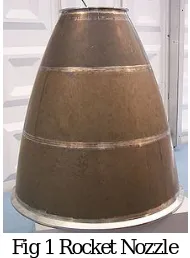
[image:2.612.259.354.376.505.2]A nozzle is a device designed to control the direction or characteristics of a fluid flow (especially to increase velocity) as it exits (or enters) an enclosed chamber or pipe. Frequently, the goal of a nozzle is to increase the kinetic energy of the flowing medium at the expense of its pressure and internal energy. Nozzle can be described as convergent (narrowing down from a wide diameter to a smaller diameter in the direction of the flow) or divergent (expanding from a smaller diameter to larger one).
Fig 1 Rocket Nozzle
out in China since 1997. In 1964, an approximate design method of the aerospike nozzle was proposed by Angelino. This method is based on the assumptions that the exhaust properties at the plug inlet are uniform and one- dimensional, so that the expansion fan emanating from the external lip of the primary nozzle are straight lines and properties along each expansion wave are uniform.
A. Thrust chamber assembly:
The thrust chamber assembly consists of a gimbal bearing, an oxidizer dome, an injector, a thrust chamber body, a thrust chamber nozzle extension, and thermal insulation. The thrust chamber assembly receives propellants under pressure supplied by turbo pump, mixes and burns them and imparts a high velocity to the expelled combustion gases to produced thrust. The thrust chamber assembly also serves as a mount or support for all engine hardware.
B. Thrust chamber injector:
The thrust chamber injector directs fuel and oxidizer into the thrust chamber in a pattern which ensures efficient and satisfactory combustion. The injector is multi-orifice with copper fuel rings and copper oxidizer rings forming the face of the injector and containing the injection orifice pattern. Assembled to the face are radial and circumferential copper baffles which extend downward and compartmentalized the injector face. The baffles and rings, together with a segregated injector fuel system, are installed in a stainless steel body.
Oxidizer enters the injector from the oxidizer dome. Fuel enters the injector from the thrust chamber fuel inlet manifold, and in order to facilitate the engine start phase and to reduce pressure losses, part of flow is introduced directly into the thrust chamber. The remaining fuel flows through alternate tubes which run the length of the thrust chamber body to the nozzle exit. There, it enters a return manifold and flows back to the injector through the remaining tubes.
C. Thrust chamber body
The thrust chamber body provides a combustion chamber for burning propellants under pressure and an expansion nozzle for expelling gases produced by the burned propellants at the high velocity required to produce the desired thrust. The thrust chamber is tabular walled and regenerative fuel cooled, and the nozzle is bell-shaped.
D. Thrust chamber nozzle extension:
The thrust chamber nozzle extension increases the expansion ration of the thrust chamber from 10:1 to 16:1. It is detachable unit that is bolted to the exit end ring of the thrust chamber. The injector of the nozzle extension is protected from the engine exhaust gas environment(5800 Fahrenheit) by film cooling, using the turbine exhaust gases (1200 Fahrenheit) as the coolant. The exhaust gas enters the extension between a continues outer wall and a shingled inner wall, pass out through injection slots between the shingles, and flow over the surface of shingles forming a boundary layer between the inner wall of the nozzle extension and the hotter exhaust gases exiting from main engine combustion chamber. The nozzle extension is made of high strength stainless steel .
A nonlinear computational fluid dynamics code is used to calculate the aerodynamic thrust, and a three dimensional finite element model is used to determine the structural response and weight. The model will be used to demonstrate, multidisciplinary design optimization (MDO). A multidisciplinary analytic model of a linear aerospike rocket nozzle has been developed; this model includes predictions of nozzle thrust, nozzle weight, and effective vehicle gross-liftoff weight (GLOW). The MDO approach is a methodology for the design of complex engineering systems and subsystems that coherently exploits the synergism of mutually interacting phenomenon. Traditional methods of design, analysis and optimization have been based on the approach where discipline is isolated.
Fluid–structure interaction (FSI) is the interaction of some movable or deformable structure with an internal or surrounding fluid flow. Fluid–structure interaction problems and metaphysics problems in general are often too complex to solve analytically and so they have to be analyzed by means of experiments or numerical simulation. Research in the fields of computational fluid dynamics and computational structural dynamics is still ongoing but the maturity of these fields enables numerical simulation of fluid-structure interaction. There are two main approaches exist for the simulation of fluid–fluid-structure interaction problems:
1) Monolithic approach: The monolithic approach consisting the equations, governing the flow and the displacement of the
2) Partitioned approach: The partitioned approach consisting the equations, governing the flow and the displacement of the structure are solved separately, with two distinct solvers. In this approach it solves differently therefore required less timing compare to monolithic approach.
In this project I had used CFD software like fluent and gambit for determining exhaust gas pressure and velocity coming out from aerospike Nozzle. And also used ANSYS software for determining Vone misses stress and shear stresses acting on the nozzle boundary. I had taken the basic shape for nozzle contour was parabolic. After doing study on it, changed the contour profile for better performance. That is for increasing thrust and minimizing stress. So different contour profiles used are:
3) Parabolic contour profile.
4) Cubical contour profile.
5) Semi cubical parabolic contour profile.
These are the different contour profiles are studies. And from that best one is find out on the base of our aim i.e. to increase thrust and minimizing weight.
II. INPUT PARAMETERS:
Length - 19ft Width - 12 ft. 4in Thrust(Sea level) - 1,500,000lb Specific impulse (min.) - 260 sec Rated run duration - 150 sec
Flowrate: Oxidiser – 3,945lb/sec (24,811 gpm) Fuel- 1,738lb/ sec (15471 gpm) Mixture Ratio - 2.27:1 oxidiser to fuel Chamber pressure – 965 psia
Weight flight config. – 18,500 lb. maximum
Expansion area ratio – 16:1 with nozzle extension 10:1 without nozzle extension
Maximum nozzle exit dia. – 11ft. 7in
These parameters are taken from “Saturn V news reference “F1 engine fact sheet”
[image:4.612.58.553.603.711.2]A. Parabolic Profile
Fig 2 Parabolic nozzle contour shape in CFD Fig 3 Parabolic contour pressure profile in CFD.
B. Cubical Profile
[image:5.612.49.548.89.210.2] [image:5.612.57.563.238.384.2]Fig 6 Cubical nozzle contour shape in CFD Fig 7 Cubical contour pressure profile in CFD.
Fig 8 Cubical contour velocity profile in CFD. Fig 9 Vone mises stress.
C. Semi Cubical parabolic Profile
Fig 10 Semi Cubical parabolic nozzle contour Fig 11 Semi Cubical parabolic contour shape
in CFD profile pressure in CFD.
[image:5.612.41.536.416.535.2] [image:5.612.54.562.571.705.2]III. CONCLUSION
Sr No. Profiles Pressure difference Velocity Stress
1 Parabolic Profile 5.10 3.08 117.9
2 Cubical Profile 5.5 3.17 120.3
4 Semi Cubical Parabolic Profile 5.12 3.09 109
Graph 1 : Pressure diff. Vs Configuration Graph 2 : Stress Vs Configuration
Three profiles of the nozzle surface contours using CFD for flow and structural analysis. All the cases are studies like their pressure and velocity profile coming from the output of CFD. And from structural analysis, vone misses stresses. Then comparing all three results, the Semi cubical parabolic profile is the best for structural integrity due to minimum stress developed.The Semi cubical profile produces better thrust compared to other profilewith minimum thrust.
REFERENCES
[1] Chen, C.L., Chakravarthy, S.R., Hung, C.M., 1994. Numerical investigation of separated nozzle flows. AIAA Journal 32 (9), 1836–1843.
[2] A. N. Kraiko and a. A. Osipov on tm3 detonation of the shape of a supersonic Nozzle think into consideration the variation of Aircraft flight conditions Pmm
vol. 34, nu6, 1970, pp. 1067-1075
[3] Gearold R. Johnson,* H. Doyle Thompson'~ And Joe D. Hoffman “Design, of maximum thrust plug nozzles with variable inlet geometry” Computers and
Fluids, Vol 2, pp 173-190 Pergamon Press, 1974 PrAted in Great Brltam
[4] Trong T. Bui , James E. Murray. NASA Dryden Flight Research Center, Edwards, CA, 93523 Charles E. Rogers. Air Force Flight Test Center, Edwards Air
Force Base, CA, 93523 Scott Bartel blacksky Corporation, Carlsbad, CA, 92008 and Anthony Cesaroni and Mike Dennett.. Cesaroni Technology/Cesaroni Aerospace, Sarasota, FL, 34243 “Flight Research of an Aerospike Nozzle Using High Power Solid Rockets” 41st AIAA/ASME/SAE/ASEE Joint Propulsion Conference & Exhibit AIAA-2005-3797Tucson Convention Center, Tucson, Arizona July 10.13, 2005.
[5] A. Balabel, A.M. Hegab, M. Nasr, Samy M. El-Behery* “Assessment of turbulence modeling for gas flow in two-dimensional convergent–divergent rocket
nozzle” Contents lists available at Science Direct Applied Mathematical Modelling journal homepage: www.elsevier.com/locate/apm.
[6] Mine Yumusak [2013] has presented a paper “Analysis and design optimization of solid rocket motors in viscous flows”Computers & Fluids 75 (2013) 22–34.
5.05 5.1 5.15 5.2 5.25 5.3 5.35 5.4 5.45 5.5 5.55
0 1 2 3 4
P re ss . D if f Configuration 108 110 112 114 116 118 120 122
0 1 2 3 4
St
re
ss