R E S E A R C H A R T I C L E
Open Access
The Peritraumatic Behavior Questionnaire:
development and initial validation of a new
measure for combat-related peritraumatic
reactions
Agorastos Agorastos
1,2, William P Nash
3, Sarah Nunnink
1,3,4, Kate A Yurgil
4, Abigail Goldsmith
3,4, Brett T Litz
5,6,
Heather Johnson
4, James B Lohr
1,3,4and Dewleen G Baker
1,3,4,7*Abstract
Background:Posttraumatic stress disorder (PTSD) is one of the most commonly observed stress-related conditions following combat exposure and its effective prevention is a high health-care priority. Reports of peritraumatic reactions have been shown to be highly associated with PTSD among combat exposed service members. However, existing instruments measuring peritraumatic symptoms were not specifically developed to assess combat-related peritraumatic stress and each demonstrates a different peritraumatic focus. We therefore developed the
Peritraumatic Behavior Questionnaire (PBQ), a new military-specific rating scale focused upon the wide range of symptoms suggestive of combat-related peritraumatic distress in actively deployed Service Members. This study describes the development of the PBQ and reports on the psychometric properties of its self-rated version (PBQ-SR). Methods:688 Marine infantry service members were retrospectively assessed by the PBQ-SR within the scope of the Marine Resiliency Study after their deployment to war zone. Participants have been additionally assessed by a variety of questionnaires, as well as clinical interviews both pre and post-deployment.
Results:The PBQ-SR demonstrated satisfactory internal consistency, convergent and discriminant validity, as well as high correlation with trait dissociation prior to deployment. Component analysis suggested a latent bi-dimensional structure separating a peritraumatic emotional distress and physical awareness factor. The PBQ-SR total score showed high correlation to general anxiety, depression, poorer general health and posttraumatic symptoms after deployment and remained a significant predictor of PTSD severity, after controlling for those measures. The suggested screening cut-off score of 12 points demonstrated satisfactory predictive power.
Conclusions:This study confirms the ability of the PBQ-SR to unify the underlying peritraumatic symptom dimensions and reliably assess combat-related peritraumatic reaction as a general construct. The PBQ-SR demonstrated promise as a potential standard screening measure in military clinical practice, while It’s predictive power should be established in prospective studies.
Keywords:Peritraumatic behavior questionnaire, Peritraumatic dissociation, Peritraumatic reaction, Posttraumatic stress disorder (PTSD), Stress, Psychometric properties, Validity, Reliability, Screening, Assessment
* Correspondence:[email protected]
1Veterans Affairs Center of Excellence for Stress and Mental Health, VA San Diego, CA, USA
3Department of Psychiatry, University of California, San Diego, CA, USA Full list of author information is available at the end of the article
Background
Posttraumatic stress disorder (PTSD) is one of the most common stress-related conditions in active duty Service Members after combat exposure [1-3]. Early at-risk detection and prevention of the development of PTSD could therefore lead to substantial benefits concerning the potential personal, social, and economic conse-quences of this disorder in military populations [4-6]. Although prior literature has identified pre-existing and post-hoc risk factors for PTSD, limitations in the pre-dictive value of these factors have recently prompted particular interest in the immediate peritraumatic re-sponse after trauma exposure as a fairly robust predictor of PTSD development.
Peritraumatic stress reactions refer to the different stress-associated behavioral, emotional, cognitive, and physiological symptoms during and immediately follow-ing a traumatic event (e.g., fear of dyfollow-ing, fear of losfollow-ing emotional control, tachycardia, sweating, shaking, dizzi-ness, dissociative symptoms, reduction of awaredizzi-ness, etc.). These reactions have demonstrated a strong and consistent association with the subsequent development of posttraumatic stress symptoms [7-18]. The degree of the peritraumatic adrenergic hyperactivation following a stressful or traumatic event is related to different patterns of physiological response [19], subjective experience of injury and trauma-related fears [11,20], resilience and cop-ing mechanisms [21], poor military traincop-ing outcomes [22,23], as well as symptomatic outcomes in trauma sequelae [21,24]. Pathophysiological pathways suggested for increasing the risk for PTSD include enhanced fear conditioning [25], behavioral avoidance coping [26], mem-ory processing disruption [27-30], and over-consolidation of traumatic memories [31,32]. A prolonged continuation of the biological and behavioral responses following acute traumatic stress may lead to greater pairing of the trau-matic memory with distress, initiating a cascade of sec-ondary biological alterations with long-term adverse consequences including interference with fear extinction learning and retention [33-36]. Peritraumatic stress is, thus, a salient pre-clinical indicator of risk and could provide sufficient evidence to warrant evaluation, the provision of stress first aid, and, if necessary, sustained formal mental health intervention to promote healing and re-covery [37-42].
Yet, the valid assessment of relevant behavioral, emo-tional, cognitive, and physiological information is the greatest challenge in combat-related, mental health research. Although instruments measuring peritraumatic symptoms exist, they were not specifically developed to assess combat-related peritraumatic reactions. In addition, the two most widely used peritraumatic scales each dem-onstrate different peritraumatic foci. The Peritraumatic Dissociative Experiences Questionnaire (PDEQ) mainly
assesses dissociative symptoms and physical reactions, while the Peritraumatic Distress Inventory (PDI) primarily targets emotional/cognitive peritraumatic aspects [43-47]. Thus, when used independently, these scales may insuffi-ciently capture the wide range of possible symptoms or reactions in the immediate aftermath of a combat-related trauma.
To redress this problem, we developed the Peritrau-matic Behavior Questionnaire (PBQ). The goal was to generate a new, military-specific rating scale able to unify the underlying peritraumatic symptom dimensions and reliably assess combat-related peritraumatic reaction as a general construct in actively deployed Service Mem-bers. The goal of this primary study lies in the demon-stration of satisfactory psychometric properties of the subjective PBQ version (PBQ - Self Report, PBQ-SR).
Methods
Subjects
All subjects enrolled were consenting active duty male Marines recruited from infantry battalions of the 1st Marine Division stationed at Marine Corps Air-Ground Combat Center, 29 Palms, or Camp Pendleton, in south-ern California. Because the MRS study targeted only ground combat units, no women were included in the study. Ethnic distribution was included in similar pro-portion to the representation in the Marine Corps [48] (cf. Table 1, legend). There were no other exclusion cri-teria. 706 deploying male Marines signed informed con-sent prior to deployment and were included in the study. Of all deployed participants, 688 Marines (mean age 22.1 ± 3.4 years) participated in post-deployment assessments, returned valid questionnaires and were included in our analysis (cf. Table 1). Of those, 404 Marine subjects reported no history of prior combat deployments.
Development of the peritraumatic behavior questionnaire The goal was to develop a questionnaire that is easy to administer and score due to its simple rating and scoring instructions and clearly specified areas of evaluation. To develop the content for the Peritraumatic Behavior Questionnaire (PBQ) for use in a war zone, a panel of subject matter experts generated an initial pool of items and helped select the final set of items, emphasizing content validity [49,50]. The expert panel was formed by established clinical mental health professionals, with ex-perience treating in-theater and post-deployment, com-bat-related, acute and posttraumatic stress symptoms, as well as research professionals with a focus in PTSD. The PBQ-SR was developed using the expert consensus method in four steps (Step 1: Item pool generation; Step 2: Item pool screening; Step 3: Items’adjustment; Step 4: Final review) [51].
Agorastoset al. BMC Psychiatry2013,13:9 Page 2 of 11
In step 1, a large item pool with different questions assessing peritraumatic reactions was generated. Con-structs considered for inclusion were frequently observed peritraumatic symptoms seen in the battlefield of opera-tions. Items were collected through summarizing clinical expertise derived from prior battle-field experience with traumatized Service Members, clinical notes and prior patients’comments, a comprehensive literature review fo-cused upon peritraumatic symptoms using a standard database search, and well established peritraumatic and dissociation questionnaires found to correlate with PTSD development, trauma history or symptom severity (e.g. Peritraumatic Distress Inventory – PDI; Peritraumatic Dissociative Experiences Questionnaire–PDEQ; Somato-form Dissociation Questionnaire - SDQ-20, Clinician Administered Dissociative Symptoms Scale - CADSS) [44,45,47,52-55]. In step 2, the item pool was screened to determine: (a) the questions’applicability and relevance to military war zone experiences and culture and (b) the feasibility of objectively observing described symptoms, an attribute additionally rated by a focus group of Navy corpsmen previously deployed with Marine combat units. Peritraumatic reactions in battle are representative for
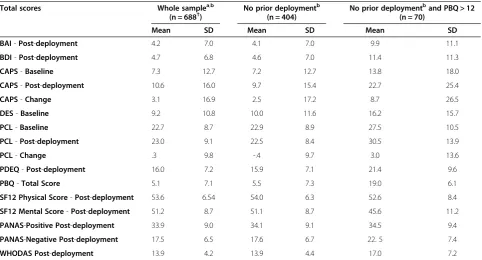
[image:3.595.57.540.99.359.2]extraordinary stress challenges for Service Members, who are faced with pervasive loss, life threat, extreme physical discomfort and moral conflicts, witnessing death and overcoming fear [56]. However during combat, the pri-mary importance of these reactions lies in potential inter-ference with maintenance of operational resilience, including mission effectiveness and optimal performance [57]. Thus as those aspects of peritraumatic reactions are already to deployed Service Members and salient to com-bat operations, special attention has been given to includ-ing such items in our questionnaire. Missinclud-ing pool items addressing possible emotional changes or loss of control sometimes experienced in the aftermath of trauma or loss were identified and consequently also included into the item pool (i.e. items such as“acting inappropriately giddy or silly”; “uncontrollable laughing, crying, or screaming”; and “not feeling normally remorseful”). On the contrary, several questions reflecting ubiquitous experiences in the-ater (e.g., "I was afraid for my safety") were excluded from the item pool. Step 3 included slight language modifica-tions of the collected quesmodifica-tions in order to reflect military terminology and to qualify for use in military operational settings. In the final step, the selected items were reviewed Table 1 Means of psychometric scores assessed by different instruments in the sample
Total scores Whole samplea,b
(n = 688†)
No prior deploymentb (n = 404)
No prior deploymentband PBQ > 12 (n = 70)
Mean SD Mean SD Mean SD
BAI-Post-deployment 4.2 7.0 4.1 7.0 9.9 11.1
BDI-Post-deployment 4.7 6.8 4.6 7.0 11.4 11.3
CAPS-Baseline 7.3 12.7 7.2 12.7 13.8 18.0
CAPS-Post-deployment 10.6 16.0 9.7 15.4 22.7 25.4
CAPS-Change 3.1 16.9 2.5 17.2 8.7 26.5
DES-Baseline 9.2 10.8 10.0 11.6 16.2 15.7
PCL-Baseline 22.7 8.7 22.9 8.9 27.5 10.5
PCL-Post-deployment 23.0 9.1 22.5 8.4 30.5 13.9
PCL-Change .3 9.8 -.4 9.7 3.0 13.6
PDEQ-Post-deployment 16.0 7.2 15.9 7.1 21.4 9.6
PBQ-Total Score 5.1 7.1 5.5 7.3 19.0 6.1
SF12 Physical Score-Post-deployment 53.6 6.54 54.0 6.3 52.6 8.4
SF12 Mental Score-Post-deployment 51.2 8.7 51.1 8.7 45.6 11.2
PANAS-Positive Post-deployment 33.9 9.0 34.1 9.1 34.5 9.4
PANAS-Negative Post-deployment 17.5 6.5 17.6 6.7 22. 5 7.4
WHODAS Post-deployment 13.9 4.2 13.9 4.4 17.0 7.2
Total scores of psychometric scores are reported as mean values ± SD. Measures were assessed either before (Baseline) or after deployment (Post-deployment). Changes indicate differences in the scores between pre and post-deployment. BAI: Beck’s Anxiety Index; BDI: Beck’s Depression Inventory-II; CAPS: Clinician Administered PTSD Scale; DES: Dissociative Experiences Scale-II; PANAS: Positive Affect Negative Affect Schedule; PDEQ: Peritraumatic Dissociative Experiences Questionnaire - Self Report; PCL: PTSD Checklist; SF-12: Short Form 12, Version 2; WHODAS: World Health Organization Disability Assessment Schedule II. a
Demographics of whole sample in percentage (percentages under 1.0% are not reported).: Education (Some High School: 1.9%; GED: 1.5%; High School Diploma: 60.2%; Some College: 30.6%; Associates Degree: 2.5%; 4-year College Degree: 3.1%), Ethnicity (Not Hispanic or Latino: 74.6%; Mexican: 14.2%; Puerto Rican: 2.8%; South or Central American: 3.2%; Other Spanish culture or origin: 5.2%), Race (Black or African American: 4.9%; American Indian or Alaskan Native: 1.5%; Asian: 2.7%; Native Hawaiian or Pacific Islander: 1.0%; White: 83.7%; More than one: 7.2%).
b
again by the expert’s panel in order to ensure that all different battle-field related stress symptoms were ad-equately represented in the draft.
A total of 15 potential scale items were then selected from the remaining item pool (cf. Additional file 1). The final questionnaire items were refined and assembled into a 5-point-Likert scale structure, ranging from “Not at All True” to “Extremely True” (scored 0–4), to pro-mote the comparability of our results to prior studies using existing questionnaires. Finally, the self-report ver-sion (PBQ-SR) was created by merely using first-person pronouns such as "I" and "my". All questions refer to symptoms during and/or immediately after the most stressful event experienced during the last deployment. It was further specified in the measure’s instructions that these reactions must have been unusual for the individ-ual and not within their typical range of thoughts, emo-tions or behavior. The PBQ-SR can be completed within 5 min. The 15 individual items were summed to com-pute a single summary score. Higher scores indicate higher levels of peritraumatic symptoms.
Methods
This study used data collected within the scope of the
“Validation of the Peritraumatic Behavior Questionnaire” study, approved by the institutional review boards of the University of California San Diego, the VA San Diego Research Service (VA R&D and UCSD IRB approval #090563), the Brooke Army Medical Center and CENT-COM. This is a pilot study linked to the“Marine Resili-ency Study” (MRS), a larger prospective investigation of active duty Marines approved by the institutional review boards of the University of California San Diego, VA San Diego Research Service, and Naval Health Research Center (VA R&D and UCSD IRB approval #070533) [48].
Informed consent for all deploying MRS Marines volunteering for this study was obtained prior to deploy-ment. The PBQ-SR was administered to Marines at post-deployment assessment, along with other MRS study questionnaires, as part of the standard test battery for the MRS study. Exact post-deployment evaluation time periods varied between 8 and 12 weeks post-deployment depending on pre-scheduled assessment time points. Each platoon of each company were avail-able for ½ day for collection of data, including paper-pencil questionnaires (approx. 1 ½ hrs). Two to four study staff members were specifically designated for monitoring of participants during questionnaires, as well as being present to answer questions, but were not con-stantly in the room where single participants filled out self-report measures. Survey response confidentiality was maintained at any time by providing spacing of at least 5 feet between chairs/desks where self-report ques-tionnaires were completed by participants. Assessments
were mainly conducted in Marine training spaces on a Marine Corps base, except for Marines not available to be tested with their units if discharged after deployment, transferred to a different unit or hospitalized. Those Marines were assessed at the VA San Diego Medical Center or at other locations.
Measures
All MRS participants completed the following question-naire prior to deployment only:
–The Dissociative Experiences Scale-II (DES): The DES is a 28-item, 11-point-Likert-scaled, self-report questionnaire assessing dissociative symptomatology during the past month. The DES has reported satisfactory psychometric properties, while higher scores indicate higher dissociative traits [58,59].
Participants also completed the following instruments both pre- and post-deployment:
–The PTSD Checklist (PCL): The PCL, a 17-item, 5-point-Likert-scaled, self-report questionnaire assessing PTSD symptom severity. The PCL has repeatedly demonstrated good psychometric qualities with higher scores indicating higher PTSD symptom severity [60,61]. In our study the PCL was used with respect to a specific traumatic event.
–The Clinician Administered PTSD Scale (CAPS): The CAPS was administered by trained clinicians in a face-to-face interview with MRS participants both pre- and post-deployment. The CAPS is a structured diagnostic interview that assesses the core and associated symptoms of PTSD and is considered the gold standard diagnostic manual for assessing PTSD in clinical research [62-64]. While several scoring rules and cut-off scores have been suggested, higher scores indicate higher symptom severity [64].
Finally, in addition to the PBQ-SR, the following ques-tionnaires were administered after deployment only:
–Peritraumatic Dissociative Experiences Questionnaire– Self Report (PDEQ): The PDEQ is a 10-item,
5-point-Likert-scaled, self-report questionnaire assessing peritraumatic dissociation. The PDEQ has well-established psychometric properties, with higher total scores indicating increased peritraumatic dissociation [43,54] thus served as the reference standard in the evaluation of the PBQ-SR.
–Positive Affect Negative Affect Schedule (PANAS): The PANAS consists of two 10-item self-report scales designed to provide independent measures of positive (PANAS-P) and negative affectivity (PANAS-N).
Agorastoset al. BMC Psychiatry2013,13:9 Page 4 of 11
Each item is rated on a five-point-Likert scale, while low scores reflect the absence of the reported feelings [65,66].
–Beck Depression Inventory-II (BDI): The BDI is a 21-item, four-point-Likert-scaled, self-rating scale designed to measure emotional, cognitive, behavioural and somatic symptoms of depression over the previous two weeks and has become one of the most widely accepted instruments for detecting depression in normal populations [67,68].
–Beck Anxiety Index (BAI): The BAI is an established 21-item, four-point-Likert-scaled, self-report instrument assessing severity of anxiety symptoms during the past week [69].
–Short Form 12, Version 2 (SF-12): The SF-12 is a widely used and repeatedly validated, 12-item, 5 and 3-point-Likert-scaled, self-report questionnaire assessing health-related quality of life. Sub-scores are divided according to physical and mental health items. The SF-12 was developed as a more concise alternative to the original SF-36 and has been shown to mirror closely the physical and mental
components of the original form, such as pain, general health, physical functioning, social functioning, vitality, etc. [70].
–World Health Organization Disability Assessment Schedule-II (WHODAS), Short Version: Developed from the original 36-item version, the WHODAS-II, Short Version is a 17-item, self-report generic health-status instrument assessing functioning in the last 30 days in six domains: communication, mobility, self-care, interpersonal, life activities, and participation [71]. The first 12 items are 5-point Likert-scale questions that assess areas of functioning while 5 additional items pertain to overall health, frequency of functional impairments, and interference caused by impairments. Only the 12 core items are aggregated into a total score.
Statistical analysis
The main objective was the assessment of the major psy-chometric properties of the PBQ-SR. Internal consistency was assessed using corrected item-total correlations and Cronbach’s alpha coefficients. Construct validity was investigated by assessing the convergent and discriminant validity of the measure with respect to previously estab-lished measures. PBQ-SR internal consistency, as well as convergent and discriminant reliability were explored using the entire sample (N = 688). Concurrent validity of the PBQ-SR was assessed in order to explore its correl-ation to related measure scores assessed in our samples after deployment. In order to avoid bias of combat-related stresses or traumas associated with prior deployments, we excluded previously deployed Marines from this analysis.
Concurrent validity correlations and cut-off scores were explored and calculated only in the sub-sample without any history of prior deployment (N = 404). A CAPS screening cut-off score of ≥45 was used to dichotomize the population, as suggested in the literature [64]. Changes in measures were computed as differences in total scores between pre- and post-deployment. Preliminary analyses were performed to ensure no violation of normality, lin-earity and homoscedasticity. Descriptive statistics are given in mean and standard deviation (SD) for ordinal scaled variables. Correlations are reported by the Pearson product–moment correlation coefficient and group differ-ences were calculated by an independent-samples t-test. All tests of significance were 2-tailed, and p-values < .05 were considered significant. Statistical analyses were con-ducted using the Statistical Package for Social Sciences Version 20 (SPSS Inc., Chicago, IL).
Results
Clinical characteristics
The means and SD of all instruments assessed are pre-sented in Table 1.
Factor analysis
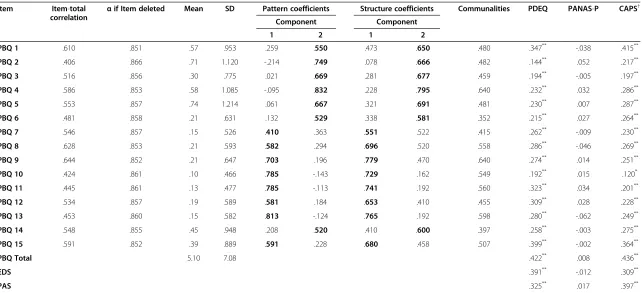
The 15 items of the PBQ-SR were subjected to principal components analysis (PCA) with direct oblimin rotation to investigate the underlying structure of the question-naire. Prior to performing PCA, the suitability of data was confirmed (Kaiser-Meyer-Olkin value: .893; Barlett’s test of sphericity: p < .001). PCA suggested a two-factor solution with only two components exceeding an eigen-value >1, explaining 38.1% and 12.4% of the variance re-spectively. An inspection of the screeplot revealed a clear break after the second component. The two-factor solution explained a total of 50.5% of the variance. The correlation between the two factors wasr= .39. Aligned with the two-factor solution, we divided the two sub-scales of the PBQ-SR, entitled Emotional Distress Sub-scale (EDS) and Physical Awareness SubSub-scale (PAS), according to the different item content of the components included. The EDS included emotional, perspective and coping items, while the PAS reflected awareness, dissocia-tive and physical symptom items.
Reliability
Table 2 Principal component analysis and convergent, discriminate and concurrent validity of the PBQ-SR
Item Item-total correlation α
if Item deleted Mean SD Pattern coefficients Structure coefficients Communalities PDEQ PANAS-P CAPS†
Component Component
1 2 1 2
PBQ 1 .610 .851 .57 .953 .259 .550 .473 .650 .480 .347** -.038 .415**
PBQ 2 .406 .866 .71 1.120 -.214 .749 .078 .666 .482 .144** .052 .217**
PBQ 3 .516 .856 .30 .775 .021 .669 .281 .677 .459 .194** -.005 .197**
PBQ 4 .586 .853 .58 1.085 -.095 .832 .228 .795 .640 .232** .032 .286**
PBQ 5 .553 .857 .74 1.214 .061 .667 .321 .691 .481 .230** .007 .287**
PBQ 6 .481 .858 .21 .631 .132 .529 .338 .581 .352 .215** .027 .264**
PBQ 7 .546 .857 .15 .526 .410 .363 .551 .522 .415 .262** -.009 .230**
PBQ 8 .628 .853 .21 .593 .582 .294 .696 .520 .558 .286** -.046 .269**
PBQ 9 .644 .852 .21 .647 .703 .196 .779 .470 .640 .274** .014 .251**
PBQ 10 .424 .861 .10 .466 .785 -.143 .729 .162 .549 .192** .015 .120*
PBQ 11 .445 .861 .13 .477 .785 -.113 .741 .192 .560 .323** .034 .201**
PBQ 12 .534 .857 .19 .589 .581 .184 .653 .410 .455 .309** .028 .228**
PBQ 13 .453 .860 .15 .582 .813 -.124 .765 .192 .598 .280** -.062 .249**
PBQ 14 .548 .855 .45 .948 .208 .520 .410 .600 .397 .258** -.003 .275**
PBQ 15 .591 .852 .39 .889 .591 .228 .680 .458 .507 .399** -.002 .364**
PBQ Total 5.10 7.08 .422** .008 .436**
EDS .391** -.012 .309**
PAS .325** .017 .397**
Pattern and structure matrix of PCA with Oblimin rotation of two factor solution of PBQ-SR items and convergent, discriminate and concurrent validity of all items and total scores in the whole sample (n = 687). Correlations are given by the Pearson’sr. PBQ: Peritraumatic Behavior Questionnaire; EDS: Emotional Distress Subscale; PAS: Physical Awareness Subscale; CAPS: Clinician Administered PTSD Scale; DES: Dissociative Experiences Scale-II; PANAS-P: Positive Affect Negative Affect Schedule–Positive Affect Scale; PDEQ: Peritraumatic Dissociative Experiences Questionnaire–Self Report;.
#
Statistical trend: .05 < p < 0.1. * p < .05.
** p < .001.
†including only participants without prior deployment.
Agorastos
et
al.
BMC
Psychiatry
2013,
13
:9
Page
6
o
f
1
1
http://ww
w.biomedce
ntral.com/1
471-244X/13
be used as a measure of peritraumatic reactions in battle-related trauma (cf. Table 2). The psychometric properties of both subscales were computed separately. The EDS and the PAS both displayed a good internal consistency (Cronbach’s alpha = 0.80 and .85 respectively).
Construct validity
Convergent validity was assessed using a Pearson prod-uct–moment correlation test to the PDEQ total score. We observed a robust statistically significant positive correlation between the total scores of the two measures (r = .422, p < .001, n = 667), as well as between each of the PBQ-SR items and PDEQ total score (cf. Table 2). Discriminant validity was examined by exploring the association between PBQ-SR total score and the diver-gent and theoretically unrelated constructs of PANAS-P scale. The PBQ-SR did not correlate with PANAS-P total score at all (r = .008, p = .846, n = 661). In the sample without prior deployment, PBQ-SR even showed a slight negative discriminant correlation to the PANAS-P, similarly to the PDEQ, confirming that the two scales are both equally unrelated to a conceptually different measure such the PANAS-P Scale. The EDS and the PAS both also displayed a satisfactory convergent and discriminant validity (cf. Table 2).
Concurrent validity
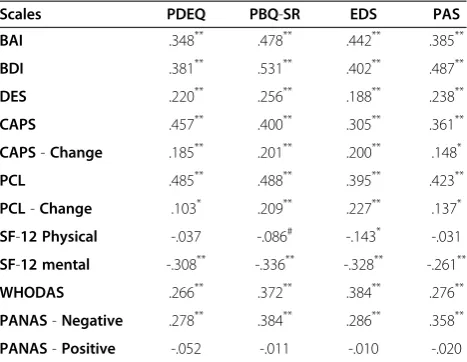
Concurrent validity was measured by exploring the rela-tion of the PBQ-SR total score to several scales assessing general anxiety, depression, negative affect, lower general health and posttraumatic symptoms after deployment and their changes over time, showing significant correlations (cf. Table 3). In addition, the PBQ-SR showed a significant positive correlation to the DES total score (r = .256; p < .001, n = 401; cf. Table 3). The same correlations of these measures to PDEQ were also computed and pre-sented in Table 3. Controlling for CAPS and PCL baseline scores had no significant effect on our results. The EDS and the PAS both displayed a significant concurrent valid-ity correlations to other measures (cf. Table 3).
Multivariate analyses
Hierarchical multiple regression models were used to evaluate associations between PBQ-SR and PTSD symp-tomology while controlling for co-morbid anxiety and depressive symptoms, general health status, personality and emotional trait factors in terms of criterion validity. PTSD symptoms were indexed by CAPS and PCL total scores, however due to their high collinearity, CAPS and PCL total scores were entered as dependent variables in separate regression models. Preliminary analyses were conducted to ensure no violation of normality, linearity, multicollinearity and homoscedasticity. BDI, BAI, WHO-DAS, DES and PANAS-N total scores were entered as
independent variables at step 1 and PBQ-SR in step 2. The final models were statistically significant and explained a total variance of 34.7% (F(6, 389)= 34.4, p < .001)
and 47% (F(6, 389)= 57.6, p < .001) for CAPS and PCL
scores, respectively. After controlling for the other mea-sures, PBQ-SR remained a significant predictor of PTSD symptom severity as assessed by both measures (CAPS: β= .232; 95%-CI: .025–.439; t = 2.2; p = .028; PCL:β= .181; 95%-CI: .079–.283; t = 3.5; p = .001).
Cut-off score
[image:7.595.305.539.122.303.2]The relation between PTSD-risk status (CAPS score≥45; whole sample: 4.8%, no prior deployment: 4%) and the PBQ total score was also examined using receiver oper-ating characteristic (ROC) curves. Marines with a prior deployment were excluded from the analysis. The area under the curve was .85, which indicates that the PBQ is quite accurate in identifying PTSD-risk positive cases. The ROC diagram suggested a cut-off of 12 points (sensitivity 75.0%, specificity 85.6%) as the most appropriate one for screening purposes. In a direct uni-variate logistic regression, participants with a PBQ-SR total score above 12 had a 17.9 odds ratio of PTSD-risk group affiliation (B= 2.88;SE= .59; Wald= 23.5;df =1; Sig. <.001; Exp(B)= 17.9). Also after controlling for BDI, BAI, WHODAS and PANAS-N scores in a Table 3 Correlations of peritraumatic instruments to measures assessed post-deployment in participants without prior deployment (n = 404)
Scales PDEQ PBQ-SR EDS PAS
BAI .348** .478** .442** .385**
BDI .381** .531** .402** .487**
DES .220** .256** .188** .238**
CAPS .457** .400** .305** .361**
CAPS-Change .185** .201** .200** .148*
PCL .485** .488** .395** .423**
PCL-Change .103* .209** .227** .137*
SF-12 Physical -.037 -.086# -.143* -.031
SF-12 mental -.308** -.336** -.328** -.261**
WHODAS .266** .372** .384** .276**
PANAS-Negative .278** .384** .286** .358**
PANAS-Positive -.052 -.011 -.010 -.020
Correlations are given by the Pearson’sr. PBQ: Peritraumatic Behavior Questionnaire; EDS: Emotional Distress Subscale; PAS: Physical Awareness Subscale. BAI: Beck’s Anxiety Index; BDI: Beck’s Depression Inventory-II; CAPS: Clinician Administered PTSD Scale; DES: Dissociative Experiences Scale-II; PANAS: Positive Affect Negative Affect Schedule; PDEQ: Peritraumatic Dissociative Experiences Questionnaire–Self Report; PCL: PTSD Checklist; SF-12: Short Form 12, Version 2; WHODAS: World Health Organization Disability Assessment Schedule II. Change indicates differences in the scores between pre and post-deployment.
#
Statistical trend: .05 < p < 0.1. * p < .05.
stepwise multiple linear regression model, a PBQ-SR score above 12 was the only significant predictor of af-filiation in the PTSD-risk group (full model: χ2= 46.2, p < .001, variance explained: 11.0 - 38.3%, PBQ-SR≥12: B= 1.76; SE= .73; Wald= 5.9; df =1; p= .015; Exp(B)= 5.8), indicating that the cut-off score selected was able to distinguish between respondents. Using the PBQ-SR cut-off score of 12 points as a dichotomous variable, we compared the two resulting groups with respect to the other psychometric measures. Participants reporting PBQ-SR scores higher than the cut-off showed signifi-cantly higher anxiety (BAI: t(399)=−5.075, p < .001),
depression (BDI: t(399)=−5.840, p < .001) and negative
affect (PANAS-N: t(399)=−6.117, p < .001) scores, lower
general health scores (WHODAS: t(399)=−4.171, p < .001)
and a greater increase of PTSD symptoms after deploy-ment (CAPS-Change: t(395)=−2.232, p = .029;
PCL-Change: t(393)=−2.381, p = .020) than the control group.
Discussion
This study validates a new instrument for the assessment of peritraumatic symptoms. To our knowledge, PBQ-SR is the first instrument specifically designed to measure several components of combat-related peritraumatic stress. The questionnaire was assessed using retrospect-ive data on 688 Marine infantry service members with respect to the most stressful event during their last de-ployment. PBQ-SR demonstrated satisfactory psycho-metric properties with good internal consistency and discriminant validity as to PANAS-Positive Score. De-scriptive analysis of each item, inter-item correlation and Cronbach'sαstability after item deletion indicate that all 15 items of the questionnaire could be retained. The sta-tistically significant positive correlation between both the PBQ-SR total score and all of its 15 items to the PDEQ confirms the ability of PBQ-SR to reliably assess peritraumatic reactions as a general construct.
Consistent with prior results research [46], there was a significant positive correlation between the PBQ-SR total score and measures of general anxiety, depression, nega-tive affect and lower general health after deployment. PBQ-SR also showed high concurrent validity with re-spect to posttraumatic symptoms after deployment and their changes over time. PTSD severity strongly corre-lated not only with PBQ-SR total scores and the two subscales, but also with most of the fifteen individual PBQ-SR items. In order to compare the concurrent psy-chometric properties of PBQ-SR to PDEQ, we recalcu-lated all correlations with respect to PDEQ (cf. Table 3). Our results suggest similar psychometric properties, while the PBQ-SR shows slightly better concurrent valid-ity to almost every other measure assessed (cf. Table 3).
Linear and logistic regressions have shown that PBQ-SR total score remained a significant predictive factor of
PTSD symptom severity, even after controlling for de-pression, general anxiety, negative affect and general health. Our results suggest a PBQ-SR cut-off score of 12 points for screening purposes. This score has been shown to correctly classify respondents at risk for PTSD even after controlling for other psychopathologies. In addition, participants exceeding this cut-off score also showed significantly higher anxiety, depression and negative affect scores, lower general health scores and a greater increase of PTSD symptoms after deployment when compared to the control group.
As literature suggests that peritraumatic symptoms partly rely on pre-existing factors, such as trait dissoci-ation and may be an important risk factor for PTSD de-velopment and resilience [24,72,73], we also investigated the correlation between peritraumatic symptoms (PBQ-SR), trait dissociation assessed by the DES and posttrau-matic symptoms (CAPS). Our results showed a statisti-cally significant correlation between all three scores and confirm prior findings. However, even though the DES total score also correlated significantly with the CAPS total score (r = .188, n = 394, p < .001), the close correl-ation of PBQ-SR to the CAPS total score remained significant even after controlling for trait dissociation (r = .370, n = 393, p < .001).
A principal component analysis suggested the existence of two underlying factors: physical/dissociative (PAS) and perceptive/emotional (EDS) aspects of peritraumatic stress reaction. Both factors have demonstrated satisfactory con-vergent validity to PTSD specific measures and significant concurrent validity correlations to other measures such as general anxiety, depression, negative affect and general health (cf. Tables 2 and 3). At present, the two pre-existing scales assessing peritraumatic reactions (PDEQ and PDI) seem to each focus separately on different dimensions of peritraumatic symptoms. PDEQ’s underlying structure is shown to reflect more dissociative symptoms such as altered awareness and derealization (reflecting the PAS), while PDI focuses more on emotional peritraumatic distress symptoms (reflecting the EDS). Hence, our results suggest that PBQ-SR is a new scale that may have incremental val-idity by unifying and assessing the two major underlying peritraumatic symptom dimensions, which would other-wise require the administration of both PDEQ and the PDI. Assessing both dimensions also affirms the clinical rele-vancy of PBQ-SR and we therefore support the use of both subscales in clinical practice. The separate use of EDS and PAS could, however, be considered in psychiatric research.
In summary, our study replicates and extends the find-ings of other studies reporting peritraumatic dissociation to be a robust correlate of PTSD symptoms in adults. Our findings suggest that peritraumatic symptoms as measured by the PBQ may be useful indices of risk and need for early intervention for PTSD in service members
Agorastoset al. BMC Psychiatry2013,13:9 Page 8 of 11
deployed to combat zones, should, however, be prospect-ively validated through immediate peritraumatic assess-ment through in-theater administration of the PBQ-SR in the future.
Limitations and strengths
Because the content development focused on the behav-ioral indicators of the phenomenology of service members under great strain in a war-zone, the PBQ stands out as a peritraumatic index uniquely suitable for military mem-bers. The PBQ is a questionnaire that is easy to administer and score due to its simple rating and scoring instructions and clearly specified areas of evaluation. The 5-point-Likert scale structure promotes the comparability of our results to prior studies using already existing scales. Con-cerning the psychometric properties of the PBQ-SR, excluding Marines with prior deployments from the pre-dictive analyses has contributed to the reduction of bias risk due to prior stressors, while the use of the trauma-specific CAPS score likely contributed to a higher trauma-specific predictive power of our results. The size, as well as the homogeneity of our assessed sample (Marine, infantry) in terms of gender, age and kind of exposure type is a specific feature and further strength of our study, compared to val-idation studies designed for other scales. This may be an advantage for military-use of the questionnaire, but may limit its generalizability to other populations. In addition, as the optimal cutoff score was empirically established in our study, cross-validation in an independent sample appears necessary. Further limitations also include the lack of assessment of prior traumatic life events or child-hood trauma, combat exposure level and test-retest vari-ability of the measure. In addition, we evaluated the PBQ-SR on male Marine Corps infantry units who deployed to Afghanistan in a period of time that was relatively quies-cent. It is an empirical question whether these results would be generalizable to more highly exposed troops, in other branches of service, and with women. However, the most significant limitation of the study is the retrospect-ive, self-report assessment of peritraumatic symptoms, which precludes a conclusion on predictive validity of the PBQ-SR. Retrospective assessment of symptoms may also lead to distortion of recollections or bias due to current symptoms [74] and subjective assessment of combat-related symptoms could introduce bias and distortions related to cognitive barriers (i.e. fear of stigma, warrior ethos, criticism, fear of removal from unit, etc.) and adap-tive denial coping mechanisms of Service Members [2,75]. Despite those concerns, our results suggest good reliabil-ity, validity and applicability of the PBQ-SR.
Conclusion
The PBQ-SR is a reliable and valid new instrument for globally assessing different underlying dimensions of
combat-related peritraumatic symptoms in active duty Service Members and demonstrates high correlation to various PTSD-specific, as well as related symptoms. The PBQ-SR may contribute to more accurate and earlier identification of individuals at high risk for developing combat-related acute and posttraumatic stress symp-toms, allowing for further monitoring, coping support or immediate evidence-based treatment. The ability of the PBQ-SR to serve as a standard self-rated questionnaire with incremental validity in military clinical practice and predictive validity towards PTSD development, should, however, be prospectively validated through immediate, in-theater peritraumatic assessment in future studies.
The opinions and assertions contained herein are the private views of the authors, and do not necessarily re-flect the official positions or policies of the Department of Defense, the Department of the Navy, or the Depart-ment of Veterans Affairs.
Additional file
Additional file 1:The Peritraumatic Behavior Questionnaire–Self Report (PBQ-SR).
Competing interests
All authors declare that they have no financial or non-financial competing interests.
Authors' contributions
AA carried out all statistical analyses and contributed to the interpretation of data and drafting of the manuscript. WPN and DGB conceived of the study and have made substantial contributions to coordination and design. SN and KAY have been involved in drafting the manuscript and revising it critically for important intellectual content. AG, BTL, JBL and DGB contributed to the interpretation of data and have been involved in revising the manuscript critically for important intellectual content. HJ has made substantial contributions to acquisition of data. All authors have given final approval of the version to be published.
Acknowledgements
We would like to acknowledge CAPT. Brian Schumacher who served medical monitor, as well as the Navy Corpsmen at Camp Pendleton who participated in the PBQ development focus group. The“Validation of the Peritraumatic Behavior Questionnaire”study was funded through Congressionally Directed Medical Research Programs small (pilot) project mechanism (Award No.: Contract W81XWH-10-1-0693) (DGB). The linked MRS study is funded by VA HSR&D (Grant No.: RDIS 0024), the Marine Corps and Navy BUMED. We would also like to thank Amela Ahmetovic, Nilima Biswas, William H. Black, Mahalah R. Buell, Teresa Carper, Andrew De La Rosa, Benjamin Dickstein, Caitlin Fernandes, Susan Fesperman, David Fink, Summer Fitzgerald, Steven Gerard, Gali Goldwaser, Patricia Gorman, Jorge A. Gutierrez, John A. Hall, Jr, Christian J. Hansen, Laura Harder, Pia Heppner, Alexandra Kelada, Christopher L. Lehnig, Jennifer Lemmer, Morgan LeSuer-Mandernack, Manjula Mahata, Adam X. Maihofer, Theodore Morrison, Arame Motazedi, Elin Olsson, Ines Pandzic, Anjana H. Patel, Dhaval H. Patel, Sejal Patel, Shetal M. Patel, Taylor Perin-Kash, James O.E. Pittman, Stephanie Raducha, Brenda Thomas, Elisa Tsan, Maria Anna Valencerina, Chelsea Wallace, Kuixing Zhang, and the many intermittent on-site MRS clinician-interviewers and data collection staff.
Author details
1
Healthcare System, San Diego, CA, USA.5Department of Psychiatry and Department of Psychology, Boston University School of Medicine, Boston, MA, USA.6National Center for Post Traumatic Stress Disorder, VA Boston Healthcare System, Boston, MA, USA.7Department of Psychiatry, University of California San Diego, 9500 Gilman Drive (0603V), La Jolla, CA 92093-0603V, USA.
Received: 8 October 2012 Accepted: 2 January 2013 Published: 5 January 2013
References
1. Smith TC, Ryan MA, Wingard DL, Slymen DJ, Sallis JF, Kritz-Silverstein D: New onset and persistent symptoms of post-traumatic stress disorder self reported after deployment and combat exposures: prospective population based US military cohort study.BMJ Clinical research ed2008, 336(7640):366–371.
2. Hoge CW, Castro CA, Messer SC, McGurk D, Cotting DI, Koffman RL:Combat duty in Iraq and Afghanistan, mental health problems, and barriers to care.N Engl J Med2004,351(1):13–22.
3. Lapierre CB, Schwegler AF, Labauve BJ:Posttraumatic stress and depression symptoms in soldiers returning from combat operations in Iraq and Afghanistan.J Trauma Stress2007,20(6):933–943.
4. Hellmann J, Heuser I, Kronenberg G:Targeted prevention of posttraumatic stress disorder.Nervenarzt2010, Epub ahead of print.
5. Grasso D, Boonsiri J, Lipschitz D, Guyer A, Houshyar S, Douglas-Palumberi H, Massey J, Kaufman J:Posttraumatic stress disorder: the missed diagnosis.
Child Welfare2009,88(4):157–176.
6. Druss BG, Hwang I, Petukhova M, Sampson NA, Wang PS, Kessler RC: Impairment in role functioning in mental and chronic medical disorders in the United States: results from the National Comorbidity Survey Replication.Mol Psychiatry2009,14(7):728–737.
7. Bovin MJ, Marx BP:The importance of the peritraumatic experience in defining traumatic stress.Psychol Bull2011,137(1):47–67.
8. Ozer EJ, Best SR, Lipsey TL, Weiss DS:Predictors of posttraumatic stress disorder and symptoms in adults: a meta-analysis.Psychol Bull2003, 129(1):52–73.
9. Lima AA, Fiszman A, Marques-Portella C, Mendlowicz MV, Coutinho ES, Maia DC, Berger W, Rocha-Rego V, Volchan E, Mari JJ,et al:The impact of tonic immobility reaction on the prognosis of posttraumatic stress disorder.
J Psychiatr Res2010,44(4):224–228.
10. Lensvelt-Mulders G, van der Hart O, van Ochten JM, van Son MJ, Steele K, Breeman L:Relations among peritraumatic dissociation and
posttraumatic stress: a meta-analysis.Clin Psychol Rev2008, 28(7):1138–1151.
11. Gershuny BS, Cloitre M, Otto MW:Peritraumatic dissociation and PTSD severity: do event-related fears about death and control mediate their relation?Behav Res Ther2003,41(2):157–166.
12. Gould NF, McKibben JB, Hall R, Corry NH, Amoyal NA, Mason ST, McCann UD, Fauerbach JA:Peritraumatic heart rate and posttraumatic stress disorder in patients with severe burns.J Clin Psychiatry2011, 72(4):539–547.
13. Marmar CR, McCaslin SE, Metzler TJ, Best S, Weiss DS, Fagan J, Liberman A, Pole N, Otte C, Yehuda R,et al:Predictors of posttraumatic stress in police and other first responders.Ann N Y Acad Sci2006,1071:1–18.
14. McGhee LL, Slater TM, Garza TH, Fowler M, DeSocio PA, Maani CV:The relationship of early pain scores and posttraumatic stress disorder in burned soldiers.J Burn Care Res2011,32(1):46–51.
15. Breh DC, Seidler GH:Is peritraumatic dissociation a risk factor for PTSD?
J Trauma Dissociation2007,8(1):53–69.
16. McNally RJ:Psychological mechanisms in acute response to trauma.Biol Psychiatry2003,53(9):779–788.
17. Briere J, Scott C, Weathers F:Peritraumatic and persistent dissociation in the presumed etiology of PTSD.Am J Psychiatry2005,162(12):2295–2301. 18. Fikretoglu D, Brunet A, Best S, Metzler T, Delucchi K, Weiss DS, Fagan J,
Marmar C:The relationship between peritraumatic distress and peritraumatic dissociation: an examination of two competing models.
J Nerv Ment Dis2006,194(11):853–858.
19. Griffin MG, Resick PA, Mechanic MB:Objective assessment of
peritraumatic dissociation: psychophysiological indicators.Am J Psychiatry
1997,154(8):1081–1088.
20. Gabert-Quillen CA, Fallon W, Delahanty DL:PTSD after traumatic injury: an investigation of the impact of injury severity and peritraumatic moderators.J Health Psychol2011,16(4):678–687.
21. Pacella ML, Irish L, Ostrowski SA, Sledjeski E, Ciesla JA, Fallon W, Spoonster E, Delahanty DL:Avoidant coping as a mediator between peritraumatic dissociation and posttraumatic stress disorder symptoms.J Trauma Stress
2011,24(3):317–325.
22. Eid J, Morgan CA 3rd:Dissociation, hardiness, and performance in military cadets participating in survival training.Mil Med2006,171(5):436–442. 23. Morgan CA, Southwick SM, Hazliett G, Dial-Ward M:Baseline dissociation
and prospective success in special forces assessment and selection.
Psychiatry (Edgmont)2008,5(7):53–58.
24. Galatzer-Levy IR, Madan A, Neylan TC, Henn-Haase C, Marmar CR: Peritraumatic and trait dissociation differentiate police officers with resilient versus symptomatic trajectories of posttraumatic stress symptoms.J Trauma Stress2011,24(5):557–565.
25. Orr SP, Metzger LJ, Lasko NB, Macklin ML, Peri T, Pitman RK:De novo conditioning in trauma-exposed individuals with and without posttraumatic stress disorder.J Abnorm Psychol2000,109(2):290–298. 26. Tiet QQ, Rosen C, Cavella S, Moos RH, Finney JW, Yesavage J:Coping,
symptoms, and functioning outcomes of patients with posttraumatic stress disorder.J Trauma Stress2006,19(6):799–811.
27. Henckens MJ, Hermans EJ, Pu Z, Joels M, Fernandez G:Stressed memories: how acute stress affects memory formation in humans.J Neurosci2009, 29(32):10111–10119.
28. McCleery JM, Harvey AG:Integration of psychological and biological approaches to trauma memory: implications for pharmacological prevention of PTSD.J Trauma Stress2004,17(6):485–496.
29. Zohar J, Juven-Wetzler A, Myers V, Fostick L:Post-traumatic stress disorder: facts and fiction.Curr Opin Psychiatry2008,21(1):74–77.
30. Otte C, Neylan TC, Pole N, Metzler T, Best S, Henn-Haase C, Yehuda R, Marmar CR:Association between childhood trauma and catecholamine response to psychological stress in police academy recruits.Biol Psychiatry2005,57(1):27–32.
31. Southwick SM, Bremner JD, Rasmusson A, Morgan CA 3rd, Arnsten A, Charney DS:Role of norepinephrine in the pathophysiology and treatment of posttraumatic stress disorder.Biol Psychiatry1999, 46(9):1192–1204.
32. Pitman RK, Shalev AY, Orr SP:Posttraumatic stress disorder: emotion, conditioning and memory. InThe New Cognitive Neurosciences. Edited by Corbetta MD, Gazzaniga MS. New York: Plenum Press; 2000:687–700. 33. Krystal JH, Neumeister A:Noradrenergic and serotonergic mechanisms in
the neurobiology of posttraumatic stress disorder and resilience.Brain Res2009,1293:13–23.
34. Friedman MJ, Pitman RK:New findings on the neurobiology of posttraumatic stress disorder.J Trauma Stress2007,20(5):653–655. 35. Heim C, Nemeroff CB:Neurobiology of posttraumatic stress disorder.CNS
Spectr2009,14(1 Suppl 1):13–24.
36. Milad MR, Pitman RK, Ellis CB, Gold AL, Shin LM, Lasko NB, Zeidan MA, Handwerger K, Orr SP, Rauch SL:Neurobiological basis of failure to recall extinction memory in posttraumatic stress disorder.Biol Psychiatry2009, 66(12):1075–1082.
37. Bryant RA:Acute stress reactions: can biological responses predict posttraumatic stress disorder?CNS Spectr2003,8(9):668–674. 38. Cahill L, Prins B, Weber M, McGaugh JL:Beta-adrenergic activation and
memory for emotional events.Nature1994,371(6499):702–704. 39. Ehring T, Ehlers A, Cleare AJ, Glucksman E:Do acute psychological and
psychobiological responses to trauma predict subsequent symptom severities of PTSD and depression?Psychiatry Res2008,161(1):67–75. 40. Birmes P, Brunet A, Carreras D, Ducasse JL, Charlet JP, Lauque D,
Sztulman H, Schmitt L:The predictive power of peritraumatic dissociation and acute stress symptoms for posttraumatic stress symptoms: a three-month prospective study.Am J Psychiatry2003, 160(7):1337–1339.
41. Agorastos A, Marmar CR, Otte C:Immediate and early behavioral interventions for the prevention of acute and posttraumatic stress disorder.Curr Opin Psychiatry2011,24(6):526–532.
42. Nash WP, Krantz L, Stein N, Westphal R, Litz BT:Comprehensive soldier fitness, battlemind, and the stress continuum model: military organizational approaches to prevention. InCaring for veterans with deployment-related stress disorders. Edited by Ruzek JI, Schnurr PP, Vasterling
Agorastoset al. BMC Psychiatry2013,13:9 Page 10 of 11
JJ, Friedman MJ. Iraq, Afghanistan, and beyond: American Psychological Association; 2011:193–214.
43. Birmes P, Brunet A, Benoit M, Defer S, Hatton L, Sztulman H, Schmitt L: Validation of the Peritraumatic Dissociative Experiences Questionnaire self-report version in two samples of French-speaking individuals exposed to trauma.Eur Psychiatry2005,20(2):145–151.
44. Brunet A, Weiss DS, Metzler TJ, Best SR, Neylan TC, Rogers C, Fagan J, Marmar CR:The Peritraumatic Distress Inventory: a proposed measure of PTSD criterion A2.Am J Psychiatry2001,158(9):1480–1485.
45. Bui E, Brunet A, Allenou C, Camassel C, Raynaud JP, Claudet I, Fries F, Cahuzac JP, Grandjean H, Schmitt L,et al:Peritraumatic reactions and posttraumatic stress symptoms in school-aged children victims of road traffic accident.Gen Hosp Psychiatry2010,32(3):330–333.
46. Marmar CR, Metzler TJ, Otte C:The Peritraumatic Dissociative Experiences Questionnaire. InAssessing Psychological Trauma and PTSD: A Handbook for Practitioners. Edited by Wilson JP, Keane TM. New York, NY: Guilford Press; 2004:144–167.
47. Nishi D, Matsuoka Y, Yonemoto N, Noguchi H, Kim Y, Kanba S: Peritraumatic Distress Inventory as a predictor of post-traumatic stress disorder after a severe motor vehicle accident.Psychiatry Clin Neurosci
2010,64(2):149–156.
48. Baker DG, Nash WP, Litz BT, Geyer MA, Risbrough VB, Nievergelt CM, O'Connor DT, Larson GE, Schork NJ, Vasterling JJ,et al:Predictors of risk and resilience for posttraumatic stress disorder among ground combat marines: methods of the marine resiliency study.Prev Chronic Dis2012, 9:E97.
49. Vogt DS, King DW, King LA:Focus groups in psychological assessment: enhancing content validity by consulting members of the target population.Psychol Assess2004,16(3):231–243.
50. Haynes SN, Richard DC, Kubany ES:Content validity in psychological assessment: a functional approach to concepts and methods.Psychol Assess1995,7(3):238–247.
51. Helmer O:Looking forward: A guide to future research. Beverly Hills, CA: Sage; 1983.
52. Nijenhuis ER, Spinhoven P, Van Dyck R, Van der Hart O, Vanderlinden J:The development and psychometric characteristics of the Somatoform Dissociation Questionnaire (SDQ-20).J Nerv Ment Dis1996, 184(11):688–694.
53. Nijenhuis ER, Spinhoven P, van Dyck R, van der Hart O, Vanderlinden J: Degree of somatoform and psychological dissociation in dissociative disorder is correlated with reported trauma.J Trauma Stress1998, 11(4):711–730.
54. Marmar CR, Weiss DS, Metzler TJ:The Peritraumatic Dissociative Experiences Questionnaire. InAssessing Psychological Trauma and PTSD. Edited by Wilson JP, Keane TM. New York, NY: Guilford Press; 1997:412–428. 55. Bremner JD, Krystal JH, Putnam FW, Southwick SM, Marmar C, Charney DS,
Mazure CM:Measurement of dissociative states with the Clinician-Administered Dissociative States Scale (CADSS).J Trauma Stress1998, 11(1):125–136.
56. Bruner VE, Woll P:The battle within: understanding the physiology of war-zone stress experience.Soc Work Health Care2011,50(1):19–33. 57. Nash WP, Steenkamp M, Conoscenti L, Litz BT:The stress continuum
model: a military organizational approach to resilience and recovery. In
Resilience and Mental Health: Challenges Across the Lifespan. Edited by Southwick SM, Litz BT, Charney D, Friedman MJ. New York: Cambridge University Press; 2011.
58. Dubester KA, Braun BG:Psychometric properties of the Dissociative Experiences Scale.J Nerv Ment Dis1995,183(4):231–235.
59. Wright DB, Loftus EF:Measuring dissociation: comparison of alternative forms of the dissociative experiences scale.Am J Psychol1999, 112(4):497–519.
60. Blanchard EB, Jones-Alexander J, Buckley TC, Forneris CA:Psychometric properties of the PTSD Checklist (PCL).Behav Res Ther1996,34(8):669–673. 61. Wilkins KC, Lang AJ, Norman SB:Synthesis of the psychometric properties
of the PTSD checklist (PCL) military, civilian, and specific versions.
Depress Anxiety2011,28(7):596–606.
62. Blake DD, Weathers FW, Nagy LM, Kaloupek DG, Gusman FD, Charney DS, Keane TM:The development of a Clinician-Administered PTSD Scale.
J Trauma Stress1995,8(1):75–90.
63. Weathers FW, Litz BT:Psychometric properties of the Clinician-Administered PTSD Scale, CAPS-1.PTSD Research Quarterly1994,5:2–6.
64. Weathers FW, Ruscio AM, Keane TM:Psychometric properties of nine scoring rules for the Clinician-Administered Posttraumatic Stress Disorder Scale.Psychol Assess1999,11(2):124–133.
65. Watson D, Clark LA, Tellegen A:Development and validation of brief measures of positive and negative affect: the PANAS scales.J Pers Soc Psychol1988,54(6):1063–1070.
66. Crawford JR, Henry JD:The positive and negative affect schedule (PANAS): construct validity, measurement properties and normative data in a large non-clinical sample.Br J Clin Psychol2004,43(Pt 3):245–265. 67. Beck AT, Ward CH, Mendelson M, Mock J, Erbaugh J:An inventory for
measuring depression.Arch Gen Psychiatry1961,4:561–571. 68. Beck AT, Steer RA, Garbin MG:Psychometric properties of the Beck
depression inventory: twenty-five years of evaluation.Clin Psychol Rev
1998,8:77–100.
69. Beck AT, Epstein N, Brown G, Steer RA:An inventory for measuring clinical anxiety: psychometric properties.J Consult Clin Psychol1988,
56(6):893–897.
70. Gandek B, Ware JE, Aaronson NK, Apolone G, Bjorner JB, Brazier JE, Bullinger M, Kaasa S, Leplege A, Prieto L,et al:Cross-validation of item selection and scoring for the SF-12 Health Survey in nine countries: results from the IQOLA Project. International Quality of Life Assessment.J Clin Epidemiol1998,51(11):1171–1178.
71. World Health Organization:Measuring Health and Disability: Manual for WHO Disability Assessment Schedule–WHODAS 2.0. Geneva: WHO; 2010. 72. Inslicht SS, McCaslin SE, Metzler TJ, Henn-Haase C, Hart SL, Maguen S,
Neylan TC, Marmar CR:Family psychiatric history, peritraumatic reactivity, and posttraumatic stress symptoms: a prospective study of police.
J Psychiatr Res2010,44(1):22–31.
73. McCaslin SE, Inslicht SS, Metzler TJ, Henn-Haase C, Maguen S, Neylan TC, Choucroun G, Marmar CR:Trait dissociation predicts posttraumatic stress disorder symptoms in a prospective study of urban police officers.J Nerv Ment Dis2008,196(12):912–918.
74. Southwick SM, Morgan A, Nicolaou AL, Charney DS:Consistency of memory for combat-related traumatic events in veterans of operation desert storm.Am J Psychiat1997,154(2):173–177.
75. Nash WP:Combat/operational stress adaptations and injuries. InCombat Stress Injury Theory, Research, and Management. Edited by Figley CR, Nash WP. New York, NY: Routledge Press; 2007.
doi:10.1186/1471-244X-13-9
Cite this article as:Agorastoset al.:The Peritraumatic Behavior Questionnaire: development and initial validation of a new measure for combat-related peritraumatic reactions.BMC Psychiatry201313:9.
Submit your next manuscript to BioMed Central and take full advantage of:
• Convenient online submission
• Thorough peer review
• No space constraints or color figure charges
• Immediate publication on acceptance
• Inclusion in PubMed, CAS, Scopus and Google Scholar
• Research which is freely available for redistribution