2017 2nd International Conference on Advances in Management Engineering and Information Technology (AMEIT 2017) ISBN: 978-1-60595-457-8
Teaching Reform Practice of Mechanism Design Course Based on
Virtual Simulation Technology
Yong-xiang LI
1,*, Lu-qing ZHANG
2, Hai-xia GUO
3and Jin-song ZHANG
11
Xingzhi College, Zhejiang Normal University, Jinhua, China 2
Zhejiang Wanliyang Transmission Co.Ltd, Jinhua, China 3
College of Economics and Management, Zhejiang Normal University, Jinhua, China
*Corresponding author
Keywords: Virtual simulation technology, Education technology, Mechanism design, Teaching reform and innovation.
Abstract. According to the characteristics of mechanism design course with the excessive knowledge points and comparatively abstract content, especially in combination with engineering practice, this paper puts forward the teaching reform of mechanism design course based on virtual simulation technology. Firstly, in the course of teaching theory, combined with engineering cases, the paper uses the virtual simulation technology to interpret the principle of knowledge point and its application in engineering. Secondly, in the comprehensive practice teaching, the virtual assembly technology is used to improve the students' ability of knowledge application and innovation design. The teaching practice results show that the virtual simulation teaching based on the engineering application is helpful to deepen the students' understanding of curriculum knowledge, stimulate students’ interest in learning, cultivate students' innovative design ability and achieve the goal of the teaching reform.
Introduction
The mechanism design course, as the main course for the students majoring in mechanical engineering, plays an important role in the training of students' comprehensive mechanical design ability [1]. In view of the characteristics of the course with more knowledge points, the students tend to feel it very abstract and boring in the class, greatly reducing the enthusiasm of learning. In recent years, with the adjustment of professional structure and the deepening of curriculum system, the teaching contents of the course are constantly updated and increased, but the class hours have been continuously reduced [2,3]. Therefore, how to solve the conflict of teaching hours and teaching contents to improve the students’ innovation ability of mechanisim design in limited hours, has become the goal of teaching reform for the majority of teachers.
mechanism transmission simulation through the UG animator plug-in production. Therefore, combined with the engineering example in this paper, the teaching reform of mechanism design course based on the virtual simulation technology was put forward, through demonstrating 2D graphics, 3D entity assembly process and the motion simulation function, to deepen the students understanding of knowledge, arouse the learning initiative of the students and cultivate the students’ innovation ability.
Structural Material Preparation of Virtual Simulation Teaching
It is necessary to create three-dimensional entity parts, three-dimensional assembly and 2D engineering drawing of engineering structures for the virtual simulation teaching in mechanism design course. In view of the powerful model building functionality of the software UG NX, with the internal integration of multiple modules, the software UG NX has become the mainstream design tools for 3D modeling of mechanical product and widely used in product development. Therefore, the paper will use it to perform 3D solid modeling and assembly based on the design parameters of the engineering structure. The part drawing, assembly drawing and engineering drawing could share the relevant constraints, and changes in any graphics will be automatically reflected in the other two graphics. In addition, 3D assembly drawing can be also used to dynamically simulate the transmission relationship between the components.
3D Entity Modeling of the Parts
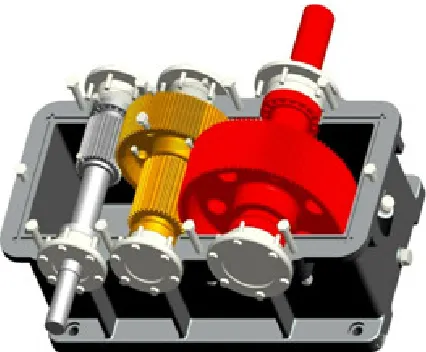
The secondary cylindrical gear reducer is mainly composed of the housing, gear, shaft, end cover, rolling bearing, key, pin, bolts, screws, gaskets, etc. In the process of creating solid parts in UG NX software, we firstly need to draw the section sketches of the parts, and then form the basic entity characteristics of the parts by operations such as stretching, rotating, scanning and lofting and so on, and finally complete the entity modeling through the operations like chamfer, fillet, excision, shell, mirror, array and so forth.
3D Assembly Generation
Figure 1. The reducer solid assembly model.
Animation Material Preparation of Virtual Simulation Teaching
The animation material of virtual simulation teaching includes 3D solid parts demonstration, assembly process animation and motion simulation animation. UG Animator is dedicated to the production, editing, playing and recording the animation, and can generate the animation files applied on the multimedia player. When entering the motion simulation module of UG software, the animator menus and animator controller toolbar will appear.
Production of 3D Solid Parts Demonstration
Before click on the "animation wizard" command button in the toolbar "Animator controller", the created solid component model must be opened. Following the prompts from dialog box “animation wizard”, successively select the type of animation, the rotation axis and the rotation direction, set the animation playback time, the delay time and other parameters to complete the animation production. In order to demonstrate the characteristics of the solid parts based on the positioning of omnidirectional vision, each part is separately carried out the clockwise rotation around the X axis, Y axis and Z axis in the animation settings. It is important to note that the start time of the next animation is the end of the previous animation.
Production of Assembly Process Animation
The design idea of the assembly process animation of the reducer is to let the reducer assembly rotate a circle in order to observe the appearance feature of the reducer assembly, and then to conduct the assembly process animation.
Open the dialog box “animation wizard”, according to the prompt, we choose the animation type for rotation, and the production of the rotation animation includes the rotation axis for Y axis, the rotation number for 1 and the direction of rotation for clockwise. After that, clicking on the "play animation" button, you can see the assembly clockwisely rotate 360 degrees in 10 seconds and then stop to show the appearance characteristics of the assembly model.
bar along the time line, and also adjust the assembly sequence and the moving speed by dragging the key points.
Production of Movement Simulation Animation
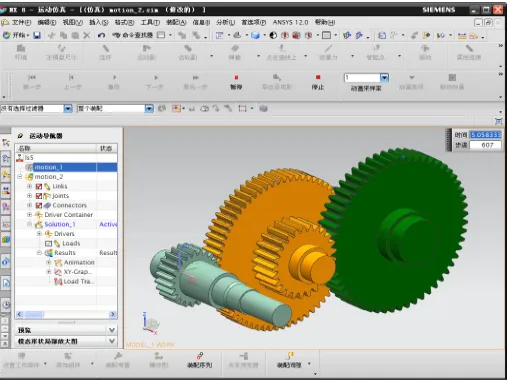
[image:4.612.180.434.256.446.2]Using the physical simulation tools, the gear shaft is set as the driving element to simulate the transmission process animation. In the interface of UG animator, we open the dialog box “animation wizard”, according to the prompt, to choose the animation type for physical simulation. As the same time, the length of time is 20 seconds in the dialog box of "animation control options" with the delay time of 0, and then click the “record the animation” menu command on the toolbar “animator controller’ to complete the transmission process simulation animation of the reducer, as shown in Fig.2. For the generated assembly model, by means of the statistical calculation function, physical simulation and interference check tool provided by UG software, we can also engage in the dynamic performance analysis and inspection of the transmission system, intuitive understanding of overall design effect the reducer, in order to avoid the unnecessary mistakes.
Figure 2. Transmission process simulation animation of the reducer.
Summary
The paper is mainly devoted to explore a new teaching model based on integration of modern educational concepts and technology into teaching in the course of the mechanisim design. By using UG software, this paper successfully completes 3D solid product design and assembly modeling of the secondary cylindrical gear reducer and then carrys out the virtual assembly animation and motion simulation. It will combine the traditional teaching methods like the blackboard-writing and the teaching aid with modern teaching means, to make the classroom teaching change from the monotony to the vividness, to strengthen the student’s intuitive perceptual knowledge of common mechanical parts. Meanwhile, it can effectively combine the theoretical teaching and practice training of the mechanism design course, which is beneficial to the cultivation of students' practical ability and innovation consciousness.
Acknowledgement
References
[1] K. Di, T.B. Yu, P.Y. Chen and L.J Meng, Application of virtual reality technology in experimental teaching of mechanical engineering, Experimental Technology and Management. 10(2014) 10-14.
[2] X.E. Wu, Research and application of virtual reality technology in the course of modern education technology, China Educational Technology. 3(2011)96-100.
[3] Q.F. Meng, Y.L. Shang and X.W. Ma, Research on the teaching method of integrating virtual reality with traditional teaching, Education and Vocation. 24(2010)149-151.
[4] Y. Kuang and X. Wang, Application of virtual reality technology in education and teaching, China Adult Education. 10(2016)110-113.
[5] J.W. Zhang and H.J. Kong, Application of virtual reality technology in practice teaching, e-Education Research. 4(2010)109-113.
[6] D.J. Liu, X.L. Liu and Y. Zhang, Application of virtual reality technology in education: potential, current situation and challenges, Open Education Research. 4(2016)25-32.