2017 2nd International Conference on Manufacturing Science and Information Engineering (ICMSIE 2017) ISBN: 978-1-60595-516-2
Effectiveness Evaluation of Satellite-ground
Collaborative Communication Network Based
on AHP-FCE Method
Yao Wang, Yun Liang, Pengfei Zhang, Li Huang
and Feng Huang
ABSTRACT
In order to realize the Global Energy Internet, a communication network architecture named Satellite-Ground Collaborative Communication Network (SGCCN) is proposed in this paper. To confirm the feasibility of relevant technology and the collaborative network, an effectiveness evaluation scheme and index system of the complex network architecture are designed, and a method of evaluating the performance of SGCCN based on Analytic Hierarchy Process- Fuzzy Comprehensive Evaluation (AHP-FCE) method is proposed. Effectiveness evaluation simulation of the complex system is also carried out, and the evaluation results are obtained. The evaluation method proposed in this paper can provide a reference for similar field research. 1
INTRODUCTION
The concept of Global Energy Internet was proposed at the UN General Assembly Development Summit on September 26, 2015. Building a Global Energy Internet can promote clean and green solutions to meet global electricity demand. The Global Energy Internet will have the ability to transmit wind energy, solar power, marine energy and other renewable energy to all types of users. Satellite-ground collaborative technology will be an inevitable choice when implementing the
1Yao Wang, Yun Liang, Pengfei Zhang, Li Huang, Feng Huang, State Grid Laboratory of
Global Energy Internet communication network architecture. Obviously, the Satellite-Ground Collaborative Communication Network (SGCCN) system is a complex system task, so we need a scientific, effective and quantitative assessment method to evaluate its performance.
Inter-Satellite Link
Operation Control Center Beidou
Satellite
Communicati on Satellite
Optical Fiber Network 3G/4G/5G
Base Station
3G/4G/5G Terminal
Terminal
Satellite Communicat
ion
Microwave Network
Monitoring Nodes: Sensor
Transmission Line
Monitoring Stations Positioning
[image:2.612.138.460.169.354.2]and Timing
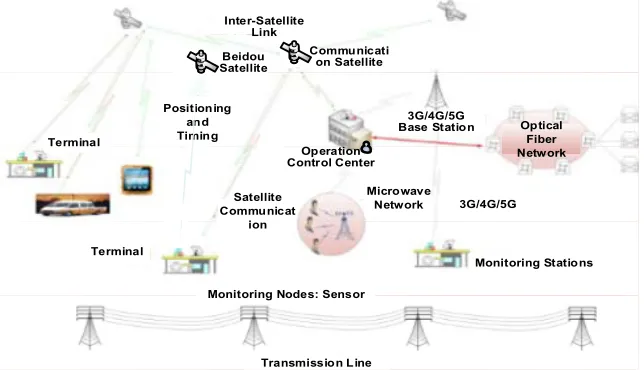
Figure 1. SGCCN architecture supporting the Global Energy Internet.
About the research achievements in the field of effectiveness evaluation, many research scholars have proposed various evaluation methods for different evaluation objects and purposes. At present, in the field of satellite communications, effectiveness evaluation is mainly used in military satellite communication, satellite defense communication network system, satellite communication system anti-jamming performance [1-4], etc. However, there is no report on effectiveness evaluation model and evaluation method aimed at Satellite-Ground Cooperative Communication Network.
To verify the feasibility of related technology, SGCCN is regarded as the evaluation object and an effectiveness evaluation index system is designed, and an evaluation method based on Analytic Hierarchy Process and Fuzzy Comprehensive Evaluation (AHP-FCE) method is also proposed for SGCCN. Finally, this method is used to evaluate SGCCN, and the simulation evaluation results are obtained.
SGCCN EFFECTIVENESS EVALUATION SYSTEM
types and with different function. These satellite constellations connected by Inter-Satellite Link (ISL) and they can also contact with kinds of communication platforms through satellite-ground link.
As is shown in Figure 2, an assessment scheme aiming at SGCCN is proposed in this paper. At first, it will gather related data through ground terminals and mobile terminals, payload on satellites and the gateway on earth. And then it will acquire key indicators data by earth-satellite-earth link communication joint simulation. Lastly, it will evaluate the comprehensive effectiveness of SGCCN according to the evaluation index system designed.
Ground sensor nodes and gathered data Satellite constellation and communications data
Ground mobile terminal data acquisition Satellite communication data acquisition Ground gateway data acquisition
Key indicators analysis and evaluation
Simulation data storage and management Ground local
communication network/ communication link
Information
interaction Information
interaction
The satellite-ground communication link between satellite and gateway stations
Inter-satellite communication link
Satellite-ground communication
link joint simulation Satellite-ground communication link joint simulation
Main parameters and
performance indicators Collected data and so on
Control instruction Management
information
Simulation scene information Operation
process information
Ground operation management center simulation Simulation
generates data Evaluate analysis results Backward link data flow
Forward link data flow System internal data flow
System control and
[image:3.612.101.487.239.422.2]management data flow Simulation network management
Figure 2. Assessment scheme of SGCCN.
The Satellite-Ground Collaborative Communication
Network
Evaluation Index System
Coverage
Global Area Coverage Global Coverage Time Percentage
Minimum redundancy Maximum revisit time
Security Anti-interference
Security Certification Communication
Ability
Packet loss rate Throughput Rain attenuation Real-time Data transmission delay
[image:4.612.125.473.85.269.2]Delay jitter Topological cycle Beam switching success rate Average wait time for beam switching Dynamicity
Figure 3. SGCCN evaluation index system.
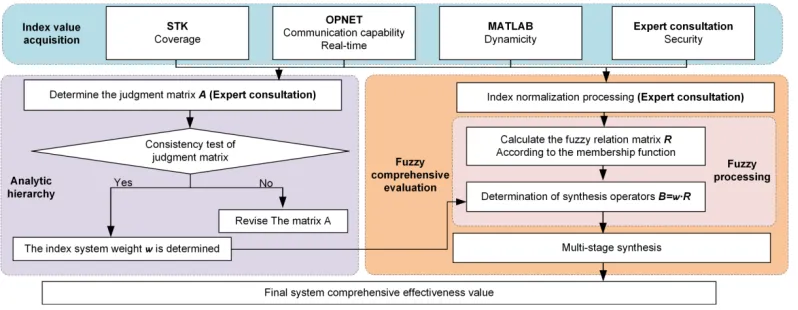
Figure 4. steps of AHP-FCE.
EFFECTIVENESS ANALYZING OF SGCCN
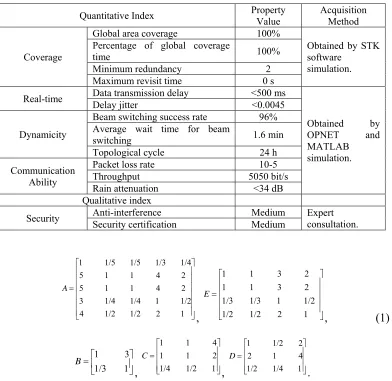
SGCCN simulation system is based on the established index system. In the simulation system, STK, OPNET and MATLAB softwares are used. The index attribute values obtained by software simulation and expert consultation, and the acquisition methods are shown in TABLE I.
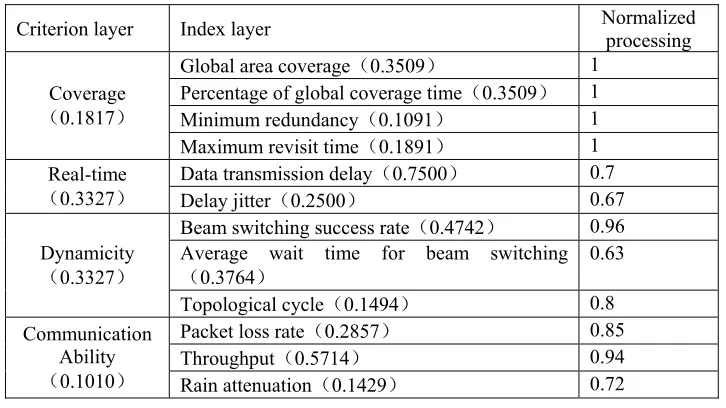
[image:4.612.101.500.321.476.2]indexes are deleted as the weight of safety is less than 0.1. Finally, weight of each index is shown in TABLE II.
TABLE I. VALUES OF INDEXES OF INDEXES AND ACQUISITION METHOD.
Quantitative Index Property Value Acquisition Method
Coverage
Global area coverage 100%
Obtained by STK software
simulation. Percentage of global coverage
time 100%
Minimum redundancy 2
Maximum revisit time 0 s
Real-time Data transmission delay <500 ms
Obtained by
OPNET and
MATLAB simulation.
Delay jitter <0.0045
Dynamicity
Beam switching success rate 96%
Average wait time for beam
switching 1.6 min
Topological cycle 24 h
Communication Ability
Packet loss rate 10-5
Throughput 5050 bit/s
Rain attenuation <34 dB
Qualitative index
Security Anti-interference Security certification Medium Medium Expert consultation.
1 2 1/2 1/2 4 1/2 1 1/4 1/4 3 2 4 1 1 5 2 4 1 1 5 1/4 1/3 1/5 1/5 1 A , 1 2 1/2 1/2 1/2 1 1/3 1/3 2 3 1 1 2 3 1 1 E
, (1)
1 1/3 3 1 B , 1 1/2 1/4 2 1 1 4 1 1 C , 1 1/4 1/2 4 1 2 2 1/2 1 D .
The outcome of the first synthesis calculation is the input of second synthesis, and the fuzzy matrix of the second synthesis is established as shown in Fomula (2).
TABLE II. WEIGHT OF INDEX AND ITS NORMALIZATION PROCESSING RESULT.
Criterion layer Index layer Normalized processing
Coverage
(0.1817)
Global area coverage(0.3509) 1
Percentage of global coverage time(0.3509) 1
Minimum redundancy(0.1091) 1
Maximum revisit time(0.1891) 1
Real-time
(0.3327)
Data transmission delay(0.7500) 0.7
Delay jitter(0.2500) 0.67
Dynamicity
(0.3327)
Beam switching success rate(0.4742) 0.96
Average wait time for beam switching
(0.3764)
0.63
Topological cycle(0.1494) 0.8
Communication Ability
(0.1010)
Packet loss rate(0.2857) 0.85
Throughput(0.5714) 0.94
Rain attenuation(0.1429) 0.72
55 0 43 0 02 0 0 0 43 0 39 0 18 0 0 0 0 77 0 23 0 0 0 1 0 0 0 0 ~ . . . . . . . . R (2)
Formula (3) shows the final evaluation result of overall scheme.
] 0.476 0.374 0.098 0 0 [ ~ ~ R
r (3)
According to the principle of maximum membership, the synthesis result shows that the effectiveness evaluation result of SGCCN belongs to comment level "excellent".
CONCLUSIONS
the end, effectiveness of SGCCN is quantitatively evaluated in this paper. Evaluation model and method proposed in this paper is useful for subsequent SGCCN construction stages, such as design, test, use and optimize, which can provide certain reference values, and also provide a reference for the similar research field.
ACKNOWLEDGEMENT
This work was supported by the science and technology project of State Grid Corporation of China (SGCC): research on the global energy interconnection oriented architecture of satellite and terrestrial integrated communication system.
REFERENCES
1. A. M. Elhady. 2014. “Remote sensing satellite system overall effectiveness analysis and
modeling,” presented at the IEEE Aerospace Conference, March 1-8, 2014 .
2. Li Zhang, Rui Yu, Xin Jin, et al. 2016. “Effectiveness Evaluation of Military Satellite
Communication System Based on Dual Hesitant Fuzzy Information,” Ship Electronic Engineering. 36 (1): 97-100.
3. Yang Shen, Xiuhe Li, Yong Li. 2013. “Research on simulation for countermine and its efficiency
evaluation of early warning satellite,” Aerospace Electronic Warfare. 29 (2): 9-11.
4. Lei Hu, Hao Li, Shiqiang Yan, et al. 2015. “Building of Operational Effectiveness Evaluation