R E S E A R C H A R T I C L E
Open Access
Consensus on draft OMERACT core
domains for clinical trials of Total Joint
Replacement outcome by orthopaedic
surgeons: a report from the International
consensus on outcome measures in TJR
trials (I-COMiTT) group
Jasvinder A. Singh
1,2*, Michael Dohm
3and Peter F. Choong
4,5Abstract
Background:There are no core outcome domain or measurement sets for Total Joint Replacement (TJR) clinical
trials. Our objective was to achieve an International consensus by orthopaedic surgeons on the OMERACT core domain/area set for TJR clinical trials.
Methods:We conducted surveys of two orthopaedic surgeon cohorts, which included (1) the leadership of
international orthopaedic societies and surgeons (IOS; cohort 1), and (2) the members of the American Academy of Orthopaedic Surgeons’Outcome Special Interest Group (AAOS-Outcome SIG), and/or the Outcome Research Interest Group of the Orthopaedic Research Society (ORS; cohort 2). Participants rated OMERACT-endorsed preliminary core area set for TJR clinical trials on a 1 to 9 scale, indicating 1–3 as domain of limited importance, 4–6 being important, but not critical, and 7–9 being critical.
Results:Eighteen survey participants from the IOS group and 69 participants from the AAOS-Outcome SIG/ORS
groups completed the survey questionnaire. The median (interquartile range [IQR]) scores were seven or higher for all six proposed preliminary core areas/domains across both groups, IOS and AAOS-Outcome SIG/ORS, respectively: pain, 8 [8, 9] and 8 [7, 9]; function, 8 [8, 8] and 8 [7, 9]; patient satisfaction, 8 [7, 9] and 8 [7, 8]; revision surgery, 7 [6, 9] and 8 [6, 8]; adverse events, 7 [5, 8] and 7 [6, 9]; and death, 7 [7, 9] and 8 [5, 9]. Respective median scores were lower for two additional optional domains: patient participation, 6.5 [5, 7] and 6 [5, 8]; and cost, 6 [5, 7] and 6 [5, 7].
Conclusions: This study showed that two independent surveys dervied from three groups of orthopaedic
surgeons with international representation endorsed a preliminary/draft OMERACT core domain/area set for Joint Replacement clinical trials.
Keywords:OMERACT, Core domain, Clinical trails, Total Joint Arthroplasty, TJR
* Correspondence:[email protected]
1University of Alabama at Birmingham, Birmingham, AL, USA 2Birmingham Veterans Affairs Medical Center, Birmingham, AL, USA
Full list of author information is available at the end of the article
Background
Total Joint Replacement (TJR) is one of the most common elective procedures performed in the US and worldwide. The rate of utilization of this highly cost effective and clinically successful procedure has, in part, been attributed to the increasing prevalence of osteoarthritis, obesity, and an aging population [1–3]. Despite the recognition that the measurement of pain and function after TJR is very important and the common practice is to assess these outcomes in clinical practice, there is no consensus as to which domains or outcome measures should be included in every TJR trial. Consistency in measurement is essential for enabling valid comparisons between TJR clinical trials and head-to-head studies, which currently is hampered by the heterogeneity of outcome measures [4], and the inabil-ity to pool data for meta-analysis. A TJR outcome Work-ing Group (WG) first met at the OMERACT-9 meetWork-ing in 2008 where this critical issue was discussed in detail [5]. Based on the strategy outlined, we have continued the work in this area within our WG for the last 8 years.
The method of development of TJR trial core domain set was a multi-step, data-driven process that required a consensus by key stakeholders, including but not limited to orthopaedic surgeons and patients; step-by-step details are available in a previous publication [6]. Consensus for core domains was defined as the agreement of different stakeholders (and different groups of the same stakeholder type, i.e., two groups of patients or two groups of physicians) for a similar set, if not the same, core domains. In case of a discrepancy in ratings, we would discuss with various stakeholders to agree to a final common domain set, i.e., consensus. We performed two surveys among 1) orthopaedic surgeons and 2) patients, clinicians, ortho-paedic surgeons, and methodologists [7] that identified seven potential domains for a draft TJR trial core domain set (including joint-specific quality of life). At the OMERACT-2014 meeting in Budapest, a multi-stakeholder group including orthopaedic surgeons, patients, academic researchers and industry scientists, discussed in detail and by consensus endorsed a preliminary core domain set for TJR clinical trials [6]. The TJR clinical trial preliminary core domain set included six core domains, namely, pain, func-tion, patient satisfacfunc-tion, revision surgery, adverse events and death [6]. Other domains were considered but not endorsed for inclusion in the core set were patient expecta-tions, joint-specific quality of life and generic quality of life [6]. Joint-specific quality of life was thought to be redundant with functional ability, pain and patient satisfac-tion and therefore not included in core domain set, details of the discussion are provided elsewhere [6]. We previously determined that the next step in this consensus process was to obtain further input from more independent groups from two important stakeholder communities, the ortho-paedic surgeons and the patients.
The objective of the current study was to assess whether a broader orthopaedic community will engage in further development of the draft TJR trial core domain set, endorse or propose modification. We performed two separate surveys with three groups of orthopaedic surgeons to obtain a consensus on the draft TJR trial core domain set. We surveyed: (1) the present/past leadership of inter-national orthopaedic societies (IOS) (survey 1); and (2) the members of the American Academy of Orthopaedic Surgeons’ Outcome Special Interest Group (AAOS-Out-come SIG) and the Out(AAOS-Out-come Research Interest Group of the Orthopaedic Research Society (ORS) at the annual meetings (survey 2), using each groups’email list.
Methods Setting
We surveyed three groups of orthopaedic surgeons, key stakeholders for this consensus, by performing two separate surveys. These surgeons included not only clini-cians, but also orthopaedic clinical trialists and leading total joint registry investigators. We met orthopaedic sur-geons face to face at the AAOS meeting and subsequently obtained email lists for three groups of orthopaedic sur-geons, categorized as follows for two independent surveys: (1) the present/past IOS leadership (survey 1); and (2) the members of the AAOS-Outcomes SIG and the Outcome Research Interest Group of the ORS (survey 2), who attended the respective meetings at the AAOS-2015.
Survey and analyses
(OMERACT) Total Joint Replacement (TJR) Clinical Trial Draft Core Domain Set, submitted).
Summary statistics are calculated for the two cohorts of survey participants. We calculated the median (inter-quartile range) ratings for each of the preliminary core domain/area within each group, the orthopaedic sur-geon/registry leadership group and the AAOS-Outcome SIG/ORS orthopaedic surgeon groups.
Results
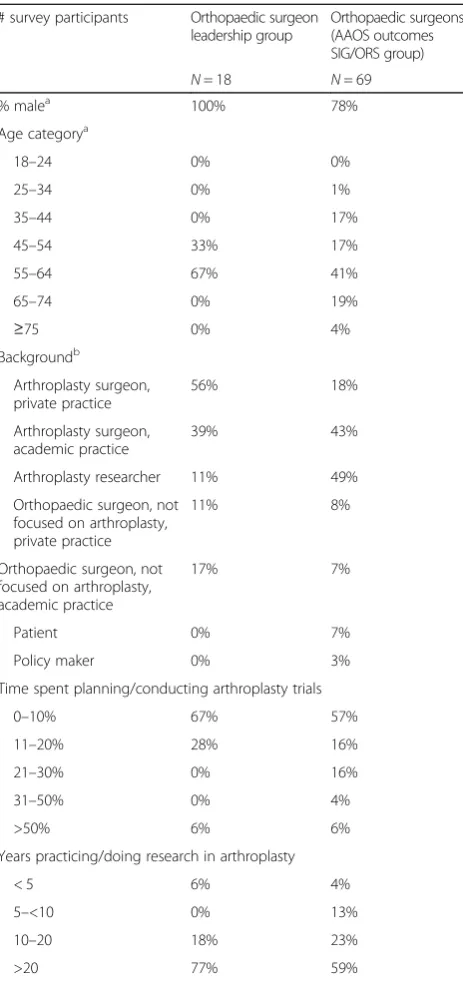
There were 18 survey participants from the IOS group and 69 participants from the AAOS-Outcomes SIG/ORS outcome groups who completed the questionnaire. Of the survey respondents, respectively, 100 and 78% were male, >90% in both were arthroplasty researcher/surgeons, and 67 and 64% were 55 years and older (Table 1).
The pattern of endorsement and ratings of both core do-mains and optional dodo-mains for measurement in arthro-plasty RCTs were similar across the two diverse groups of orthopaedic surgeons (Table 2). All six proposed prelimin-ary core domains of pain, function, patient satisfaction, revision surgery, adverse event and death achieved a median score of 7 or 8 on a 0–9 scale in both groups, i.e., were rated as critically important. The median score for two additional optional domains, patient participation and cost, achieved a median score of 6–6.5 in both groups (Table 2).
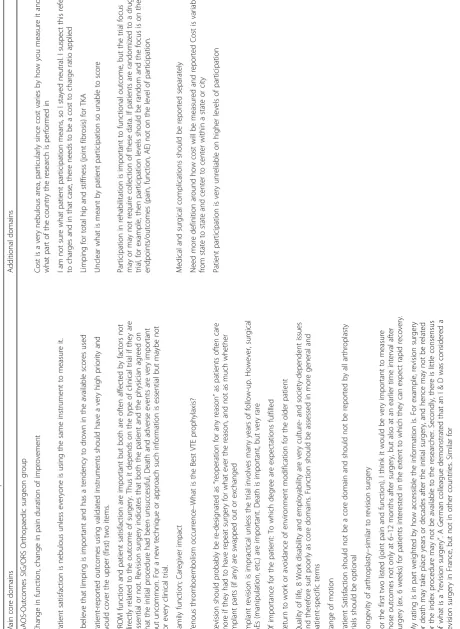
Several important comments were provided by survey respondents, which shed further insight into this issue (Table 3). Additional core domains brought up for con-sideration by 1 respondent each were: caregiver impact; venous thromboembolism occurrence; return to work; quality of life; and range of motion. Some participants commented that the domains of revision (at some speci-fied time/s after TJR) and patient participation (social vs. work) need to be defined clearly.
Discussion
TJR clinical trials often report outcomes that are heteroge-neous and difficult to combine and compare across trials in a systematic review or comparative analysis [4, 5]. This het-erogeneity is not only a major barrier to accurate com-parison between trials but also an impediment to the development of consensus, which is critical for the collective analysis of the important findings that TJR trials may bring. The various international joint re-placement registries have recognized the importance of harmonizing outcome collection and reporting based on expert consensus and have initiated a col-laborative approach to establishing a framework [8]. To date, such an effort has not been completed for a core measurement set in TJR clinical trials.
The OMERACT TJR Working Group, an International group with patient partnership, is pursuing this goal through International collaboration with groups such as the
[image:3.595.306.538.97.589.2]AAOS-Outcome SIG, the ORS, the International Society of Arthroplasty Registries (ISAR), and Functional Outcomes in Total Joint Replacement (FORCE-TJR). In the last few meetings, the OMERACT TJR WG has made significant progress in assembling a multi-stakeholder group and com-pleted the literature reviews examining the frequency of reporting of various domains (pain, function, revision etc.) in TJR clinical trials (Richards B, et al. Outcome measures
Table 1Participant characteristics
# survey participants Orthopaedic surgeon leadership group
Orthopaedic surgeons (AAOS outcomes SIG/ORS group)
N= 18 N= 69
% malea 100% 78%
Age categorya
18–24 0% 0%
25–34 0% 1%
35–44 0% 17%
45–54 33% 17%
55–64 67% 41%
65–74 0% 19%
≥75 0% 4%
Backgroundb
Arthroplasty surgeon, private practice
56% 18%
Arthroplasty surgeon, academic practice
39% 43%
Arthroplasty researcher 11% 49%
Orthopaedic surgeon, not focused on arthroplasty, private practice
11% 8%
Orthopaedic surgeon, not focused on arthroplasty, academic practice
17% 7%
Patient 0% 7%
Policy maker 0% 3%
Time spent planning/conducting arthroplasty trials
0–10% 67% 57%
11–20% 28% 16%
21–30% 0% 16%
31–50% 0% 4%
>50% 6% 6%
Years practicing/doing research in arthroplasty
< 5 6% 4%
5–<10 0% 13%
10–20 18% 23%
>20 77% 59%
a
Missing values for AAOS-Outcome SIG and OMERACT cohorts: sex: 5 vs. none; age, 4 vs. none;b
used in arthroplasty trials: Systematic review of the 2008 and 2013 literature, submitted; Wall P, et al. Do outcomes reported in randomised controlled trials of joint replace-ment surgery fulfil the OMERACT 2.0 Filter? A review of the 2008 and 2013 literature, submitted).
At OMERACT 2014 TJR WG, a preliminary core domain set for TJR clinical trials was developed based on systematic literature reviews, the OMERACT filter 2.0, and two separate surveys at orthopaedic surgery meetings and the OMERACT pre-meeting [6]. This proposed draft TJR core domain set (pain, function, patient satisfaction, revi-sion, adverse events, death, joint-specific quality of life) was discussed with a multi-stakeholder group at OMERACT-2014 TJR WG that included patients who had undergone arthroplasty, orthopaedic surgeons (in an academic setting or community-based practice), psychometricians, physical/ occupational therapists, other clinicians and arthroplasty researchers, and finally endorsed with six core domains [6]. This multi-stakeholder OMERACT group helped develop the draft TJR clinical trial core domain set including experts in the development of clinical trial core domain sets and following a well-described methodology based on a solid framework of the OMERACT filer 2.0 [9–11].
In the current study, both groups of orthopaedic sur-geons achieved consensus on the six TJR clinical trial core domains (scores of 7 or above) and did not propose any new core domains. These are very important findings, since these Delphi involved two groups of orthopaedic surgeons independent of those who had participated in the develop-ment of the preliminary TJR clinical trial core domain set. This is not surprising since this TJR core domain set was developed over several years after multiple systematic re-views and with multi-stakeholder input consisting of ortho-paedic surgeons, patients who had undergone arthroplasty and methodologists who have an extensive experience with developing and validating core domain and measurement
sets. The OMERACT’s philosophy of a multi-stakeholder involvement from the beginning of the process, and a data driven approach, are key to successfully achieving a broad stakeholder consensus on this draft TJR clinical trial core domain set. This evidence indicates that preliminary TJR core domain set initially developed with multi-stakeholder input and endorsed at OMERACT 2014 meeting was endorsed independently by orthopaedic surgeons.
Core domain sets are those domains that should be re-ported in every clinical trial for the condition, regardless of the intervention, as they are critical to the conceptualization of the condition/disease. One must not confuse a core do-main with the primary outcome for each clinical trial, which is always specific to each research question. In some studies, core domain measures will be primary outcome, since they are the focus of the research question; in other studies, they may be secondary study outcomes. Our work indicates that this draft TJR core domain set is now ready for the next phase, namely, the identification and validation of measures that accurately reflect each core domain, and further dis-semination of this TJR core domain set to key stakeholders.
[image:4.595.57.535.99.290.2]We received qualitative feedback from the surveys, which has helped us with further specification of two core domains. One suggestion was to consider any reop-eration, not just revision, due to its relevance to pa-tients- this indicates that the core domain would be revision/reoperation. Another suggestion was to specify whether death was related vs. not procedure-related. With further refinement of the core domains, these two proposals will be the subject of future WG discussions. It is interesting and reassuring that several of domains brought up one participant each (caregiver impact; venous thromboembolism occurrence; return to work; quality of life; and range of motion) were consid-ered previously. Based on Delphi and detailed discus-sions with surgeons, patients and other stakeholders,
Table 2Preliminary core areas/domains for TJR clinical trials
Orthopaedic surgeon leadership group Median [IQR]
Orthopaedic surgeons (AAOS, ORS group) Median [IQR]
Main Domains to be reported in every TJR clinical trial
Joint Pain 8 [8, 9] 8 [7, 9]
Function or functional ability (ability to function in society, work; work productivity, employability;disability;work disability)
8 [8, 8] 8 [7, 9]
Patient Satisfaction (satisfaction with the outcome, satisfaction with the procedure)
8 [7, 9] 8 [7, 8]
Revision surgery 7 [6, 9] 8 [6, 8]
Adverse events 7 [5, 8] 7 [6, 9]
Death 7 [7, 9] 8 [5, 9]
Additional domains for consideration for reporting in TJR clinical trials
Patient Participation 6.5 [5, 7] 6 [5, 8]
they were recommended not for inclusion in the core domain set, since they were not considered to represent an independent core domain, above and beyond the six domains already included.
We noted that both groups independently rated the additional non-core domains (patient participation, cost) as important but not critical; the median scores were 6 to 6.5, appropriately lower than the core domains, since these are not core domains. Non-core domains are those domains that may be additionally reported in a TJR clin-ical trial, depending on the clinclin-ical question being asked. Our study findings must be interpreted with caution, since they may not be generalizable to other groups. Our orthopaedic surgeon samples were 78 and 100% male, which may limit the generalizability of the findings to all surgeons. The gender distribution among ortho-paedic surgeons is not balanced in general. We devel-oped this draft TJR core domain set for clinical trials; it is possible that with validation and future work, this set or a similar set may be endorsed for observational stud-ies as well.
Our study has several strengths, including use of the same survey in two groups of stakeholders, inclusion of both leaders of orthopaedic societies as well as the group of orthopaedic surgeons and researchers from commu-nity and academic practices.
Conclusions
In conclusion, the current study shows further inde-pendent endorsement of the draft TJR core domain set for reporting of TJR clinical trials. The next steps in this process, are a wider endorsement of these by OMER-ACT and/or orthopaedic organizations that we have been collaborating with. This will be followed by the development of a valid, data- and consensus-driven TJR clinical trial core outcome measurement set. Our group will aim to complete this step over the next 2 years. The process will be completed with multi-stakeholder input with a particular emphasis of involvement of patients and TJR surgeons.
Abbreviations
AAOS:American Academy of Orthopaedic Surgeons’Outcome Special Interest Group; NRS: Numeric Rating Scale; OA: Osteoarthritis;
OMERACT: Outcome measures in rheumatology; ORS: Outcome Research Interest Group of the Orthopaedic Research Society; SIG: Special Interest Group; TJR: Total Joint Replacement; TKA: Total knee arthroplasty; WG: Working group; WOMAC: Western Ontario and McMaster Universities Osteoarthritis Index
Acknowledgements
We thank the orthopaedic surgeons for their time and participation in this survey study.
Funding
There is no direct funding for this study. This study was supported by the resources and use of facilities at Birmingham VA Medical Center at Birmingham, Alabama, USA.
Availability of data and materials
These data were collected as a part of this study and were available to us as study Investigators. These data are protected by the HIPAA and patient privacy laws in the United States; no public links are available to these protected health information datasets. These data will be made available to others after appropriate data privacy and human subjects approvals needed by our institution. Requests should be sent to [email protected].
Authors’contributions
All authors have read and approved the manuscript. JS: development of study question and protocol. JS, MD: modification and finalization of study protocol. JS, MD, PC: Data collection. JS: Data programming, data analysis. JS, MD, PC: Interpretation of data analysis. JS: First Draft of manuscript. JS, MD, PC: Critical revisions and approval of the final version of the manuscript.
Authors’information
JAS is the co-chair of the OMERACT TJR Working group assessing the outcome measures in arthroplasty and has served as expert/lead on task forces for the specialty societies and the US FDA. Other authors have no other relevant information.
Each author certifies that his or her institution has approved the human protocol for this investigation and that all investigations were conducted in conformity with ethical principles of research.
“The views expressed in this article are those of the authors and do not necessarily reflect the position or policy of the Department of Veterans Affairs or the United States government.”
Names, Degrees and Academic title:
JA Singh, MBBS, MPH Professor of Medicine and Epidemiology. M Dohm, MD, FAAOS, ABOS Assistant Professor of Orthopaedic Surgery, Assistant Professor of Medicine.
P F Choong, MBBS, MD, FRACS, FAOrthA Professor of Surgery.
Competing interests
JAS has received research grants from Takeda and Savient and consultant fees from Savient, Takeda, Regeneron, Merz, Bioiberica, Crealta and Allergan pharmaceuticals, WebMD, UBM LLC and the American College of Rheumatology. JAS serves as the principal investigator for an investigator-initiated study funded by Horizon pharmaceuticals through a grant to DINORA, Inc., a 501 (c)(3) entity. JAS is a member of the executive of OMER-ACT, an organization that develops outcome measures in rheumatology and receives arms-length funding from 36 companies; a member of the American College of Rheumatology’s (ACR) Annual Meeting Planning Committee (AMPC); Chair of the ACR Meet-the-Professor, Workshop and Study Group Subcommittee; and a member of the Veterans Affairs Rheumatology Field Advisory Committee. MD receives no direct funding and has no financial conflicts. He is a member of the American Joint Replacement Registry (AJRR) and Chairman of the Data Elements Committee as well as an associate member of the International Society of Arthroplasty Registers (ISAR), is a member of the evidence based practice committee for AAHKS and Chairman of the AAOS Outcome Special Interest Group. PC has received consultancy fees from DePuy, Zimmer and Stryker as part of surgeon design or research teams. PC’s institution has received research grant funding from Allergan, DePuy and Medacta. None of the authors have any non-financial disclosures. JAS is a Section Editor for BMC Musculoskeletal Disorders.
Consent for publication Not applicable.
Ethics approval and consent to participate
This was a study of orthopaedic surgeons participating in the AAOS-Outcomes SIG or the ORS meeting or the IOS group, and not patients. No ethical approval was needed for collecting opinions from orthopaedic surgeons attending special interest group meetings, regarding TJR trial core domains. The surgeons provided implicit consent by voluntarily completing the survey.
Author details
1University of Alabama at Birmingham, Birmingham, AL, USA.2Birmingham
Veterans Affairs Medical Center, Birmingham, AL, USA.3Department of Orthopaedic Surgery, University of Arizona, Tucson, AZ, USA.4Department of
Surgery, University of Melbourne, Melbourne, Australia.5Department of
Received: 10 October 2016 Accepted: 16 January 2017
References
1. Kurtz S, Ong K, Lau E, Mowat F, Halpern M. Projections of primary and revision hip and knee arthroplasty in the United States from 2005 to 2030. J Bone Joint Surg Am. 2007;89:780–5.
2. Healthcare Cost and Utilization Project (HCUP). HCUP Facts and Figures 2009- Section 3: Inpatient Hospital Stays by Procedure. Exhibit 3.1 Most Frequent All-listed Procedures. Rockville: Agency for Healthcare Research and Quality; 2012. Updated February 2012. http://hcup-us.ahrq.gov/reports/ factsandfigures/2009/pdfs/FF_2009_section3.pdf. 10 Feb 2014.
3. Ethgen O, Bruyere O, Richy F, Dardennes C, Reginster JY. Health-related quality of life in total hip and total knee arthroplasty. A qualitative and systematic review of the literature. J Bone Joint Surg Am. 2004;86-A:963–74. 4. Riddle DL, Stratford PW, Bowman DH. Findings of extensive variation in the types of outcome measures used in hip and knee replacement clinical trials: a systematic review. Arthritis Rheum. 2008;59:876–83.
5. Riddle DL, Stratford PW, Singh JA, Strand CV. Variation in outcome measures in hip and knee arthroplasty clinical trials: a proposed approach to achieving consensus. J Rheumatol. 2009;36:2050–6.
6. Singh JA, Dohm M, Sprowson AP, Wall PD, Richards BL, Gossec L, et al. Outcome Domains and Measures in Total Joint Replacement Clinical Trials: Can We Harmonize Them? An OMERACT Collaborative Initiative. J Rheumatol. 2015;42(12):2496–502.
7. Singh JA, Dohm M. Towards Consensus on the Reporting of Core Outcome Domains in Total Joint Replacement Clinical Trials: The Derivation of the Preliminary Core Outcome Domain Set. J Arthritis. 2016;5:6.
8. Rolfson O, Wissig S, van Maasakkers L, Stowell C, Ackerman I, Ayers D, et al. Defining an International Standard Set of Outcome Measures for Patients with Hip or Knee Osteoarthritis: Consensus of the International Consortium for Health Outcomes Measurement Hip and Knee Osteoarthritis Working Group. Arthritis Care Res (Hoboken). 2016;68:1631–9.
9. Boers M, Kirwan JR, Wells G, Beaton D, Gossec L, d’Agostino MA, et al. Developing core outcome measurement sets for clinical trials: OMERACT filter 2.0. J Clin Epidemiol. 2014;67:745–53.
10. Boers M, Kirwan JR, Gossec L, Conaghan PG, D’Agostino MA, Bingham 3rd CO, et al. How to choose core outcome measurement sets for clinical trials: OMERACT 11 approves filter 2.0. J Rheumatol. 2014;41:1025–30.
11. Singh JA, Taylor WJ, Simon LS, Khanna PP, Stamp LK, McQueen FM, et al. Patient-reported outcomes in chronic gout: a report from OMERACT 10. J Rheumatol. 2011;38:1452–7.
• We accept pre-submission inquiries
• Our selector tool helps you to find the most relevant journal
• We provide round the clock customer support
• Convenient online submission
• Thorough peer review
• Inclusion in PubMed and all major indexing services
• Maximum visibility for your research
Submit your manuscript at www.biomedcentral.com/submit