Evaluation of the Knowledge of Science Teachers with
Didactic Transposition Theory
Fatma Bulut Atalar
1, Mustafa Ergun
2,*1OMÜ Foundation Private Secondary School, Samsun, Turkey
2Science Education Department, Faculty of Education, Ondokuz Mayis University, Samsun, Turkey
Copyright©2018 by authors, all rights reserved. Authors agree that this article remains permanently open access under the terms of the Creative Commons Attribution License 4.0 International License
Abstract
The quality of the process of teaching is related to the behaviors shown by the teacher and their capability. In cases where teachers who have different training are expected to teach the same topic, teachers may make some alterations in the topics in question. Turkish education system has teachers who have different training but teach the same subject. Transposition is an institutional framework which is concerned with transformation of the knowledge given in schools from its status as didactic scientific knowledge to learned knowledge. The purpose in this study is to determine the factors influential on the process of transformation from knowledge to be taught to knowledge that is taught that are caused by science teachers. In this context, this study was conducted with 5 science teachers with different training and a total of 159 students of these teachers at 7th grade. Interviews were held with the science teachers and students on the subjects of electron configuration and chemical properties and chemical bonds, and their classes were recorded. As a result of the collected data, it was concluded that the science teachers with different training take the curricula into consideration while transforming the knowledge to be taught, and this transformation was affected by the department they graduated from.Keywords
Science Education, Didactic Transposition, Science Teacher, Electron Configuration, Chemical Bonds, Turkey1. Introduction
The quality of the process of learning-teaching is related to the behaviors shown by the teacher and their capability. Qualifications of the teacher are primary factors that affect the efficiency of this process significantly. Turkish education system has different teacher profiles that attend the science courses in middle school. These teachers who are employed in middle schools graduate from the departments of Science Teaching at faculties of education at universities. Additionally, people who have graduated
from different departments (physics, chemistry, biology, agriculture, environment, etc.) of different faculties (science, science-letters, engineering, etc.) and have different professions can also work as science teachers in middle schools by getting a field training certificate. For example, current science teachers include those who completed a chemistry degree, received a field training certificate and attend science courses in a middle school. The field knowledge and professional capacity of science teachers who teach the same course are related to not only their individual skills, but also the education and training they received from the department they graduated from. It would not be mistaken to expect that teachers graduated from different departments who teach the same course transfer the information in the curriculum to students in different ways. In this context, this difference in situations may be explained especially by the concept of the didactic, didactic transposition theory and anthropological theory of the didactic [1]. The word didactic corresponds to different meanings in different languages. The word didactic used in this study may be attributed to its meanings in German and French. In French, the noun “didactique” refers to the science that takes the teaching of disciplined knowledge as its subject. The phenomena that are relevant to the didactique of a science are those that pertain to its dissemination [2, 3].
Chevallard [4] explained the term Didactic Transposition by starting with studies that are conducted in the field of mathematics teaching [5]. However, today, it has become a theory that is used not only in the field of mathematics, but also in the fields of language, philosophy, social sciences, music, physics teaching, technology, and science [6-21].
Figure 1. Diagram of the process of didactic transposition [22]
Didactic transposition theory introduces distinctions among: (1) scholarly scientific knowledge, as it is produced by scientists (2) knowledge to be taught officially, as prescribed by the curriculum; (3) knowledge as it is actually taught by teachers in the classroom; and (4) knowledge as it is actually learnt by students. Figure 1 illustrates various steps involved in didactic transposition [22].
The didactic transposition process can be understood as a set of changes that knowledge suffers, the academic sphere (scientific knowledge) of the school environment, in two stages: external (produces the knowledge to be taught) and internal (produces taught to know).
In didactic transposition theory, transpositions related to the teacher are divided into two sections as external and internal transpositions. External didactic transposition is described as “transition from scientific knowledge to knowledge to be taught”, while internal didactic transposition is described as “transition from knowledge to be taught to taught knowledge.” External didactic transposition covers exposure of the scientific knowledge to various changes during its transition from scientific knowledge to knowledge to be taught. Internal transposition covers all internal effects and transpositions in an education system which turns knowledge to be taught into learnt knowledge.
The Anthropological Theory of the didactic approach developed by Chevallard [1, 23] discussed the constituents object, individual, institution and the interrelations among these.
Object: It is denoted by the letter O and constitutes all there is (tangible and intangible) for at least one person. In this case, anything can be an object: any subject or concept (chemical bond, acid, temperature, heat, cell, and weight), any number (pi), the concept of family, or emotions (excitement and fear).
Individual: It is denoted by the letter X and every person may be defined as an individual (baby, student, teacher, janitor, school principal).
Institution: It is denoted by the letter I. It is an order which teaches or imposes on its students the ideas and knowledge of itself and has genuine methods and rules (school, religion, science course, family)
In a school environment in general, the object is knowledge, the student or the teacher is the individual, and the classroom, the class or the school is the institution. According to this theory, there are two types of recognizing, knowing something, or in general, an object: personal relation and institutional relation.
When an object O starts existing for an individual X, X recognizes O and develops a personal recognition towards O. A person’s personal recognition of any object is shown as R(X, O) and this states that the individual X recognizes O. In time, personal recognitions of X change and develop, or in clearer words; objects that did not use to exist for X start to exist, and X’s personal recognition changes for the objects that already exist [17].
In Anthropological Theory of the Didactic, learning is expressed as the change in the personal recognition of an individual X for O. This change means the beginning of existence where there is no personal recognition, and development of existence where there is personal recognition. This learning does not change the individual, but their knowledge. In order to talk about learning in the anthropological theory, one should involve institutional relation in this theory.
If any object O is recognized by any institution I, this O is an object in I, and the institution I has an institutional relation to the object O which is shown as R(I,O) [17]. When an individual X enters an institution I, they become an element of the institution I. The personal relation of X who is an element of the institution I to an object O, namely R(X,O), will change and develop under the conditions of R(I,O), which is the institutional relation of I to O. In this case, learning will occur when the formula R(X,O) changes.
[image:2.595.127.468.80.138.2]misconceptions about chemical bonds and the structure of matter [27-32].
2. Purpose
The general objective in this study is to determine the factors that arise from science teachers influential on the process of transforming “knowledge to be taught” into “learnt knowledge” based on didactic transposition theory.
The study consists of the following sub-questions: 1. How is the relationship between the field
knowledge of science teachers related to the subjects of electron configuration and chemical bonds and curricula?
2. What is the influence of the departments science teachers graduate from on the transformation of knowledge that occurs on the level of the teacher in the subjects of electron configuration and chemical bonds?
3. Is there an effect of the professional experiences of science teachers on the transformation of knowledge that occurs on the level of the teacher in the subjects of electron configuration and chemical bonds?
For this purpose, the subjects to be investigated were chosen as electron configuration and chemical properties and chemical bonds in the unit structure and properties of matter. The reason for choosing these science subjects as the subjects of study are the following;
The subjects of the atom and chemical bonds are dependent on abstract concepts
There are subjects that are open to misconceptions as students might not be able to construct correct images in these (which may be because of the expressions or drawings of the teacher)
Teachers are obliged to consider restrictions in subject instruction based on the curriculum. The term restriction here refers to taking into consideration the class levels of targeted learning outcomes.
3. Method
The model in this study was chosen as the qualitative research method of case study, which is suitable for the problem of the study and the data collection process. A case study is the in-depth analysis and interpretation of one or more events, settings, programs, social groups, communities, individuals or localized systems [33]. The process of qualitative research is a process where different data collection methods such as observation, interview and document analysis are used, and events are presented in their natural environment in a realistic and comprehensive manner [34]. While the qualities that qualitative research techniques should have are discussed in the literature under different titles [35-37], the most frequently encountered
qualities are that they encourage sensitivity to the natural environment, the researcher has a participatory role, the study has a comprehensive approach, they facilitate revelation of perceptions, flexibility is provided for the study design, and the analyses are inductive [34].
3.1. Sample
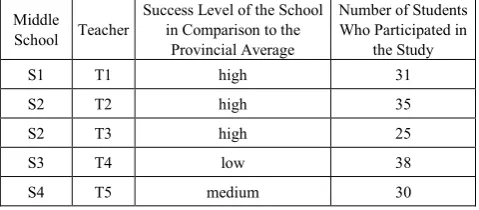
[image:3.595.302.541.303.406.2]The sample of this study consisted of 5 science teachers employed at 4 different middle schools in the central district of a metropolitan province in the Black Sea Region in Turkey, and a total of 159 students in their classes at 7th grade. As seen in Table 1, attention was paid to choose the 5 teachers such that they would have different departments of graduation and levels of experience. Additionally, the average success levels of their schools in the high school placement examinations were also different (Table 2).
Table 1. Information on the Teachers in the Sample Institution of
Graduation Department of Graduation Teacher Professional Experience Institute of
Pedagogy Physics, Chemistry, Biology (PCB) T1 31 years Faculty of
Science
Chemistry T2 17 years
Biology T3 18 years
Faculty of Education
Chemistry Education T4 13 years
Science Education T5 9 years
The teacher T1 was employed at the institution S1, which had higher success levels in the high school placement examinations in comparison to the provincial average. The teachers T2 and T3 worked at the institution S2, which had higher success levels in comparison to the provincial average. The teacher T4 worked at the institution S3, which had lower success levels in comparison to the provincial average. The teacher T5 worked at the institution S4, which had mid-level success levels in comparison to the provincial average.
Table 2. Success Levels of the Schools in the Study in Terms of the High School Placement Examinations
Middle
School Teacher
Success Level of the School in Comparison to the
Provincial Average
Number of Students Who Participated in
the Study
S1 T1 high 31
S2 T2 high 35
S2 T3 high 25
S3 T4 low 38
S4 T5 medium 30
3.2. Data Collection
The study was conducted on the subjects of electron configuration and chemical properties and chemical bonds
in the middle school science curriculum.
[image:3.595.302.542.559.664.2]were recorded on the days and times decided upon with the teachers and 8 class hours of each teacher were observed by the researcher. The lectures were recorded on video. All audio recordings were carried onto the computer environment and transcribed. While the analysis used only the audio recordings, the videos were not analyzed. For each of the observed teachers, the researcher filled out the science teaching field specialty proficiency form prepared by the Turkish Ministry of National Education (MoNE).
At the third stage, the teachers were asked to respond to the interview questions. During the interviews, the teachers were asked how they defined some key concepts chosen from the relevant class subjects (atom, molecule, electron, shell, ion, chemical bond, ionic bond, covalent bond) in a way that is suitable for the level of students. At the end of the class, the researcher applied the questionnaire prepared for the students. This questionnaire consists of six questions. While one of these questions is about the training of the teacher, the others are related to students’ evaluation of the teacher’s behaviors during class.
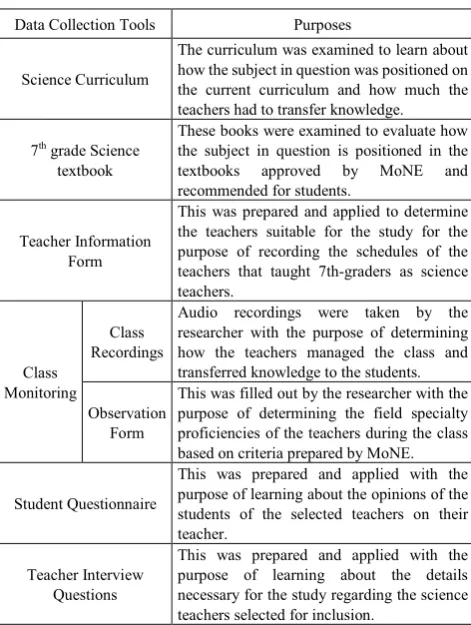
[image:4.595.301.538.340.553.2]This study, while the teachers were analyzed based on transposition theory, used different sources of data as the science curriculum, the science textbook, teacher interview questions, class recordings, student questionnaires and the science teacher field specialty proficiency form (Table 3).
Table 3. Data Collection Tools and Their Purposes
Data Collection Tools Purposes
Science Curriculum
The curriculum was examined to learn about how the subject in question was positioned on the current curriculum and how much the teachers had to transfer knowledge.
7th grade Science
textbook
These books were examined to evaluate how the subject in question is positioned in the textbooks approved by MoNE and recommended for students.
Teacher Information Form
This was prepared and applied to determine the teachers suitable for the study for the purpose of recording the schedules of the teachers that taught 7th-graders as science teachers.
Class Monitoring
Class Recordings
Audio recordings were taken by the researcher with the purpose of determining how the teachers managed the class and transferred knowledge to the students.
Observation Form
This was filled out by the researcher with the purpose of determining the field specialty proficiencies of the teachers during the class based on criteria prepared by MoNE.
Student Questionnaire
This was prepared and applied with the purpose of learning about the opinions of the students of the selected teachers on their teacher.
Teacher Interview Questions
This was prepared and applied with the purpose of learning about the details necessary for the study regarding the science teachers selected for inclusion.
3.3. Data Analysis
Class monitoring and researcher observation were taken as the basis while analyzing the data in the study. The teacher interview questions and field specialty proficiency ratings were also taken into account while analyzing the responses of the students to the questions in the questionnaire. The analysis used the concepts included in the Anthropological Theory of Didactics approach developed by Chevallard [5]. The concepts adapted to the study in this context are given in Table 4.
According to the table given below the formulae of the relations of the participant teachers to the subject they would teach are given below;
[image:4.595.56.292.395.708.2]In general R(X1, F), in specific R(X1, E) and R(X1, K) In general R(X2, F), in specific R(X2, E) and R(X2, K) In general R(X3, F), in specific R(X3, E) and R(X3, K) In general R(X4, F), in specific R(X4, E) and R(X4, K) In general R(X5, F), in specific R(X5, E) and R(X5, K) Table 4. Anthropological Theory of Didactics Concepts Included in the Study (Object, Individual and Institution)
Institution Individual (teacher) Object (subject)) School
Code Code Training Type of Code Subject
I1 X1 M1 F Science Education
I2 X2 M2 E
Electron Configuration and Chemical Properties
I2 X3 M3 K Chemical Bonds
I3 X4 M4
I4 X5 M5
F: Science education
E: Electron configuration and chemical properties K: Chemical bonds
I: The school which employs the teacher X: The teacher
M: The type of the teacher’s training
As the subject chosen for the study is in scope of the science course, while the statement R(X1,F) was expressed as in general, the statements R(X1,E) and R(X1,K) were expressed as in specific while relating based on the subjects of the relevant topics. Here, the formulae R(X1,E) and R(X1,K) are used to express the relation of the teacher X1 with the subjects of electron configuration and chemical properties and chemical bonds, and the formula R(X1,F) is used while making generalizations in science.
In general R(I1,F) In general R(I2,F) In general R(I3,F) In general R(I4,F)
The formula R(I1,F) denotes the relation of the teacher coded as X1 to the science education at the institution they work for. The other formulae work the same based on the relation of the institutions to science education. As two of the teachers worked at the same institution, 4 different schools were formulized.
Formulae of the relations of graduated departments for the science teachers; In general R(X1,M1)
In general R(X2,M2) In general R(X3,M3) In general R(X4,M4) In general R(X5,M5)
The formula R(X1, M1) denotes the relation of the teacher coded as X1 to the department they graduated from. The other formulae work the same based on the relations of five teachers to the departments they graduated from.
Formulae of the teacher-school relations based on the relations of the teachers to their science education in general; In general R(X1,F) ~ R(I1,F)
In general R(X2,F) ~ R(I2,F) In general R(X3,F) ~ R(I3,F) In general R(X4,F) ~ R(I4,F) In general R(X5,F) ~ R(I4,F)
The formula R(X1,F) ~ R(I1,F) describes the compliance between the general science education of the teacher coded as X1 and the relation of the institution they work for to science education. If the level of science education of the teacher is high and the general level of science education at the institution they work for is also high there is compliance in R(X1,F) ~ R(I1,F). The other formulae also describe the compliance between the teachers’ and their institutions’ science education in general.
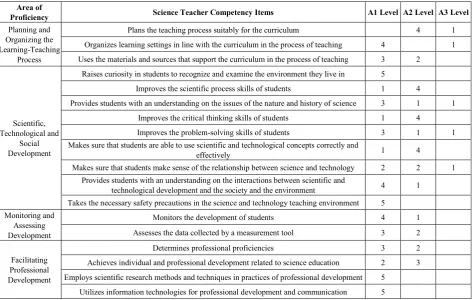
The observation form that was used in the study was prepared by selecting 18 suitable competency criteria from among 24 criteria described in the science teacher competency document prepared by the Directorate of Training and Education of Teachers, MoNE. For each criterion, performance indicators of A1, A2, and A3 were determined. These performance indicators are detailed as the following:
A1 level: This covers the awareness of the teacher in
their practices regarding the curriculum and their basic knowledge, skills and attitudes towards the profession of teaching.
A2 level: In addition to the knowledge and awareness of the teacher on A1 level, this covers performance indicators where the teacher applies the curriculum correctly via the experiences they have gained in their practices in the process of instruction, differentiates their practices and considers the interests and needs of students.
A3 level: This covers the performance indicators that
necessitates the teacher to differentiate their practices that they improved on A2 level by considering different variables of teaching. A teacher who has performance indicators on this level may contribute to their field by novel practices based on their genuine interpretation, and constantly collaborate with their colleagues, parents of students, civil society organizations and other institutions [38].
4. Findings
Considering the explanations to the key concepts asked in the interview form by T1, who was the most professionally experienced teacher and graduated from PCB, it was found that the teacher used long and
complicated statements in their explanations, these statements were higher than the level of the science curriculum, and they contained concepts that cover the subjects taught in a higher grade which would challenge the levels and readiness of students. It was seen that T2 described the same concepts with simple and short sentences. Providing key concepts with such little explanation may create difficulties in understanding of the concepts and comprehension of the subject by students. It was observed that T2 described the concepts they explained in the interview form in a way that was different, shorter and careless than the way they explained them in the classroom. On the other hand, T3 and T5 explained the same concepts in simple sentences, and in suitability with the textbook, student levels and the curriculum. It was understood through in-class observations that T4 also used simple statements while describing the concepts in question, but they employed terms (non-metal, orbital) and expressions (electrical attraction force) that are not used at 7th grade for some concepts (covalent bond and shell). As stated by T4 in the interview form, they found the description of chemistry subjects in the textbook insufficient and transferred the knowledge they had to their students by reducing it. It was found that the concepts provided by T4 during class were not limited to the textbook, and even on a higher level.
21% of T1’s students, 68% of T3’s students and 42% of T4’s students responded as ‘yes’ to the question in the questionnaire “Do you know which department your teacher graduated from?” The response by the students of T2 and T5 was ‘no’ by 100%. It is understood from this that students had no awareness of what kind of training their teachers had.
was ‘yes’ by 90% of T1’s students, 96% of T3’s students, 97% of T5’s students, and 100% of T2’s and T4’s students. This suggests that students thought their teacher managed the class in a way that is suitable for their levels.
The students were asked the question “Which of the physics, chemistry and biology subjects does your teacher teach better?” T1’s students responded as chemistry by 40%, biology by 50% and physics by 10%. For T2, this was 42% chemistry, 29% biology and 29% physics. For T3, this was 34% chemistry, 36% biology and 29% physics. For T4, this was 36% chemistry, 34% biology and 30% physics. For T5, this was 44% chemistry, 24% biology and 32% physics. Considering the responses in general, it is seen that the teachers were perceived by the students as teaching the subjects better in chemistry by 41%, biology by 33% and physics by 26%. Considered both in general and individually, it is seen that chemistry subjects were taught better by the teachers.
The responses to the question “In which subjects does your teacher actively include you in the classroom?” were chemistry by 38%, biology by 33%, and physics by 29%. The responses by the students indicate that the teachers included students more actively in chemistry subjects.
The responses to the question “Are your teacher able to
comfortably respond to you when you want details of a subject or ask questions?” were ‘yes’ by 74% of T1’s students, 94% of T2’s students, 92% of T5’s students, and 100% of T3’s and T4’s students. In general, the students thought that they received answers to questions they ask of their teachers or obtained detailed information on the subject.
The answers to the question “Is there an additional source you utilize in classes?” were ‘yes’ by 42% of T1’s students, 51% of T2’s students, 32% of T3’s students, 95% of T4’s students and 23% of T5’s students. The general overview of the cases shows that additional source usage in the classroom varied by teachers. It was observed that usage of additional sources decreased as there were no questions in the high school placement examinations from the subjects in 7th grade and teachers are prohibited from using sources except the textbooks provided by MoNE.
[image:6.595.63.536.397.697.2]The science teacher competency levels of all the teachers in the sample are given in Table 5. Accordingly, it was observed based on the frequency of the teacher’s proficiencies that there were 54 proficiencies at A1 level, 31 proficiencies at A2 level, only 5 proficiencies at A3 level, and all of these 5 proficiencies belonged to the same teacher.
Table 5. Frequencies of the Science Teacher Competency Levels of the Teachers in the Sample Area of
Proficiency Science Teacher Competency Items A1 Level A2 Level A3 Level Planning and
Organizing the Learning-Teaching
Process
Plans the teaching process suitably for the curriculum 4 1
Organizes learning settings in line with the curriculum in the process of teaching 4 1
Uses the materials and sources that support the curriculum in the process of teaching 3 2
Scientific, Technological and
Social Development
Raises curiosity in students to recognize and examine the environment they live in 5
Improves the scientific process skills of students 1 4
Provides students with an understanding on the issues of the nature and history of science 3 1 1
Improves the critical thinking skills of students 1 4
Improves the problem-solving skills of students 3 1 1
Makes sure that students are able to use scientific and technological concepts correctly and
effectively 1 4
Makes sure that students make sense of the relationship between science and technology 2 2 1 Provides students with an understanding on the interactions between scientific and
technological development and the society and the environment 4 1
Takes the necessary safety precautions in the science and technology teaching environment 5 Monitoring and
Assessing Development
Monitors the development of students 4 1
Assesses the data collected by a measurement tool 3 2
Facilitating Professional Development
Determines professional proficiencies 3 2
Achieves individual and professional development related to science education 2 3 Employs scientific research methods and techniques in practices of professional development 5
5. Conclusions
In scope of the first research question, the relationship between the field knowledge that the teachers had on the subjects of electron configuration and chemical bonds and the content of the curricula was investigated. As a result of the responses by the teachers on the explanation of key concepts of the subject in question in the interviews, it was concluded that the teachers usually explained the concepts in suitability with the curriculum, and the teachers who graduated from the departments of chemistry and chemistry teaching taught these concepts in more detail. As the subjects chosen in the study is in the branch of chemistry, the departments that the teachers in the sample graduated from generally presented compliance between R(X2,E), R(X2,K) and R(X2,M2), and between R(X4,E), R(X4,K) and R(X4,M4). While the teachers in the study were seen to rather take the curriculum as a basis while preparing for the class, they preferred the curriculum, the textbook and test books in this order in the process. Student questionnaire results revealed that the subject in question was generally taught by the teachers appropriately for the levels of students. The teachers stated that they considered the targeted outcomes and behaviors included in the curriculum, and they did not have difficulties in transferring these goals and outcomes to the students. It was observed that the subject in question was suitable for 7th-grade students, and while the teachers in the study were careful not to wander off outside the curriculum, they went beyond the curriculum on some occasions for the subject to be understood more clearly. The fact that the national examinations contain only the subjects of 8th grade did not cause any change in the way of teaching the subject for any of the teachers.
Regarding the second research question, the effects of the departments that the teachers graduated from on the transformation of knowledge on the level of the teacher in the subjects of electron configuration and chemical bonds
were investigated. According to the results of the student questionnaire, it was understood that the subject in question was taught by the teachers in suitability for the levels of the students, while the teachers who graduated from departments of chemistry and chemistry teaching taught chemistry subject better and included students more actively regarding chemistry subjects among other science subjects. Based on this result, it was concluded that there were differences in the subjects discussed by the teachers based on the departments they graduated from, and they taught the subjects related to their own field in more detail. It was found that the teachers in the study found the textbook insufficient for the subject in question, and the teacher who graduated with a chemistry teaching degree also transferred their own knowledge to students because of the insufficiency of information in the textbook. It is seen that the departments that the teachers graduated from
were generally in compliance with R(X2,F)~R(M2,F) and R(X4,F)~R(M4,F) in the science education subjects according to anthropological didactics. This result is in parallel with the results obtained by the other data collection tools. While the relation of the teachers to their institutions was generally in compliance with R(X2,F)~R(I2,F), it was not in compliance with R(X4,F)~R(I4,F). The reason why it was not in compliance with R(X4,F)~R(I4,F) is believed to be due to other parameters in the study (student level, physical conditions, etc.). Additionally, as the condition R(X3,M3) affected R(X3,F) negatively, R(X3,F)~R(M3,F) and R(X3,F)~R(I3,F) could not be internally compliant.
According to the results obtained by the form filled out by the researcher based on observations towards the same research question, it was seen that the teacher with the highest proficiency was the one who was a graduate of chemistry teaching, while the least proficient teacher was the one who was a graduate of biology. It is believed that the teacher with a chemistry teaching degree had high proficiency because they were a graduate of an education faculty and the subject of the study was chosen from within the branch of chemistry.
Regarding the third problem, the effects of the professional experience of the teachers on the transformation of knowledge on the level of the teacher in the subjects of electron configuration and chemical bond
were investigated. It was observed that the teacher with a longer experience in their profession provided more examples that were also suitable for the levels of the students, and they made more repetitions in teaching the subject in question in comparison to the other teachers. It was observed that the teachers with shorter professional experience usually utilized examples in the textbook or on contemporary issues. Most students who participated in the questionnaire preferred young teachers, and as the reason for this, they stated that they felt closer to young teacher, they spoke the same language together, and such teachers are more active and youthful. Those who preferred more experienced teachers thought that such teachers had a better comprehension of the subject as they had more experience. The class monitoring activities of the researcher revealed that the number of years of experience for the teachers did not present an effect on their professional proficiencies that can be noticed clearly, and differences arose from the students, the setting and individual experiences.
6. Discussion and Recommendations
the properties of selected chemistry concepts were revealed under the same theoretical framework. The data obtained in the study were analyzed under three separate contexts.
Firstly, the study found that, while the teachers frequently referred to the curriculum as a basis while preparing the class, they preferred the curriculum, the text book and test books in this order in the process. As stated by Yıldırım [35], it is seen that concepts used in the processes of planning and managing classes are restricted primarily by the science curriculum, and then the textbooks. Additionally, the study by Kaya & Ergun [21] reported that teachers who were employed at different schools and stated that they used the curriculum as a reference reflected their classes in different ways. The data in this study were in line with their results.
Secondly, the proficiency level of the teacher in the study who was a graduate of chemistry teaching was found to be higher in comparison to the others. It is believed that the teacher with a chemistry teaching degree had high proficiency because they were a graduate of an education faculty and the subject of the study was chosen from within the branch of chemistry. While there are studies in the literature which reported that the interpersonal self-efficacy beliefs of science teachers did not change significantly based on variables of gender and city but there were significant differences based on their experience and the institutions that they graduated from [41], these were in parallel to this study. Finally, the class monitoring activities of the researcher revealed that the number of years of experience for the teachers did not present an effect on their professional proficiencies that can be noticed clearly, and differences arose from the students, the setting and individual experiences. Önen and Öztuna [42] investigated the feelings of self-efficacy of science and mathematics teachers working at middle schools based on their professional experience, and it was found that the self-efficacy levels of science teachers based on experience levels were close to each other. The study [43] found that the self-efficacy levels of actively working science and form teachers towards science education did not have significance differences based on their experience levels.
Elaborating on the results obtained in this study, firstly, it may be recommended that this study is repeated in the future with teachers who graduated from different departments. It may be recommended for the Ministry of National Education to provide these teachers who graduated from different departments but teach the same subject and fill these gaps. Additionally, it may be recommended that this study conducted with science subjects is applied in other fields, too.
Acknowledgements
This study is a part of the first author’s master's thesis and this work was supported by OMU-BAP
(PYO.EGF.1904.11.002).
REFERENCES
[1] Y. Chevallard. Concepts fondamentaux de la didactique: perspectives apportées par une approche anthropologique [Fundamental concepts in didactics: Perspectives provided by an anthropological approach]. Recherches en Didactique des Mathématiques, vol. 12(1), 73-112, 1992.
[2] P. Clément. La recherche en didactique de la biologie [Research in the didactics of biology]. In P. Clément, H.-R. Dahmani & F. Khammar (Eds.), Didactique de la biologie. Recherches, innovations, formations (pp. 11-28). Blida, Algérie: Ecole Nationale Supérieure de l'Hydraulique, 2000. [3] M. Artigue & C. Winslow. International comparative studies on mathematics education: A viewpoint from the anthropological theory of didactics. Recherches en Didactique des Mathematiques, 30(1), 47-82, 2010.
[4] Y. Chevallard. La transposition didactique - Du savoir savant au savoir enseigne [Didactic transposition: From scholarly knowledge to taught knowledge]. Grenoble: La Pensée sauvage, 1985.
[5] Y. Chevallard & M.-A. Johsua. Un Exemple D’analyse De La Transposition Didactique: La Notion De Distance, Recherche En Didactique Des Mathématiques, 3(2), pp. 157-239, 1982.
[6] M. Abrougui. La génétique humaine dans l’enseignement secondaire en France et en Tunisie. Unpublished Doctorat Thesis, Université Claude Bernard- Lyon I, Lyon, France, 1997.
[7] M. Chatoney. Sciences Technologie à l’école. Etude des pratiques en Technologie. Université de Provence AixMarseille, UFR de Psychologie et Sciences de l’éducation. Unpublished Master thesis, Marseille, France, 1999.
[8] M. Yıldırım. Le Concept De Chromosome Dans
L’enseignement Génétique En France et En Turquie Dans L’enseignement Sécondaire. Approche Didactique”, unpublished master thesis. Université Réné Descartes-Paris 5. Faculté des Sciences Humaines et Sociales- Sorbonne. Paris, France, 2002.
[9] L. Ravel. des programmes a la classe: etude de la transposition didactique interne. exemple de l’arithmétique en terminale S spécialité mathématique. Unpublised doctorat thesis. Université Joseph Fourier, France, 2003.
[10] S. Özgür. Analyse de la transposition didactique en turquie des institutions noosphériennes à l’enseignant, l’enseignement de la digestion humaine au collège. Unpublished doctorat thesis, Université Joseph Fourier. Grenoble, France, 2004.
[11] F.Ç. Pelitoğlu. İlköğretim 6. sınıf Sindirim Sistemi Konusunun Transpozisyon Didaktik Teorisine Göre İncelenmesi. Unpublished master thesis, Balıkesir
Üniversitesi, Fen Bilimleri Enstitüsü, Balıkesir, 2006.
[12] B.T. Khánh Hằng. Une étude didactique de la vie de
et savoirs de la formation universitaire, peuvent-ils être source de difficultés pour les enseignants? Unpublised doctorat thesis. Université Joseph Fourier, France-Université de Pedagogie de Ho Chi Minh Ville – Vietnam, 2005.
[13] M.P. Quessada & P. Clement. Introduction du concept d’évolution humaine buissonnante dans les manuels scolaires de sciences de la vie et de la terre de terminal scientifique, Actes Rencontres de l'ARDIST (Association pour la Recherche en Didactique des Sciences et des Techniques) (pp. 293-300). Lyon: INRP, 2005.
[14] V. Diaz & A. Poblete. A Model of Professional Competences in Mathematics to Update Mathematical and Didactic Knowledge of Teachers, International Journal of Mathematical Education in Science and Technology, 48(5), 702-714, 2017.
[15] N. M. Gericke, M. Hagberg, V. C. Santos, L.M. Joaquim, C.N. El-Hani. Conceptual Variation or Incoherence? Textbook Discourse on Genes in Six Countries, Science & Education, 23(2), 381-416, 2014.
[16] P. Maurício, B. Valente, I. Chagas. A Didactic Sequence of Elementary Geometric Optics Informed by History and Philosophy of Science, International Journal of Science and Mathematics Education, 15(3), 527-543, 2017.
[17] P. Frejd & C. Bergsten. Mathematical modelling as a professional task. Educational Studies in Mathematics, 91(1), 11-35, 2016.
[18] K. Corbett. Gender, identity and culture in learning physics, Cultural Studies of Science Education, 11(2), 371-378, 2016.
[19] D. L. Banegas. Sharing Views of CLIL Lesson Planning in Language Teacher Education, Latin American Journal of Content and Language Integrated Learning, 8(2), 104-130, 2015.
[20] F. Darnis & L. Lafont. Cooperative learning and dyadic interactions: two modes of knowledge construction in socio-constructivist settings for team-sport teaching. Physical Education and Sport Pedagogy, 20(5), 459-173, 2015.
[21] G. Kaya & M. Ergun. An Investigation of the Particulate Nature of Matter Unit according to Didactic Transposition Theory, Elementary Education Online, 11(4), 1101-1120, 2012.
[22] M. Bosch & J. Gascon. Twenty-Five Years of Didactic Transposition, ICMI Bulletin, 58, ss. 51-65, 2006.
[23] Y. Chevallard. L’analyse des pratiques enseignantes en anthropologie du didactique. Recherches en Didactique des Mathématiques, vol. 19(2), 221-265, 1999.
[24] S. Ünal. Lise 1 ve Lise 3 Öğrencilerinin Kimyasal Bağlar
Konusundaki Kavramları Anlama Seviyelerinin Karşılaştırılması, Yayınlanmamış Yüksek Lisans Tezi.
Trabzon: Karadeniz Teknik Üniversitesi Fen Bilimleri Enstitüsü, 2003.
[25] İ. Genel. Kimyasal Bağlar Konusu İle İlgili Kavram
Yanılgılarının Belirlenmesi Ve Bu Yanılgıların Giderilmesi,
Yüksek Lisans Tezi. Van: Yüzüncü Yıl Üniversitesi Fen
Bilimleri Enstitüsü, 2008.
[26] G. Nicoll. A Report of Undergraduates’ Bonding Misconceptions, International Journal of Science Education, 23, 707-730, 2001.
[27] H. Özmen. Üniversite Öğrencilerinin Kimyasal Bağlanma Konusunu Anlama ve Yanılgılarını Gidermelerine
Bilgisayar Destekli Öğretimin Etkisi, Milli Eğitim Dergisi,
175, 185-197, 2007.
[28] D. Kılıç. Analojilerle Öğretim Modelinin 9. Sınıf Öğrencilerinin Kimyasal Bağlar Konusundaki Yanlış Kavramalarının Giderilmesi Üzerine Etkisi, Yüksek Lisans Tezi. Ankara: Gazi Üniversitesi Eğitim Bilimleri Enstitüsü Kimya Eğitimi Bilim Dalı, 2007.
[29] V. Barker & R. Millar. Students’ reasoning about basic chemical thermodynamics and chemical bonding: What changes occur during a context-based post-16 chemistry course? International Journal of Science Education, 22(11), 1171–1200, 2000.
[30] J.P. Birk & M.J. Kurtz. Effect of experience on retention and elimination of misconceptions about molecular structure and bonding. Journal of Chemical Education, 76, 124–128, 1999. [31] A. Bergqvist, A. Models of Chemical Bonding:
Representations Used in School Textbooks and by Teachers and their Relation to Students? Difficulties in Understanding. Dissertation, Karlstad: Karlstad University, 2012.
[32] R. Lee & M. M. Cheng. The Relationship between Teaching and Learning of Chemical Bonding and Structures. In Topics and Trends in Current Science Education, edited by C. Bruguière, A. Tiberghien and P. Clément, 403–417. Dordrecht: Springer, 2014.
[33] J.H. MacMillan & S. Schumacher. Research in education: Evidence-based inquiry (7th Edition). London: Pearson, 2010.
[34] A. Yıldırım & H. Şimşek. Sosyal Bilimlerde Nitel Araştırma
Yöntemleri, 7. Baskı, Ankara: Seçkin Yayıncılık, 2008.
[35] R. Bogdan & S.K. Biklen. Qualitative research for education: an introduction to theory and methods. Boston: Allyn and Bacon, 1998.
[36] J.P. Goetz & M.D. LeCompte. Ethnography and Qualitative Design in Educational Research, Second Edition, New York: Academic Press, 1984.
[37] M.Q. Patton. How to use qualitative methods in evaluation. Newbury Park, CA: Sage, 1987.
[38] Online Available: Science Teacher Competency, Online
available from http://oygm.meb.gov.tr/meb_iys_dosyalar/2017_11/061601
43_3-YYretmen_Yeterlikleri_KitabY_fen_ve_teknoloji_Y Yretmeni_Yzel_alan_yeterlikleri_ilkYYretim_parYa_6.pdf [39] M. Grosbois, G. Ricco & R. Sirota. Du laboratoire à la classe
le parcours du savoir. Etude de la transposition didactique du concept de respiration. Paris: ADAPT, 1992.
[40] M. Yıldırım. İlköğretim Fen ve Teknoloji Dersinde Genetik
Ünitesinin Bilimsel Bilgilerden Öğretmen Bilgilerine Geçişinin “Didaktiksel Dönüşüm Teorisi” Yaklaşımıyla Değerlendirilmesi, Yayınlanmamış Doktora Tezi. Marmara Üniversitesi, Eğitim Bilimleri Enstitüsü, 2008.
Öğretmenlerinin Kişilerarası Öz-Yeterlik İnançlarının Bazı Değişkenler Açısından İncelenmesi, International Journal of
New Trends in Arts, Sports & Science Education , 1(1), 21-35, 2012.
[42] F. Önen & Öztuna A. Fen Bilgisi ve Matematik
Öğretmenlerinin Öz Yeterlik Duygusunun Belirlenmesi,
Yeditepe Üniversitesi Eğitim Fakültesi E Dergisi, 1(1), 1-13,
2006.
[43] A. Saracaloğlu & N. Yenice. Fen Bilgisi ve Sınıf
Öğretmenlerinin Öz-Yeterlik İnançlarının Bazı Değişkenler
Açısından İncelenmesi, Eğitimde Kuram ve Uygulama, 5(2),
![Figure 1. Diagram of the process of didactic transposition [22]](https://thumb-us.123doks.com/thumbv2/123dok_us/8769759.898303/2.595.127.468.80.138/figure-diagram-process-didactic-transposition.webp)