2018 International Conference on Computer, Communications and Mechatronics Engineering (CCME 2018) ISBN: 978-1-60595-611-4
Study and Application of Ability Enablement Platform for Enterprise
Xing MA, Shuo SHAN
and Li-dan WANG
Centre of Information Technology, CGN Power Co., Ltd., Shenzhen City, China
Keywords: Ability Enablement Platform, AEP, Operation and maintenance
Abstract: After years of “chimney-type” system construction, the repeated function construction and
maintenance bring repeated investment. The integration and cooperation cost of the interaction between “chimney-type” systems can be extremely high, and the system construction is harmful to the precipitation and development of the business. This paper introduced the construction idea of the ability enablement platform for enterprise, proposed an enterprise group's ability enablement platform program, and built the enterprise's ability enablement platform based on the methods as described above. The application of the ability enablement platform for enterprise helps to form the core competence of sustainable operation, which strongly supports the Internet transformation of enterprise.
Introduction
In the traditional system construction mode, functional reuse is not considered from a global perspective, and the launch of each new system indicates that a new "chimney" system has been built. Building a system based entirely on business needs has become the standard process for the construction of information projects in the past few years, which led to the establishment of internal chimneys in the early stages of IT system construction. Thus, it is difficult for enterprises to achieve internet transformation due to the huge transformation costs. The Enterprise Service Bus (ESB) can solve the system integration problem well, but it also faces the high cost of system integration because of a lot of coordination and development costs. In addition, ESB is not conducive to the precipitation and sustainable development of the business from a development perspective.
The concept of the Ability Enablement Platform for Enterprise (AEP) is essentially service sharing. Through service sharing, the AEP can reduce the cost waste caused by redundant construction, make up for the lack of flexibility of ESB services, build a shared service system, and foster a platform for business innovation.
The Origin and Construction Ideas of AEP
Ability Enablement” is the process of empowering and digital product assetization. Based on integrating and utilizing the core competencies of existing enterprises, enterprises adopt a unified multi-level open interface to develop core competencies of enterprises, and gather developers with potential and creativity inside and outside the enterprise, so that developers can continuously utilize these capabilities. All this mentioned above promotes the process of enterprise development and transformation with innovative applications and services. We call this process “Enterprise Ability Enablement”. With the continuous deepening of information construction, more and more enterprises realize that ability enablement is not only a change at the technical level, but also a major conceptual change in enterprise information construction. Taking an enterprise group as an example, after understanding the concept of enterprise ability enablement, they quickly discovered the problems in the direction of enterprise information construction, and realized that information construction is not only developed systems based on business needs, but more importantly, through the precipitation of core capabilities, IT department can lead the transformation of the business in faster and better way.
capabilities. Ability aggregation can use the public software assets accumulated by informatization construction as the starting point for the convergence of capabilities. Taking a group as an example, the AEP is developed from the DP (Developing Platform, which integrates common business scenarios and process functions) and the ASC (Application Software Center, which aggregates common components and services). Open and operational abilities of the enterprise is the lifeblood of the AEP. Openness can reflect the value of abilities, and it requires underlying technological changes to support; Operation means that capabilities can maintain lasting value, requiring business operations teams to innovate based on business needs until they lead the business.
Design and Implementation of the AEP
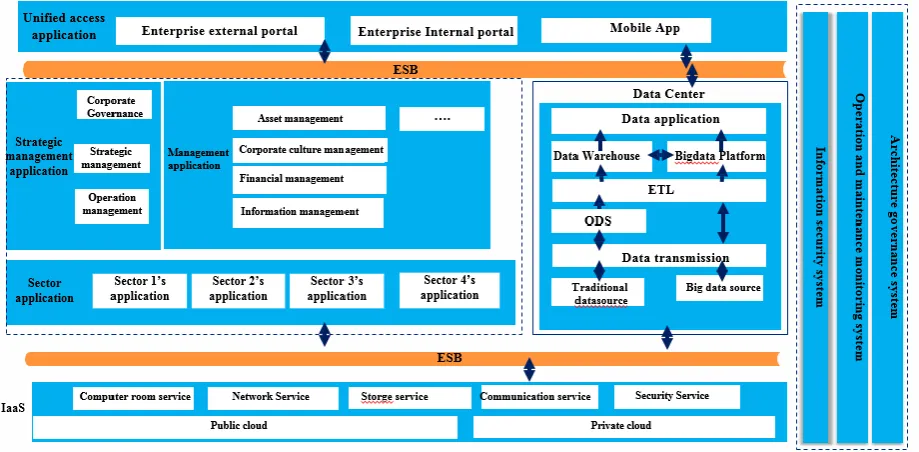
[image:2.595.67.527.418.644.2]Taking the business structure of an enterprise group as an example (as shown in the figure below), the degree of informatization of the enterprise has been high and the planning is basically perfect. But at the same time, it also exposed some problems: the overall utilization of computing resources is relatively low; chimney-style construction is quite common, most systems’ shared functions are single deployment, etc. The enterprise's SOA implementation is a typical “top-down” construction model. Each system that needs to provide service encapsulation and transformation is in its own operation and maintenance (O&M) period. The O&M personnel lack enthusiasm. When the new business system expects the original service to be transformed, the O&M team will give up the support for the new business under the traditional concept of operation’s maintenance. In this case, on the one hand, the demander must re-implement the function to generate a new chimney; on the other hand, limited by the previous service design’s versatility and forward-looking, large-scale renovation of existing services requires a lot of work. Thus, the business realized in the construction of IT systems cannot be precipitated and continuously developed.
Figure 1. Business structure of an enterprise group.
In summary, the architecture of the AEP should get rid of the limitation of the “chimney-style” construction model, return to the essence of SOA, and plan the AEP through a shared service model. The following is a description of the process by which a group builds the AEP based on the needs of ability aggregation, openness, and operations.
Hierarchical Structure of the AEP
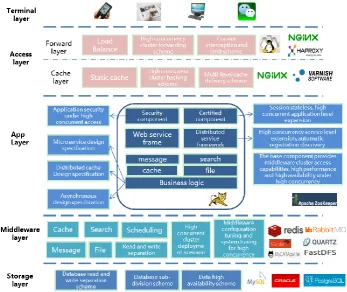
From the perspective of ability aggregation, the AEP adjusts the IT architecture from the top-level design layer. The AEP involves multiple technologies and functional levels. To fundamentally solve the problems caused by traditional single-point deployment, such as performance, data silos and low
resource utilization. The IT architecture introduces distributed architecture and related technologies, including containerization based on traditional infrastructure. The storage layer has a highly available database solution to support read and write separation; the middleware layer provides high-concurrency and highly reliable cluster deployment capability; the application layer adopts micro-service architecture to support horizontal scaling; the access layer has made a unified forwarding and cache response faster. In addition, container cloud management, micro-service governance and DevOps governance system are introduced between the container cloud and the application, forming a relatively complete distributed IT architecture solution, which can effectively support the construction of the AEP.
Figure 2. Hierarchical structure of AEP.
Functional Architecture of the AEP
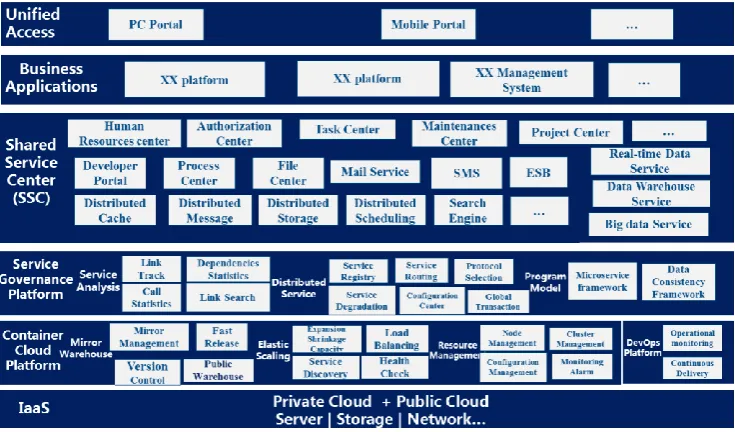
Figure 3. Functional architecture of the enterprise capability open platform.
IaaS layer: The private cloud inside the enterprise has all been virtualized, and the public cloud is connected through a dedicated line. The infrastructure resources realize the resource pool management through the container cloud platform. All these above aggregate the infrastructure’s ability.
Container cloud platform: it provides container-based runtime engine based on Mesos, Kubernetes container scheduling solution, solves issues such as development, testing, unified operating environment, rapid service deployment, runtime service management, scheduling issues. It also provides the unify access ability to physical machines, virtual machines, private clouds, and public clouds, shielding the complexity of the infrastructure layer.
DevOps platform: it provides an integrated platform for development and O&M, solves the problem of business agile response and rapid product release. It also effectively supports application monitoring and automated O&M management under the micro-service architecture;
Service Governance Platform: it provides a microservice architecture programming model and best practices to provide full log monitoring, statistics and analysis based on service logs;
Shared service center (SSC): The enterprise's SSC includes multiple service centers, such as human resources center, process center, and authorization center. As the business develops, more and more capabilities are gathered to the SSCs.
Operational Plan for AEP
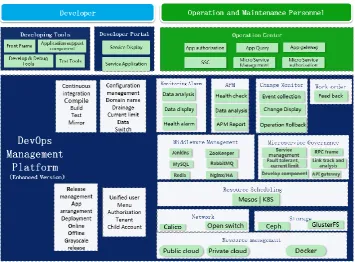
After completing the platform construction and deployment of microservices, the next important step is operation. The operation of AEP includes two areas: open capability and continuous operation. In terms of capability openness, the platform provides a developer portal to centralize and display capabilities, such as online documentation, online application for micro-services, etc. There are two important aspects in the continuous operation level. First, the platform provides an enhanced version of the DevOps management platform (integrated with the micro-service governance platform and container cloud platform’s function) to support the pipeline operations from development, deployment to O&M, which greatly simplifying the production process and improving the efficiency and safety of the production; second, the platform provides operation center for the AEP to support the management of the SSC. Continuous operation, Figure 4 is the operation plan of the group's capacity open platform:
Figure 4. Schematic diagram of the operation plan of the AEP (the blue part refers to the functional part shared by the developer and O&M personnel, and the access is controlled by the authority. The green bottom part refers to the
functions that the O&M and operation personnel can access.)
On the one hand, the above-mentioned operational solutions can effectively ensure that the core competence of the enterprise can be easily obtained and used. On the other hand, it provides platform support for the continuous accumulation of core capabilities.
AEP’s Application
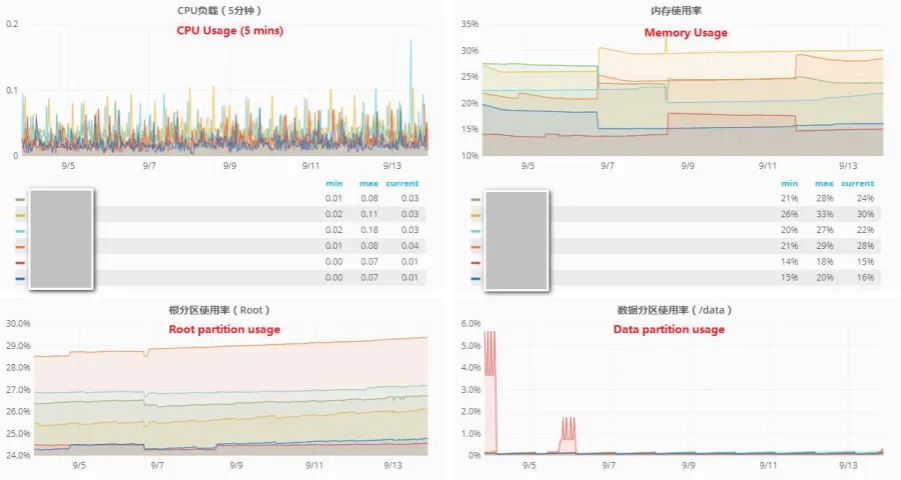
Figure 5. Resource pool monitoring screenshot (use of CPU, etc.).
Figure 6. Resource pool monitoring screenshot (network access usage).
Figure 7. Application monitoring screenshot (use of CPU, etc.).
Figure 8. Monitor large disk screenshot (system operation)
[image:7.595.160.439.529.762.2]Summary
At present, 28 types of applications have been put into production, realizing full link monitoring of services, maximizing the high availability of services, and meeting the basic needs of opening and operating core capabilities of enterprises. Through the landing of the AEP, the company has completely changed the previous “chimney-style” construction and one-legged walking mode. The new projects are all constructed based on the shared service model. The construction period of the project and the efficiency of resource input have been significantly improved. On the other hand, the enterprise's information center can adjust the organizational formation to become a more efficient shared business center, from the previous "business support" department in the enterprise to a team based on the core business and data operations, focusing more on the business innovation and service nourishment. In the end, it will cultivate a compound talent combined with business and technology for the enterprise.
References
[1] Chen De-hua, Pan Qiao,Wang Mei. Design and Practice of Data Autonomous Open Application Platform[J].BigData, 2018, 4(2): 2018019.
[2] Zhong Zhi-min, Liang Zheng. How to build a capability open platform[J]. Communications Enterprise Management, 2017 (1): 38-42.
[3] Li Wen-ming, Cui Jun-jiao, Jia Hong-ju. Design and Implementation of Open Platform for Business Support Capability[J]. Telecommunications Engineering Technology and Standardization, 2017, 30(7): 31-36.
[4] Luo J, Van de Ven A H, Jing R, et al. Transitioning from a hierarchical product organization to an open platform organization: a Chinese case study[J]. Journal of Organization Design, 2018, 7(1).