ROAR, the University of East London Institutional Repository:
This paper is made available online in accordance with publisher policies. Please scroll down to view the document itself. Please refer to the repository record for this item and our policy information available from the repository home page for further information.
To see the final version of this paper please visit the publisher’s website. Access to the published version may require a subscription.
Author(s): Catharine Montgomery, Katie V. Ashmore, Ashok Jansari
Article Title: The effects of a modest dose of alcohol on executive functioning and prospective memory
Year of publication: 2011
Citation: Montgomery, C., Ashmore, K. V. and Jansari, A. (2011) 'The effects of a modest dose of alcohol on executive functioning and prospective memory'. Human Psychopharmacology: Clinical and Experimental, 26(3), pp. 208-215.
Link to published version: dx.doi.org/10.1002/hup.1194
Publisher statement:
“This is the pre-peer reviewed version of the following article: Montgomery, C., Ashmore, K. V. and Jansari, A. (2011) 'The effects of a modest dose of alcohol on executive functioning and prospective memory'. Human Psychopharmacology: Clinical and Experimental, 26(3), pp. 208-215, which has been published in final form at http://onlinelibrary.wiley.com/doi/10.1002/hup.1194/full”
1 The Effects of a Modest Dose of Alcohol on Executive Functioning and Prospective memory.
Catharine Montgomery1, Katie V. Ashmore1, Ashok Jansari2.
1
Liverpool John Moores University
2
University of East London
Running Head: Effects of Alcohol on Cognitive Functions
Keywords: alcohol; executive functioning; prospective memory; virtual reality; memory.
Corresponding Author:
Dr Catharine Montgomery
Liverpool John Moores University
Tom Reilly Building,
Byrom St,
Liverpool. L3 3AF
Tel: +44 151 904 6295
2 Abstract
Rationale: Acute alcohol intoxication selectively impairs executive functioning and
prospective memory. Much previous research in this area has used laboratory based tasks which may not mimic functions that individuals with dysexecutive syndrome have problems with in everyday life. The present study aimed to assess the effects of a modest dose of alcohol on executive functioning and Prospective Memory (PM) using a virtual reality task, and investigate the role of executive planning in PM performance. Methods: Forty healthy participants were administered 0.4g/kg alcohol or matched placebo in a double-blind design. Executive function and Prospective Memory were assessed using the Jansari, Agnew,
Akesson, & Murphy (JAAM) task, requiring participants to play the role of an office worker.
Results: Alcohol intoxication selectively impaired executive function and prospective
memory. Participants in the alcohol condition performed worse on the planning,
3 Introduction
Alcohol is one of the western world’s most popular drugs (Babor et al. 2003), such that the subjective effects of alcohol are well known. Memory impairments while intoxicated (e.g. Poltavski et al. 2010), and memory impairments following chronic use of alcohol (i.e. alcoholism) are well documented (Oscar-Berman, 1980). However, much of the previous research in this area is reliant on laboratory based tasks which may not reflect processes that intoxicated individuals typically have problems with in day-to-day life.
Previous research using laboratory based tasks of executive functioning have shown that acute alcohol intoxication will adversely affect planning at higher doses, although not at moderate doses. For example, a dose of 0.8g/kg impaired planning time and number of trials completed in the minimum number of moves on the Tower of London (TOL) task
(Weissenborn & Duka, 2003). However, 0.6g/kg alcohol does not appear to affect any aspect of TOL performance (Leitz et al. 2009), and may even facilitate performance (Paraskevaides et al. 2010). Alcohol intoxication also adversely affects performance on the Wisconsin Card Sorting Task (Lyvers & Malzman, 1991), with increased perseverative errors indicating set-switching deficits. Finn et al. (1999) similarly found an increase in set set-switching deficits while intoxicated. Decision making is also subject to the effects of alcohol intoxication, with 0.6g/kg increasing risky decision making in a gambling task (George et al. 2005). In
4 scores between the alcohol and placebo sessions (Volkow et al. 2006), suggesting that such changes in metabolism due to alcohol may not impair these processes.
Among non-executive cognitive functions, acute alcohol intoxication also causes deficits in visuospatial attention (Post et al. 1996), spatial and verbal learning capacity (Mungas et al. 1994), memory and attention (Tiplady et al. 1998), episodic memory (Curran & Hildebrandt, 1999; Soderlund et al. 2007) and memory scanning (Grattan-Miscio & Vogel-Sprott, 2005). For a review of the effects of alcohol on cognition see Fillmore (2007).
Recently, the use of such tasks to infer impaired function in real-world settings has been criticised as such tasks typically require performance on a range of tasks, which
5 alcohol drinkers may report a greater incidence of PM slips in the real-world (e.g. Heffernan & Bartholemew 2006). In summary, while there is some evidence to suggest that VR
assessments of PM are subject to the effects of acute alcohol intoxication, the effects of acute alcohol intoxication on executive functions using VR tasks is sparse.
The present study utilised the JAAM (Jansari et al. 2004). The JAAM was originally developed to assess dysexecutive syndrome in individuals with frontal lobe
damage. Such individuals may perform normatively on laboratory-based executive measures, but have obvious problems with day-to-day functioning (e.g. McGeorge et al. 2001). The JAAM follows the Multiple Errands model as the components are designed to recreate
realistic tasks as opposed to the more traditional functional tasks. The subscales that comprise the JAAM are based on 5 executive-type constructs, and are outlined in the method section.
7 Method
Design
A double-blind between groups design was implemented with condition (alcohol versus placebo) as the between groups variable and the scores on the JAAM task as the dependent variables.
Participants
Forty participants were randomly allocated to the alcohol or placebo conditions1. Participants in the alcohol condition (6 male; mean age 20.15) and participants in the placebo condition (7 male; mean age 19.40) were of comparable age and gender composition. Participants were recruited via the online research participation scheme (SONA Experiment Management System) at Liverpool John Moores University (LJMU). All participants were of students of white British origin and were right handed. Participants were eligible to participate if they were aged between 18 and 25, had consumed at least 10 UK units2
Materials
of alcohol in the last week, had consumed 4 UK units in one session in the last month, and weighed at least 50kg (females) and 60kg (males). Participants were not eligible to take part if they were pregnant or breastfeeding, if they had ever been advised by a medic to cut down on their alcohol use, or if they had ever been diagnosed with an alcohol or substance use disorder. In addition, participants were excluded if they had a neurological disorder (e.g. migraine, epilepsy, dyslexia), were currently taking medication that may affect Central Nervous System Functioning (e.g. antipsychotics, antidepressants) or had a history of illicit drug use.
The UWIST Mood Adjective Checklist (UMACL- Matthews et al. 1990)
1n = 20 in each group is sufficient for detecting a difference of 1 SD at alpha=.05 and beta = .20 (Hinkle et al.
1994).
8 The UMACL is an 18 item checklist yielding scores for state anxiety, arousal and depressed mood. Participants indicate how they are feeling at the time of testing on a 5–point Likert scale ranging from “not at all” to “extremely” for each of the 18 adjectives. Total scores for anxiety, arousal and depressed mood are calculated by summing the component responses, taking account of reverse scored items. High scores (above the midpoint of 18) are indicative of higher levels of anxiety, arousal and depressed mood.
Subjective Intoxication- Addiction Research Centre Inventory (ARCI-Haertzen 1974)
The 15 items in the ARCI questionnaire are based on experienced substance users’ descriptions of intoxication, and all relate to some aspect of alcohol intoxication (e.g. “My Speech is Slurred”) that are answered in a True/False format. A total subjective intoxication score is calculated by summing the responses to all 15 items. Higher scores indicate higher perceived subjective intoxication.
Alcohol Use Disorders Identification Test (AUDIT: Saunders et al. 1993)
The AUDIT is used to identify hazardous drinking. It is comprised of 10 Likert scaled items pertaining to the frequency and intensity of recent alcohol use. A score of more than 8 indicates a strong likelihood of hazardous or harmful alcohol consumption.
Raven’s Progressive Matrices- RPM (Raven et al. 1998)
9
The Epworth Sleepiness Scale- ESS (Johns & Hocking 1997)
The ESS represents the likelihood of dozing off during the day in various situations. Participants have to respond to the 8 items on a scale of 0 (would never doze off in this situation) to 3 (high chance of dozing off in this situation). The total score is calculated by summing the responses to all items, with higher scores indicating greater daytime sleepiness.
JAAM (Jansari et al. 2004)
The JAAM is a virtual reality assessment which involves the participant playing the role of someone working for a day in an office environment, helping to set up a meeting. The JAAM was created to assess aspects of day to day life that individuals with dysexecutive syndrome typically report having problems with. The task has been used extensively in a clinical setting and has previously documented executive function deficits in individuals with damage to the frontal lobes relative to “normal” individuals (e.g. Jansari et al. 2004; 2007; 2008). More recently it has been used in the area of Psychopharmacology to assess the effects of nicotine on executive functioning (Edginton et al. 2008), and ecstasy-related deficits in executive functioning (Montgomery et al. 2010a).
10 The JAAM task has 8 subscales. These are summarised in Table 1 below.
<<Insert Table 1 About Here>>
The JAAM takes around 40 minutes to complete. Participants receive a score of 0 (no attempt made), 1 (satisfactory performance) or 2 (perfect performance) for each sub-task of each subscale. The scores for subtasks of each subscale are then summed and standardised by calculating a total percentage score for each subscale. A total performance percentage score is calculated for the JAAM by summing raw scores for each subscale, dividing by the total possible score and multiplying by 100.
Procedure
11 requested to refrain from driving or riding a bicycle for the remainder of the day. The study was approved by Liverpool John Moores University Research Ethics Committee.
Statistical Analysis
12 Results
Scores for background variables are displayed in Table 2. A series of t-tests was performed to assess group differences in the background variables. There were no significant differences between the groups in any of the background variables, p>.05 in all cases, age: t(38) = 0.67, p>.05; RPM: t(38) = 0.20, p>.05; arousal: t(38) = 0.13, p>.05; anxiety: t(38) = 0.38, p>.05; depressed mood: t(38) = 0.56, p>.05 or ESS scores: t(38) = 1.00, p>.05. In terms of alcohol use, there were no significant group differences in units consumed in the week prior to testing: t(38) = .69, p>.05 or AUDIT scores: t(38) = 0.08, p>.05. As there were no significant differences between the alcohol and placebo groups on any of the background variables (p>.05 in all cases) these are not discussed further.
<Insert Table 2 about here>
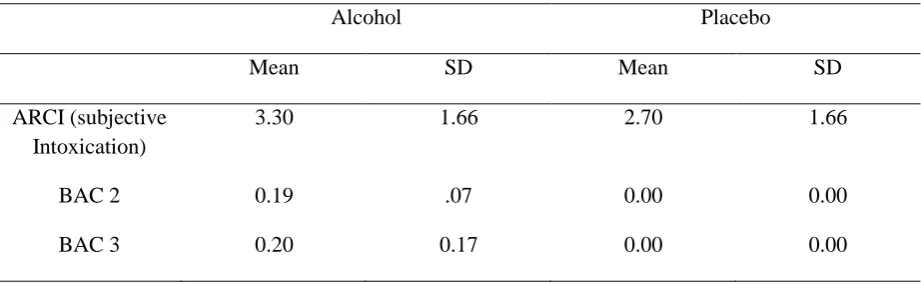
Scores for subjective intoxication and breathalyzer readings at time 2 and 3 are displayed in Table 3. There were significant group differences in BAC at Time 2: t(19) = -11.96, p<.001 and BAC at time 3: t(19) = -5.25, p<.001 indicating that the alcohol group were intoxicated (as Levene’s test was significant, degrees of freedom have been adjusted accordingly). However, group differences on the ARCI (subjective intoxication) were non-significant: t(38) = -0.15, p>.05, indicating that drink type did not affect subjective intoxication.
<Insert Table 3 about here>
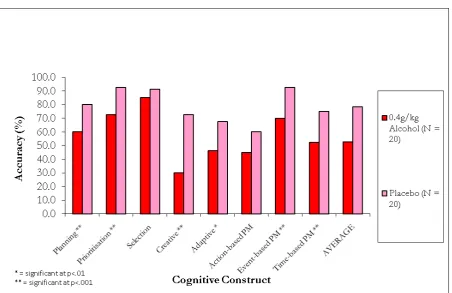
13 prioritisation subscale F(1,38) = 13.51, p<.001; creativity subscale F(1,38) = 19.27, p<.001; Adaptability subscale F(1,38) = 10.26, p<.01; event-based PM subscale F(1,38) = 12.12, p<.001 and time-based PM subscale F(1,38) = 15.55, p<.001. Group differences on the selection subscale and action-based prospective memory subscale were non-significant.
<Insert figure 1 about here>
Relationship between executive planning and PM.
14 Discussion
The present study aimed to assess the effects of 0.4g/kg alcohol on performance on a virtual reality task of executive functioning and prospective remembering. 0.4g/kg of alcohol differentially impaired executive constructs, which is noteworthy considering the dose compared to previous research. The results of the present research support previous
laboratory based research into the effects of alcohol on prospective memory (e.g. Leitz et al. 2009; Paraskevaides et al. 2010) and the nature of alcohol-related prospective memory deficits (e.g. Leitz et al. 2009). However, the present study suggests that the impairments are present at a relatively modest dose of alcohol, and while participants BAC showed that they were intoxicated, they did not perceive themselves to be intoxicated.
The results of the present study showed that acute alcohol intoxication affects different aspects of executive function. Alcohol impairments were seen on the planning, prioritisation, creativity and adaptability subscales. The results of the present study support previous research in a number of ways. Firstly, previous research has shown that acute alcohol intoxication will impair performance on the TOL (e.g. Weissenborn & Duka, 2003), which has a large planning component, although this is not always the case (e.g. Leitz et al. 2009 found 0.6g/kg of alcohol did not impair performance on TOL, while Paraskevaides et al. 2010 found that alcohol administration actually decreased completion time). Secondly,
previous research shows that cognitive flexibility is also subject to the effects of alcohol administration (e.g. Finn et al. 1999; Lyvers & Malzman 1991). Both the creative thinking and adaptive thinking subscales of the JAAM task would require cognitive flexibility,
especially when re-assigning tasks during the JAAM when the changing demands require one to do so. The prioritisation subscale required participants to order events according to
15 memory updating, which would be important for adequate performance on this aspect of the JAAM (e.g. George et al. 2005). However, alcohol did not impair the selection subscale of the task. This subscale is similar to a decision making task- for example participants have to decide which postal services are most appropriate for a range of mail items that need to be sent. There are a number of possible reasons for the absence of alcohol-related impairments. Firstly, it may be that in real-world settings, our ability to select simple appropriate responses when we have adequate information is not impaired as it is a relatively easy task. Secondly, it may also be possible that at a dose of 0.4g/kg, alcohol does not impair this aspect of
executive functioning. Indeed many simpler cognitive functions may be relatively preserved at this dose (e.g. Fillmore, 2007), and it would be interesting for future research to investigate the effects of a higher dose of alcohol using this paradigm.
In terms of prospective remembering, the present study showed that a low dose of alcohol will impair time-based (TB) and event-based (EB) prospective memory, but action-based prospective memory (ABPM) appears to be relatively preserved at this dose. Similarly Curran and co-workers (Leitz et al. 2009; Paraskevaides et al. 2010) found that a higher dose of alcohol also impaired prospective memory. The tasks in these subscales typically involved recording events (e.g. recording the times of fire alarms- EBPM), turning on equipment 10 minutes prior to the start of the meeting (TBPM) or remembering to amend diaries (e.g. when new items of post need to be sent, update post diary- ABPM). While it is possible that
16 technology to assess executive functioning has also found a link between planning and PM performance (Sweeney et al. 2010). Burgess and Shallice (1997) have argued that the type of planning and not just planning per se is important for PM performance. In the present study, the score for planning was based on both written prescriptive elements (e.g. participants had to write a plan of action based on the tasks that had been left for them by the manager), and also environment-based elements (e.g. participants had to arrange the chairs in the meeting room so that everyone could see the board). It is likely that the more prescriptive elements of planning, such as writing and indeed following the plan of action contributed to performance in the PM subscales in the current study.
While the most likely moderator of PM performance itself is not only the executive planning of the task but the maintenance of task demands and attention to a visible clock, it is possible that prospective memory is to some extent governed by an internal clock and the efficiency of this clock in tracking time. Studies on human prospective timing have also shown that alcohol may affect internal clock speed (Ogden et al. under review), with higher doses (0.6g/kg) yielding mixed results. For example a dose of 0.6g/kg resulted in
overestimations of time in a verbal estimation task, although this dose appeared to facilitate performance on a short-duration (400ms) temporal generalization task It is therefore
suggested that administration of 0.6g/kg alcohol results in an increase in internal clock speed. However, the same was not seen for a dose of 0.4g/kg, and in future studies it would be beneficial to investigate the role of human timing in prospective memory performance.
The results in terms of intoxication were worthy of note. Participants were
administered 0.4g/kg of alcohol; depending on bodyweight, this meant participants consumed between 2.75 – 4 UK units of alcohol. The BAC levels indicated that participants who
17 significantly more intoxicated than those in the placebo group (although mean scores are in the right direction). One possible explanation is that participants may have presented some tolerance to the effects of alcohol, as a result of regular previous exposure (all participants were regular social drinkers). Such behavioural tolerance has been shown between
experienced and novice alcohol users, after administration of an alcoholic beverage. Fillmore & Vogel-Sprott (1996) found that alcohol administration impaired the performance of novice drinkers in a rotor pursuit task, but not that of experienced users. Therefore it would be interesting for future research to investigate the effects acute intoxication on heavy versus light drinkers using this paradigm.
There were however a number of limitations of the present study. Drinks were administered in a double-blind design, but we did not check the participants’ and
experimenter’s beliefs on the content of the drink. Consequently it remains a possibility that the participants or the experimenter may have guessed which condition was being
18 In conclusion, the present study provides further support for the effect of alcohol intoxication on executive processes and prospective memory. The dose of alcohol used in the present study was modest suggesting that in real-world processes such as those in the virtual reality paradigm, impairments may be present at lower doses. Individuals who drink similarly modest amounts of alcohol outside the laboratory and attempt to perform routine duties (e.g. organising items in work, adapting to changing goals in their job, driving a car) may not realise that their performance will be impaired.
Acknowledgements
None.
Conflicts of Interest
19 References
Amieva H, Phillips L, Della Salla S (2003) Behavioral dysexecutive symptoms in normal aging, Brain and Cognition53: 129–132.
Babor TF, Caetano R, Casswell S, Edwards G, Giesbrecht N, Graham K, Grube J,
Gruenewald P, Hill L, Holder H, Homel R, Osterberg E, Rehm J, Room R, Rossow I (2003) Alcohol: No Ordinary Commodity. Research and Public Policy. Oxford University Press: Oxford UK.
Bisby JA, Leitz JR, Morgan CJA, Curran HV (2010) Decreases in recollective experience following acute alcohol: a dose-response study. Psychopharmacology 208: 67-74. Burgess PW, Shallice T (1997) The relationship between prospective and retrospective
memory: Neuropsychological evidence. In Cognitive Models of Memory, Conway MA (ed.). MIT Press: Cambridge, MA.
Chaytor N, Schmitter-Edgecombe M (2003) The ecological validity of neuropsychological tests: A review of the literature on everyday cognitive skills. Neuropsychology Review 13: 181–197.
Curran HV, Hildebrandt M (1999) Dissociative effects of alcohol on re-collective experience.
Conscious Cognition 8: 497-509.
Edginton T, Dawkins L, Bradon L, Nikolla D, Herbert C, Jansari A (2008) An Investigation of the Effects of Nicotine on Executive Processes Using a Virtual Reality
Environment. Brain Impairment 9(2): 207.
Eslinger PJ, Damasio AR (1985) Severe disturbance of higher cognition after bilateral frontal lobe ablation: patient EVR. Neurology 35:1731-1741
20 Fillmore MT, Vogel-Sprott M (1996) Social drinking history, behavioral tolerance and the
expectation of alcohol. Psychopharmacology 127: 359-364.
Finn PR, Justus A, Mazas C, Steinmetz JE (1999) Working memory, executive processes and the effects of alcohol on Go/No-Go learning: testing a model of behavioural
regulation and impulsivity. Psychopharmacology 146, 465-472.
George S, Rogers R, Duka T (2005) The acute effect of alcohol on decision making in social drinkers. Psychopharmacology 182: 160-169.
Grattan-Miscio K, Vogel-Sprott M (2005) Alcohol, intentional control and inappropriate behavior: Modulation by caffeine or an incentive. Journal of Clinical and
Experimental Psychopharmacology 13: 48-55
Haertzen CA (1974) An overview of addiction research center inventory scales: an appendix and manual of scales. National Institute on Drug Abuse.
Heffernan TM, Bartholomew J (2006) Does excessive alcohol use in teenagers affect their everyday prospective memory? Journal of Adolescent Health 39: 138-140.
Hinkle DE, Wiersma W, Jurs SG (1994) Applied Statistics for the Behavioral Sciences (3rd ed.). Boston MA: Houghton Mifflin Company
Jansari A, Debreceni K, Bartfai A, Eriksson M (2008) Swedish JAAM? Adaptation of a Virtual Reality Assessment of Dysexecutive Syndrome to a New Culture and Language. Brain Impairment 9(2):220
21 Jansari A, Agnew R, Akesson K, Murphy L (2004) The use of Virtual Reality to assess and
predict realworld Executive Dysfunction: Can VR help for work-placement rehabilitation? Brain Impairment 5: 110.
Johns MW (1991) A new method for measuring daytime sleepiness: the Epworth Sleepiness Scale. Sleep 14: 540-545.
Kliegel M, Ramuschkat G, Martin M (2003) Executive functions and prospective memory performance in old age: an analysis of event-based and time-based prospective memory. Z Gerontol Geriatr 36: 35-41.
Leitz JR, Morgan CJ, Bisby JA, Rendell PG, Curran V (2009) Global impairment of prospective memory following acute alcohol. Psychopharmacology 205: 379–387. Lyvers M, Malzman I (1991) Selective effects of alcohol on Wisconsin card sorting
performance. British Journal of Addiction 86: 399-407.
Matthews G, Jones DM, Chamberlain AG (1990) Refining the measurement of mood: The UWIST Mood Adjective Checklist. British Journal of Psychology 81: 17-42.
Marczinski CA, Abroms BD, Van Selst M, Fillmore MT (2005) Alcohol-induced impairment of behavioral control: differential effects on engaging vs. disengaging responses.
Psychopharmacology 182: 452–459
McGeorge P, Phillips LH, Crawford JR, Garden SE, Della Sala S, Milne AB, Hamilton S, Callender JS (2001) Using Virtual Environments in the Assessment of Executive Dysfunction. Presence: Teleoperators and Virtual Environments 10: 375-383. Montgomery C, Hatton NP, Fisk JE, Ogden RS, Jansari A (2010a) Assessing the functional
significance of ecstasy-related memory deficits using a virtual paradigm. Human
22 Montgomery C, Field M, Atkinson A, Cole JC, Goudie AJ, Sumnall HR (2010b). Effects of
alcohol preload on attentional bias towards cocaine related cues.
Psychopharmacology 210: 365-275.
Moskowitz H, Fiorentino D (2000) A review of the literature on the effects of low doses of
alcohol on driving-related skills. Washington, DC: US National Highway Traffic
Safety Administration.
Mungas D, Ehlers CL, Wall TL (1994) Effects of acute alcohol administration on verbal and spatial learning. Alcohol and Alcoholism 29: 163-169.
Ogden RS, Wearden J, Gallagher D, Montgomery C (under review) The effects of alcohol administration on human timing.
Oscar-Berman M (1980) Neuropsychological consequences of long term chronic alcoholism. Am Sci 68: 410-419.
Paraskevaides T, Morgan CJ, Leitz JR, Bisby JA, Rendell PG, Curran HV (2010) Drinking and future thinking: acute effects of alcohol on prospective memory and future
simulation.
Poltavski DV, Marino JM, Guido JM, Kulland A, Petros TV (2010) Effects of acute alcohol intoxication on verbal memory in young men as a function of time of day. Physiol Behav 102(1): 91-5.
Post RB, Lott LA, Maddock RJ, Beede JI (1996) An effect of alcohol on the distribution of spatial attention. Journal of Studies on Alcohol 57: 260–266.
Raven J, Raven JC, Court JH (1998) Manual for Raven’s Progressive Matrices and
23 Ready RE, Stierman L, Paulsen JS (2001) Ecological validity of neuropsychological and
personality measures of executive functions. The Clinical Neuropsychologist15: 314– 323.
Rendell PG, Craik FIM (2000) Virtual week and actual week: age-related differences in prospective memory. Applied Cognitive Psychology 14: 43-62.
Rendell P, Gray T, Henry J, Tolan A (2007) Prospective memory impairment in “ecstasy” (MDMA) users. Psychopharmacology 194: 497-504.
Rizzo AA, Buckwalter JG (1997) Virtual Reality and Cognitive Assessment and
Rehabilitation. In Riva, G (Ed.) Virtual Reality in Neuro-Psycho-Physiology. IOS
Press.
Saunders JB, Aasland OG, Babor TF, dela Fuente JR, Grant M (1993) Development of the Alcohol Use disorders Identification Test (AUDIT): WHO Collaborative Project on Early Detection of Persons with Harmful alcohol consumption-II. Addiction 88: 791– 804.
Schoenmakers T, Wiers RW, Field M (2008) Effects of a low dose of alcohol on cognitive biases and craving in heavy drinkers. Psychopharmacology 197: 169–178
Soderlund H, Grady CL, Easdon C, Tulving E (2007) Acute effects of alcohol on neural correlates of episodic memory encoding. Neuroimage 35: 928-939.
Sweeney S, Kersel1 D, Morris RG, Manly T, Evans JJ (2010) The sensitivity of a virtual reality task to planning and prospective memory impairments: Group differences and the efficacy of periodic alerts on performance. Neuropsychological Rehabilitation 20: 239-263.
24 Volkow ND, Wang GJ, Francheschi D, Fowler JS, Thanos PK, Maynard L, Gatley SJ, Wong
C, Veech RL, Kunos G, Li TK (2006) Low doses of alcohol substantially decrease glucose metabolism in the human brain. Neuroimage 29: 295-301.
Weissenborn R, Duka T (2003) Acute alcohol effects on cognitive function in social drinkers: Their relationship to drinking habits. Psychopharmacology 165: 306-312.
Williams-Hemby L, Porrino LJ (1994) Low and moderate doses of ethanol produce distinct patterns of cerebral metabolic changes in rats. Alcohol Clinical and Experimental
Research 18: 982–988.
Wilson BA (1993) Ecological validity of neuropsychological assessment: Do
neuropsychological indexes predict performance in everyday activities? Applied and
Preventive Psychology2: 209–215.
25 Table 1
Subscales in the JAAM task
Scale Description
Planning Participants are required to order items in a logical manner and not due
to their perceived importance. Therefore they have to decide which tasks would logically be carried out first, for example writing a plan of action based on the list of tasks left for them by their manager.
Prioritisation Participants must order items according to their relative importance; for
example they should order the items on the agenda so that the important ones will be discussed first.
Selection Participants have to choose between two or more alternatives by
drawing on previous knowledge. For example the participant has items of post which need to be sent to various destinations, and with differing urgency. Thus successful performance requires them to select the appropriate postal service based on the urgencies and type of mail.
Creative Thinking Participants must look for solutions to problems using non-specified
ways. For example, there is graffiti on the whiteboard. It is written in permanent ink and they must find a way to cover it.
Adaptive Thinking Participants must achieve their goals in changing conditions of success.
This requires them to propose suitable solutions to new problems as they arise.
Action-Based PM Participants must remember to execute a task cued by a stimulus in the
task they are already engaged with. For example, they receive a message about new items of post to be sent, and must update the post diary accordingly.
Event-Based PM Participants must remember to perform a task cued by an event, for
example noting the time of fire alarms on their notes for the manager.
Time-Based PM Participants must remember to perform an action at a certain time point.
26 Table 2
Scores for Alcohol and Placebo conditions on Background variables
Alcohol Placebo p (sig.)
Mean S.D. Mean S.D.
Age (years) 19.40 4.42 20.15 2.30 p>.05
Raven’s Progressive Matrices (maximum 60)
46.87 6.13 51.51 4.45 p>.05
Epworth Sleep Scale (Maximum 24)
7.39 4.84 6.52 3.99 p>.05
Average Weekly Alcohol Use (Units)
4.30 1.66 4.44 1.60 p>.05
Depressed Mood 11.75 2.45 12.25 3.13 p>.05
Anxiety 12.30 3.80 12.75 3.67 p>.05
Arousal 20.60 3.35 20.75 3.91 p>.05
27 Table 3: Indices of intoxication
Alcohol Placebo
Mean SD Mean SD
ARCI (subjective Intoxication)
3.30 1.66 2.70 1.66
BAC 2 0.19 .07 0.00 0.00
28 Figure 1