ROGER SAUL SILVERSTONE
THE TELEVISION MESSAGE AS SOCIAL OBJECT:
A comparative study of the structure and content television programmes in Britain
Ph.D. Thesis.
Roger Saul Silverstone
THE TELEVISION MESSAGE AS SOCIAL OBJECT:
A comparative study of the structure and content of television programmes in Britain (excluding public affairs, children's
television and shorts). The thesis will be both a theoretical and empirical examination of the applicability of the varieties of analysis of symbolic orders which have been advanced by such writers as Levi-Strauss and Foucault.
The thesis is an exploration, through the study of the narrative structure of a series of television drama programmes, of the relationship between television, myths and folktales.
Following upon work done principally by Claude Levi-Strauss and Vladimir Propp, but also others writing in the field of semiological and structural analysis, a detailed examination of the video-recorded
texts of a thirteen part drama series is presented.
It is argued in the context of an examination of, respectively, television and language, television and the mythic, and of the nature of narrative, that the television drama preserves the forms which otherwise might be thought of as particular to oral culture and communication.
Television, in its preservation of these forms, and in its generally mythic character, gains its effectiveness thereby and must be
under-stood sociologically in such terns. The effect of such an understanding, it is argued, will be to challenge any comprehension of the medium
3
-CONTENTS
Page
Fo rewo rd 4
Chapter 1 Television and Culture 5
Chapter 2 Television and Language 37
Chapter 3 The Mythic and Television 98
Chapter 4 On Narrative 165
Chapter 5 Intimate Strangers. Morphology 223 Chapter 6 Intimate Strangers. A Structure 268
Chapter 7 Television and Society 328
Figures and Tables
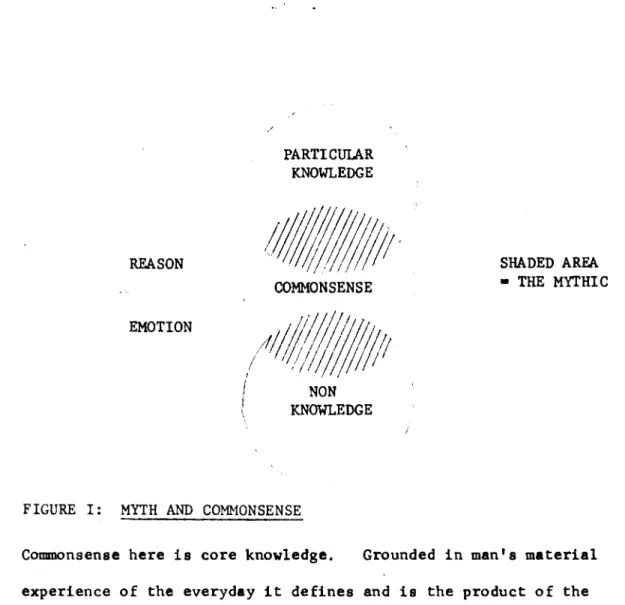
Figure I Commonserise and Myth
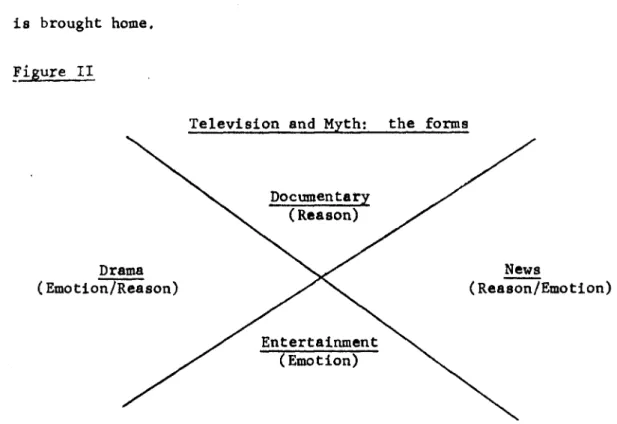
Figure II Television and Myth: the Forms 150
Figure III A Model of Narrative 207 Table I Doctors (Physical Lack) 287 Figure IV The Dynamic Geography of
Intimate Strangers 291 Table II Helpers and Seducers (Social Lack) 293
Table III Helpers and Opposers (Cultural Lack) 297
Figure V The geographical code 299
Figure VI Dynamics within the geographical code 300
Figure VII The Social Code 303 Figure VIII The Techno-Economic Code 306
Figure IX The Physical Code 307
Figure X Summary Structure 308 Figure XI Domestic Geography 31 1
Appendices
1. Analysis of Episode 6 of Intimate Strangers 358 in terms of Christian Metz's 'Grande syntagmatique'.
2. Vladimir Propp's Narrative Functions 362 3. A.J. Greimas1 Structural Model of the Narrative 364
4. Series Morphology (following Vladimir Propp) 366
5. Series Structure (following Greimas) 369 6. Analysis of the Morphology of Episode 6 using the
categories of Vladimir Propp
7. Analysis of the Structure of Episode 6 using the categories of A.J. Greimas
370 371
There are a number of disparate points that I must make.
As far as the long title of the thesis is concerned, two things will quickly become clear: firstly that the empirical analysis is exclusively concerned with television drama - the comparative work involves reference to a number of separate episodes of a
television drama series; and secondly, the theoretical framework, while it owes much to a reading of Michel Foucault, nevertheless is
less specifically dependent on him than other so-called structuralist wri ters.
Work done on and through the texts of Intimate Strangers was much helped by the kind cooperation of London Weekend Television, who produced and transmitted the programmes. They not only gave me permission to video-record them, but they provided me with copies of the scripts. Needless to say I am particularly grateful to them.
5
-CHAPTER I
Television and Culture
Television is important. 947. of the population of the United Kingdom
over the age of five has access to a television set. Each member of
that population watches it an average of 16 hours and 27 minutes per
week.* This much at least is certain and demonstrable. Less
demonstrable, however, though equally certain, is that television is
qualitatively important.
I aim in this thesis to explore some aspects of this qualitative
dimension, and to do so through analysis of the television message,
and, in particular, its narrative structure. I will be concerned with
television as language and television as myth. I expect to show that
television preserves forms of cultural experience that were previously
thought of as being the peculiar prerogative of 'primitive' societies
and that in so doing it anchors our experience, historical, changing,
uncertain into another which is relatively unchanging and more certain.
The way the television presents its texts is the key to the discussion.
The analysis of the television message and in particular its structural
analysis is a relatively recent development. It is prompted by the
inadequacy and inconsistency of many of the findings into the effects
of television and correlatively the realisation that the study of effects
cannot be undertaken in vacuo, that is in ignorance of the context, both
social and cultural, of the supposed equation of message and action.
And it is prompted by a recognition that television does not consist
in a collection of isolated events to which individuals will react
and meaning of its messages cannot simply be derived from a study of its
2
content.
Similarly the production of the programmes, the relationship of
the producing organisation to other institutions of society, while
clearly being viable objects of study, do not reach the central questions 3
surrounding the nature of television. These questions are, I suggest,
those that seek cultures significance in what Clifford Geertz calls 4
"the autonomous process of symbolic formulation" ; in the recognition
that at the heart of any social process of communication lies a symbolic
system of cognitive, affective, and evaluative messages - rich, complex
and resilient.
What is it that television is saying? How does it say it? These seem
important and much neglected questions and they lead straight to an
analysis of the message of television and to the ways in which its
meanings are communicated. Other questions of course can and should
be asked; for example, who is speaking, and to what effect? Both
sets of questions are interdependent. Both are necessary. M y choice
is therefore premised on the perception both of a lack and an inadequacy.
The lack consists in the relative paucity of any mature studies of the
content of television and the inadequacy in the arguments, false as I
hope to show, that television can only be understood in terms of the
specificity of bourgeois culture and ideology, and as such is either
distorting or transient or both."*
In order to begin there is a need for a notion of culture, and then of
myth and common sense. Each, of course, poses something of a problem
and I can only sketch in this introduction what appear to be their
-7-In anthropology the claim for culture's autonomy as an object o f study is
itself dependent on the recognition of man's distinctiveness as opposed
to animal. It is a distinctiveness grounded in man's consciousness,
t
his language and in his attempts to make sense of his world. The core
of man's cultural activity lies in his capacity to generate meaning,
to communicate, to transmit and to order those meanings; it lies in
the creation of a specifically symbolic level of existence.
Anthropol-ogists have also argued, though with differing degrees of emphasis,
that the culture of primitive societies, both the product and the
condition of the relatively simple social structure with which it is
associated, manifests a coherence which is systemic. Further, they
suggest, that one measure at least of increasing social complexity is
to be found in the increasing differentiation in cultural and social
6 structure.
The intellectual space occupied by culture in the analysis of primitive
societies has been replaced by the concept of ideology in industrial
societies. The boundaries are, of course, blurred. However the
recognition of societies as historically conditioned, dynamic and
changing has involved a rejection of the relatively autonomous, static
and consensual notion of culture. This has been replaced by a stress
on just those historical conditions, on social relations, on power
and on the recognition that change and conflict are the new order of 7
the day. Needless to say primitive societies are neither static nor
conflict free; but equally industrial societies are neither constantly o
changing nor entirely conflict ridden. I would like to suggest that
the notion of culture, so far only crudely drawn, has a place in the
analysis of contemporary societies. I would also like to suggest that
an important key to the understanding of culture can be found in the
operationally; it mediates between a situation of pure nature, of no
knowledge or understanding of the world and one in which, subsequently,
that knowledge becomes more specialised, and becomes more scientific *
or more philosophical. Mythic space is defined by its competence to
set and articulate the boundaries of what passes for conventional
knowledge in primitive society and by its capacity to articulate
differences and similarities in what amounts to a developing but always
complete cultural m a p . I suggest that this relationship of pre-cultural
(natural), mythic, and as it were post mythic, can be formally introduced
into an analysis of contemporary culture and the resulting model allows 9 the situation and function of television to be stated quite clearly.
To do so involves the recognition that contemporary culture is highly
10
differentiated, much of it is inaccessible without mediation, to the
majority of its members. In this situation the mythic does not define
a particular stage in the transition from ignorance to knowledge, but a
particular territory within which, simultaneously, the incompatibilities
within contemporary culture are ameliorated. Within our society we
are faced with different types of knowledge and experience which are
both familiar and unfamiliar. The unfamiliar is of two kinds: the
specialised and the nonsensical. The specialised consists in the
particular forms of art, science and politics which we might call
professional;1' they are complex and esoteric and they are produced
and maintained by specialist and more or less exclusive groups.
The nonsensical consists in what is rejected by a culture, the mythical i 2
of earlier societies, but also the mythical, the alien or the phoney,
of other, contemporary societies, as well as the distortions,
unaccep-tabilities and objects of fear that always bubble up beneath the crust
Between these two forms of knowledge, the one super-cultural, the
other pre- (or anti- or even non-) cultural, lies the world of the
everyday and the modes of communication which articulate everyday
concerns; formally and functionally identically placed to the mythic
in primitive society. Here, then, is the domain of the mythic in
contemporary society, a domain in which for most of the time moat of
us live, a domain where boundaries are constantly being defined and
redefined. These boundaries are being defined and redefined both in
relation to new developments in the particular forms of esoteric
knowledge whose language, concept or aesthetic is of such complexity
as to deny us access, and also in relation to the underworld of the
threatening and incomprehensible, of that which we understand (or
we think we do) but have rejected. In a technically advanced world
this is the nature against which our integrity needs to be upheld;
but this is the familiar, though often terrifying, nature and not the
unfamiliar nature discussed and explored by science.
Television like myth occupies the middle ground and in so doing defines
in its particular way the basic categories and content of the culture
of the everyday world. It is an important part of the argument of
this thesis that television,supremely among the other media of mass
communication, is coherently, systematically and centrally at work in
the articulation of culture and in the mediation of alien bodies of
knowledge and experience. To understand the nature of this activity
it is not enough to argue in terms of reflection or effects; one
must begin with a theory which seeks to encompass the complexity
of the cultural system, and a methodology which allows for the
A t the heart of such a theory must be the notion of the commensense
world. "The everyday life world is the province of reality in which
man continuously participates in ways which are at once inevitable and 13 .
patterned." This Schutzian vision of the daily world, a world
dominated by the demands of practical rationality and by the recipes
of taken for granted knowledge is a fruitful one. Albeit difficult
to penetrate methodologically and perhaps theoretically impossible to
justify, it is relatively easy to describe. Social life is characterised,
and indeed is only possible because so much of what constitutes it can
be taken for granted, can be unthought; we deal in typicalities, we
make assumptions, predictions and choices in an 'all-things-being-equal'
frame of mind. The everyday world is marked by its repetitiveness,
its abstraction, its anonymity and the ever present possibility of J4
transcendence. It is not a world of laws, nor even of probabilities,
but of hopes and fears and of more or less adequately informed choices,'"*
both programmed and unprogratnmed. Our choices, our unconsciously
directed responses, are played against a backdrop of the typical and the
unproblematic. By definition, as it were, commonsense is that to
which no-one is excluded, nor is it transformed by an individual's
practice of it. "It is perhaps the essential characteristic of our
everyday lives that any problem which arises has as its tacit background
the unproblematic status of the mundane reality which commonsense men
share. However profound and far reaching the problem m a y be, it is
a problem over and against that which is taken for granted; the validity
of the world within which we come to inquire, no doubt to probe or to
reflect."1 6
The unpredictable and the uncertain both surround and pervade the
everyday world. They continually challenge the peace perhaps more
-11-by that which we don't; the world we know and the security of that
knowledge is constantly being pricked by the chance event, the encounter,
the intrusion of the new and the unfamiliar. Our world, at least that }
portion of it which we can take for granted is a kernel; we step out
of it at our peril, and because it is chaos (the unknown and the
unthought) which we fear m o s t , we are constantly at work revising the
limits of what it is that we can take for granted, constantly incorporating
more and more within our own stock of knowledge.'^ This is both, of
course, an individual and a social/cultural process, but the point is
that our knowledge of the world, the knowledge which guides our everyday
activities is bounded; there is an' horizon to experience.
Horizons both define and limit, include and exclude; they are static
in that they are always there, but dynamic in that their content is
always changing. Things both come into view and then disappear, a
disappearance the result of their incorporation into the familiar.
A s C.D. Burns notes: "On the horizon are facts or aspects of facts
or events or situations - realities like any other in the fully
experienced world, but different from those in that, as it w e r e , we
see them only from one side. Horizon facts are those whose connections
with the fully experienced is clear enough, but not their connection 18
with what m a y still be experienced and is not yet."
The everyday world of commonsense, then, has two horizons, the one of
the particular sciences and arts (with their own horizons of the new
and the unknown), the other of the general negations of what passes for
the true and the acceptable. Where these three domains meet lie
regions of ambiguity and uncertainty; of a lack of clarity about
context and meaning, and a lack of clarity about the bases for choice,
Our responses to the ambiguous and the uncertain will be m a n y . A s
individuals we can be tolerant or intolerant, anarchic or staid. But
we only know and recognise these various corrosions of meaning because
we already k n o w , consciously but more often unconsciously, the system
of symbolic coherences which are the essence of our culture. O n tfie
one hand there are the events of the real world, intrusions of history
as it were, the speech (parole) of the everyday; on the other the
security of a structure, the guarantee of communication, the language 19
(langue) of the everyday; actions and events, rules and structure,
interdependent of course and constantly changing, but each of a
different order. Indeed the commonsense world in its language and
in its beliefs and actions is the privileged site where langue and
parole meet. The everyday world is simultaneously a world of rule
and transgression; but no knowledge of it is possible, just as it is
itself impossible, without an understanding of those rules. Hence
we are led to its structure, to the grounds of its possibility, and to
the identification of the syntax and semantics of its meanings.
In this context, therefore, how are we to understand the cultural
significance of television? It might be suggested that television
is of the conmonsense world but at the same time distinct from it.
Of necessity involved in that world, it must equally of necessity
manifest more clearly, though not necessarily directly, the structures
underlying it. Then it might be suggested that television both speaks
to and speaks of the modes of thought and feeling that orient our
actions in the daily round. It Is not so much a guide to action, or
a guide for the perplexed, but rather a commentary, a more or less gentle
mastication of the categories and boundaries of culture and an exploration
of the ambiguities and uncertainties that are endemic to it. In order
1 3
-texts presented on television themselves, and to identify in what the
discourse of television consists. In so far as television communicates
something to each of u s , and to all of u s , notwithstanding the individual's
processes of selection and interpretation which cannot for one moment 20
be denied, the messages that television transmits are common. Whether
this commonness is genuine or whether it is an imposed structure, an
Ideological form, is for the moment beside the point.
The examination of the messages that are transmitted by television begins
with their structure, understood in terms of the patterns of meaning
which can be shown to exist within a series of texts and upon which the
21
specific meaning of a specific text is seen to depend. The problems
are immense, for clearly even a superficial consideration of the nature
of the televisual texts would be able to identify any number of different 22
levels of coding, or of structuring:.' those both specific to the medium
and dependent on its technical make-up and those more generally at work
within many media including face-to-face interaction.
Television is not one language but m a n y . It is however coordinated,
its various codes knitting together in a text which w e , as viewers, can
read and to which we respond. There are therefore a number of
prelim-inary observations which can be made about the nature of its communication.
The first refers to the relatively restricted nature of its codes.
No communication is without restriction; the freedom that we have to 23
construct always new sentences in speech is largely illusory; even
in the most open of social contexts there are required forms of speech,
just as there are different conventions and limitations of expression
whether one chooses to write or to talk. L.S. Vygotsky for example
notes some of these differences: "Communication in writing relies on
than oral speech to convey the same Idea. It is addressed to an absent
person who rarely has in mind the same subject as the writer. Therefore
it must be fully deployed; syntactic differentiation is at a maximum;
24 and expressions are used that would seem unnatural in conversation."
In writing there are manifest differences between poetry and prose and
as Roman Jakobson points out language itself is multifaceted and
multi-functional; different emphases as between the emotive, the referential,
the poetic, the phatic, the metalingual, and the conative dimensions of
language generate different types of text, and conversely different
25
types of text demand different forms of stress. In oral speech there
seem to be differences between what Basil Bernstein calls restricted and
elaborated c o d e s . ^
Television will be host to all or any of these many varieties of expression,
but television Itself is a specific form of communication and imposes
its own structure, rhetorically, on that which it transmits. W e are
familiar with what are popularly known as its formats; we recognise
beginnings and endings and patterns of presentation. Television speaks,
but it speaks anonymously and indiscriminately. Its messages are well
defined and abbreviated but ephemeral. Programmes begin and end but 27
broadcasting itself is endless. Communication is relatively compact
and condensed. It is repetitive. Television indeed shares with film
a metalinguistic situation somewhere between the oral and the written, but
compared to film television is much closer to the oral form. It is 28
nearer the everyday world, and its anonymity is ameliorated by the
relative directness of its communication and by the familiarity which
that engenders, a familiarity which video seems itself to engender.
Television is, I suggest, a mode of communication with particular
characteristics. To be Involved with it, as audience or as producer,
is to be involved more or less passively in a communicative context
which in its structuring alone limits what can be said and how. It
has in this sense much in common with other forms of ritual communication
which in their denial or restriction of the right of free response, and
by their distance from the context of normal face-to-face communication,
exercise a subtle but nevertheless real form of cultural control. I
wish to suggest that the primary mechanism for this restriction in
television's communication is narrative, and that it is through a study
of this code, the rules according to which stories are told, both
fictional and non-fictional, that much will be learnt about the nature
of television as a whole.
W.B. Gallie in his discussion of narration in history writes of stories
in this way: "We follow a story across contingencies or accidents,
coincidences, unpredictable events of all kinds, yet the story's general
direction and continuous advance towards its final conclusion somehow
29
succeed in rendering these contingencies acceptable." It is in
making the unacceptable acceptable, in clarifying ambiguity and
strengthening resistance to uncertainty that the television narrative
gains its significance. Generally the stories, from drama to news and
to documentary are told according to consistent not to say traditional 30
rules. Rarely for television the bold experiments and advances of
modernism which were in part a precise and self-conscious challenge to
just those structures of story-telling which seemed so restrictive of
true creativity. Television story-telling is a craft. The texts
themselves, the programmes, are the result of collective and often
anonymous activity: producers, directors, cameramen, props, make-up
The telling of a story is a deceptively complex act. On the one hand
it depends on the culture which provides it with its specific meaning 31
through both content and context of performance. On the other it
depends on • specific set of rules, the formal structure of narrative 3 2
itself. This itself can be meaningful, not only because the abstract
narrative qode generates a statement of the kind "This is a story:
understand it as such", but because the telling of a story - in a sense
always once upon a time - is a social occasion of a particular sort.
But having said this we need to make a further distinction still, and
that between the temporal and the non-temporal aspects of narrative 33
structure, what I choose to call the chronologic and the logic.
Opinion is divided as to the relative significance of each of these;
Claude Bremond for example is quite adamant as to the primacy of the
chronologic: "L'object du recit est le temps et non l'eternit^; l*enonce
du devenlr du choses epuise leur sens proprement narratif. Q u ' apres
cela le recit puisse Stre asservi, par certains genres litteraires et
par certaines ideologies, & exprimer un sense second, est que ce se
sens second puisse a 1'occasion se redulre a un jeu d1antinomies 34
conceptuelles, ce n'est pas douteux, mais c'est un autre problfeme."
This is a position with both Claude Levi-Strauss and A . J . Greimas
substantially, if not entirely, refuse. For them narrative consists
in the systemic logic independent of the particular chronology of a 35
given text. I shall have occasion to turn to this distinction many
In its temporality narrative rewrites, as it w e r e , the world. The w a y
of its expression is not dependent on conventional experience or
perception; narrative does not reflect or imitate. Its relationship
to that world is, though in a very narrow sense, contingent, or unmotiv-36
ated. In the everyday world we m a y , Indeed we do, account for 37
ourselves and our own histories in narrative terms and in so doing
we are creating a text which has meaning, a coherence, a significance
in the same way as in a text which is publically communicated. The
simple copula '... and then ...' is (like television) both of the
every-day world and not of it, and in the telling of a story the ambiguity and
uncertainty of the world which surrounds it is progressively reduced.
A story begins with a more or less arbitrary delimitation of what will
be of potential significance both in events and context. A s it unfolds 39
the narrative reduces, to borrow an expression from elsewhere, the
level of 'potential surprise'. So when we are surprised or shocked by
an event in, for example, a Hitchcock story, that surprise is in a sense
expected.
But narrative is more than just a chronologic, its meanings are not
just dependent on its formal temporal structuring. A significant part
of the narrative, which I have already called the logic, consists in the
patterned interrelationships according to which content is ordered, its
synchronic arrangement.
Central to an understanding of this way of perceiving narrative is the
work on myth of Claude Levi-Strauss. He opens the first volume of
"The aim of this book is to show how empirical categories - such as the categories of the raw and the cooked, the fresh and the decayed, the moistened and the burned etc., which can only be accurately defined by ethnographic observation and, in each instance, by adopting the stand~ point of a particular culture - can nonetheless be used as conceptual tools with which to
elaborate abstract ideas and combine them in the form of propositions..'I expect it to prove that there is a kind of logic in tangible qualities, and to demonstrate the operation of that logic and reveal its laws'.'39
For Levi-Strauss primitive culture is the product of the work of a
mythical figure, a brlcole^p. who,faced with nature that is apparently
systematic (the diversity of species) and also a previous set of equally
concrete concepts, constructs a new building with the bricks of the old.
Connections and more connections are made between the elements that
make up the world of the'primitive's sensory experience and these
connections are ordered within and by a logic which is in part dependent
on their natural ordering and in part on the natural classifying
capacity of the human m i n d . The result is culture. More particularly
there results Levi-Strauss's own analysis of myths which seeks to
identify the structures according to which they are organised; this
analysis, in all its multi-faceted complexity is of an intrinsic logic
of frog and Jaguar, of girls mad about honey and tapirs, and it depends
for its understanding on an a priori (but at the same time concrete)
pre-logic of simple oppositions, the raw and the cooked, inside and outside
40
and so on. A s the analysis proceeds the chronology of the narrative
tends to disappear. Indeed there Is very little respect given to the
integrity of the myths which he analyses and for this he has been such 41
criticised. But this lack, if such it b e , can be mitigated If one
recognises that different cultures will have different styles of
story-telling (of coutseeach culture will have m a n y ) . While one style may
-19-chronologic, it will be dense in the juxtaposition of events. Secondly
Levi-Strauss's own concern is with his myths as carriers of information
and as attempted solutions to the perennial dilemmas of man's existence;
as such while this concern would lead him to recognise the chronology
of the texts it does much more positively encourage him to seek their
connections in the mythic system as a whole.
The model of the narrative text has therefore three basic levels,
distinct but obviously interrelated: the chronolglc, the logic and the
content; the chronologic, which provides the narrative with its form,
though as such it is not without semantic significance; the logic, the
logic of sensible qualities, the logic of equivalence and transformation
within whose mesh a specific set of cultural messages is' generated and
regurgitated, and finally the content itself dependent on a
categor-isation of and in the lived in world, a categorcategor-isation which m a y be
similar to or different from that generated in the narrated text. For
example, a journey from home to work in a particular story can act as
illustration. It will advance the action, bringing perhaps the hero
nearer to his ultimate test; it will, in its opposition present a
category which in conjunction with others,such as country and city,
life and death, generates a particular foundation of meaning which it
will share with other stories of the culture (and indeed other cultures)
and finally it betrays in this opposition the lived relation in the
culture and society as a whole. Home and w o r k , city and country, will
be meaningful only if they have meaning outside the text, and indeed
they come to the text redolent of meaning. Investigation of narrated
texts, myths or television programmes, demands in the final analysis
consideration of all these three levels of structuring and their 42
The juxtaposition once again of myth and television as examples of
narrated texts is deliberate. I have already suggested that they
are, in a certain sense, formally equivalent, both at work in culture
*
in a similar way. The problem now is to determine in what ways the
formal skeleton can be given flesh - in what ways the similarity of
myth in primitive society and television in our own can be given
substance.
The mythical in contemporary culture has often been, and is increasingly
becoming, remarked upon and d i s c u s s e d . T h e disenchantment of the
world, the arrival of new technologies, continuing manifestations of
what for a better phrase might be called 'secular e c s t a s y '4 4 have
alerted students of the social and the cultural to the w a y the gaps in
our over-rational universe are being filled. Attitudes to the connections
that have been drawn are varied; the following from Donald MacRae is
both prescient and among the more enlightened; it deserves to be well
quoted:
"Today the mass media of communication - press, film and television in ascending order of Importance from this standpoint - are all introducing new ways of seeing the world and human relations. They play tricks with time and space; they bring the far near, and make the
Perhaps what unites myth and the mythical as it is presented in
primitive society and television as it is transmitted in our own, is
the prestige accorded to the communication by those receiving it.
While the nature of the legitimation in one society compared to the
other has manifestly changed, still the weight of tradition, the
embodiment of received wisdom, the oracular explanations of past,
present and future and the assumed potency - the assumed capacity to
effect changes - all conspire to identify structural and functional
similarities if not identities. Secularization reduces the sacred
to the prestigious - but the difference m a y only be in the word.
Above all both television and myth act as mediators and although not
just between the real and the cosmic, significantly so. Television
technology extends our sensory perceptions in a way manifestly injurious
to the linearity of the printed page; it introduces synesthesia, it 46
creates the global village; we are, literally, in touch. But the
technology itself is also part of the taken-for-granted world; at the
touch of a switch and in ways mysterious and hence both distanced from
our everyday experience but yet part of it, we can turn on to that other
world which is at the same time our own. These two worlds juxtapose
at the screen, both a domestic nodal point and a frame for the display
of the limited, vicarious and often crucial experiences that television
makes constantly available. The frame is significant; it both focuses
on and defines a different reality; it is the locus of a continually 47 practiced ritual. Mary Douglas writes:
experience. It can permit knowledge of what would otherwise not be known at all. It does not merely externalise experience, bringing it out into the light of day, but it modifies experience in so expressing it."48
i
In a different but parallel context Siegfried Kracauer illustrates how
in the framing of the original script of The Cabinet of D r . Caligari by
setting it within a narrative told by a madman, the original revolutionary
intentions of the authors were entirely transformed. The frame, then,
has physical, social, political and aesthetic dimensions and to be involved
with experiences that are framed, above all visually, is to be involved 49
in both the limited and the transcendent.
This framing is of course doubly confounded; narration acts also as a
frame and as such translates the world that is lived via its contingent
rules of transformation into a world that is told. And it is in the
telling, even in the essential anonymity of the telling, disguised by
those who speak it, that television and myth are close. The stories
in television are told, as from a distance, and that distance which may
be historical, geographical, social or cosmic, or all four, generates
the magic and the mystery which in primitive societies are associated
with myth.
Above all what myth does is to obliterate, only to redefine the conventional
notions of time and space; in defining its own reality the linearity of
time and the contiguity of space which a r e , at least in our own culture
and linguistic tradition,taken for granted, are replaced by a time that
is both reversible and ever present and a spatial ordering which has been
called elsewhere, in the context of film, surrogate. Compare for
example a discussion of film (in this case the arguments are equally
2 3
-"Far from being 'realistic' film suppresses ordinary reality as much as possible and replaces it with an artifact of space and time. The space and time of the viewer is all but erased and replaced by the film... But while one Is viewing the film all places and moments are present when they are shown. Film has no past tense, no was.'®®
"... by'living'the myths one emerges from profane chronological time and enters a time that is of a different quality, a'sacred'Time at once primordial and infinitely recoverable."-''
This juxtaposition is meant to be suggestive rather than conclusive;
indeed there are as many disputes about the nature of film and television
as there are about m y t h , but the comparison is an important one
neverthe-less, and I shall return to it.
However one or two problems have appeared. The first concerns the
apparent contradiction between an analysis which stresses on the one
hand the significance of the narrative, which is supremely a linear
chronological form and on the other the destruction of that chronology
in televisual and filmic texts. But this is more apparent than real.
The televisual text consists both in immediacy on the one hand and in
recollection and anticipation on the other; the immediacy is
preemin-ently visual, the diachrony of recollection and anticipation is
preeminently verbal. In addition any one narrated text loses its
specificity as a narrative when it is placed alongside others. Once
this is done the linear narrative chronologies with beginnings, middles
and ends, which define the integrity of a particular story, become
serialised; the ends herald a new beginning and ends and beginnings
52
as such lose some of their significance. Indeed as both Mircea Eliade
and Claude Levi-Strauss5 3 in their different ways recognise, mythic
narratives are carriers of basically other more symbolic messages,
which for Eliade relate specifically to the transcendence of time and
solutions which a particular culture offers to the universal dilemmas
of human existence. There are, of course, elements of both in
television.
The second problem follows from this but is less easily faced. It
revolves around the question o f what we are to make of a series of texts
whose main effect, if not purpose, seemfi to be the obliteration of
history; and correlatively, of what we are to make of texts which have
as part of their functioning an ability to incorporate, bricoleur fashion,
any and every item which m a y be of interest: "Myth", Ernst Cassirer
writes, "seems to roll up everything it touches into unity without
distinction....Things which come into contact with one another in a
mythical sense - whether this contact is taken as a spatial or temporal
contiguity or as a similarity, however remote, or as membership in the
same class or species - have fundamentally ceased to be a multiplicity:
54 they have acquired a substantial unity."
Cassirer Is dismayed by the intrusion of such forms into historical and
55
therefore rational societies. Roland Barthes, from a different
perspective, is equally dismayed. It is the naturalisation in m y t h ,
the mystification that such lnsensitivity to history generates which is
at the centre of the polemics against the mythic in contemporary culture.
For him also myth is a way of speaking, but it is parasitic, parasitic on 56
and destructive of,the possibility of speaking the truth. The openness
of myth is a false openness and we are blind to its ideological activity.
His analysis is dependent on a theory which guides him to the specificity
of capitalist-bourgeois society and therefore of its culture. It is
much quoted:
2 5
-ICs relevance and usefulness depends on whether the theory of culture,
predominantly reflective, which it embodies is an adequate one and
equally on whether, in culture, there is something as unique and
\
specific as its bourgeois form. It also depends on whether we like
that culture or not.
Much of the argument must centre on an ability to demonstrate
theor-etically and empirically that the narrative structures which we have
been discussing, the chronologic and the logic of culturd. communication,
are universal in the sense that they persist across cultures and through
time, and also on the ability to demonstrate in what ways these structures
Integrate with the content of the specific cultures in which they are
made manifest. The task is an enormous one and easily outruns the
entirely modest attempt in this thesis. Indeed even the distinction
between structure and content is an artificial o n e , though it does hel£
to distinguish the permanent from the impermanent, the fixed from the
ephemeral in culture, and at the very least it should allow us to decide
whether these distinctions are in any way meaningful.
A recent study of advertising makes a similar point. Varda Langholr
Leymore suggests that the structure of advertisements is similar to
that of the myths studied by Claude Levi-Strauss, albeit for her in a
degenerate way. Both myth and advertising she argues "strive to provide
answers to the eternal polarities of the human condition. While the
dichotomies, or the dilemmas, are universal, the specific answers are not....
The classlficatory activity of the mind alone is both predetermined
and universal. But the specific configurations of relationships between
variables are culturally bound. The essential point is that the human
mind is sensitive to certain problems which emanate from the human
universally apprehended and as such constitute universal themes.
58 The specific solutions offered to them are, nevertheless, varied."
W e can take the reference to the human mind in whatever way we t
choose; the recognition that different cultures,
or aspects of them, are organised according to the same rules is not by
itself an invitation to search for and speculate about their origin,
but an invitation merely to return to the cultural texts for further
analysis. These texts are as real and as concrete as anything that
human beings have created through their action, and should be investigated 59 *
systematically, accordingly.
The universality of culture lies in its logic and in the demands for the
generation and exchange of meanings without which we are not human. To
talk of system, structure, logic, order, patterns, is not however to impose
a static view or to reify what is forever changing, but it is to recognise
that there is, simply, a consistency in the activity of man and that that
consistency manifests itself in social and cultural relations. In this
sense the cultural texts which are analysed, from myth to television,
are of their very essence conservative; they speak coherence and generate
security - and as Marshal Sahlins argues: "... the isomorphism between
diverse codes - social, geographical, mythical, and economic - is neither
fantastic nor the product of a pure speculative interest, it is a real
condition of life.1*6 0
Marshal Sahlins1 discussion, which involves an overturning of the classical
Marxian argument of the dependence of culture oh material and practical
interest, is Itself of particular interest for in many ways it runs
parallel to much that has been said here. Sahlins is concerned to
develop a theory and a methodology adequate to identify both similarity
2 7
-meanings, treated as a coherent and self-sufficient set of complex
Interrelationships, must precede the organisation of work and its
attendant social relations. Culture cannot simply be derived from
•
material relations, and cultural logic is not simply a practical
utilitarian logic transformed into ideas. On the contrary, the very
possibility of material existence is grounded in the coherence of the
system of culture.6 1
There are two aspects to his argument. Firstly that culture, both that
of the primitive and of the m o d e m , is concrete, the result of the
confrontation in the symbolic of mind and matter.
"It is not merely species which are 'good to think?. Levi-Strauss's famous dictum is applicable to all kinds of naturally occurring things and relations. The whole of nature is the potential object of the symbolic praxis, whose cunning, rather like Hegel's Reason, consists in this: that it puts to the
service of its own intentions those relations among things existing by their own properties.
W e would expect to find, and we do, contemporary culture generating forever
new sets of relations with what is to hand, but generating them according
to a logic which transcends their particular ephemerality.
The second aspect of his argument is that these relations are lived;
they comprise the warp and the weft of social activity; that whereas
the primitive lived his life according to the categories defined by
the totemic structure of his culture, w e , perhaps more dominated by
appearance, live our life according to the logics of fashion in clothing,
6 3 food and other consumables - a language preeminently of consumption.
The fact that these relations are lived guarantees, for Sahlins, their
materiality; the fact that our daily, social, productive lives are
organised according to the structures and codes of culture transports
these structures from a world of subjective perceptions, in a way perhaps
The analysis of television programmes follows' from arguments like
these and from those advanced elsewhere in this introductory chapter.
With the tools provided by and developed from Vladimir Propp, Claude
Levi-Strauss, A . J . Greimas, Christian M e t z ^ and others, all of whom
have been concerned with the intrinsic analysis of culture, and its
codes, the social and cultural object, television, can be approached
and its significance more firmly understood. A full consideration of
their work in theory and in practice takes up the major part of this
thesis. But to do it in this manner, in other words working from the
text outwards, inevitably creates its own problems, and if pursued
fully, as is my intention, has a number of far reaching implications.
Central amongst these are the way in which we need to understand ideology
in contemporary culture and the contribution to it which television makes.
Central too, is the way in which television's culture (such a phrase
itself is entirely question begging) is articulated into the everyday
world and to the continuity and changes within our everyday experience.
I will return to these considerations again, but most substantially in
the final chapter.
Suffice it to say now that I see television as being part ideology, part
culture; both inside history and outside it, manifestly open to and
contributing to change, latently preserving forms of experience that
are resistant to change. The analysis of the structure of the message
immediately identifies a set of coherences beneath and within the
manifestly diverse; the relation of these coherences to others in
similar forms of communication within the same culture and within other
cultures opens the way to the identification of what might be called a
cultural rather than an ideological ground-base, upon which historical
manifestations of culture are constructed, and whose operation makes
2 9
-old and familiar while still maintaining their novelty, by their
incorporation into pre-existing patterns of experience; the
trans-formation is cultural, the motor is structural, and at the level of
the everyday where these processes are most visible and most significant,
change is, at root, very slow indeed.
The hypothesis with which I begin is therefore this: that our involvement
with television, an involvement which affects almost every member of our
society from infancy onwards, is an involvement with a type of
commun-ication which in its compression and redefinition of historical,
geographic^, social and cosmic experience identifies a coherence, a
continuity and a commonness in culture, but to which, blinded by the
glare of manifest historical and other changes, of conflict and of
difference, we are unaware. Television, like myth is both structuring
and structured; the former referring to its process the latter to Its
effect. When we watch television we are watching a series of messages
that both order our experience and define its categories, but which do
so in ways that transcend the historical conditions of that experience.
We need to understand through the analysis of the texts themselves how
1. B.P. Emmett, The Television and Radio Audience in Britain, in Dennis McQuail, Sociology of Mass Communications. Harmonds-worth, 1972. 195-219.
2. cf. Joseph T . Klapper, The Effects of Mass Communication. New York. 1960; W . P . Davison, On the Effects of Communication, in L.A. Dexter and D.M. White (Eds.), People, Society and Mass Communication. New York. 1964. 69-90; J.D. Halloran, The Effects of Television. London. 1970; H.T. Himmelweit, A . Oppenheim and P . Vince, Television and the Child. Oxford,
1958; Dennis McQuail, The Influence and Effects of Mass Media, in J . Curran et. al., Mass Communication and Society. London. 1977. 70-94; idem. Towards a Sociology of Mass Communication. London. 1969; Charles R . Wright, Functional Analysis and
Mass Communication, in L.A.Dexter and D.M. White, o p . cit. 91-109. G . Steiner, The People Look at Television, New York. 1963;
Harold Lasswell, The Structure and Function of Communication in Society, in W . Schramm (Ed.), Mass Communication, Urbana, 2nd edition 1960. 117-140; Paul Lazarsfeld and R.K. Merton, Mass Conmunication, Popular Taste and Organised Social Action,
in W . Schramm, op. cit. 492-512; Elihu Katz and Paul F . Lazarsfeld, Personal Influence. New York. 1964; Elihu Katz and David
Foulkes, On the Use of the Mass Media as 'Escape': Clarification of a Concept. Public Opinion Quarterly. 1962. Vol. 26. (2) 377-388; Elihu Katz, The Two step Flow of Communication, in W . Schramm (Ed.), op. cit. 346-366; Dennis McQuail, Jay G. Blumler and J.R. Brown, The Television Audience: A Revised
Perspective, in Dennis McQuail, Sociology of Mass Communication. Harmondsworth. 1972. 135-165; Dennis McQuail and Michael Gurevitch, Explaining Audience Behaviour, in Jay G. Blumler and Elihu Katz, The Uses of Mass Conmunication. Beverley Hills.
1974; R.K. Merton, Patterns of Influence: A Study of Inter-personal Influence and Communications Behaviour in a Local Community, in R.K. Merton, Social Theory and Social Structure. New York. 1957. 387-420; W . Belson, The Impact of Television. London. 1967; idem, Television Violence and the Adolescent Boy. Farnborough. 1978; Ray Brown (Ed.), Children and
Television. London. 1976; &*en Dunn, The Box in the Corner. London. 1977; D . Howitt and G. Cumberbatch, Mass Media, Violence and Society. London. 1975; Grant Noble, Children in Front of the Small Screen. London. 1975; Wilbur Schramm, Jack Lyle and Edwin B. Parker, Television in the Lives of our Children. Stanford.
1961.
On content analysis, see B. Berelson, Content Analysis in Communication Research. New York. 1952; Ithiel de Sola Pool
(Ed.), Trends m Content Analysis. Urbana. 1959; and also Olivier Burgelin, Structural Analysis and Mass Communication,
in Dennis McQuail, Sociology of Mass Communication, o p . cit. 313-328. The difference, quite simply, between a structuralist approach
and that of content analysis, is that between a method which eschews quantification, takes into account the form of a
3 1
-3. Studies of the production of news and documentary also have a long history; among the more recent see David Altheide, Creating Reality. Beverly Hills. 1974; Philip Schlesinger, Putting Reality Together: B.B.C. News. London. 1978; see also Warren Breed, Social Control in the Newsroom, a functional analysis, in Social Forces. 1955. 326-335; Malcolm Warner, Organisational Context and Control of Policy in the Television newsroom, in British Journal of Sociology. 1971. 283-294. see also Philip Elliott, The Making of a Television Series. London.
1972; James D . Halloran, Philip Elliott, and Graham Murdock, 1 Demonstrations and Communication. Harmondsworth. 1970.
4. Clifford Geertz, Ideology as a Cultural System, in The Interpretation of Cultures. London. 1975. p. 207.
5. Influences here include the Frankfurt School, Antonio Gramsci, Roland Barthes and Louis Althusser. In Britain the spearhead of Marxian analysis has come from the Centre for Contemporary Cultural Studies in Birmingham; see their Working Papers in Cultural Studies, 1-10, and their occasional papers; see also many of the contributions to Screen, at least since 1974. More recently there has been something of a flood of critical
study of the media, see for example: Glasgow Media Group, Bad News. London. 1977; the journal, Media, Culture and Society; the reader, James Curran, Michael Gurevitch, Janet Woollacott (Eds.), Mass Communication and Society. London. 1977; the papers in Michele Barrett et al. (Eds.), Ideology and Cultural Production, London 1979. Some of the implica-tions of this literature will be discussed below, and also in Chapter 7.
6. The most substantive review of the anthropological literature on culture is that of A.L. Kroeber and Clyde Kluckhohn,
Culture: A Critical Review of Concepts and Definitions, Papers of the Peabody Museum, Harvard Vol. XLVII No. 1. 1952. And see also: A.L. Kroeber, The Nature of Culture. Chicago. 1952; Bronislaw Malinowski, Culture, Encyclopedia of the Social Sciences, IV. 1931. 621-645; more recent anthropological dis-cussions include Zigmunt Bauman, Culture as Praxis. London. 1973; T.O. Beidelman, Some Implications of Culture, in John
McKinney Tiryakin, Theoretical Sociology. New York. 1970. 499-527; James A . Boon, Further Operations of Culture in Anthropology, in Louis Schneider and Charles Bonjean, The Idea of Culture in the Social Sciences. Cambridge. 1973. 1-32; Clifford Geertz, Ideology as a Cultural System, op. cit.; Edmund Leach,
Culture and Communication. Cambridge. 1976; Marshall Sahlins, Culture and Practical Reason. Chicago. 1976. Among sociologists who have a place for a notion of culture as such, admittedly few, Talcott Parsons seems preeminent: see his The Concepts of
Culture and Social System, American Sociological Review, 1958. 23. 582-3 (with A.L. Kroeber), Culture and Social System Revisited, in Schneider and Bonjean, op. cit., and of course The Social
8 ,
9.
1 0 ,
11.
1 2 ,
13 14 15 16 17 18 19 20
In anthropology see Max Gluckman, Custom and Conflict in Africa. Oxford. 1956; and in sociology preeminently, Vilfredo Pareto, above all in The Mind and Society (4 Vols.) London. 1935.
At this stage my definition follows that of Claude L5vi-Strauss; > see Chapter 3 for a further discussion and the presentation of
a model of what I call in that chapter the mythic, and its relationship to commonsense.
A trivial observation, but one central to an understanding of comtemporary society. Central of course is Emile Durkheim, The Division of Labour in Society. New York. 1933.
Thelma McCormack, Folk Culture and the Mass Media, Archives Europgennes de Sociologie. 1969. Vol. 10 (2) 220-237; she distinguishes between professional, applied and amateur culture.
The word 'mythical' here is deliberately ambiguous: while in the social sciences we would wish to be precise and use the term 'myth' to define a specific body of, or way of telling, stories of a particular kind, in common parlance the word 'mythical' is often used to identify the false, the phoney or the alien.
Alfred Schutz and Thomas Luckman, The Structures of the Life-World. London. 1974. p . 3. See also Alfred Schutz, Collected Papers. (3 Vols.). The Hague. 1973; and idem, The Phenomenology of the Social World. London. 1972. A characterisation of the everyday world discussed by Maurice Nathanson, in Phenomenology and Typification, in
Social Research. Vol. 37. No. 1. Spring 1970. 1-22.
Alfred Schutz, The Problem of Rationality in the Social World, in Dorothy Emmett and Alisdair Maclntyre, Sociological Theory and Philosophical Analysis. London. 1970. p . 98.
Nathanson, op. cit. p . 2.
Suzanne Langer, Philosophy in a New Key. Cambridge, Mass. 1951. esp. p . 287. see also, Peter Berger, The Social Reality of Religion. London. 1969.
C.D. Burns, The Sense of the Horizon, in Philosophy. Vol. VIII. No. 31. July 1933. p. 302.
The source of the distinction between langue and parole is Ferdinand de Saussure, Course in General Linguistics. New York. 1959, (London. 1966). See my discussion in Chapter
2.
Stuart Hall, Encoding and Decoding in the Television Discourse. Centre for Cultural Studies, University of Birmingham- Mimeo.
3 3
-21. Structure can then be understood in terms of the patterns of meaning which can be shown to exist within a series of texts
and upon which the specific meaning of a specific text is seen to depend. The different levels of structuring are often referred to as Codes. The series of individual items of communication comprising the Message, become - once they are treated as an object of analysis - the Text. The texts themselves partake of wider unity (or unities) that of the Discourse. See chapter 4 below.
i
22. Umberto Eco, Articulations of a Cinemantic Code, Cinemantics. 1. Jan. 1970. 3-9; idem, Towards a Semiotic Inquiry into the Television Message, Working Papers in Cultural Studies. 3. Autumn 1972. 103-121; idem, A Theory of Semiotics. London. 1977.
23. In relation to ritual language, see Maurice Bloch, Symbols, Song, Dance and Features of Articulation, in European Journal of Sociology. XV, 1974, 1, 55-81.
24. Lev S. Vygotsky, Thought and Language. Cambridge, Mass. 1962. 142.
25. Roman Jakobson, Closing Statement. Linguistics and Poetics, in Thomas A . Sebeok (Ed.) Style in Language, Cambridge, Mass.
1960. 350-377.
26. Basil Bernstein. Class, Codes and Control, esp.. Vol. I. London, 1971.
27. Raymond Williams, Television, Technology and Cultural Form. London. 1972; T.C. Worsley, Television, the Ephemeral Art. London. 1972.
28. Charlotte Brunsden and David Morley, Everyday Television: 'Nationwide'. London. 1978.
29. W.B. Gallie,Philosophy and the Historical Understanding. London. 1964. p. 29. See also Kenneth Burke, Rhetoric of Motives. New York. 1955. p . 197.
30. For a preliminary analysis, Roger Silverstone, An Approach to the Structural Analysis of the Television Message. Screen. 17. No. 2. 1976. 9-40. And of course, chapters 6 and 7 below. See also Paul Rock, News as Eternal Recurrence, in Stanley Cohen and Jock Young, The Manufacture of News. London. 1973.
73-81.
31. Dell Hymes, Breakthrough into Performance, in Dan Ben-Amos and Kenneth Goldstein. Folklore. Performance and Communica-tion. The Hague. 1975. 11-74; Roger D . Abrahams, The
Complex Relations of Simple Forms, Genre. 2. No. 2. June 1969. 104-128.
32. R.O. Kolker and J . Douglas Ousley, A Phenomenology of Cinematic Time and Space, in British Journal of Aesthetics. Vol. 13. 4. Autumn 1973. p.390. On the interdependence of syntax and
semantics, see, for example, Jerrold J . Fodor and Jerry A . Katz, The Structure of a Semantic Theory, in Jay F . Rosenberg and Charles Travis (Eds.) Readings in the Philosophy of Language. New Jersey. 1971. 472-514.
35. There is a very full discussion of both these approaches to narrative and to the mythic in Chapter 4 below.
36. Roland Barthes, Introduction & 1'analyse structurale des r£cits, Communications. 8. 26-27, where he writes this: 'Ainsi, dans tout recit, 1'imitation n'est pas de 'representer', elle est de
constituer un spectacle qui nous reste encore tres finigmatique,
mais qui ne sourait etre d'ordre mim£tique; la 'r£alitfi' d'une > sequence n'est pas dans la suite 'naturelle' des actions qui la
composent, mais dans la logique qui s'y expose, s'y risque et s'y satisfait....Le r£cit ne fait pas voir, il n'imite pas; la passion qui peut nous enflammer & la lecture d'un roman n'est pas celle d'une 'vision' (en fait nous ne 'voyons' rien), c'est celle du sens....'
37. William Labov and Joshua Waletsky, Narrative Analysis: Oral Versions of Personal Experience, in June Helm (Ed.), Essays on the Verbal and Visual Arts. Proceedings of the 1966 Annual Spring Meeting of the American Ethnological Society. Seattle.
12-44.
38. See the discussion of uncertainty in business decisions in Tom Burns and G.M. Stalker, The Management of Innovation. London.
1961. pp. 110-119; and also C.G. Carter, G.P. Meredith and G.L.S. Shackle, Uncertainty and Business Decisions. Liverpool.
1954.
39. Claude Levi-Strauss, The Raw and the Cooked. London. 1969. p . 1. 40. Once again, Levi-Straussian observations; see Chapters 3 and 4
below.
41. In particular the discussion between Percy Cohen and James A . Boon in Man: Percy S. Cohen, Theories of Myth, Man. Vol. 4. No. 3. Sept. 1969. 337-353; and James A . Boon, Lgvi-Strauss and Narrative, Man. Vol. 5. No. 4. Dec. 1970. 702-3; see also Terence S.
Turner, Oedipus: Time and Structure in Narrative Form, in Robert F . Spencer, Forms of Symbolic Action. Proceedings of the 1969 Annual Spring Meeting of the American Ethnological Society. Seattle. 1969. 26-68.
42. See J.M. Lotman and A.M. Pjatagorsky, La Texte et le Fonction, Semiotica. 1. 1969. 205-217, for a similar analysis, and below, pp. 205ff.
43. see footnote 1 Chapter 3.
44. This phrase is adapted from Bernice Martin, Notes for a Dying Counter-Culture. Mimeo. 1977.
45. Donald MacRae, Advertising and Sociology, Ideology and Society. London. 1961. p . 84.
3 5
-47. Mircea Eliade, Myth and Reality. London. 1964. p . 140.
48. Mary Douglas, Purity and Danger. Harmondsworth. 1970. p. 79.
49. Siegfried Kracauer, From Caligari to Hitler. Princeton. 1947. 65-67. 50. R.P. Kolker and J . Douglas Ousley, op. cit. p . 391.
51. Mircea Eliade, op. cit. p . 18.
»
52. see especially Raymond Williams, op. cit.; and on alternative perceptions of time see Edmund Leach, Two Essays Concerning the Symbolic Representation of Time in Edmund Leach, Rethinking Anthropology. London. 1961. 124-36.
53. Mircea Eliade, The Myth of the Eternal Return. London. 1955; Claude Lfivi-Strauss, Structural Anthropology, (Vol. 1.).
Harmondsworth. 1963, and elsewhere. See below, chapter 3. 54. Ernst Cassirer, The Philosophy of Symbolic Forms. Vol. II,
Mythical Thought. New Haven and London. 1955. p. 63. 55. idem. An Essay on Man. New Haven and London. 1944; The
Myth of the State. New Haven and London. 1946.
56. Roland Barthes, Mythologies. London. 1972; but see also Max Horkheimer and Theodor Adorno, Dialectic of Enlightenment. New York. 1972; and Jurgen Habermas, Towards a Theory of Communicative Competence, in Hans Peter Dreitzel, Recent
Sociology. No. 2. London. 1970; and his Legitimation Crisis. London. 1976.
57. Quoted as the epigraph on page 1 of Glasgow Media Group, Bad News. London. 1976. (From Roland Barthes, Introduction & 1'analyse structurale des R£cits, Communications 8. p. 22).
58. Varda Langholz Leymore, Hidden Myth. London. 1975. 154-5. 59. Clifford Geertz, Introduction to Clifford Geertz (Ed) Myth,
Symbol and Culture. New York. 1971, x-xi:"..African passage rites, nineteenth century novels, scientific theories, English landscape paintings, or the ways in which moral judgements are phrased, have as good a claim to public existence as houses, stones and trees, and are therefore as susceptible to objective investigation and systematic analysis as these apparently harder 'realities' ."
60. Marshall Sahlins, Culture and Practical Reason. Chicago. 1976. p. 41 .
61. ibid, p. 266: "...No cultural form can ever be read from a set of material forces as if the cultural were the dependent variable of an inescapable practical logic. The very form of social
elaborate than any wild (sauvage) variety, not that it has been liberated from a natural-material basis, but precisely because nature has been domesticated."