Estimation of Ready Queue Processing Time using
Efficient Factor Type Estimator (E-F-T) in Multiprocessor
Environment
ABSTRACT
The ready queue processing time estimation problem appears when many processes remain in the ready queue after the sudden failure. The system manager has to decide immediately how much further time is required to process remaining jobs in the ready queue. In lottery scheduling, this prediction is possible with the help of sampling techniques. Ratio method, existing in literature of sampling, was previously used by authors to predict the time required provided highly correlated source of auxiliary information is available and used.
This paper suggests two new estimation methods which are compared in terms of estimating the total processing time. Under large sample approximation, the bias and m.s.e of proposed estimators have been obtained in the set up of random sampling applicable to lottery scheduling. Performance of both is compared in terms of mean squared error. The confidence intervals are calculated for the estimate and they provide strong numerical support to the theoretical findings.
Keywords
Lottery Scheduling, Efficient-Factor-Type Estimator, Bias, Mean Squared Error (M.S.E), Variance, Confidence Intervals.
1.
INTRODUCTION
Suppose there are k processors in a multiprocessor and multi-user environment and a large number of processes, say N, are in a waiting queue. The CPU scheduler adopts lottery scheduling procedure to choose randomly any n processes from the waiting queue (n<N) and allocates to k processors (k<N) in sequential manner. Lottery scheduling is different from basic scheduling algorithm where each process is allocated a number of lottery tickets determining the possibility of process when to use the CPU. At each schedule point, a lottery is held and the process in the ready queue with the winning ticket gets the CPU utilization. Unlike priority scheduling, every job has equal chance of being represented to the processors. Lottery scheduling does not suffer from starvation.
A technical problem appears when N is very large, and because of the congestion in processing occurs, many processes have to wait until they are called in random manner. If all of sudden the system collapses due to failure of power supply or maintenance problem, technical faults or any other unavoidable reasons, the system manager has to look for backup management. His problem at this juncture is to know how much time requires further for finishing up the remaining processes. These
predictions are uncertain and require probability mechanism to resolve. This paper takes such problem and presents two estimation methods for predicting the possible time interval required for processing the remaining jobs.
Shukla and Jain [12] discussed multiprocessor environment, for usual lottery scheduling procedures in order to obtain ready queue time estimate. A method of estimation is suggested by authors and they computed the predicted time intervals. Shukla et al. [8] studied similar problem using systematic lottery scheduling scheme in order to improve upon the prediction of ready queue processing time. Shukla et al. [11] discussed similar problem when processes are grouped according to some criteria in different queues. Shukla et al. [10] introduced size based priority scheme for the ready queue time length prediction and have shown that it is better than usual lottery scheduling in terms of confidence interval for estimates. This paper present E-F-T estimation method for such estimation and compares the two estimation procedures.
2.
A REVIEW
Cochran [2] contains an introduction to the methods of sampling theory with application over multiple data. David [3] extended lottery scheduling, a proportional share resource management algorithm to provide the performance assurance present in traditional non real time process scheduler. Dynamic tickets were incorporated into a lottery scheduler to improve the interactive response time and to reduce kernel lock contention. Raz et al. [4] presented procedure of deciding priorities among jobs by maintaining fairness in selection procedure. Shukla and Jain [7] [9] tackled Markov Chain based study of transitions in multilevel queue scheduling. Shukla and Jain [13] performed analysis of thread scheduling and Deficit Round Robin Alternated (DRRA) scheduling algorithm using Markov Chain Model approach. Shukla and Jain [5] suggested a stochastic model for evaluating the reaching probabilities of message flow in space-division switches. Shukla, Jain and Ojha [6] performed a task of analysis of multilevel queue scheduling with the effect of data model approach. Waldspurger [1] proposed that lottery scheduling ticket/currency framework can accommodate scheduling mechanism other than the probabilistic lottery algorithm and discussed the proportional share resource management technique. Singh and Shukla [14] discussed a family of Factor-type ratio estimator for existing population mean. In another contribution Singh and Shukla [15] derived Efficient factor type estimator for estimating the same population parameter.
1
D. Shukla
Deptt. of Mathematics and Statistics
Dr.H.S.Gour Central University
Sagar, (M.P), INDIA
2
Anjali Jain
Deptt. of Computer Science and
Applications
Yiping [22] developed a queuing theory model to predict system behavior and CPU queue length in Microsoft NT, Windows 2000 and derived fair share scheduling which guarantees application performance by explicitly allocating share of system resources among competing workloads. Some other useful contributions are [16], [17], [18], [19], [20], [21].
3. PROBLEM DEFINITION
It is common and well known idea that often the more input information provides better prediction subject to condition if information is related. Based on this thought the efficient factor type estimation technique has been introduced in order to get more precise confidence intervals compared due to Shukla et al. [14].
4. PROCESSOR STRUCTURE AND
NOTATIONS
Let
Q
1,
Q
2,
Q
3...
.
Q
kbek
processors who receive intake from the ready queue containingP
1,
P
2,
P
3...
.
P
N processes(n<N). Processes are in long, medium and short term scheduling waiting queues prepared for transferring to ready queue. When a process is blocked or suspended, it is back to respective queue. The figure 1 shows the diagram of scheduling process structured with k processors.
Let;
N: - Total processes in the system.
n:- Sample size of randomly selected processes. f:- Sampling fraction.
i
Y
: - CPU burst time of each ith process
i
1
,
2
,
3
...
N
.i
X
: - Value of ith auxiliary variable like size of process or process priority or processes response time (time interval between arrival and processor entering).
N
i i
Y N Y
1 1
: - The mean of CPU burst time of Nprocesses in the ready queue.
N i
i
X N X
1 1
: - The mean of size of Nprocesses in the ready queue.
Y S
CY Y : - Coefficient of varation for population parameter Y.
X S
C X
X : - Coefficient of variation for population parameter X.
Y X S C XY
XY : - Coefficient of variation due to X and Y.
4.1
Modified
Multiprocessor
Lottery
Scheduling
[As Shukla, Jain and Chouwdhary[13])
Step I: When a process enters into ready queue, it is allotted a
random number (in specified range).
Step II: Each processor
Q
1,
Q
2,
Q
3...
.
Q
K generates uniqueand uncommon random number in similar specified range stated in Step I.
Step III: Matching of both random numbers takes place
between process and processor. If both random numbers are same for a process in ready queue, it is assigned to that processor.
Step IV: Processor either blocks or processes the job. It selects
another process by random manner.
Step V: After when one job processed completely or partially
processors generate time consumed in processing as
y
i(Time5.
ESTIMATION OF READY QUEUE
PROCESSING TIME (as [12])
We know Ratio estimator:yr yX/x, where y,xare sample
means and Xis population mean.
y YPV S
V
B k 02 … (1)
02 11
2 2
20 P S V 2PSV
V Y y
M k ... (2)
In above expressions
/ ; , 0Ey Y x X Y X Y X
Vij i j i j …
(3)
Consider following notations;
1
2
; d d
A
1
4
;
d
d
B
2
3
4
d d d
C
where d is a constant(0d).The class of efficient factor-type estimator proposed by[14] is
x C X fB A
x fB X C A y
Td
...(*)
It gives T1yr,T2yp,T3yaandT4 y[as Shukla et
al.[14]]. The term
y
p,
y
a are well known product estimator andSrivenkatramana and Tracy [19] estimator.
The fact that A, B and C can more generally be written
k a1
k a2
;A
k
a
1
k
b
1
;
B
k a2
k b1
k b2
.C
With b2
a2b1
/2has not defined in Shukla et.al [16]. Theyhave arbitrarily chosen a11,a22,b14in order to define
(*).However, it has been observed that if structures of A, B, C are not changed different selection ofa1,
a
2,b
1and
2 1
/22 a b
b do not disturb the properties of the class of estimatorsTd.Changes in the choice of these constants only shift
the origin of d tok.
Blocked/Suspended Long term scheduling Long term scheduling
Medium term scheduling
Medium term scheduling
Ready/ suspended
Ready Queue
Short term scheduling
Medium term scheduling J1
J2
J3
Jn
.
.
.
Exit
.
.
.
.
Q3
Q2
Q1
QK
m2 mr mn
… … …
P1 P2 P3… … …
PNL1
L2
L3
Ln
[image:3.595.49.545.64.400.2].
.
.
.
.
.
.
Figure 1: Ready Queue Processing Under Lottery Scheduling
We define here the following one-parameter family of T
F
E estimators:
s s k x C X fB A x fB X C A yT … (4)
) ( ) ( x X Cs X C fB A x X fBs X C fB A yTk …
(5) Where
s
X xs
xs 1 ;sn/
Nn
,0s1/2andC B
A, , andf have same meaning as in (4).
5.1 Performance Measures of
Tk[As per [14]]
Taking large sample approximations, yY
1e1
and
1 e2
X
x such that
ij
j ie Ve
E 1 2 , we get
2 2 1 1 Cse C fB A fBse C fB A e E Y TE k …
(6)
As it is obvious that
1
2
fB C A
Cse
... (7)
for all choices of A, B and C, the bias is given by
YPV SV T
Bias( k) 02 ... (8)
Similarly the expression for m.s.e given by
02 11
2 2 20 2 ) ( .
.SET YV P S V PSV
M k ... (9)
.
WhereP
fBs / AfBC
and
Cs/
AfBC
.5.2 Suggested Estimators
UsingShukla et al. [14], we suggest two estimators as below
Atd5, we choose one estimator in class
T
kmarked as TA
s s A x X f x f X y T 6 4 12 4 18 ... (10)
f s V s V f fs Y T Bias A 4 18 6 4 18 6 402 ...
(11)
02 11
2 2 20 2 4 18 6 4 2 4 18 6 4 ) ( . . sV f fs V s f fs V Y T E S M A
Similarly at d6, we choose one estimator from class
T
kmarked asB T
s s B x X f x f X y T 24 10 20 10 44 ... (13)
f s V s V f fs Y T Bias B 10 44 24 10 44 24 1002 ...
(14)
02 11
2 2 20 2 10 44 24 10 2 10 44 24 10 ) ( . . sV f fs V s f fs V Y T E S M B ... (15)
Wheresn/(Nn)
The 95% confidence interval of the estimate using
T
A andT
Bare:
] 0.95 [ 2 , 1 A nA t V T
T
P ... (16)
] 0.95 [ 2 , 1 B nB t V T
T
P ... (17)
Where
2
A A
A MT BT
T
V ... (18)
2
B B
B MT BT
T
V ...
(19)
More explicitly, one can write 95% confidence intervals for mean estimation
] 0.95 [ 2 , 1 2 ,1
A A n A
n
A t V T Y T t V T
T
P
] 0.95 [ 2 , 1 2 ,1
B B n B
n
B t V T Y T t VT
T
P
where 2 , 1 n
t is t-value at (n-1) degree of freedom and at
levelof significance and where
T
A,T
B are the sample basedestimates of population parameter Y . These estimates
T
A,B
T
are predictors for average time required to complete a process by a processor. Suppose out of Nprocesses, n are processed (n<N) and remaining (N-n) are still in the system when sudden collapse occurs. Then thepredicted total time required for remaining jobs is; where
, 63 . 5362
X Y73.23.
AA N n T
t (20)
BB N n T
6. NUMERICAL ANALYSIS
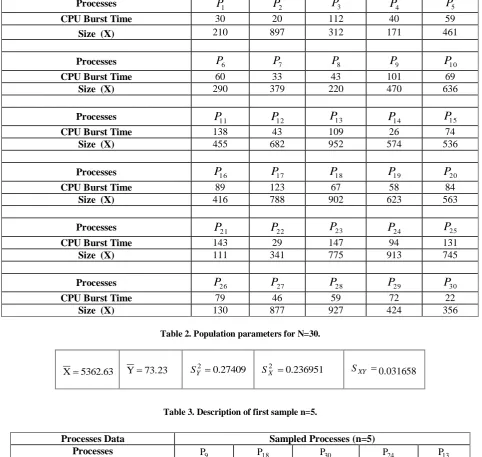
Consider 30 processes in ready queue at a time whose size measure X is also given in terms of bytes. If we assume that all
the processes are processed completely in the ready queue, the CPU burst time Y is mentioned against them.
Table 1. Data of Ready Queue
Processes
P
1P
2P
3P
4P
5CPU Burst Time
30
20
112
40
59
Size (X)
210
897
312
171
461
Processes
P
6P
7P
8P
9P
10CPU Burst Time
60
33
43
101
69
Size (X)
290
379
220
470
636
Processes
P
11P
12P
13P
14P
15CPU Burst Time
138
43
109
26
74
Size (X)
455
682
952
574
536
Processes
P
16P
17P
18P
19P
20CPU Burst Time
89
123
67
58
84
Size (X)
416
788
902
623
563
Processes
P
21P
22P
23P
24P
25CPU Burst Time
143
29
147
94
131
Size (X)
111
341
775
913
745
Processes
P
26P
27P
28P
29P
30CPU Burst Time
79
46
59
72
22
Size (X)
130
877
927
424
356
[image:5.595.57.540.144.601.2]Table 2. Population parameters for N=30.
Table 3. Description of first sample n=5.
Table 4. Population Parameters for first sample( n=5). 63
. 5362
X Y73.23 SY2 0.27409 SX2 0.236951 SXY
0.031658
Processes Data
Sampled Processes (n=5)
Processes
P9 P18 P30 P24 P13CPU Burst Time (Y
i)
101
67
22
94
109
Processes Size( X
i)
470
902
356
913
952
Table 5. Bias and MSE and confidence interval of
T
AandT
Bestimators (When n=5).Table 6. Description of second sample n=10.
Table 7. Population Parameters for second sample (n=10).
Table 8. Bias and MSE and confidence interval of
T
AandT
Bestimators (When n=10).Table 9. Description of third sample n=15. )
(TA
Bias
-0.0115
Bias(TB)-0.0126
) ( . .SETA
M
242.8404
M.S.E(TB)241.9289
)
(
T
AVar
242.8403
Var
(
T
B)
241.9288
Estimated Confidence Interval lengths
Estimate
(
T
A)
95 % Confidence Intervals for
)
(
T
AEstimate
)
(
T
B95% Confidence Intervals for
)
(
T
B71.18
(28.90-115.42)
70.50
(28.98-115.33)
Processes Parameters
Sampled Processes (n=10)
Processes
P20P
27 P11 P1 P22 P15 P23 P5 P10 P29CPU Burst Time (Y
i)
84
40
138
30
29
74
147
59
69
72
Processes Size (X
i)
563
171
455
210
341
536
775
461
636
424
N=30
n=10
f=0.3333
V0.13361V
02
0
.015797
V200.018273 V110.002111) (TA
Bias
-0.0047
Bias(TB)-0.001
) ( . .SETA
M
96.7872
M.S.E(TB)96.4893
)
(
T
AVar
96.7871
Var
(
T
B)
96.4892
Estimated Confidence Interval lengths
Estimate
(
T
A)
95% Confidence Intervals for
)
(
T
AEstimate
)
(
T
B95% Confidence Intervals for
)
(
T
B147.41
(123.82-168.33)
143.46
(123.86-168.30)
Processes
Data
Sampled Processes( n=15)
Processes
P15 P23 P5 P10 P29 P30 P6 P17 P25 P15 P20P
27 P11 P1 P22CPU
Burst
Time (Y
i)
74
147
59
69
72
22
60
123
131
74
84
40
138
30
29
Processes
Size(X
i)
[image:7.595.60.531.102.147.2]
Table 10.Population Parameters for third sample (n=15).
Table 11. Bias and MSE and confidence interval of
T
AandT
Bestimators (When n=15).7. CONCLUSION
Two estimators
T
AandT
B suggested for estimation of averageready queue remaining time. The estimate by
T
A= 71.18 while BT
= 70.50 (when n=5). Both are close to true value. The M.S.Eof
T
B (=241.93) is lesser to the M.S.E ofT
A(=242.84) for n=5. BT
is uniformly efficient overT
Afor all n=5, 10 and 15 due tolower M.S.E. The true values of CPU burst time lies within the range of confidence interval. It is recommended to prefer
B
T
over
T
A in setup of lottery scheduling for estimationpurpose.
8. REFERENCES
[1] Carl A. Waldspurger and William E. Weihl 1994. Lottery Scheduling a flexible proportional-share resource management. In: Proceedings of the 1st USENIX Symposium on Operating Systems Design and Implementation (OSDI), pp.1-11.
[2] Cochran 2005. Sampling Technique, Wiley Eastern Publication, New Delhi.
[3] David Petro, Garth A. Gibson and John W. Milford 1999. Implementing Lottery Scheduling: Matching the specializations in Traditional Schedulers. In: Proceedings of the USENIX Annual Technical Conference USA, pp.66-80.
[4] Raz, D., B. Itzahak and Levy H. 2004. Classes, Priorities and Fairness in Queuing Systems, Research report, Rutgers University.
[5] Shukla D., Jain, S. 2010. A Stochastic Model Approach for Reaching Probabilities of Message Flow in Space-Division Switches. International Journal of Computer Networks, Vol. 2, Issue 2, pp. 140-151.
[6] Shukla, D, Jain, Saurabh and Ojha, S. 2010. Effect of Data Model Approach for the Analysis of Multi-Level Queue Scheduling, International Journal of Advanced Networking and Applications, Vol. 2 Issue 1, pp. 419-427.
[7] Shukla, D. and Jain, S. 2007. Deadlock state study in security based multilevel queue scheduling scheme in operating system. In: Proceedings of National Conference on Network Security and Management, NCNSM-07, pp. 166-175.
[8] Shukla, D., Jain, A. 2010. Estimation of ready queue processing time under SL scheduling scheme in multiprocessor environment. International Journal of Computer Science and Security (IJCSS), Vol. 4(1), pp. 74-81.
[9] Shukla,D. and Jain, S. 2009. Analysis of Thread scheduling with multiple processors under a Markov chain model, Journal of Computer Science, Vol. 3 , Issue 5, pp. 78-86. [10]Shukla,D., Jain, A. 2011. Analysis of Ready Queue
Processing Time under PPS-LS and SRS-LS scheme in Multiprocessing Environment. GESJ: Computer Science and Telecommunication, 6(26), pp. 99.
[11]Shukla,D., Jain, Anjali and Choduary, A. 2010. Estimation of ready queue processing time under Usual Group Lottery Scheduling (GLS) in Multiprocessor Environment. International Journal of Computer and Applications (IJCA), Vol. 8, No. 14, pp. 39-45.
[12]Shukla,D., Jain, Anjali and Choduary, A. 2011. Estimation of ready queue processing time under Usual Lottery Scheduling (ULS) in Multiprocessor Environment. Journal of Applied Computer Science and Mathematics (JACSM), Vol. 11, No 11, pp.58-63.
[13]Shukla,D., Jain, Saurabh and Singh S. 2008. A Markov chain model for Deficit Round Robin Alternated (DRRA) scheduling algorithm. In: Proceedings of the International Conference on Mathematics and Computer Science, ICMCS-08, pp. 52-61.
N=30
n=15
f=0.5
V0.13361V
02
0
.007989
V200.009136 V110.001055) (TA
Bias
-0.0017
Bias(TB)-0.00261
) ( . .SE TA
M
48.32569
M.S.E(TB)48.2682
)
(
T
AVar
48.32568
Var
(
T
B)
48.2681
Estimated Confidence Interval lengths
Estimate
(
T
A)
95% Confidence Intervals for
)
(
T
AEstimate
)
(
T
B95% Confidence Intervals for
)
(
T
B[14]Shukla D., Singh V.K., Singh G.N. 2001. On the use of transformation in factor-type estimator, METRON International Journal of Statistics, Vol. XLV, pp. 349-361. [15]Singh V.K., Shukla D. 1992. An efficient one-parameter
family of factor-type estimator in sample surveys, METRON International Journal of Statistics, Vol. XVV, pp.139-159.
[16]Singh V.K., Shukla D. 1987. One parameter family of factor type ratio estimators, METRON International Journal of Statistics, Vol. XLV- N. 1-2, pp. 273-283. [17]Silberschatz, A. and Galvin, P. 1999. Operating System
Concepts, Ed.5, John Wiley and Sons (Asia), Inc.
[18]Singh, Daroga and Choudhary, F.S. 1986. Theory and Analysis of Sample Survey and Designs, Wiley Eastern Limited, New Delhi.
[19]Srivenkataramana, T. 1980. A dual to ratio estimator in sample survey, Biometrika, Vol. 67, pp. 199-204.
[20]Stalling, W. 2004. Operating Systems, Ed.5, Pearson Education, Singapore, Indian Edition, New Delhi. [21]Tanenbaum, A. 2000. Operating system, Ed. 8, Prentice
Hall of India, New Delhi.
[22]Yiping Ding, William Flynn 2000. Interpreting Windows NT Processor Queue Length Measurements. In: Proceedings of the 31st Computer Measurement Group Conference, Vol. 2, pp.759-770.
9. APPENDIX
Table 11: Values Of‘
t
’For Given ProbabilitiesDegree
of
freedom
Probabilities of a deviation
greater than
t
0.025
4
2.776
9
2.262
14
2.145
19
2.093
24
2.064
N X X
N
SX i
2
2
2 1
Y
Y
X
X
N
S
XY2
1
i
i
N Y Y
N
SY i
2
2