Munich Personal RePEc Archive
Monotone Methods for Equilibrium
Selection under Perfect Foresight
Dynamics
Oyama, Daisuke and Takahashi, Satoru and Hofbauer, Josef
2 May 2003
Online at
https://mpra.ub.uni-muenchen.de/6721/
Monotone Methods for Equilibrium Selection under
Perfect Foresight Dynamics
∗Daisuke Oyama
Graduate School of Economics, Hitotsubashi University Naka 2-1, Kunitachi, Tokyo 186-8601, Japan
Satoru Takahashi
Department of Economics, Princeton University Princeton, NJ 08544, USA
and
Josef Hofbauer
Department of Mathematics, University of Vienna Nordbergstrasse 15, A-1090 Vienna, Austria
May 2, 2003; revised January 27, 2006
∗This paper has been presented at University of Tokyo, University of Vienna,
Univer-sity of Wisconsin-Madison, and conferences/workshops in Heidelberg, Kyoto, Marseille, Prague, Salamanca, San Diego, Tokyo, Urbino, and Vienna. We are grateful to the au-diences as well as Drew Fudenberg, Michihiro Kandori, Akihiko Matsui, Stephen Morris, William H. Sandholm, and Takashi Ui for helpful comments and discussions. D. Oyama acknowledges Grant-in-Aid for JSPS Fellows. D. Oyama and J. Hofbauer acknowledge support from the Austrian Science Fund (project P15281). J. Hofbauer acknowledges support from UCL’s Centre for Economic Learning and Social Evolution (ELSE).
Abstract
This paper studies a dynamic adjustment process in a large society of forward-looking agents where payoffs are given by a normal form supermodular game. The stationary states of the dynamics correspond to the Nash equilibria of the stage game. It is shown that if the stage game has a monotone potential maximizer, then the corresponding stationary state is uniquely linearly absorbing and globally accessible for any small degree of friction. Among binary supermodular games, a simple example of a unanimity game with three players is provided where there are multiple globally accessible states for a small friction.
Journal of Economic LiteratureClassification Numbers: C72, C73.
Contents
1 Introduction 1
2 Perfect Foresight Dynamics 5
2.1 Stage Game . . . 5
2.2 Perfect Foresight Paths . . . 6
2.3 Best Response Correspondence . . . 8
2.4 Stability Concepts . . . 9
3 Supermodularity and Monotonicity 10 3.1 Supermodular Games . . . 11
3.2 Comparison Theorem . . . 13
3.3 Stability under Rationalizable Foresight . . . 17
4 Games with Monotone Potentials 20 4.1 Monotone Potential Maximizer . . . 21
4.2 Results . . . 22
4.3 Examples . . . 23
4.3.1 p-Dominance . . . 23
4.3.2 Local Potential Maximizer . . . 24
4.3.3 Symmetric 3×3 Supermodular Games . . . 26
4.3.4 Young’s Example . . . 27
5 Binary Supermodular Games 27 5.1 General Results . . . 28
5.2 Unanimity Games . . . 29
5.2.1 Global Accessibility . . . 30
5.2.2 Absorption . . . 30
5.2.3 Two-Player Case . . . 31
5.2.4 Three-Player Case . . . 31
5.3 Binary Games with Linear Incentives . . . 33
5.4 Binary Games with Invariant Diagonal . . . 36
6 Conclusion 38 Appendix 39 A.1 Proof of Proposition 3.7 . . . 39
A.2 Proof of Theorem 4.1 . . . 40
A.3 Proof of Theorem 4.2 . . . 43
A.4 Proofs for Subsection 4.3 . . . 45
A.5 Proofs for Subsection 5.1 . . . 48
1
Introduction
Supermodular games capture the key concept of strategic complementarity in various economic phenomena. Examples include oligopolistic competi-tion, adoption of new technologies, bank runs, currency crises, and eco-nomic development. Strategic complementarity plays an important role in particular in Keynesian macroeconomics (Cooper (1999)). From a theoreti-cal viewpoint, those games have appealing properties due to their monotone structure (Topkis (1979), Milgrom and Roberts (1990), Vives (1990), and Athey (2001)).
A salient feature of supermodular games is that there typically exist multiple Nash equilibria due to strategic complementarities, which raises the question as to which equilibrium is likely to be played. To address the problem of equilibrium selection, game theory has so far proposed two major strands of approaches besides the classic one by Harsanyi and Selten (1988). One is to consider the stability of Nash equilibria in the context of evolution-ary dynamics (Kandori, Mailath, and Rob (1993), Young (1993), Kandori and Rob (1995) for stochastic models; Hofbauer (1999) for a deterministic model); the other is to embed the original game in a static incomplete infor-mation game and examine the robustness of equilibrium outcomes to a small amount of uncertainty (Carlsson and van Damme (1993), Frankel, Morris, and Pauzner (2003), Morris and Shin (2003); Kajii and Morris (1997), Morris and Ui (2005)).
Our approach in the present paper is to examine the stability of Nash equilibria in supermodular games under perfect foresight dynamics, first in-troduced by Matsui and Matsuyama (1995) for 2×2 games.1 We consider
a dynamics adjustment process in a large society where agents make irre-versible decisions (e.g., career or sector choices as considered in Matsuyama (1991)) and instantaneous payoffs are given by a normal form supermodular game. In contrast to most evolutionary models where agents are myopic and boundedly rational, our model has forward-looking, rational agents. Combined with a dynamic environment with frictions in action revisions, this gives rise to the possibility that self-fulfilling beliefs destabilize strict Nash equilibria, which allows us to discriminate among Nash equilibria. In-deed, Matsui and Matsuyama (1995) demonstrate that in 2×2 coordination games, the society can escape from the risk-dominated equilibrium to the risk-dominant equilibrium but not vice versa, provided that the friction is sufficiently small. The purpose of this paper is to derive sufficient condi-tions for the stability of Nash equilibria for broader classes of supermodular games, thereby providing a link between ours and other approaches. In particular, we show that for games with monotone potentials (Morris and
1This class of dynamics is also studied by Matsuyama (1991) but with nonlinear payoff
Ui (2005)), our condition coincides with that for the robustness to incom-plete information (Kajii and Morris (1997)). On the other hand, there are also disagreements: e.g., in unanimity games with more than two players, the equilibrium selection criterion based on Nash product (Harsanyi and Selten (1988)) is not supported.
We employ the following framework. The society consists ofN large pop-ulations of infinitesimal agents, who are repeatedly and randomly matched to play anN-player normal form game. There are frictions: each agent must make a commitment to a particular action for a random time interval. Op-portunities to revise actions follow Poisson processes which are independent across agents. The dynamics thus exhibits inertia in that the action distri-bution in the society changes continuously. Unlike in standard evolutionary games, each agent forms his belief about the future path of the action distri-bution and, when given a revision opportunity, takes an action to maximize his expected discounted payoff. A perfect foresight path is defined to be a feasible path of action distribution along which every revising agent takes a best response to the future course of play. While the stationary states of this dynamics corresponds to the Nash equilibria of the stage game, there may also exist a perfect foresight path that escapes from a strict Nash equilib-rium when the degree of friction, defined as the discounted average duration of the commitment, is sufficiently small. We say that a Nash equilibrium
a∗ is linearly absorbing if the feasible path converging linearly to a∗ is the
unique perfect foresight path whenever the initial state is close enough toa∗;
a∗ isglobally accessible if for any initial state, there exists a perfect foresight
path converging toa∗.2 If a Nash equilibrium is both linearly absorbing and
globally accessible, then self-fulfilling expectations cannot destabilize this equilibrium, whereas from any other equilibrium, expectations may lead the society to this equilibrium; that is to say, it is the unique equilibrium that is robust to the possibility of self-fulfilling prophecies.
Several equilibrium selection results based on the perfect foresight dy-namics have been obtained so far. Matsui and Matsuyama (1995) demon-strate that in 2×2 coordination games, a strict Nash equilibrium is linearly absorbing and globally accessible for any small degree of friction if and only if it is the risk-dominant equilibrium. Beyond 2×2 games, Oyama (2002) appeals to the notion of p-dominance to identify (in a single population setting) a class of games where one can explicitly characterize the set of per-fect foresight paths relevant for stability considerations, showing that a p -dominant equilibrium withp <1/2 is selected.3 Hofbauer and Sorger (2002)
and Kojima (2003) obtain related results based on other generalizations of
2Since there may exist multiple perfect foresight paths for a given initial state, it is
possible that a state is globally accessible but not linearly absorbing. Indeed, we provide an example where there exist multiple globally accessible states when the friction is small; by definition, none of them is linearly absorbing.
the risk-dominance concept in a multiple population setting.4 Hofbauer
and Sorger (1999, 2002) establish the selection of the unique potential max-imizer for potential games, both in a single population setting and in a multi-population setting.5 Their results rely on the relationship between
the perfect foresight paths and the solutions to an associated optimal con-trol problem as well as the Hamiltonian structure that the dynamics has when the stage game is a potential game.
In this paper, we consider supermodular games and games that have some monotonic relationship with supermodular games, by employing meth-ods of analysis based on monotonicity and comparison. An underlying ob-servation is that a perfect foresight path is characterized as a fixed point of the best response correspondence defined on the set of feasible paths. We observe that if the stage game is supermodular, this correspondence is monotone with respect to the partial order over feasible paths induced by the stochastic dominance order. We then compare the perfect foresight paths of two different stage games that are comparable in terms of best responses and show the following analogue to the comparison theorem from the theory of monotone dynamical systems (Smith (1995)):6 if at least one of the two games is supermodular, then the order of best responses between the games is preserved in the perfect foresight dynamics. This fact allows us to transfer stability properties from one game to the other.
We apply our monotone methods to the class of games with monotone potentials introduced by Morris and Ui (2005), who show that a monotone potential maximizer (MP-maximizer) is robust to incomplete information (Kajii and Morris (1997)).7 A normal form game is said to have a
mono-tone potential if it is comparable (in terms of best responses) to a potential game, and the action profile that maximizes the potential is said to be an
MP-maximizer. Monotone potential games include both potential games and, interestingly, games with a p-dominant equilibrium with ∑
ipi < 1.
By invoking the potential game results due to Hofbauer and Sorger (2002),
4Kim (1996) establishes a similar result for binary games with many identical players. 5To be precise, they show that a unique potential maximizer a∗ is absorbing (and
globally accessible for small friction): i.e., any perfect foresight path, which may or may not be unique, from a neighborhood ofa∗must converge toa∗. It is not known whether a
potential maximizer is linearly absorbing. In supermodular games, as we show, absorption and linear absorption are equivalent.
6Hofbauer and Sandholm (2002) show that when the underlying game is supermodular,
the perturbed best response dynamics forms a monotone dynamical system. The perfect foresight dynamics, on the other hand, cannot be considered as a dynamical system due to the multiplicity of perfect foresight paths.
7More generally, Morris and Ui (2005) show that a generalized potential maximizer is
our main result shows that if the stage game or the monotone potential is supermodular, then an MP-maximizer is globally accessible for any small degree of friction and (generically) linearly absorbing for any degree of fric-tion. Our result thus unifies and extends the previous results using potential maximization andp-dominance, as done by Morris and Ui (2005) for the ro-bustness of equilibria to incomplete information.
We then study the class of binary supermodular games, for which we obtain complete characterizations for linear absorption and for global acces-sibility. These characterizations are applied to three subclasses. First, for unanimity games, we show that our selection criterion is not in agreement with that in terms of Nash product.8 In fact, the perfect foresight dy-namics fails to select a single Nash equilibrium for some unanimity games. A nondegenerate example (Example 5.2.1 in Subsection 5.2) demonstrates that the two strict Nash equilibria are mutually accessible, actually glob-ally accessible, for a small friction. Second, for games with linear incentives (Selten (1995)), we find a connection to the concept of spatial dominance due to Hofbauer (1999). It is shown that if a strict Nash equilibrium is glob-ally accessible under the perfect foresight dynamics with a small friction, then it is spatially dominant. This implies in particular that for (generic) games with linear incentives, a globally accessible equilibrium is unique if it exists.9 Third, we introduce the class of games with invariant diagonal, in which all players receive the same payoffs when they all play the same mixed strategy. For this class of games, we obtain the generic existence of a linearly absorbing and globally accessible equilibrium for a small friction. The concept of perfect foresight path requires that agents optimize against their beliefs about the future path of the action distribution and that those beliefs coincide with the actual path. Relaxing the latter requirement, Matsui and Oyama (2002) introduce the model of rationalizable foresight dynamics, where while the rationality of the agents as well as the struc-ture of the society is common knowledge, beliefs about the fustruc-ture path are not necessarily coordinated among the agents. It is instead assumed that the agents form their beliefs in a rationalizable manner: in particular, they may misforecast the future. Arationalizable foresight pathis a feasible path along which every revising agent optimizes against another rationalizable foresight path. We show that in supermodular games, a linearly absorbing and globally accessible state is the unique state from which no rationalizable foresight path escapes. That is, our stability results for supermodular games also hold under the less demanding assumption of rationalizable foresight.
8Hofbauer (1999) shows that in unanimity games, the Nash equilibrium with the higher
Nash product is selected in his spatio-temporal model.
9Takahashi (2004) considers many-action supermodular games with linear incentives
The paper is organized as follows. Section 2 introduces the perfect fore-sight dynamics for general finiteN-player games and provides a character-ization of perfect foresight paths as the fixed points of the best response correspondence defined on the set of feasible paths. Section 3 studies mono-tone properties of the perfect foresight dynamics and proves our comparison theorem. It also examines the relationship between the stability concepts under perfect foresight and those under rationalizable foresight. Section 4 considers games with monotone potentials and establishes the selection of MP-maximizer. Section 5 gives complete characterizations for the stability of strict Nash equilibria in binary supermodular games. Detailed analyses are conducted for unanimity games, games with linear incentives, and games with invariant diagonal. Section 6 concludes.
2
Perfect Foresight Dynamics
2.1 Stage Game
Let G = (I,(Ai)i∈I,(ui)i∈I) be a normal form game with N ≥ 2 players,
where I ={1,2, . . . , N} is the set of players, Ai = {0,1, . . . , ni} the finite
set of actions for player i∈I, and ui: ∏i∈IAi →Rthe payoff function for
playeri. We denote ∏
i∈IAi byA and
∏
j6=iAj by A−i.
Denote by R+ the set of all nonnegative real numbers and by R++ the
set of all positive real numbers. The set of mixed strategies for player i is denoted by
∆(Ai) =
{
xi = (xi0, xi1, . . . , xini)∈R
ni+1 +
¯ ¯ ¯
∑
h∈Ai
xih= 1
}
,
which is identified with the ni-dimensional simplex. We sometimes
iden-tify each action in Ai with the element of ∆(Ai) that assigns one to the
corresponding coordinate. The polyhedron∏
i∈I∆(Ai) is a subset of then
-dimensional real space endowed with the sup norm|·|, wheren=∑
i∈I(ni+
1). For x ∈ ∏
i∆(Ai) and ε > 0, Bε(x) denotes the ε-neighborhood of x
relative to∏
i∆(Ai), i.e.,Bε(x) ={y∈∏i∆(Ai)| |y−x|< ε}.
Payoff functionsui(h,·) are extended to∏j6=i∆(Aj), andui(·) to∏j∈I∆(Aj),
i.e.,
ui(h, x−i) =
∑
a−i∈A−i
(∏
j6=ixjaj
)
ui(h, a−i)
forx−i ∈∏j6=i∆(Aj), and
ui(x) =
∑
h∈Ai
xihui(h, x−i)
for x ∈ ∏
∏
j6=i∆(Aj) in pure strategies, i.e.,
bri(x−i) = arg max h∈Ai
ui(h, x−i)
={h∈Ai|ui(h, x−i)≥ui(k, x−i) for allk∈Ai}.
An element x∗ ∈ ∏
i∆(Ai) is a Nash equilibrium if for all i ∈ I and all
h∈Ai,
x∗ih>0⇒h∈bri(x∗−i),
and x∗ is a strict Nash equilibrium if for all i∈I and all h∈A
i,
x∗ih>0⇒ {h}=bri(x∗−i).
Let ∆(A−i) be the set of probability distributions on A−i. We
some-times extend ui(h,·) to ∆(A−i). For πi ∈ ∆(A−i), we write ui(h, πi) =
∑
a−i∈A−iπi(a−i)ui(h, a−i) andbr
i(π
i) = arg maxh∈Aiui(h, πi).
2.2 Perfect Foresight Paths
Given anN-player normal form game, which will be called the stage game, we consider the following dynamic societal game. Society consists ofN large populations of infinitesimal agents, one for each role in the stage game. In each population, agents are identical and anonymous. At each point in time, one agent is selected randomly from each population and matched to form an N-tuple and play the stage game. Agents cannot switch actions at every point in time. Instead, every agent must make a commitment to a particular action for a random time interval. Time instants at which each agent can switch actions follow a Poisson process with the arrival rate
λ > 0. The processes are independent across agents. We choose without loss of generality the unit of time in such a way thatλ= 1.10
The action distribution in populationi∈I at timet∈R+is denoted by
φi(t) = (φi0(t), φi1(t), . . . , φini(t))∈∆(Ai),
whereφih(t) is the fraction of agents who are committing to action h∈Ai
at time t. Let φ(t) = (φ1(t), φ2(t), . . . , φN(t)) ∈ ∏i∆(Ai). Due to the
assumption that the switching times follow independent Poisson processes with arrival rateλ= 1,φih(·) is Lipschitz continuous with Lipschitz constant
1, which implies in particular that it is differentiable at almost all t ≥ 0. Moreover, its speed of adjustment is bounded: ˙φih(t) ≥ −φih(t), where
∑
h∈Ai
˙
φih(t) = 0. We call such a pathφ(·) a feasible path.
10We can alternatively assume as follows. Each agent exits from his population
Definition 2.1. A path φ: R+ → ∏i∆(Ai) is said to be feasible if it is
Lipschitz continuous, and for all i ∈ I and almost all t ≥ 0, there exists
αi(t)∈∆(Ai) such that
˙
φi(t) =αi(t)−φi(t). (2.1)
In Equation (2.1), αi(t) ∈∆(Ai) denotes the action distribution of the
agents in populationiwho have a revision opportunity during the short time interval [t, t+dt). In particular, if for some action profile a= (ai)i∈I ∈A,
αi(t) =ai for all i∈I and all t≥0, then the resulting feasible path, which
converges linearly toa, is called a linear path toa.
Denote by Φi the set of feasible paths for populationi, and let Φ =∏
iΦi
and Φ−i = ∏
j6=iΦj. For x ∈
∏
i∆(Ai), the set of feasible paths starting
fromxis denoted by Φx=∏iΦix. For eachx∈
∏
i∆(Ai), Φx is convex and
compact in the topology of uniform convergence on compact intervals.11
An agent in population ianticipates the future evolution of the action distribution, and, if given the opportunity to switch actions, commits to an action that maximizes his expected discounted payoff. Since the duration of the commitment has an exponential distribution with mean 1, the expected discounted payoff of committing to action h ∈ Ai at time t with a given
anticipated pathφ∈Φ is represented by
Vih(φ)(t) = (1 +θ)
∫ ∞
0
∫ t+s
t
e−θ(z−t)ui(h, φ−i(z))dz e−sds
= (1 +θ)
∫ ∞
t
e−(1+θ)(s−t)ui(h, φ−i(s))ds,
where θ > 0 is a common discount rate (relative to λ= 1). We view the discounted average duration of a commitment, θ/λ = θ, as the degree of friction. Note that V is well-defined whenever θ >−1.
Given a feasible path φ∈ Φ, letBRi(φ)(t) be the set of best responses in pure strategies toφ−i= (φj)j6=i at timet, i.e.,
BRi(φ)(t) = arg max
h∈Ai
Vih(φ)(t).
Note that for each i∈ I, the correspondence BRi: Φ×R+ → Ai is upper
semi-continuous sinceVi is continuous.
A perfect foresight path is a feasible path along which each agent opti-mizes against the correctly anticipated future path.
Definition 2.2. A feasible path φ is said to be a perfect foresight path if for all i∈I, allh∈Ai, and almost allt≥0,
˙
φih(t)>−φih(t)⇒h∈BRi(φ)(t). (2.2)
Note that ˙φih(t)>−φih(t) (i.e.,αih(t) >0 in (2.1)) implies that action
h is taken by some positive fraction of the agents in population ihaving a revision opportunity during the short time interval [t, t+dt). The definition says that such an action must be a best response to the path φitself.
2.3 Best Response Correspondence
For a given initial statex∈∏
i∆(Ai), a best response path for population
i to a feasible path φ ∈ Φx is a feasible path ψi ∈ Φix along which every
agent takes an optimal action against φ. This defines the best response correspondence βxi: Φx → Φix which maps each feasible path φ∈Φx to the
set of best response paths for populationi:
βxi(φ) ={ψi ∈Φix|ψ˙ih(t)>−ψih(t)⇒h∈BRi(φ)(t) a.e.}. (2.3)
Letβx: Φx→Φx be defined byβx(φ) =∏iβxi(φ). We denote byβ: Φ→Φ
the extension ofβx to Φ, i.e.,β(φ) =βφ(0)(φ) forφ∈Φ.
A perfect foresight path φ with φ(0) =x is a fixed point of βx: Φx →
Φx, i.e., φ ∈ βx(φ). The existence of perfect foresight paths follows, due
to Kakutani’s fixed point theorem, from the fact that βx is a nonempty-,
convex-, and compact-valued upper semi-continuous correspondence. This fact can be shown by either of the two characterizations given below.
Remark 2.1. For a given feasible path φ ∈ Φx, a best response path ψ ∈
βx(φ) is a Lipschitz solution to the differential inclusion
˙
ψ(t)∈F(φ)(t)−ψ(t) a.e., ψ(0) =x, (2.4)
whereF: Φ×R+→∏i∆(Ai) is defined by
Fi(φ)(t) ={αi∈∆(Ai)|αih>0⇒h∈BRi(φ)(t)}, (2.5)
which is the convex hull ofBRi(φ)(t). SinceF(φ)(·) is convex- and compact-valued, and upper semi-continuous, the existence theorem for differential inclusions (see, e.g., Aubin and Cellina (1984, Theorem 2.1.4)) implies the nonemptiness of the set of solutions,βx(φ). The convexity of βx(φ) is
obvi-ous. Furthermore, we can show that βx(φ) is compact and depends upper
semi-continuously onφ. For these properties ofβx, we only need the upper
semi-continuity ofBRi, which is in turn implied by the continuity ofVi.
Lemma 2.1. βx is compact-valued and upper semi-continuous.
Proof. Since the values are contained in the compact set Φx, it is sufficient
to show thatβx has a closed graph. Let{φk}∞k=1 and{ψk}∞k=1 be such that
ψk ∈ βx(φk), and assume that φk → φ and ψk → ψ as k→ ∞. Take any
i∈I,h ∈Ai, andt≥0 such that ˙ψih(t)>−ψih(t). We want to show that
Observe that for anyε >0, there exists ¯k such that for allk≥¯k,
˙
ψkih(tk)>−ψkih(tk)
for some tk ∈ (t−ε, t+ε). Take a sequence {εℓ}∞ℓ=1 such that εℓ > 0
and εℓ → 0 as ℓ → ∞. Then, we can take a subsequence {ψkℓ}∞ℓ=1 of
{ψk}∞
k=1 such that ˙ψ
kℓ
ih(tℓ)>−ψihkℓ(tℓ) holds for sometℓ ∈(t−εℓ, t+εℓ). By
assumption, h ∈BRi(φkℓ)(t
ℓ) for all ℓ. Now letℓ → ∞. Since BRi(·)(·) is
upper semi-continuous, we haveh∈BRi(φ)(t).
Remark2.2. The correspondenceβi
x is actually the best response
correspon-dence for an associated differential game, as constructed in Hofbauer and Sorger (2002). With the stage game G, the discount rate θ > 0, and an initial state x ∈ ∏
i∆(Ai) given, the associated differential game is an N
-player normal form game in which the set of actions for -playeri∈ I is Φi x
and the payoff function for playeriis given by
Ji(φ) =
∫ ∞
0
e−θtui(φ(t))dt. (2.6)
As shown by Hofbauer and Sorger (2002), the perfect foresight paths are precisely the Nash equilibria of this game, due to the following fact.
Lemma 2.2. For a feasible path φ∈Φx,
βxi(φ) = arg max
ψi∈Φix
Ji(ψi, φ−i).
Proof. Follows from Lemma 3.1 in Hofbauer and Sorger (2002).
The continuity ofJi, the quasi-concavity ofJi(·, φ−i), and the
compact-ness of Φix therefore imply the desired properties ofβix.
2.4 Stability Concepts
The constant path ¯φgiven by ¯φ(t) =x∗∈∏
i∆(Ai) for allt≥0 is a perfect
foresight path if and only if x∗ is a Nash equilibrium of the stage game. Nevertheless, there may exist another perfect foresight path starting at x∗
Definition 2.3. (a) x∗ ∈∏
i∆(Ai) is absorbing if there exists ε > 0 such
that any perfect foresight path from anyx∈Bε(x∗) converges tox∗.
(b) a∗ ∈ A is linearly absorbing if there exists ε > 0 such that for any
x∈Bε(a∗), the linear path toa∗ is a unique perfect foresight path fromx.
(c) x∗ ∈ ∏
i∆(Ai) is accessible from x ∈
∏
i∆(Ai) if there exists a
perfect foresight path fromx that converges to x∗. x∗ isglobally accessible
if it is accessible from anyx.
Ifx∗ is absorbing and the current state is close enough tox∗, then along
any (not necessarily unique) perfect foresight path, the behavior pattern of the society converges to x∗. Linear absorption is a stronger concept than
absorption:12 ifa∗is linearly absorbing and the current state is close enough to a∗, then the perfect foresight path is unique, along which every agent
at revision opportunity takes the action prescribed in a∗. If a (linearly)
absorbing state is also globally accessible, then it is the unique (linearly) absorbing state; if a globally accessible state is also absorbing, then it is the unique globally accessible state.
A globally accessible state is not necessarily absorbing, as there are gen-erally multiple perfect foresight paths from a given initial state. We present a (nondegenerate) example in Subsection 5.2 (Example 5.2.1) that has two globally accessible states for small θ; by definition, neither of them is ab-sorbing.
Any absorbing or globally accessible state is a Nash equilibrium of the stage game, which follows from the proposition below.
Proposition 2.3. If x∗ ∈∏
i∆(Ai) is the limit of a perfect foresight path,
thenx∗ is a Nash equilibrium.
Proof. Suppose that x∗ is the limit of a perfect foresight pathφ∗. Let ¯φbe
the constant path atx∗, i.e., ¯φ(t) =x∗ for all t≥0. Letφt be the feasible
path defined by φt(s) =φ∗(s+t) for alls≥0. Then, {φt}t
≥0 converges to
¯
φast→ ∞.
Take any i ∈ I and any h ∈ Ai with x∗ih > 0. Then, there exists a
sequence {tk}∞
k=1 such that tk → ∞ as k → ∞ and h ∈ BRi(φ∗)(tk) =
BRi(φtk)(0) for any k since φ∗ is a perfect foresight path that converges
to x∗. Let k → ∞. By the upper semi-continuity of BRi(·)(0), we have
h∈BRi( ¯φ)(0) =bri(x∗ −i).
3
Supermodularity and Monotonicity
Supermodular games are games in which actions are ordered so that each player’s marginal payoff to any increase in his action is nondecreasing in
12No example is known of a state that is absorbing but not linearly absorbing. We will
other players’ actions. In this section, we first identify monotone properties of the perfect foresight dynamics for supermodular stage games. In partic-ular, we observe the monotonicity of the best response correspondence β
with respect to a partial order on Φ induced by the stochastic dominance relation over mixed strategies. We then prove a comparison theorem for the perfect foresight paths associated with two different stage games that are comparable in terms of best responses. This theorem implies that if at least one of the two games is supermodular, then one game inherits stability properties from the other. Finally, we show that for supermodular games, stability under perfect foresight is equivalent to that under rationalizable foresight (Matsui and Oyama (2002)).
3.1 Supermodular Games
Forxi, yi∈∆(Ai), we write xi -yi ifyi stochastically dominates xi, i.e.,
ni
∑
k=h
xik ≤ ni
∑
k=h
yik
for all h ∈Ai. For x, y∈ ∏i∆(Ai), we write x -y if xi -yi for all i∈I
and x−i - y−i if xj - yj for all j 6= i. Moreover, we define φi - ψi for
φi, ψi ∈Φi by φi(t)-ψi(t) for allt≥0;φ-ψ forφ, ψ∈Φ byφi -ψi for
all i∈I; and φ−i -ψ−i for φ−i, ψ−i ∈Φ−i by φj -ψj for all j 6=i. Note
that if φ(0)-ψ(0) and ˙φ(t) +φ(t)-ψ˙(t) +ψ(t) for almost all t≥0, then
φ-ψ.
The gameGis said to besupermodular if wheneverh < k, the difference
ui(k, a−i)−ui(h, a−i) is nondecreasing ina−i ∈A−i, i.e., if a−i ≤b−i, then
ui(k, a−i)−ui(h, a−i)≤ui(k, b−i)−ui(h, b−i).
It is well known that this property extends to mixed strategies: ifh < kand
x−i -y−i, then
ui(k, x−i)−ui(h, x−i)≤ui(k, y−i)−ui(h, y−i).
The expected discounted payoff functionVipreserves this property, implying
thatBRi is monotone with respect to the partial order on Φ.
Lemma 3.1. Suppose that the stage game is supermodular. For φ, ψ ∈Φ, if φ−i -ψ−i, then for all i∈I and all t≥0,
Vik(φ)(t)−Vih(φ)(t)≤Vik(ψ)(t)−Vih(ψ)(t)
for h < k, and
minBRi(φ)(t)≤minBRi(ψ)(t),
Proof. Supposeφ−i-ψ−i and fix anyt. Ifk > h, then
Vik(φ)(t)−Vih(φ)(t)
= (1 +θ)
∫ ∞
t
e−(1+θ)(s−t){
ui(k, φ−i(s))−ui(h, φ−i(s))}ds ≤(1 +θ)
∫ ∞
t
e−(1+θ)(s−t){
ui(k, ψ−i(s))−ui(h, ψ−i(s))
}
ds
=Vik(ψ)(t)−Vih(ψ)(t).
Next, letk= minBRi(φ)(t). For any h < k,
Vik(ψ)(t)−Vih(ψ)(t)≥Vik(φ)(t)−Vih(φ)(t)>0
sinceh /∈BRi(φ)(t). Hence, if ℓ∈BRi(ψ)(t), thenℓ≥k= minBRi(φ)(t). We thus have minBRi(ψ)(t)≥minBRi(φ)(t).
The other claim that maxBRi(φ)(t) ≤ maxBRi(ψ)(t) can be proved similarly.
The next proposition establishes the monotonicity of the best response correspondence βi over Φ. For φ ∈ Φ, a feasible path φ−i ∈ βi(φ) is the smallest element of βi(φ) if φ−i -φ′
i for all φ′i ∈ βi(φ), and φ+i ∈ βi(φ) is
the largest element ofβi(φ) if φ′
i-φ+i for all φ′i ∈βi(φ).
Proposition 3.2. Suppose that the stage game is supermodular. Forφ∈Φ,
βi(φ) has the smallest elementminβi(φ)and the largest element maxβi(φ).
If φi(0)-ψi(0) and φ−i -ψ−i, then
minβi(φ)-minβi(ψ),
maxβi(φ)-maxβi(ψ).
Proof. Take φ and ψ such that φi(0) = xi,ψi(0) = yi, xi -yi, and φ−i
-ψ−i. First, we construct φ−i = minβi(φ); the construction of maxβi(φ) is
similar. Define
αi(t) = minBRi(φ)(t),
where the right hand side is considered as a mixed strategy. Note thatαi is
lower semi-continuous, and hence, measurable, sinceBRi(φ)(·) is an upper semi-continuous correspondence. Then, the unique solutionφ−i to
˙
φ−i (t) =αi(t)−φ−i (t) a.e., φ−i (0) =xi
is given by
φ−i (t) =e−txi+
∫ t
0
es−tαi(s)ds.
By construction,φ−i ∈βi(φ), and φ−i -φ′
i for allφ′i ∈βi(φ), i.e., φ−i is the
On the other hand, any path ψ′
i∈βi(ψ) is given by
ψi′(t) =e−tyi+
∫ t
0
es−tα′i(s)ds
for some α′
i:R+ → ∆(Ai) such that α′i(t) ∈ Fi(ψ)(t) for almost all t ≥ 0,
whereFi(ψ) is defined by (2.5). Sinceφ−i-ψ−i, it follows from Lemma 3.1
that
minBRi(φ)(t)≤minBRi(ψ)(t),
and hence, αi(t) - α′i(t) for almost all t. Together with the assumption
that xi - yi, this implies that φ−i - ψi′, thereby completing the proof of
minβi(φ)-minβi(ψ).
3.2 Comparison Theorem
Fix the set of players, I, and the set of action profiles, A. Consider two gamesG = (I,(Ai)i∈I,(ui)i∈I) and G′ = (I,(Ai)i∈I,(vi)i∈I) satisfying that
for all i∈I and all πi ∈∆(A−i),
minbrivi(πi)≤minbriui(πi), (3.1)
or that for alli∈I and allπi ∈∆(A−i),
maxbrivi(πi)≤maxbriui(πi), (3.2)
wherebriui(πi) and brivi(πi) are the sets of best responses toπi in games G
and G′, respectively. In this subsection, we study the relationship between
the perfect foresight paths for the stage gameGand those forG′. Note that
the state space ∏
i∆(Ai) is common in both cases. We will show that if
GorG′ is supermodular, then the perfect foresight dynamics preserves the
order of best responses betweenGandG′, and therefore,Ginherits stability
properties fromG′.
To specify the payoff functions, we denote by BRiui(φ)(t) (BRivi(φ)(t), resp.) the set of best responses for populationito a feasible pathφat time
twhen the stage game is G(G′, resp.). Note that this can be written as
BRiui(φ)(t) =briui(πti(φ))
with a probability distributionπt
i(φ)∈∆(A−i) which is given by
πti(φ)(a−i) = (1 +θ)
∫ ∞
t
e−(1+θ)(s−t)(∏
j6=iφjaj(s)
)
ds.
Thus, if (3.1) is satisfied, then for anyφ∈Φ and anyt≥0,
while if (3.2) is satisfied, then for anyφ∈Φ and anyt≥0,
maxBRivi(φ)(t)≤maxBRiui(φ)(t). (3.4)
The following lemma is a key to our comparison theorem. The proof relies on a fixed point argument together with the monotonicity ofBRi.
Lemma 3.3. Let x, y∈∏
i∆(Ai) be such thaty-x.
(a) Suppose thatGandG′ satisfy(3.1)and thatGorG′ is supermodular.
If a feasible path φ∈Φx satisfies that for all i∈I, all h ∈Ai, and almost
allt≥0,
˙
φih(t)>−φih(t)⇒h≥minBRiui(φ)(t), (3.5)
then there exists a perfect foresight path ψ∗ ∈Φ
y for G′ such that ψ∗ -φ.
(b) Suppose thatGandG′ satisfy(3.2)and thatGorG′ is supermodular. If a feasible path ψ ∈Φy satisfies that for all i∈I, all h∈Ai, and almost
allt≥0,
˙
ψih(t)>−ψih(t)⇒h≤maxBRivi(ψ)(t), (3.6)
then there exists a perfect foresight path φ∗∈Φx for G such that ψ-φ∗.
Proof. We only show (a). Given x, y ∈ ∏
i∆(Ai) with y -x and φ ∈ Φx
satisfying (3.5), define the convex and compact subset ˜Φy ⊂Φy to be
˜
Φy ={ψ∈Φy|ψ-φ}.
Let βG′ be the best response correspondence for the stage game G′. We
define a convex- and compact-valued and upper semi-continuous correspon-dence ˜βG′: ˜Φy →Φ˜y by
˜
βG′(ψ) =βG′(ψ)∩Φ˜y (ψ∈Φ˜y).
We want to show that ˜βG′(ψ) is nonempty for any ψ ∈ Φ˜y. Then, it
follows from Kakutani’s fixed point theorem that ˜βG′ has a fixed point
ψ∗ ∈ β˜
G′(ψ∗) ⊂ Φ˜y, which is a perfect foresight path for G′ and satisfies
ψ∗ -φ.
Forψ∈Φ˜y, take anyi∈I,h∈Ai, andt≥0 such that ˙φih(t)>−φih(t).
IfGis supermodular, then
h≥minBRiui(φ)(t)≥minBRiui(ψ)(t)≥minBRivi(ψ)(t),
where the second inequality follows from the supermodularity of G and Lemma 3.1, and the third inequality follows from the assumption of (3.1). IfG′ is supermodular, then
where the second inequality follows from the assumption of (3.1), and the third inequality follows from the supermodularity of G′ and Lemma 3.1. Therefore, in each case, we have
h≥minBRivi(ψ)(t)
for all hsuch that ˙φih(t)>−φih(t).
Now let ψ′ ∈Φ
y be given by
˙
ψ′
i(t) = minBRivi(ψ)(t)−ψ
′
i(t) a.e., ψi′(0) =yi
for all i ∈ I. By construction, we have ψ′ ∈ β
G′(ψ). Since ψ′(0) = y
-x = φ(0) and ˙ψ′(t) + ψ′(t) - φ˙(t) +φ(t) for almost all t, we also have
ψ′ -φ. Therefore, we haveψ′ ∈β˜G′(ψ), which implies the nonemptiness of
˜
βG′(ψ).
As a corollary, we have the following result, which is an analogue to the comparison theorem from the theory of differential equations (Walter (1970)) or monotone (cooperative) dynamical systems (Smith (1995)) and to the comparative statics theorem (Milgrom and Roberts (1990)).
Theorem 3.4. Let x, y∈∏
i∆(Ai) be such thaty -x.
(a) Suppose thatGandG′ satisfy(3.1)and thatGorG′ is supermodular.
For any perfect foresight pathφ∗ forG withφ∗(0) =x, there exists a perfect
foresight pathψ∗ for G′ with ψ∗(0) =y such that ψ∗ -φ∗.
(b) Suppose thatGandG′ satisfy(3.2)and thatGorG′ is supermodular.
For any perfect foresight pathψ∗ forG′ withψ∗(0) =y, there exists a perfect
foresight pathφ∗ for G withφ∗(0) =x such that ψ∗ -φ∗.
Suppose that Gor G′ is supermodular. This theorem implies that if G
is comparable (in terms of best responses) to G′, then G inherits stability
properties from G′. First, assume that G and G′ satisfy (3.1) and that
action profile maxA = (ni)i∈I is (linearly) absorbing in G′. Take any state
x∈Bε(maxA) for a sufficiently small ε >0 and any perfect foresight path
φ∗ forGwithφ∗(0) =x. By Theorem 3.4(a), there exists a perfect foresight
path ψ∗ for G′ with ψ∗(0) = x such that ψ∗ - φ∗. By the assumption
that maxA is (linearly) absorbing in G′, ψ∗ converges (linearly) to maxA,
so that φ∗ also converges (linearly) to maxA. This implies that maxA is (linearly) absorbing inGas well.
Second, assume that G and G′ satisfy (3.2) and that maxA is globally
accessible in G′. Take any state x ∈ ∏
i∆(Ai). By the assumption that
maxA is globally accessible in G′, there exists a perfect foresight path ψ∗
forG′ with ψ∗(0) =x that converges to maxA. By Theorem 3.4(b), there
exists a perfect foresight path φ∗ forG with φ∗(0) =x such that ψ∗ -φ∗. Sinceψ∗ converges to maxA,φ∗ also converges to maxA. This implies that
Note that by reversing the orders of actions, the above arguments can be applied to minA.
A candidate for the gameG′ is a potential game. Such a case is
consid-ered, with some refinement, in Section 4.
Lemma 3.3 with G′ =G (i.e., vi =ui for all i∈I) yields the following
corollary. We say that a feasible pathφis asuperpath if ˙
φih(t)>−φih(t)⇒h≥minBRi(φ)(t) (3.7)
for alli∈I, all h∈Ai, and almost all t≥0; a feasible path ψ is asubpath
if
˙
ψih(t)>−ψih(t)⇒h≤maxBRi(ψ)(t) (3.8)
for all i∈I, allh∈Ai, and almost allt≥0.
Lemma 3.5. Suppose that the stage game is supermodular. Let x, y ∈
∏
i∆(Ai) be such thaty-x.
(a) If there exists a superpathφwithφ(0) =x, then there exists a perfect foresight pathψ∗ with ψ∗(0) =y such that ψ∗ -φ.
(b) If there exists a subpath ψ with ψ(0) = y, then there exists a perfect foresight pathφ∗ withφ∗(0) =x such that ψ-φ∗.
This lemma is used in Section 5 as well as in the following propositions.
Proposition 3.6. Suppose that the stage game is supermodular. If x∗ ∈ ∏
i∆(Ai) is absorbing, then it is a strict Nash equilibrium.
Proof. In light of Proposition 2.3, it is sufficient to show that any Nash equi-librium that is not a strict Nash equiequi-librium is not absorbing. Suppose that
x∗ is a non-strict Nash equilibrium. We show the existence of an escaping path from x∗.
Let a′
i (a′′i, resp.) be the smallest (the largest, resp.) in bri(x∗−i) for
each playeri, and leta′= (a′i)i∈I and a′′ = (a′′i)i∈I, which are considered as
mixed strategy profiles. Note that a′ -x∗ -a′′ and, by the definition of a
non-strict Nash equilibrium, a′ 6=a′′, so that a′ or a′′ is different from x∗.
Let us assume thata′6=x∗.
Now denote by ¯φ the constant path such that ¯φ(t) = x∗ for all t. Note
that BRi( ¯φ)(t) = bri(x∗
−i), so that minBRi( ¯φ)(t) = a′i for all t. Let φ be
the feasible path starting fromx∗ and converging linearly toa′, i.e.,
φ(t) =e−tx∗+ (1−e−t)a′.
This path satisfiesφ-φ¯, φ6= ¯φ, and ˙φih(t) >−φih(t) only for h=a′i. We
also have
a′i = minBRi( ¯φ)(t)≥minBRi(φ)(t),
foresight path ψ∗ from x∗ such that ψ∗ - φ, which does not converge to
x∗.
The next proposition shows the equivalence of absorption and linear absorption for supermodular games.
Proposition 3.7. Suppose that the stage game is supermodular. If a∗ ∈A
is absorbing, then it is linearly absorbing. Proof. See Appendix.
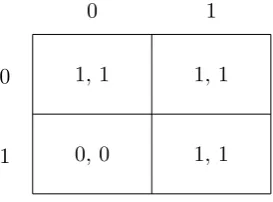
A globally accessible state need not be a strict Nash equilibrium in gen-eral. Even for the class of strict supermodular games, there are degenerate games where a non-strict, pure-strategy Nash equilibrium is globally accessi-ble. In the game given by Figure 1, the non-strict Nash equilibrium (0,1) is globally accessible for any degree of friction. It is an open problem whether every globally accessible state must be a pure Nash equilibrium in generic supermodular games.
0
1
0 1
1, 1 1, 1
[image:21.595.222.359.364.465.2]0, 0 1, 1
Figure 1: Globally accessible, non-strict Nash equilibrium
3.3 Stability under Rationalizable Foresight
Following Matsui and Oyama (2002), we define rationalizable foresight paths as follows. First let Ψ0 be the set of all feasible paths, Φ. Then for each positive integerk, define Ψk to be
Ψk ={
ψ∈Ψk−1¯¯∀i∈I, ∀h∈Ai, a.a. t≥0 : [˙
ψih(t)>−ψih(t)
⇒ ∃ψ′ ∈Ψk−1 :ψ′(s) =ψ(s)∀s∈[0, t] and h∈BRi(ψ′)(t)]}
.
Along a path in Ψk, an agent with a revision opportunity at time t takes a
best response to some path in Ψk−1 while knowing the past history up to
timet.13 Let Ψ∗ =∩∞
k=0Ψk.
Definition 3.1. A path in Ψ∗ is arationalizable foresight path.
Our concept of rationalizable foresight path differs from rationalizability in the associated differential game defined in Remark 2.2. The former incor-porates the feature of societal games that different agents in a population can have different beliefs and a single agent can have different beliefs at different revision opportunities, while for the latter, each population acts as a single player, who makes his decision only at time zero.
Along every rationalizable foresight path, each agent optimizes against some, possibly different, rationalizable foresight path. We state this with-out a proof, as it is essentially the same as Proposition 3.3 in Matsui and Oyama (2002).
Proposition 3.8. A feasible pathψ∈Φis contained inΨ∗ if and only if for
alli∈I, all h∈Ai, and almost all t≥0 such that ψ˙ih(t) >−ψih(t), there
exists ψ′ ∈Ψ∗ such thatψ′(s) =ψ(s) for all s∈[0, t]and h∈BRi(ψ′)(t).
As in a one-shot game, we have the following relationship between perfect and rationalizable foresight paths. This is verified by observing that every perfect foresight path is contained in each Ψk.
Lemma 3.9. A perfect foresight path is a rationalizable foresight path.
We define absorption under rationalizable foresight analogously to that under perfect foresight.14
Definition 3.2. x∗ ∈ ∏
i∆(Ai) is absorbing under rationalizable foresight
if there exists ε > 0 such that any rationalizable foresight path from any
x∈Bε(x∗) converges tox∗.
13Since the environment is stationary andBRi(φ)(t) depends only on the behavior ofφ
after timet, in the definition of Ψk one can equivalently take
ψ′ as a path in Ψk−1 that
only satisfiesψ′(t) =ψ(t).
14We can also define global accessibility under rationalizable foresight in a similar
An absorbing state under rationalizable foresight is also absorbing under perfect foresight due to Lemma 3.9, but not vice versa in general. See Examples 3.1 and 4.1 in Matsui and Oyama (2002). For supermodular games, however, we can show the converse.
Theorem 3.10. Suppose that the stage game is supermodular. Then, x∗ ∈ ∏
i∆(Ai) is absorbing under rationalizable foresight if and only if it is
ab-sorbing under perfect foresight.
Therefore, in supermodular games, an absorbing and globally accessible state under perfect foresight is the unique state that is absorbing under rationalizable foresight.
The “if” part of this theorem follows from the lemma below. For x ∈
∏
i∆(Ai), let Ψkx= Ψk∩Φx and Ψ∗x =
∩∞
k=0Ψkx. Note that Ψ∗x = Ψ∗∩Φx,
i.e., Ψ∗
x is the set of rationalizable foresight paths fromx.
Lemma 3.11. Suppose that the stage game is supermodular. Then, Ψ∗
x
has the smallest and the largest elements, and these elements are perfect foresight paths.
Proof. We show that Ψ∗
x has the smallest element and that it is a perfect
foresight path. Letφ0 be the smallest feasible path from x (i.e., the linear
path fromxto minA) andφkthe smallest best response path toφk−1, which is given by
˙
φki(t) = minBRi(φk−1)(t)−φki(t) a.e., φki(0) =xi.
Then, {φk}∞k=0 is an increasing sequence in the compact set Φx, so that {φk}∞
k=0 converges to someφ∗∈Φx. By the upper semi-continuity ofβx,φ∗
is a perfect foresight path, and hence, an element of Ψ∗
x by Lemma 3.9.
It suffices to show that φ∗ is a lower bound of Ψ∗x. Let us show thatφk
is a lower bound of Ψkx(⊃Ψ∗
x) for allk. Then, it follows that the limitφ∗ is
also a lower bound of Ψ∗
x.
First, φ0 is a lower bound of Ψ0x. Then, suppose that φk−1 is a lower bound of Ψk−1
x . Fix any ψ ∈ Ψkx, and take any i and any t such that φki
and ψi are differentiable at t. For any h such that ˙ψih(t) > −ψih(t), we
haveh∈BRi(ψ′)(t) for someψ′ ∈Ψk−1
x . Sinceφk−1-ψ′ by assumption, it
follows from the supermodularity and Lemma 3.1 that minBRi(φk−1)(t)≤
minBRi(ψ′)(t) ≤ h. Therefore, we have ˙φk
i(t) +φki(t) - ψ˙i(t) +ψi(t) for
almost allt, which implies thatφk -ψ. Hence,φkis a lower bound of Ψk x.
Proof of Theorem 3.10. “If” part: Take any rationalizable foresight pathψ
fromxsufficiently close tox∗. By Lemma 3.11, there exist perfect foresight
pathsφandφ′ fromxsuch thatφ-ψ-φ′. Ifx∗is absorbing under perfect
foresight, then bothφandφ′ converge tox∗, and therefore,ψalso converges tox∗.
Remark3.1. All the results in this section, as well as Lemma 2.1, hold under more general settings (after appropriate modifications of replacing “φ−i
-ψ−i” with “φ-ψ”, and bri with BRi) where Vi(·)(·) : Φ×R+ →Rni+1 is
continuous andVi(·)(t) : Φ→Rni+1 is supermodular, i.e., if φ-ψ, then
Vik(φ)(t)−Vih(φ)(t)≤Vik(ψ)(t)−Vih(ψ)(t)
fork > h. Examples of such functions include the expected discounted pay-offs induced by the stage game where the payoff to an agent in populationi
taking actionh ∈Ai is given by a continuous functiongih: ∏i∆(Ai)→R.
Note here that the payoff function for an agent in populationimay depend on the action distribution within populationiitself and may not beN-linear in ∏
i∆(Ai). Such payoff functions can describe random matching models
within a single population, considered in Matsui and Matsuyama (1995), Hofbauer and Sorger (1999), and Oyama (2002), as well as models with non-linear payoffs, considered in Matsuyama (1991, 1992) and Kaneda (1995). In alternative settings,Vi may depend on the past behavior ofφ.
4
Games with Monotone Potentials
This section applies the monotonicity argument developed in the previ-ous section to games with monotone potentials introduced by Morris and Ui (2005). Suppose that games G and G′ satisfy (3.1) or (3.2). Roughly
speaking, G has a monotone potential if G′ can be chosen as a potential
game, and action profile maxA is a monotone potential maximizer of G if it is the unique potential maximizer ofG′. For potential games, Hofbauer
and Sorger (2002) show that the unique potential maximizer is absorbing and globally accessible for any small degree of friction. Therefore, we can conclude from Theorem 3.4 and the subsequent discussion that if G or G′
is supermodular, then maxA is absorbing (if (3.1) is satisfied) and globally accessible (if (3.2) is satisfied) for any small degree of friction in the stage gameG.
For the precise definition, which is given in the subsection below, two remarks are in order. First, whenG′ is a potential game, a condition weaker
than both (3.1) and (3.2) is sufficient for the global accessibility result. Morris and Ui’s (2005) definition of monotone potential employs this weaker version (Definition 4.1), while (3.1) corresponds to what we call strict mono-tone potential (Definition 4.2). Second, in order to define the concept for action profiles a∗ other than maxA or minA, we need to divide the set of actions for each player i into two parts: the actions below a∗
i and those
abovea∗
4.1 Monotone Potential Maximizer
Fix an action profile a∗ ∈ A. Let A−
i = {h ∈ Ai|h ≤ a∗i} and A+i = {h ∈ Ai|h ≥ a∗i}. For a function f: A → R, a probability distribution
πi ∈∆(A−i), and a nonempty set of actions A′i⊂Ai, let
brif(πi|A′i) = arg max
h∈A′
i
f(h, πi),
wheref(h, πi) =∑a−i∈A−iπi(a−i)f(h, a−i). We employ the following
sim-plified version of monotone potential.15
Definition 4.1. The action profile a∗ ∈ A is a monotone potential
maxi-mizer, or an MP-maximizer, ofG if there exists a function v:A →R with
v(a∗)> v(a) for all a6=a∗ such that for alli∈I and all π
i ∈∆(A−i),
minbriv(πi|A−i )≤maxbriui(πi|A−i ), (4.1)
and
maxbriv(πi|A+i )≥minbriui(πi|A +
i ). (4.2)
Such a functionv is called amonotone potential function fora∗.
In addition, we introduce a slight refinement of MP-maximizer.16
Definition 4.2. The action profile a∗ ∈ A is a strict monotone potential
maximizer, or astrict MP-maximizer, ofGif there exists a functionv:A→
Rwithv(a∗)> v(a) for alla6=a∗such that for alli∈Iand allπi∈∆(A−i),
minbriv(πi|A−i )≤minbriui(πi|A
−
i ), (4.3)
and
maxbriv(πi|A+i )≥maxbriui(πi|A+i ). (4.4) Such a functionv is called astrict monotone potential function fora∗.
A (strict) maximizer is a (strict) Nash equilibrium. A strict MP-maximizer is always an MP-MP-maximizer, but the converse is not true. In a degenerate game (with at least two action profiles) where payoffs are con-stant for each player, all the action profiles become MP-maximizers, while none of them is a strict MP-maximizer. For a generic choice of payoffs, an MP-maximizer is a strict MP-maximizer. For supermodular games, a strict MP-maximizer is unique if it exists, due to Theorems 4.1 and 4.2 given below.
15In Morris and Ui (2005), a monotone potential function is defined on a given partition
ofA.
16Morris (1999) introduces a version of MP-maximizer, which is stronger than our
con-cept of strict MP-maximizer: ifa∗is an MP-maximizer in the sense of Morris (1999), then
MP-maximizer unifies several existing concepts. A unique weighted po-tential maximizer is a strict MP-maximizer. A (strict)p-dominant equilib-rium with ∑
i∈Ipi <1 is a (strict) MP-maximizer. For games with
dimin-ishing marginal returns, MP-maximizer reduces to local potential maximizer (Morris (1999) and Morris and Ui (2005)). See Subsection 4.3 for details.
4.2 Results
For a function f:A→ R, a feasible pathφ, and a nonempty set of actions
A′i ⊂Ai, let
BRif(φ|A′i)(t) = arg max
h∈A′
i
(1 +θ)
∫ ∞
t
e−(1+θ)(s−t)f(h, φ−i(s))ds,
wheref(h, x−i) =∑a−i∈A−i(
∏
j6=ixjaj)f(h, a−i) forx−i ∈
∏
j6=i∆(Aj). Let
Gv = (I,(Ai)i∈I,(v)i∈I) be the potential game in which all players have
the common payoff functionv. We have the following two theorems. Their proofs are given in the Appendix.
Theorem 4.1. Suppose that the stage game G has an MP-maximizer a∗
with a monotone potential function v. If G or Gv is supermodular, then
there existsθ >¯ 0 such that a∗ is globally accessible for all θ∈(0,θ¯).
Theorem 4.2. Suppose that the stage game G has a strict MP-maximizer
a∗ with a strict monotone potential functionv. IfGor G
v is supermodular,
thena∗ is linearly absorbing for allθ >0.
In particular, a strict MP-maximizer is the unique linearly absorbing (and globally accessible) state for any small degree of friction, ifGorGv is
supermodular.
Given an MP-maximizer a∗ and a monotone potential v, observe that
the restricted gamesG−v = (I,(A−i )i∈I,(v)i∈I) andG+v = (I,(A+i )i∈I,(v)i∈I)
are potential games with the unique potential maximizer a∗. The proofs of
Theorems 4.1 and 4.2 utilize this observation to apply results on potential games by Hofbauer and Sorger (2002).
The proofs proceed as follows. Suppose thata∗ is an MP-maximizer with
a monotone potential functionv. Observe (for the case where a∗= maxA)
that (4.1) is weaker than (3.2). We thus need feasible pathsφ−andφ+such that
˙
φ−i (t) = minBRvi(φ−|A−i )(t)−φ−i (t) a.e., φ−i (0) = minAi,
˙
φ+i (t) = maxBRiv(φ+|A+i )(t)−φ+i (t) a.e., φ+i (0) = maxAi
for alli∈I, and limt→∞φ−(t) = limt→∞φ+(t) = a∗. Notice that φ− (φ+,
resp.) is a feasible path on ∏
i∆(A−i ) (
∏
i∆(A+i ), resp.), and actually a
perfect foresight path for the stage gameG−
To obtain these paths, we use the fact that if the stage game is a potential game, then any solution to a certain optimal control problem is a perfect foresight path, and when the frictionθ >0 is sufficiently small, it converges to the potential maximizera∗. Fix such a smallθ. We show that a minimal
(maximal, resp.) solution to the optimal control problem associated with
G−
v (G+v, resp.) satisfies the above conditions.
Then, an argument similar to that in the proof of Lemma 3.3 allows us to show that ifG orGv is supermodular, then for anyx ∈∏i∆(Ai), there
exists a perfect foresight path φ∗ with φ∗(0) =x such that φ− -φ∗ -φ+.
Sinceφ− and φ+ converge to a∗,φ∗ also converges toa∗. This implies that
a∗ is globally accessible for a small friction.
Next, suppose that a∗ is a strict MP-maximizer with a strict monotone
potential function v. Take any perfect foresight path φ∗ starting from a
state sufficiently close to a∗. As in the proof of Lemma 3.3, we can show that if G or Gv is supermodular, then there exist feasible paths φ− and
φ+ starting from states sufficiently close to a∗ such that φ− - φ∗ - φ+
and thatφ− andφ+ are perfect foresight paths for the restricted gamesG−v
and G+v, respectively. Since a∗, the potential maximizer ofG−
v and G+v, is
absorbing inG−
v and G+v,φ− and φ+ converge toa∗, and therefore,φ∗ also
converges to a∗. In the case where G is supermodular, this implies thata∗
is linearly absorbing inG, due to Proposition 3.7. In the case where Gv is
supermodular, a∗ is linearly absorbing in G−
v and G+v, so that φ− and φ+
converge linearly toa∗. Therefore,φ∗also converges linearly toa∗, implying
the linear absorption ofa∗ inG.
4.3 Examples
This subsection provides special cases of games with monotone potentials. For games with no monotone potential, see Examples 5.2.1 and 5.4.1.
4.3.1 p-Dominance
Let p = (p1, . . . , pN) ∈ [0,1)N. The notion of p-dominance (Kajii and
Morris (1997)) is a many-player, many-action generalization of risk-dominance.
Definition 4.3. (a) An action profile a∗ ∈ A is a p-dominant equilibrium
ofGif for alli∈I,a∗
i ∈bri(πi) holds for allπi ∈∆(A−i) withπi(a∗−i)≥pi.
(b) An action profilea∗ is a strictp-dominant equilibrium ofGif for all
i∈I,{a∗
i}=bri(πi) holds for allπi∈∆(A−i) withπi(a∗−i)> pi.
Lemma 4.3. If a∗ is a (strict) p-dominant equilibrium with ∑
i∈Ipi < 1,
then a∗ is a (strict) MP-maximizer with the (strict) monotone potential v
given by
v(a) =
{
1−∑
i∈Ipi if a=a∗,
−∑
i∈C(a)pi otherwise,
where C(a) ={i∈I|ai =a∗i}.
Proof. See Appendix.
By relabeling actions so that a∗i = maxAi for all i ∈ I, we can have
v supermodular. Therefore, we have the following result as a corollary to Theorems 4.1 and 4.2, which generalizes a result for symmetric two-player games by Oyama (2002, Theorem 3).
Corollary 4.4. (a) A p-dominant equilibrium with ∑
i∈Ipi <1 is globally
accessible for any small degree of friction.
(b) A strictp-dominant equilibrium with ∑
i∈Ipi <1 is linearly
absorb-ing for any degree of friction.
In particular, a strict p-dominant equilibrium with ∑
i∈Ipi < 1 is the
unique linearly absorbing (and globally accessible) state for any small degree of friction.
Remark 4.1. Hofbauer and Sorger (2002) consider the following concept of 1/2-dominance and show that for games with linear incentives, it implies linear absorption and global accessibility for small frictions. An action profile
a∗ ∈ A is said to be 1/2-dominant if for all i ∈ I, {a∗i} = bri(x−i) holds
for allx−i ∈∏j=6 i∆(Aj) such that xja∗
j ≥1/2 for all j6=i. For two-player
games, 1/2-dominance is equivalent to strictp-dominance withpi<1/2 for
any i∈ I, so that Corollary 4.4 covers their result. For games with more than two players, there is no obvious relation. Note the difference between
πi andx−i in the definitions.
4.3.2 Local Potential Maximizer
We consider a simplified version of local potential maximizer introduced by Morris and Ui (2005) as well as its refinement.
Definition 4.4. (a) An action profilea∗∈Ais alocal potential maximizer,
or an LP-maximizer, ofG if there exists a function v:A→Rwithv(a∗)>
v(a) for alla6=a∗such that for alli∈I, there exists a functionµi:Ai→R+
such that ifh < a∗
i, then for alla−i∈A−i,
µi(h)(v(h+ 1, a−i)−v(h, a−i))≤ui(h+ 1, a−i)−ui(h, a−i),
and if h > a∗
i, then for alla−i ∈A−i,
Such a functionv is called alocal potential function fora∗.
(b) An action profile a∗ is a strict local potential maximizer, or a strict LP-maximizer, of Gif there exists a function v:A → R withv(a∗) > v(a)
for alla6=a∗ such that for all i∈I, there exists a function µ
i:Ai →R++
such that ifh < a∗i, then for alla−i∈A−i,
µi(h)(v(h+ 1, a−i)−v(h, a−i))≤ui(h+ 1, a−i)−ui(h, a−i),
and if h > a∗
i, then for alla−i ∈A−i,
µi(h)
(
v(h−1, a−i)−v(h, a−i)
)
≤ui(h−1, a−i)−ui(h, a−i).
Such a functionv is called astrict local potential function fora∗.
An LP-maximizer is a strict LP-maximizer if one can take strictly posi-tive numbers for the weightsµi.17
The game Gis said to havediminishing marginal returns if for alli∈I, allh6= 0, ni, and all a−i ∈A−i,
ui(h, a−i)−ui(h−1, a−i)≥ui(h+ 1, a−i)−ui(h, a−i).
In games with diminishing marginal returns, the MP-maximizer conditions reduce to the LP-maximizer conditions.
Lemma 4.5. If the game G has a (strict) LP-maximizer a∗ with a (strict)
local potential function v and if G or Gv has diminishing marginal returns,
thena∗ is a (strict) MP-maximizer with the same function v.
Proof. See Appendix.
We have the following result as a corollary to Theorems 4.1 and 4.2.
Corollary 4.6. (a) Suppose that the stage game G has an LP-maximizer
a∗ with a local potential function v. If G or G
v has diminishing marginal
returns and if G or Gv is supermodular, then a∗ is globally accessible for
any small degree of friction.
(b) Suppose that the stage game G has a strict LP-maximizera∗ with a
strict local potential functionv. If GorGv has diminishing marginal returns
and if GorGv is supermodular, then a∗ is linearly absorbing for any degree
of friction.
In particular, a strict LP-maximizer is the unique linearly absorbing (and globally accessible) state for any small degree of friction, if G or Gv
has diminishing marginal returns andGorGv is supermodular.
17Morris (1999) and Frankel, Morris, and Pauzner (2003) give a slightly different