
Efficient Re-Ranking of Images from the Web using Bag
based Method
S.Keerthana
PG Department of ComputerScience
sona college of technology Salem-05, TN, India
R.C.Narayanan
PG Department of ComputerScience
sona college of technology Salem-05, TN, India
K.Krishnamoorthy
PG Department of ComputerScience
sona college of technology Salem-05, TN, India
1.
ABSTRACT
An image retrieval system is a computer system for browsing, searching and retrieving images from a large database of digital images. Given a textual query in traditional text based image retrieval (TBIR),relevant images are to be re ranked using visual features after the initial text based image search. In this paper, we propose a new bag based re ranking framework for large scale TBIR. We compute this problem as Multiple Instance Learning and Generalized Multiple Instance (GMI) learning method. To address the ambiguities on the instance labels in the positive and negative bags we propose a GMI settings. Also the user log performs the operation of individual user interaction with the system which improves the performance of image retrieval.
General Terms
Multiple Instance, Generalized Multiple Instance, Image
Re- ranking , Text Based Image Retrieval
Keywords
Image retrieval, Re-ranking, Search engine
2.
INTRODUCTION
The image ranking as an effective way to improve the results of Web based image search has been adopted by current commercial search engines. Given a query keyword a pool of images are re-ranked by the search engines based on the query. By asking the user to select a particular image from the pool, the remaining images are re-ranked based on the user selected image. To avoid the ambiguities in the re-ranked process and to achieve an effective and efficient re-ranking process we introduce a Bag Based Re-ranking approach. It performs
Automatic annotation process by K-means algorithm which split the positive and negative bag that contains relevant and irrelevant images respectively.
GMI-SVM process which perform bag based re-ranking effectively.
Perform user log operation for individual user log in.
For this, first we partition the relevant images into clusters by using visual and textual features .here we use MI learning method , we treat each cluster as a bag and the images inside the cluster as instances.
In the GMI learning process, Automatic bag annotation process can be used to find positive and negative bags for training classifiers. User log can separate log for each user so that when the same user gives the same query again, directly the re-ranked clusters can be displayed to them from the cache memory maintained, in order to avoid user interaction for the ordering of the representative images. It also saves the execution time of the query.
3.
RELATED WORK
3 PROPOSED WORK
After the user log in, initially user log displays the
information about the previous user recently searched images. From that a particular query selected by the user or a new query given by the user which retrieves images from the database. In the existing system, classification of images can be displayed by means of semantic signature. In our approach visual and textual features can be compared with the user selected image by means of shape, color and texture. In the annotation bag process K-means algorithm can be used to split the positive and negative bags which contain relevant and irrelevant images respectively.
Fig 1 System architecture
Here positive bag only consider for re-ranking operation, this can send to the bag based re-ranking process which perform GMI learning method. This will provide an effective and efficient re-ranked image output to the user. Generally it performs the following five operations.
1. Construction of web image repository
2. Discovery of reference classes
3. Bag annotation process
4. Image Re-Ranking
5. Performance comparison
3.1. Construction of web image repository
Initially user log is performed which provide an authentication to each user. Depends on the user given query, collection of the images can be stored in the database
3.2. Discovery of Reference classes
Here the user given query relevant words are searched and it provides an easy access for relevant images. It will contain maximum of three relevant words which is relevant to the query word. This process contains two operations such as keyword expansion and selects reference classes respectively. In the keyword expansion, the relevant previous word and next word images queries are listed and which is already stored in the database that could be searched by the corresponding users. In the select reference classes corresponding images could be displayed to the user.
For a keyword q, we automatically define its reference classes through finding a set of keyword expansions E(q) most relevant to q, to achieve this a set of images S(q) are retrieved by the search engine using q as query based on textual information. keyword expansions are found from the words extracted from the images in S(q)3.
3.3 Bag Annotation Process
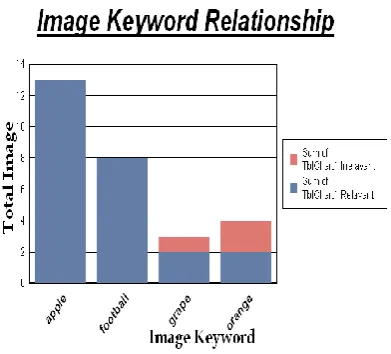
In bag annotation process, visual and textual features such as color, shape and textures are considered and compared with user selected image. Here each image color could be counted and that can be counted and stored in database. These counting can be compared with remaining other images. For this we can use instance ranking score. This can calculate positive and negative bag images. S(BI) perform this task .. Depends on the ranking percentage the chart could be plotted which represent relevant and irrelevant images percentage. By using this user can find relevant image percentage score. The image keyword relationship compares the total image versus image keyword shows in fig 4.
3.4 Image Re-Ranking
In this process input is selected by the user and the corresponding output can be displayed by Re Ranking of images. Here the positive bag and negative bag percentage could be calculated by means of Generalized Multiple Instance(GMI) Learning process. If the output ratio exceeds 69 percent then it moves to positive bag otherwise it moves to negative bag . This negative bag images are irrelevant that cannot be considered here. In fig.5, it shows the re-ranking
Positive bag Classification of image
classifier (semantic sign)
Text query input from the user
Collection of image from web
Image data base
Image selection by user
Visual Textual feature
Image DB Annotation bag process
Negative bag Output to user
Image Data base
Bag based re – ranking process
Re ranked relevant image output to user User
percentage for every image. Depends on the number of relevant images the percentage could be calculated for every image in the database.
3.5 Performance Comparison
The proposed system is expected to deliver the below performance in comparison with the existing system and the same is interpreted below.
Table 1. Approximate Performance Measure
This system provide an more efficient and security compare to the existing method. The keyword relationship performance can be viewed in fig.5 and the relevant images ranking score performance can be shown in fig.7.
4. MATHEMATICAL MODEL
4.1 Construction of Image Database with
Text
Initially we are going to collect all type of images on the Internet (Eg: Google). This can collect all kind of images with text to a large collection of image data base.
4.1.1 Initial Ranking
For each retrieved relevant image x, an instance ranking score can be defined as follows:
r X = −τ+1δ (1)
Where 𝛿 is the total number of tags in image x and 𝜏 is the rank Position of the query tag q in the tag list of an image x.
𝜏𝑖< 𝜏𝑗 and 𝑖 ≠ j then we have 𝑟 𝑋𝑖 > 𝑟 𝑋𝑗 . In other words, when one relevant image contains the textual query q at the top position in its tag list, this image will be assigned a higher ranking score. When the positions of the query tag q at the top position in its tag list, this image will be assigned a higher ranking score. When the positions of the query tag q are the same for the two images 𝜏𝑖= 𝜏𝑗 . the ranking score is decided by 𝛿𝑖 and 𝛿𝑗.
4.2 Applying Bag Annotation for Re
-ranking the Database Images
After the user provides a textual query q (e.g., “fox”), our system exploits the inverted file method to automatically find relevant web images whose surrounding text contains the textual query tag q, as well as irrelevant web images whose surrounding text do not contain q.
Each image is considered as an “instance”. To construct “bags”, we partition the relevant images into clusters using the k-means clustering method based on visual features and textual features. After that, each cluster is considered as a bag.
4.2.1 Bag Annotation Process
In bag annotation process, for each bag BI, its bag ranking score S(BI) is defined as the average instance ranking score,
𝑆 BI = x∈BI r(x)|x| (2)
Where | BI | stands for the cardinality of a bag BI..
4.3 Implementing the Generalized
Multiple-Instance (GMI)
It performs the bag based re ranking process. To facilitate GMI learning methods in our framework, we have to annotate positive and negative bags to train classifiers. In our automatic bag annotation method, the top ranked bags with higher bag ranking scores are used as pseudo positive bags and the same number of pseudo negative bags is obtained by randomly sampling a few irrelevant images.
4.3.1 GMI Learning Method
The instance of positive and negative bag, y+1
2
i:x∈Bi ≥ μ Bi for Yi=1, and (3)
y+1 2
i:x∈Bi ≤ γ Bi for YI = -1. (4)
Where,
µpositive bag γnegative bag
4.4 exploiting user logs for user log in
An effective exploitation of user logs for improving the performance of image retrieval system is to reduce the number of user interactions required before satisfactory results are achieved. The system assumes the availability of user logs from previous user interactions for a given query concept. Thus the system is to exploit the existing user logs to improve the performance of the image retrieval system.
For user log, membership function can be used for every user logging in. The classification algorithm produces the list of image ids from metadata repository.
5.
RESULTS
Here the input is given by the user from the collection of images in fig.2. Depends on the user given feedback image the corresponding relevant images result will be produced in the fig 3. The bag annotation process can perform an effective Re-ranking operation. Fig 3 shows the source and corresponding matching image that produces percentage of matching and their bag status of the input image. This gives an effective rank of that particular input image. By using this user can find the percentage of the input images and their bag Keyword
Image re ranking before process
Image re ranking after process
Apple 10% 20%
Fox 15% 37%
rating according to the percentage score rating.
[image:4.595.317.552.139.282.2]Fig 2.input image
Fig 3.output image
[image:4.595.328.550.436.597.2]In fig 4.the image keyword relationship chart represents the comparison of total image versus image keyword. It can be plotted after the bag annotation process. Here it can display the total number of relevant and irrelevant images to the user. In this fig apple keyword contains 13 relevant images. In keyword graph contains 2 relevant and 1 irrelevant images.
Fig.4.Keyword Relationship Chart
Fig 5 shows the relevant positive bag images. If the matching of source and match image percentage increases that could be stored in the positive bag and it is displayed to the user. The negative bag contains only the lower percentage of irrelevant images and it cannot be considered.
Fig.6.positive bag images
In fig.6 the positive image ranking score can be displayed for every keyword. It shows the ranking percentage of comparison result with other images. Here every images ranking percentage can be varied according to the relevant images in the positive bag. The higher percentage of ranking score has the more relevant images which moves to the positive bag whereas below 70 percentage moves to the negative bag which contain irrelevant images. This provides an more efficient re-ranking of images compare to the existing method.
Fig.6.Image Ranking Score Chart
6.
CONCLUSION
[image:4.595.71.267.554.731.2]7.
REFERENCES
[1] Xiao gang Wang, Ken Liu and Xiao Tang „Query-Specific Visual Semantic Spaces for Web Image Re-ranking‟. In Proceeding of the 14th ACM International Conference on Multimedia,(2011) .
[2] J. Cui, F. Wen,, and X. Tang: Real time Google and live image search re-ranking. In ProcACM Multimedia, (2008).
[3] jen-hao Hsiao., chu-song chen., and ming-syanchen : A novel language model based approach for image object mining and re-ranking. 2008 IEEE DOI 10.1109/ICDM (2008).
[4] Y. Rui, T. S. Huang, and S. Mehrotra: Content-based image retrieval withrelevance feedback in mars. In Proceedings of the IEEE InternationalConference on Image Processing, pages 815–818, 1997.
[5] W. H. Hsu, L. S. Kennedy., and S.-F. Chang:Video search reranking via information bottleneck principle. In Proceeding of the 14th ACMInternational Conference on Multimedia, pages 35–44, (2006).
[6] Z.-H. Zhou and H.-B. Dai:Exploiting image contents in web search. In Proceedings of the 20th International
Joint Conference on ArtificalIntelligence, pages 2928– 2933, (2007).
[7] Y. Jing and S. Baluja: Textual query of personal photos facilitated by large scale web data. In Proceeding of the 17th International Conference on World Wide Web, pages 307–316,( 2008).
[8] Florian Schroff., Antonio Criminisi., and Andrew Zisserman: Harvesting Image Databases from the Web. Proc. IEEE Conf.Computer Vision and Pattern Recognition, (2011).
[9] MattiaBroilo:A Stochastic Approach to Image Retrieval Using Relevance Feedback and Particle Swarm OptimizationIn Proceedings 10th Workshop on Multimedia Signal Processing-MMSP, Cairns, Australia, ( 2008).
[10]R. Yan., A. G. Hauptmann., and R. Jin: Multimedia search withpseudo-relevance feedback. In Proceedings of the ACM International Conference on Image and Video Retrieval, pages 238–247, (2003).
![Spain [stet] accession to the EMU: a long and hilly road](data:image/gif;base64,R0lGODlhAQABAIAAAP///wAAACH5BAEAAAAALAAAAAABAAEAAAICRAEAOw==)