From Playground to
Protea
Netball South Africa’s Long Term Participants
Fr o m pla yg ro u n d t o pro tea – N et b all L TP D
2
Long-Term Participant Development
Netball Long Term Participant Development Committee Bennie Saayman, Project Leader
Marlene Wagner, Advisor Louise Du Plessis, Advisor
Carin Strauss, Technical and Tactical Coaching Dr Charlotte Scholtz, Emotional Development Janine du Toit, Mental, Cognitive
Almaret du Toit, Health Annelie Lucas, Health Francois Nel, Technical
Istvan Balyi, M.A. PacificSport Canadian Sport Centre Vancouver
Netball South Africa thanks all coaches, expert consultants and the many volunteers for contributing to the development of this publication.
Netball South Africa Long Term Participant Development
Copyright © 2011Netball SA 846 Park Street Arcadia, Pretoria, 0083
www.netball-sa.co.za
Authors: Netball SA Long Term Participant Development Committee Editors: Dr Charlotte Scholtz, Annelie Lucas
Photo Credits: SASCOC; Annelie Lucas; Reg Caldecott - Netball South Africa
All rights reserved. No part of this material may be printed or reproduced or utilized in any form or by any electronic, mechanical, or other means, now known or hereafter invented, including photocopying and recording, or in any information storage or retrieval system, without permission from Netball South Africa
Fr o m pla yg ro u n d t o pro tea – N et b all L TP D
3
Message from President NSA
First of all NSA would like to express sincere gratitude and appreciation to SASCOC for including netball as one of the codes in the LTPD project. We see this project as the breakthrough in ensuring that South Africa has the platform to identify the unique netball style that is peculiar to us and doing the necessary research around this to strengthen those techniques and style of play that should come naturally to any netball player who is of South African origin. Yes, in all sport codes one appreciates what could be learned from other countries but this should find a firm base of our own brand of netball. In this way our players will be assisted to build on their natural talent while borrowing from other countries only to spice up the game. We also wish to commend Mrs Bennie Saayman, Director: Coaches at NSA for the commitment shown on this project. It has not been easy for her and the team of coaches she worked with to stay in the project, due to other commitments. Mrs Saayman and her team have made us proud, but the most significant thing to point out is the passion they have shown to have for the development of netball in South Africa. We are quite aware that this project was very technical and they had to do a lot of research into the netball game. We are confident that their efforts will pay off. It was also an honour for NSA to have been in this project with a representative from school netball. This indicates how seriously NSA takes the role of school netball technical officials with the understanding that schools are our incubator where future protea netball players are nurtured.
We would like to thank Ms Desiree Vardhanfrom SASCOC who has tirelessly encouraged NSA to persevere working against all odds to complete the document that is now to be launched as the blue print for netball. We wish to assure SASCOC that we would oversee the implementation of the document as this paves way for netball to really talk about our own brand of netball.
Yours in Netball Mimi Mthethwa
Fr o m pla yg ro u n d t o pro tea – N et b all L TP D
4
TABLE OF CONTENTS
Table of Contents Acknowledgements 1 President’s message 2 Overview / Introduction 4 Reasons for LTPD 4Current sport system challenges 5
Athlete development model 5
1. What is LTPD? 7
2. The 10 Key Factors Influencing LTAD 10
3. The 10 S’s of Training and Performance 10
4. Building a Pathway: The Seven Stage LTAD 13
STAGE ONE: Active Start 13
STAGE TWO: FUNdamentals 14
STAGE THREE: Learn to Train 15
STAGE FOUR: Train to Train 16
STAGE FIVE: Train to Compete 18
STAGE SIX: Train to Win 20
STAGE SEVEN: Active for Life 21
Fr o m pla yg ro u n d t o pro tea – N et b all L TP D
5
OVERVIEW / INTRODUCTIONLong Term Participant Development (LTPD) is about achieving optimal training, competition and recovery throughout an athlete’s career, particular in relations to the important growth and development years of young people. If a long term approach to training is not adopted there is likely to be a plateau in performance, when growth and development slows significantly. For some athletes this may result in their performances getting worse. At this point the short-term training approach cannot be reversed. This often leads to drop out before an athlete has achieved close to their potential.
REASONS FOR LTPD
There are five clear reasons for introducing a LTPD approach: To establish a clear Athlete development pathway
To identify gaps in the current Athlete development pathway
To realign and integrate the programmes for developing Athletes and netball in South Africa To provide a planning tool, based on scientific research, for coaches and administrators To guide planning for optimal performance
LTPD provides a framework for:
optimal training, competition and recovery programming with relation to biological development and maturation
equal opportunity for participation and competition
Athlete-centred, coach-driven and administration, sport science and sponsor supported.
The process to develop netball’s LTPD framework was extensive, inclusive and comprehensive.
This process initiated re-thinking ALL aspects of netball including the three most difficult tasks of changing: 1. System Alignment: aligning the netball community under one set of rules.
2. System Alignment and Integration: developing and integrating clear pathways that allow athletes, coaches, officials and administrators to progress through the system. These pathways must permit athletes to be involved in three distinct streams: health of the nation (recreational in nature), develop the game and compete for the nation. The pathways must also integrate a positive relationship between the educational and club-delivery system.
3. Competition Schedules: ensure the appropriate ratio of training to competition at all ages. Within our current development system we have produced a delivery stream of netball called “competition.” This was not a planned process. For numerous reasons the majority of our developing athletes are playing too many games without the opportunity to gain proper practice of the skills needed to play the game.
The South African Netball LTPD Framework should be viewed as both an integrated and collaborative model that is meant to guide the optimization of athletic development for both our age-group and elite Athlete development systems. This initiative will influence all stages of an athlete’s development including: an individual’s entry and early years in sport and physical activity; assist in developing a talent detection, selection and development plan and related processes; inform the training and competitive approaches congruent with the various stages; and encourage lifelong participation in the sport of netball South Africa.
Fr o m pla yg ro u n d t o pro tea – N et b all L TP D
6
Guiding Principles of NSA’s LTPD framework
The following guiding principles are central to Netball South Africa’s Long Term Participant Development Framework:
That our programming directs athletes towards doing the right thing at the right time.
That our athletes are encouraged to achieve stage specific outcomes prior to undertaking activities associated with the subsequent stage.
That our training programs are tailored to the individual based on the nature of their development and considers their physical, psychological and social characteristics.
That netball will work with, and not in opposition to, or repeating the work of, other sports that athletes are participants within during their early years of development.
CURRENT SPORT SYSTEM CHALLENGES
The following are some general observations of the current netball system in South Africa. Young athletes under-train, over-compete
Low training to competition rations in early years Adult competition superimposed on young Athletes
Adult training programmes superimposed on young Athletes
Training in early years focuses on outcomes (winning) rather than processes (optimal training) Chronological age influences coaching rather than biological age
The “critical” periods of accelerated adaptation are not fully utilized
Poor training between 6-16 years of age cannot be fully corrected (Athletes will never reach genetic potential)
The best coaches are encouraged to work at elite level
Coach education tends to skim the growth, development and maturation of young people Administrators and officials need to be educated in LTPD principles
ATHLETE DEVELOPMENT MODEL
The Athlete Development Model (ADM) provides a framework for LTPD that illustrates to coaches, parents, volunteers and administrators at the local, provincial and national levels, the importance of participation in securing the health of the nation.
Fr o m pla yg ro u n d t o pro tea – N et b all L TP D
7
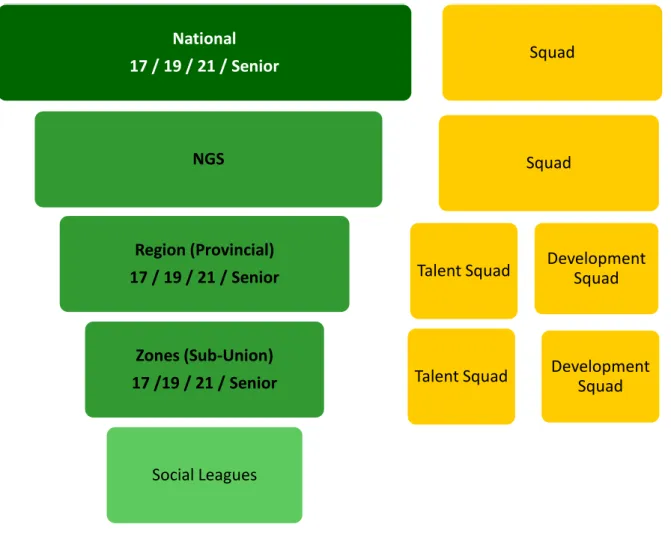
B:Figure 1: Schematic presentation of the South African Athlete Development Model (ADM). A: A complete presentation of the SA ADM; B: Individual Athlete-specific development pathway
The model will be used as a guide for coaches and administrators and will assist them in understanding the importance of teaching particular aspects of the game to Athletes at specific stages of development. It is hoped that with this systematic approach, skills and abilities needed to achieve excellence in netball will be reachable. It will also ensure that all participants will receive the appropriate training that will produce well-rounded people and maintain a lifelong passion for the sport.
The delivery of an aligned, consistent and systematic development system ensures that everyone’s needs are being met at every level of the programming. Every participant in the game will be able to see the pathways which will lead him or her to their own level of self-fulfillment. Proper application of this document will ensure that coaches are educated with respects to the needs of their athletes. The ability of the caic to teach these skills then becomes of paramount importance. Therefore, the development of the coach as a teacher must be the primary focus. Coaches must be supported with frequent clinics and other educational resources that are made available through Netball South Africa and the Provincial Federations in order to stay current.
National
17 / 19 / 21 / Senior
NGS
Region (Provincial)
17 / 19 / 21 / Senior
Zones (Sub-Union)
17 /19 / 21 / Senior
Social Leagues
Squad
Squad
Talent Squad
Talent Squad
Development
Squad
Development
Squad
“It takes 10 years of extensive practice to excel in anything”
Fr o m pla yg ro u n d t o pro tea – N et b all L TP D
8
WHAT IS LTPD?The Long-Term Participant Development (or LTPD) model provides a framework for an optimal training, competition and recovery schedule for each stage of athletic development. The model is based on the idea that there are a number of different physiological, mental/ cognitive, and emotional development stages through which an athlete progresses and that each stage requires a different set of training, competition and recovery programs for optimal performance. The model is therefore based on the developmental age rather than the chronological age of the athlete. Coaches who engage in the model and its practices are more likely to produce athletes who reach their full athletic potential. However, the LTPD model is inclusive, meaning that the principles which underpin it are equally applicable to people of all ages and abilities whether they are participating in elite sport or recreational physical activity.
This model represents a paradigm shift, a philosophically different approach to sport and physical activity. It draws on the experiences of various athlete development projects that have been implemented by different sport organizations in Canada & elsewhere. In order to be successful LTPD requires full sport system alignment and integration. As such the model is Athlete centred, coach driven and administration, sport science and sponsor supported.
LTPD is a vehicle for change. It differs from the other athlete development models because it acknowledges that physical education, school sports, competitive sport, and recreational activities are mutually interdependent.
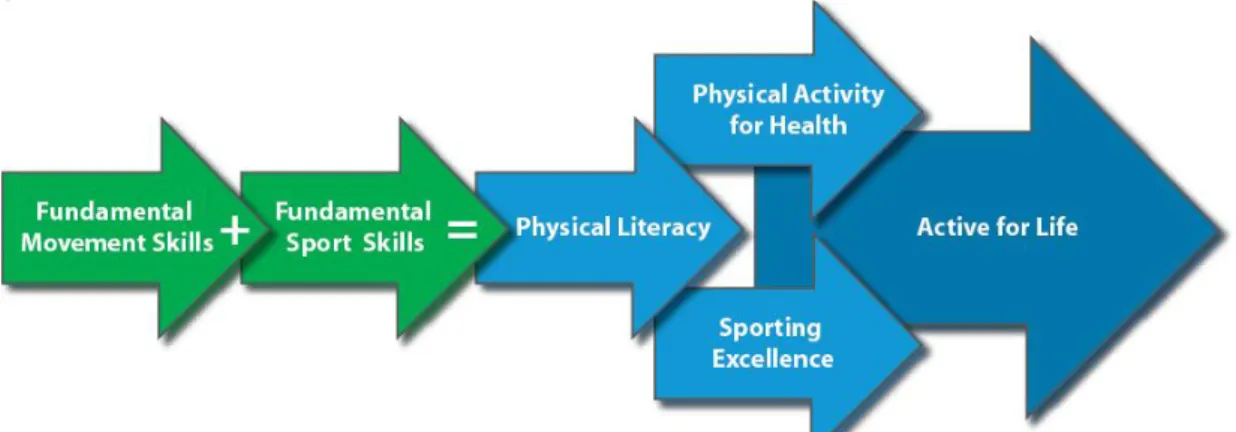
LTPD also positively affects the quality of training and competition by taking into consideration factors such as developmental age and critical periods of optimal trainability. It builds athletic ability beginning with a foundation of fundamental movement skills and introduces fitness and sport skills at the appropriate developmental age. Figure 2 illustrates the recommended support system interrelationship between physical education, recreation and podium performance.
Netball is a late specialisation sport. Characteristic of late specialization sports is that specialization prior to age 10 is not recommended since it contributes to early burn-out, drop-out, and retirement from training and competition.
Fr o m pla yg ro u n d t o pro tea – N et b all L TP D
9
Underpinning life-long participation in physical activity and excellence in performance sport is the concept of Physical Literacy (see Figure 3). Physical literacy is defined as the mastery of fundamental movement skills and fundamental sport skills. A physically literate person moves with poise, economy and confidence in a wide variety of physically challenging situations, is perceptive in reading all aspects of the physical environment. He/ she anticipate the movement needs or possibilities, and responds appropriately with intelligence and imagination." (Whitehead, 2001)
Figure 3 Participation In Lifelong Physical Activity (Way et al, 2005)
Within the eight staged LTPD model for netball the first three stages focus on fun and physical literacy. Athletes grow and improve within the sport through programs designed to introduce the basic technical skills in an adventurous environment, which assists in the development of overall motor and sport skills. Following the first three stages, there is a transition to either further development or excellence in netball or life-long participation in netball and/or other sports at the recreational or less competitive level. For athletes who wish to pursue excellence, increasing specialization in netball and an expanding focus on competition permit them to mature athletically and aspire to national and international podiums.
Fr o m pla yg ro u n d t o pro tea – N et b all L TP D
1
0
Regardless of the level of excellence or sport-mastery achieved however, participation in netball can enhance the health, fitness and mental well-being of South Africans of all ages. Netball is a “Sport for Life”
The first 3 stages encourage Physical Literacy and sport for all:
1. Active Start 2. FUNdamentals 3. Learning to Train
The next 4 stages focus on excellence:
4. Training to Train 5. Learning to Compete
6. Training to Win (Navigator II)
The final stage encourages life-long physical activity:
7. Active for Life
Individuals can move from the first 3 LTPD stages to either excellence, life-long participation in the same sport, or remaining active for life in another activity.
To better understand the LTPD model, and its role in helping participants to achieve these goals, it is useful to discuss ten key factors which influence the model and set it apart from other long-term development models. Before these factors are outlined, however, an analysis of Netball in South Africa will be presented, which will serve as a springboard to develop an implementation plan.
Fr o m pla yg ro u n d t o pro tea – N et b all L TP D
1
1
2. The Ten Key Factors Influencing LTPD
Research has identified 10 important factors that influence athlete development. Netball programs built around these factors will ensure that athletes can experience optimal development in their chosen sport as well as lifelong involvement in physical activity.
2.1. The Ten Year Rule
2.2. The FUNdamentals - Developing Physical Literacy 2.3. Chronological Age vs. Developmental Age
2.4. Mental, Cognitive and Emotional Development 2.5. Specialization
2.6. Trainability
2.7. Periodisation (Annual training, competition & recovery plan) 2.8. Calendar Planning for Competition
2.9. System Alignment and Integration 2.10. Continuous Improvement
3. The 10 S’s of Training and Performance
There are Ten S’s of training which need to be integrated when developing annual training, competition and recovery plans. Each of these capacities is trainable throughout an Athlete’s lifetime, but there are clearly critical periods (or sensitive periods) in the development of each capacity during which training produces the greatest benefit to each athlete’s improvements.
3.1 Stamina (Endurance)
Netball requires a combination of stamina and strength. Athletes need increased focus on aerobic capacity training (continuous or aerobic interval workloads) as they enter PHV, and they should be progressively introduced to aerobic power training
3.2 Strength
A combination of endurance and strength is required to be successful at the highest level
3.3 Speed
It is highly recommended that speed should be trained on a regular and frequent basis, for example, at every training session as part of the warm up.
3.4 Skill
Girls and boys both have one window for optimal skills training. Physical literacy is the development of
Fr o m pla yg ro u n d t o pro tea – N et b all L TP D
1
2
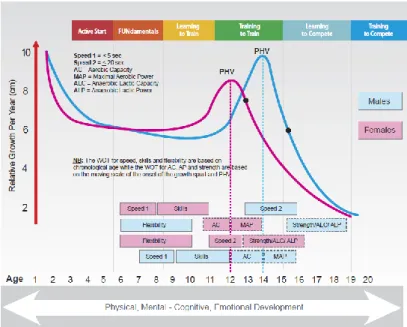
Figure 6: Pacific Sport; Windows of Optimal Trainability (adapted from Balyi and Way, 2005) – From X-Country Skiing Canada
3.5 Suppleness
The sensitive period of trainability for suppleness occurs between the ages of six and 10 years in both girls and boys.
3.6 Structure / Stature
This component addresses the six stages of growth (Phase 1: very rapid growth and very rapid deceleration; Phase 2: steady growth; Phase 3: rapid growth; Phase 4: rapid deceleration; Phase 5: slow deceleration; Phase 6: cessation of growth) in the human body linking them to the windows of optimal trainability.
Figure7: Six stages of growth chart
3.7 (p) Psychology
Sport is a physical and mental challenge. As an Athlete progresses through LTPD stages the mental training aspect will evolve from: having fun and respecting opponent
3.8 Sustenance
Sustenance includes aspects like, nutrition, hydration, rest, sleep and regeneration. Underlining sustenance is the need for optimal recovery management moving the athlete to the 24/7 model which places a high
Fr o m pla yg ro u n d t o pro tea – N et b all L TP D
1
3
degree of importance on the individual’s activities away from the field of play. See the “Recovery and Regeneration for Long-Term Athlete Development” document (www.canadiansportforlife.ca)
3.9 Schooling
In training program design the demands of school must be considered. This is only limited to the demands placed by school sports or physical education classes. This includes integrating school academic loads, duties, school related stresses, and timing of exams. When possible, training camps and competition tours should compliment, not conflict, with the timing of major schools academic events.
3.10 Socio-Cultural
The socio-cultural aspects of sport are significant and must be managed through proper planning. Socialization via sport will ensure that general societal values and norms will be internalised via sport participation
Fr o m pla yg ro u n d t o pro tea – N et b all L TP D
1
4
4. Building a Pathway: The Seven Stage LTPD
Netball is a late specialization sport. Based on the Canadian Sport for Life, the Netball Long-term Athlete Development model distinguishes seven stages (you have 8 stages bellow, you can say it is modified after the SC4L) of athlete development:
1. Active Start 3 - 6 years of age 2. FUNdamentals 6 - 9
3. Learn to Train 9 – 13 4. Train to Train 13 – 17 5. Train to Compete 17-19 6. Train to Win 19 - 28
7. Active for Life Enter any time
During the first three of these stages, children should be exposed to a wide variety of activities to ensure proper development of overall motor skills and sports skills. After the first three stages, there is focus on specialization. During the subsequent phases the athlete can further develop and strive for excellence in Netball or transition to life-long participation in Netball and/ or other sports at a recreational or less competitive level.
The following sections detail the objectives of each stage within the context of developmental age.
STAGE 1
PHASE ACTIVE START AGE 3 – 6 YEARS
Netball is a late maturation sport and therefore does not recommend any formal, adult organized netball at the Active Start stage of development.
FUN and part of daily life
Fitness and movement skills development Focus on learning proper movement skills
such as running, jumping, wheeling, twisting, kicking, throwing and catching Not sedentary for more than 60 minutes
except when sleeping
Some organized physical activity
Exploration of risk and limits in safe environments
Active movement environment combined with well-structured gymnastics and swimming programs
Daily physical activity
IMPLICATION FOR THE COACH
Conduct Fun Netball.
Relatively short training sessions (20 – 30 minutes). Build skill with simple sequences and lots of practice.
Simple relays and short games for young children e.g. Rats and Rabbits One or two quality cues per Fun Netball session.
Lots of prompts for creative play in and outside of the structured programme.
IMPLEMENTATION GUIDELINES
Basic Netball skills development:
Fr o m pla yg ro u n d t o pro tea – N et b all L TP D
1
5
STAGE 2PHASE FUNDAMENTALS AGE 6 - 9 YEARS
The goal at this level is to learn fundamental movement skills through netball in a positive fun way. The participants will be introduced to very basic fundamental netball skills. It is not to win, but rather to have fun while playing sport and ensuring success.
Overall movement skills FUN and participation
General, overall development
Integrated mental, cognitive, and emotional development
ABC’s of Athleticism: agility, balance, coordination and speed
ABC’s of Athletics: running, jumping, wheeling and rowing
Medicine ball, Swiss ball, own body strength exercises
Introduce simple rules of ethics of sport Screening for talent
No peroiodisation, but well-structured programs
Daily physical activity
IMPLICATION FOR THE COACH
Volume/Intensity of training according to growth and maturity; could be high volume with increasing intensity.
Coaching at this stage will be by:
Coaches with experience in coaching the age group Mini-netball coaches
PERIODISATION
Number and length of sessions:
Different sports, including netball, should be played between 5 and 6 times per week. Each session should be a maximum of 45 – 60 minutes.
IMPLEMENTATION GUIDELINES
1. Fundamental movements
Pushing, pulling, lunging, squatting, bending, twisting and walking, jogging and sprinting. When these movements are combined, they create things such as agility, balance, throwing, catching, jumping, etc. 2. Basic netball fundamentals:
Footwork and movement skills Landing (1/2 Foot) Spring and stop Side step
Ball skills Chest pass
Shoulder pass Catching
Attacking skills Straight lead
Dodge
Change of direction
Defending skills Shadow movement
Defense with hands over the ball Shooting skills Basic shooting action
Perception skills Introduction to awareness of space
Strategies Introduce competition through minor games Rotation on all playing positions
Fr o m pla yg ro u n d t o pro tea – N et b all L TP D
1
6
COMPETITION GUIDELINES. The amount of competition will be unlimited and fun. Competition will take place at festivals and team events.
STAGE 3
PHASE LEARNING TO TRAIN AGE 09 - 13 YEARS
This is major motor-learning stage. During this time, children are developmentally ready to acquire the fundamental movement skills that are the cornerstones of all athletic development. At this stage the technical skills can start to be emphasized. The basic fundamentals are still important since many children will also use this stage as an entry level. Simple developmentally appropriate tactics can be used to allow the children to play team netball.
Overall sport skills development
Major skill learning stage: all basic sport should be learned before entering Training to Train
Integrated mental, cognitive and emotional development
Introduction to mental preparation
Medicine ball, Swiss ball, own body strength exercise
Introduce ancillary capacities Talent identification
Single or double periodisation
Sport specific training 3 times week; participation in other sport 3 times a week
IMPLICATION FOR THE COACH
Volume and intensity of training: Low volume – Increasing intensity. Coaching at this stage will be by:
Coaches with experience in coaching the age and ability of the group. Level 1 and 2 accredited coaches
High Performance coaches
PERIODISATION
Number and length of sessions:
4 to 6 sport sessions should be participated in per week. – 2 or 3 sessions of other sports. Each session should be a maximum of 90 minutes in length.
IMPLEMENTATION GUIDELINES
Basic netball fundamentals:
Ball skills Chest pass
Shoulder pass Catching
Attacking skills Straight lead/single dodge Change of direction
Combine into simple movements on court
Defending skills Shadowing
Defense with hands over the ball Three feet recovery
Defend the shot
Combine simple movements into defending actions Shooting skills Basic shooting action
Introduce working in combination Rebounding
Fr o m pla yg ro u n d t o pro tea – N et b all L TP D
1
7
Perception skills Awareness of space Timing of movement
Introduce decision making – simple options in practises Strategies Establish competition through minor games
Continue development of a number of positions Introduce positional roles
COMPETITION GUIDELINES
Competition will take place in school matches.
The amount of competition will consist of 6 minor competitions and 1 major competition, 3 times per 24-30 week season.
STAGE 4
PHASE TRAIN TO TRAIN AGE 13 – 17 YEARS
The goal at this stage is to continue to build the athletic base. During these years, the Athletes will be introduced to many of the technical and tactical parts of netball. The physical capacities that need to be trained are now completely dependent of the developmental age of the individual. Coaches must be aware of the differences in maturation rates and allow for appropriate adjustments.
Sport specific skill development
Major fitness development stage: aerobic and strength. The onset of Peak Height Velocity (PHV) and PHV are the reference point
Integrate mental, cognitive and emotional development
Introduce free weights Develop ancillary capacities
Frequent musculoskeletal evaluations during PHV
Selection
Single or double periodisation
Sport specific training 6-9 times per week including complementary sports
IMPLICATION FOR THE COACH
Volume and intensity of training: Medium volume – high intensity. Coaching at this stage will be by:
o Coaches with experience in coaching at regional, provincial and national level o Club coaches
o High Performance coaches o National development coaches
IMPLEMENTATION GUIDELINES
Footwork and movement skills Ball skills
Attacking skills Straight lead
Dodge and double doge Two leads
Re-offer Change of pace Half roll, full role Clear and drive
Spring, change of direction Space awareness
Fr o m pla yg ro u n d t o pro tea – N et b all L TP D
1
8
Front cut Communication skillsDefending skills Shadowing
One on one / two on one Positioning front and side Body control / repositioning Defensive footwork
Interception
Recovery to 3 feet (0.9) Work the ground Defend the shot
Work hands over the ball Communication
Shooting skills Technique
Shooting situations Concentration Rebounding
Working in combination Communication skills Introduce mental strategies
Perception skills Space awareness
Introduce awareness of space, athlete and pass Introduce movement on/off the ball
Timing
Movement in relation to court situations Release of pass
Vision
Basic peripheral vision exercises
Awareness of athletes in relation to the ball and situation
Decision making
Introduce selection of pass for situation Simple options to athletes
Balancing space on court
Selections of appropriate options in court situations
Introduce ‘reading the game’ techniques in response to opponent’s movements
Strategies Consolidate knowledge of positional roles Develop court principles and strategies
COMPETITION GUIDELINES
Competition will take place at major school and national events.
The amount of competition will consist of 3 to 5 major and 1 national competition, according to the National Calendar schedule.
PERIODIZATION
Fr o m pla yg ro u n d t o pro tea – N et b all L TP D
1
9
6 or 7 sport sessions should be participated in per week – 4 netball sessions and 2 or 3 sessions of other sports.
Each session should be a maximum of 2 hours in length.
STAGE 5
PHASE TRAIN TO COMPETE AGE 17 – 19 YEARS
Very specific netball training should now be applied. Athletes should be introduced to all aspects of the game and should begin to refine all technical aspects and most tactical components. Athletes, who are now proficient at performing both basic and sport-specific skills, learn to perform these skills under a variety of competitive conditions during training. Fitness programs, recovery programs, psychological preparation and technical development are now individually tailored to a greater degree and address each Athlete’s individual strengths and weaknesses.
Sport, event, position-specific physical conditioning
Sport, event, position-specific technical tactical preparation
Sport, event, position-specific technical and playing skills under competitive conditions
Integrated mental, cognitive and emotional development
Advanced mental preparation Optimize ancillary capacity Specialization
Single, double or triple periodization Sport specific technical, tactical and fitness
training 9-12 times per week
IMPLICATION FOR THE COACH
Volume and intensity of training: Medium volume – high intensity. Coaching at this stage will be by:
o Coaches with experience in coaching at regional, provincial and national level o Club coaches
o High Performance coaches o National development coaches
IMPLEMENTATION GUIDELINES
Footwork and movement skills Ball skills
Attacking skills Consolidate and advance: Straight lead
Dodge and double doge Two leads
Re-offer Change of pace Half roll, full role Clear and drive
Spring, change of direction Space awareness
Front cut Screens
Fr o m pla yg ro u n d t o pro tea – N et b all L TP D
2
0
Defending skills Consolidate and advance: Shadowing
One on one / two on one First ball
Dropping back (Sagging) Positioning front/side/back Body control / repositioning Defensive footwork
Interception
Recovery to 3 feet (0.9) Work the ground Defend the shot
Work hands over the ball Split circle
Zone
Work together in/out of circle Communication skills
Shooting skills Technique
Shooting situations Concentration Rebounding
Work rat and the shot Working in combination Communication skills
Consolidate mental strategies
Perception skills Space awareness
Understanding of awareness of space, athlete and pass
Understanding of movement on/off the ball Timing
Movement Release of pass
Able to apply to pressured situations Vision
Awareness of athletes in relation to the ball and pressure
Decision making
Balancing space on court
‘reading the game’ techniques in response to opponent’s movements
Create/select appropriate options in court situations
Strategies Extend knowledge of positional roles
Develop the ability to read the game and apply appropriate responses to court situations
Fr o m pla yg ro u n d t o pro tea – N et b all L TP D
2
1
Competition will take place at school, domestic and national events
The amount of competition will consist of between 5 and 10 major events plus 2 provincial or national events.
PERIODIZATION
Number and length of sessions:
Between 8 and 12 sessions per week should be participated in, including physical conditioning. Each session should be a maximum of hours in length.
STAGE 6
PHASE TRAIN TO WIN AGE 19 – 28 YEARS
All facets of the game have already been introduced, emphasized, developed and refined. There will be many new strategies, improvement on all technical and tactical areas and philosophies that will depend on the individual coach.
Ages are sport specific based on international normative data
Maintenance or improvement of physical capacities
Modeling and possible aspects of training and performance
Frequent prophylactic breaks
Maximize ancillary capacities High performance
Single, double, triple or multiple periodisation
Sport specific technical, tactical and fitness training 9-15 times per week
IMPLICATION FOR THE COACH
Volume and intensity of training: Low to medium volume – High intensity Coaching at this stage will be by:
Coaches with experience in coaching at regional, provincial and national level Level 2 and 3 accredited coaches
High Performance coaches Provincial and National coaches
ANNUAL PROGRAMME
PERIODIZATION NETBALL SPECIFIC TRAINING HOURS OF COMPETITION
25 weeks netball training; 13 – 15 weeks competition
max.
Winter:
6 hours per week Summer:
4 hours per week Duration:
120 minutes max per session
hours per week
IMPLEMENTATION GUIDELINES
The main objective should be to optimize fitness preparation, sport/event specific skills and performance.
50% of available time is devoted to the development of technical and tactical skills and fitness improvements.
50% of available time is devoted to competition and competition-specific training.
Fr o m pla yg ro u n d t o pro tea – N et b all L TP D
2
2
Special emphasis is placed on optimum preparation by modeling training and competition.
Fitness programs, recovery programs, psychological preparation and technical development are now individually tailored to the Athlete’s needs.
Double and multiple periodizations is the optimal framework of preparation.
COMPETITION GUIDELINES
Competition will take place at domestic, national and international competitions.
The amount of competition will reflect the school and national and international programme.
STAGE 7
PHASE ACTIVE FOR LIFE AGE ANY AGE
The age of transition from competitive sport to lifelong physical activity and participation in sport Minimum of 60 minutes moderate daily
activities or 30 minutes of intense activity for adults
Transfer from one sport to another Move from highly competitive sport to
lifelong competitive sport through age group competition
Move from competitive sport to recreational activities
Move to sport careers or volunteering There is a better opportunity to be
Active for Life if physical literacy is achieved before the Training to Train stage
Netball programs need to ensure:
Move from competitive netball to volunteering as a coach, official or administrator
A positive experience in sport is key to retaining Athletes after they leave the competitive stream. Netball must make the shift from cutting Athletes to redirecting them to sports where they are predisposed to train and perform well. THIS MAY OCCUR AT ANY AGE
IN SUMMARY
When looking at research done you will realize that it takes a minimum of 10 000 hours or at least 10 years of correct and efficient training to become an elite athlete. An athlete that has used their training time effectively, focusing on WINDOWS OF TRAINABILITY, will always perform better at the elite level.
NOTE: This document is a summary of a more detailed document entitled “Netball South Africa LTPD Document” and all data and references is contained therein.