Hardware Based Packet Classification for
High Speed Internet Routers
1 C
Chad R. Meiners • Alex X. Liu • Eric Torng
Hardware Based
Packet Classification for
ISBN 978-1-4419-6699-5 e-ISBN 978-1-4419-6700-8 DOI 10.1007/978-1-4419-6700-8
Springer New York Dordrecht Heidelberg London
Library of Congress Control Number: 2010928719 © Springer Science+Business Media, LLC 2010
All rights reserved. This work may not be translated or copied in whole or in part without the written permission of the publisher (Springer Science+Business Media, LLC, 233 Spring Street, New York, NY 10013, USA), except for brief excerpts in connection with reviews or scholarly analysis. Use in connec-tion with any form of informaconnec-tion storage and retrieval, electronic adaptaconnec-tion, computer software, or by similar or dissimilar methodology now known or hereafter developed is forbidden.
The use in this publication of trade names, trademarks, service marks, and similar terms, even if they are not identified as such, is not to be taken as an expression of opinion as to whether or not they are subject to proprietary rights.
Printed on acid-free paper
Springer is part of Springer Science+Business Media (www.springer.com) Chad R. Meiners
Michigan State University Department of Computer Science and Engineering Engineering Building 3115 East Lansing, MI 48824-1226 USA [email protected] Eric Torng
Michigan State University Department of Computer Science and Engineering Engineering Building 3115 East Lansing, MI 48824-1226 USA [email protected] Alex X. Liu
Michigan State University Department of Computer Science and Engineering
Engineering Building 3115 East Lansing, MI 48824-1226 USA
This material is based upon work supported by the National Science Foundation under Grant No. 0916044. Any opinions, findings, and conclusions or recommendations
expressed in this material are those of the authors and do not necessarily reflect the views of the National Science Foundation.
This book is dedicated to chance encounters at the correct time.
– Chad Meiners
Dedicated with love and respect
to my parents Shuxiang Wang and Yuhai Liu (God rest his soul),
to Huibo Heidi Ma
to my twin sons Max Boyang and Louis Boyang,
to whom I owe all that I am and all that I have accomplished.
– Alex X. Liu
Dedicated to Pat and Annika.
Contents
1 Introduction. . . 1
1.1 Motivation . . . 2
1.2 Contribution . . . 3
2 Background. . . 5
2.1 Firewall decision diagrams . . . 6
2.2 One-Dimensional Classi¿er Minimization . . . 9
3 Related Work. . . 15
3.1 TCAM Based Classi¿ers . . . 15
3.1.1 Classi¿er Minimization: . . . 15
3.1.2 Range Encoding: . . . 18
3.1.3 Circuit Modi¿cation: . . . 20
3.2 Software Based Techniques . . . 20
3.2.1 Parallel decomposition . . . 21
3.2.2 Decision Trees . . . 23
Part I Equivalent Transformation Techniques 4 TCAM Razor. . . 31
4.1 Multi-dimensional TCAM Minimization: The Basics . . . 31
4.1.1 Conversion to Firewall Decision Diagrams . . . 31
4.1.2 Multi-dimensional TCAM Minimization . . . 32
4.1.3 Removing Redundant Rules . . . 34
4.1.4 The Algorithm . . . 34
4.1.5 TCAM Update . . . 35
4.2 Multi-dimensional TCAM Minimization: The Optimization Techniques . . . 35
4.2.1 Lazy Copying in FDD Construction . . . 35
4.2.2 Hashing in FDD Reduction . . . 36
viii Contents
5 Bit Weaving . . . 41
5.1 Bit Swapping . . . 43
5.1.1 Pre¿x Bit Swapping Algorithm . . . 43
5.1.2 Minimal Cross-Free Classi¿er Partitioning Algorithm . . . 45
5.1.3 Partial List Minimization Algorithm . . . 47
5.2 Bit Merging . . . 47
5.2.1 De¿nitions . . . 48
5.2.2 Bit Merging Algorithm (BMA) . . . 48
5.3 Discussion . . . 51
5.3.1 Redundancy Removal . . . 51
5.3.2 Incremental Classi¿er Updates . . . 51
5.3.3 Composability of Bit Weaving . . . 52
5.3.4 Pre¿x Shadowing . . . 53
5.4 Complexity Analysis of Bit Weaving . . . 54
6 All-Match Redundancy Removal. . . 57
6.1 All-Match Based Redundancy Theorem . . . 57
6.1.1 All-Match FDDs . . . 57
6.1.2 The All-Match Based Redundancy Theorem . . . 59
6.2 All-Match Based Redundancy Removal . . . 60
6.2.1 The All-Match FDD Construction Algorithm . . . 60
6.2.2 The All-Match Based Redundancy Removal Algorithm . . . . 60
6.2.3 Proof of Complete Redundancy Removal . . . 63
6.3 Optimization Techniques . . . 64
6.3.1 Decision Chaining . . . 64
6.3.2 Isomorphic Terminal Nodes Elimination . . . 66
6.4 Classi¿er Incremental Updates . . . 67
6.4.1 Rule Insertion . . . 68
6.4.2 Rule Deletion . . . 68
6.4.3 Rule Modi¿cation . . . 69
6.5 Redundancy Analysis . . . 69
Part II New Architectural Approaches 7 Sequential Decomposition. . . 75
7.1 Multi-Lookup Approach . . . 77
7.1.1 Constructing Multi-lookup Table . . . 77
7.1.2 Packet Processing . . . 80 7.1.3 Analysis . . . 81 7.2 Pipelined-lookup Approach . . . 82 7.2.1 Pipelined-Table Construction . . . 82 7.2.2 Packet Processing . . . 84 7.2.3 Analysis . . . 84 7.3 Packing Approach . . . 85 7.3.1 Strict Partitioning . . . 86
Contents ix
7.3.2 Shadow Packing . . . 89
7.3.3 Strict Partitioning vs. Shadow Packing . . . 93
7.4 Table Consolidation . . . 93
7.4.1 Table Consolidation Algorithm . . . 93
7.4.2 Hierarchical Table Consolidation . . . 94
7.4.3 TCAM/SRAM Space Tradeoff via Bounded Consolidation . 96 7.5 One-Dimensional Table Consolidation . . . 96
7.5.1 Table Consolidation with Sequential Decomposition . . . 96
7.5.2 Coping with More Fields than TCAM chips . . . 97
7.6 Implementation Issues . . . 97
7.6.1 TCAM Update . . . 97
7.6.2 Non-ordered FDDs . . . 98
7.6.3 Lookup Short Circuiting . . . 98
7.6.4 Best Variable Ordering . . . 99
8 Topological Transformations . . . 101
8.1 Topological Transformation . . . 103
8.1.1 Architectures . . . 103
8.1.2 Measuring TCAM space . . . 105
8.1.3 TCAM Update . . . 106
8.2 Domain Compression . . . 106
8.2.1 Step 1: Compute Equivalence Classes . . . 107
8.2.2 Step 2: Construct Transformers . . . 107
8.2.3 Step 3: Construct Transformed Classi¿er . . . 109
8.3 Pre¿x Alignment . . . 111
8.3.1 Pre¿x Alignment Overview . . . 111
8.3.2 One-dimensional Pre¿x Alignment . . . 113
8.3.3 Multi-Dimensional Pre¿x Alignment . . . 116
8.3.4 Composing with Domain Compression . . . 117
References. . . 119
List of Figures
2.1 Illustration of FDD construction . . . 8
2.2 An example one-dimensional TCAM minimization problem . . . 12
2.3 Illustration of dynamic program . . . 12
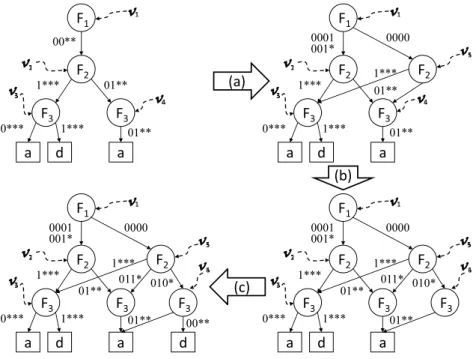
4.1 A¿rewall decision diagram . . . 32
4.2 “Virtual” one-dimensional packet classi¿er . . . 33
4.3 Lazing copying of subgraphs . . . 36
4.4 Example of lazing copying . . . 37
4.5a Before FDD reduction . . . 37
4.5b After FDD reduction . . . 37
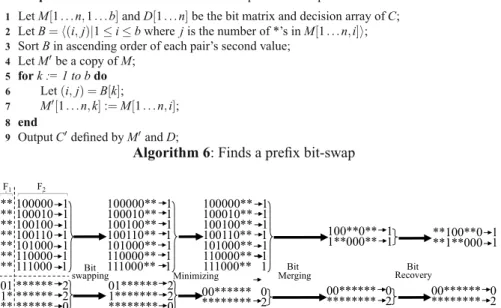
5.1 Example of the bit weaving approach . . . 42
5.2 Example of bit-swapping . . . 45
5.3 Applying bit weaving algorithm to an example classi¿er . . . 45
5.4 Example of Bit Merging Algorithm Execution . . . 50
6.1 A simple packet classi¿er . . . 58
6.2 An all-match FDD for the packet classi¿er in Fig 6.1 . . . 58
6.3 Constructing an all-match FDD . . . 61
6.4 The containment list and the residency List for the all-match FDD . . 62
6.5 The resulting packet classi¿er after removing redundant rules . . . 63
6.6 Constructing an all-match tree with decision chaining . . . 66
6.7 All-Match Tree with decision tree chaining constructed in rule order and reverse order. . . 67
7.1 Reducing information redundancy . . . 76
7.2 FDD generation and reduction . . . 78
7.3 The Multi-lookup scheme . . . 79
7.4 Table generation and table mergence in the pipelined-lookup approach . . . 83
7.5 Example of a pipelined-lookup . . . 84
xii List of Figures
7.6 Strict partitioning of a TCAM chip . . . 87
7.7 Decisions in SRAM . . . 87
7.8 Reassigning the table IDs . . . 88
7.9 Shadow packed tables & shadow packing tree . . . 90
7.10 The shadow packing process. . . 92
7.11 Consolidation of 2-dimensional tables . . . 94
7.12 Table consolidation for pipelined-lookup sequential decomposition . . 95
8.1 Example of topological transformations . . . 102
8.2 Multi-lookup architecture . . . 104
8.3 Parallel pipelined-lookup architecture . . . 104
8.4 Chained pipelined-lookup architecture . . . 105
8.5 Step 1 of domain compression . . . 108
8.6 Step 2 of domain compression . . . 109
8.7 Step 3 of domain compression . . . 109
List of Tables
1.1 An example packet classi¿er . . . 1
1.2 TCAM Razor output for the example packet classi¿er in Table 1.1 . . 1
4.1 A minimum packet classi¿er corresponding tov2in Fig. 4.1 . . . 32
4.2 A minimum packet classi¿er corresponding tov3in Fig. 4.1 . . . 33
4.3 A minimum packet classi¿er corresponding tov1in Fig. 4.1 . . . 34
4.4 Packet classi¿er generated from the FDD in Figure 4.1 . . . 34
4.5 Rules from the FDDs in Figure 4.5a and Figure 4.5b . . . 38
5.1 The second partition bene¿ts from the pre¿x shadow of the¿rst partition . . . 53
5.2 The output of bit merging determines the input. . . 54
5.3 The set of all ternary covers generated per round . . . 55
Chapter 1
Introduction
Packet classi¿cation, which is widely used on the Internet, is the core mechanism that enables routers to perform many networking services such as¿rewall packet¿ l-tering, virtual private networks (VPNs), network address translation (NAT), quality of service (QoS), load balancing, traf¿c accounting and monitoring, differentiated services (Diffserv), etc. As more services are deployed on the Internet, packet clas-si¿cation grows in demand and importance.
The function of a packet classi¿cation system is to map each packet to a decision (i.e.,, action) according to a sequence (i.e.,, ordered list) of rules, which is called a packet classi¿er. Each rule in a packet classi¿er has a predicate over some packet header¿elds and a decision to be performed upon the packets that match the predi-cate. To resolve possible conÀicts among rules in a classi¿er, the decision for each packet is the decision of the¿rst (i.e., highest priority) rule that the packet matches. Table 1.1 shows an example packet classi¿er of two rules. The format of these rules is based upon the format used in Access Control Lists on Cisco routers.
Rule Source IP Destination IP Source Port Destination Port Protocol Action
r1 1.2.3.0/24 192.168.0.1 [1,65534] [1,65534] TCP accept
r2 * * * * * discard
Table 1.1 An example packet classi¿er
Rule Source IP Destination IP Source Port Destination Port Protocol Action
r1 1.2.3.0/24 192.168.0.1 0 * * discard r2 1.2.3.0/24 192.168.0.1 65535 * * discard r3 1.2.3.0/24 192.168.0.1 * 0 * discard r4 1.2.3.0/24 192.168.0.1 * 65535 * discard r5 1.2.3.0/24 192.168.0.1 [0,65535] [0,65535] TCP accept r6 * * * * * discard
Table 1.2 TCAM Razor output for the example packet classi¿er in Table 1.1
1 C. R. Meiners et al., Hardware Based Packet Classification for High Speed Internet Routers, DOI 10.1007/978-1-4419-6700-8_1, © Springer Science+Business Media, LLC 2010
2 1 Introduction
1.1 Motivation
To classify the never-ending supply of packets at wire speed, Ternary Content Ad-dressable Memories (TCAMs) have become the de facto standard for high-speed routers on the Internet [Lakshminarayanan et al(2005)Lakshminarayanan, Rangara-jan, and Venkatachary]. A TCAM is a memory chip where each entry can store a packet classi¿cation rule that is encoded in ternary format. Given a packet, the TCAM hardware can compare the packet with all stored rules in parallel and then return the decision of the¿rst rule that the packet matches. Thus, it takesO(1)time to¿nd the decision for any given packet. In 2003, most packet classi¿cation devices shipped were TCAM-based. More than 6 million TCAM devices were deployed worldwide in 2004.
A traditional random access memory chip receives an address and returns the content of the memory at that address. A TCAM chip works in a reverse manner: it receives content and returns the address of the¿rstentry where the content lies in the TCAM in constant time (i.e.,, a few CPU cycles). Exploiting this hardware feature, TCAM-based packet classi¿ers store a rule in each entry as an array of 0’s, 1’s, or *’s (don’t-carevalues). A packet header (i.e.,, a search key) matches an entry if and only if their corresponding 0’s and 1’s match. Given a search key to a TCAM, the hardware circuits compare the key with all its occupied entries in parallel and return the index (or the content, depending on the chip architecture and con¿guration,) of the¿rst matching entry.
Despite their high speed, TCAMs have their own limitations with respect to packet classi¿cation.
∙ Range expansion:TCAMs can only store rules that are encoded in ternary for-mat. In a typical packet classi¿cation rule, source IP address, destination IP ad-dress, and protocol type are speci¿ed in pre¿x format, which can be directly stored in TCAMs, but source and destination port numbers are speci¿ed in ranges (i.e.,, integer intervals), which need to be converted to one or more pre¿xes be-fore being stored in TCAMs. This can lead to a signi¿cant increase in the number of TCAM entries needed to encode a rule. For example, 30 pre¿xes are needed to represent the single range[1,65534], so 30×30=900 TCAM entries are re-quired to represent the single ruler1in Table 1.1.
∙ Low capacity:TCAMs have limited capacity. The largest TCAM chip available on the market has 18Mb while 2Mb and 1Mb chips are most popular. Given that each TCAM entry has 144 bits and a packet classi¿cation rule may have a worst expansion factor of 900, it is possible that an 18Mb TCAM chip cannot store all the required entries for a modest packet classi¿er of only 139 rules. While the worst case may not happen in reality, this is certainly an alarming issue. Furthermore, TCAM capacity is not expected to increase dramatically in the near future due to other limitations that we will discuss next.
∙ High power consumption and heat generation:TCAM chips consume large amounts of power and generate large amounts of heat. For example, a 1Mb TCAM chip consumes 15-30 watts of power. Power consumption together with
1.2 Contribution 3
the consequent heat generation is a serious problem for core routers and other networking devices.
∙ Large board space occupation:TCAMs occupy much more board space than SRAMs. For networking devices such as routers, area ef¿ciency of the circuit board is a critical issue.
∙ High hardware costTCAMs are expensive. For example, a 1Mb TCAM chip costs about 200∼250 U.S. dollars. TCAM cost is a signi¿cant fraction of router cost.
1.2 Contribution
This work describes two methods of addressing packet classi¿cation and the related TCAM based issues:equivalent transformation techniquesandnew architectural approaches.
Equivalent transformation techniques seek to ¿nd semantically equivalent but more ef¿cient classi¿ers. Three methods of equivalent transformation are TCAM Razor, Bit Weaving, and All-Match Redundancy Removal. TCAM Razor decom-poses a multi-¿eld problem into a series of single-¿eld problems; these problems are solved optimally and then recomposed into a greedy multi-¿eld solution. Bit Weaving differs from TCAM Razor in that it treat the multi-¿eld rules as rules with a single¿eld. This new classi¿er is analyzed for rule adjencies to produce a smaller list of single¿eld rules, which are then converted back into multi-¿eld rules. In con-trast, All-match Redundancy Removal identi¿es a maximal set of rules that can be removed from a packet classi¿er without changing the packet classi¿er’s semantics. New architectural approaches seek to modify how the TCAM based packet clas-si¿ers operate in order to improve ef¿ciency. We propose two approaches: sequen-tial decomposition and topological transformation. Sequensequen-tial decomposition de-composes a singled-¿eld packet classi¿cation TCAM lookup into a sequence of
d 1-¿eld TCAM lookups. Topological transformations provide methods to trans-late the domain of each packet¿eld into a more ef¿cient representation. Both tech-niques allow for the ef¿cient utilization of TCAM space. These techniques mitigate the effects of range expansion; however, they also have the unique advantage that they¿nd optimizations beyond range expansion. This advantage allows for sublin-ear compression.
Chapter 2
Background
We now formally de¿ne the concepts of¿elds, packets, and packet classi¿ers. A ¿eld Fiis a variable of¿nite length (i.e.,, of a¿nite number of bits). The domain of
¿eldFiofwbits, denotedD(Fi), is[0,2w−1]. Apacketover thed¿eldsF1,⋅⋅⋅,Fd
is ad-tuple(p1,⋅⋅⋅,pd)where each pi (1≤i≤d) is an element ofD(Fi). Packet
classi¿ers usually check the following ¿ve ¿elds: source IP address, destination IP address, source port number, destination port number, and protocol type. The lengths of these packet¿elds are 32, 32, 16, 16, and 8, respectively. We useΣ to denote the set of all packets over¿eldsF1,⋅⋅⋅,Fd. It follows thatΣis a¿nite set and
∣Σ∣=∣D(F1)∣ × ⋅⋅⋅ × ∣D(Fd)∣, where∣Σ∣denotes the number of elements in setΣ
and∣D(Fi)∣denotes the number of elements in setD(Fi).
Arule has the form ⟨predicate⟩ → ⟨decision⟩. A ⟨predicate⟩ de¿nes a set of packets over the¿eldsF1throughFd, and is speci¿ed asF1∈S1∧⋅⋅⋅∧Fd∈Sdwhere
eachSiis a subset ofD(Fi)and is speci¿ed as either a pre¿x or a nonnegative integer
interval. Apre¿x{0,1}k{∗}w−kwithkleading 0s or 1s for a packet¿eld of length
wdenotes the integer interval[{0,1}k{0}w−k,{0,1}k{1}w−k]. For example, pre¿x
01** denotes the interval[0100,0111]. A ruleF1∈S1∧ ⋅⋅⋅ ∧Fd∈Sd→ ⟨decision⟩
is apre¿x ruleif and only if eachSiis represented as a pre¿x.
A packet matches a rule if and only if the packet matches the predicate of the rule. A packet(p1,⋅⋅⋅,pd)matchesa predicateF1∈S1∧⋅⋅⋅∧Fd∈Sdif and only if
the conditionp1∈S1∧ ⋅⋅⋅ ∧pd∈Sdholds. We useDSto denote the set of possible
values that⟨decision⟩can be. Typical elements ofDSinclude accept, discard, accept with logging, and discard with logging.
A sequence of rules⟨r1,⋅⋅⋅,rn⟩iscompleteif and only if for any packet p, there
is at least one rule in the sequence that p matches. To ensure that a sequence of rules is complete and thus a packet classi¿er, the predicate of the last rule is usually speci¿ed asF1∈D(F1)∧ ⋅⋅⋅Fd∈ ∧D(Fd). Apacket classi¿er ℂis a sequence of
rules that is complete. The size ofℂ, denoted∣ℂ∣, is the number of rules inℂ. A packet classi¿erℂis apre¿x packet classi¿er if and only if every rule inℂ is a pre¿x rule. A classi¿er withd¿elds is called ad-dimensional packet classi¿er.
Two rules in a packet classi¿er mayoverlap; that is, a single packet may match both rules. Furthermore, two rules in a packet classi¿er mayconÀict; that is, the two
5 C. R. Meiners et al., Hardware Based Packet Classification for High Speed Internet Routers, DOI 10.1007/978-1-4419-6700-8_2, © Springer Science+Business Media, LLC 2010
6 2 Background
rules not only overlap but also have different decisions. Packet classi¿ers typically resolve such conÀicts by employing a¿rst-match resolution strategy where the de-cision for a packet p is the decision of the¿rst (i.e., highest priority) rule that p
matches inℂ. The decision that packet classi¿erℂmakes for packet pis denoted ℂ(p).
We can think of a packet classi¿erℂas de¿ning a many-to-one mapping function fromΣ toDS. Two packet classi¿ersℂ1andℂ2areequivalent, denotedℂ1≡ℂ2, if and only if they de¿ne the same mapping function fromΣ toDS; that is, for any packetp∈Σ, we haveℂ1(p) =ℂ2(p). A rule isredundantin a classi¿er if and only if removing the rule does not change the semantics of the classi¿er. Furthermore, we de¿ne the equivalence relation that classi¿erℂde¿nes on each¿eld domain and the resulting equivalence classes. We use the notationΣ−ito denote the set of all(d−1)
-tuple packets over the¿elds(F1,⋅⋅⋅,Fi−1,Fi+1,⋅⋅⋅,Fd)andp−ito denote an element
ofΣ−i. Then we useℂ(pi,p−i)to denote the decision that packet classi¿erℂmakes
for the packetpthat is formed by combiningpi∈D(Fi)andp−i.
De¿nition 2.1 (Equivalence Class). Given a packet classi¿erℂover¿eldsF1,⋅⋅⋅,
Fd, we say that x,y∈D(Fi)for 1≤i≤d areequivalent with respect toℂif and
only ifℂ(x,p−i) =ℂ(y,p−i)for any p−i∈Σ−i. It follows thatℂpartitions D(Fi)
intoequivalence classes. We use the notationℂ{x}to denote the equivalence class thatxbelongs to as de¿ned by classi¿erℂ.
In a typical packet classi¿er rule, the¿elds of source IP, destination IP, and pro-tocol type are speci¿ed in pre¿x format, which can be directly stored in TCAMs; however, the remaining two¿elds of source port and destination port are speci¿ed as ranges (i.e.,, non-negative integer intervals), which are typically converted to pre-¿xes before being stored in TCAMs. This leads torange expansion, the process of converting a non-pre¿x rule to pre¿x rules. In range expansion, each¿eld of a rule is¿rst expanded separately. The goal is to¿nd a minimum set of pre¿xes such that the union of the pre¿xes corresponds to the range (see Algorithm 1). For example, if one 3-bit¿eld of a rule is the range[1,6], a corresponding minimum set of pre¿xes would be 001, 01∗, 10∗, 110. The worst-case range expansion of a w−bit range results in a set containing 2w−2 pre¿xes [Gupta and McKeown(2001)]. The next step is to compute the cross product of the set of pre¿xes for each¿eld, resulting in a potentially large number of pre¿x rules.
2.1 Firewall decision diagrams
A crucial data structure required for this work is the Firewall Decision Diagram (FDD) [Gouda and Liu(2004)]. AFirewall Decision Diagram(FDD) with a deci-sion setDSand over¿eldsF1,⋅⋅⋅,Fd is an acyclic and directed graph that has the
following¿ve properties: (1) There is exactly one node that has no incoming edges. This node is called theroot. The nodes that have no outgoing edges are called ter-minalnodes. (2) Each nodevhas a label, denotedF(v), such that
2.1 Firewall decision diagrams 7 Input: An intervalInterval= (a,b)and a pre¿x aligned intervaltest= (c,d)s.t.
a,b,c,d∈ℕ.
Output: A list of pre¿x aligned ranges.
Leti= (e,f)be the intersection ofIntervalandtest;
1
ifi is emptythen 2
returnan empty list ;
3 else 4
ifi=testthen 5
returna list that contains onlytest;
6 else 7
Splittestinto two pre¿x intervalslowandhigh;
8
returnthe concatination of GetPre¿xes(Interval,low)) and
9
GetPre¿xes(Interval,high) ; end
10 end 11
Algorithm 1: GetPre¿xes(Interval, test =(0,232−1)
F(v)∈
{
{F1,⋅⋅⋅,Fd}ifvis a nonterminal node,
DS ifvis a terminal node.
(3) Each edgee:u→vis labeled with a nonempty set of integers, denoted I(e), whereI(e)is a subset of the domain of u’s label (i.e.,, I(e)⊆D(F(u))). (4) A directed path from the root to a terminal node is called adecision path. No two nodes on a decision path have the same label. (5) The set of all outgoing edges of a nodev, denotedE(v), satis¿es the following two conditions: (i)Consistency:
I(e)∩I(e′) = /0 for any two distinct edges e and e′ inE(v). (ii) Completeness:
∪
e∈E(v)I(e) =D(F(v)).
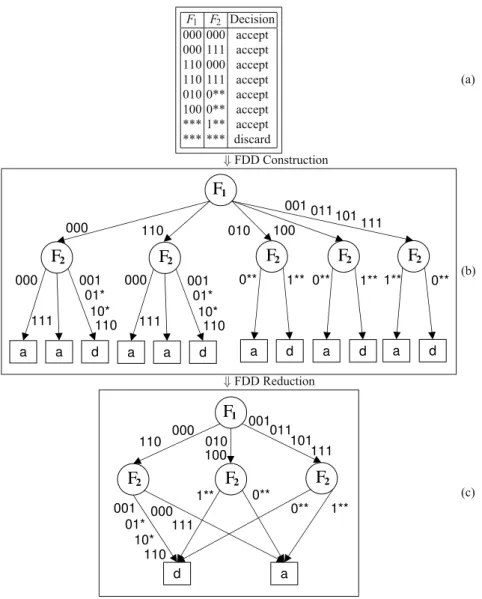
We de¿ne afull-length ordered FDDas an FDD where in each decision path all ¿elds appear exactly once and in the same order. For ease of presentation, we use the term “FDD” to mean “full-length ordered FDD” if not otherwise speci¿ed. Given a packet classi¿erℂ, the FDD construction algorithm in [Liu and Gouda(2004)] can convert it to an equivalent full-length ordered FDD f. Figure 2.1(a) contains a sample classi¿er, and Figure 2.1(b) shows the resultant FDD from the construction process shown by Agorithms 2 and 3.
Input: A packet classi¿erf:⟨r1,r2,⋅⋅⋅,rn⟩
Output: Atfor packet classi¿erf
Build a path from ruler1. Letvdenote the root. The label of the terminal node is⟨1⟩. ;
1 for i={2,...,n} ∈Cdo 2 APPEND(v,ri, 1,i) ; 3 end 4
Algorithm 2: FDD Construction Algorithm
After an FDD f is constructed, we can reduce f’s size by merging isomorphic subgraphs. A full-length ordered FDD f is reducedif and only if it satis¿es the
8 2 Background F1 F2 Decision 000 000 accept 000 111 accept 110 000 accept 110 111 accept 010 0** accept 100 0** accept *** 1** accept *** *** discard (a) ⇓FDD Construction
F
1F
2 d a aF
2 d aF
2 d a 000 110 000 111F
2 d a 001 01* 10* 110F
2 d a a 000 111 001 01* 10* 110 0** 1** 0** 1** 1** 0** 010 100 001 011 101 111 (b) ⇓FDD Reduction 110 111 010 001F
1F
2F
2 a d 110 000 000 111F
2 001 01* 10* 1** 0** 0** 1** 100 011 101 (c)Fig. 2.1 Illustration of FDD construction
following two conditions: (1) no two nodes in f are isomorphic; (2) no two nodes have more than one edge between them. Two nodesvandv′ in an FDD are
iso-morphicif and only ifvandv′satisfy one of the following two conditions: (1) both
vandv′are terminal nodes with identical labels; (2) bothvandv′ are nonterminal nodes and there is a one-to-one correspondence between the outgoing edges ofvand the outgoing edges ofv′such that every pair of corresponding edges have identical labels and they both point to the same node. A reduced FDD is essentially a
canoni-2.2 One-Dimensional Classi¿er Minimization 9 Input: A vertexv, a rule(F1∈S1)∧ ⋅⋅⋅ ∧(Fd∈Sd)→ ⟨dec⟩, a depthm, and a rule numberi.
Output:vincludes the rule(F1∈S1)∧ ⋅⋅⋅ ∧(Fd∈Sd)→ ⟨dec⟩in the FDD
/* F(v) =Fm and E(v) ={e1,⋅⋅⋅,ek} */
ifm=d+1then 1
Makei’s decision ofv’s label if the decision is not already de¿ned. ;
2 return 3 end 4 else if(Sm−(I(e1)∪ ⋅⋅⋅ ∪I(ek)))∕=/0then 5
Add an outgoing edgeek+1with labelSm−(I(e1)∪ ⋅⋅⋅ ∪I(ek))tov;
6
Build a decision path from(Fm+1∈Sm+1)∧ ⋅⋅⋅ ∧(Fd∈Sd)→ ⟨dec⟩, and makeek+1 7
point to the¿rst node in this path ;
Addito the end of the label of the terminal node of this decision path ;
8 end 9 forj := 1 to kdo 10 ifI(ej)⊆Smthen 11
APPEND(ej’s target,(F1∈S1)∧ ⋅⋅⋅ ∧(Fd∈Sd)→ ⟨dec⟩,m+1,i);
12 end 13
Add one outgoing edgeetov, and labelewithI(ej)∩Sm;
14
Make a copy of the subgraph rooted at the target node ofej, and makeepoints to the
15
root of the copy ;
Replace the label ofejbyI(ej)−Sm;
16
APPEND(e’s target,(F1∈S1)∧ ⋅⋅⋅ ∧(Fd∈Sd)→ ⟨dec⟩,m+1,i);
17 end 18 return 19 Algorithm 3: APPEND
cal representation for packet classi¿ers. Figure 2.1(c) shows the reduced FDD from Figure 2.1(b).
2.2 One-Dimensional Classi
¿
er Minimization
The special problem ofweightedone-¿eld TCAM minimization is used as a build-ing block for multi-dimensional TCAM minimization. Given a one-¿eld packet classi¿erf ofnpre¿x rules⟨r1,r2,⋅⋅⋅,rn⟩, where{Decision(r1),Decision(r2),⋅⋅⋅,
Decision(rn) }={d1,d2,⋅⋅⋅,dz} and each decision di is associated with a cost
Cost(di)(for 1≤i≤z), we de¿ne the cost of packet classi¿er f as follows:
Cost(f) =
∑
ni=1
Cost(Decision(ri))
Based upon the above de¿nition, the problem of weighted one-dimensional TCAM minimization is stated as follows.
De¿nition 2.2.Weighted One-Dimensional Pre¿x Minimization Problem Given a one-¿eld packet classi¿er f1where each decision is associated with a cost,¿nd a
10 2 Background
pre¿x packet classi¿erf2∈ {f1}such that for any pre¿x packet classi¿er f ∈ {f1}, the conditionCost(f2)≤Cost(f)holds.
The problem of one-dimensional pre¿x minimization (with uniform cost) has been studied in [Draves et al(1999)Draves, King, Venkatachary, and Zill, Suri et al(2003)Suri, Sandholm, and Warkhede] in the context of compressing routing ta-bles. I generalize the dynamic programming solution in [Suri et al(2003)Suri, Sand-holm, and Warkhede] to solve the weighted one-dimensional TCAM minimization. There are three key observations:
1. For any one-dimensional packet classi¿er f on{∗}w, we can always change the
predicate of the last rule to be{∗}wwithout changing the semantics of the packet
classi¿er. This follows from the completeness property of packet classi¿ers. 2. Consider any one-dimensional packet classi¿er f on{∗}w. Let f′be f appended
with rule{∗}w→d, wheredcan be any decision. The observation is thatf ≡f′. This is because the new rule is redundant in f′sincef must be complete. A rule in a packet classi¿er isredundantif and only if removing the rule from the packet classi¿er does not change the semantics of the packet classi¿er.
3. For any pre¿xP∈ {0,1}k{∗}w−k(0≤k≤w), one and only one of the following
conditions holds:
a. P∈ {0,1}k0{∗}w−k−1, b. P∈ {0,1}k1{∗}w−k−1, c. P={0,1}k{∗}w−k.
This property allows us to divide a problem of {0,1}k{∗}w−k into two
sub-problems: {0,1}k0{∗}w−k−1, and {0,1}k1{∗}w−k−1. This divide-and-conquer strategy can be applied recursively.
We formulate an optimal dynamic programming solution to the weighted one-dimensional TCAM minimization problem.
LetP denote a pre¿x {0,1}k{∗}w−k. We use P to denote the pre¿x {0,1}k
0{∗}w−k−1, andPto denote the pre¿x{0,1}k1{∗}w−k−1.
Given a one-dimensional packet classi¿er f on {∗}w, we use f
P to denote a packet classi¿er onPsuch that for anyx∈P, fP(x) = f(x), and we use fPd to denote a similar packet classi¿er onPwith the additional restriction that the¿nal decision isd.
C(fP)denotes the minimum cost of a packet classi¿ertthat is equivalent tofP, andC(fd
P)denotes the minimum cost of a packet classi¿ert′that is equivalent to
fPand the decision of the last rule int′isd.
Given a one-dimensional packet classi¿erf on{∗}wand a pre¿xPwhereP⊆
{∗}w,f is consistent onPif and only if∀x,y∈P, f(x) = f(y).
The dynamic programming solution to the weighted one-dimensional TCAM minimization problem is based on the following theorem. The proof of the theorem shows how to divide a problem into sub-problems and how to combine solutions to sub-problems into a solution to the original problem.
2.2 One-Dimensional Classi¿er Minimization 11 Theorem 2.1.Given a one-dimensional packet classi¿er f on{∗}w, a pre¿xP
whereP⊆ {∗}w, the set of all possible decisions{d
1,d2,⋅⋅⋅,dz}where each
deci-sion dihas a cost wdi(1≤i≤z), we have that
C(fP) = z min i=1C(f di P) where each C(fdi P)is calculated as follows: (1) If f is consistent onP, then C(fdi P) = { wf(x) if f(x) =di wf(x)+wdi if f(x)∕=di
(2) If f is not consistent onP, then
C(fdi P) =min ⎧ ⎨ ⎩ C(fd1 P) +C(fPd1)−wd1+wdi, ..., C(fdi−1 P ) +C(f di−1 P )−wdi−1+wdi, C(fdi P) +C(fPdi)−wdi, C(fdi+1 P ) +C(f di+1 P )−wdi+1+wdi, ..., C(fdz P) +C(fPdz)−wda+wdi
Proof. (1) The base case is when f is consistent onP. In this case, the minimum cost pre¿x packet classi¿er in{fP} is clearly ⟨P → f(x)⟩, and the cost of this packet classi¿er iswf(x). Furthermore, fordi∕=f(x), the minimum cost pre¿x packet
classi¿er in{fP}with decisiondiin the last rule is⟨P → f(x),P→di⟩where
the second rule is redundant. The cost of this packet classi¿er iswf(x)+wdi. (2) Iff is not consistent onP, dividePintoPandP. The crucial observation is that an optimal solution f∗to{f
P}is essentially an optimal solution f1to the sub-problem of minimizing fP appended with an optimal solution f2 to the sub-problem of minimizing fP. The only interaction that can occur betweenf1and f2 is if their¿nal rules have the same decision, in which case both¿nal rules can be replaced with one¿nal rule covering all ofP with the same decision. Letdxbe
the decision of the last rule in f1anddybe the decision of the last rule in f2. Then
we can compose f∗whose last rule has decisiondi from f1 and f2 based on the following cases:
(A)dx=dy=di: In this case, f can be constructed by listing all the rules in f1 except the last rule, followed by all the rules in f2except the last rule, and then the last ruleP→di. Thus,Cost(f) =Cost(f1) +Cost(f2)−wdi.
(B)dx=dy∕=di: In this case,f can be constructed by listing all the rules inf1except the last rule, followed by all the rules in f2except the last rule, then ruleP→dx,
and¿nally ruleP→di. Thus,Cost(f) =Cost(f1) +Cost(f2)−wdx+wdi. (C)dx∕=dy,dx=di,dy∕=di: We do not need to consider this case becauseC(fPdi) +
C(fdy P) =C(f di P) + (C(f dy P) +wdi)−wdi ≥C(f di P) +C(fPdi)−wdi. (D)dx∕=dy,dx∕=di,dy=di: Similarly, this case need not be considered.
12 2 Background
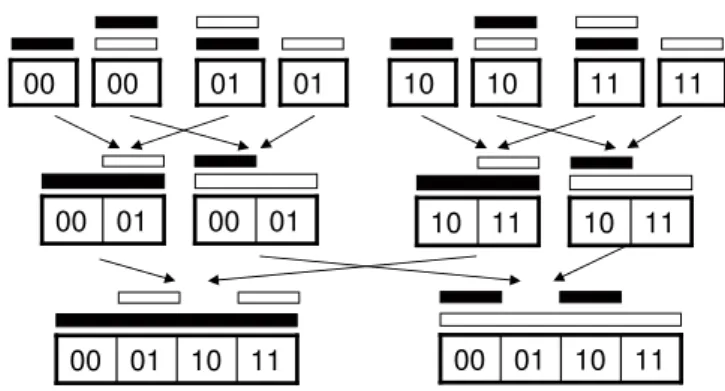
Figure 2.2 shows the illustration of a one-dimensional TCAM minimization problem, where the black bar denotes decision “accept” and the white bar denotes decision “discard”. Figure 2.3 illustrates how the dynamic programming works on this example. Algorithm 4 shows the pseudocode for¿ndingC(fdi
P).
00 01 10 11
Fig. 2.2 An example one-dimensional TCAM minimization problem
00 01 10 11 00 01 10 11
00 01 00 01 10 11 10 11
00 00 01 01 10 10 11 11
2.2 One-Dimensional Classi¿er Minimization 13 Input: AUniversethey contains the color information of each pre¿x in the domain, a pre¿x
intervalp, and dictionary of weights for each color.
Output: A dictionary that contains the cost of the optimal pre¿x solution for keys (Pre f ix,Color)where the pre¿xPre f ixhas the background colorColor. Letcbe the colors at pre¿xponUniverse;
1
LetColorsbe the set of colors de¿ned byColorWeights;
2
ifc is monochromaticthen 3
Letanswerbe an emtpy dictionary ;
4
foreachcolor∈Colorsdo 5
ifcolor∕=cthen 6
answer[(p,color)] =ColorWeights[c] +ColorWeights[color];
7
else 8
answer[(p,color)] =ColorWeights[c];
9 end 10 end 11 else 12
Splitpintolowandhigh;
13
Letanswerbe a new dictionary that contains the keys from
14
ODPM(Universe,low,ColorWeights) and ODPM(Universe,low,ColorWeights) ; foreachcolor that is de¿ned by ColorWeightsdo
15 answer[(p,color)] = 16 mincc∈Colors ⎧ ⎨ ⎩
answer[(lowPre f ix,cc)] +answer[(highPre f ix,cc)]
−ColorWeights[cc]ifcolor=cc answer[(lowPre f ix,cc)] +answer[(highPre f ix,cc)]
−ColorWeights[cc] +ColorWeights[color]otherwise ⎫ ⎬ ⎭ ; end 17 end 18 returnanswer ; 19
Chapter 3
Related Work
There is signi¿cant prior work on packet classi¿cation for both TCAM based packet classi¿cation and software based packet classi¿cation. While TCAM based sys-tems are more immediately relevant, software based classi¿cation shares a degree of commonality with the sequential decomposition technique; however, differences in available hardware result in very different design decisions.
3.1 TCAM Based Classi
¿
ers
There is signi¿cant prior work on minimizing the TCAM space occupied by a sin-gle classi¿er. Such work falls into three broad categories: (1)classi¿er minimization
(e.g.,, [Draves et al(1999)Draves, King, Venkatachary, and Zill,Suri et al(2003)Suri, Sandholm, and Warkhede, Applegate et al(2007)Applegate, Calinescu, Johnson, Karloff, Ligett, and Wang, Liu and Gouda(2005), Dong et al(2006)Dong, Banerjee, Wang, Agrawal, and Shukla, McGeer and Yalagandula(2009)]), which converts a given classi¿er to a semantically equivalent classi¿er that requires fewer TCAM en-tries; (2)range encoding(e.g.,, [Liu(2002), van Lunteren and Engbersen(2003), Pao et al(2006)Pao, Li, and Zhou, Lakshminarayanan et al(2005)Lakshminarayanan, Rangarajan, and Venkatachary, Bremler-Barr and Hendler(2007)]), which encodes the ranges (i.e.,, source port and destination port) in a manner that reduces range ex-pansion; and (3)circuit modi¿cation(e.g.,, [Spitznagel et al(2003)Spitznagel, Tay-lor, and Turner]), which modi¿es TCAM circuits to accommodate range compar-isons.
3.1.1 Classi
¿
er Minimization:
The basic idea is to convert a given packet classi¿er to another semantically equiva-lent packet classi¿er that requires fewer TCAM entries. Several classi¿er
minimiza-15 C. R. Meiners et al., Hardware Based Packet Classification for High Speed Internet Routers, DOI 10.1007/978-1-4419-6700-8_3, © Springer Science+Business Media, LLC 2010
16 3 Related Work
tion schemes have been proposed [Draves et al(1999)Draves, King, Venkatachary, and Zill,Suri et al(2003)Suri, Sandholm, and Warkhede,Applegate et al(2007)Apple-gate, Calinescu, Johnson, Karloff, Ligett, and Wang, Liu and Gouda(2005), Dong et al(2006)Dong, Banerjee, Wang, Agrawal, and Shukla]. The work in [Draves et al(1999)Draves, King, Venkatachary, and Zill, Suri et al(2003)Suri, Sandholm, and Warkhede,Applegate et al(2007)Applegate, Calinescu, Johnson, Karloff, Ligett, and Wang] focuses on one-dimensional and two dimensional packet classi¿ers. Construction Optimal IP Tables
In [Draves et al(1999)Draves, King, Venkatachary, and Zill], Draves et al. present a polynomial algorithm for generating a minimum equivalent packet classi¿er for one-dimensional pre¿x match classi¿ers. Their algorithm,Optimal Routing Table Constructor(ORTC), works by reducing a longest matching pre¿x trie to its minimal representation via three traversals. This minimal trie can then be used to use to generate a minimum single¿eld pre¿x classi¿er. A longest match pre¿x classi¿er can be trivially converted into a¿rst match pre¿x classi¿er by sorting the rules such that the longer pre¿x rules appear before shorter pre¿x rules.
Compressing Two-Dimensional Routing Tables
In [Suri et al(2003)Suri, Sandholm, and Warkhede], Suri et al. present a polyno-mial time dynamic program that generates a minimum equivalent packet classi¿er for one-dimensional pre¿x classi¿ers. This dynamic program is equivalent to the dynamic program presented in Chapter 2.2. Furthermore, Suri et al. present a gen-eralization of this dynamic program for two or more ¿elds. They show that this generalization produces optimal two¿eld classi¿ers when the the solution space of classi¿ers is restricted such that the predicates of any two rules in the a classi¿er are either disjoint, or one predicate is a subset of the other. However, these generalized algorithms have a signi¿cant time requirements,O(N∣DS∣(w1× ⋅⋅⋅ ×wd)), where
wdis the number of bits used forFi. As a result, the dynamic program ceases to be
usable for more than two¿elds.
Complete Redundancy Detection in Firewalls
In [Liu and Gouda(2005)], Liu and Gouda, propose the¿rst algorithm that is guar-anteed to detect and remove a maximal set of redundant rules within a classi¿er. They propose two types of redundant rules,upward redundantrules anddownward redundantrules. These two types of rules are shown to completely categorize the set of all redundant rules. Liu and Gouda’s algorithm¿rst uses an iterative FDD construction technique to remove all upward redundant rules, and it uses a different iterative FDD construction technique to remove all downward redundant rules. By
3.1 TCAM Based Classi¿ers 17
removing both types of rules, the algorithm produces a classi¿er free of redundant rules. Note, that this algorithm is not guaranteed to remove the maximum number of redundant rules since there can be interdependencies between redundant rules. However, this algorithm is effective for all types of classi¿ers, and its ef¿ciency scales well as the number of¿elds in a classi¿er increases.
Packet Classi¿ers in Ternary CAMs can be Smaller
In [Dong et al(2006)Dong, Banerjee, Wang, Agrawal, and Shukla], Dong et al. pro-pose the¿rst algorithm that modi¿es rules within a classi¿er in an attempt to reduce the effects of range expansion. They propose four types of operations: trimming
rules,expandingrules,mergingrules, andaddingrules. The basic idea of their al-gorithm is that by trimming or expanding the space covered by a predicate, the range expansion for each rule can be reduced. They propose a two stage algorithm that¿rst trims the predicate space of every rule and then expands the predicate space of each rule going from last to¿rst. This algorithm is signi¿cant in that it accom-modates classi¿ers with more than two¿elds. However, it is unknown whether or not the algorithm is optimal given a one-dimensional classi¿er. Furthermore, The algorithm requires repeated applications for a classi¿er to converge upon a minimal set of rules and depends heavily upon repeated applications of the redundancy re-moval technique found in [Liu and Gouda(2005)]. This suggests that their algorithm requires a signi¿cant amount of computational overhead.
Compressing Rectilinear Pictures and Minimizing Access Control Lists
In [Applegate et al(2007)Applegate, Calinescu, Johnson, Karloff, Ligett, and Wang], Applegate et al. propose an optimal solution for two¿eld classi¿ers composed en-tirely ofstrip rules. Strip rules have a wild card for at least one¿eld. However, while this work is of theoretical interest, it does not scale tod-dimensional classi¿ers, and it is not clear that packet classi¿ers can be ef¿ciently represented with strip rules Minimizing Rulesets for TCAM Implementation
In [McGeer and Yalagandula(2009)], McGeer and Yalgandula show that¿nding the minimal number of TCAM rules to represent a classi¿er is NP-hard. They show this property by reducing circuit equivalence to TCAM rule minimization. However, their reduction does not produce a feasible method for optimal TCAM rule mini-mization. The author, instead, propose a heuristic based approximation algorithm for TCAM classi¿ers with exactly two decisions.
18 3 Related Work
3.1.2 Range Encoding:
The basic idea is to¿rst encode ranges that appear in a classi¿er and store the en-coded rules in a TCAM. When a packet comes, the packet needs to be preprocessed so that the resulting encoded packet can be used as a search key for the TCAM. Previous range encoding schemes fall into two categories: database independent encoding schemes [Lakshminarayanan et al(2005)Lakshminarayanan, Rangarajan, and Venkatachary, Bremler-Barr and Hendler(2007)], where the encoding of each rule is independent of other rules in the classi¿er, and database dependent encod-ing schemes [Liu(2002),van Lunteren and Engbersen(2003),Pao et al(2006)Pao, Li, and Zhou], where the encoding of each rule may depend on other rules in the classi-¿er. The advantage of database independent encoding schemes is that they allow fast incremental updates to the classi¿er since each rule is encoded independently. How-ever, database dependent schemes have the potential for better space savings since they can utilize the low number of unique ranges that appear in real life classi¿ers to achieve lower range expansion.
Algorithms for Advanced Packet Classi¿cation
Lakshminarayanan et al. propose a scheme called fence encoding, which encodes in-terval ranges as a range of unary numbers [Lakshminarayanan et al(2005)Lakshmin-arayanan, Rangarajan, and Venkatachary]. All ranges under fence encoding have an expansion factor of one, which implies that all ranges can be encoded with one rule, but the number of unary bits required for each rule is prohibitive since a¿eld with lengthwrequires 2w bits per rule. To reduce the required number of bits in a rule,
Lakshminarayan et al. proposed the technique called DIRPE, which compresses the size of fence encodings at the expense of increasing the average expansion ratio. DIRPE works by dividing a ¿eld into equally sized sub-¿elds, which are called
chunks, and fence encoding these chunks. Selecting the number of chunks pro-vides a trade-off between range expansion and TCAM entry width. The authors also propose a method of combining DIRPE with Liu’s range encoding scheme found in [Liu(2002)] to handle ranges that have a large expansion factor under DIRPE. However, this combination negates DIRPE’s ability to allow fast updates for classi-¿ers.
Space-ef¿cient TCAM-based Classi¿cation using Gray Coding
Bremler-Barr and Hendler, in [Bremler-Barr and Hendler(2007)], propose a scheme in which ¿eld domains are encoded using binary reÀected gray codes(BRGC). While there is no advantage or disadvantage to using a BRGC for¿elds that con-tain only pre¿x ranges, using BRGC on non-pre¿x ranges breaks up the range in such a way that additional ternary bits can be used to eliminate some of the pre¿xes needed to represent a range. The result is that some of the pre¿xes ranges required
3.1 TCAM Based Classi¿ers 19
to represent a range are merged together into a single ternary entry. The authors note that this encoding technique is especially effective for small ranges and name their encoding algorithmshort range gray encodingor SGRE. Since SGRE does not re-quire any additional TCAM bits to encode ranges, Bremler-Barr and Hendler also propose a method of combining SGRE with Liu’s range encoding technique. Like DIRPE this combination negates SGRE’s ability to support fast updates for classi-¿ers, but it allows for the technique to concisely encode ranges with large expansion factors under SRGE.
Ef¿cient Mapping of Range Classi¿ers into Ternary-CAM
In [Liu(2002)], Liu proposes an encoding method that designates speci¿c ternary bits within each TCAM entry to represent a speci¿c range. A packet ¿eld is en-coded via an SRAM lookup table that maps each¿eld value to a codeword that has a designated bit set to 1 if and only if the value is an element of the corresponding range. Each rule’s range predicate can then be encoded such that the designated bit is set to 1 and every other bit is set to∗. This technique eliminates range expansion completely; however, it also requiresnbits per TCAM entry when a classi¿er hasn
unique ranges in a¿eld. This technique quickly becomes impractical as the number of unique ranges within a¿eld increases. To combat the explosive growth in required bits, Liu proposes splitting a¿eld domain intokdisjoint ranges such that each dis-joint range intersects with a small number of unique ranges. Since⌈logk+1⌉bits are needed to encode these disjoint ranges, this scheme allows for a¿eld to be en-coded using⌈logk+1⌉+n′bits wheren′is the maximum number of unique ranges that intersect with a given disjoint range. Using this scheme means that rule predi-cates that intersects with more than one disjoint range must be replicated for each intersection. To manage the trade off between rule expansion and bit expansion, Liu proposes a heuristic algorithm that repeatedly¿nds and merges the pair of disjoint ranges that reduces rule expansion the most. These merges continue until a budget ofbbits is exhausted.
Fast and Scalable Packet Classi¿cation
In [van Lunteren and Engbersen(2003)], van Lunteren and Engbersen propose an encoding method similar to [Liu(2002)]. In their encoding scheme, they control the required number of bits by partitioning the unique ranges intollayers. The ranges within each layer are then broken into disjoint ranges so that each layer can be encoded in⌈logni⌉bits whereni is the number of disjoint ranges in layeri. Each
¿eld then become the concatenated encoding for each layer. The authors also note that if a disjoint rangerin one layer contains a disjoint ranger′in another layer, this information can be used to reduce the number of bits needed to encoder′’s layer. Unfortunately, no algorithms are given for partitioning unique ranges into layers.
20 3 Related Work
An Encoding Scheme for TCAM-based Packet Classi¿cation
In [Pao et al(2006)Pao, Li, and Zhou], Pao et al. propose an encoding algorithm calledpre¿x inclusion encoding(PIC). PIC utilizes van Lunteren and Engbersen’s observation that containment information for one layer can reduce the number of bits required to encode ranges in the next layer. That is the scheme produces a series ofllayersL1,...,Llsuch that each disjoint range inLiis a subset of a single range
ofLi−1fori∈ {2,...,l}. With this property, PIC can encode a¿eld predicate into a compact pre¿x range. PIC was designed for encoding¿elds with pre¿x ranges and large domains such as the source IP for IPv6 headers. However, the authors do sug-gests techniques for adapting their scheme to encode range¿elds. These techniques require breaking overlapping ranges into disjoint ranges, which in turn requires that encoded rules are replicated in a manner similar to other encoding techniques.
3.1.3 Circuit Modi
¿
cation:
The basic idea is to modify TCAM circuits to accommodate range comparisons. For example, Spitznagel et al. proposed adding comparators at each entry level to better accommodate range matching [Spitznagel et al(2003)Spitznagel, Taylor, and Turner]. While this research direction is important, such solutions are hard to deploy due to high cost [Lakshminarayanan et al(2005)Lakshminarayanan, Rangarajan, and Venkatachary], and modi¿ed TCAMs may be less applicable to applications other than packet processing.
3.2 Software Based Techniques
The simplest software based technique for packet classi¿cation is a linear search, which has excellent storage requirement but becomes too slow for wire speed packet classi¿cation for even modest sized classi¿ers. As a results, a rich body of software based packet classi¿cation techniques have been developed [Singh et al(2003)Singh, Baboescu, Varghese, and Wang, Qiu et al(2001)Qiu, Varghese, and Suri, Taylor and Turner(2005), Lakshman and Stiliadis(1998), Gupta and McKeown(1999a), Feld-mann and Muthukrishnan(2000),boe scu and Varghese(2001),Woo(2000),Baboescu et al(2003)Baboescu, Singh, and Varghese,Srinivasan et al(1998)Srinivasan, Vargh-ese, Suri, and Waldvogel, iva san et al(1999)iva san, Suri, and Varghese], and an ex-tensive survey of these techniques can be found in [Taylor(2005)]. These techniques trade storage space for an improvement in search time via special preprocessing of the classi¿er rules. Techniques can be partitioned into two categories: parallel decomposition and decision tree classi¿cation.
3.2 Software Based Techniques 21
3.2.1 Parallel decomposition
The objective of parallel decomposition techniques [Lakshman and Stiliadis(1998), boe scu and Varghese(2001), Srinivasan et al(1998)Srinivasan, Varghese, Suri, and Waldvogel,iva san et al(1999)iva san, Suri, and Varghese,Gupta and McKeown(1999a), Taylor and Turner(2005)] is to break the classi¿cation process into several steps that can performed in parallel. The above techniques perform the decomposition along the¿eld boundaries of a packet header. This in effect allows for fast and ef¿cient single¿eld classi¿cation solutions to encode each¿eld in parallel. These new val-ues are then composed via one or more additional classi¿cations stages to yield a correct classi¿cation.
High-speed Policy-based Packet Forwarding using Ef¿cient Multi-dimensional Range Matching
In [Lakshman and Stiliadis(1998)], Lakshman and Stiliadis propose encoding each ¿eld’s value into a bitmap that speci¿es a containment relationship among values and rules [Lakshman and Stiliadis(1998)]. This bitmap indicates whether or not an encoded value intersects with a given rule’s¿eld predicate. Once each¿eld is en-coded, this method uses customized parallel AND gates to perform an intersection of these bitmaps and ultimately¿nds the¿rst matching rule. This technique is ef-fective; however it requires a bit line for each rule in the classi¿er and must be implemented on customized hardware.
Scalable Packet Classi¿cation
In [boe scu and Varghese(2001)], Baboescu and Varghese improve on the above technique by observing that for classi¿ers with a low occurrence of wildcards, bitmaps will be sparely populated with 1’s. They group bits within each bitmap into chunks and represent each chuck with a single bit which is the logical OR of all the bits within the chunk. This allows the second stage to skip the comparison of a signi¿cant number of bits. For classi¿ers that have a low occurrence of wildcards, this technique is very effective at reducing the number of memory access needed to perform the second stage processing; however, this reduction is diminished once wildcards occur more frequently within a classi¿er.
Fast and Scalable Layer Four Switching
In [Srinivasan et al(1998)Srinivasan, Varghese, Suri, and Waldvogel], Srinivasan et al. propose an encoding method calledcross-productingthat assigns a unique num-ber to each maximal disjoint range within a classi¿er¿eld and constructs a lookup table for the cross product of the numbers associated with each¿eld. This technique
22 3 Related Work
is fast; however, its storage requirements multiplicatively increases as the number of¿elds and ranges increases. As a result, the authors only intend crossproducting for small classi¿ers with two¿elds.
Packet Classi¿cation on Multiple Fields
In [Gupta and McKeown(1999a)], Gupta and McKeown propose an encoding method called Recursive Flow Classi¿cation (RFC) that is an optimized version of the cross-producting scheme. This uses recursive cross-producting tables to reduce the space requirements of regular cross-producting tables. Furthermore, they map disjoint ranges that are contained by the same set of rules into a single value. RFC’s mapping tables de¿ne an equivalence relation; however, this equivalence relation is less general than the domain compression technique discussed in Chapter 8, so they are unable to achieve a maximum compression for each¿eld domain in most cases. Furthermore, the recursive cross-producting scheme requires a signi¿cant amount of space to store in memory.
Packet Classi¿cation using Tuple Space Search
In [iva san et al(1999)iva san, Suri, and Varghese], Srinivasan et al. propose a tuple based search approach. This approach transforms each rule predicate withd ¿elds into ad-tuple, which is in essence a hash of the predicate. The idea is that this initial hashing divides the search space into regions that can be searched in parallel. Perfect hashing functions are used to¿nd exact matches in each tuple’s search space. The authors propose two methods of determining appropriate tuples to search. The¿rst method is an exhaustive search of each tuple, and the second uses a set pruning trie for each¿eld that returns a set of candidate tuples. With set pruning, the intersections of the results from each¿eld is the set of tuple spaces that need to be searched. Scalable Packet Classi¿cation using Distributed Crossproducting of Field Labels In [Taylor and Turner(2005)], Taylor and Turner propose the Distributed Crosspro-ducting of Field Labels (DCFL) method that assigns each locally unique range within a¿eld a locally unique number. Each¿eld value is encoded into a set of num-bers, which represents the ranges that contains the value. These sets are crosspro-ducted together and then intersected with the set of unique tuples generated from the classi¿er’s ¿eld predicates. The resulting intersection provides a list of rules that the packet header matches. The authors optimize this technique by incremen-tally performing the crossproduct and ¿ltering the intermediate results after each incremental crossproduct. This optimization can dramatically reduce that number of false positive tuples that are generated. Since overlapping ranges diminish the incremental crossproducts’ ability to keep the number of candidate matches low, the
3.2 Software Based Techniques 23
technique’s performance depends on classi¿ers having a low number of overlapping ranges.
3.2.2 Decision Trees
Decision tree techniques [Gupta and McKeown(1999b), Singh et al(2003)Singh, Baboescu, Varghese, and Wang, Woo(2000), Qiu et al(2001)Qiu, Varghese, and Suri, Feldmann and Muthukrishnan(2000), Baboescu et al(2003)Baboescu, Singh, and Varghese] use tree structures to successively prune the search space to a single rule or a small number of rules, which are then searched linearly to¿nd a match. Decision tree methods such as HiCuts [Gupta and McKeown(1999b)] and Hyper-cuts [Singh et al(2003)Singh, Baboescu, Varghese, and Wang] are similar inÀavor to our sequential decomposition approach in that they use a sequence of searches where each search uses a portion of the packet predicate to classify a packet. How-ever, software-based methods are constrained by a complex tradeoff among how many searches need to be performed, the time required to perform a search and the space required to store the data structure that facilitates the search. In the worst case, these methods require many searches, slow searches, or tremendous amounts of memory.
Classi¿cation Using Hierarchical Intelligent Cuttings
In [Gupta and McKeown(1999b)], Gupta and McKeown present a decision tree al-gorithm calledHiCuts. This algorithm builds a decision tree similar to an unordered FDD with the following differences: Each node makes a decision based on a parti-tion of a¿eld’s domain, and leaves are allowed to store a list of rules. The rationale for both of these decisions is derived directly from the limitations of SRAM lookup methods. The authors implement each node as a lookup table so that the next node in the tree can be found in constant time. However, since a¿eld domain of size 232is prohibitively large, the¿eld domain must becutinto subsets to limit the size of each tree node. This technique successively prunes the set of candidate rules with the de-cision tree until the set of rules is below a certain threshold. Once this threshold is reached, the list of remaining rules is stored in the leaf at the end of the decision path. The rationale for this decision is to save storage space since small lists usu-ally result in big subtrees. The authors also present a parameterized construction algorithm that allows the user to trade maximum lookup time for storage space. Packet Classi¿cation using Multidimensional Cutting
In [Singh et al(2003)Singh, Baboescu, Varghese, and Wang], Singh et al. present
24 3 Related Work
allow each node in the decision tree to build a multidimensional lookup table from cuts in multiple¿elds. This improvement allows for a more effective pruning of the list of candidate rules. The authors show that HyperCuts signi¿cantly improves upon the performance of HiCuts.
A Modular Approach to Packet Classi¿cation
In [Woo(2000)], Woo uses a three stage approach to classifying packets. The¿rst stage is a lookup table that distributes packet value among a set of decision trees by matchingmbits within a rule predicate. These decision trees are binary trees where the nodes select the appropriate bit within the predicate to determine which edge to follow. The second stage traverses the decision tree until the third stage is reached when a leaf in the decision tree is found. These leaves contain a list of one or more candidate matches that is searched sequentially until a match is found. One key assumption in Woo’s work is that each classi¿er predicate needs to be transformed into a ternary bit string. This assumption implies that classi¿ers with signi¿cant amounts of range expansion will degrade the storage ef¿ciency of this technique. Fast Firewall Implementations for Software-based and Hardware-based Routers In [Qiu et al(2001)Qiu, Varghese, and Suri], Qiu et al. revisit two trie-based lookup schemes for packet classi¿cation that have been traditionally dismissed as being in-ef¿cient and show that for real packet classi¿ers, they offer predictable classi¿cation speeds. Longest pre¿x matching tries are an ef¿cient data structure for performing an exact match for a single¿eld packet; however, once packet classi¿ers requires multiple¿eld packets, some packets will not match against the longest pre¿x in all dimensions. The¿rst technique that they examine uses a backtracking search on a multi-¿eld trie to¿nd every candidate rule. They provide a set of optimizations for the multi-¿eld trie that speeds up the backtracking search; however, the num-ber of memory accesses required to classify each packet range from 117 to 196 for real-life classi¿ers. The second technique that they examine uses set pruning tries, which enumerate all decision paths so that each packet value can only follow a sin-gle path. The authors also propose two compression algorithms that help to reduce the storage requirements for set pruning tries and backtracking tries. Set pruning tries outperform backtracking search at the expense of additional memory storage requirements; however, experimental results suggest that backtracking tries offer a better performance for storage trade off. The experimental results suggest that these techniques offer a 2 to 5 times speedup over linear search.
Part I
Equivalent Transformation Techniques
29
Consider the following TCAM Minimization Problem:given a packet classi¿er, how can we generate another semantically equivalent packet classi¿er that requires the least number of TCAM entries?Two packet classi¿ers are (semantically) equiv-alent if and only if they have the same decision for every packet. For example, the two packets classi¿ers in Tables 1.1 and 1.2 are equivalent; however, the one in Ta-ble 1.1 requires 900 TCAM entries, and the one in TaTa-ble 1.2 requires only 6 TCAM entries.
Solving this problem helps to address the limitations of TCAMs. As we reduce the number of TCAM entries required, we can use smaller TCAMs, which results in less board space and lower hardware cost. Furthermore, reducing the number of rules in a TCAM directly reduces power consumption and heat generation because the energy consumed by a TCAM grows linearly with the number of ternary rules it stores [Yu et al(2005)Yu, Lakshman, Motoyama, and Katz].
While the optimal solution to the above problem is conceivably NP-hard, in this thesis, we propose a practical algorithmic solution using two techniques. Our¿rst technique, TCAM Razor, generates new but equivalent classi¿ers, whereas our sec-ond technique, all-match redundancy removal,¿nds a set of rules that can be safely removed from a classi¿er