UC Santa Barbara Electronic Theses and Dissertations
Title
Stepping Up the Cybersecurity Game: Protecting Online Services from Malicious Activity Permalink https://escholarship.org/uc/item/7ns1p3vh Author Stringhini, Gianluca Publication Date 2014 Peer reviewed|Thesis/dissertation
Santa Barbara
Stepping Up the Cybersecurity Game: Protecting Online Services from Malicious Activity
A Dissertation submitted in partial satisfaction of the requirements for the degree Doctor of Philosophy
in Computer Science
by
Gianluca Stringhini
Committee in charge:
Professor Christopher Kruegel, Chair Professor Giovanni Vigna
Professor Ben Y. Zhao
Professor Ben Y. Zhao
Professor Giovanni Vigna
Professor Christopher Kruegel, Chair
Protecting Online Services from Malicious Activity
Copyright c2014 by
Many people have supported and helped me during this long journey called PhD.
I would like to thank my adviser Christopher Kruegel and Giovanni Vigna, for men-toring me throughout my PhD. Their advice has been extremely important to teach me what research is all about, and to overcome the many difficulties that I encountered dur-ing my projects. I would also like to thank Ben Zhao and Dick Kemmerer for always being there for me and providing me with great advice both in research and during my job hunt. I am also thankful to Janet Kayfetz, who spent many hours helping me improve my writing and presenting skills.
This work would have not been possible without my coauthors, both the ones at UCSB and the ones far away. I would like to thank all of them for working together with me, and for the fruitful conversations in real life or over the Internet. I would also like to thank the folks at IBM Research, Symantec, and Yahoo! for their support, and for showing me what research in the industry is like.
I would like to thank all the people that have been part of the Seclab during these years. It is the best lab that one could wish for, and a great environment to work in. I will always remember the long deadline nights, the CTF competitions, and all the conversations that we had during my stay at UCSB. I have also been very fortunate to have great friends (a.k.a. the Seclab extended family) who made these five years memorable. You guys rock, thanks for all the adventures, the partying, and the good times.
June 2014
EDUCATION University of California, Santa Barbara
Ph.D., Computer Science
Santa Barbara, CA USA September 2009 – June 2014
University of California, Santa Barbara
M.S., Computer Science
Santa Barbara, CA USA
September 2009 – January 2014
Universit´a degli Studi di Genova
Laurea Specialistica (M.S. Equivalent) in Computer Engineering
Genova, Italy
September 2006 – March 2009
Universit´a degli Studi di Genova
Laurea Triennale (B.S. Equivalent) in Computer Engineering
Genova, Italy
September 2003 – September 2006
ACADEMIC
EXPERIENCE
University of California, Santa Barbara
Research Assistant, Computer Security Lab
Santa Barbara, CA USA September 2009 – June 2014
Sunnyvale, CA USA
November 2013 – May 2014
• Developed novel techniques to detect large-scale malicious activity on online services
Symantec Corp.
Research Intern
San Francisco, CA USA February 2013 – May 2013
• Developed novel techniques to detect targeted email attacks
IBM T.J. Watson Research Center
Visiting Researcher
Yorktown Heights, NY USA September 2012 – December 2012
• Developed techniques to detect targeted attacks against cor-porate networks
In Proceedings of the 2010 Annual Computer Security Applica-tion Conference (ACSAC), Austin, TX.
The Underground Economy of Spam: A Botmaster’s Per-spective of Coordinating Large-Scale Spam Campaigns
Brett Stone-Gross, Thorsten Holz, Gianluca Stringhini, and Gio-vanni Vigna
In Proceedings of the 2011 USENIX Workshop on Large-Scale Exploits and Emerging Threats (LEET), Boston, MA.
BotMagnifier: Locating Spambots on the Internet
Gianluca Stringhini, Thorsten Holz, Brett Stone-Gross, Christo-pher Kruegel, and Giovanni Vigna
In Proceedings of the 2011 USENIX Security Symposium, San Francisco, CA, 2011.
Hit ’em Where it Hurts: A Live Security Exercise on Cyber Situational Awareness
Adam Doupe, Manuel Egele, Benjamin Caillat, Gianluca Stringhini, Gorkem Yakin, Ali Zand, Ludovico Cavedon, and Gio-vanni Vigna
In Proceedings of the 2011 Annual Computer Security Applica-tions Conference (ACSAC), Orlando, FL.
B@bel: Leveraging Email Delivery for Spam Mitigation
Gianluca Stringhini, Manuel Egele, Apostolis Zarras, Thorsen Holz, Christopher Kruegel, and Giovanni Vigna
In Proceedings of the 2012 USENIX Security Symposium, Belle-vue, WA, 2012.
Poultry Markets: On the Underground Economy of Twitter Followers
Gianluca Stringhini, Manuel Egele, Christopher Kruegel, and Giovanni Vigna
In Proceedings of the 2012 SIGCOMM Workshop on Online So-cial Networks (WOSN), Helsinki, Finland, 2012.
Manuel Egele, Gianluca Stringhini, Christopher Kruegel, and Giovanni Vigna
In Proceedings of the 2013 ISOC Network and Distributed Sys-tems Symposium (NDSS), San Diego, CA.
Two Years of Short URLs Internet Measurement: Security Threats and Countermeasures
Federico Maggi, Alessandro Frossi, Gianluca Stringhini, Brett Stone-Gross, Christopher Kruegel, Giovanni Vigna, and Stefano Zanero
In Proceedings of the 2013 International World Wide Web Con-ference (WWW), Rio De Janeiro, Brazil.
Follow the Green: Growth and Dynamics in Twitter Follow-ers Markets
Gianluca Stringhini, Gang Wang, Manuel Egele, Christopher Kruegel, Giovanni Vigna, Ben Y. Zhao, and Haitao Zheng
In Proceedings of the 2013 Internet Measurement Conference (IMC), Barcelona, Spain.
Shady Paths: Leveraging Surfing Crowds to Detect Malicious Web Pages
Gianluca Stringhini, Christopher Kruegel, and Giovanni Vigna
In Proceedings of the 2013 ACM Conference on Computer and Communication Security (CCS), Berlin, Germany.
Stranger Danger: Exploring the Ecosystem of Ad-based URL Shortening Services
Nick Nikiforakis, Federico Maggi, Gianluca Stringhini, M Zubair Rafique, Wouter Joosen, Christopher Kruegel, Frank Piessens, Giovanni Vigna, and Stefano Zanero
In Proceedings of the 2014 International World Wide Web Con-ference (WWW), Seoul, Korea.
The Harvester, the Botmaster, and the Spammer: On the Re-lations Between the Different Actors in the Spam Landscape
Gianluca Stringhini, Oliver Hohlfeld, Christopher Kruegel, and Giovanni Vigna
Jane Iedemska, Gianluca Stringhini, Richard Kemmerer, Christo-pher Kruegel, and Giovanni Vigna
In Proceedings of the 2014 International Workshop on Cyber-crime (IWCC), San Jose, CA.
Stepping Up the Cybersecurity Game: Protecting Online Services from Malicious Activity
by
Gianluca Stringhini
The rise in popularity of online services such as social networks, web-based emails, and blogs has made them a popular platform for attackers. Cybercriminals leverage such services to spread spam, malware, and steal personal information from their victims. In a typical cybercriminal operation, miscreants first infect their victims’ machines with malicious software and have them join a botnet, which is a network of compromised computers. In the second step, the infected machines are often leveraged to connect to legitimate online services and perform malicious activities.
As a consequence, online services receive activity from both legitimate and malicious users. However, while legitimate users use these services for the purposes they were designed for, malicious parties exploit them for their illegal actions, which are often linked to an economic gain. In this thesis, I show that the way in which malicious users and legitimate ones interact with Internet services presents differences. I then develop
ties that misuse Internet services.
As examples of this research approach, I first study the problem of spamming botnets, which are misused to send hundreds of millions of spam emails to mailservers spread across the globe. I show that botmasters typically split a list of victim email addresses among their bots, and that it is possible to identify bots belonging to the same botnet by enumerating the mailservers that are contacted by IP addresses over time. I developed a system, called BOTMAGNIFIER, which learns the set of mailservers contacted by the bots belonging to a certain botnet, and finds more bots belonging to that same botnet.
I then study the problem of misused accounts on online social networks. I first look at the problem of fake accounts that are set up by cybercriminals to spread malicious content. I study themodus operandi of the cybercriminals controlling such accounts, and I present a system to automatically flag a social network accounts as fake. I then look at the problem of legitimate accounts getting compromised by miscreants, and I present COMPA, a system that learns the typical habits of social network users and considers messages that deviate from the learned behavior as possible compromises.
As a last example, I present EVILCOHORT, a system that detects communities of online accounts that are accessed by the same botnet. EVILCOHORT works by clustering together accounts that are accessed by a common set of IP addresses, and can work on any online service that requires the use of accounts (social networks, web-based emails, blogs, etc.).
1 Introduction . . . 1
1.1 Anatomy of a Cybercriminal Operation . . . 4
1.1.1 Infected Machines . . . 5
1.1.2 Command and Control Infrastructure . . . 7
1.1.3 Malicious Online Service Accounts . . . 9
1.2 Dissertation Overview . . . 11
1.2.1 Detecting Misbehaving Hosts . . . 11
1.2.2 Detecting Misbehaving Accounts . . . 12
1.2.3 Studying the Relations Between Bots and Malicious Accounts . 15 1.3 Contributions . . . 16
2 Related Work . . . 18
2.1 The Evolution of Botnets . . . 18
2.1.1 The Evolution of Botnet Structures . . . 19
2.1.2 The Evolution of the Botnet Infection Model . . . 21
2.2 The Evolution of Mitigation Techniques . . . 22
2.2.1 Detecting Infections . . . 22
2.2.2 Detecting Command and Control Activity . . . 26
2.2.3 Detecting Malicious Content . . . 28
3 Locating Spambots on the Internet . . . 35 3.1 Introduction . . . 35 3.1.1 Input Datasets . . . 38 3.1.2 Approach . . . 38 3.2 Input Datasets . . . 40 3.2.1 Seed Pools . . . 40 3.2.2 Transaction Log . . . 44
3.3 Characterizing Bot Behavior . . . 46
3.4 Bot Magnification . . . 48
3.4.1 Threshold Computation . . . 49
3.5 Spam Attribution . . . 53
3.5.1 Spambot Analysis Environment . . . 53
3.5.2 Botnet Tags . . . 55
3.5.3 Botnet Clustering . . . 55
3.6 Evaluation . . . 59
3.6.1 Validation of the Approach . . . 60
3.6.2 Tracking Bot Populations . . . 63
3.6.3 Application of Results . . . 68
3.6.4 Universality ofk . . . 73
4 Background: Online Social Networks . . . 78
4.1 The Facebook Social Network . . . 80
4.2 The MySpace Social Network . . . 82
4.3 The Twitter Social Network . . . 82
5 Detecting Fake Online Social Network Accounts . . . 84
5.1 Introduction . . . 84
5.2 Data Collection . . . 86
5.2.1 Honey-Profiles . . . 86
5.2.2 Collection of Data . . . 88
5.3 Analysis of Collected Data . . . 89
5.3.1 Identification of Spam Accounts . . . 92
5.3.2 Spam Bot Analysis . . . 94
5.4 Spam Profile Detection . . . 99
5.4.1 Spam Detection on Facebook . . . 102
5.4.2 Spam Detection on Twitter . . . 103
5.4.3 Identification of Spam Campaigns . . . 106
5.5 Conclusions . . . 110
6 Detecting Compromised Online Social Network Accounts . . . 111
6.1 Introduction . . . 111
6.2 Behavioral Profiles . . . 116
6.2.1 Modeling Message Characteristics . . . 118
6.3.2 Robustness of the Models . . . 127
6.3.3 Novelty of the modelled features . . . 129
6.4 Grouping of Similar Messages . . . 131
6.5 Compromised Account Detection . . . 135
6.6 Evaluation . . . 137
6.6.1 Data Collection . . . 138
6.6.2 Training the Classifier . . . 140
6.6.3 Detection on Twitter . . . 143
6.6.4 Detection on Facebook . . . 150
6.6.5 Case Studies . . . 151
6.6.6 Detecting Worms . . . 154
6.7 Detecting High-profile Compromises . . . 157
6.8 Limitations . . . 161
6.9 Conclusions . . . 162
III
Detecting The Relations Between Malicious Hosts and
On-line Accounts
163
7 Detecting Malicious Account Communities on Online Services . . . 1647.1 Introduction . . . 164
7.2 Background: Analysis of Malicious Activity on a Webmail Service . . . 168
7.3 EVILCOHORT: Overview . . . 174
7.3.1 Data Collection . . . 175
7.3.4 Postprocessing Step . . . 178
7.4 Description of the Datasets . . . 182
7.4.1 Webmail Activity Dataset . . . 182
7.4.2 Online Social Network Login Dataset . . . 183
7.5 Evaluation . . . 184
7.5.1 Threshold Selection . . . 185
7.5.2 Detection in the Wild . . . 189
7.5.3 Result Analysis . . . 193
7.6 Discussion . . . 199
7.7 Conclusions . . . 201
8 Conclusions and Future Work . . . 204
3.1 Overview of BOTMAGNIFIER. . . 39
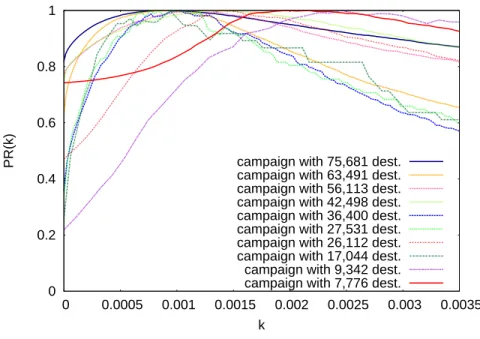
3.2 Quality of magnification for varyingkusing tenCutwailcampaigns of different sizes. . . 51
3.3 Growth ofLethicIP addresses. . . 66
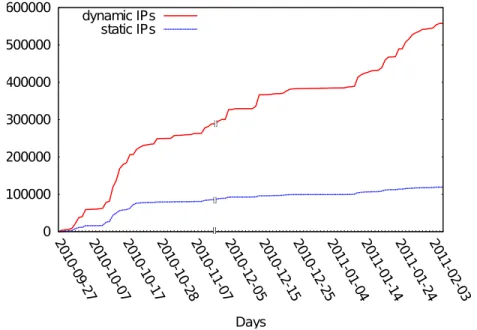
3.4 Growth of the dynamic and static IP address populations for the two major botnets. . . 67
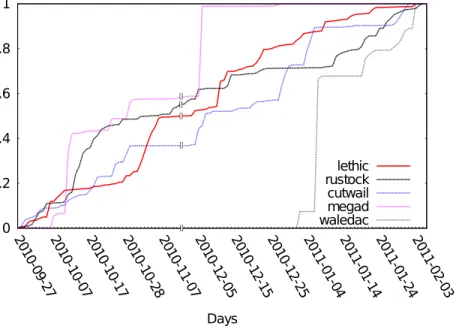
3.5 Cumulative Distribution Function (CDF) for the dynamic IP addresses. . 68
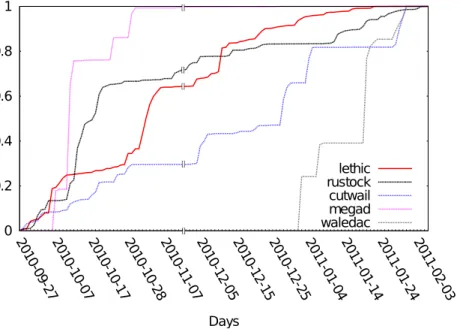
3.6 Cumulative Distribution Function (CDF) for the static IP addresses. . . 69
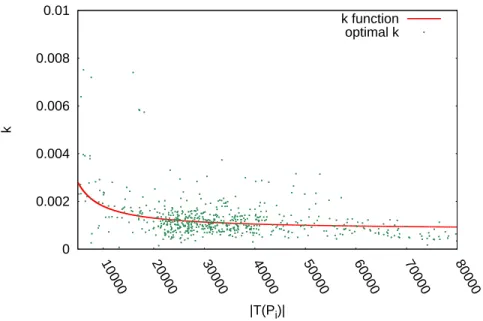
3.7 Analysis of our function fork compared to the optimal value ofk for 600 campaigns. . . 74
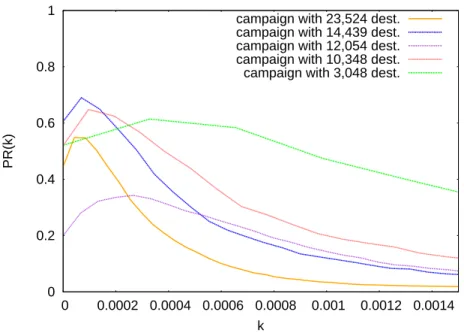
3.8 Precision vs. Recall functions for five campaigns observed in the net-flow dataset. . . 75
5.1 Friend requests received by our honey-profiles on Facebook. . . 90
5.2 Messages observed by our honey-profiles on Facebook. . . 91
5.3 Users starting following our honey-profiles on Twitter. . . 94
5.4 Messages received by our honey-profiles on Twitter. . . 95
5.5 Activity of campaigns over time. . . 106
6.1 Features evolving with different sizes of training sets. Each experiment was conducted 25 times on random subsets of 25%, 50%, 70%, 90%, and 99% of the 5,236 labeled training instances. The fraction of positive to negative samples remained constant. . . 142
on Twitter. . . 148
7.1 Average time (in days) before a spamming account was suspended in
L, given the number of IP addresses accessing that account. Accounts accessed by many IP addresses can be stealthier in their operation and survive longer. The plot shows bumps when we reach accounts ac-cessed by a very high number of accounts, because these accounts are very rare. . . 170 7.2 Number of spam emails sent per day on average by accounts accessed
by a certain number of IP addresses. Accounts accessed by more IP addresses are generally able to send more emails from their malicious accounts. . . 171 7.3 Number of spam emails sent per IP address that accessed a certain
ac-count. If many IP addresses access the same account, each of them can send a small number of emails and help keeping the malicious accounts under the radar from the webmail provider. . . 172 7.4 Cumulative Distribution Function (CDF) of the number of IP addresses
that accessed benign accounts in T and malicious accounts in L. As it can be seen, malicious accounts are more likely to be accessed by multiple IP addresses than legitimate ones. . . 173 7.5 Overview of EVILCOHORT. The darker circles represent IP addresses,
while the lighter circles represent online accounts. . . 174 7.6 Number of malicious accounts detected per day by EVILCOHORT on
EVILCOHORTon the datasetD1. . . 190
7.8 Correlation between user agents and IPs: legitimate accounts (left) and malicious accounts (right). . . 194 7.9 Time series plotting login event over time: all accounts (leftmost),
legit-imate accounts behind a NAT (middle left) and malicious communities (middle right and rightmost). . . 198 7.10 Activity of legitimate users behind a NAT: IP address usage (left) and
account usage (right). . . 202 7.11 Activity of non malicious community: IP address usage (left) and
ac-count usage (right). . . 202 7.12 Activity of malicious communities: IP address usage (left) and accounts
3.1 Overview of the BOTMAGNIFIERresults. . . 64
5.1 Friend requests received by our honey-profiles on the various social networks. . . 90 5.2 Messages received by our honey-profiles on the various social networks. 91 5.3 Spam campaigns observed. . . 107
6.1 Comparison of the features used by previous work. . . 132 6.2 Evaluation Results for the Text (Twitter and Facebook) and URL (Twitter)
Similarity measure. . . 144 6.3 Behavioral profile violations of news agency Twitter accounts within
most recent 500 tweets. . . 158
7.1 Statistics of activity events on our online social network login dataset. . 183 7.2 Summary of the results reported by EVILCOHORT for different values
of the thresholds. . . 185 7.3 Number of malicious communities detected per day by EVILCOHORT
on the datasetD2. . . 191
7.4 Size of the malicious communities detected by EVILCOHORT on the
datasetD2. Numbers (Average, Median and Maximum) are expressed
Number of Communities, Acc - Number of Accounts,log(c)- Average correlation, UA Sim - User-Agent Similarity, UA string - User-Agent String. . . 195
Introduction
Cybercrime is a serious threat for Internet users. Miscreants infect their victim comput-ers and control them to perform malicious activities, such as sending email spam [125], stealing their victims’ personal information [123], performing denial of service at-tacks [59], or mining digital currencies [71]. Cybercrime operations are a successful business, generating important revenues for attackers [77, 78].
To perform malicious activity on online services, such as online social networks, web-based email services, and blog platforms, cybercriminals need access to three elements:
infected machines, acommand and control infrastructure, andonline accounts. Cyber-criminals can either infect computers themselves to take control of them [108, 125], or can purchase already-compromised machines on the black market [38]. After taking control of a number of compromised machines, the attacker instructs them to connect to a server under his control — the infected machine becomes abotand joins a botnet,
which is a network of compromised computers controlled by the same cybercriminal through a command and control (C&C) server [51]. A cybercriminal controlling a botnet is typically referred to as abotmaster. The C&C server is then used by the cy-bercriminal to issue commands to his bots. A common action performed by botmasters is to instruct their bots to connect to accounts under their control on online services, and perform malicious activity such as spreading spam, malware, or crawling sensitive information. These accounts can be fake ones, created specifically for malicious pur-poses [138] or legitimate accounts that have been compromised and are now under the cybercriminal’s control [63].
Leveraging existing services to spread malicious content provides three advantages to the cybercriminal. First, it is easy to reach many victims, since popular online services have many millions of users that are well connected. Consider traditional email spam operations, where miscreants have to harvest a large number of victim email addresses (on the web or from infected hosts) before they can start to send spam [128]. On social networks, cybercriminals can easily find and contact their victims or leverage the existing friends of legitimate accounts that they compromised [63]. In some cases, such as blog and forum spam, cybercriminals do not even have to collect a list of victims, because their malicious content will be shown to anybody who is visiting the web page on which the spam comment is posted [101, 139]. A second advantage of using online services to spread malicious content is that while users have become aware of the threats associated with email, they are not as familiar with scams and spam that spreads through more recent channels (such as social networks) [75, 35]. The third advantage is that while online services have good defenses against threats coming from the outside, they have a much harder time in detecting misuse that originates from accounts within the
service itself [136].
In this dissertation I present my contribution to fighting cybercriminal operations. My work follows a data-driven approach to detect and block malicious activity on online services. In my research, I observe the way in which infected machines interact with legitimate online services, compared to regular users. Such interactions will show dif-ferences, because malicious and legitimate users use online services for very different purposes: while miscreants want to make a profit from interacting with legitimate ser-vices, and therefore aim at performing as much malicious activity as they can, regular users stick to a fair use of the online service, using it in the way the service was de-signed.
After identifying differences in the interaction behavior that clearly distinguish mali-cious and legitimate activity, I design systems that leverage them to detect and block this malicious activity. As examples of this research approach, I present four projects that fight different types of malicious activity on online services:
• BOTMAGNIFIER, a system that learns the email-sending behavior of the
spam-ming bots belonging to a botnet, and is able to find more bots belonging to the same botnet in the wild.
• SPAMDETECTOR, a system that learns the typical modus operandi of
miscre-ants that leverage fake accounts on social networks, and is able to detect such accounts.
• COMPA, a system that is able to detect whether an online social network account has been compromised and is now misused by a cybercriminal.
• EVILCOHORT, a system that studies the relations between infected computers
and online accounts, and is able to detect communities of accounts on an online service that are accessed by the same botnet.
In the following, I first describe the elements and the characteristics of a typical cyber-criminal operation. Then, I provide an overview of this dissertation work in fighting them. Finally, I present the contributions of this thesis.
1.1
Anatomy of a Cybercriminal Operation
As I mentioned, a cybercriminal operation is typically composed of three parts: a set of
infected machines, acommand and control infrastructurethat allows the cybercriminal to give orders to his bots, and a set of online accounts, which are used by the bots to connect to online services and perform malicious activity, such as spreading spam. Although online accounts are not required in all cases, they are usually needed if the infected machine is required to access restricted information on the service, or post content. In the following, I describe the three elements needed by cybercriminals to run their operations, and illustrate the options that they have for each of these elements, as well as the challenges and drawbacks associated to them.
1.1.1
Infected Machines
Ideally, a cybercriminal would want access to as many infected machines as possible. The first infections that happened on the Internet belonged to the class ofworms[80]. In this type of threat, machines would get infected by having a vulnerability in a soft-ware component compromised. After the machine becomes infected, it would scan the network for other vulnerable machines, and try to exploit them. Worm infections are characterized by the fact that they are spreading autonomously, and often time this spread got out of control. In 1988, the first worm ever developed resulted in generat-ing so much traffic that the Internet backbone had to be restarted [80]. This particular threat, known as the “Morris worm,” did not aim to turn a profit or generate any ma-licious activity other than spreading, and was designed to show the feasibility of an Internet-wide infection. More recent threats, which had large denial of service attacks against webservers as a goal, spread out of control too and were detected before they could reach their goal [156].
Not only worm activity tends to be very obvious and easy to detect, but recent research showed that a botnet can effectively manage only a certain number of bots, before the command and control channel gets saturated [73] — a botnet composed of two many bots results in having a part of them remaining idle. Due to these practical issues – the lack of stealthiness and the uselessness of having more infected machines than needed – cybercriminals stopped using the worm-like spread to collect populations of infected computers; the last popular worm wasConficker, which dates back to 2008 [118].
involve self-spreading infections. Instead, malware is installed by having users click on a malicious attachment in spam emails [125] or by having the user visit a malicious web page, which would try to exploit vulnerability in the user’s browser and install a malicious program without the user noticing [108]. A third type of distribution involves having the user visit a scam web page that convinces her to install a malware program, disguised as a useful tool (such as an antivirus program) [122].
Nowadays, an entire economy emerged that is specialized in providing infected com-puters to cybercriminals. Miscreants set up their own botnet, which is able to install a malware of of their customers’ choice on demand [38]. The infections used by such botnets are usually very resilient and difficult to eradicate — for example the mali-cious program could reside in the master boot record (MBR) of a hard drive and patch the operating system kernel at each reboot to remain undetected [124]. The sophisti-cation of this market has evolved to the point that customers can specify the type of infected machines that they want to buy, in terms of operating system, configuration, and geographic location. Bots located in developed countries (e.g., the United States or the United Kingdom) are more expensive than bots located in other countries [38]. This might be linked to the fact that such machines are more valuable for particular cy-bercriminal schemes, such as stealing banking information. However, recent research showed that for traditional cybercriminal activity, such as sending spam, there is no advantage for a miscreant to buy bots in expensive countries [73].
Computer infections are a real problem in nowadays Internet. A recent report by Symantec shows that in 2013 the company detected 2.3 billion infected machines [135]. In Chapter 2.2 we provide an overview of the techniques that have been proposed to
detect and clean up infected computers, while in Chapter 3 we present a novel system to detect infected computers that are used to spread email spam.
1.1.2
Command and Control Infrastructure
After a cybercriminal has collected a number of infected computers, he instructs them to connect to a command and control (C&C) infrastructure under his control. This in-frastructure can be a single server [125], or a multitude of communicating servers [44].
Botnets that take advantage of a single server can either leverage a well-known proto-col, such as IRC [25], or a proprietary, encrypted protocol [125]. Using a proprietary protocol makes it more difficult for researchers to intercept the commands issued by the botmaster, but the fact that the operation uses only one C&C server constitutes a single point of failure, and security researchers can take down the entire botnet by seizing this server. To be more resilient, other botnets use multiple C&C servers. In particular, a multi-tier model is commonly used: a unique C&C server is hidden through multiple layers of servers whose only purpose is relaying connections between the bots and the upper levels of the C&C infrastructure [44]. The purpose of the relay servers is to hide the actualmothership, which is the server from which the botmaster issues commands, and make takedowns difficult: as long as a majority of relays and the mothership are still available, the botnet remains operational.
Some botnets obfuscate their infrastructure even more, by using a peer-to-peer scheme. In this model, the bots themselves act as relays between the infected machines and the upper C&C infrastructure [102]. Although these schemes make it more difficult
for researchers to identify the C&C servers, this type of infrastructure has the problem that a good fraction of the command and control traffic passes through the infected machines. Researchers can then pretend to be bots and infiltratethe botnet, obtaining important insights on the entire cybercriminal operation [44, 102, 121].
Another technique that cybercriminals can use to obfuscate their operations is modify-ing the IP address that corresponds to a certain domain often, with a technique called
fast flux[69]. In this model, a set of relay servers is associated to the same DNS domain in quick sequence, one at a time. The infected machines contacting the C&C infrastruc-ture do that by issuing DNS queries to the domain, and therefore the botnet can work regardless the relay that is active at the moment. As long as one of the relays associated to the domain is active, the operation keeps being alive, and the bots are able to receive their orders.
A more recent technique that makes the detection of C&C infrastructures even more difficult is dynamically changing the DNS domain to access the infrastructure over time. By leveraging a time-dependent algorithm, known asdomain generation algo-rithm(DGA), the bots can dynamically generate the domain that is active at a certain point in time, and connect to the C&C infrastructure [28].
In Chapter 2.2 we discuss the different efforts conducted by the research community to disrupt C&C infrastructures. As we mentioned previously, in this dissertation we focus on developing mitigation systems based on the way in which infected machines inter-act with legitimate, online services. Since C&C infrastructures are entirely composed of servers controlled by cybercriminals, studying them goes beyond the scope of this thesis.
1.1.3
Malicious Online Service Accounts
To interact with many online services, such as online social networks and web-based email services, cybercriminals need access to accounts on such services. These ac-counts can be used to spread malicious content on the service, such as spam and links pointing to malware [63], or to connect to the service and crawl sensitive information, such as user profile data [74]. The accounts that cybercriminals can take advantage of to spread malicious content can befake accounts, which have been specifically created for that purpose, orcompromised accounts, which belong to legitimate users but have been taken over by the cybercriminal.
To obtain fake accounts on an online service, miscreants can either create them them-selves, pay workers on crowdsourcing platforms to create a number of them [145], or purchase a bulk of already-created ones on the black market [138]. These accounts can then be used to spread malicious content on the online service. A problem with fake accounts is that many online services, such as social networks, require users to build a network of contacts to share content. A fake account is problematic in this regard, since real users are less likely to accept contact requests from people they do not know [35]. Also, trying to establish a large number of social connections in a short period of time is suspicious, and can lead to the fake account being detected and deleted by the online service [150]. In the case of online social networks, an alternative that cybercrimi-nals can attempt to quickly acquire contacts is purchasing friends or followers online: there are many services that promise to provide a large number of contacts to their customers [127, 132]. Often times, these contacts come from legitimate accounts that have been compromised. In Chapter 5 we will present SPAMDETECTOR, our solution
to detect fake accounts misused by cybercriminals on online social networks.
As an alternative to fake accounts, cybercriminals can leverage legitimate online ac-counts that have been compromised. A compromised account offers multiple advan-tages for cybercriminals compared to a fake one. First of all, a legitimate account already has an established network of trust, and therefore the cybercriminal does not need to create one. In addition, the friends of the compromised account’s legitimate owner are likely to trust her, and therefore it is more likely for them to click on the links that the account posts [75]. As an additional advantage, from the social network perspective dealing with compromised accounts is more difficult than dealing with fake accounts: while a fake account can just be suspended with no consequences, a com-promised account needs special handling, such as resetting the account password and informing the account’s legitimate owner about what happened.
Compromised accounts can be stolen by having their owners give away credentials through a phishing scam [22], by luring users into authorizing a rogue application to use the accounts through social engineering [132], or by leveraging a vulnerability in the web application that powers the online service (for example, an XSS vulnerabil-ity) [143]; in this case, the user automatically posts some content of the attacker’s choice by displaying the malicious content in her web browser. Due to the automatic exploitation of such vulnerabilities, the messages generated by an XSS vulnerability tend to spread in an uncontrollable fashion (similar to the typical worm behavior that we discussed in Chapter 1.1.1) [41]. In chapter 6 we present COMPA, the first system to detect legitimate online social network accounts that have been compromised. This work represents the first step in ensuring that messages that spread on online social
networks are really authored by who they claim to come from.
1.2
Dissertation Overview
This dissertation collects the contributions of four papers: “BOTMAGNIFIER: Locating Spambots on the Internet” [129] (USENIX Security 2011), “Detecting Spammers on Social Networks” [130] (ACSAC 2010), “COMPA: Detecting Compromised Accounts on Social Networks” [57] (NDSS 2013), and “EVILCOHORT: Detecting Communities
of Malicious Accounts on Online Services” (under submission). These systems detect and block various types of malicious activity aimed at online services, at three different levels: they either look at infected hosts, at accounts that are misused by cybercriminals, or at the relation between infected hosts and malicious accounts. In the following, I illustrate a summary of the aforementioned systems.
1.2.1
Detecting Misbehaving Hosts
One way of disrupting cybercriminal operations is developing techniques to detect and block the infected machines that form botnets. A common task that cybercriminals use botnets for is sending spam emails to their victims. Typically, a botmaster sets up a botnet by infecting victim computers, and rents it out to spammer groups to carry out spam campaigns, in which similar email messages are sent to a large group of Internet users in a short amount of time. Tracking the bot-infected hosts that participate in spam campaigns, and attributing these hosts to spam botnets that are active on the Internet, are
challenging but important tasks. In particular, this information can improve blacklist-based spam defenses and guide botnet mitigation efforts.
In Chapter 3 I present a novel technique to support the identification and tracking of bots that send spam. Our technique takes as input an initial set of IP addresses that are known to be associated with spam bots, and learns their spamming behavior. This initial set is then “magnified” by analyzing large-scale email delivery logs to identify other hosts on the Internet whose behavior is similar to the behavior previously modeled. We implemented our technique in a tool, called BOTMAGNIFIER, and applied it to several data streams related to the delivery of email traffic. Our results show that it is possible to identify and track a substantial number of spam bots by using our magnification technique — Over a period of four months, we were able to grow the set of known bots belonging to well-known botnets by 925,978 IP addresses, which accounts for 45.6% of the total. We also tracked the evolution and activity of such spamming botnets over time. Moreover, we show that our results can help to improve state-of-the-art spam blacklists.
1.2.2
Detecting Misbehaving Accounts
An orthogonal way of disrupting threats against online services is detecting and block-ing the accounts that are misused by cybercriminals. In this dissertation I present two systems that detect malicious accounts on online social networks: the first one,
SPAMDETECTOR, detects accounts that are specifically created to spread spam on the
over by a cybercriminal and that are used to spread malicious content.
Detecting fake social network accounts. Social networking has become a popular
way for users to meet and interact online. Users spend a significant amount of time on popular social network platforms, storing and sharing a wealth of personal infor-mation. This information, as well as the possibility of contacting thousands of users, also attracts the interest of cybercriminals. In particular, as we mentioned earlier in this chapter, cybercriminals take advantage of fake accounts to disseminate malicious content on social networks.
In Chapter 5, we first analyze to which extent spam has entered social networks. More precisely, we analyze how spammers who target social networking sites operate. To collect the data about spamming activity, we created a large and diverse set of “honey-profiles” on three large social networking sites (Facebook, Twitter, and MySpace), and logged the kind of contacts and messages that they received. We then analyze the col-lected data and model the anomalous behavior of the fake accounts contacted our pro-files. We developed a system, called SPAMDETECTOR, which detects fake accounts that are misused by cybercriminals to spread malicious content on social networks based on the typical behavior showed by these accounts. SPAMDETECTOR was one
of the first systems that were presented to detect fake accounts on social networks.
We then aggregate the messages sent by the detected accounts in large spam campaigns. Our results show that it is possible to automatically identify the accounts used by spam-mers, and our analysis was used for take-down efforts in a real-world social network. More precisely, during this study, we collaborated with Twitter and correctly detected and deleted 15,857 spam profiles.
I present SPAMDETECTORin detail, alongside with our results, in Chapter 5.
Detecting compromised social network accounts. As the results that we obtained
with SPAMDETECTORshow, fake accounts typically exhibit highly anomalous behav-ior, and hence, are relatively easy to detect. As a response, attackers have started to compromise and abuse legitimate accounts. Compromising legitimate accounts is very effective, as attackers can leverage the trust relationships that the account owners have established in the past. Moreover, compromised accounts are more difficult to clean up because a social network provider cannot simply delete the corresponding profiles.
In Chapter 6 of this dissertation, we present the first approach to detect compromised user accounts in social networks, and we apply it to two popular social networking sites, Twitter and Facebook. Our approach uses a composition of statistical modeling and anomaly detection to identify accounts that experience a sudden change in behavior. Since behavior changes can also be due to benign reasons (e.g., a user could switch her preferred client application or post updates at an unusual time), it is necessary to derive a way to distinguish between malicious and legitimate changes. To this end, we look for groups of accounts that all experience similar changes within a short period of time, assuming that these changes are the result of a large-scale malicious campaign that is unfolding. We developed a tool, called COMPA, that implements our approach, and we ran it on a large-scale dataset of more than 1.4 billion publicly-available Twitter messages, as well as on a dataset of 106 million Facebook messages. COMPA was able to identify compromised accounts on both social networks with high precision. In particular, over a period of three months, COMPA was able to detect more than 300,000 compromised accounts on Twitter. We worked closely with the Twitter security team
to make sure that these accounts were cleaned up. In addition, we show that COMPA would have helped in detecting two high-profile compromises against news agency accounts that happened on Twitter in 2011 and in 2013.
I present COMPA in detail in Chapter 6.
1.2.3
Studying the Relations Between Bots and Malicious Accounts
So far, I have presented techniques that either focus on detecting malicious hosts or malicious accounts on online services. In Chapter 7 I present the first system that detects malicious accounts on online services by studying the relations between the accounts controlled by a cybercriminal and the botnet (i.e., the set of IP addresses) that accesses them.
We first study the accounts that were used to send spam on a large web-based email service, and show that accounts that are accessed by botnets are particularly dangerous because of the amount of malicious activity that they can carry out and their ability to survive for long periods of time. Since botnets are composed by a finite number of infected computers, we observe that cybercriminals tend to have their bots connect to multiple online accounts to perform malicious activity. We present EVILCOHORT, a system that detects online accounts that are accessed by the same botnet. We evaluated
EVILCOHORT on multiple online services: first, we ran it on a dataset collected on a
large web-based email service, and were able to detect 1.2 million malicious accounts over a period of five months. We also ran the system on a dataset collected on multiple social networks, and were able to detect 111,647 malicious accounts over a period of 8
days.
Our results show that EVILCOHORT can reliably detect malicious accounts that are accessed by botnets. In addition, EVILCOHORT opens exciting scenarios in the area of malicious account detection: unlike previous systems that can detect malicious ac-counts only once they send malicious content or interact with the online service (for example by sending a friend request to a victim), our system only looks at the set of IP addresses that access a set of accounts. Therefore, EVILCOHORT can detect accounts
that, although controlled by cybercriminals, do not perform any “clearly” malicious activity on the online service. An example are botnets that use the online service as command and control channel, and retrieve commands from the network without post-ing anythpost-ing.
In Chapter 7 I provide a detailed description of EVILCOHORT, and I show detailed statistics on the communities of malicious accounts that we detected.
1.3
Contributions
In summary, this dissertation makes the following contributions:
• I present a system to increase the knowledge on the set of bots belonging to a bot-net. This system can be used to track the population of large botnets, and record important events in the botnet’s lifetime (such as a takedown, or a botnet becom-ing active again after a period of inactivity). In addition, our system is a useful aid to improve DNS blacklists, which are known to have coverage problems [109].
• I present one of the first systems to detect and block fake accounts that are mis-used by cybercriminals on online social networks. The system reaches very high precision, and is a helpful tool for social network operators to keep their networks safe.
• I present the first system able to detect that an online social network account has been compromised. In addition to detecting large-scale compromises, in which thousands of accounts are involved and misused by botnets, this system would have been helpful in preventing two high-profile social network accounts belong-ing to news agencies from bebelong-ing compromised and post unwanted content.
• I present an analysis of the relation between the set of IP addresses accessing an online account and its maliciousness. I show that accounts that are accessed by botnets are particularly dangerous for the online service, and present a system to detect and block such accounts.
Related Work
Cybercriminals and security researchers are involved in an arms race. Every time a new mitigation technique is deployed, a more advanced attack or botnet scheme is developed. In this chapter, I first analyze the evolution that botnets followed over the years. Then, I describe the detection and mitigation systems that have been developed by the security community to fight the threat of cybercriminal operations.
2.1
The Evolution of Botnets
Since they first became a threat, in the mid-2000s, botnets evolved considerably, to keep up with the security research being conducted to disrupt them and make sure their operation could continue. This evolution happened in two aspects: the structure of the botnets and the way they propagate their infections to acquire new victims.
2.1.1
The Evolution of Botnet Structures
IRC botnets.The first botnets borrowed characteristics from Internet Relay Chat (IRC) bots. After being infected, a bot would connect to an IRC server, join a specific channel, and wait for orders [25, 54, 55]. These botnets did not use a lot of sophistication to hide their actions. They usually used a password to protect the IRC channel where the botmaster would give the orders, but both the server name and the password would be in clear in the malicious binary. Therefore, researchers could retrieve this information and join the channel to learn important information about the botnet. As an alternative, researchers could sinkhole the DNS traffic asking for the malicious domains, so that the infected machines would connect to them instead of going to the Command and Control (C&C) server [25]. Another weakness of this model is that the C&C traffic used the IRC protocol, which is easy to detect and monitor.
Proprietary botnets. To avoid using known protocols and make their activity less evident, botmasters started using proprietary, encrypted protocols for their C&C traf-fic [125]. This makes botnet infiltration more diftraf-ficult, but researchers can still reverse engineer the protocol, create software that implements it, and join the botnet. In addi-tion, since the infrastructure still uses a single domain, sinkholing remains possible.
Multiple tier botnets.To make their infrastructure more resilient to attacks, botmasters started developing multiple-tier botnets [123]. In this architecture, instead of contacting the C&C server directly, the bots contact one of many proxies, which then forward their request to the C&C server. By doing this cybercriminals make sure that, even if researchers took control of a limited number of proxies, the botnet would still be
operational.
In addition, botmasters developed a new technique that gives them even more reliabil-ity on their C&C infrastructure: fast flux [69, 103]. This technique is similar to the ones involved in Round Robin DNS and the ones used by Content Delivery Networks, and its goal is to assign a fast-changing number of IP addresses to the domains used by the botnet C&C infrastructure. By doing this, the botmaster ensures that even if a very small number of proxies would survive a takedown, the botnet would still be operational.
Even if the C&C infrastructure in this scheme uses multiple domains, it is still possible for researchers to sinkhole or blacklist them.
Domain Generation Algorithms. To mitigate the disadvantages of having a limited
number of domains for the C&C infrastructure, cybercriminals developed algorithms that allow both the bots and the C&C to generate domains on the fly. These algorithms, called Domain Generation Algorithms (DGAs), are typically time-sensitive, and, at any point in time, tell bots at which domain they can find the C&C server (or one of the proxies associated to it) [123]. The botmaster has to register the domains that will be used in the future, and make sure his infrastructure will respond to the bots at the right time.
Of course, researchers could reverse engineer the domain generation algorithm, and register the domains before the botmaster does. A countermeasure to this is making the DGA non-deterministic, for example by using information taken from social network trending topics. This way it is impossible to predict the DGA domains long time before
they become active.
Peer-to-peer botnets. Another evolution is to make the botnet peer-to-peer [85, 121]. In this architecture, another level of relayers is deployed between the bots and the prox-ies. Typically, those bots that do not have a public IP address (i.e., are behind a NAT) act as regular bots, while those that have a public IP address act as relayer bots. Regular bots find the nearest relayer by implementing some sort of Overnet protocol, which is typical of peer-to-peer networks (e.g., Kademlia [96]). A problem of this approach is that the botmaster gives up the control on a critical part of his infrastructure (i.e., the relayers) to infected machines. Researchers could reverse engineer the C&C protocol and infiltrate the botnet by pretending to be a relayer. This would allow them to collect a wealth of information about the botnet, for example enumerate the bots, or collect the spam templates that are delivered to the infected machines.
2.1.2
The Evolution of the Botnet Infection Model
Not only the botnet structure changed over time, but also the infection model that bot-masters use to gain control of more machines evolved. At the beginning, bots were behaving like Internet worms [65]. This means that an infected machine would scan for more vulnerable hosts in her network, and try to propagate. This approach be-came less and less used over time, with Conficker being the last large botnet using it in 2008 [106]. The next step has been to use bots that did not propagate on their own anymore. In this phase, the main channels of infection were two:
on them [125].
• Setting up malicious web pages that tried to exploit vulnerabilities in the victim’s browser and to download and install a malicious binary (a so-called drive-by download attack[108]).
Nowadays, the trend botmasters follow to deploy their bots is to use third party services. These services typically use pre-existing botnets to download additional components (i.e., bots) on the infected machines for a fee [38].
2.2
The Evolution of Mitigation Techniques
To disrupt a botnet that misuses a legitimate online service, researchers can intervene at different levels: mitigation systems can focus on detecting infected machines, on detecting malicious C&C infrastructures, on detecting malicious content (e.g., email spam), or on detecting malicious online service accounts. In the following, I analyze the efforts performed by the research community in each of these four fields.
2.2.1
Detecting Infections
One way of fighting large-scale cybercriminal operations is detecting infected comput-ers before they can cause any harm. In this section I discuss the research that has been conducted to achieve this goal.
host. By looking at the binaries that get installed, one can try to infer whether they are malicious or not. Traditional anti-viruses build signatures (e.g., regular expressions) from known malware, and look for the presence of those signatures in the binaries the user downloads [24]. This technique is not very robust, and previous work showed how the detection can be fooled by simple obfuscations such as inserting NOP instructions and performing code transpositions [46, 47].
Remaining in the field of static analysis, a better approach is to extract semantic infor-mation from known malware samples, and look for the same semantics in new samples while performing detection [48, 47]. The issue here is that program equivalence is an undecidable problem. Therefore, even if the proposed systems can cover a number of variations that model the same behavior, it is not guaranteed that this will work for any possible sample. In addition, modern malware comes packed (i.e., encrypted) and decrypts itself at runtime, and this makes static analysis difficult.
Dynamic analysis makes malware analysis easier, because one can look at the program once the decryption has happened. The techniques that have been proposed include modelling the behavior of a program based on the system calls it executes [82], moni-toring programs accessing sensitive information while they should not [153], or look-ing at the buffers allocated by a malware sample to reconstruct the C&C protocol it uses [39]. The problem of dynamic analysis is that running large amounts of malware samples takes time and resources, and cybercriminals can realize that the malware is being run in an analysis environment, and avoid performing any malicious activity [91].
Malicious web pages detection. Another approach used by researchers is looking at malicious web pages that try to compromise the victims browser and automatically
download a piece of malware (in a so-called drive-by download attack [108]). These attacks are typically performed by malicious JavaScript scripts. To detect such scripts, various approaches have been used:
• Using machine learning to detect legitimate and malicious web pages. The fea-tures that researchers leveraged include how many HTTP redirections the web page uses, or whether the JavaScript code included in the web page is obfus-cated. Detection can be performed either offline, by re-visiting the page with an instrumented browser [52], or online, by instrumenting the victim’s browser and stopping executing the page once one detects that it is malicious [53, 68, 131].
• Looking at the changes in the victim’s system when she visits a malicious web page. The creation of files of the changes of registry keys are indicators of the compromise [93, 108].
• The last possibility is to look at typical attack patterns and flag as malicious any script that shows those patterns [113].
The problem with these techniques is mostly that they rely on a static model to detect malicious scripts, or they train on malicious behavior that might adapt and change over time [72]. Therefore, they could miss newer attacks cybercriminals might come up with.
Network based detection.Another vantage point that can be leveraged for detection is the network traffic generated by infected machines. By observing the malicious traffic generated by such machines it is possible to learn important information about botnets, and develop effective countermeasures.
A direction researchers looked at is detecting successful infections by monitoring net-work traffic [65]. In this research net-work, infections are modeled as a set of flows that picture the different steps of the infection. Although interesting, this model cannot be applied anymore today. The reason is that years ago botnet infections followed a well defined, worm-like behavior (i.e., scanning for victims, exploitation, download of an egg, connection to the command and control), which is not widely used anymore.
More recent research proposed to look at the correlation between C&C messages and malicious activity. The idea is that any time a bot will receive a command, it will per-form a malicious activity. By looking at this correlation, it is possible to detect bots without any previous knowledge of the botnet [64]. The problem is how to identify C&C traffic. Older approaches looked for commonly-misused, well-known protocols (e.g., IRC) [66]. However, this type of techniques are not applicable anymore, since most botnets moved to proprietary protocols for their C&C traffic. More recent work looks for malicious activity first, and then looks for any interaction with external servers that happened before that activity to find the actual commands [147]. Zand et al. pro-posed a system to find strings that are typical of C&C commands, and leverage them for detection [155].
DNS based detection. Similar to most legitimate Internet services, botnets use the DNS infrastructure to easily connect the different components of their infrastructure (i.e., the bots and the C&C server). Therefore, by looking at the interaction between bots and DNS servers researchers can learn important information about the botnet, such as which IP addresses are associated to infected machines. This can be done by sinkholing the domains used by a botnet’s C&C infrastructure. By doing this, the
infected machines will contact the researchers instead of the botmaster, and it will be possible to enumerate them [55]. Another option is to look in local DNS servers for the presence of cached results associated to malicious domains [25]. If such records are found, that is an indicator of the presence of infected machines in the network.
Ramachandran et al. analyzed queries against a DNS blacklist (DNSBL) to reveal botnet memberships [111]; the intuition behind their approach is that bots might check if their own IP address is blacklisted by a given DNSBL. Such queries can be detected, which discloses information about infected machines.
In Chapter 3 we present BOTMAGNIFIER, a system that can grow the set of known
infected machines belonging to a botnet by observing the set of mailservers contacted by such machines over time. As we will see, BOTMAGNIFIERhelps in integrating DNS
blacklists, significantly improving the coverage offered by these services.
2.2.2
Detecting Command and Control Activity
Other work operated at the Command and Control level. The goal is typically to learn important information about the botnet, or to attempt a takedown.
For older botnets that were using IRC, infiltration was easy. All that researchers had to do was joining the IRC server and a particular channel, and look for the commands being issued by the botmaster [25]. Nowadays, this is not possible anymore, and re-searchers need to reverse engineer the C&C protocol first. A way of doing that is by active probing [45]. This type of techniques enable botnet infiltration, which means
that researchers can create a piece of software that behaves exactly like a bot, but does not execute any malicious activity [39, 44, 59, 84, 85, 121].
Another possibility, for those botnets that use it, is to reverse engineer the Domain Gen-eration Algorithm (DGA) used by the botnet. By doing this, researchers can register the C&C domains before the botmasters do, and impersonate the C&C server [110, 123]. An orthogonal approach is to take down the C&C server and perform an offline analysis of the server to reconstruct information [102].
In the case of botnets that use fast flux, the domains that use such techniques present very different characteristics from legitimate ones, and can be detected. For example, the IP addresses returned for a DNS query to a fast flux domain will belong to very different networks in various parts of the world, their Time to Live (TTL) will be low, and two subsequent queries will return different results. Previous work focused on building classifiers based on such characteristics, to detect fast flux domains [69, 70, 103].
Another possible way of interacting with the C&C infrastructure is by setting up honey-pots. Honeypots are virtualized environments where it is possible to run malware, and monitor its activity [76]. Monitoring the activity of the bots can give insights on what the C&C IP addresses and domains are. This information can be used for blacklisting them [126] or for performing botnet takedowns [125]. Honeypots, however, come with some problems. First of all, malware might detect that it is running in a virtualized environment, and do not perform any malicious activity [31]. On the other hand, while running malware, researchers need to make sure that their environment is constrained enough that this malware cannot damage anybody.
One last approach is to detect C&C domains by observing patterns in which domains are queried by infected machines. Proposed systems use local data from Recursive DNS servers [26, 34], or a more comprehensive view by looking at the Top Level Domain (TLD) level [27].
2.2.3
Detecting Malicious Content
Infected computers are commonly used to spread malicious content, such as spam, phishing scams, or links pointing to malicious web pages. In this section I briefly discuss the research that has been performed to detect such malicious content.
Existing work on spam filtering can be broadly classified in two categories: post-acceptance methods and pre-acceptance methods. Post-acceptance methods receive the full message and then rely on content analysis to detect spam emails. There are many approaches that allow one to differentiate between spam and legitimate emails: popular methods include Naive Bayes, Support Vector Machines (SVMs), or similar methods from the field of machine learning [114, 56, 98, 116]. Other approaches for content-based filtering rely on identifying the URLs used in spam messages [148, 14], or in looking at the content of the page pointed by such URLs looking for keywords that are typical of spam [137]. A third method isDomainKeys Identified Mail(DKIM), a system that verifies that an email has been sent by a certain domain by using graphic signatures [89]. In practice, performing content analysis or computing crypto-graphic checksums on every incoming email can be expensive and might lead to high load on busy servers [136]. Furthermore, an attacker might attempt to bypass the
con-tent analysis system by crafting spam messages in specific ways [92, 100]. In general, the drawback of post-acceptance methods is that an email has to be received before it can be analyzed.
Pre-acceptance methods attempt to detect spam before actually receiving the full mes-sage. Some analysis techniques take the origin of an email into account and analyze distinctive features about the sender of an email (e.g., the IP address or autonomous system the email is sent from, or the geographical distance between the sender and the receiver) [67, 142, 112]. In practice, these sender-based techniques have coverage problems: previous work showed how IP blacklists miss detecting a large fraction of the IP addresses that are actually sending spam, especially due to the highly dynamic nature of the machines that send spam (typically botnets) [119, 109, 125].
In Chapter 3 I show that our system to detect infected hosts that send spam can be effectively used to increase the coverage provided by IP blacklists.
2.2.4
Detecting Malicious Online Service Accounts
To perform their malicious activity, such as spreading malicious content, cybercrimi-nals typically instruct their bots to connect to accounts on legitimate online services that are under their control. To obtain such accounts, they can pay workers to create account for them [145], purchase mass-created fake accounts [138], or buy credentials of compromised accounts on such services [125]. Given the magnitude of the problem, numerous approaches have been proposed to detect accounts that perform malicious activities on online services.
In Chapter 5, I will present SPAMDETECTOR, one of the first systems that was
devel-oped to detect fake accounts used to spread spam on social networks. Similar to our system, other early detection techniques for malicious activity on social networks fo-cused on identifying fake accounts and spam messages [32, 87] by leveraging features that are geared towards recognizing characteristics of spam accounts (such as the pres-ence of URLs in messages or the message similarity across user posts). Yu et al. [154] proposed a system to detect fake social network accounts; the system looks at the net-work structure, and flags accounts that are not well-connected with their peers in the network as possibly malicious. The idea behind this approach is that fake accounts will stand out compared to legitimate ones, because legitimate users will connect less frequently to them than they do with people they know in real life. To overcome this problem, miscreants started connecting several fake accounts with each others, creating dense neighborhoods. Although these connections will make them look more similar to legitimate accounts, fake accounts will still be reasonably isolated from legitimate communities of accounts. Cai et al. [40] proposed a system that detects fake profiles on social networks by examining densely interconnected groups of profiles. These tech-niques work reasonably well, and both Twitter and Facebook rely on similar heuristics to detect fake accounts [62, 140].
Yang et al. [151] performed an analysis of fake accounts on Renren, a popular Chinese microblogging platform [21]. Their results contradict previous work; in fact, they show that fake accounts on Renren do not typically create connections among each other, but they tend to integrate into the regular social graph.
attack-ers has shifted, and a large fraction of the accounts carrying out malicious activities were not created for this purpose, but started as legitimate accounts that were compro-mised [61, 63]. Since these accounts do not show a consistently malicious behavior, previous systems will fail to recognize them as malicious. Grier et al. [63] studied the behavior of compromised accounts on Twitter by entering the credentials of an account they controlled on a phishing campaign site. They then observed that the account started sending out phishing tweets, and searched Twitter for similar tweets, identifying thou-sands of compromised accounts. This approach does not scale as it requires identifying and joining each new phishing campaign. Also, this approach is limited to phishing campaigns. In Chapter 6, I will present COMPA, the first system to detect that a social network account has been compromised, and is now used by a cybercriminal to spread malicious content.
Gao et al. [61] developed a clustering approach to detect spam wall posts on Face-book. They also attempted to determine whether an account that sent a spam post was compromised. To this end, the authors look at the wall post history of spam accounts. However, the classification is very simple. When an account received a benign wall post from one of their connections (friends), they automatically considered that account as being legitimate but compromised. The problem with this technique is that, as we show in Chapter 5, spam victims occasionally send messages to these spam accounts. This would cause their approach to detect legitimate accounts as compromised. Moreover, the system needs to know whether an account has sent spam before it can classify it as fake or compromised. COMPA, on the other hand, detects compromised accounts also when they are not involved in spam campaigns. As an improvement to these tech-niques, Gao et al. [60] proposed a system that groups similar messages posted on social
networks together, and makes a decision about the maliciousness of the messages based on features of the message cluster. Although this system can detect compromised ac-counts, as well as fake ones, their approach is focused on detecting accounts that spread URLs through their messages and, therefore, is not as generic as COMPA. Other ap-proaches look at how messages propagate on social networks, looking for messages that spread anomalously, such as worms [41, 149].
Lee et al. [88] proposed WARNINGBIRD, a system that detects spam links posted on
Twitter by analyzing the characteristics of HTTP redirection chains that lead to a final spam page.
Xu et al. [149] present a system that, by monitoring a small number of nodes, de-tects worms propagating on social networks. This paper does not directly address the problem of compromised accounts, but could detect large-scale infections such as koob-face[30]. Chu et al. [49] analyze three categories of Twitter users: humans, bots, and cyborgs, which are software-aided humans that share characteristics from both bots and humans. To this end, the authors use a classifier that examines how regularly an account tweets, as well as other account features such as the application that is used to post up-dates. Using this paper’s terminology, compromised accounts would fall in the cyborg category. However, the paper does not provide a way of reliably detecting them, since these accounts are often times misclassified as either bots or humans. More precisely, their true positive rate forcyborgaccounts is only of 82.8%. The system that I present in Chapter 6 can detect such accounts much more reliably. Also, the authors in [49] do not provide a clear distinction between compromised accounts and legitimate ones that use third-party applications to post updates on Twitter.
Yang et al. [150] studied new Twitter spammers that act in a stealthy way to avoid detection. In their system, they use advanced features such as the topology of the network that surrounds the spammer. They do not try to distinguish compromised from fake accounts. For their analysis they used the features presented in Chapter 5 as a baseline, and present additional features that are able to detect stealthier accounts used to send spam.
Wang et al. [144] proposed a technique to detect malicious accounts on social networks, based on the sequence of clicks that the people (or the programs) controlling such ac-counts perform. Jacob et al. [74] presented PUBCRAWL, a system that detects accounts that are used to crawl online services. Benevenuto et al. presented a system to detect accounts that leverage the Youtube service to spread malicious content [33].
In Chapter 7 I present EVILCOHORT, the first system that, instead of detecting mali-cious hosts or malimali-cious accounts separately, observes the way in which bot-infected machines access online accounts, and detects communities of accounts that are accessed by the same botnet. As I will show, this allows us to flag accounts as malicious although they do not spread any malicious content on the online service, but for example use it as a C&C channel.