System UsingFPGA. Doctoral thesis (PhD), Manchester Metropolitan
Univer-sity.
Downloaded from:
http://e-space.mmu.ac.uk/626461/
Usage rights:
Creative Commons: Attribution-Noncommercial-Share Alike
4.0
Please cite the published version
Hardware Acceleration of Network
Intrusion Detection System Using
FPGA
by
Adeel Hashmi
A thesis submitted in partial fulfillment for the degree of Doctor of Philosophy
in the
Faculty of Science and Engineering
School of Computing, Mathematics and Digital Technology
I would like to express my gratitude to my PhD supervisors Dr. Andy Nisbet and Mr. Clive Mingham for the guidance and support. Throughout my thesis writing period, they provided encouragement, sound advice, good teaching, and lots of good ideas. I would have been lost without them.
I am grateful to my office mates for providing a stimulating and fun environment in which to learn and grow. I am especially grateful to Pete, Naomi and John for their valuable feedbacks and providing me regular cups of coffee.
Special thanks to my friends Nauman and Kaleem for helping me get through the difficult times, and for all the emotional support, entertainment, and caring they provided. Lastly, and most importantly, I wish to thank my family for their support, patience and understanding. To them I dedicate this thesis.
This thesis presents new algorithms and hardware designs for Signature-based Net-work Intrusion Detection System (SB-NIDS) optimisation exploiting a hybrid hardware-software co-designed embedded processing platform. The work describe concentrates on optimisation of a complete SB-NIDS Snort application software on a FPGA based hardware-software target rather than on the implementation of a single functional unit for hardware acceleration. Pattern Matching Hardware Accelerator (PMHA) based on Bloom filter was designed to optimise SB-NIDS performance for execution on a Xilinx MicroBlaze soft-core processor. The Bloom filter approach enables the potentially large number of network intrusion attack patterns to be efficiently represented and searched primarily using accesses to FPGA on-chip memory. The thesis demonstrates, the via-bility of hybrid hardware-software co-designed approach for SB-NIDS. Future work is required to investigate the effects of later generation FPGA technology and multi-core processors in order to clearly prove the benefits over conventional processor platforms for SB-NIDS.
The strengths and weaknesses of the hardware accelerators and algorithms are analysed, and experimental results are examined to determine the effectiveness of the implemen-tation. Experimental results confirm that the PMHA is capable of performing network packet analysis for gigabit rate network traffic. Experimental test results indicate that our SB-NIDS prototype implementation on relatively low clock rate embedded process-ing platform performance is approximately 1.7 times better than Snort executprocess-ing on a general purpose processor on PC when comparing processor cycles rather than wall clock time.
Contents
Acknowledgements i Abstract ii List of Figures vi List of Tables ix Abbreviations x 1 Introduction 11.1 Background and Problem Overview . . . 1
1.2 Solution Synopsis . . . 2
1.3 Aims and Objectives . . . 3
1.3.1 Objectives . . . 3
1.4 Contributions and Claims . . . 4
1.5 Thesis Outline . . . 6
2 Background 7 2.1 Chapter Roadmap . . . 7
2.2 Network Security Issues . . . 8
2.2.1 Flawed Internet Protocol Design . . . 9
2.2.2 Vulnerabilities in Software . . . 21
2.2.3 Malicious Code . . . 22
2.3 Network Defence Mechanism . . . 25
2.3.1 Configuration Management . . . 25
2.3.2 Firewall . . . 25
2.3.3 Intrusion Detection System . . . 27
2.4 Intrusion Detection System: An Indepth Analysis . . . 28
2.4.1 Host Monitoring . . . 28
2.4.2 Network Monitoring . . . 28
2.4.3 Types of Intrusion Detection System . . . 28
2.4.4 Intrusion Detection Techniques . . . 32
2.4.5 Popular Intrusion Detection System Products . . . 33
2.4.6 Issues and Limitations of Intrusion Detection System . . . 34
2.4.7 NIDS Computationally Demanding Process . . . 36
2.5 Summary . . . 39 iii
3 Survey and Related Work 40
3.1 Chapter Roadmap . . . 40
3.2 Introduction to Literature Review . . . 41
3.3 Literature Explanation . . . 41
3.4 SB-NIDS using High Performance Computing Platform . . . 41
3.4.1 Computer Clusters for SB-NIDS . . . 44
3.4.2 Embedded Processing Platform for NIDS . . . 50
3.5 Pattern Matching for SB-NIDS . . . 53
3.5.1 SB-NIDS Specific Pattern Matching Algorithms . . . 54
3.5.2 Packet Filtering Technique for Pattern Matching in SB-NIDS . . . 58
3.5.3 Pattern matching using High Performance Computing Platform . . 68
3.6 Chapter Summary . . . 74
4 Proposed System Architecture 75 4.1 Chapter Roadmap . . . 75 4.2 System Description . . . 76 4.2.1 Overview . . . 76 4.2.2 Architecture . . . 76 4.2.3 Deployment . . . 77 4.2.4 Features . . . 77 4.3 System Prototyping . . . 79 4.3.1 Snort . . . 79 4.3.2 Snort Architecture . . . 80 4.3.3 Prototyping Challenges . . . 85 4.3.4 Prototyping Requirements . . . 86 4.4 Chapter Summary . . . 91
5 Design and Implementation 92 5.1 Chapter Roadmap . . . 92
5.2 Snort Port on Hybrid Hardware-Software Processing Platform (MMU-Snort I) . . . 93
5.2.1 Analysis . . . 93
5.2.2 Design . . . 94
5.2.3 Implementation . . . 97
5.3 Pattern Matching Hardware Accelerator (MMU-Snort II) . . . 99
5.3.1 Analysis . . . 100
5.3.2 Design . . . 106
5.3.3 Implementation . . . 114
5.4 Final Optimisation of Snort Port (MMU-Snort III) . . . 118
5.4.1 Analysis . . . 118
5.4.2 Design . . . 123
5.5 Chapter Summary . . . 128
6 Results and Analysis 129 6.1 Chapter Roadmap . . . 129
6.2 Experimental Testbed . . . 130
6.3.1 Functional Test . . . 131
6.3.2 Performance Test . . . 131
6.4 Testing and Evaluation of Pattern Matching Hardware Accelerator (MMU-Snort II and MMU-(MMU-Snort III) . . . 135
6.4.1 Performance Test . . . 135
6.4.2 Comparison with Previous Work . . . 143
6.5 Chapter Summary . . . 144
7 Conclusion and Future Work 145 7.1 Chapter Summary . . . 145
7.2 Overall Conclusion . . . 149
7.3 Limitations and Future Directions . . . 150
7.3.1 Regular Expression Search . . . 150
7.3.2 Non-Interruptible Update . . . 151
7.3.3 Packet filtering . . . 152
7.4 Final Comments . . . 152
Bibliography 154
2.1 Two core reasons of network attacks . . . 8
2.2 Denial of Service classification . . . 10
2.3 Denial of Service second classification . . . 10
2.4 Denial of Service attacks using TCP . . . 11
2.5 Normal TCP connection and TCP SYN flooding attack . . . 12
2.6 Denial of Service attacks using ICMP . . . 13
2.7 Smurf attack . . . 14
2.8 Denial of Service attacks using IP . . . 15
2.9 Network topology of DDoS . . . 17
2.10 MAC address forgery attack also known as ARP spoofing . . . 19
2.11 Types of malware . . . 23
2.12 Firewall sitting between LAN and the Internet . . . 26
2.13 Types of Firewall . . . 26
2.14 Typical IDS data analyses flow . . . 27
2.15 Types of IDS . . . 29
2.16 Typical NIDS data analyses flow . . . 30
2.17 NIDS sitting between LAN and the Internet . . . 30
2.18 Typical HIDS data analyses flow . . . 31
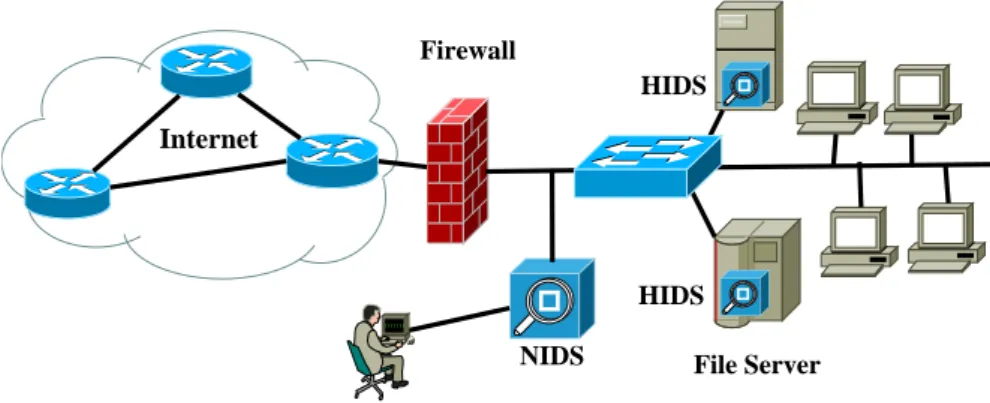
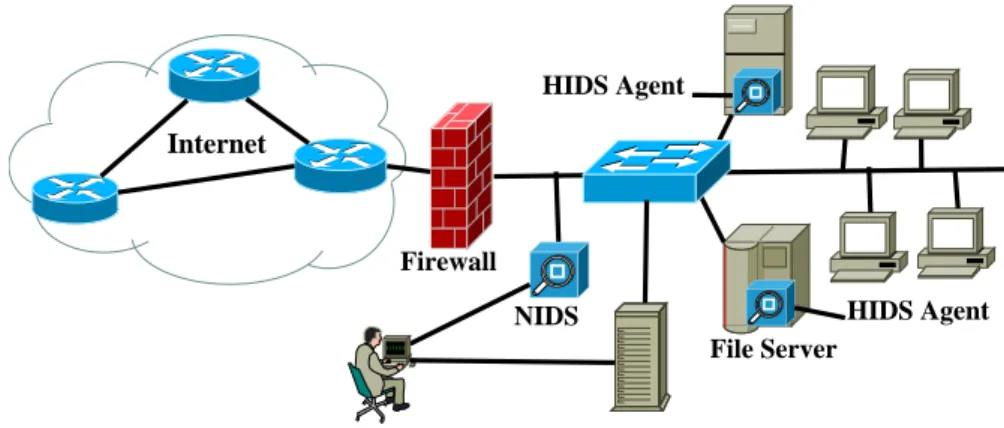
2.19 NIDS sitting between LAN and the Internet and HIDS agents on Internet facing servers . . . 32
2.20 Packet Inspection in SB-NIDS . . . 37
3.1 Network Intrusion Detection Systems and Filtering Systems . . . 42
3.2 Pattern Matching . . . 43
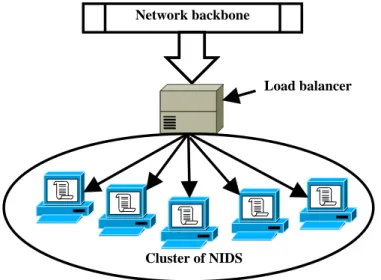
3.3 Typical arrangement of hardware for Cluster-based SB-NIDS . . . 45
3.4 Loadbalancing using hash calculator . . . 47
3.5 Suffix tree and Bad-character shift table for SBMH . . . 55
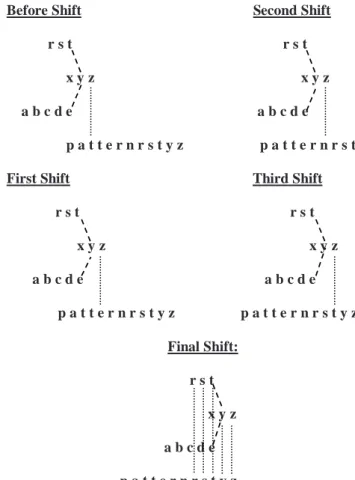
3.6 Example showing pattern search in a text “patternrstyz”. Pattern “rstyz” is found in a text in final shift . . . 55
3.7 Prefix tree and text alignment to begin pattern search in AC-BM algorithm 56 3.8 Search shows good-prefix shift . . . 57
3.9 Block diagram showing typical position of Filtering System for SB-NIDS . 58 3.10 Pre-processing in ExB of a text “1000poundsinnetworkpacket” . . . 60
3.11 ExB algorithm searching patterns in a text “1000poundsinnetworkpacket” 60 3.12 Example of pre-processing of patterns “filteringprocess” and “filterin-goodmilk” in PIRAMHA . . . 62
3.13 Example of searching text “verygoodfilteringprocess” for patterns “filter-ingprocess” and “filteringoodmilk” in PIRAMHA . . . 62
3.14 Block diagram of Snort offloader showing two main hardware modules . . 64
3.15 Packet processing flow in filtering hardware . . . 66
4.1 NIDS Modules . . . 76
4.2 NIDS Deployment . . . 77
4.3 Snort architecture showing packet processing flow . . . 80
4.4 Packet Sniffer function . . . 81
4.5 Packet processing flow through Preprocessors . . . 82
4.6 Packet checking in Detection Engine . . . 83
4.7 Snort rule of CGI-PHF attack . . . 83
4.8 Snort rule header . . . 84
4.9 HandelC and MicroBlaze design system . . . 88
4.10 OPB slave memory space in system.mhs file . . . 89
4.11 OPB slave memory space in system.mhs file . . . 90
5.1 Snort on RC300 board . . . 96
5.2 Packet Capture Hardware Accelerator (PCHA) architecture . . . 97
5.3 Decision Engine Hardware Accelerator (DEHA) architecture . . . 98
5.4 Key Stages of Snort . . . 100
5.5 Parsed structure of Snort rules in memory (SRT) . . . 101
5.6 A state machine concept constructed using patterns “he, she, him, her, his”102 5.7 Example Snort rule . . . 103
5.8 Python code: 3 character string to integer conversion . . . 103
5.9 Empty Bloom Filter . . . 104
5.10 Insert bit-strings (x1) and (x2) . . . 104
5.11 Query bit-strings (x3) and (x4) . . . 104
5.12 Top level diagram showing modified Detection Engine . . . 107
5.13 Block diagram of pattern matching hardware function unit . . . 107
5.14 Packet processing flow for Snort rule evaluation . . . 109
5.15 Rule selection . . . 110
5.16 Hardware modules performing packet payload searching . . . 111
5.17 Rule units computing hash values . . . 112
5.18 2-to-N hash module computing ten hash values using two hash values . . 113
5.19 Bloom filter index checking with corresponding hash values . . . 113
5.20 False positive analyser with hash table lookup unit and comparator circuit 114 5.21 Pattern Matching Hardware Accelerator (PMHA) architecture . . . 115
5.22 Hash calculator circuit design . . . 116
5.23 Rule selection and evaluation result . . . 120
5.24 Example Snort rules . . . 120
5.25 Patterns from Snort rules with their length . . . 122
5.26 A line graph showing the increase of patterns after breakup . . . 123
5.27 Old and new Pattern Matching algorithms on FPGA . . . 124
5.28 Rule selection and evaluation result with modified algorithm . . . 125
5.29 Modified false positive analyser with Hash table lookup unit and Com-parator circuit . . . 126
5.30 Pattern matching algorithm flowchart for longer (>64 bytes) pattern . . 127
6.2 Snort CPU cycles comparison . . . 132
6.3 CPU cycles count of Snort on PC . . . 133
6.4 CPU cycles count of Snort on MicroBlaze . . . 134
6.5 Synthesis result on Xilinx XC2V6000 -4 Virtex-II FPGA . . . 134
6.6 Aho-Corasick state machine and pattern matching hardware accelerator memory requirements . . . 136
6.7 Aho-Corasick (ac-standard) state machine memory size (MB) for different character count . . . 136
6.8 PMHA throughput at 50 MHz for the test results in Table 6.1 . . . 137
6.9 Pattern Matching Hardware Accelerator (PMHA) throughput with total 7876 patterns . . . 138
6.10 PMHA throughput comparison before and after optimisation . . . 139
6.11 PMHA throughput comparison before and after optimisation . . . 140
6.12 False Positive vs Bloom filter size . . . 141
6.13 Synthesis result of six hash module on Xilinx XC2V6000 -4 Virtex-II FPGA142 6.14 Synthesis result of two hash module and 2-to-N hash module on Xilinx XC2V6000 -4 Virtex-II FPGA . . . 143
6.15 Synthesis result of full SB-NIDS prototype (MMU-Snort III) on Xilinx XC2V6000 -4 Virtex-II FPGA . . . 143
List of Tables
2.1 Summary of DoS attacks using TCP . . . 11
2.2 Summary of DoS attacks using ICMP . . . 13
2.3 Summary of DoS attacks using IP . . . 16
2.4 Common DDoS attack tools . . . 17
2.5 Forgery using Network protocols . . . 18
2.6 Viruses types and behaviour . . . 24
2.7 Comparison of IDS types . . . 29
2.8 Summary of IDS detection techniques . . . 32
2.9 Summary: Product details of leading HIDS and NIDS . . . 34
2.10 Summary: Best NIDS/NIPS product of leading private companies . . . . 34
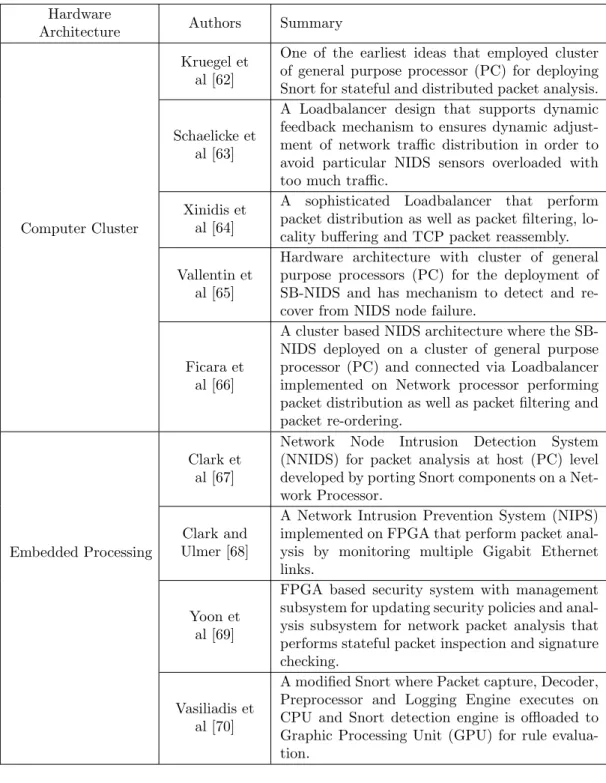
3.1 Summary of Computer cluster and Embedded processing based SB-NIDS 44 3.2 NIDS cluster hardware specification . . . 46
3.3 Advantages and disadvantages of cluster based NIDS . . . 46
3.4 NIDS specific hybrid multi-pattern matching algorithms . . . 54
3.5 Pattern Filtering Systems . . . 58
3.6 Details of Hardware technologies . . . 59
3.7 Advantages and disadvantages of software based pattern matching filter-ing system . . . 59
3.8 Hardware based pattern filtering . . . 67
3.9 Some pattern matching implementation on FPGA and Network Processor 69 3.10 Hardware Details of development platform . . . 70
3.11 Snort Rule Evaluation Systems summary . . . 72
4.1 Modifier Keywords . . . 85
5.1 Profile of Snort on PC . . . 93
5.2 Total number of patterns . . . 122
6.1 Clock cycle count of Pattern Matching Hardware Accelerator (PMHA) . . 137
6.2 Comparison of clock cycle count of PMHA before and after optimisation . 139 6.3 False positive rate of PMHA (MMU-SnortII) with 7876 patterns . . . 141
6.4 False positive rate of PMHA (MMU-Snort III) with 9150 patterns . . . . 142
6.5 Pattern Matching Hardware Accelerator (PMHA) Memory Size (Kbits) . 143 6.6 Pattern matching hardware architecture on FPGA . . . 144
AC Aho-Corasick
ARP AddressResolutionProtocol
ASIC ApplicationSpecificIntegrated Circuit
ASIP Application-SpecificInstruction-set Processor
BGP Border GatewayProtocol
BM Boyer-Moore
BRAM BlockRandom AccessMemory
CAM Content Addressable Memory
CERT Computer Emergency ResponseTeam
CIAC Computer Incident AdvisoryCapability
CPU Central Processing Unit
DEHA Decision Engine HardwareAccelerator
DoS Denialof Service
DDoS Distributed Denialof Service
DPI DeepPacketInspection
ESMTP Enhanced Simple Mail Transfer Protocol
FPGA Field ProgrammableGate Array
FSL Fast Simplex Link
Gbps Giga-bit persecond
GPU GraphicProcessing Unit
GUI Graphical UserInterface
HDL Hardware Description Language
HIDS Host IntrusionDetectionSystem
HTTP HypertextTransfer Protocol
IC IntegratedCircuit
ICMP InernetControl MessageProtocol
IDS IntrusionDetection System
IP Internet Protocol
IPS IntrusionPreventionSystem
IPsec Internet ProtocolSecurity
IPv4 Internet Protocolversion4 IPv6 Internet Protocolversion6 IRC Internet Relay Chat
ISP Internet Service Provider
LMB LocalMemory Bus
MAC MediaAcess Control
MIT MassachusettsInstituteof Technology
MTU MaximumTransmission Unit
NIDS Network IntrusionDetection System x
NIDS Network IntrusionPreventionSystem
NPU Netwok Processing Unit
OPB On-chipPeripheralBus
OS OperatingSystem
OSPF OpenShortestPathFirst
OTN Option TreeNode
P2P Peer-to-Peer
PCHA PacketCapture HardwareAccelerator
PMHA PatternMatchingHardware Accelerator
POD Pingof Death
PCRE PerlCompatibleRegularExpressions
QoS Qualityof Service
RAM RandomAccessMemory
RISC ReducedInstruction SetComputer
RPC RemoteProcedure Call
RTN RuleTree Node
SB-NIDS Signature Based-NetworkIntrusionDetection System
SB-NIPS Signature Based-NetworkIntrusionPreventionSystem
SDRAM Synchronous Dynamic Random AccessMemory
SIP Session InitiationProtocol
SMTP Simple MailTransfer Protocol
SoC System on Chip
SoPC System on ProgrammableChip
SPI StatefulPacket Inspection
SRAM StaticRandom AccessMemory
SRT Snort RuleTree
SSL Secure Socket Layer
TCP TransmissionControl Protocol
TFN TribeFloodNetwork
ToS Type of Service
TTL Time to live
UDP User Datagram Protocol
US-CERT United States-Computer EmergencyReadinessTeam
Introduction
This thesis is about optimisation of Signature-based Network Intrusion Detection Sys-tem (SB-NIDS) packet analysis speed. A complete SB-NIDS prototype is presented, developed using hybrid hardware-software embedded processing platform.
1.1
Background and Problem Overview
One of the effective ways to secure computer networks from the attacks is the network defence software technology such as Network Intrusion Detection System (NIDS). NIDS has been widely adopted in the business and government sector to secure computer networks by detecting different kinds of network attack as well as detection of illegal access to confidential data and resources. Although NIDS is a good network defence software, on high data rate networks such as gigabit rate its performance is poor. It is unable to analyse all traffic as network packets arrive faster than NIDS packet analysis speed. Consequently, NIDS packet buffer fills very quickly and force it to drop some packets without analysis in order to make more space in buffer for new packets. For example, SB-NIDS software package Snort when executed on Intel Xeon Dual-Core 2.0 GHz general purpose processor and test with network test data which requires 175 concurrent Transmission Control Protocol (TCP) connections is only able to analyse network traffic up to 566 Mbps throughput [2, 3]. The main reasons for slow packet analysis rate are the complexity of network packet analysis operations and frequent memory accesses. These operations typically involve bit masking, bit comparison, bit shifting that general purpose processor instruction sets do not support efficiently. Also frequent memory accesses on these loosely coupled processor architectures consume a relatively high number of CPU clock cycles (100s) if a cache miss occurs (Section 6.3).
Various attempts have been made to optimise SB-NIDS packet analysis speed (Chap-ter 3). Most of the current state of the art solutions optimise only specific computation-ally intensive parts or components of SB-NIDS software (Section 3.5). Some solutions use clusters of processors and high performance embedded processing platforms in or-der to optimise a complete SB-NIDS application (Section 3.4.1). Commercial NIDS solutions based on embedded processing platforms use high specification embedded pro-cessing hardware. They claim to provide a complete SB-NIDS solutions with a support of up to 10 Gbps network throughput (Section 2.4.5). Still a great deal of work needed to be done to support NIDS packet analysis throughput preferably over 10 gigabit rate as network data rates continuously increasing such as recently approved IEEE 802.3ba standard which supports 40 Gbps and 100 Gbps transmission rate [4].
1.2
Solution Synopsis
A prototype SB-NIDS using hybrid hardware-software embedded processing platform was developed to enable high speed packet analysis. To support this effort, an open source and widely used SB-NIDS software package Snort was used. An execution analysis of Snort was carried out using software profiling tools in order to identify bottlenecks in packet analysis. Based on the profiling results, the most suitable embedded processing platform was selected. This embedded platform is a hybrid hardware-software processing solution having tightly coupled hardware architecture to enable low clock cycle accesses to hardware peripherals such as Network Interface Cards (NICs) and memory. It also allows hardware accelerator development in Field Programmable Gate Array (FPGA) and multi-processing using MicroBlaze soft processing cores. One of the main goals of hardware accelerator development is to offload any computationally significant operation of a software from a CPU to FPGA. FPGA provides parallelism, pipelining and bit-level processing facility, and has great potential to reduce and/or remove performance bottlenecks in SB-NIDS software. Multi-processing facility can be applied to SB-NIDS packet analysis process in order to improve the overall SB-NIDS processing efficiency although this is not investigated in this thesis.
Prototyping and optimisation was carried out in stages. Initially, Snort was ported to the embedded processing platform. This involved Snort software architecture restructur-ing in order to successfully map and execute to new processrestructur-ing platform which is based on Xilinx MicroBlaze soft-core processor and FPGA. This prototype is called as Manch-ester Metropolitan University-Snort I (MMU-Snort I). MMU-Snort I performance on new processing platform then evaluated to identify any improvement or bottlenecks in packet analysis processes. Test results showed that prototype SB-NIDS or MMU-Snort I
execution speed has improved when compared with the CPU clock cycles of the original Snort software package when executed on a PC with a general purpose processor. In the next stage pattern matching algorithm performance was optimised. This involved development of Pattern Matching Hardware Accelerator (PMHA) and its integration into Snort prototype or MMU-Snort I. This resulted in the second prototype called
MMU-Snort II. PMHA provides high throughput and low memory pattern matching solution using a Bloom filter data structure based approach which allows quick lookup of keywords or patterns [5]. The size of the attack signatures is significantly reduced to the extent that the whole attack pattern represented as Bloom filter is stored to FPGA on-chip memory/Block Random Access Memory (BRAM) for quick checking of signature presence in packet payload data. Aditionally, full database of patterns is stored in off-chip Synchronous Dynamic Random Access Memory (SDRAM) for further signature checking in case a signature stored in FPGA BRAM is found in a packet during first stage of pattern lookup. This is because Bloom filter search approach can provide false positive matches for pattern lookup. The integration of PMHA into MMU-Snort I required further design changes, resulting in an optimised and integrated PMHA for Snort on the same processing platform. In the last stage, PMHA was further optimised to search efficiently longer patterns (> 64 Bytes) and for fast pruning of Bloom filter false positive matches which resulted in MMU-Snort III prototype.
In summary, investigation and development of complete SB-NIDS prototype using hy-brid hardware-software processing platform is presented here, with a focus on the added benefits of throughput and reduced memory requirements. A full description of the architectures and algorithms is presented in this thesis. In addition, a detailed per-formance analysis and experimental results are used to demonstrate the suitability of hybrid hardware-software platform for SB-NIDS execution, higher throughput support and smaller memory requirements.
1.3
Aims and Objectives
The aim of this research project is to develop a series of algorithms and hardware architectures for SB-NIDS in order to optimise its packet analysis speed.
1.3.1 Objectives
• Design and implement SB-NIDS prototype that perform network packet analysis at higher speed than Snort on general purpose processor.
• Evaluate SB-NIDS prototype using publicly available data for SB-NIDS testing and identify packet analysis speed improvement and/or any performance issues.
• Gain efficiency and/or improve SB-NIDS packet analysis speed by offloading pat-tern matching from CPU to FPGA that search one of the largest attack patpat-terns preferably at gigabit data rate.
• Use Snort application specific knowledge (Section 5.2.2) to improve pattern match-ing (PMHA) performance further by reducmatch-ing number of pattern search per packet.
• Evaluate PMHA implementation using publicly available test data for SB-NIDS in order to to verify its performance improvement.
1.4
Contributions and Claims
The primary objective of this effort is the development of SB-NIDS prototype solution using one of the viable embedded hybrid hardware-software processing platforms. The main challenge faced in the development on this platform is the design and implemen-tation of a full SB-NIDS while improving the performance needed by the state of the art networks of today. This embedded processing platform is flexible as it not only al-lows the execution of complete software applications such as SB-NIDS on an embedded processor but also supports software optimisation, and enables the offloading of pro-cessing from a CPU to FPGA hardware and multi-propro-cessing with multiple propro-cessing cores. It also enables overall improvements in packet analysis speed of SB-NIDS due to tightly coupled hardware architecture in which hardware peripherals like Ethernet network interface have significantly lower latency access to network data and the CPU performs relatively fast off-chip memory accesses requiring tens of clock cycles in com-parison to hundreds of clock cycles on general purpose processor architectures. The platform memory hierarchy arrangement in low-to-high clock cycles memory access sort order are, FPGA BRAM, off-chip Static Random Access Memory (SRAM) and off-chip Synchronous Dynamic Random Access Memory (SDRAM). This allows further improve-ments in the SB-NIDS performance by storing frequently access data such as network attack patterns or signatures to low latency access memory. Overall the processing plat-form features is found to be viable to implement the SB-NIDS. Also, flexible hybrid hardware-software processing and scalability in terms of multiple processing cores are ideal for further optimisation of other SB-NIDS components that are bottlenecks on high speed packet analysis. The idea presented in this thesis is a prototype SB-NIDS solution
that is intended to demonstrate the suitability of hybrid hardware-software processing for SB-NIDS execution, optimisation and further research and development.
Initially a study of Snort SB-NIDS software architecture was carried out in detail to un-derstand the packet analysis mechanism and processing requirements, this study was then used to restructure Snort architecture for porting and optimisation on hybrid hardware-software processing platform, and in this way a novel SB-NIDS prototype architecture called Snort I on this platform was devised. In the next stage MMU-Snort II was developed which involved the development of special PMHA and algorithm suitable for low memory hardware that can also be easily integrated with MMU-Snort I. This effort tempts the development of a algorithm that reduces the amount of large memory required to store the attack signatures and reduces the pattern matching com-putational time to enable high speed pattern search in payload. The primary benefit attained through this which also advances the state of the art, is the compression of the whole attack signatures that fit on-chip FPGA memory for performing quick filtering or lookup, less computations required for pattern search than other closely related state of the art solutions that were implemented using bloom filter based pattern matching technique, and a complete SB-NIDS prototype based on one of the effective and widely used open source SB-NIDS, which when further optimise in future using multiple pro-cessing core and also migrate to a recent and more advanced hybrid hardware-software processing platform will enable the high data rate network protection.
The strengths and weaknesses of the architecture and algorithms were analysed, and experimental results were obtained to determine the effectiveness of the implementation. The resulting contributions of this work are:
• A novel SB-NIDS prototype based on one of the effective and widely used open source SB-NIDS software packageSnort prototyped on a hybrid hardware-software processing platform for further research, development and optimisation.
• A PMHA that compactly store 7876 unique attack patterns in 8 KB of FPGA BRAM using Bloom filter search approach that supports quick lookup of packet data for checking pattern presence.
• An application specific PMHA design which also integrated into prototype SB-NIDS that supports parallel pattern search in a packet payload up to 1.85 Gbps throughput.
• An inclusion of Snort application specific knowledge or logic to PMHA that reduces the number of packet data lookup in Bloom filter stored in FPGA BRAM for 45 % of SB-NIDS attack signatures1.
1
• An adoption of technique to Bloom filter search approach that reduces the number of hash value computation required by the Bloom filter based search algorithm [6]. The PMHA computes only two hash value in this implementation which produces the same Bloom filter false positive rate as with ten hash values.
1.5
Thesis Outline
This thesis describes a solution to the problem presented in section 1.1. Chapter 2 is the detail discussion on network security issues and technologies. Chapter 3 is the summary and discussion of the state of the art SB-NIDS and pattern matching solutions. Chapter 4 is the proposed system architectures detail. Chapter 5 is the design and implementation details of SB-NIDS (MMU-Snort I) and PMHA (MMU-Snort II and MMU-Snort III). Chapter 6 presents the analyses and results which include comparison of all three prototypes performance in order to estimate performance improvements. This also include comparison of the results with the closely related state of the art PMHA. Finally, Chapter 7 summarises the findings and provides some insight into future directions.
Background
“Whoever thinks his problem can be solved using cryptography, doesn’t understand his problem and doesn’t understand cryptography (Arritributed by Roger Needham and Butler Lampson to each other)”
The statement above is also relevant for current state of the art computer security de-fence mechanisms such as Firewalls and Intrusion Detection System (IDS). Currently, no effective solution exists for all network security problems and in some situations defence mechanisms are themselves vulnerable to network attacks and/or their failure may lead to complete failure of a network. To understand the scale of network security problems, issues concerning network security threats and defence mechanisms are discussed in de-tail in this chapter. The current state of the art in network security technologies are presented in (Chapter 3).
2.1
Chapter Roadmap
The rest of the chapter is outlined as follows:
• In section 2.2, range of network security issues are discussed concerning two core problems: flaws in network protocol design with reference to the Internet Protocol suite (also known as Transmission Control Protocol/Internet Protocol (TCP/IP)) and vulnerabilities in software applications and Operating Systems (OS). Other network security threats (Malwares such as Viruses, Worms and Spywares) are discussed briefly to clarify and quantify the scale of network security problems.
• In section 2.3, core network defence mechanisms are discussed to illustrate counter measures deployed against common network security attacks.
• In section 2.4, the main issues concerning Intrusion Detection System (IDS) tech-nology, limitations and performance are explained in detail. The discussion main focus is Signature-Based Network Intrusion Detection System (SB-NIDS) technol-ogy.
2.2
Network Security Issues
The increasing frequency of cyber crimes and computer hacking attacks such as Denial of Services (DoS) and phishing attacks are indicated by [7–10]. Further, a recent malware (Section 2.2.3) attack on the University of Exeter (UK) computer network resulted in the shut down of their entire campus network service [11]. Such problems have occurred in domains including banking, financial services and retail. Network security problems are compounded by a heavy reliance on Web for accessing everyday services such as bill payments and online shopping transactions. Consequently, web based services are an attractive targets for hackers whose goal is to steal personal financial details. The hackers themselves are competent, but a big part of problem is actually the “Internet” itself as explained by Professor Ross Anderson,
“The Internet protocol suite was designed for a world in which trusted hosts at universities and research labs co-operated to manage networking
in a co-operative way [12].”
Consequently, the Internet was not designed to support secure online services. Flaws such as easy to manipulate key packet values (Internet Protocol address, Port number etc) in the “Internet protocol suite (TCP/IP)” hinder the provision of effective mecha-nisms to deal with network security issues. Further, software application vulnerabilities enables hackers to install malware on computers in order to create large distributed collections of hacked machines (botnets) that are deployed to launch Distributed Denial of Service (DDoS) attacks on computer systems or services (Figure 2.1).
Network attacks core reasons Flawed network protocol design Vulnerabilities in software systems
2.2.1 Flawed Internet Protocol Design
Network protocols such as IP, TCP, Simple Mail Transfer Protocol (SMTP), and Hyper-text Transfer Protocol (HTTP) are the core protocols for packet based communication over the Internet. These protocols and others such as Peer-to-Peer (P2P) Protocol, Voice Over Internet Protocol (VoIP), Session Initiation Protocol (SIP) have lead to the development of online network services such as file sharing, electronic media streaming and financial payment systems. The secure provision of such services is challenging be-cause they are built on top of IP protocol which is itself flawed. These protocols do not directly provide authenticity or confidentiality protection. Thus, knowledgeable users can exploit basic sniffer programs to inspect network packets and even to manipulate critical protocol features inside packets such as IP addresses, ports and payload data values. Protocol based network attacks exploit authenticity and confidentiality issues and may involve manipulation of packets in order to launch:–
• Denial of Services (DoS) and Distributed Denial of Service (DDoS) attacks
• Forgery attacks
• Session Hijacking attacks
In the following sections, protocol based attacks are discussed in order to demonstrate the exact nature of problems and flaws with Internet protocols.
Denial Of Service (DoS) Attacks
Definition: DoS is an attack on critical network resources such as routers, OS, appli-cation servers, network links aimed at disrupting their normal function.
DoS attacks can bring down critical network resources and normally results in commu-nication disruption and service access denial to legitimate hosts.
Classification: Typically DoS attacks strive to deplete available processing and net-work bandwidth resources which Hussain et al suggested to classified into: software exploits and flooding attacks [13] (Figure 2.2).
Software exploitsare a direct attack on critical network computing equipments (Routers, Switches, Server machines etc.) whereas Resource depletion attacks aim to deplete computational processing resources. A TCP SYN DoS attack sends a succession of SYN requests to a server (Section 2.2.1) 1. The goal of this attack is to cause memory
1
TCP SYN packet used in three way TCP handshake process between two machines for establishing TCP connection.
Denial of Service
Packet Flooding Software Exploits
Figure 2.2: Denial of Service classification
and processing resource depletion in order to prevent new legitimate requests for TCP connections to open and/or for those currently open to fail to make progress on the machine under attack. Aflooding or bandwidth depletion attack is an attempt to deplete network link bandwidth by sending a high volume of network packets. In this type of attack, an attacker floods the target network with network packets that completely occupies the network bandwidth and does not let the legitimate user to get connected to the network (Figure 2.3).
Denial of Service
Bandwidth Depletion Resource Depletion
Figure 2.3: Denial of Service second classification
Network Protocols in DoS Attacks
DoS attacks are typically carried out using lower level network protocols: TCP, Internet Control Message Protocol (ICMP), User Datagram Protocol (UDP), and IP. Some of these protocols used for DoS attack identified by Computer Emergency Response Team (CERT) are [14]:
• TCP attack
• ICMP Ping of Death attack
• UDP flood attack
DoS attacks are not limited to this list of protocols but can also be carried out using IP packet by exploiting fragmentation and reassembly feature of IP packet.
DoS Attacks Using TCP
TCP is a connection oriented session level protocol for reliable duplex communication over the Internet. Many web services on the Internet utilise TCP. Such web services are hosted on server machines with potentially hundreds and thousands of client machines simultaneously connected via TCP protocol. Server machines must have high computa-tional performance and large size main memory in order to serve each and every client request efficiently and to maintain TCP connection state. Servers are very vulnerable to attack as it is easy for hackers to launch DoS attacks exploiting TCP packet header flags bits (SYN, RST).
The two widely known DoS attacks carried out by the manipulation of TCP flags are:
TCP SYN attack andTCP Reset attack [15, 16] (Figure 2.4).
DoS attack using TCP
TCP RST
attack
TCP SYN
attack
Figure 2.4: Denial of Service attacks using TCP
Table 2.1: Summary of DoS attacks using TCP
Attack How Effect Remedy
TCP SYN
Attacker sends repeated TCP SYN packet with forged source IP address to target machine.
Server main memory becomes full due to pending connec-tion request.
Software Patch
TCP RST
TCP RST packet with forged IP address is send by attacker to the target machine.
Drop connection that dis-rupts the communication.
No Solu-tion
TCP SYN Attack: TCP protocol specification specifies one of the main purposes
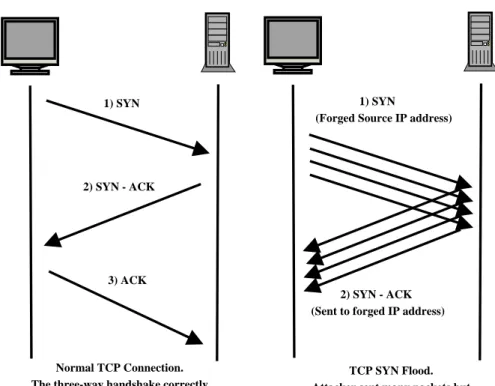
of TCP SYN flag is for establishing connection between two machines. This is carried out using a three way handshake process involving (SYN, SYN-ACK, ACK) packet exchanges. Hackers exploit this connection establishment process in order to carry out DoS attack. The attack involves sending a series of TCP packets to the target machine for connection request with a TCP SYN flag set and forged source IP address. The target machine on receipt of every TCP SYN packet must allocate space in the SYN queue in system memory and acknowledge the request by sending back a TCP packet with ACK flag set to the source machine IP address. The source machine will never acknowledge this message because source IP address is forged by the attacker. The result is that the
target system SYN queue can become full and force the target machine to reject further connection requests. Figure 2.5 shows a normal TCP connection establishment process and TCP SYN attack.
1) SYN
2) SYN - ACK
3) ACK
Normal TCP Connection. The three-way handshake correctly
performed
Client Server
1) SYN
(Forged Source IP address)
2) SYN - ACK (Sent to forged IP address)
TCP SYN Flood. Attacker sent many packets but
no ACK pakets
Attacker Server
Figure 2.5: Normal TCP connection and TCP SYN flooding attack
TCP SYN is one of the classic examples of using the TCP protocol to attack network resources. However, this attack can be fixed by patching the OS (SYN cookie fix) or a defence mechanism can be used to monitor an unexpected number of flooded request (Section 2.3).
TCP RST Attack: The purpose of the TCP RST flag is to immediately terminate an
established TCP connection between two machines. If a packet with TCP RST flag set to ‘1’ received by the destination system then it immediately terminates TCP connection without any further exchange of TCP packets. The RST flag option is also exploited by attackers to launch DoS attack as examined for the first time in 2003 by Watson [16]. According to Watson’s description, an attacker closely monitors TCP communications across networks and gathers vital information concerning host IP addresses and ports of current participants in TCP connections. On obtaining this information an attacker launches an attack by creating a TCP packet with a participants host IP address and ports along with TCP RST flag set and sends this packet to any of the two participants’ hosts resulting in an instant connection termination and DoS effect.
DoS Attack Using ICMP
ICMP is a connectionless protocol and an integral part of IP suite. The ping command uses ICMP for troubleshooting network communication issues and gathering network details about hosts and open ports. The information gathered can be used to launch
ICMP DoS attack. Two famous DoS attack carried out using ICMP protocols are the
Smurf attack and Ping of Death attacks [17, 18] (Figure 2.6).
DoS attack using ICMP
Ping of Death
attack
Smurf
attack
Figure 2.6: Denial of Service attacks using ICMP
Table 2.2: Summary of DoS attacks using ICMP
Attack How Effect Remedy
Smurt attack
Attacker sends ICMP ping packet with target machine IP address set as source IP to the broadcast address.
Network bandwidth depletes due to packet flooding as well as processor resources ex-hausts. Protocol fix pro-posed in August 1999 Ping of Death
Attacker sends oversize ICMP ping packets to the target ma-chine.
Processors resource depletes due to operating system prob-lem dealing with oversize packets.
Operating System patch
Smurf Attack: uses an ICMP echo request/reply (ping) packet. The attacker must
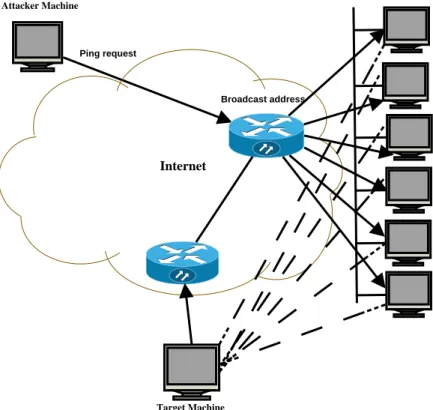
acquire network information concerning particular IP addresses of hosts. The attacker then spoofs2 ICMP echo request packets to be from one or more valid hosts (victims) and sends a high volume of packets to the network broadcast address. Now every host on a network receives an ICMP packet and they reply back to the spoofed IP address of the victims (valid hosts). Now each victim who originally did not send any ICMP packet will receive ICMP echo reply from all hosts on a network and this depletes network bandwidth and may overwhelm the victim machine causing DoS effect. Smurf attack is shown in figure 2.7.
Figure 2.7 shows only one ping request in smurf attack. A technical countermeasure was proposed in August 1999 to the protocol standard that ICMP echo requests sent to the broadcast address are no longer replied to by default [19]. Router configuration can also be used to prevent the propagation of broadcast packets to other subnetworks.
2
Internet
Attacker Machine
Target Machine
Ping request
Broadcast address
Figure 2.7: Smurf attack
Ping Of Death Attack: Another kind of DoS attack using ICMP is also carried out
using ICMP echo request/reply packet or ping packet calledPing of Death (POD) DoS attack. An attacker sends a high volume of malformed or oversize ICMP ping packets3 up to the allowed maximum IP size of 65535 bytes. These packets are then fragmented by the transmission network. The victim machine receiving such fragmented packets tries to reassemble them and a buffer overflow can occur causing a system crash or reboot. This attack is no longer effective as most operating systems are patched to deal with malformed ping packets by allocating a significant amount of memory and via the incorporation of buffer overflow checking code.
DoS Attack Using UDP
UDP is a connectionless transport layer protocol. Thus, it is possible to send any type of UDP packet to any machine on any ports without informing the recipient or handshaking. UDP port DoS attack is a DoS attack based on UDP [20].
UDP Port DoS Attack: here, an attacker sends a series of UDP packets to an IP
address of a victim machine on a specific port or a set of random ports. For every UDP packet received by a victim, its OS tries to determine which application provides services on this port. If the victim machine is not running any application for the
3
requested service on a port then it replies with an ICMP destination port unreachable packet indicating there is no service available. If the attackers send UDP packets in large volume then the overhead of triggering repeated ICMP destination port unreachable reply packets can overwhelm the victim machine processing and it may even deplete network bandwidth.
This attack can easily be stopped by analysing the network traffic using network defence technology such as NIDS with correct packet filtering policies (Section 2.3).
DoS Attack Using IP
IP is widely used protocol and is compatible to work with different types of commu-nication standards such as Ethernet, Fiber Distributed Data Interface (FDDI) etc. IP allows applications to send up to 65535 bytes in a single packet (including 20 bytes packet header). When a packet of such size is sent over a network it is often fragmented into multiple packets because of Maximum Transmission Unit (MTU)4 packet/frame transmission limits. All fragmented packets must be reassembled at the destination sys-tem before passing upward to the application layer. The memory and computational requirements of reassembly can be used to cause DoS effect such asPing of Death DoS attack. Others DoS attacks caused by manipulation of IP protocol areLand attack and
Teardrop attack [21] (Figure 2.8).
DoS attack using IP
Teardrop
attack
Land
attack
Figure 2.8: Denial of Service attacks using IP
Land Attack: here, attackers manipulate the IP packet source field by copying the
destination IP address into the source IP address field in order to trick the destination machine into sending packets to itself to crash the machine and cause DoS effect.
Teardrop Attack: exploits a bug found in OS fragmentation and re-assembly code that
improperly handles overlapping (and hence malformed) IP fragments. An overlapping IP fragment occurs if two or more IP fragments have offsets indicating that they overlap each other in position within the unfragmented IP datagram. An attacker sends a series
4
Table 2.3: Summary of DoS attacks using IP
Attack How Effect Remedy
Land attack
Attacker flood the target ma-chine with IP packets with destination IP address of ma-chine copied into source IP ad-dress field.
Target machine sends the packet to itself that exhausts the processor resources.
Operating System patch
Teardrop attack
Attacker sends series of over-lapping IP fragments to victim machine that exploits bugs in OS fragmentation and re-assembly code.
Processors resource depletes due to operating system prob-lem with overlapping IP frag-ments.
Operating System patch
of overlapping IP fragments to a target machine and this cause system crash and DoS effect.
These two attacks can easily be stopped with proper configuration (OS patch) and/or by the deployment of defence mechanism such as firewalls or NIDS (Section 2.3).
Distributed Denial Of Service (DDoS) Attack
Definition: DDoS uses multiple compromised host systems to mount a coordinated attack on critical network resources in order to cause DoS effects.
Explanation: In DDoS attack there is typically a master host or node controlling a number of slave machines to initiate or stop an attack. The master node is in direct con-trol of an attacker that has taken concon-trol of slave machines usingDDoS agent software. DDoS agent software is installed into victim machines either by exploiting a vulnerabil-ity (Section 2.2.2) in software systems or by tricking the user into installing the agent software. There may be more than one master node controlled by the attackers that are used to manage the distributed network of slaves. An attacker usually instructs master nodes to launch an attack using active slaves and direct them to simultaneously launch an attack. This DoS attack when launched with a number of nodes is called DDoS attack. Network topology of DDoS is shown in figure 2.9.
According to Computer Incident Advisory Capability (CIAC) (Renamed to Department of Energy-Cyber Incident Response Capability (DOE-CIRC) [22]), the first such kind of DDoS was seen in the summer of 1999 with the introduction of DDoS attack tools [23]. DDoS exploits the weaknesses of common Internet protocol and launches DoS attacks (TCP SYN flood attack, UDP flood attack, ICMP flood attack etc.) in a distributed manner in order to quickly deplete processing and bandwidth resources of target ma-chines and network. First successful DDoS attacks noted in the year of 2000 when Yahoo
Internet Attacker
Master Node (Router)
Master Node (Router)
Target Server Slave Nodes
Slave Nodes
Figure 2.9: Network topology of DDoS
website was attacked which resulted in DoS [24]. Table 2.4 has the summary of some common DDoS attack tools.
Table 2.4: Common DDoS attack tools
Tools Protocols Description
Trinoo (aka
Trin00) UDP
This tool sends out a large number of UDP packets to the victim.
The Tribe Flood
Network (TFN) ICMP, TCP and UDP
This tool is able to attack victims with ICMP flood, SYN flood, UDP flood and Smurf attacks.
Stacheldraht ICMP, TCP and UDP This tool combines the features of Trinoo and TFN with encryption support. Trinity TCP and UDP This tool uses Internet Relay Chat (IRC)
for launching UDP or TCP flood attack. Tribe Flood
Network 2K (TFN2K)
ICMP, TCP and UDP
Successor to TFN. This tool uses TCP, UDP, ICMP or a Smurf packet flood to tar-get the victim.
Shaft ICMP, TCP and UDP
This tool uses TCP, UDP and ICMP pack-ets or all three at the same time for flooding victim.
Omega ICMP, TCP, UDP and IGMP
Similar to Shaft. This tool use TCP, UDP, ICMP, IGMP or mixture of protocols to flood the victim.
Forgery Attacks Using Protocols
The basic problem is that the core Internet network protocols provide no significant authenticity or confidentiality protection. Network packets can easily be intercepted and manipulated to forge or alter IP addresses in order to create spoofed packet containing false values. Forgery is usually carried out to misrepresent another computer system, or for attackers/hackers to conceal their identity by forgery which is clearly illegal.
However, packet manipulation and forgery are correct or, atleast are accepted according to IP protocol specifications in order to support functionality such as legitimate remote access to electronic services whose access is restricted via source IP address. Most DoS attacks discussed in previous section and all in this section are carried out with spoofed addresses.
Table 2.5: Forgery using Network protocols
Protocol Description SMTP (Email
address)
An email address to represent email sender/receiver identify can be forged to carry out spamming or phishing attack.
IP (IP address) Most of the attacks on networks and IT infrastructure use IP address forgery to misrepresent or hide real identity of attackers. MAC (MAC
address)
MAC address manipulation on LAN used to hide or misrepresent attacker identity to carry out attack such as session hijacking.
Forgery Attack Using SMTP
Simple Mail Transport Protocol (SMTP) is the standard protocol for sending electronic mail (E-mail) across IP networks. SMTP is a simple text based protocol where client and server exchange string commands for connection establishment, authentication, and sending of mail data over reliable transport layer (TCP) to recipient mail servers. SMTP has no real security mechanism as it is created on the idea of co-operation and trust like other lower level protocols. SMTP allows open mail relay. This means an SMTP server can be configured to allow anyone on the Internet to send e-mail through it, not just mail destined for, or originating from, known users. This significantly con-tributes to the large security problem of current time known as E-mail spamming.
E-mail Spamming: Spammers usually use forged email addresses in order to pretend
their E-mail comes from a real company (in some cases invalid email addresses are deployed to conceal identity). The goal of Spam is to trick a user into releasing sensitive information such as Bank details or to lure them into the inadvertent installation of a trojan horse or virus (Section 2.2.3) when downloading an apparently useful program. Basic SMTP has no mechanism to authenticate users and/or to verify forged sender email address in packet headers and it will assume that any correctly formatted email address is valid. Email phishing attacks are carried out using forged email addresses.
Solution: There is no effective way to stop spam emails. Although proper
configura-tion of SMTP server is recommended and there should be a single point of entry for connecting to an SMTP server usually through some kind of defence technology so ev-ery connection can be monitored (Section 2.3). The SMTP extension protocol called
Enhanced SMTP (ESMTP) provides user authentication based on usernames and pass-words.
Forgery Attack Using MAC
Medium Access Control (MAC) is a link layer level protocol of TCP/IP that allows multiple devices to be connected to a shared physical communication medium. The data communication between machines in this shared medium is supported mainly with the help of a 48 bit unique MAC address (also known as a hardware address). This address is used in a shared communication medium to identify the individual machines.
MAC Attack: Attacker and victim machines should be on the same subnet for MAC
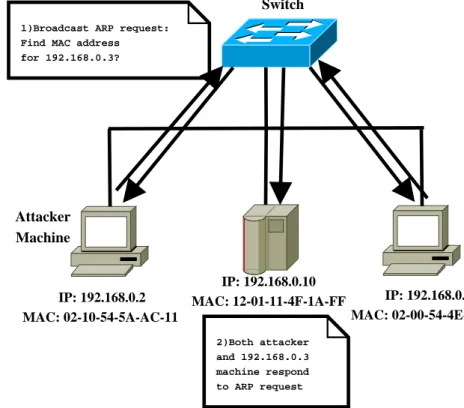
based forgery attack. An attacker creates a spoofed packet with a forged MAC address to misrepresent another computer system. The main aim of the attack is to take over a victim’s communication with another computer on a subnet exchanging sensitive data and information. There is no defined mechanism to detect MAC address forgery due to the lack of confidentiality mechanisms in network protocol. Figure 2.10 shows the forgery attack carry out using Address Resolution Protocol (ARP).
Switch
1)Broadcast ARP request: Find MAC address for 192.168.0.3? Attacker Machine IP: 192.168.0.3 MAC: 02-00-54-4E-11-FF 2)Both attacker and 192.168.0.3 machine respond to ARP request IP: 192.168.0.10 MAC: 12-01-11-4F-1A-FF IP: 192.168.0.2 MAC: 02-10-54-5A-AC-11
Forgery Attack Using IP
Most of the attacks discussed until now forged addresses such as MAC address, IP ad-dresses or email address in order to create spoofed network packet for launching different types of complex network attacks such as DoS or DDoS. Some network configurations also provide access to network services on resources based on IP or MAC address au-thentication. If an attacker forges these addresses then it can gain access to services and information. There are other kinds of attack that carried out with the help of forged IP address such assession hijacking and routing attacks.
Session Hijacking Using Protocols
Definition: An unauthorised access to information or services in a computer system by infiltration through an already established connection between hosts is calledSession Hijacking.
Explanation: Like most of the attacks discussed previously, spoofed packets with forged IP address are commonly used for session hijacking as well as for routing attacks. Attackers exploit flaws or weaknesses of protocols such as TCP, ICMP and Border Gateway protocol (BGP) in order to carry out session hijacking. Session hijacking and routing attacks involve direct intrusion into established network connections. The objective of these attacks is not just the disruption of communication between hosts but to actually change the routes used by a host or a router in order to eavesdrop on communication and steal vital sensitive information directly from network packets.
Session Hijacking Using TCP
TCP supports reliable duplex stream based communication. Packets are delivered in order using 32 bit sequence numbers in each and every TCP datagram.
Attack Description: TCP session hijacking attack alters TCP sequence numbers. An
attacker must guess or intercept packets to get the correct TCP sequence number of a TCP session between two hosts. Then, with a TCP sequence number and a forged IP address of any other trusted host on the network, an attacker creates a spoofed TCP packet and sends it to the target/victim machine. Because of the correct sequence number the other host treats the packet as an established session packet and starts exchanging packets with an attacker machine and discloses sensitive information. The other machine that originally had an established session with the victim machine now has an invalid TCP sequence number and its TCP session with the host is invalid.
Session Hijacking Using Routing
Session hijacking can also be carried out by exploiting weaknesses in network routing table update procedures. The two protocols used for hijacking sessions are ICMP (Route Redirect message) and Border Gateway Protocol (BGP) [25, 26]. An attacker creates a spoofed packet with the forged IP address of a victim to misrepresent and inform the gateway or routers to update their route table with false routing information in order to redirect communication through a rogue or compromised gateway/router. In this way an attacker is able to successfully see all communication of a victim machine.
In this section a small number of protocol weaknesses and flaws were discussed along with variety of network attacks. A more comprehensive overview of network attacks and flaws in protocols is presented in the survey presented by Simon Hansman and Ray Hunt [27].
2.2.2 Vulnerabilities in Software
Vulnerabilities in softwares and bad host configurations provide additional opportunities for hackers to launch different types of network attacks. These vulnerabilities arise due to flawed programming or badly tested software releases. For example, it is relatively common for new or updated versions of libraries and applications to be released that are related to networking and operating system services. SysAdmin, Audit, Network, Secu-rity (SANS/MITRE) reported in 2009 about the top 25 dangerous coding errors where two of the errors led to more than 1.5 million US dollars of website security breaches during 2008 [28]. The common software flaws are unchecked user inputs potentially leading to buffer overflows and SQL injection5, fundamental issues with OS user policies where possible unauthorised privilege escalation is possible with the potential for mal-ware to execute commands on behalf of a hacker. Further, password management flaws can allow the user or root/Administrator passwords to be cryptographically weak and therefore easily compromised by hackers in order to gain unauthorised access. A key task for a network administrator is to be aware of current vulnerabilities in operating system and application software and to deploy updates or fixes as and when they become available. The next section discusses network attacks exploiting common vulnerabilities in software and is further evidence for the need for proper network configurations and defence mechanism for networks (Section 2.3).
DoS Attacks Using Software Vulnerabilities
Some common DoS attacks carried out by hackers by exploiting software vulnerabilities are now discussed:
Buffer Overflow Attack: exploits flawed programming where a buffer can be overfilled
and values are written into adjacent memory to the end of the buffer storage. This causes corruption of data which either crashes the application or it can be used to cause the execution of injected code in order to perform a malicious operation.
Crasher Attacks: causes the host systems to crash, leading to DoS due to a reboot.
A popular example of crasher attacks exploiting OS vulnerabilities areland attack and
Ping of death (Section 2.2.1).
2.2.3 Malicious Code
Malicious code is commonly referred as Malware.
Definition: Malware is a software program designed to perform malicious activities on a computer system without owner consent.
Explanation: Malware is deployed to cause damage to a computer system by an at-tacker. It can be used to take control of a computer system, to access sensitive infor-mation and to launch attacks on other computer system. Malware installation on any computer is difficult to detect and prevent. Advanced defence mechanisms sometimes even find it difficult to counter those new variants of malwares commonly known as zero day exploits (Section 2.4.6). However, certain combination of defence mechanism are effective but far from perfect in completely countering any new or zero-day malware attacks (Section 2.3).
Types Of Malware: Malwares can be self-replicating in order to propagate themselves either by attaching themselves from one computer file to another, or by emailing them-selves to other machines using a victim’s email client software address book. Examples of self-replicating malwares are computer Viruses and Worms (Figure 2.11).
Like self-replicating malwares, non-replicating malwares also performs malicious activ-ities usually by fooling them installing on victims machine. Commonly known non-replicating malwares areTrojan Horse,SpywareandAdware(Bad Adware) (Figure 2.11). Other malwares include backdoors, trojan downloaders, password stealers, Crimeware
Non-replicating malwares Adware (Bad Adware) Trojan Horse Spyware Malware Self-replicating malwares Worms Viruses
Figure 2.11: Types of malware
Crimeware: is a malicious software intended to yield financial benefits for an attacker using theft of personal information for fraudulent use, theft of trade secrets or intellectual property and spam distribution [29].
Mobile Malware: is a malicious software designed to infiltrate mobile devices without user consent. Security analysts believe mobile malware is a significant and large threat due to the exponential increase in number of mobile devices such as smart phones and netbook mobile devices with mobile internet connectivity [30].
Self-replicating Malware
Computer viruses and worms are self-replicating malwares that propagate and infect systems to perform malicious activity. A virus propagates by attaching itself to com-puter files. A worm propagates through a comcom-puter network without attaching itself to computer file.
Virus: The term computer virus first came to known in 1986. Fred Cohen’s PhD thesis
demonstrated how program code could propagate itself from one machine to another [31]. Table 2.6 summarises some common virus types [32].
The top four virus types in table 2.6 are easy to detect using virus scanner technology. However, the last three types of viruses use tactics that enable them to successfully avoid detection by virus scanners or other network defence mechanism such as SB-NIDS.
Worm: Computer worms typically cause more destruction to computer systems and
networks than computer viruses. Computer worms are of two types: Mass-mailing
worms and Network-aware worms [27]. Mass-mailing worms spread through emails. Example of mass-mailing worm is Mellisa that attaches itself to email for propagation. Network-aware worms are more sophisticated and destructive than mass-mailing worms. Network-aware worms look for known vulnerabilities in Internet hosts and try to gain access in order to compromise machines. Once a worm reaches a target machine it modifies critical operating system files to hide its identity and then attempts to propagate
Table 2.6: Viruses types and behaviour
Protocol Description Detection
File Infector Mainly infects the program files (.EXE, .COM, .BIN etc). It may also infect script or configuration file. Easy Boot record
infector Infects system boot sector. Easy Multi-partite virus Hybrid nature. Infects boot record as well as file. Easy Macro virus Infects macro-enabled Microsoft office document. Easy Stealth virus Stealth virus disguises itself to thwart detection by
altering its file size, or concealing itself in memory. Hard Encrypted virus
It uses encryption to hide itself from virus scanners. Each time it infects it automatically encodes itself differently.
Hard Polymorphic virus Everytime this virus infects file it changes its
signa-ture. Hard
to further hosts. Examples of this kind of worm is SQL slammer worm that exploits the known vulnerability in Microsoft SQL Server 2000 and Microsoft Desktop Engine.
Non-replicating Malware
There are other malicious codes or malwares which are intrusive, hostile and annoying. Unlike viruses and worms they are non-replicating and do not propagate themselves. Such malware often installs itself in a victim machine by tricking the user into believing them to be benign programs when actually they have a malicious purpose. Often such programs interfere with system settings and open backdoors for remote access to system resources. The two widely known non-replicating malwares are: Trojan Horse and
Spyware.
Trojan Horse: Trojan Horse or a Trojan is a non-replicating malware that spreads
by opening an email attachment or downloading and running a file from the Internet containing trojan code. Trojans appear to perform desirable functions but are used to compromise victim system security. Usually it changes system settings and allows hackers to remotely connect to a machine for malicious purpose. Desirable operations performed by hackers using trojans are file uploading and downloading, launching at-tacks such as DDoS and email spamming, other malware installations, data theft, remote screen viewing, rebooting the machine and resource hogging of hardisk space and pro-cessor computing power.
Spyware: A non-replicating malware that secretly installs itself in a victim’s machine for the purpose of collecting data. Sometimes spyware come as part of regular software packages and are installed in a hidden directory. Spyware monitors victim’s system usage and Internet surfing habits and sends the information over the internet to spyware owner
or hacker. Information collected using spyware is then used to target advertisements and to further tempt the user into installing other malicious malwares.
2.3
Network Defence Mechanism
This section discusses techniques and some state of the art network security technologies used to minimise and counter network threats.
2.3.1 Configuration Management
Configuration management aims to minimise network security issues through technically sound network organisation and by frequently applying application software updates and OS patches. Vulnerability scanner and configuration management software tools are available to automatically apply such updates and patches. Encryption is typically deployed to protect the transmission of sensitive information. Typical deployments include the IP layer using a framework such as IPsec or at the application layer using the Secure Socket Layer (SSL) protocol. Firewalls are typically used to secure a network from outside attack and to prevent subversive users from advertising unauthorised network services to the external internet beyond the firewall. Another strategy is Virtual Private Network (VPN) which securely sends private data between two sites or locations.
2.3.2 Firewall
A Firewall is a combination of software and hardware coupled with restrictions on net-work topology that is used to secure and limit netnet-work access. A typical firewall deploy-ment is shown in figure 2.12. Firewalls are used to limit outgoing and incoming network traffic to ensure that it is well-formed (thus preventing spoofed packets entering or leav-ing the network) and legitimate. Standard networkleav-ing equipment such as routers offer functionality such as packet filtering using rules to determine which incoming/outgoing network packets are allowed to pass or be dropped.
Types Of Firewall: Firewall comes in three main flavours as shown in figure 2.13,
although variations of these basic organisations are also possible.
Packet Filter: A packet filter applies selective passing or blocking of network pack-ets based on Open System Interconnection (OSI) layer 3 (IPv4/IPv6) and OSI-layer 4 (TCP, UDP, ICMP, and ICMPv6) headers. The most often used criteria of passing or blocking the packets are source and destination IP addresses (IPv4 and IPv6), source
Internet
Internal Network Firewall Dual-homed
Host
Figure 2.12: Firewall sitting between LAN and the Internet
Firewall
Application
Gateway
Packet
Filter
Circuit
Gateway
Figure 2.13: Types of Firewall
and destination ports (TCP, UDP, ICMP, and ICMPv6). Some packet filter also checks the ICMP codes along with other criteria to pass or block network packets.
Packet filters can detect packets that has spoofed or malformed IP addresses for launch-ing different network attacks (Section 2.2.1). For example, packet filters can stop all the packets coming from outside the network with forged local network IP addresses in sender source packet header field to foil attacks. Packet filters cannot detect any protocol violation that is often used to disguise certain types of attack traffic because packet filters make no attempt to understand the packet payload data.
Circuit Gateways: It is a more complex firewall that can detect specific protocol vi-olations. A circuit gateway monitors the transport level of OSI model (OSI layer 4 or TCP sessions). For example, TCP handshaking between host is checked to determine whether a requested session is legitimate. Also circuit gateway monitors the request/re-ply packets of established session for detecting protocol violation. For example, TCP SYN DoS attack can easily be detected by circuit gateways.