OLLSCOIL LUIMNIGH
Towards a Product Derivation Process
Reference Model for Software Product
Line Organisations
Submitted by Pádraig O’Leary For the award of Doctor of PhilosophySupervised by Dr. Ita Richardson
Prof. Steffen Thiel
Submitted to the University of Limerick January 2010
Pádraig O’Leary (2010)
Towards a Product Derivation Process Reference Model for Software Product Line Organisations
Abstract
The derivation of individual products from a software product line is still seen as a time-consuming and expensive activity in many organisations. Despite recognition that an effective derivation process could alleviate many of the difficulties associated with product derivation, little work has been dedicated to this area. Existing approaches have very different scope and emphasise different aspects of the derivation process. Furthermore, they are frequently too specialised to a specific development technique to serve as a general solution. This leaves organisations with no centralised starting point for defining an approach to product derivation.
Accordingly there is a strong need for a structured approach to product derivation which defines activities, tasks, roles, inputs and outputs of each step in a structured and systematic way.
Through a series of research stages using sources in industry and academia, this research has developed a process reference model for product derivation (Pro-PD). Pro-PD focuses on the essential activities, tasks, roles and work products used to derive products from a software product line. Pro-PD is an adaptable approach and can be tailored to suit different process environments.
Declaration
The work presented in this thesis is entirely my own work. It has not been submitted previously to this or any other institute for this or any other academic award. Where use has been made of the work of other people, it has been acknowledged and referenced.
Signed: _______________ Date: ______________
Acknowledgements
The author wishes to acknowledge the help and support of several people and organisations, without whom, this thesis would not have been possible.
Firstly I would like to thank my two supervisors, Dr. Ita Richardson and Prof. Steffen Thiel. They filled the journey with support and encouragement. Thank you both very much!
I would like to thank my examiners, Dr. Jim Buckley and Dr. Liam O‘Brien, for their time and feedback.
This research has been funded by Science Foundation Ireland through IRCSET under Grant no. RS/06/167. I would like to thank them for the opportunity. To Lero and all its members, I‘m grateful for the supportive research environment over the past few years.
To my family Jerry, Margaret, Tadhg, Catherine, Helen and Kate, your support began long before I ever undertook this journey. I have been very fortunate.
Mo mhile buíochas do na daoine thuasluaite a chabhraigh liom agus a thug tacaíocht dom
Table of Contents
CHAPTER ONE: INTRODUCTION ...15
1.1INTRODUCTION ... 15
1.2PROBLEM STATEMENT ... 16
1.3OVERVIEW OF PROPOSED SOLUTION ... 16
1.4DEVELOPMENT AND EVALUATION ... 17
1.5CONTRIBUTION ... 18
1.6OUTSIDE THE SCOPE OF THE WORK ... 19
1.7STRUCTURE OF THESIS ... 19
CHAPTER TWO: LITERATURE REVIEW ...21
2.1INTRODUCTION ... 21
2.2SOFTWARE PRODUCT LINES ... 21
2.2.1 Background to Software Product Lines ... 22
2.2.2 Fundamentals and Basic Concepts ... 22
2.3PRODUCT DERIVATION ... 24
2.3.1 Approaches ... 25
2.3.2 Conclusion ... 38
2.4SOFTWARE PROCESS RESEARCH ... 41
2.4.1 Software Process Models ... 42
2.4.2 Process Reference Models ... 46
2.4.3 Software Product Line Assessment Methods ... 49
2.5CONCLUSION ... 50
CHAPTER THREE: RESEARCH METHODOLOGY ...52
3.1INTRODUCTION ... 52
3.2RESEARCH OBJECTIVES ... 52
3.2.1 Objective One – To Define a Structured Process Model for Product Derivation ... 53
3.2.2 Objective Two - To Demonstrate the Adaptability of the Process Model ... 53
3.2.3 Objective Three - To add to the Established Knowledge on Product Derivation ... 54
3.2.4 Finally ... 54
3.3RESEARCH PHILOSOPHY ... 54
3.3.2 Quantitative vs. Qualitative ... 55
3.3.3 Explanatory vs. Exploratory ... 56
3.3.4 Inductive vs. Deductive ... 56
3.3.5 Constructive ... 57
3.4RESEARCH DESIGN ... 57
3.4.1 Overview of Research Design ... 58
3.4.2 Stage One – Literature Review and Expert Opinion Workshops ... 61
3.4.3 Stage Two – Industrial Case Study: Robert Bosch GmbH ... 66
3.4.4 Stage Three – Academic Comparative Analysis: DOPLERUCon ... 71
3.4.5 Stage Four – Systematic Evaluation ... 73
3.4.6 Research Design Conclusion ... 75
3.5RESEARCH VALIDITY ... 76
3.6HANDLING REFINEMENTS ... 79
3.7MEETING THE RESEARCH OBJECTIVES ... 80
3.8SUMMARY ... 81
CHAPTER FOUR: DEVELOPMENT AND EVALUATION OF PRO-PD ...82
4.1INTRODUCTION ... 82
4.2STAGE ONE -LITERATURE REVIEW AND EXPERT OPINION WORKSHOPS ... 83
4.2.1 Steps taken in Stage One ... 83
4.2.2 Observations ... 83
4.2.3 Conclusion of Stage One ... 92
4.3STAGE TWO -INDUSTRIAL CASE STUDY:ROBERT BOSCH GMBH ... 93
4.3.1 Observations from the Case Study ... 93
4.3.2 Impact on Pro-PD ... 97
4.3.3 Reaction of Robert Bosch GmbH Workshop Participants to Pro-PD Version One ... 102
4.3.4 Summary of Pro-PD Changes due to Stage Two of Research ... 102
4.3.5 Conclusion of Stage Two: Industrial Case Study ... 105
4.4STAGE THREE -ACADEMIC COMPARATIVE ANALYSIS:DOPLERUCON ... 105
4.4.1 Preparing for Derivation Comparison ... 106
4.4.2 Product Configuration Comparison... 109
4.4.3 Product Development and Testing Comparison ... 111
4.4.5 Summary of Pro-PD Changes due to Stage Three of Research ... 115
4.5STAGE FOUR:EVALUATION ... 117
4.5.1 Evaluation Method ... 117
4.5.2 Inter-model Evaluation ... 118
4.5.3 Analysis of Existing Approaches ... 126
4.5.4 Discussion of Results ... 137
4.5.5 Summary of Pro-PD Changes due to Stage Four of Research ... 138
4.6FORMALISING THE MODEL ... 139
4.6.1 Describing Pro-PD using EPF – Introducing Activities ... 140
4.7SUMMARY ... 140
CHAPTER FIVE: PRO-PD DESCRIPTION ... 142
5.1INTRODUCTION ... 142
5.2PROCESS DESCRIPTION... 142
5.2.1 Roles ... 143
5.2.2 Units of Work: Tasks and Activities ... 148
5.2.3 Work Products ... 170
5.3WATERFALL INSTANTIATION ... 173
5.3.1 Preparing for Derivation ... 175
5.3.2 Product Configuration ... 175
5.3.3 Product Development and Testing ... 176
5.4PRO-PDMATRIX ... 176
5.5CONCLUSION ... 177
CHAPTER SIX: ADAPTING PRO-PD TO AGILE ... 178
6.1INTRODUCTION ... 178
6.2AGILE PRACTICES AND SPL ... 178
6.3THE AGILE MANIFESTO AND PRODUCT DERIVATION ... 180
6.4THE MODEL IN ACTION –AN ITERATIVE INSTANTIATION ... 184
6.4.1 Use by Specialisation - Agile Pro-PD ... 185
6.4.2 Model Phases ... 186
6.4.3 Phase Milestones ... 190
6.5INCREASING AGILITY IN PRODUCT DERIVATION ... 191
6.5.2 Automation of Product Derivation ... 192
6.5.3 Product Derivation Iterations ... 193
6.5.4 Agile Testing Techniques ... 193
6.6CONCLUSION AND FUTURE WORK ... 194
CHAPTER SEVEN: CONCLUSION ... 195
7.1INTRODUCTION ... 195
7.2RESEARCH DESIGN ... 195
7.3MEETING THE RESEARCH OBJECTIVES ... 197
7.3.1 Objective One – To define a structured process model for product derivation ... 197
7.3.2 Objective Two - To demonstrate the adaptability of the process model ... 197
7.3.3 Objective Three - To add to the established knowledge on product derivation... 198
7.4OVERVIEW OF SOLUTION ... 198
7.5SUMMARY OF CONTRIBUTION ... 199
7.6LIMITATIONS ... 201
7.6.1 Product Testing ... 201
7.6.2 Adaptation Guidelines ... 202
7.6.3 Case Study Bias ... 202
7.7FUTURE WORK ... 202
7.7.1 Industrial Application of Pro-PD ... 202
7.7.2 Regulatory Conformance ... 203
7.7.3 Agile Product Derivation ... 203
7.8CONCLUDING REMARKS ... 204
List of Figures
Figure 1-1 Overview of Research Design ______________________________________________ 18 Figure 2-1 Domain and Application Engineering Phase [19] _______________________________ 24 Figure 2-2 FORM Process [28] _______________________________________________________ 29 Figure 2-3 The Three Activities of SPL [1] ______________________________________________ 32 Figure 2-4 The ConIPF Derivation Process [3] ___________________________________________ 35 Figure 2-5 DOPLERUCON Approach[34] ________________________________________________ 36 Figure 2-6 Waterfall Model [7] ______________________________________________________ 43 Figure 2-7 Spiral Model [42] ________________________________________________________ 44 Figure 2-8 Use by Specialisation _____________________________________________________ 49 Figure 3-1 Overview of Research Design ______________________________________________ 60 Figure 3-2 Stage One ______________________________________________________________ 61 Figure 3-3 Workshop Whiteboard ___________________________________________________ 65 Figure 3-4 Stage Two: Industrial Case Study ___________________________________________ 68 Figure 3-5 Sample Whiteboard Drawing from the Case Study Workshop ____________________ 69 Figure 3-6 Academic Comparative Analysis ____________________________________________ 71 Figure 3-7 Systematic Evaluation ____________________________________________________ 75 Figure 4-1 The COVAMOF Derivation Process [22] ______________________________________ 84 Figure 4-2 Form Application Engineering [28] __________________________________________ 85 Figure 4-3 Overview of Pro-PD Version One ____________________________________________ 86 Figure 4-4 Framework Skeleton Discussions at Workshop ________________________________ 88 Figure 4-5 Impact Analysis _________________________________________________________ 92 Figure 4-6 Synchronisation Caused by Platform-Product Dependency _______________________ 96 Figure 4-7 Organisational Structure and Roles _________________________________________ 99 Figure 4-8 Product Development ___________________________________________________ 101 Figure 4-9 Systematic Evaluation ___________________________________________________ 118 Figure 5-1 Conceptual Model of Pro-PD Structure ______________________________________ 143 Figure 5-2 Customer Role _________________________________________________________ 144 Figure 5-3 Platform Manager Role __________________________________________________ 145 Figure 5-4 Product Architect Role ___________________________________________________ 146 Figure 5-5 Product Developer Role __________________________________________________ 147 Figure 5-6 Product Manager Role ___________________________________________________ 148 Figure 5-7 Product Tester Role _____________________________________________________ 148
Figure 5-8 Overview of Pro-PD Activities _____________________________________________ 150 Figure 5-9 Initiate Project Activity __________________________________________________ 152 Figure 5-10 Identify and Refine Requirements Activity __________________________________ 156 Figure 5-11 Derive the Product Activity ______________________________________________ 160 Figure 5-12 Develop the Product Activity _____________________________________________ 164 Figure 5-13 Test the Product Activity ________________________________________________ 167 Figure 5-14 Project Assessment Activity ______________________________________________ 169 Figure 5-15 Waterfall phases and work products ______________________________________ 174 Figure 5-16 Preparing for Derivation Phase ___________________________________________ 175 Figure 5-17 Product Configuration Phase ____________________________________________ 176 Figure 5-18 Product Development and Testing ________________________________________ 176 Figure 6-1 Agile Pro-PD ___________________________________________________________ 187 Figure 6-2 Preparing for Derivation Phase ____________________________________________ 188 Figure 6-3 Product Derivation Phase ________________________________________________ 189 Figure 6-4 Product Development and Testing Phase ____________________________________ 190 Figure 7-1 Overview of Research Design _____________________________________________ 196 Figure 7-2 Pro-PD as a Foundation for Automated Approaches ___________________________ 200
List of Tables
Table 2-1 The SEI Product Line Practice Areas [1] ... 33
Table 3-1 Model Notation ... 64
Table 3-2 Simplified Version of Spreadsheet Used ... 73
Table 4-1 Description of Phase Attributes ... 88
Table 4-2 Impact Analysis Phase ... 89
Table 4-3 Description of Task Attributes ... 90
Table 4-4 Task Attributes for Customer Negotiation ... 91
Table 4-5 Summary of Stage Two Changes to Pro-PD ... 105
Table 4-6 Mapping Preparing for Derivation to DOPLERUCon ... 108
Table 4-7 Mapping Product Configuration to DOPLERUCon ... 110
Table 4-8 Mapping Product Development and Testing to DOPLERUCon ... 113
Table 4-9 Summary of Stage Three Changes to Pro-PD ... 117
Table 4-10 Evaluation of Requirements Engineering Practice Area ... 122
Table 4-11 Practice Summary Results ... 124
Table 4-12 Practice Classification ... 125
Table 4-13 Evaluation Framework (adapted from [99]) ... 128
Table 4-14 Results of Analysis Using Evaluation Framework ... 135
Table 4-15 Summary of Stage Four Changes to Pro-PD ... 139
Table 5-1 Initiate Project Activity Summary ... 151
Table 5-2 Identify and Refine Requirements Activity Summary ... 155
Table 5-3 Derive the Product Activity Summary ... 159
Table 5-4 Develop the Product Activity Summary ... 163
Table 5-5 Test the Product Activity Summary ... 167
Table 5-6 Project Assessment Activity Summary ... 169
Table 5-7 Work Product Table ... 173
Chapter One:
Introduction
1.1 Introduction
A Software Product Line (SPL) is a set of software-intensive systems that share a common, managed set of features satisfying the specific needs of a particular market segment or mission and that are developed from a common set of core assets in a prescribed way [1]. The SPL approach makes a distinction between domain engineering, where a common platform for an a number of products is designed and implemented, and application engineering, where a product is derived based on the platform components [2]. The separation into domain engineering and application engineering allows the development of software artefacts which are shared among the products within that domain. These shared artefacts become separate entities in their own right, subscribing to providing shared functionality across multiple products.
It is during application engineering that the individual products within a product line are constructed. The products are built using a number of shared software artefacts created during domain engineering. The process of creating these individual products using the platform artefacts is known as product derivation.
Product derivation is the process of constructing a product from a Software Product Line‘s (SPL) core assets [3]. An effective product derivation process can help to ensure that the benefits delivered through using these shared artefacts across the products within a product line is greater than the effort required to develop the shared assets. In fact, the underlying assumption in SPL that ―the investments required for building the reusable assets during domain engineering are outweighed by the benefits of rapid derivation of individual products‖ [4] might not hold if inefficient derivation practices diminishes the expected gains.
1.2 Problem Statement
In the context of inefficient product derivation, a number of publications speak of the difficulties associated with the process. Hotz et al. [2] describe it as ―slow and error prone, even if no new development is involved‖. Griss [5] identifies the inherent complexity and the coordination required in the derivation process by stating that ―…as a product is defined by selecting a group of features, a carefully coordinated and complicated mixture of parts of different components are involved‖. Therefore, the derivation of individual products from shared software assets is still a time-consuming and expensive activity in many organisations [3].
Despite this, there has been little work dedicated to the overall product derivation process. Rabiser et al. [6] claim that ―guidance and support are needed to increase efficiency and to deal with the complexity of product derivation‖. As Deelstra et al. [3] states there ―is a lack of methodological support for application engineering and, consequently, organisations fail to exploit the full benefits of software product families.‖ As a result current approaches fail to provide a holistic view of product derivation leaving organisations with no centralised starting point for defining an approach to product derivation. This results in ad-hoc solutions. Accordingly there is a strong need for a structured approach to product derivation which defines activities, tasks, roles, inputs and outputs of each step in a structured and systematic way. This thesis aims to fill this identified gap and the objective of the work described can be stated as:
To define a systematic process which will provide a structured approach to the derivation of products from a software product line, based on a set of tasks, roles and work products, and to demonstrate its adaptability to different process models.
1.3 Overview of Proposed Solution
In order to achieve the goal, defined above, this thesis develops the Pro-PD process for product derivation. Pro-PD is a process reference model for product derivation that is minimal, complete, and adaptable:
Complete – it can be manifested as an entire process to build a system; Adaptable – it can be adapted to different process types.
Pro-PD is a minimally sufficient process reference model for product derivation. This means that only fundamental product derivation process content is included. Domain and discipline specific content is not included in Pro-PD. Pro-PD is independent of the methods and techniques used to derive a product focusing instead on the essential tasks, roles and work artefacts used to derive products from a software product line. Finally, Pro-PD is adaptable, it can be used as a foundation from which company specific product derivation process content can be developed. The process structure is based on the waterfall process model [7]; however, to demonstrate its flexibility, it is adapted to fit the characteristics of an iterative process model in Chapter Six.
1.4 Development and Evaluation
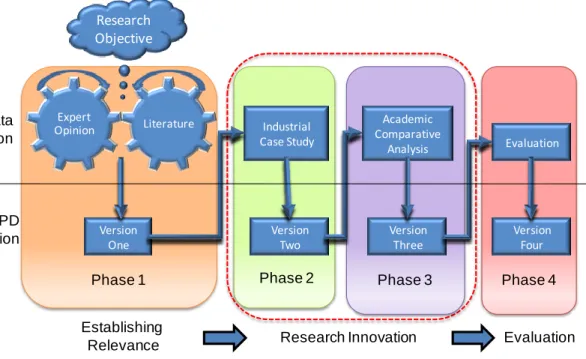
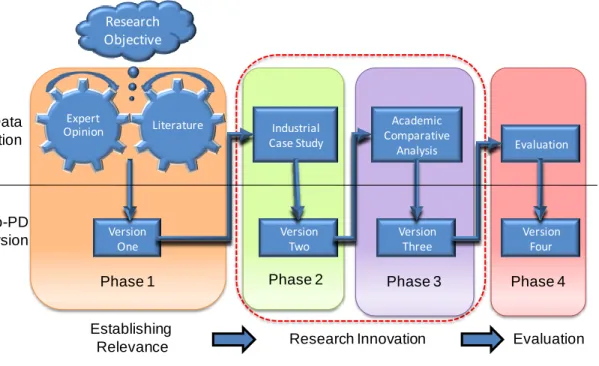
Pro-PD was constructed using development – evaluation stages (see Figure 1-1). Version one of Pro-PD was developed through sources in the literature and captured expert opinion, and evaluated during an industrial case study with Robert Bosch GmbH. Version two was developed based on a study of derivation practices at Robert Bosch GmbH and evaluated during a research collaboration with the DOPPLER laboratory. Version three was developed based on the findings of the research collaboration with DOPPLER. This version was evaluated through an inter-model evaluation and an adapted SPL evaluation framework. Finally, with the results of this evaluation integrated, version four of Pro-PD is presented.
Version One Industrial Case Study Version Two Academic Comparative Analysis Version Three Evaluation Version Four Literature Data Collection Pro-PD Version Research Objective
Phase 1 Phase 2 Phase 3 Phase 4
Expert Opinion
Research Innovation Establishing
Relevance Evaluation
Figure 1-1 Overview of Research Design 1.5 Contribution
This research has resulted in a number of contributions. An extensive literature review is presented that highlights issues within current approaches to product derivation. Observations on product derivation practice from both academia and industry are described.
An adaptable process model for product derivation (Pro-PD) is developed and evaluated; the model describes the roles, work products and activities essential for product derivation. Pro-PD can be used as a foundation from which company specific product derivation process content can be developed therefore providing companies with a solid starting point for the definition of a product derivation approach
The research contributes to the potential integration of Agile practices in product derivation through the adaptation of Pro-PD to create A-Pro-PD. The Agile instantiation of Pro-PD provides a means of supporting the adoption of Agile practices. An integrated Agile approach could solve many of the problems associated with product derivation‘s complex and cumbersome nature. A combination of Agile and SPL is expected to create a leaner but more disciplined product derivation process.
1.6 Outside the Scope of the Work
As the proposed process model is part of a broader SPL context, a set of related aspects will not be included. The following issues are not directly addressed by this work:
Domain Engineering. An important issue in the SPL process is to define the development of the artefacts for reuse. However, this aspect can be as complex as product derivation, involving the definition of activities, tasks, inputs, outputs, and roles;
System Delivery or System Maintenance: Pro-PD is focused on product construction and does not consider system delivery or system maintenance;
1.7 Structure of Thesis
The remainder of this thesis is organised as follows:
Chapter Two: Literature Review. The chapter commences with a discussion on the emergence of SPL and the associated concepts. The current approaches to product derivation are discussed along with outstanding issues. The concept of software process improvement is introduced with an overview of the more famous process models. Process reference models are introduced and various adaptation approaches outlined. Finally, an overview of existing SPL assessment methods is presented.
Chapter Three: Research Methodology. The research objectives are presented and justification is made for the choice of research paradigm. The research design is presented including the selection of research methods and a detailed description of how these methods were executed. Potential threats to the research validity are identified and discussed. Finally, the researcher looks at how the research objectives were met through the applied research methodology.
Chapter Four: Development and Evaluation of Pro-PD. The iterative development and evaluation of the model is presented. The observations made
during the various stages of development and evaluation, are described and their influence on the final model outlined.
Chapter Five: Pro-PD Description. This chapter presents an overview of the proposed process reference model for product derivation (Pro-PD). The process concepts, roles, work products and tasks are described.
Chapter Six: Adapting Pro-PD to Agile. In this chapter Pro-PD is adapted. The adaptation of Pro-PD to fit the characteristics of an Agile process model is demonstrated.
Chapter Seven: Conclusion. A summary of the contribution of this work is presented and the directions for future work are outlined.
Chapter Two:
Literature Review
2.1 Introduction
For the past decade the software product line approach has been an emerging paradigm that provides means to incorporate reuse as a part of software development [1, 8]. The basic concept of SPL is to develop a software foundation that can be used for every product line member. So rather than developing variant products independently, one reuses existing components that are designed to be reused.
This idea of software reuse has existed for some time. Software development is time-consuming and error-prone and the systems produced are complex. Reuse is seen as a strategy for solving these issues.
However, the existing reuse processes present crucial problems such as gaps in important activities like development for (Domain Engineering) and with (Application Engineering) reuse. Even today, with SPL, there is still no clear consensus about the activities to be performed (inputs, outputs, artefacts and roles) and the requirements that an effective reuse process must meet.
Bayer et al. [9] summarised this gap when they said ―A flexible method that can be customised to support various enterprise situations with enough guidance and support is needed‖ (pp. 122). With this motivation, the reminder of this chapter presents an overview of SPL and a review of SPL approaches with a focus on product derivation. The area of Software Process Improvement is discussed including the use of process reference models. Finally, the literature review concludes with a review of SPL assessment methods.
2.2 Software Product Lines
SPL is expected to provide similar advantages as product lines in manufacturing. The main advantages anticipated are reduced time to market and lower development costs [1] once the product line for an application domain is functional. While the success of product lines in manufacturing can be seen as a source of inspiration to the software engineering
community, the original concept was first introduced by Parnas [10] when he proposed the idea of families of related software products. Some experts believe that SPL will become the dominant software development paradigm in the near future [11]. Product flexibility is currently a very important factor in the software market and, with product lines, the promise of a tailor made system built specifically for the needs of a particular customer or group of customers can be fulfilled. Especially for large companies, product lines offer an efficient way to exploit the commonalities shared by different products to achieve economies of production [12, 13].
2.2.1Background to Software Product Lines
According to McGregor et al. [14] Whitney revolutionised the manufacturing of rifles using interchangeable parts. As Coallier et al. [15] explain this was the first widespread use of the product line approach. Whitney promised to build 10,000 muskets of different models in two years for the US government. The following citation, which is still relevant today, discusses the results of his efforts [16].
“Almost eight years was required for Whitney to fill the order, because practice still showed many gaps in his system. The number of details seemed endless. However, most of the ten thousand were turned out in the last two years. In 1811, Whitney took an order for fifteen thousand, and these were turned out within only two years.”
The example shows that while there are substantial arguments in favour of product lines, implementing a product line takes a lot of effort. Other famous product line instances are Ford‘s assembly line approach and Boeing‘s aircraft production line. Of course, any company who exploits commonality in their products to enable mass-production could be said to be involved in product lines.
2.2.2Fundamentals and Basic Concepts
The fundamental idea on which software product lines are based is on the planned reuse and management of a set of artefacts from which you can systematically design, define,
build and maintain a set of related products in a given domain. This idea is captured best by Clements and Northrop [1]:
Definition 1 (Software Product Lines) a set of software-intensive systems sharing a common, managed set of features that satisfy the specific needs of a particular market segment or mission and that are developed from a common set of core assets in a prescribed way.
A software product line captures the commonalities between a set of products while providing for the differences between different instances of the product. The SPL approach is much more about strategic reuse of artefacts. As a result SPL is as much about business practices as they are about the technical practices [17]. Adopting a product line approach requires a shift in mindset for most organisations, as the focus changes from single system development to developing a product line. Alternative terminologies for SPL exist, van der Linden [18] reports that the term ―product family‖ or ―system family‖ is used in Europe, whereas in the United States the term ―software product line‖ is more commonly used.
SPL organisations need to perform two intertwined activities domain engineering and application engineering. In domain engineering the commonalities and variabilities between the products within the product line are designed and realised. In application engineering these commonalities and variabilities are used to derive individual products. This separation into domain engineering and application engineering allows the development of software assets which are shared among the products within that domain (see Figure 2-1). These shared assets become separate entities in their own right, providing shared functionality across multiple products. It is during application engineering that the individual products within a product line are constructed. The products are constructed using a number of shared software artefacts created during domain engineering and where necessary product specific development. The process of creating these individual products is known as product derivation.
Figure 2-1 Domain and Application Engineering Phase [19]
2.3 Product Derivation
Product Derivation is the process of constructing a product from a product line of software assets [3]. An effective product derivation process within an organisation ensures that the effort required to develop the platform assets is less than the benefits delivered through using these shared artefacts across the products within a product line. In fact, the underlying assumption in SPL that ―the investments required for building the reusable assets during domain engineering are outweighed by the benefits of rapid derivation of individual products‖ [4] might not hold if inefficient derivation practices diminishes the expected gains. Hence, there is a strong need for the identification of a systematic structured approach to product derivation in order to achieve maximum return on investment within SPL development.
Over time, a systematic and mature product derivation process can lead to automatic generation of products if the platform is suitably evolved to the needs of the
product line, the organisation has institutionalised the required practice areas [20] and the various activities of the derivation process are automated and supported by adequate tools.
In an ideal SPL environment, product derivation is a configuration and integration activity rather than a development one. However in practice, many requirements are not accounted for in the shared product family artefacts and can only be accommodated by adaptation of existing components and assets or even new development [21].
Much of the SPL research to date has been focused on the design and implementation of the shared software artefacts in a way that application engineers can derive the products with greater ease. However there is little work dedicated to the overall product derivation process. As a result, the derivation of individual products from shared software assets is still a time-consuming and expensive activity in many organisations [3].
Griss [5] identifies the inherent complexity and the coordination in the derivation
process by stating that ―…as a product is defined by selecting a group of features, a
carefully coordinated and complicated mixture of parts of different components are involved‖. Other authors such as Rabiser et al. [6] have also re-iterated the call for further guidance and support in the product derivation process.
Many of the existing SPL approaches consider product derivation purely in terms of the configuration of platform artefacts. The SPL approaches that support or partly automate product derivation in software product line development are presented in the following section, along with the product derivation specific approaches; COVAMOF [22]
and DOPLERUCON [23].
2.3.1Approaches
2.3.1.1PuLSE/PuLSE-I
PuLSE (Product Line Software Engineering) [9] is a method engineering framework
developed at the Fraunhofer IESE. The method consists of three major elements: Deployment Phases, Support Components and Technical Components. Deployment phases include various activities required to develop the framework. Support components supply
any additional expertise needed for process customisation and/or to solve any other organisational issues. Technical components provide the technical knowledge required to carry out different deployment activities. For this task, PuLSE has components for Customising (BC), Scoping (Eco), Modelling (CDA), Architecting (DSSA), Instantiating (I) and Evolving and Management (EM).
It is the Instantiating component that describes the ―derivation part‖ of the PuLSE
method, PuLSE-I (I for instantiation) [24]. PuLSE-I activities cover planning product
derivation, instantiating a product architecture from the reference architecture using decision models, and additional designing, implementation, and testing activities. Delivery and maintenance processes are also addressed. Several process steps are defined based on other PuLSE artefacts, e.g., reference architecture, domain decision model and scope definition. The approach defines roles and tasks, however on a very high-level.
According to Atkinson et al. [25], PuLSE has been applied in a number of different contexts for different purposes. It proved to be helpful for introducing sound documentation and development techniques into existing development practices. However, where a formalised process did not exist, the introduction of PuLSE turned out to be problematic.
PuLSE-I is not a standalone derivation process. Many dependencies exist to other parts of the overall PuLSE process making PuLSE highly iterative but also highly complex. The approach is not very applicable outside the scope of a PuLSE applied product line. Overall, PuLSE-I is a complex approach with a high-level process description. The approach is not flexible and explicit tailoring possibilities should be defined to make it more usable.
2.3.1.2KobrA
The KobrA [25] approach is centred on component-based product line development and integrates existing software engineering technologies like framework and process modelling. As described in the previous section, in situations where there were no pre-existing processes or well-defined products, the introduction of PuLSE turned out to be
problematic. With this in mind, the KobrA approach was proposed [25]. KobrA is an object-oriented customisation of the PuLSE method.
KobrA identifies commonalities and variabilities in a specific application domain and creates a reusable software infrastructure (or framework) which may be instantiated to identify the specific products. KobrA has two main activities: initially, framework engineering creates and maintains a generic framework that embodies all product variants that make up the family, including information about their common and disjoint features. Next, application engineering uses the framework built during framework engineering to construct specific applications within the domain covered by the framework. The application engineering process is explicitly defined and based on decision models to present variability to the customer and to instantiate a concrete application based on ―framework models‖ describing the component-based product line.
While KobrA provides an alternative approach to the technical aspects of PuLSE, it does not provide further process support. Furthermore, there is no support for product specific development. FIDJI contributes to this point by defining a flexible instantiation process.
2.3.1.3FIDJI
FIDJI is a flexible product derivation process [26], part of an overall model-driven SPL based development methodology [27]. The FIDJI product derivation process consists of writing model transformation, using a set of predefined transformation operations, which will reuse core model assets to build the product. This transformation is written by the product engineer and checked against instantiation constraints. Hence, the FIDJI product derivation process offers the flexibility required to support product specific requirements, support via transformation operations and control through instantiation constraints.
From a methodological perspective, product derivation at a given abstraction level can be seen as a reconciliation between an ―ideal‖ model stemming from customer requirements and the existing architectural framework model. The reconciliation takes
place in writing an instantiation program that takes into account the ―ideal‖ model and instantiation constraints in order to obtain the model of the actual SPL member.
2.3.1.4FORM
In an approach called FORM [28], Kang et al. have extended the FODA approach [29] to consider application engineering. The idea of FORM is to analyse domain features and use the identified features to derive products (see Figure 2-2).
The FORM approach consists of the domain engineering and application engineering process. The FORM application engineering process consists of requirements analysis and feature selection, architecture model selection and application development. Product derivation beings with requirements analysis and tries to find a matching set of features. The selected features can be instantiated to a product configuration by following the dependencies and constraints documented in the feature model. The architecture model selection is facilitated through feature selection also. Application development finally consists of following the specifications and selecting pre-coded components, filling in skeletons, or instantiating parameterised templates [28].
In application engineering, the emphasis is on the analysis phase with the use of the developed features. However, few directions are defined to select the architectural model and develop the applications using the existing components.
FORM, from a software engineering perspective, is applying approved software engineering principles that support adaptability and reusability. FORM also covers domain and application engineering but does not define the complete process of software development nor does it define any tool support. To use FORM as a complete process would require a degree of customisation and integration with other methods and research for an appropriate tool chain supporting the integrated methods.
Figure 2-2 FORM Process [28]
2.3.1.5FAST
The goal of the FAST [30] approach is to rapidly generate products from a product line using generation tools. The approach considers most of the facets of product line development.
The FAST application engineering process covers requirements elicitation, requirements analysis, product configuration and, additional development and testing. The process is described using state-based process modelling. The FAST approach is based on semi-automated product derivation where the product is developed through a combination of generation tools and manual product development. The FAST process begins by identifying variabilities and commonalities among potential product line members and then creating an application modelling language for specifying the individual products within that domain. The application modelling language is used as the basis for building a
generator. Product derivation is greatly simplified by describing the products in the application modelling language and generating the products.
If the product line requirements can be properly scoped and identified, FAST can develop individual products very quickly. However to enable automatic product derivation, system specifications must be precisely defined and specified. If there is a change or error in the requirements, specifications have to be modified and the translation needs to be altered. Additionally since requirements are specified using custom domain specification languages, other organisations may have difficulties in adopting them.
2.3.1.6Dream
In [31] Kim et al. analyse the respective shortcomings of SPL engineering and model driven architecture (MDA). They propose an overview of a complete method integrating both approaches, which they call Dream. The Dream methodology adopts key activities of SPL and model transformation features of MDA. The Dream approach allows the semi-automatic development of products within the product line.
The Dream approach consists of two processes; framework engineering and application engineering. In framework engineering the generic architecture for the product line is designed. A decision model is developed that describes variation points, variants and mechanisms to tailor the generic architecture.
The application engineering process consists of application requirements analysis, framework instantiation, application specific construction and integration and deployment. In this phase applications that fall under the scope of the product line are derived. Derivation is performed using the decision model developed during framework engineering. A product architecture is instantiated based on the decisions in the decision model and according to the variants selected for a specific product. For requirements which were not originally envisaged by the framework engineering stage, application specific construction occurs. Application specific construction involves an integration phase where the application specific construction and the instantiated product architecture are integrated into a single product model.
The Dream approach allows the semi-automatic development of products within the product line. Kim et al. claim that it builds on earlier approaches by explicitly specifying the application construction and integration phases. However the approach does not give detailed information on the models used during the different phases of the process nor are the type of transformations required or applied discussed in detail. Additionally, there is little support for the derivation process other than a high level description of the activities required i.e. integrate the application specific construction and the instantiated product architecture. Furthermore, no guidance is provided on how the approach could be applied or tailored to an industrial setting.
2.3.1.7SEI Product Line Practice Framework
The SEI Product Line Practice Framework (PLPF) [1] is built around what its authors term the ―three essential activities‖ of SPL, namely Core Asset Development, Product Development, and Management. Core Asset Development is mainly concerned with defining the Product Line scope and producing the core assets from which the products will be built. Product Development consists in turning these core assets into products, and Management oversees both these activities at the project and organisational level. Figure 2-3 illustrates these three essential activities of SPL.
The PLP includes 29 practice areas grouped into three categories, namely practices related to Software Engineering, Technical Management and Organisational Management. Table 2-1 summarises the Practice Areas.
Clements and Northrop [1] define the term ―practice area‖ as a body of work or a collection of activities that an organisation must master to successfully carry out the essential work related to an SPL. Northrop [17] further elaborates the effectiveness and importance of practice areas because they help in making the essential activities more achievable by dividing activities into smaller parts that can be easily traced.
Figure 2-3 The Three Activities of SPL [1]
The approach used by the SEI is to identify foundational concepts underlying software product lines and activities to be considered when creating a product line. The listed practice areas comprise an extensive set of competencies and issues necessary to consider for successful adoption of product lines. The PLPF supports product line planning and management, rather than giving concrete instructions on implementing specific engineering tasks.
In addition to the PLPF, the SEI also supports the automation of product derivation. McGregor [32] describes a high-level framework of practices for deciding when to automate product derivation, how to choose the right technology, and how to plan and
carry out the derivation process. According to the framework, production plans have to be
developed to prepare the derivation process. Such plans are documents describing inputs, necessary activities, and desired outputs of product derivation. Chastek and McGregor [20] propose detailed guidelines for creating, using, and evaluating such production plans.
Software Engineering Practice Areas Technical Management Practice Areas Organisational Management Practice Areas
Architecture Definition Configuration Management Building a Business Case
Architecture Evaluation Make/Buy/Mine/Commission
Analysis
Customer Interface Management
Component Development Measurement and Tracking Developing an Acquisition
Strategy
Mining Existing Assets Process Discipline Funding
Requirements Engineering Scoping Launching and
Institutionalizing Software System
Integration
Technical Planning Market Analysis
Testing Technical Risk Management Operations
Understanding Relevant Domains
Tool Support Organisational Planning
Using Externally Available Software
Organisational Risk Management
Structuring the Organisation Technology Forecasting Training
Table 2-1 The SEI Product Line Practice Areas [1]
The framework defined by the SEI is a robust description of best practice involving important technical and non-technical aspects grouped in software product line practical areas. However the framework is very generic and does not define specific ways of performing the activities. There is a strong focus on planning product derivation with the ultimate goal to automate the derivation process.
2.3.1.8COVAMOF
Deelstra et al. [3] present a product derivation framework developed based on two
industrial case studies. The framework consists of two phases: an initial and an iteration phase (see Figure 2-4). During the initial phase, a first product configuration is derived from the product line artefacts. The initial configuration is modified in a number of subsequent iterations during the iteration phase until the product sufficiently implements the imposed requirements. Requirements that cannot be accommodated by existing assets are handled by product specific adaptation or reactive evolution. Parts of the authors derivation framework have been implemented in a research tool called COVAMOF-VS [33], a variability modelling framework which purports to solve the product derivation problems associated with dependencies.
The initial work by Deelstra et al. provides a framework of terminology and concepts
for product derivation. The approach is very tool-focused and centred on the configuration of products. There is no support for the early phases of product derivation or product specific development and testing. The framework assumes ‗engineers‘ perform all the work and does not specify responsibilities, or define role and task structures. The framework focuses on product configuration and is a high-level attempt at providing the methodological support
Figure 2-4 The ConIPF Derivation Process [3]
2.3.1.9DOPLERUCON
DOPLERUCon [34] is a tool-supported approach for product configuration with capabilities
for adapting and augmenting variability models to guide sales people and application
engineers through product derivation (see Figure 2-5). DOPLERUCON builds on existing
decision-oriented approaches and aims to support domain experts as well as engineers through the provision of user centred tool support.
The approach assumes the creation of domain engineering models which describe the commonalities and the variability of relevant core assets such as requirements, features or architectural elements.
Figure 2-5 DOPLERUCON Approach[34]
From a high-level point of view DOPLERUCon comprises the following activities
which need to be conducted in an iterative manner (see [34] for details):
In Configuration Preparation (see 1 in Figure 2-5) project managers prepare variability models for a concrete project/customer. They capture customer information and resolve variability based on high-level requirements known early on. They further define the roles and tasks of the people involved in product derivation. Additionally, domain experts model guidance on decisions to provide additional rationale or recommendations for decision-making. The sub-activities of configuration preparation are: define project,
review variability model, create and manage guidance, adapt variability model, and define roles and tasks. Configuration preparation is supported by the tool ProjectKing [6]. The output is a project-specific version of the original variability model called the derivation model.
Product Configuration (see 2 in Figure 2-5) starts with presenting decisions to sales people and engineers according to their roles and tasks defined in the derivation model. Sales people communicate with customers to elicit their detailed requirements and take decisions accordingly. Engineers perform more technical configuration based on sales peoples‘ decisions. The sub-activities of product configuration are: review available variability, communicate variability, take decisions and customise assets, and generate configurations. Product configuration is supported by the tool ConfigurationWizard [35]. The outputs are selected and customised assets.
Application Requirements Engineering (see 3 in Figure 2-5) aims at capturing, negotiating, and managing requirements that cannot be fulfilled by the product line. These will likely arise during product configuration. The sub-activities of application requirements engineering are elicit and capture product-specific requirements, relate product-specific requirements to the available variability, and negotiate product-specific requirements. ConfigurationWizard supports capturing such requirements and relating them to existing assets and decisions [6].
During Additional Development (see 4 in Figure 2-5) product-specific requirements
are addressed. Developers have to take into account the already existing assets and their relationships. New developments need to be tested. Activities like prototyping and unit
testing are therefore typically involved. DOPLERUCon does not define concrete
sub-activities for additional development because it assumes this activity to be too domain-specific.
Product Integration and Deployment (see 5 in Figure 2-5) means integrating derived assets with new developments and preparing them for deployment. Again, the concrete steps involved differ from company to company. ConfigurationWizard can be extended with domain-specific tools, e.g., to enable generating build files or settings files.
In Product Line Evolution (see 6 in Figure 2-5) domain and application engineers collaborate to find out which of the additionally developed and/or changed assets should become part of the product line. Sub-activities are: analyse newly developed assets and analyse new requirements.
DOPLERPUCon is focused on providing user-centred tool support for product derivation. There is little support for the product derivation process within the approach.
The defined process is too abstract to be of use. For instance, DOPLERUCON does not
define how to handle or negotiate unsatisfied customer requirements.
In Chapter Four, the DOPLERUCON approach is discussed in more detail (See
Section 4.4).
2.3.2Conclusion
The methods evaluated have very different scope and emphasise different aspects of the derivation process. Some of them, like FIDJI (see Section 2.3.1.3), capture only a small part of the process while others, like PuLSE-I (see Section 2.3.1.1) are much broader. All of them (with the exception of the SEI PLPF) come with different amounts of prescription and tool support. Some describe a generic process rather vaguely and others are very close to practise and prescriptive in the definition of their process steps and documentation.
FORM was directly derived and developed from FODA by the original author and extends it to the software design phases. It applies software engineering principles but gives only a few suggestions regarding the implementation. KobrA (see Section 2.3.1.2) has been derived as an instantiation of PuLSE with the intention of rapid use. It makes use of UML diagrams and templates for the defined development items and is component-oriented. However it does not provide the required process detail. Other approaches like QADA [36] (not discussed) introduce quality assurance, and so each of them has its own strengths. What most of them have in common is that they are quite abstract, and lack process specifics.
From the study of these approaches, the key areas for concern are: Defining a flow of artefacts
Defining roles and responsibilities Providing process support
Ensuring adaptability
2.3.2.1Defining a Flow of Artefacts
Product development within a SPL requires a high degree of coordination and communication. The product team design and implement customer-specific assets based on customer requirements. The platform team receives the required extensions to the existing platform to facilitate the new customer requirements. Frequently both customer-specific and platform development occur in parallel. There is a need for awareness of the artefacts and stakeholders involved in product derivation.
Many of the existing approaches [22] do not explicitly define the flow of artefacts within product derivation. In Dream [31] little information is provided on the usage of
model artefacts during the different phases of the approach. DOPLERUCon does provide
some description of artefact flow however they are specified level of granularity is too abstract to give useful guidance for practitioners. A good starting point could be PuLSE-I [24], as it names the development items in a descriptive manner. However, it does not provide detailed description of artefacts usage within the process,
2.3.2.2Defining Roles and Responsibilities
Diverse people with diverse tasks, roles, and responsibilities are involved in product derivation. Current approaches do not provide sufficient support for the managing of roles and assignment of roles to tasks and artefacts within the product derivation process.
DOPLERUCON acknowledges the need for defining roles and responsibilities during a
derivation project but no guidance is provided on how this should occur. FAST [30] assigns activities to one of the three defined derivation roles but this is done at a very high level and is unusable in any practical setting.
2.3.2.3Providing Process Support
The arguments for defining process should be a familiar one. A well-defined process can be managed, measured and observed, and therefore improved. An emphasis on processes helps software development to become more like engineering, with predictable time and effort constraints, and less like art [37]. Boeckle [38] finds that transforming an organisation to create products as members of a product line required installing corresponding processes, and organisational structure and methods.
Clements and Northrop explain the fundamental need for documented processes within SPL [1] as follows:
An essential aspect of software engineering is the discipline it requires for a group of people to work together cooperatively to solve a common problem. Defined processes set the bounds for each person‘s roles and responsibilities so that the collaboration is a successful and efficient one. … If software engineering is about a group of people working together to solve a problem cooperatively, then product line software engineering requires cooperation in spades. … In fact, organisations that do not have a strong process culture will find deploying a successful product line a perilous proposition.
Furthermore, key authors in the area have called for process support within product derivation [3, 6, 22, 32].
Despite this there is relatively modest support for the derivation process in existing approaches. In Dream little information is provided on the models employed in the different phases of the Dream process. While KobrA provides a detailed analysis model and some methodological guidelines it does not provide any detailed description. Deelstra et al. [3] provide a framework of terminology and concepts, however it is presented at a high level.
A good starting point could be PuLSE-I [24], as it names and briefly describes the development items, which roles are responsible for which tasks and which artefacts are consumed or produced by a certain activity. Furthermore, many dependencies exist to other
parts of the PuLSE process which means that the approach is not very applicable outside the scope of a PuLSE applied product line.
All in all, there are a number of defined processes but those described are too abstract or not explicit in their description of the process. Furthermore, they are frequently too specialised to a specific development technique to serve as a general solution.
2.3.2.4Ensuring Adaptability
All of the various approaches presented have been developed with different goals, for different purposes, and in different domains. Some are rather focused on the early phases of derivation [39, 40], some are intended to support specific aspects, such as variability within product derivation [33], and others focus on tool support [6].
All the different people involved in product derivation are supported in their tasks by these different approaches and tools. Because of the difficulty of integrating these different approaches and tools, product derivation can become an error-prone and tedious task. Furthermore every domain and organisation has its specific environmental characteristics. It is challenging to integrate an approach with an existing environment and process. The difficulty for standardization is that every process still requires adaptation and customisation for each company. Otherwise it will not be possible to apply them in practice.
Organisations need a product derivation approach that can be easily integrated with different existing approaches and environments. To support this, research into new approaches must ensure that they are adaptable to allow integration with existing processes and environments.
2.4 Software Process Research
A software process is the collection of related tasks leading to a product. A process is important to define how an organisation should perform its activities, and how people work and interact, in order to ensure efficiency, reproducibility, and homogeneity [41].
In the previous section, the lack of process support for product derivation was identified. In this section, the subject of Software Process Improvement is discussed. The evolution of software process models over time is shown, beginning with a discussion on the waterfall model [7], then the spiral model [42] and, finally Agile methods [43, 44]. How the construction and use of process reference model can streamline the design of (particular) situation specific models is discussed in Section 2.4.2. This provides additional rational for the establishment of Pro-PD. Later in the thesis the original Pro-PD, developed in the context of a waterfall process, is adapted to be employed in an agile context. This adaptation is achieved by a process called Use by Specialisation and this is defined in Section 2.4.2.1.1. Finally, the state of the art in SPL process assessment is reviewed in Section 2.4.3.
2.4.1Software Process Models
The software process is the technical and management framework established for applying tools, methods, and people to the software task. In short, a defined process provides the software professionals with the framework they need to do a consistently professional job [45].
The classic software life cycle is often represented as a simple prescriptive waterfall model (see Section 2.4.1.1). In the waterfall model, software development proceeds through an orderly sequence of transitions from one phase to the next in order. The spiral model (see Section 2.4.1.2) represents a risk driven approach to software development. Agile methods (see Section 2.4.1.3) refers to a group of development methodologies based on iterative development, where requirements and solutions evolve over time.
These process models have developed over the decades and demonstrate the evolution of process models from traditional (waterfall model) to contemporary (Agile methods). The described process models also vary in terms of their ability to support evolving requirements which are identified late in product development. In later chapters, the waterfall model and Agile methods will be used as the basis for Pro-PD instantiations.
The waterfall model and Agile methods are contrasting approaches in terms of both their maturity and approach to software development,
2.4.1.1The Waterfall Model
The waterfall model was first proposed by Royce [7] in 1970. The model contains distinct development stages that are in strict sequential order, which means an activity begins only after the preceding activity is finished. Additionally, each phase represents a milestone to indicate the end of a particular phase. The major stages of the model are shown in the following figure.
Figure 2-6 Waterfall Model [7]
In an ideal world, changing back to a prerequisite activity is not encouraged in the Waterfall Model. However, in reality, projects rarely follow the sequential flow: requirement changes can happen. Another disadvantage of the Waterfall Model is that it only describes high level activities occurring during the software life cycle.
2.4.1.2The Spiral Model
The Spiral model, originally developed by Boehm [42], is an evolutionary development process model (see Figure 2-7) which explicitly takes risk into consideration when performing software development activities. By iterating through the software development activities, increasingly versions of software are released. Boehm describes the model ―a risk-driven process model‖ and ―is used to guide multi-stakeholder concurrent engineering of software intensive systems‖. It emphasises two distinguishing features. The model takes the cyclic approach, and each cycle can connected to a phase within the Waterfall model. The initial round is to analyse the system feasibility; subsequent passes round the spiral are to develop the requirement specification and then progressively more sophisticated versions of the software.
2.4.1.3Agile Methods
Agile Methods have recently gained popularity among large numbers of companies as a mechanism for reducing costs and increasing ability to handle change in dynamic market conditions. Researchers and practitioners have proposed several software development approaches based on the principles of the Agile manifesto [46]. The Agile manifesto defines four basic core values:
Individuals and interactions over processes and tools; Working software over comprehensive documentation; Customer collaboration over contract negotiation; Responding to change over following a plan.
In addition to these four values, the Agile manifesto defines a set of principles that form guidelines for development. The Agile manifesto provides a foundation for all of the Agile methods including: eXtreme Programming (XP) [47] and Scrum [44].
XP evolved from the problems caused by the long development cycles of traditional development models [43]. The individual practices of XP are not new however those practices have been collected and lined up to function with each other in a novel way. The term ‗extreme‘ comes from taking these commonsense principles and practices to extreme levels [48].
Scrum provides a project management framework that focuses development into 30-day Sprint cycles in which a specified set of Backlog features are delivered [44]. The core practice in Scrum is the use of daily 15-minute team meetings for coordination and integration. Scrum does not define any specific software development techniques. Scrum concentrates on how team members should function in order to produce good quality code and maintain flexibility in a changing environment.
Although XP and Scrum are based on a common guideline defined by the Agile manifesto, they vary in focus and presentation. XP emphasises technical elements of the development lifecycle, while Scrum concentrates on the project management. One of the central principles of the Agile approach is the focus on people. People, coupled with
![Figure 2-1 Domain and Application Engineering Phase [19]](https://thumb-us.123doks.com/thumbv2/123dok_us/1402372.2687741/24.918.260.808.146.565/figure-domain-application-engineering-phase.webp)
![Figure 2-2 FORM Process [28]](https://thumb-us.123doks.com/thumbv2/123dok_us/1402372.2687741/29.918.176.830.156.598/figure-form-process.webp)
![Figure 2-3 The Three Activities of SPL [1]](https://thumb-us.123doks.com/thumbv2/123dok_us/1402372.2687741/32.918.217.786.157.587/figure-activities-spl.webp)
![Figure 2-4 The ConIPF Derivation Process [3]](https://thumb-us.123doks.com/thumbv2/123dok_us/1402372.2687741/35.918.174.829.159.502/figure-the-conipf-derivation-process.webp)
![Figure 2-5 DOPLER UCON Approach[34]](https://thumb-us.123doks.com/thumbv2/123dok_us/1402372.2687741/36.918.295.760.155.763/figure-dopler-ucon-approach.webp)
![Figure 2-7 Spiral Model [42]](https://thumb-us.123doks.com/thumbv2/123dok_us/1402372.2687741/44.918.198.801.514.1006/figure-spiral-model.webp)