Physics Procedia 39 ( 2012 ) 67 – 74
1875-3892 © 2012 Published by Elsevier B.V. Selection and/or review under responsibility of Bayerisches Laserzentrum GmbH doi: 10.1016/j.phpro.2012.10.015
LANE 2012
Differences between laser and arc welding of HSS steels
a,b, a b
aMATEX PM s.r.o., Morseova 5, 301 00 Pilsen, Czech Republic bLASER ARC, Libušínská 60, 301 00 Pilsen, Czech Republic
Abstract
Conventional welding processes often fail to provide adequate joints in high strength steels with multiphase without filler metal and with sufficient capacity for automotive and transportation industry (where the amount of AHSS steels increases each year, as well as the length of laser welds). The paper compares microstructures and properties of HSS (high strength steel) joints made by MAG (Metal Active Gas) and laser welding. The effects of main welding parameters (heat input, welding speed and others) are studied on multiphase TRIP 900 steel tubes and martensitic sheets DOCOL 1200, advanced materials for seat frames and other automotive components. Whereas the strength of conventional welds is significantly impaired, laser welding leaves strength of the base material nearly unaffected. As the nature of fracture changes during loading and depending on the welding method, failure mechanisms upon cross tension tests have been studied as well.
© 2011 Published by Elsevier Ltd. Selection and/or review under responsibility of Bayerisches Laserzentrum GmbH
Keywords: welding; microstructure; properties; laser; high strength steel
1.Introduction
Continuous improvement in properties of steels is tied to optimization of their chemical composition and thermal and mechanical treatment. These efforts lead to optimized microstructures with specific and defined sizes and distributions of microstructure constituents, often including multiple phases. This degradation of such microstructure. A classic example is the automotive industry, where high-strength multiphase steels of the DP (dual phase) or TRIP type have been used in ever increasing amounts. However, heating of DP steels leads to the tempering of martensite in the HAZ [1]. In a similar fashion,
* Corresponding author. Tel.: +42-03717-07-213 ; fax: +42-03717-07-213 .
E-mail address: .
© 2012 Published by Elsevier B.V. Selection and/or review under responsibility of Bayerisches Laserzentrum GmbH Open access under CC BY-NC-ND license.
TRIP steels exhibit changes in proportion of phases [2]. It is therefore no surprise that laser welding is the process of choice in a growing number of instances. The body of the VW Golf car contained laser welds in the length of 6 meters, whereas its next generation contained 72 meters of such welds. The proportion of AHSS (Advanced High Strength Steel) in body car structure will increase from 11% of the body weight today to 40% of the body weight by 2015 (at the expense of mild steels) [3].
Laser, the source of high-energy radiation, celebrates the 50th anniversary of its invention this year. The power density in laser welding is on the order of up to 108 W/cm2, which is about 4 orders of magnitude higher than in conventional welding methods. This is why its influence on the parent metal in the vicinity of the weld is considerably lower and the microstructure degradation is minimal. The photon beam has several effects on the surface of matter: heating, melting or even sputtering away some of its atoms. Depending on the particular effect, it can be used for heat treatment, welding, cutting or drilling. Basic data on the evolution and current state of laser processing of materials is listed in recent literature, e.g. [4-5]. Melting and welding of the surface require beam travel speeds on the order of several meters per minute and a power between 1 and 10
have positive effects on the solidification process and final properties [6]. The first experiment examined the microstru
DOCOL1200 martensitic high-strength steel and their manifestation in mechanical properties of welds. The impact on the microstructure was compared for laser beam and for the MAG method. Metallographic welding procedures.
The second part of the experimental effort was devoted to welding of high-strength TRIP steels with complex multiphase microstructures. A comparison is given between the GTAW (TIG) and MAG conventional welding methods and laser beam welding in terms of the resulting properties, microstructures and fracture initiation sites. It was found that the material in laser welds exhibits higher elongation and different fracture initiation patterns than in conventional welds. The paper also details the the continuous mode. The paper presents results obtained by the company MATEX PM which is engaged in laser welding of high-strength steels [7].
2.Experimental
2.1. DOCOL 1200
The experimental material was a low-alloyed steel sheet Docol 1200M (with 1
chemical composition included 0.11% C and 1.4 % Mn. Both butt joints and fillet welds have been tested. Diode laser with the power of 3.5
welds were prepared using the MAG method with the corresponding filler material OK Autrod 12.56 and a protective atmosphere of Ar 82%+CO2 18%.
2.2. TRIP Steel
The experiment was conducted on TRIP steel tubes with a diameter of 48
2 mm. It is a low-alloyed steel with 0.19% C, 1.5% Mn and 1.9% Si. The tubes were processed at 830°C (in the intercritical range between Ac1 a Ac3). The schedule included a 5-minute holding time at 420°C in the bainitic region. The resulting microstructure consisted of ferrite, bainite and 15% of retained austenite. The strength was 800 MPa.
For the MAG welding experiment with CO2 shielding gas, a filler material by ESAB was employed: OK 12.64 (0.1%C, 0.7% Si, 1.0% Mn, ultimate tensile strength = 440 MPa, A = 26%). This material has been designed for welding steels with strengths between 360 and 440 MPa. It contains 1% Si and 1.7% Mn. The filler material used for the GTAW (TIG) method was OK Autrod 12.58 (0.1%C, 0.8% Si, 1.1% Mn, ultimate tensile strength = 515 MPa, A = 26%); the specimens are denoted as TIG. These filler materials were chosen owing to the good agreement between their chemical composition and elongation values and those of the tube material. The welds were subsequently heat treated in order to restore the plasticity of the material. These heat treating schedules were identical to those used in previous intercritical processing of tubes. Welds treated in this manner are denoted as TIG HT and MAG HT. laser (DL) with a power of 1500 W, a fiber diameter of 150 μm; and with a welding speed of 5 m/min and Ar shielding gas. The second was made using a fiber laser (FL) with a beam diameter of 0.2 mm and a
power of 2 e was 25 l/min and the welding speed was
3.5 m/min. Specimens of the tubes were tested in tension. The microstructures of tube base material, the weld and the heat-affected zone (HAZ) were examined by metallographic techniques.
3.Results and Discussion
3.1. DOCOL 1200
The majority of fractures in laser welds initiated in the HAZ – base material interface, both in the I and T configurations. This is the location of the most severe tempering of martensite
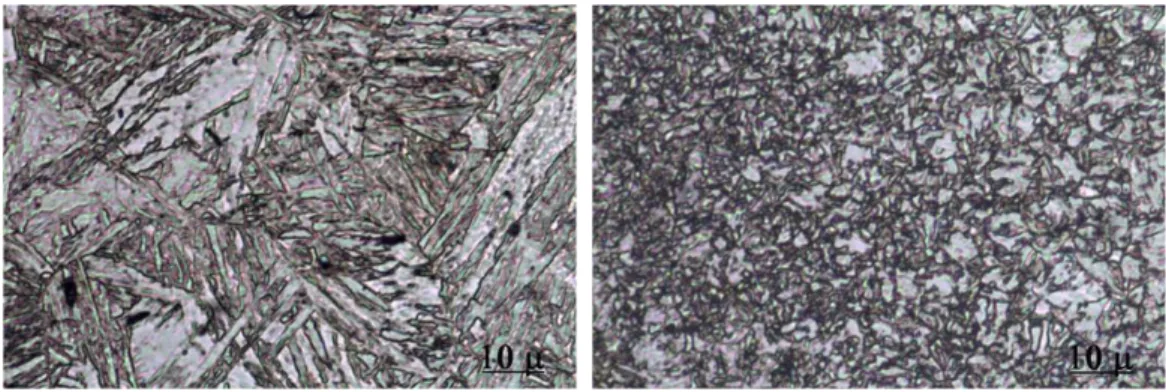
tempered and the most heavily loaded location: in the center of the weld, just below the root. Butt MAG welds typically failed in the HAZ – base metal interface. The parent metal has a dual-type microstructure consisting of martensite and a small proportion of ferrite with the grain size of about 5 μm. Laser welding is carried out without filler metal. The joint has therefore the same chemical composition as the base material and its microstructure consists of martensite. Solidification in the weld metal led to formation of coarse grains, whereas the HAZ remained fine-grained (Fig. 1). The HAZ width is 0.2 mm. Hardness remained unchanged. MAG welding produced acicular microstructure of bainite (hardness of about 230 HV), see Fig. 2, and a heat-affected zone with a 2 mm width.
Fig. 1. Microstructure of the laser: (a) weld; (b) HAZ
Fig. 2. MAG weld microstructures: (a) weld metal; (b) HAZ
Values of hardness measured in the welds are shown in Table 1. Laser welds contain martensitic microstructure with a corresponding hardness of about 370 HV. Hardness of the HAZ did not significantly decrease. Hardness of the MAG weld is dictated by the composition of the filler material. With OK Autrod 12.56 electrodes, it reaches 220 HV. Hardness in the HAZ is low as well, as martensite in the sheet base metal underwent intensive tempering.
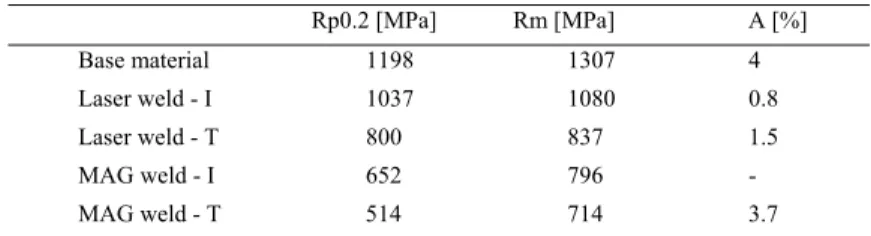
Strength of welded joints was examined by means of the classical tensile test. Its results are shown in Table 2, the laser weld is the one most close to the original state of material. The yield and ultimate strengths show a slight decrease. This is due to coarser acicular microstructure.
Table 1. Hardness HV10
Base material HAZ Weld
Laser weld 414 373 370
The decline in elongation was more pronounced; probably due to lower proportion of ferrite than in the base material. The T-joint often exhibits a more significant drop in strength: about 70% of strength of a butt joint is typically reported in literature. This was the case with the laser welds as well. By contrast, upon MAG welding the elongation of the weld material is retained (due to martensite tempering and presence of ferrite) but the drop in strength is significant, almost to one half of the original value. This is despite minimizing the introduced heat through pulse welding.
Table 2. Mechanical properties of DOCOL 1200 welds
Rp0.2 [MPa] Rm [MPa] A [%] Base material 1198 1307 4 Laser weld - I 1037 1080 0.8 Laser weld - T 800 837 1.5 MAG weld - I 652 796 - MAG weld - T 514 714 3.7 3.2. TRIP Steel
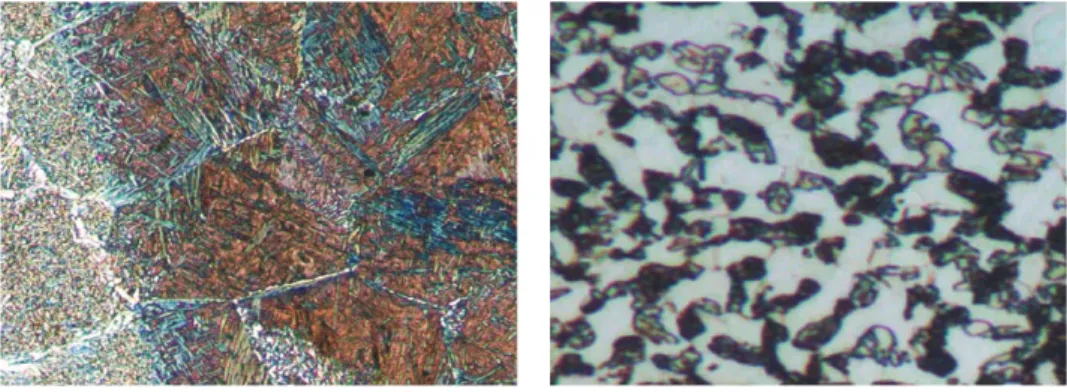
Failures in arc-welded parts occurred in all cases outside the HAZ: in the transitional region between the heat-affected zone and the base material of the tube, as shown on the side part of Fig. 3. The depth of the heat-affected zone in both MAG and GTAW (TIG) welds is approximately 5 mm. Fig. 4 shows a micrograph of the MAG specimen in the vicinity of the joint. The weld metal microstructure consists of ferrite and a small amount of acicular phase resulting from rapid cooling (Fig. 4, left). The hardness of approximately 250 HV is in line with this finding. The HAZ region close to the base material does not show signs of plastic deformation upon the tension test. It consists of martensite with high hardness. The
microstructure of this region is clearly the result of full- 3. It
borders on a dual steel-type microstructure formed in the intercritical region, where grains of original ferrite are interspersed with particles of newly-formed martensite. The proportion of martensite in the material and the hardness decreased with the falling temperature gradient. The right image in Fig. 4 shows the as-received microstructure of the TRIP steel. The typical grain size in this base material is approximately 3 μm.
Table 3 lists basic mechanical properties of welds in the TRIP material. The Rp0.2 proof stress of all
welds is higher than that of the base material of tubes. The highest ultimate strength Rm was found in the
MAG weld. The strength of the TIG weld is slightly less. The decline in elongation is very pronounced: the elongation of welds is one third of that of the base material.
In order to find whether mechanical properties of the material in the vicinity of the weld can be restored, subsequent intercritical heat treatment of the welded tubes was performed (using a schedule identical to that used for treating the tubes). This procedure did not yield favorable results. In specimens treated in this manner, the fracture initiation site was at the interface between the HAZ and the weld that no TRIP effect t
maximum strain region. The ultimate and yield strengths in these specimens approached those of the as-received material but their elongation remained very low: approximately 7%. The additional heat treatment does restore the original multiphase microstructure but the morphology of the transitional resulting elongation values low.
Fig. 4. MAG weld HAZ and base material microstructure (mag. 500×)
Mechanical tests (Table 3) showed that laser beam-welded parts have slightly higher yield and ultimate strengths than the as-received material. The elongation of the material in laser welds is about one-half that of as-received materials. Hard martensite microstructure of the weld prevented the test bar from deforming in its central region. Both sides of this central region then deformed independently. The left part (Fig. 5) showed more pronounced deformation.
Table 3. Mechanical properties of welds in TRIP steel
Rp0.2 [MPa] Rm [MPa] A [%] Base material 404 885 20.7 TIG 461.0 873.3 6.1 MAG 466.7 847.7 6.5 TIG HT 412.7 830.6 7.9 MAG HT 440.7 840.7 7.1 DL 487 1012 11.6 FL 486.7 997.2 10.7
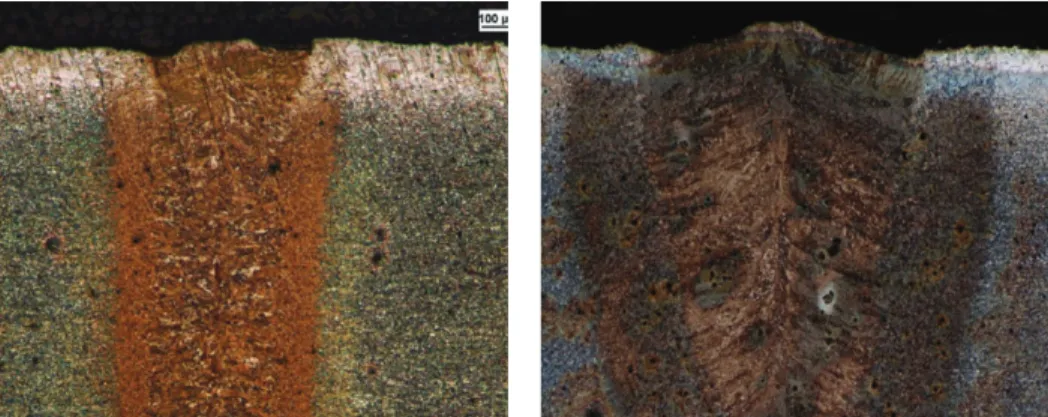
Small beam diameter, high power and high heat input rate of the laser minimize the size of the heat-affected zone, leading to a weld width as low as approximately 0.4 mm. The welding speed is several of the heat affected zone is therefore approximately 0.1 mm, as shown in Fig. 6. The chemical composition of the material contributed to the weld developing martensitic microstructure, as expected. The greater width of the FL weld is a consequence of the large diameter and power of the beam and of the
er than in the other welds).
Fig. 5. DL specimen upon tension test
This type of behavior was found in all tested specimens and can therefore be considered representative of this process. There is no difference between properties of welds made by fiber and diode lasers, as evidenced by tension test plots. Their high strengths and low elongations may be attributed to lower relative gage length of the test bar. In these welds, the fracture propagates in a manner different from that observed in arc-welded parts.The fracture remains within the base material of the tube, outside the heat-greatly distorted. It is evidenced by the steady section of the tension test plot at high stresses.
4.Conclusions
techniques. The resulting grain coarsening in the HAZ is minimal, as well as the HAZ width (0.2 mm). In both DOCOL 1200 martensitic steel and TRIP multiphase steel, the strength of laser welds is higher than that of arc welds. In these laser welds, the weld bead always showed higher hardness than that of the arc welds. In addition, it consisted of martensite in all cases. On the other hand, softening and t
welds is notably less than that in arc welds.
Consequently, the strength of DOCOL 1200 base material is retained and the elongation exhibits only a slight decrease. In contrast, the strength upon MAG welding drops to 700 MPa. The size of HAZ is 2 mm (10 times more than in laser welds) and its grain structure is very coarse. Hardness of laser welds is higher due to a greater temperature gradient and faster dissipation of heat. In laser-welded joints, the values of hardness in the weld and HAZ are approximately equal to that of the base material: about 380 HV. The MAG weld exhibited signs of tempering: hardness of the weld and HAZ dropped to 230 HV.
Significant differences between the behaviors of different types of welds in TRIP steel are most apparent in tension test specimens. Laser welding has minimum impact on the material in the vicinity of
-welded parts occur outside the weld and outside the HAZ. Plastic deformation is distributed across the entire length of the test bar (or across its half). The strength of laser welds is slightly higher than that of the base material. Their elongation is one-half that of the base material. On the other hand, the TIG weld failed at the interface between the base material and the HAZ. Its elongation was as low as 5% and its ultimate tensile strength was 100 MPa lower than that of the base material. Subsequent heat treatment of the welded tube shifted the fracture initiation site to an outer region of the weld but did not restore the plasticity of the material.
References
[1] Xia M., at all: ISIJ International, Vol. 48 (2008), No. 6, pp. 809-814. [2] Xia M., at all: ISIJ International, Vol. 48 (2008), No. 4, pp. 483-488. [3] www.autosteel.org, Accessed on July 3, 2012.
[4] Ion J.C., Laser processing of engineering materials, First Edition: Principles, Procedure and Industrial Application. Elsevier, 2005. ISBN-0-7506-6079-1.
[5]
[6] -471-43491-4.