HAL Id: hal-02265061
https://hal.archives-ouvertes.fr/hal-02265061
Submitted on 8 Aug 2019
HAL
is a multi-disciplinary open access
archive for the deposit and dissemination of
sci-entific research documents, whether they are
pub-lished or not. The documents may come from
teaching and research institutions in France or
abroad, or from public or private research centers.
L’archive ouverte pluridisciplinaire
HAL
, est
destinée au dépôt et à la diffusion de documents
scientifiques de niveau recherche, publiés ou non,
émanant des établissements d’enseignement et de
recherche français ou étrangers, des laboratoires
publics ou privés.
Learning Rich Event Representations and Interactions
for Temporal Relation Classification
Onkar Pandit, Pascal Denis, Liva Ralaivola
To cite this version:
Onkar Pandit, Pascal Denis, Liva Ralaivola. Learning Rich Event Representations and Interactions for
Temporal Relation Classification. ESANN 2019 - 27th European Symposium on Artificial Neural
Net-works, Computational Intelligence and Machine Learning, Apr 2019, Bruges, Belgium. �hal-02265061�
Learning Rich Event Representations and Interactions
for Temporal Relation Classification
Onkar Pandit1, Pascal Denis1and Liva Ralaivola2 1- MAGNET, Inria Lille - Nord Europe, Villeneuve d’Ascq, France
[email protected], [email protected]
2- QARMA, IUF, LIS, Aix-Marseille University, CNRS, Marseille, France, Criteo AI Labs, Paris, France. [email protected]
Abstract. Most existing systems for identifying temporal relations between events heavily rely on hand-crafted features derived from event words and explicit tempo-ral markers. Besides, less attention has been given to automatically learning con-textualized event representations or to finding complex interactions between events. This paper fills this gap in showing that a combination of rich event representations and interaction learning is essential to more accurate temporal relation classifica-tion. Specifically, we propose a method in which i) Recurrent Neural Networks (RNN) extract contextual information ii) character embeddings capture morpho-semantic features (e.g. tense, mood, aspect), and iii) a deep Convolutional Neu-ral Network (CNN) finds out intricate interactions between events. We show that the proposed approach outperforms most existing systems on the commonly used dataset while using fully automatic feature extraction and simple local inference.
1
Introduction
Recovering temporal information from texts is a crucial part of language understanding, and it has applications such as question answering, summarization, etc.
Temporal relation identification is divided into two main tasks, as identified by Tem-pEval campaigns [1]: i) the identification ofEVENTs and other time expressions (the so-called TIMEX’s), and ii) the classification of temporal relations (orTLINKs) among and across events and time expressions [2, 3, 4, 5]. Possible relations for this latter task include temporal precedence (i.e., BEFOREor AFTER), inclusion(i.e., INCLUDES or
IS INCLUDED), and others inspired from Allen’s algebra. In this work, we concentrate on temporal relation classification, specificallyEVENT-EVENTrelations.
The problem becomes harder in the absence of explicit temporal connectives (e.g.,
before, during), determining temporal relations depends on numerous factors,
rang-ing from tense and aspect to lexical semantics and even world knowledge. To address this issue, most state-of-the-art systems forEVENT-EVENTclassification [2, 3, 5] rely on manually-crafted feature sets directly extracted from human annotations, comple-mented with syntactic features, and semantic features extracted from static knowledge bases like WordNet or VerbOcean. Such an approach is tedious, error-prone and the semantics of events is poorly modelled due to lack of coverage of existing lexical re-sources and blindness to event contexts.
We here propose a radically different approach where we altogether dispense with hand-designed features and instead learn task-specific event representations. These rep-resentations include information both from the event wordsandits surrounding context, thus giving access to the events’ arguments and modifiers. Furthermore, character based
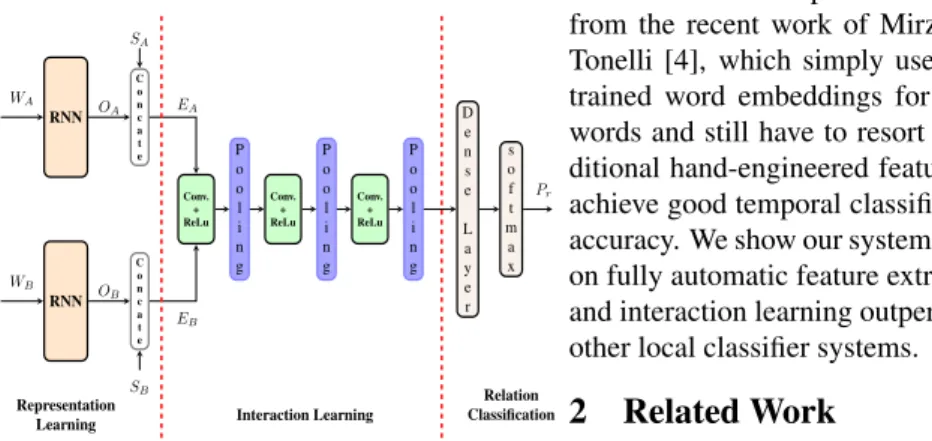
model capture another type of information captured by morphology such as tense and aspect of event. Plus, we also attempt to learn the potentially rich interactions between events. Concretely, our learning framework, as depicted in Fig.1, is based on a neu-ral network architecture, wherein: i) Recurrent Neuneu-ral Network (RNN) is employed to learn contextualized event representations ii) character embeddings is used to capture morphological information, hence encoding tense, mood and aspect information, and iii) a deep Convolutional Neural Network (CNN) architecture is then used to acquire complex, non-linear interactions between these representations.
RNN RNN C o n c a t e C o n c a t e Conv. + ReLu P o o l i n g Conv. + ReLu P o o l i n g Conv. + ReLu P o o l i n g D e n s e L a y e r s o f t m a x OA OB EA EB SA SB WA WB Pr Interaction Learning Relation Classification Representation Learning
Fig. 1: Architecture of our proposed model.
This is one important step up from the recent work of Mirza and Tonelli [4], which simply uses pre-trained word embeddings for event words and still have to resort to ad-ditional hand-engineered features to achieve good temporal classification accuracy. We show our system based on fully automatic feature extraction and interaction learning outperforms other local classifier systems.
2
Related Work
Recent temporal classification sys-tems use machine learning tech-niques due to the availability of annotated datasets. Earlier work [2, 6] studiedlocal
models (i.e., making pairwise decisions on pairs of events) and used gold-standard features extracted from TimeML annotations. State-of-the-art local models such as ClearTK [7] relied on an enlarged set of predicted features, and classifiers. These lo-calmodels may generate globally incoherent temporal relations, in the sense that the symmetry and transitivity holding between relations are not followed at the document level. This has led to development ofglobalmodels [3]. The state-of-the-art method [5] proposes a structured prediction approach.
These methods all rely on manually engineered features, which fail to model the semantics of events. To address this issue, [4] have evaluated the effectiveness of pre-trained word embeddings of event head-word. They also demonstrated the potency of basic vector combination schemes. However, representing events with word embed-dings of only its head-word is not effective and important contextual information is lost. Recently proposed LSTM-based neural network architectures [8, 9] learn event repre-sentation with use of event head word as well as context. Also, newly proposed method [10] have shown efficacy of context with use of gated RNN-attention based neural ar-chitecture. However, by using only word embeddings they fail to capture inflectional morphology of event head word, which includes crucial linguistic information such as tense, aspect, and mood. Also they lacked in finding complicated interaction between events and relied only on concatenation of event features. Moreover they [9] used syn-tactically parsed trees as inputs to the LSTM which adds burden of pre-processing.
3
Method
Our proposed neural architecture (Fig.1), consists of two main components: Repre-sentation Learning and Interaction Learning. In the RepreRepre-sentation Learning part, a bag-of-words in a fixed size window centred on each event word is fetched and fed into a RNN to get more expressive and compact representation of events. Output of the RNN is concatenated with character embedding of event head-word to get the final vector for each event. This vector representation is then used at the Interaction Learning stage: the vector representation of each event is fed to a convolution layer and the final pooling layer outputs an interaction vector between the events. A dense layer is used to combine the interaction vector before obtaining a probability score for each relation.
3.1 Representation Learning
Context-aware Representation
Each word is encoded in the event-word win-dow with word embeddings [11]. As a result, each word is assigned a fixedd-dimensional vector representation. Letclbe the context length for each event head wordwt. Thuswe consider a window of2cl+ 1words as input to the RNN. We represent this as
ma-trixW = [wt−cl· · ·wt· · ·wt+cl] ∈ R
(2cl+1)×d. Note that while considering event
context we stop at sentence boundary, also special symbols are padded if context is less thancl. The relation between input and output of RNN at each timetis given as
follows,
ht=σh(Qhwt+Uhht−1+bh) (1)
ot=σo(Qoht+bo) (2)
where,wtis the word embedding vector provided at each time step,htis hidden layer
vector andotis output vector. Q,U, andb are weight matrices and vector; σh and
σoare activation ReLU functions. For a given event, theot+cl output vector captures
a complete information about the whole sequence. The outputs of the RNN networks give compact representationsOAandOBof the events.
Morphological Representation
Semantics and arguments of events are captured with context-aware representation but it doesn’t capture morphological information such as tense and aspect. For instance, tense information is captured from context as well with auxiliary verbs (will,is). However in the absence of these words, tense information of event is expressed in inflectional suffixes such as-ed,-ing. To obtain this information, event head wordwtis represented as a sequence of charactern-gramsc1,· · ·, cm wherem is number of n-gramsin word. Fixed dc dimension vector is
learned for eachn-gram. Eventually morphological representation of word is obtained by adding vectors ofn-gramspresent in the word. Standardfasttext[13] method is used to get this representation.
Context-aware vectorOAand character embedding vectorSAare concatenated to
ob-tain final event representation asEA, similarlyEBalso obtained for eventB.
3.2 Interaction Learning
A deep Convolution Neural Network (CNN) is employed to learn nonlinear interac-tions fromEAandEB. It is comprised of three convolution and pooling layers placed
alternatively. We feed concatenated learned event representations
to the first convolution layer, where⊕is the concatenation operation. Each convolution layeriuse filtersfi, after what we compute a feature map
mki =σ(fi.EAB+bi) ∀k∈ {1,2,3}, (4)
wherefi,biare filters and bias matrices respectively andσis the ReLU activation. The
output is down-sampled with a max-pooling layer to keep prominent features intact. The output of the last layer gives the interaction betweenAandB(ρis max-pooling).
Ecomb=ρ(m3i) (5)
The combined Ecomb vector is fed to a fully connected dense layer, followed by a
softmax function to get a probability score for each temporal relation class.
4
Experiments
4.1 Datasets and Evaluation
Relations
Following recent work [5], reduced set of temporal relations:after, before,includes, is included, equal, vagueare considered for classification.
Evaluation
Complying with common practice, system’s performance is measured over gold event pairs (pairs for which relation is known). Our main evaluation measure is the Temporal Awareness metric [12], adopted in recent TempEval campaigns. We also used standard precision, recall, and F1-score.Datasets
We used TimeBank (TB) and AQUAINT (AQ) dataset for training, TimeBank-Dense(TD) for development and Platinum (TE3-PT) dataset for testing. These are the most popular datasets used for the task which have been provided at TempEval3 [1].4.2 Training Details
We used pre-trained Word2Vec vectors from Google1. Each word in the context window
of event is represented with this300-dimension vector. Character embeddings for event head word are obtained fromfasttext[13] which is also300-dimension vector. Note that only one RNN is trained with weight sharing to learn representation. Hyperparameters were tuned on the development set using a simple grid search. Considered values are: window size (cl: 3,4,5), number of neurons at RNN (#RNN: 64,128,256,512), number
of filters for CNN (#filters: 32,64,128,256), dropout at input (0.1,0.2,0.3,0.4). We also explored a number of optimization algorithms such as AdaDelta, Adam, RMSProp and Stochastic Gradient Descent(SGD). Optimal hyper-parameter values arecl= 4,#RNN
=256, #filters = 64, dropout = 0.4 and Adam optimizer.2 Once we got the optimal pa-rameter values from the validation set, we re-trained multiple models with50different seed values on the combined training and development data and report the averaged test performances.
4.3 Results
We first compare our RNN-Deep CNN approach to various baseline systems to assess the effectiveness of the learned event representations. We also want to disentangle the respective role of the representation learning and interaction learning.
Baseline systems
As Mirza and Tonelli [4] reported results only with pairwisef-scoreon different dataset, we re-implemented their system with scikit-learn Logistic
1https://code.google.com/archive/p/word2vec/
2We tried different unidirectional and bidirectional variations of RNN-LSTM and GRU, but RNN gave the best development results.
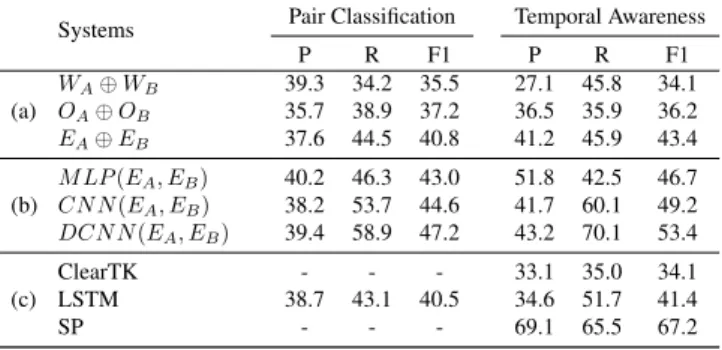
Systems Pair Classification Temporal Awareness P R F1 P R F1 (a) WA⊕WB 39.3 34.2 35.5 27.1 45.8 34.1 OA⊕OB 35.7 38.9 37.2 36.5 35.9 36.2 EA⊕EB 37.6 44.5 40.8 41.2 45.9 43.4 (b) M LP(EA, EB) 40.2 46.3 43.0 51.8 42.5 46.7 CN N(EA, EB) 38.2 53.7 44.6 41.7 60.1 49.2 DCN N(EA, EB) 39.4 58.9 47.2 43.2 70.1 53.4 (c) ClearTK - - - 33.1 35.0 34.1 LSTM 38.7 43.1 40.5 34.6 51.7 41.4 SP - - - 69.1 65.5 67.2
Table 1: Results of baseline and state-of-the-art systems
regression module, usingl2regularization (notedWA⊕WB). Word embeddingsWA
andWBof eventsAandBobtained from Word2Vec were simply concatenated (as this
is their best performing system). We conducted number of experiments to obtain opti-mal parameters and reported best performing system’s results. We got lower than the originally reported results as the dataset is sparsely annotated compared to the one in the paper (TimebankDense). As additional baselines, we used our Representation Model to learnOAandOB, subsequentlyEA,EB, but combined these vectors with simple
concatenation (OA⊕OB andEA⊕EB). In another setting learned representation is
combined with multi-layer perceptron (MLP) and single-layer convolution (CNN).
Comparison to Baseline Systems
Sectionsaandbof Table 1 summarize the performance of these different systems in terms of pairwise classification accuracy and temporal awareness scores. Looking at the first two rows of the table, we see that, as hypothesized, contextually rich features outperform pre-trained event head word em-beddings when combined with simple concatenation, both in pairwise classification and in temporal awareness. A further gain in the performance with character embeddings shows the effectiveness of morphological features. Results from the section establish the effectiveness of our rich representation learning. In sectionbof the table, we present results of the system with different interaction learning.The system with MLP inter-action learning outperforms simpleconcatenation(EA⊕EB) system, demonstratingimportance of interaction learning. Leveraging both rich event representations learning and non-linear interaction learning yield the best scores overall, cf. CN N(EA, EB)
andDCN N(EA, EB), which shows their complementarity. There, the Deep CNN
outperforms the single-layer CNN, with F1 scores of53.4and49.2, respectively. This confirms the importance of non-linear interaction learning in the task.
Comparison with State-of-the-artFinally, in the sectionc, we compare the perfor-mance of our best system,DCN N(EA, EB), with recently proposed systems :WA⊕
WB [4], ClearTK [7], which was the winner of the TempEval 2013 campaign, the
structured prediction (SP) approach[5], which is the best system to date and recently proposed LSTM [14]. Our system delivers substantial improvements overWA⊕WB,
ClearTK, and LSTM based system. However our system lags in comparison with SP as it relies only on simple local inference opposed to global inference at learning step, also totally dispenses with hand-crafted features. It is important to observe that our system closes the performance gap between SP system and automatic feature learned systems.
5
Conclusion and Future Work
In this work, we proposed RNN based neural architecture to learn event representation and CNN model to get interaction between events. A new perspective towards the combination of events proved to be effective in getting compound interactions. We compared result of our system with multiple baselines and state-of-the art systems and shown effectiveness. We now plan to learn features and interaction while considering global consistency in the relations of event pairs.
Acknowledgement
This work was supported by ANR Grant GRASP No. ANR-16-CE33-0011-01, as well as by a grant from CPER Nord-Pas de Calais/FEDER DATA Advanced data science and technologies 2015-2020.
References
[1] N. UzZaman, H. Llorens, L. Derczynski, J. Allen, M. Verhagen, and J. Puste-jovsky. Semeval-2013 task 1: Tempeval-3: Evaluating time expressions, events, and temporal relations. ACL, 2013.
[2] I. Mani, M. Verhagen, B. Wellner, C. M. Lee, and J. Pustejovsky. Machine learn-ing of temporal relations. ACL, 2006.
[3] N. Chambers, T. Cassidy, B. McDowell, and S. Bethard. Dense event ordering with a multi-pass architecture. TACL, 2014.
[4] P. Mirza and S. Tonelli. On the contribution of word embeddings to temporal relation classification. COLING, 2016.
[5] Q. Ning, Z. Feng, and D. Roth. A structured learning approach to temporal relation extraction. EMNLP, 2017.
[6] Nathanael Chambers, Shan Wang, and Dan Jurafsky. Classifying temporal rela-tions between events. ACL, 2007.
[7] S. Bethard. ClearTK-TimeML: A minimalist approach to tempeval 2013. ACL, 2013.
[8] D. Dligach, T. Miller, C. Lin, S. Bethard, and G. Savova. Neural temporal relation extraction. ACL, 2017.
[9] F. Cheng and Y. Miyao. Classifying temporal relations by bidirectional lstm over dependency paths. ACL, 2017.
[10] Y. Meng and A. Rumshisky. Context-aware neural model for temporal information extraction. ACL, 2018.
[11] T. Mikolov, I. Sutskever, K. Chen, G. S Corrado, and J. Dean. Distributed repre-sentations of words and phrases and their compositionality. NIPS, 2013.
[12] N. UzZaman and J. F. Allen. Temporal evaluation. ACL, 2011.
[13] T. Mikolov, E. Grave, P. Bojanowski, C. Puhrsch, and A. Joulin. Advances in pre-training distributed word representations. InLREC, 2018.
[14] Y. Meng, A. Rumshisky, and A. Romanov. Temporal information extraction for question answering using syntactic dependencies in an lstm-based architecture.