Round-Robin Routing Policy
Value Functions and Mean Performance with Job- and Server-specific Costs
Esa Hyytiä
Department of Communications and Networking Aalto University, Finland
Samuli Aalto
Department of Communications and Networking Aalto University, Finland
[email protected]
ABSTRACT
We study the round-robin (RR) routing to a system of par-allel queues. The cost structure comprises two components: a service fee and a queueing delay related component, where both can be job- and queue-specific random variables. With Poisson arrivals, the inter-arrival time to each queue obeys Erlang’s distribution. This allows us to study the mean and transient behavior of the queues separately. The ser-vice fee is independent of the queueing, and we obtain the corresponding mean cost rate and value function in closed forms. With respect to queueing delay, we first derive inte-gral expressions enabling efficient computation of the corre-sponding value function. By decomposition, these yield also the value function for the whole system ofkparallel queues fed by RR. Given the value function, one can carry out the first policy iteration step with arbitrary holding cost rates (e.g., delay, slowdown etc.) yielding efficient size-, cost- and state-aware policies. Moreover, the mean waiting time in an M/G/k-RR system gets resolved at the same time. The re-sults are demonstrated in the numerical examples, where we compute near optimal task assignment policies for a sample system with two servers.
Keywords
Round-Robin, M/G/k-RR-system, Erl/G/1-queue, Task as-signment, MDP
1.
INTRODUCTION
In the task assignment (or routing) problems, one chooses a server for each new job immediately upon the arrival. The objective is to minimize the mean response time, slowdown, energy consumption, or some other performance quantity of interest. Within each queue, the first-come-first-served (FCFS) scheduling is usually assumed, but other scheduling disciplines can also be considered. Even though task assign-ment problems have been studied extensively in the liter-ature, only a few optimality results are known, and these generally require homogeneous servers.
TheJoin-the-Shortest-Queue(JSQ) policy assigns a new job to the server with the least number of tasks. Assuming exponentially distributed inter-arrival times and job sizes, and homogeneous servers, [1] shows that JSQ, followed by FCFS, minimizes the mean response time. Since then the optimality of JSQ has been shown in many other settings [2, 3, 4, 5, 6, 7, 8]. Similarly,Round-Robin (RR), followed by FCFS, has been shown to be the optimal policy when it is only known that the queues were initially in the same state, and the routing history is available [3, 9, 10]. With a Poisson arrival process and RR, the inter-arrival times to each queue obey Erl(k, λ) distribution, wherekdenotes the number of servers.
The Least-Work-Left (LWL) policy assigns a new job to the queue with the least amount of unfinished work. LWL is equivalent to M/G/k with a shared queue [11, 12], and thus it makes sure no server is idle when there are jobs in the queue. Interestingly, with constant service times, LWL, JSQ and RR make equivalent decisions as in M/D/k (with a shared queue), which can also be shown to be optimal with respect to the mean delay.
The M/G/ksystem is non-trivial to analyze. More results are available for M/D/k. The first analytical result for the distribution of waiting time in M/D/k is by Crommelin [13]. Numerically much more stable expressions are given by Franx [14], who has also analyzed its transient behavior in [15]. In particular, [14] gives the waiting time distribution as a function of the queue length distribution, allowing also the determination of the mean waiting and sojourn times. For extensive surveys on the topic we refer to [16, 17]. Value functions for single server queues with Poisson ar-rivals have been derived in [18, 19, 20, 21], which form the basis also for value functions for task assignment sys-tems operating under a state-independent policy such as the Bernoulli-split. With state-dependent policies, such as RR and LWL, the queues are coupled and the analysis gets more complicated. In this paper, we derive a set of integral equa-tions that enable efficient computation of the value function with respect to arbitrary holding cost based cost structure in a size-aware task assignment system subject to RR routing policy and FCFS scheduling discipline. Jobs arrive accord-ing to a Poisson process with rate λ and the servers are assumed to be identical.1 As an interesting and useful side
1In fact, the analysis does not depend on this and the results
Round Robin
FCFS
λ
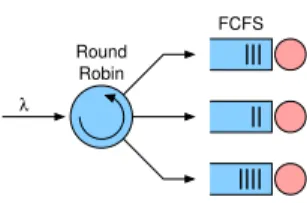
Figure 1: Round-Robin routing to k servers.
product, these expressions also provide a new approach to determine the mean waiting time in an M/G/k-RR system, whereas using the results given in [14] for M/D/k-RR re-quires the determination of the queue length distribution as an intermediate result.
The rest of the paper is organized as follows. First, in Sec-tion 2, we analyze a single Erl(k, λ)/G/1 queue and derive both differential and integral expressions for the value tion. The latter are suitable for computing the value func-tion numerically in an efficient iterative manner. Secfunc-tion 3 discusses the task assignment problem, holding costs and policy iteration. In Section 4, we give numerical examples, including a near-optimal task assignment policy based on two steps of the policy iteration, and Section 5 sheds light on possible more elaborate applications. Section 6 concludes the paper.
2.
ANALYSIS OF THE ROUND-ROBIN
In this section, we analyze the round-robin routing policy illustrated in Fig. 1. With Poisson arrivals, the arrival pro-cess to each queue is Erl(k, λ)/G/1, which facilitates the analysis. First we describe the model and the cost struc-ture, and then derive expressions for calculating the queue-specific value functions forarbitrary job-specific holding cost rates, which also give the mean delay in the system. The approach extends also the generalized round-robin routing, where the decisions are according to some predefined peri-odic sequences.
2.1
Model and Cost Structure
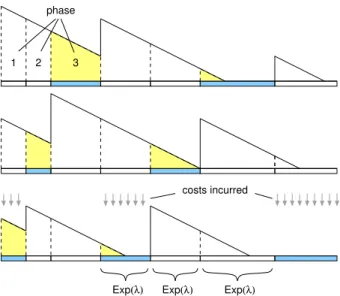
We consider an M/G/k-RR (Round-Robin) system illus-trated in Fig. 1. With a Poisson arrival process, each queue behaves according to an Erl(k, λ)/G/1 queue, where the inter-arrival time in each queue is a sum ofk independent and exponentially distributed time-intervals, i.e., phases, with mean durations of 1/λ. Jobs arrive at the end of phasek, af-ter which a new phase 1 starts. The evolution of the queues is naturally coupled as they see the same Poisson process, while each of them is in a different phase (1, . . . , k). The cost structure comprises two components. First, Jobipays aservice feeofκiupon entering a queue. Second, Jobi
in-curs costs atholding cost rateHiwhile waiting in a queue.
We further assume that the service timeX, the service fee κand the holding cost rateHall may depend on the queue they are assigned to. Thus, in general, Jobjis defined by the triple Xj,i, Hj,i and κj,i, where i corresponds to the
queue, i = 1, . . . , k. In practice, the holding cost rate is often job-specific,Hi,j =Hi and the service fee is either a
server-specific constant or a function of service time,κi,j =
systems. However, the round-robin policy is not an ideal candidate if the service rates are highly asymmetric.
gj(Xi,j) (cf. per bit charging in mobile networks). That is,
one can associate the holding cost with the queueing delay a job experiences and the service fee with a (server-specific) service cost/time (cf. energy). In particular, we assume that jobs are i.i.d.,
(Xi,Hi,κi)∼(X,H,κ),
while the different parameters of a single job may depend on each other (e.g., the service fee can be equal to the service time). Note that withH= 1 andκ=X, the costs incurred are equal to the sojourn time.
With RR, the jobs are assigned sequentially, independently of their holding cost rates and service fees, and hence the above cost structure is unnecessarily complicated. However, later in Section 3, we consider also routing policies that take into account the job- and server-specific characteristics, and hence the notation. In the rest of this section, we, however, can focus on Erl(k, λ)/G/1-queues.
2.2
Service Fees
Let us first consider the service fees each queue incurs. Let κj ∼κdenote the service fee of the jth job assigned to a
given queue. Then let i denote the current phase in the arrival process, i= 1, . . . , k, such that at the end of phase ka job arrives and a cost ofκjis incurred. We note that a
sufficient state description with respect to service fees is the current phase of the arrival process.
Consequently, thevalue functionwith respect to service fees depends only on the current phase and is defined as the expected difference between a system initially in phaseiand a system initially in equilibrium,
vi, lim
t→∞E[Vi(t)−rκt],
where Vi(t) denotes the service fees incurred during (0, t)
when initially in phasei, andrκis the mean rate at which
service fees are incurred, rκ=
λE[κ]
k .
In this case,viis relatively easy to deduce as
vi=
k−i+ 1
λ (0−rκ) + E[κ] +v1,
where the first term corresponds to the time interval until the next arrival, the second term is the mean immediate cost due to the arrival, andv1 takes care of the future costs (cf.
Markov property). Consequently, vi−v1=
i−1 k E[κ]. As each phase is equally likely,P
ivi= 0, and
vi=
2i−k−1
2k E[κ]. (1)
Letz= (κ(1), . . . , κ(k)) denote the current state of the whole system, where κ(i) is the service fee of the queue that is currently in phasei. The value function of the whole system ofkparallel queues in statezis
vz= 1 2k k X i=1 (2i−k−1)E[κ(i)]. (2)
(λ)
Exp Exp(λ) Exp(λ)
costs incurred phase
1 2 3
Figure 2: Sample path with k=3 queues.
Note that the value function is insensitive to the arrival rate λand depends only on the phases (i.e., the RR sequence) and the mean service fees. In fact, the constant offset in the value functions is irrelevant to us, and we can equally use
vz= 1 k k X i=1 iE[κ(i)], (3)
from which it is obvious that the Round-Robin sequence assigning the jobs (initially) in the increasing order of the mean service fee so that E[κ(i)]≤E[κ(i+1)] incurs the least
costs, as expected.
2.3
Virtual Waiting Time
We are often also interested in the waiting and sojourn time the jobs experience in a system. To this end, we define thevirtual waiting time in the system as the backlog of the queue receiving the next customer. More precisely, we de-fine the holding cost rate of the system to be equal to the backlog of the queue in phasek. Considering an individual Erl(k, λ)/G/1 queue, it thus incurs costs at the rate equal to the backlog only during phasek, at the end of which a new job arrives. This is illustrated in Fig. 2. Due to the PASTA property, this corresponds to the waiting time the jobs ar-riving to the M/G/k-RR system see. We let ˜r denote the mean cost rate in a single queue andrin the whole system, r= E[W], for which we have the elementary relationship
˜ r=r/k.
Consider next a single Erl(k, λ)/G/1 queue. LetIt denote
the phase of the arrival process at timetandUtthe backlog.
The cost structure described above means that the queue incurs costs at rate
Ct= 1(It=k)·Ut.
Let vi(u) denote the value function, where i denotes the
initial phase,i= 1, . . . , k, anduis the initial backlog. For-mally,
vi(u), lim
t→∞E[Vi(u, t)−r t],˜
whereVi(u, t) denotes the costs a queue initially in phasei
with backloguincurs during timet, Vi(u, t) =
Z t
0
Csds.
Next we derive a system of differential equations that the value functionsvi(u) must satisfy. For u >0, smallδ >0,
and for phasesi= 1, . . . , k−1
vi(u) = (0−˜r)δ+(1−λδ)vi(u−δ)+λδ vi+1(u−δ).
The first term corresponds to the difference between the cur-rent cost rate (zero for phasesi6=k) and the mean cost rate ˜
r multiplied by the time-interval δ. With the probability of (1−λδ), the phase remains the same andvi(u−δ) gives
the future contribution, and with the probability ofλδ, the arrival process moves to the next phasei+ 1, the value of which is given byvi+1(u−δ). In contrast, at the end of last
phaseka new job arrives, and thus forvk(u) we have
vk(u) = (u−˜r)δ+(1−λδ)vk(u−δ)+λδ
∞
Z
0
f(s)v1(u+s)ds,
where f(s) is the pdf of the service time. As δ → 0, the above yields a system of integro-differential equations,
vi0(u) =−r˜+λ(vi+1(u)−vi(u)), i= 1, .., k−1
vk0(u) =u−r˜+λ
∞
R
0
f(s) (v1(u+s)−vk(u))ds. (4)
For the special case of a constant service time ∆, the latter equation reads
v0k(u) =u−˜r+λ(v1(u+ ∆)−vk(u)),
and we have a first-order system of differential equations. Considering an empty system withu= 0 gives
˜ r =λ(vi+1(0)−vi(0)), i= 1, . . . , k−1, ˜ r =λ ∞ R 0 f(s) (v1(s)−vk(0))ds. (5)
With a constant service time ∆, the latter equations reads ˜
r=λ(v1(∆)−vk(0)).
Combining (4) and (5) gives,
v0i(0) = 0, i= 1, . . . , k,
v00i(0) = 0, i= 1, . . . , k−1.
(6) Adding the equations (5) together gives
k˜r=r=λ
Z ∞
0
f(s)(v1(s)−v1(0))ds, (7)
which for a constant service time ∆ reduces to k˜r=λ(v1(∆)−v1(0)).
Similarly, we have for alli= 1, . . . , k−1
vi+1(0)−v1(0) =
i˜r
λ. (8)
That is, initially the value functionsvi(u) atu= 0 differ by
a constant amount of ˜r/λ.
Note that both (4) and (5) are insensitive to a constant term in the vi(u). The constant offset in the value
v1(0) = 0. Unfortunately, (4) and (5) are difficult to solve
even numerically. If the mean cost rate ˜r was available in a closed form, (5) would give the initial values vi(0) = 0
also for i = 2, . . . , k. Moreover, even if the initial values were available,vk0(u) still depends on thev1(u+s), s >0,
and therefore the standard Runge-Kutta method could not be applied to compute the vi(u) foru > 0. However, one
could solve thevi(u) numerically backwards foru < u∗given
thevi(u∗) were available for someu∗ >0. We describe an
elegant approach to solve thevi(u) and ˜r in Section 2.3.2.
Finally, fork= 1 the system reduces to M/G/1, for which the exact value function is available [21]
v(u)−v(0) = u
2
2(1−ρ). (9)
It is easy to see that (9) satisfies (4), and applying to (5) gives, as expected, the Pollazcek-Khinchine formula for the mean waiting time.
2.3.1
Asymptotic Behavior
It is straightforward to argue that, with relatively broad assumptions, the asymptotic behavior of the value function of the G/G/1-FCFS queue is quadratic. For large u, the backlog decreases with an average rate of 1−ρ0, whereρ0 denotes the queue specific offered load. The virtual waiting time incurred during the remaining busy period corresponds to a triangle with initial height u and base (= duration) u/(1−ρ0). Therefore, v(u)≈ u 2 2(1−ρ0) − u 1−ρ0 ·r+v(0),
where the first term corresponds to the costs incurred during the remaining busy period, the second term to the mean cost rate during the same time-interval, and the third term corresponds to what happens after that. For large u, the first quadratic term dominates.
With Erl(k, λ)/G/1, in the context of RR, the costs are ac-crued only in the final phasekas explained above (see also Fig. 2). Letρdenote the offered load to the whole system, ρ=λE[X], so thatρ0=ρ/k. The costs accrued during the remaining busy period are roughly 1/kof the “full triangle”, i.e., foru1 we have,
vi(u)≈ u2 2(k−ρ), and v 0 i(u)≈ u k−ρ. (10)
2.3.2
Numerical Solution for
vi(u)The equations (4) can be written in integral form. Fori= 1, . . . , k−1, multiplying both sides witheλu gives
eλuvi0(u) +λeλuvi(u) =eλu(−r˜+λvi+1(u)).
The left-hand side is equal to (d/du)eλuvi(u), yielding
eλuvi(u) = Zu 0 eλs(−r˜+λvi+1(s))ds+vi(0), vi(u) = ˜ r λ(e −λu −1) +e−λuvi(0) +λ u Z 0 e−λ(u−s)vi+1(s)ds.
Similarly, for phasekone obtains vk(u) = ˜ r λ(e −λu −1) +e−λuvk(0) + e−λu+λu−1 λ2 + λ Z u 0 e−λ(u−s) Z ∞ 0 f(`)v1(s+`)d` ds.
As we are generally interested in the differences between the relative values, we can setv1(0) = 0 so that
vi(0) = (i−1)˜r λ , fori= 1, . . . , k, and ˜ r λ = vi+1(0) i , fori= 1, . . . , k−1, 1 k Z ∞ 0 f(s)v1(s)ds.
Substituting these into the above gives
vi(u) = e−λu−1 i vi+1(0) +λ u Z 0 e−λ(u−s)v i+1(s)ds, i= 1, . . . , k−1, vk(u) = e−λu−1 k Z∞ 0 f(s)v1(s)ds+ e−λu+λu−1 λ2 +λ u Z 0 e−λ(u−s) ∞ Z 0 f(`)v1(s+`)d` ds. (11) For a constant service time ∆, the latter reads
vk(u) = e−λu−1 k v1(∆) + e−λu+λu−1 λ2 +λ u Z 0 e−λ(u−s)v 1(s+ ∆)ds. (12)
Note that (11) expressesvi(u) as a functionvi+1(u) fori=
1, . . . , k−1, and vk(u) as a function of v1(u). Therefore,
given an initial guess for one of thevi(u), provided, e.g., by
(10), the equations (11) can be iterated until they converge. In practice, the convergence turns out to be fast (at least whenX has a light tail).
As a convenient side product of being able to determine the value functions efficiently, also the mean cost rate, i.e., the
mean waiting time, is obtained, e.g.,
E[W] =r=λk(v2(0)−v1(0)), (13)
wherev1(0) was set to zero. Note that in order to compute
E[W], we do not need to find the waiting time distribution first (which itself is non-trivial, [14]).
Again, fork = 1 the insensitive solution (9) can be shown to satisfy (11). That is, for the M/G/1 queue we have,
v(u) = e−λu−1 ∞ Z 0 f(s)v(s)ds+e −λu+λu−1 λ2 +λ u Z 0 e−λ(u−s) ∞ Z 0 f(`)v(s+`)d` ds, (14) which “trial” v(u) = u 2 2(1−ρ),
Waiting time Sojourn time MD1 MD2 MD1 MD2 0 0.2 0.4 0.6 0.8 1 1.2 1.4 0 0.5 1 1.5 Arrival rateΛ M e a n ti m e
Mean waiting and sojourn time
Figure 3: Mean waiting time (lower curves) and so-journ time (upper curves) for M/D/2 and M/D/1 (with service rate c=2).
2.4
Generalized Round-Robin (GRR)
RR is a special case of thegeneralized round-robin policies defined by predefined typically periodic sequences [22, 23, 24]. RR is optimal under certain assumptions when the servers are identical. However, if some servers have different service rates, then the even split of tasks that RR carries out may no longer make sense. In [22], Hajek proves the intuitive result that among a very large class of arrival pro-cess, the one with constant inter-arrival times is optimal for a single server queue with exponentially distributed ser-vice times. Then, in [23], he shows that the so-called most-regular-sequence is optimal for two, not necessarily identical, servers when jobs again obey exponential distribution. Suppose that the (external) sequenceai defining the task
assignments is periodic with k denoting the length of the period. Without lack of generality, we can consider Queue 1. With respect to service fees, both the mean rate and value function are straightforward to deduce. We omit these for brevity. For the virtual waiting time, letvi(u) again denote
its value function with respect to the backlog (in phases with actual arrivals, ai = 1). For notational convenience,
we definevi+k(u) , vi(u). Similarly as earlier, we have a
system of differential equations, v0i(u) =
−˜
r+λ(vi+1(u)−vi(u)), ifai6= 1, u−˜r+λR
f(t) (vi+1(u+t)−vi(u))dt, ifai= 1,
where the initial values are coupled, v0i(0) = ( −r˜ λ+vi+1(0), ifai6= 1, −r˜ λ+ R f(t)vi+1(t)dt, ifai= 1.
That is, the generalized (periodic) RR can be analyzed es-sentially the same way as RR. Also probabilistic variants, where subsequences are chosen with certain probabilities (for load-balancing reasons), are amenable to the same approach.
2.5
Examples with Value Function
Let us next give some elementary numerical examples with the above theoretical results. Here we consider only the virtual waiting time. The service fee is included to the cost structure later in Section 3.
v2H uL v1Hu L DH0.5,10L DH0.5,5L UH0,2L DH1L DH0. 5,10 L DH1 L 0 1 2 3 4 0 2 4 6 8 10 12 14 Backlog u V a lu e fu n c ti o n vi H u L
Value Functions for Different Service Times
Figure 5: Value function vi(u) for k=2 phases
(i=1,2) when service times obey D(0.5,10), D(0.5,5), U(0,2) and D(1) with unit mean and
λ=1.6. For both v1(u) and v2(u), service time
dis-tribution D(0.5,10)corresponds to the highest curve and D(1) to the lowest (in the order of variability).
2.5.1
Comparison of Equivalent M/D/1 and M/D/2
With identical servers and constant service times, both the round-robin and LWL are equivalent to M/D/kwith a shared queue. According to (13), the mean waiting time can be ob-tained from the value functions, and we can compare the performance of an M/D/2 queue with an equivalent M/D/1 queue that is twice as fast (c= 2). Fig. 3 illustrates both the mean waiting time and sojourn time for both. The mean waiting time with two servers is smaller than with one fast server. However, the mean sojourn time is obviously always shorter with one fast server.
2.5.2
M/D/2 w.r.t. Virtual Waiting Time
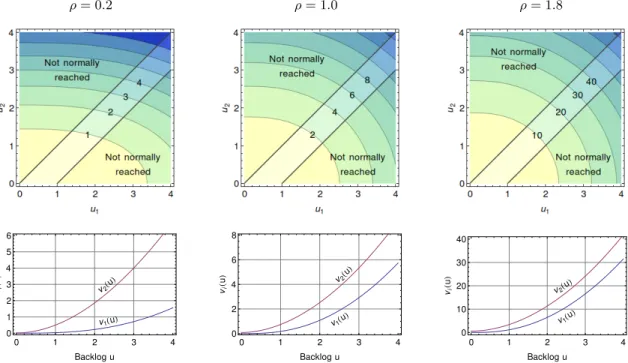
Consider next the virtual waiting time in M/D/2-RR. Fig. 4 depicts the resulting value functionv(z) for the whole system (upper row) and its components the vi(u) (lower row) for
ρ= 0.2,1.0,1.8. Considering first the upper row, we have included also states with u2 > u1 and u1 > u2+ 1, even
though the normal state space2of an initially empty
M/D/2-RR queue is the narrow strip constrained by 0≤u2 ≤u1≤
u2+1. That is, we allow an arbitrary initial state. The value
function becomes more symmetric asρincreases. From the lower row, we observe that initially, atu= 0, the slope of eachvi(u) is zero in accordance with (6).
2.5.3
Other Distributions
Let D(x1, x2) denote the discrete probability distribution
with two possible outcomes x1 and x2. We further
as-sume that x1 < 1 < x2 so that with a suitable choice
of point probabilities the mean is equal to one. Similarly, D(x) denotes the deterministic distribution with one out-come xand U(x1, x2) the uniform distribution on interval
(x1, x2). Fig. 5 illustrates the resulting value functions with
D(0.5,10), D(0.5,5), U(0,2) and D(1). In each case, the mean service time is 1 and arrival rate λ = 1.6. We can observe that the higher the variance in the service times is, the higher the initial differencev2(0)−v1(0) is. Thev1(u)
behave rather similarly (note the initial choicev1(0) = 0). 2Later, in Section 3, the so-called FPI policy may deviate
ρ= 0.2 ρ= 1.0 ρ= 1.8 v1HuL v2Hu L 0 1 2 3 4 0 1 2 3 4 5 6 Backlog u vi H u L v1Hu L v2Hu L 0 1 2 3 4 0 2 4 6 8 Backlog u vi H u L v1Hu L v2Hu L 0 1 2 3 4 0 10 20 30 40 Backlog u vi H u L
Figure 4: Value function for M/D/2-RR with respect to the virtual waiting time.
Consequently, it is obvious that vz for RR-system (with FCFS scheduling)is not insensitive to the job size distribu-tion. We note that this is in contrast to state-independent policies (e.g., Bernoulli-split) for which the value function is insensitive to the job size distribution [21].
3.
TASK ASSIGNMENT PROBLEM
In this section, we consider the system ofkparallel servers with job- and server-specific service fees and holding costs. As routing policies, we consider the following:
RR: Round-Robin assigns the jobs using a predefined se-quences1, s2, . . . , sk, s1, s2, . . .wheresi6=sjfori6=j. RND: Bernoulli-split assigns jobs in random using
proba-bilitiesp1, . . . , pk.
JSQ: Join-the-shortest-queue assigns a new job to queue with the least number of jobs.
LWL: Least-work-left assigns a new job to the queue with the shortest backlog.
Myopic chooses the queue that minimizes the costs assum-ing no other jobs arrive in future.
Ties are broken in favor of the queue with a smaller index.
3.1
State description for Round-Robin
When all servers are identical, the service fees can be omitted and the state of the system can be described by ak-tuple,
z= (u1, . . . , uk),
whereuidenotes the backlog in the queue currently in phase
i, so that the value function of the whole system is v(z) =v1(u1) +. . .+vk(uk).
The virtual waiting time isuk, i.e., the backlog of the queue
in phasek. This is the waiting time a customer arriving
to the system sees. LettingU(t) denote the virtual waiting time at timet, we haveU(t) =Uk(t).
In general, the state of the system can be described by
z= ((q1, u1), . . . ,(qk, uk)),
where the pair (qi, ui) denotes the server and its backlog
that is currently in phasei. Therefore, (q1, . . . , qk) is some
permutation of (1, . . . , k).
3.2
Waiting Time and General Holding Costs
The backlog based holding cost ratec(z) =uk can be seen
as a penalty for a long queue length. However, often one is interested in the actual waiting time, possibly weighted with arbitrary job-specific holding costs. With FCFS, the elementary relationship between the waiting time and back-log isW ∼U. The mean cost rate with respect to waiting time can be defined as
rW =λ·r=λ·E[W],
i.e., the rate at which the system incurs waiting time. Let W1, W2, . . . denote the waiting times related to the future
arrivals. One can associate the costs in two equivalent ways for arrivals until the end of the current busy period,
˜ c1 ,λE[ Z Bz 0 Uk(t)dt], ˜ c2 ,E[W1+. . .+WNz], (15)
where Uk(t) denotes the virtual waiting time at timet,Bz the duration of the (remaining) busy period (having a fi-nite mean),Nzthe number of jobs arriving during timeBz. Due to the PASTA property, ˜c1 = ˜c2. The first equation
corresponds to the virtual waiting time based holding cost c(z) =uk multiplied by the arrival rateλ, and the latter to
Figure 6: States in the diagonal where SPI suggests assigning the new job to the longer queue (assuming RR afterwards) depends on the holding cost hiof the
new job i. (E[H] =1).
Let ˜vzdenote the value function with respect to the waiting time. Then, ˜ vz−˜v0= E[W1+. . .+WNz]−rWE[Bz] =λE[ Z Bz 0 (Uk(t)−r)dt] =λ(v(z)−v(0)),
and thus the value function with respect to thewaiting time
is ˜vz=λ v(z).
Consider next the more general case with arbitrary job-specific holding costs. Let (Xj, Hj) denote the size and the
holding cost of Jobj, respectively. The jobs are are assumed to be i.i.d., (Xj, Hj)∼(X, H), while eachXjand Hj may
still depend on each other. For example, the slowdown met-ric is defined as the ratio of the delay to the service time, which corresponds toHj= 1/Xj. With FCFS, the service
times are independent of the system state and the difference in the cumulative costs is incurred during the waiting time. Therefore,
˜
v(z) =λ v(z) E[H], (16)
where E[H] denotes the mean holding cost rate of a job.
3.3
Policy Iteration
The policy iteration is a standard technique of the MDP framework to improve a given policy based on a value func-tion [25, 26, 27]. In layman’s terms, at every state, it chooses the action for which the sum of the immediate and future costs is the smallest. In our context, the immediate cost is the sum of the service fee and the waiting time of the new jobjmultiplied by its holding costhj,
κj+wj(a)·hj,
where the service feejand waiting timewj(a) get fixed upon
the task assignment actiona(with FCFS, later arriving jobs do not affect the sojourn time of the present jobs). If the basic policy is RR, then the actionamay define two things:
1. The queue for the new job.
2. The future Round-robin sequence (the phases for queues). Similarly, utilizing (16), the expected increase in the holding costs incurred in the future is
˜
v(z⊕a)−v(˜z) =λ(v(z⊕a)−v(z)) E[H],
where zis the current state of the system,z⊕a the state after actiona, andv(z) is the value function with respect to the virtual waiting time. The improved policyα0 is defined as
α0(j,z) = argmin
a∈A
(κj+wj(a)hj+ (˜v(z⊕a)−v(˜z))), (17)
whereAdenotes the set of possible actions (thekservers).
4.
NUMERICAL EXAMPLES
In the following numerical examples, we consider a system with two equally fast servers. First we assume a constant service time and then we experiment with some other ele-mentary service time distributions.
4.1
Two Policy Iteration Steps
As RR/LWL is optimal with respect to the mean delay for M/D/k, let us next consider a system with arbitrary job-specific holding cost rates. Let hdenote the holding cost rate of the new job. Ifh >E[H], the intuition suggests that the new job should be assigned to the shorter queue accord-ing to RR/LWL. However, ifh <E[H], it may be beneficial to assign the new job to the longer queue, thus keeping the other queue shorter for later arriving, possibly more impor-tant, jobs. The potential pitfall is that no such “important” job arrives and one of the servers is unnecessarily idle (which never happens with RR/LWL). For the policy improvement, it is more convenient to consider the waiting time based cost structure and (17).
Let us start with the state-independent Bernoulli-split pol-icy. With two identical servers, this policy assigns the new job to Server 1 with probability of 0.5, and otherwise to Server 2. The value function of the whole system is [21]
˜ vRND(u1, u2) = λ0E[H] 2(1−ρ0)(u 2 1+u 2 2),
whereλ0 is the queue-specific arrival rate,λ0=λ/2, andρ0 the queue-specific load,ρ0 =λ/2·∆. The mean difference in the expected costs between assigning the new job with holding costhto Server 1 and Server 2 is
∆c=h(u1−u2) + ˜vRND(u1+∆, u2)−v˜RND(u1, u2+∆) = h+λ∆ E[H] 2−λ∆ ·(u1−u2),
i.e., ∆c is negative when u1 < u2, and vice versa. This
means that thefirst policy iteration(FPI) step, choosing the action with the lowest expected costs if the consecutive deci-sions are according the basic policy (Bernoulli-split), yields LWL. Moreover, we recall that LWL was equivalent to RR with a constant service time ∆.
As the first policy iteration step yielded RR (that was equiv-alent to LWL in this case), the value function of which we can now compute, we can proceed further and carry out the
second policy iteration step (SPI),
RND =P I⇒ LWL =P I⇒ SPI.
Fig. 6 illustrates the regions in the state space where SPI chooses the alternative action, i.e., assigns the new job to the longer queue. The arrival rateλ was chosen to be 0.5.
FCFS FCFS κ = 1 κ = 4 Secondary Primary λ Routing
Figure 7: Primary and secondary server with unit holding costH=1 and service feesκ1=1 andκ2=4 processing jobs with constant service time.
We note that SPI changes the FPI policy (RR) only near the diagonal where both queues have roughly equal amount of unfinished work. Higher the holding costhof the new job is, higher the backlogs must be before the change, on average, pays off. Jobs withh≥E[H] are categorically assigned to the shorter queue.
4.2
Two Servers with Varying Service Fees
Let us next consider a server system with primary and sec-ondary server with fixed size jobs illustrated in Fig. 7. The servers are equally fast, i.e., the service time of a job is the same in both queues. The cost structure is
H= 1, and κ1= 1, κ2= 4,
i.e., the secondary server has a four times higher service fee. Alternatively, the secondary server costs, say 3 dollars per job, the primary server is free, and the jobs incur costs at the rate of 1 dollar per unit time during their sojourn time. Note that without service fees, both LWL and RR are optimal policies minimizing the mean waiting and sojourn times.
With two servers, both LWL and Myopic are clearly the so-called switch-over policies that can be defined by a curve f(u1) such that a new job is routed to Queue 2 ifu2< f(u1),
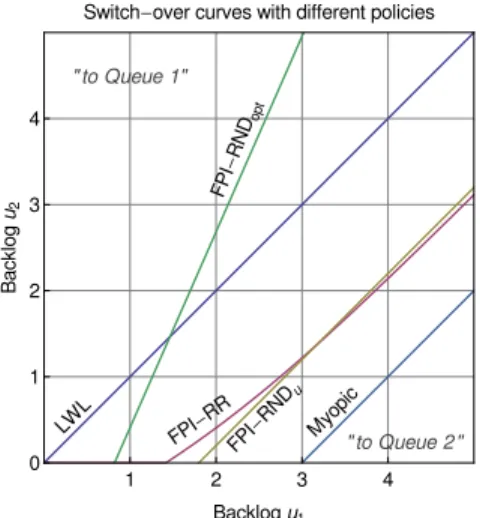
and otherwise to Queue 1. It turns out that also the FPI policies based on RND and RR yield a switch-over policy. Fig. 8 illustrates the switch-over curves forλ= 0.8. RNDopt
uses the optimal splitting probabilities, and RNDusplits the
jobs equally,p1 =p2 = 0.5. We note that the curves with
FPI-RND policies are straight lines, while with FPI-RR the switch-over curve is a slowly turning curve. Simulating the system gives the mean costs per job:
LWL: 2.20 FPI-RNDopt: 1.92
Myopic: 2.12 FPI-RNDu: 1.91
FPI-RR: 1.88
We observe that FPI-RR achieves the lowest mean cost rate, closely followed by the other two FPI policies. Numerically experimenting one can see that whenλ approaches 2 (the stability bound for this system), all FPI policies converge to LWL. Similarly, whenλ→0, Myopic is optimal and all three FPI policies reduce to it.
4.3
Varying holding cost and service times
Let us consider an elementary system comprising two iden-tical servers. Jobs arrive according to the Poisson process with rate λ. Job sizes and holding costs are i.i.d. random variables. The job size is 1 with probability of 0.9, and oth-erwise 91, so that E[X] = 10 and the variance much higher.3
3We experimented also with uniform distribution, but the
results were boring as the differences between RR, LWL,
" to Queue 1" " to Queue 2 " LW L FP I -RN Dop t FPI -RND u FPI -RR Myo pic 1 2 3 4 0 1 2 3 4 Backlogu1 B a c k lo g u2
Switch-over curves with different policies
Figure 8: Dynamic switch-over policies illustrated for a system with a constant service time, and two equally fast servers with service fees κ1=1 and
κ2=4. Each policy assigns a new job to Queue 1 when the current state is above the corresponding curve, and otherwise to Queue 2.
The holding costs are assumed to obey exponential distri-bution with mean 1.
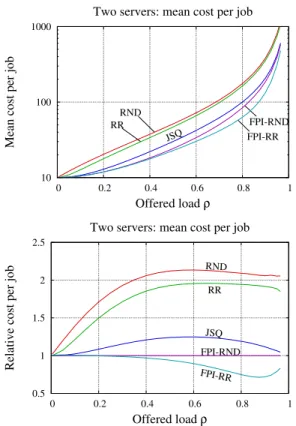
Simulation results are depicted in Fig. 9 for Bernoulli-split (RND), JSQ, RR, FPI-RND (i.e., LWL) and FPI-RR. The offered loadρis on thex-axis, and they-axis corresponds to the mean costs incurred per job. The first figure shows the absolute performance in logarithmic scale, and the second the performance relative to LWL. Note that LWL minimizes the holding cost of the current job, i.e., it makes the same greedy decision as selfish users do.
Whenρ≈0, LWL and JSQ both, obviously, work well. The task there is merely to avoid situations when two or more jobs are in one server while the other server is idle. As ρ increases beyond about 0.1, the performance of JSQ starts to degrade. At ρ ≈0.4 or higher, also the performance of LWL, due to its greedy behavior degrades. Aroundρ= 0.9, FPI-RR is about 25% better than LWL. As ρ →1, JSQ, LWL and FPI-RR appear to converge to the same point. Indeed, at that limit the mean queue lengths explode and it is sufficient to (dynamically) balance the load.
5.
APPLICATIONS
The ability to determine a value function for an Erl(λ,k)/G/1 queue enables the analysis of far more complex server sys-tems than the plain Round-Robin system. One example is illustrated in Fig. 10(a), where a multi-layer RR is con-structed: Queue 1 behaves according to Erl(λ,2)/G/1 and Queues 2 and 3 according to Erl(λ,4)/G/1. This type of arrangements are advantageous when the service rates are asymmetric.
and FPI-RR were small. In this respect, uniform distribu-tion is sufficiently close to a constant value. The chosen job size distribution has sufficiently high variance so that it is important to take into account jobs arriving in the future.
10 100 1000
0 0.2 0.4 0.6 0.8 1
Mean cost per job
Offered load ρ Two servers: mean cost per job
RND RR JSQ FPI-RND FPI-RR 0.5 1 1.5 2 2.5 0 0.2 0.4 0.6 0.8 1
Relative cost per job
Offered load ρ
Two servers: mean cost per job RND
RR
JSQ FPI-RND FPI-RR
Figure 9: Mean holding costs in the elementary ex-ample setting with two identical servers. FPI-RR achieves clearly the lowest cost rate.
Fig. 10(b) illustrates a server system which combines the good features of the Size-Interval-Task-Assignment (SITA) policy [28, 11, 29, 30] (variance reduction in service times, which can be critical for FCFS scheduling) and RR (which was the optimal policy w.r.t. delay for tasks with a constant service time). The arrival process to Queue 1 is a Poisson process as SITA is a state-independent policy. Queues 2 and 3 behave according to Erl(λ0,2)/G/1, where the service time of tasks can have a significantly smaller variance thanks to SITA. Moreover, dedicated jobs arriving according to some other Poisson process can be directed to any point already receiving a Poisson process, such as the Queue 1 and the second level RR dispatcher in Fig. 10(b). These types of sys-tems can be analyzed and their value function determined, enabling the policy improvement step.
6.
CONCLUSIONS
We have analyzed the Round-Robin (RR) routing to a sys-tem of parallel queues. RR is a commonly used robust tech-nique to balance the load by assigning tasks to different servers sequentially. It decreases the burstiness in the ar-rival process to each queue, which is important especially with FCFS scheduling.
The availability of the value function for RR-systems, via the corresponding value function of Erl(λ,k)/G/1 queues, provides new insight to this mechanism itself (and G/G/1 queues). The value functions that we considered character-ize the system state with respect to the service fees and vir-tual waiting time, and also enable the policy iteration step
Round Robin Round Robin FCFS FCFS FCFS λ (a) Round Robin small variance FCFS FCFS FCFS λ SITA short long (b)
Figure 10: (a) Multi-layer round-robin system feeds tasks to each queue with Erlang-distributed inter-arrival times. (b) In the hybrid system, Queue 1 behaves according to M/G/1 and Queues 2 and 3 according to Erl(λ0,2)/G/1 with reduced variance in the service times.
with respect to a very versatile cost structure defined by job-and server-specific service fees job-and holding costs, yielding ro-bust cost- and state-aware routing policies. Moreover, as an useful side-product, we obtain the mean waiting time in the Round-Robin system, which itself is a non-trivial result even for an M/D/k-RR.
7.
REFERENCES
[1] W. Winston, “Optimality of the shortest line
discipline,”Journal of Applied Probability, vol. 14, pp. 181–189, 1977.
[2] R. R. Weber, “On the optimal assignment of customers to parallel servers,”Journal of Applied Probability, vol. 15, no. 2, pp. 406–413, Jun. 1978. [3] A. Ephremides, P. Varaiya, and J. Walrand, “A simple
dynamic routing problem,”IEEE Transactions on Automatic Control, vol. 25, no. 4, pp. 690–693, Aug. 1980.
[4] A. Hordijk and G. Koole, “On the optimality of the generalised shortest queue policy,”Prob. Eng. Inf. Sci., vol. 4, pp. 477–487, 1990.
[5] D. Towsley, P. Sparaggis, and C. Cassandras, “Stochastic ordering properties and optimal routing control for a class of finite capacity queueing systems,” inProc. of the 29th IEEE Conference on Decision and Control, Dec. 1990, pp. 658–663.
[6] P. D. Sparaggis and D. Towsley, “Optimal routing and scheduling of customers with deadlines,”Probability in the Engineering and Informational Sciences, vol. 8, no. 1, pp. 33–49, 1994.
[7] G. Koole, P. D. Sparaggis, and D. Towsley, “Minimizing response times and queue lengths in systems of parallel queues,”Journal of Applied Probability, vol. 36, no. 4, pp. 1185–1193, Dec. 1999. [8] O. Akgun, R. Righter, and R. Wolff, “Multiple server
system with flexible arrivals,”Advances in Applied Probability, vol. 43, pp. 985–1004, 2011.
[9] Z. Liu and D. Towsley, “Optimality of the round-robin routing policy,”Journal of Applied Probability, vol. 31, no. 2, pp. 466–475, Jun. 1994.
[10] Z. Liu and R. Righter, “Optimal load balancing on distributed homogeneous unreliable processors,”
Operations Research, vol. 46, no. 4, pp. 563–573, 1998. [11] M. Harchol-Balter, M. E. Crovella, and C. D. Murta,
“On choosing a task assignment policy for a distributed server system,”Journal of Parallel and Distributed Computing, vol. 59, pp. 204–228, 1999. [12] M. Harchol-Balter,Performance Modeling and Design
of Computer Systems: Queueing Theory in Action. Cambridge University Press, 2013.
[13] C. D. Crommelin, “Delay probability formulas when the holding times are constant,”Post Office Electrical Engineers Journal, vol. 25, pp. 41–50, 1932.
[14] G. J. Franx, “A simple solution for the M/D/c waiting time distribution,”Oper. Res. Lett., vol. 29, no. 5, pp. 221–229, Dec. 2001.
[15] ——, “The transient M/D/c queueing system,” 2002. [16] H. Tijms, “New and old results for the M/D/c queue,”
AE ¨U - International Journal of Electronics and Communications, vol. 60, no. 2, pp. 125–130, 2006. [17] A. J. E. M. Janssen and J. S. H. Van Leeuwaarden,
“Back to the roots of the M/D/s queue and the works of Erlang, Crommelin and Pollaczek,”Statistica Neerlandica, vol. 62, no. 3, pp. 299–313, 2008. [18] K. R. Krishnan, “Joining the right queue: a
state-dependent decision rule,”IEEE Transactions on Automatic Control, vol. 35, no. 1, pp. 104–108, Jan. 1990.
[19] P. S. Ansell, K. D. Glazebrook, and C. Kirkbride, “Generalised ’join the shortest queue’ policies for the
dynamic routing of jobs to multi-class queues,”The Journal of the Operational Research Society, vol. 54, no. 4, pp. 379–389, Apr. 2003.
[20] S. Bhulai, “On the value function of the M/Cox(r)/1 queue,”Journal of Applied Probability, vol. 43, no. 2, pp. 363–376, Jun. 2006.
[21] E. Hyyti¨a, A. Penttinen, and S. Aalto, “Size- and state-aware dispatching problem with queue-specific job sizes,”European Journal of Operational Research, vol. 217, no. 2, pp. 357–370, Mar. 2012.
[22] B. Hajek, “The proof of a folk theorem on queuing delay with applications to routing in networks,”J. ACM, vol. 30, no. 4, pp. 834–851, Oct. 1983. [23] ——, “Extremal splittings of point processes,”
Mathematics of Operations Research, vol. 10, no. 4, pp. 543–556, Nov. 1985.
[24] Y. Arian and Y. Levy, “Algorithms for generalized round robin routing,”Oper. Res. Lett., vol. 12, no. 5, pp. 313–319, 1992.
[25] R. Bellman,Dynamic programming. Princeton University Press, 1957.
[26] R. A. Howard,Dynamic Probabilistic Systems, Volume II: Semi-Markov and Decision Processes. Wiley Interscience, 1971.
[27] M. L. Puterman,Markov Decision Processes: Discrete Stochastic Dynamic Programming. Wiley, 2005.
[28] M. E. Crovella, M. Harchol-Balter, and C. D. Murta, “Task assignment in a distributed system: Improving performance by unbalancing load,” inProceedings of SIGMETRICS ’98, Madison, Wisconsin, USA, Jun. 1998, pp. 268–269.
[29] H. Feng, V. Misra, and D. Rubenstein, “Optimal state-free, size-aware dispatching for heterogeneous M/G/-type systems,”Performance Evaluation, vol. 62, no. 1-4, pp. 475–492, 2005.
[30] M. Harchol-Balter, A. Scheller-Wolf, and A. R. Young, “Surprising results on task assignment in server farms with high-variability workloads,” inProc. of
SIGMETRICS. New York, NY, USA: ACM, 2009, pp. 287–298.