Department of Electrical Engineering
David Wilson
Style Guidelines for a Master’s Thesis in Electrical
Engineering
Master’s Thesis May 2001
Style Guidelines for a Master’s Thesis in Electrical
Engineering
David Wilson
c
This thesis is submitted in partial fulfillment of the requirements for the Master of Science degree in Electrical Engineering. All material in this thesis which is not my own work has been identi-fied and no material is included for which a degree has previously been conferred. David Wilson Approved, January 3, 2002 Opponent: NN Advisor: NN Examiner: NN iii
Abstract
This document describes the formatting rules for a Master of Science thesis as specified by the Department of Electrical Engineering at Karlstad University. The required outline of the document as well as specific formatting requirements such as page numbering and page layout are described. A chapter with specific requirements for documents written in Swedish is included. For documents produced in LATEX a special class file, called kauee thesis.cls is provided by the department. Some information on how to use this class file is also given in the document.
Acknowledgements
This style guide is an adaption from the version used in the Department of Computer Science, Karlstad University originally developed by Anna Brunstr¨om.
Contents
1 Introduction 1 2 General Layout 3 2.1 Page styles . . . 4 3 Further Details 5 3.1 Title page . . . 5 3.2 Approval page . . . 5 3.3 References . . . 54 Reports Written in Swedish 7
References 9
A The Kau thesis Class 11
B LaTeX Files 13
List of Figures
List of Tables
2.1 Standard Master’s thesis outline . . . 3 4.1 Language mapping . . . 7
Chapter 1
Introduction
This document gives the style guidelines for Master’s thesis written at the Department of Electrical Engineering, Karlstad University. It has been produced using the kauee thesis LATEX class file. Hence, this document, in addition to listing the style guidelines, also works as
a sample thesis with respect to the formatting guidelines it describes1. If you use formatting files for LATEX or Microsoft Word provided by the Department of Electrical Engineering most
of the formatting required will be handled automatically. It is strongly recommended that you use one of the provided formatting files. If you choose to use a different word processor you are still required to follow the described guidelines. Any deviations from the guidelines must be approved by the course examiner.
The reminder of the document is organized as follows. Chapter 2 describes the general layout required for the thesis. Some parts of the thesis are described in more detail in Chapter 3. Chapter 4 provides additional information required for reports written in Swedish. Finally, Chapter 5 provides some information on how to use the kauee thesis.clsclass file.
1The content and length of the document are of course not representative of a thesis.
Chapter 2
General Layout
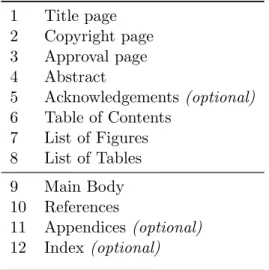
This chapter provides information on the general layout of the thesis, such as organization, page numbering etc. Again, this document serves as an example of the required layout. The outline of the report should follow the order specified in Table 2.1.
Table 2.1: Standard Master’s thesis outline 1 Title page 2 Copyright page 3 Approval page 4 Abstract 5 Acknowledgements(optional) 6 Table of Contents 7 List of Figures 8 List of Tables 9 Main Body 10 References 11 Appendices(optional) 12 Index(optional)
As indicated in Table 2.1, some portions of the thesis are optional. The “List of Figures” and/or the “List of Tables” may also be omitted due to the lack of figures and/or tables in the main body. All other parts are always required. The table of contents should list all parts following the front matters. Parts in the front matters should not be included in the table of contents. If a list of abbreviations is provided it should be placed as an appendix.
The thesis should be bound, with the cover in sky-blue for a Master’s thesis. The color is available at the printing works at the University as “himmelsbl˚a” (Colorit 72). We recommend
4 CHAPTER 2. GENERAL LAYOUT
that you bind your thesis at the University. Two-sided printing should be used. However, each part of the thesis, as outlined in Figure 2.1, should start on the right hand side. In addition, each chapter of the main body should also start on the right hand side. The first chapter of the main body should be chapter 1. Any appendices that are part of the thesis should be numbered alphabetically.
The pages of the parts preceding the main body, the front matters, should be numbered using Roman numerals. (However, no page numbers are used on the title page or the copyright page.) The pages of the remaining parts, starting with the main body, should be numbered using Arabic numerals. The page numbering should take blank pages into account. For instance the page number for the approval page is iii. (The title page is not counted in the numbering.) The page numbering for the main body should start over with page one. Figures and tables should be numbered using the chapter number followed by a running number. For instance, the first figure in Chapter 2 is numbered 2.1.
The fonts size for regular text should be 11 or 12 point. The line-spacing should be single-spaced. The text should be in block format with even right and left hand margins. This includes the abstract and the acknowledgements (when present).
2.1
Page styles
The page style for the front matters should be plain with the page number centered at the bottom of the page. In the main body the page style for the first page of a chapter is plain with the page number centered at the bottom of the page. The remaining pages of a chapter should have the page number in the upper outer corner and a text indicating the chapter or section in the inner upper corner. Left pages should have the chapter indicated and right pages should have the section indicated. Examine the headers and footers of this chapter if you are unsure about the interpretation of the description of the page style given above. The description of the page styles was put in a separate section to illustrate the layout. The page styles for the reference section and any appendices follow the same guidelines as given for the main body.
Chapter 3
Further Details
The general layout of the thesis was described in the previous chapter. This chapter provides some further details on some of the required parts of the thesis.
3.1
Title page
The title page should conform to the format illustrated by the cover page of this document. The logo of the university should be centered at the top of the page and can be obtained from the department in postscript format if needed. The report number is to be placed at the bottom of the page. Ask your adviser for the report number to use. There should be no page number on the title page.
3.2
Approval page
The approval page must be signed by the student, the opponent, the advisor, and the exam-iner. By signing the approval page the student certifies that the work presented in the thesis has indeed been carried out by the student. Material obtained from other sources must be properly cited. The date on the approval page refers to the date when the student successfully passed the thesis defense.
3.3
References
References to the literature should be done using a numbered reference list, where the reference in the text appears as the number of the reference in square brackets. For instance, Lamport’s
6 CHAPTER 3. FURTHER DETAILS
seminal paper on causality is referenced as [2]. References should be ordered alphabetically in the reference lists. Only material referenced in the text may appear in the reference list. The parts of an individual reference in the reference list should be listed in the following order: author, title, source, and date. The font and punctuation used should be consistent for all entries in the reference list. Examples on how to reference a book [3] and journal articles [2, 1] can be found in the reference list of this document.
When you want to mention the author(s) of a reference in running text the convention is to list the names if there are one or two author(s), but to use the first author followed by “et. al.” if there are more than two authors. For instance, when we reference Silberschatz and Galvins book on operating systems [3] we mention both authors. In contrast, we use the abbreviated form when we refer to the paper on termination detection by Dijkstra et. al. [1].
Chapter 4
Reports Written in Swedish
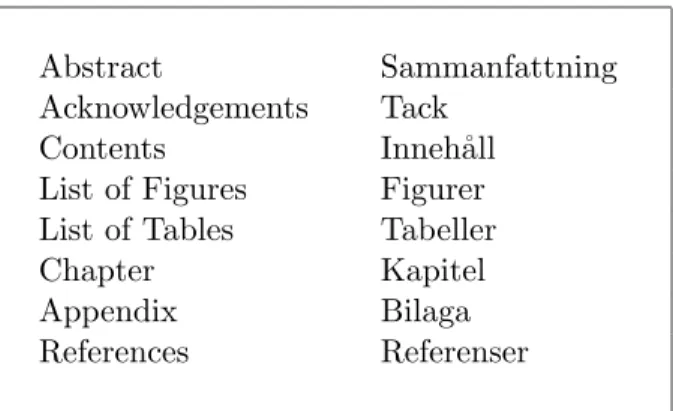
Documents written in Swedish should still use the guidelines described in chapters 2 and 3 of this document. The only exception is that two abstracts are now required. The first one written in Swedish and the second one written in English. The two abstracts should be placed on separate pages, with the abstract written in Swedish positioned first. The mapping from the English terms described in the outline of the thesis to their Swedish counterparts is given in Table 4.1. A document written in Swedish must use the Swedish names in the document.
Abstract Sammanfattning
Acknowledgements Tack
Contents Inneh˚all
List of Figures Figurer List of Tables Tabeller
Chapter Kapitel
Appendix Bilaga
References Referenser
Table 4.1: Language mapping
References
[1] Edsger W. Dijkstra, W.H.J. Feijen, and A.J.M. van Gasteren. Derivation of a termination detection algorithm for distributed computations.Information Processing Letters, 16:217– 219, 1983.
[2] Leslie Lamport. Time, clocks, and the ordering of events in a distributed system. Com-munications of the ACM, 21(7):558–565, 1978.
[3] Abraham Silberschatz and Peter B. Galvin. Operating Sytem Concepts. Addison Wesley, 4th edition, 1994.
Appendix A
The Kau thesis Class
Kau thesis.cls is a LATEX class file which formats a thesis according to the rules specified
by the Department of Computer Science at Karlstad University. It extends the LATEX report
class file and borrows heavily from the cit thesis.clsdeveloped at Caltech. The class file sets up the layout of the thesis and provides a number of helpful macro commands for defining structural elements of the document such as the title page and the approval page.
To use the class file you should put
\documentclass[12pt,twoside,openright]{kau_thesis}
at the beginning of your document. The options specify the fontsize, the use of twosided printing, and the start of new document parts on the right hand side. The easiest way to create your thesis is to start with the fileskeleton.texwhich has a LATEX skeleton
contain-ing all the required commands. The skeleton.tex file also contains comments describing the changes needed for thesis that are written in Swedish. Be aware that if you switch between English and Swedish you must remove all auxiliary files created by LATEX before
recompiling. The kau thesis.sty and skeleton.tex files are contained in the compressed tar archivekau thesis.tgzalong with additional useful files. A READMEas well as the LATEX
source for this document is also included in the archive. The archive can be obtained from <http://www.cs.kau.se/cs/docs/kau thesis.tgz>. A complete listing of the files con-tained in the archive can be found in appendix A.
Appendix B
LaTeX Files
This appendix describes all the files contained in the compressed tar archivekau thesis.tgz. The archive is available at <http://www.cs.kau.se/cs/docs/kau thesis.tgz>.
READMEREADME file for the kau thesis distribution
kau thesis.cls The main class file to generate a thesis according to the style guidelines described in this document.
skeleton.texA skeleton LATEX file that contains all the commands necessary to generate a
correctly formatted thesis.
kau.epsThe University logo in postscript format. Used on the Swedish title page.
kaueng.epsThe English version of the University logo in postscript format. Used on the English title page.
setspace.styA style file to provide better line spacing. Used in the main class file.
fancyheadings.styA style file to provide page headers. Used in the main class file.
rules.texThe LATEX source for this document.
rules.bibThe bibtex file for this document.
rules.psThis document.