econ
stor
www.econstor.eu
Der Open-Access-Publikationsserver der ZBW – Leibniz-Informationszentrum Wirtschaft
The Open Access Publication Server of the ZBW – Leibniz Information Centre for Economics
Nutzungsbedingungen:
Die ZBW räumt Ihnen als Nutzerin/Nutzer das unentgeltliche, räumlich unbeschränkte und zeitlich auf die Dauer des Schutzrechts beschränkte einfache Recht ein, das ausgewählte Werk im Rahmen der unter
→ http://www.econstor.eu/dspace/Nutzungsbedingungen nachzulesenden vollständigen Nutzungsbedingungen zu vervielfältigen, mit denen die Nutzerin/der Nutzer sich durch die erste Nutzung einverstanden erklärt.
Terms of use:
The ZBW grants you, the user, the non-exclusive right to use the selected work free of charge, territorially unrestricted and within the time limit of the term of the property rights according to the terms specified at
→ http://www.econstor.eu/dspace/Nutzungsbedingungen By the first use of the selected work the user agrees and declares to comply with these terms of use.
Almeyda, Gloria
Working Paper
Uganda Microfinance Union (Umu): A
Case Study
Working paper / University of Cologne, Development Research Center, No. 2002,5
Provided in cooperation with:
Universität zu Köln
Suggested citation: Almeyda, Gloria (2002) : Uganda Microfinance Union (Umu): A Case Study, Working paper / University of Cologne, Development Research Center, No. 2002,5, http:// hdl.handle.net/10419/23706
University of Cologne
Development Research Center
Universität zu Köln
Arbeitsstelle für Entwicklungsländerforschung
U
GANDAM
ICROFINANCEU
NION(UMU):
A C
ASES
TUDY1by
Gloria Almeyda
([email protected])
1 I gratefully acknowledge support of the study by the International Fund for Agricultural Development, Rome.
Responsibility for the contents and any errors lies with the author. I am also grateful to the Executive Director and staff of the Uganda Microfinance Union, who shared with me their experience in making UMU one of the leading Ugandan MFIs.
TABLE OF CONTENTS
Executive Summary I. INTRODUCTION
1. Origin and Evolution
2. Ownership and Governance 3. Organization and Management
II. FINANCIAL PRODUCTS
1. Original Product Design 2. Repayment Methodology 3. What Makes UMU Unique? 4. Loan Products
5. Savings Products
6. Incentives and Monitoring Loan-Portfolio Quality
III. PERFORMANCE 1. Outreach a. Scope of Outreach b. Depth of Outreach c. Quality of Outreach 2. Financial Performance a. Towards Sustainability b. Financial Structure
EXECUTIVE SUMMARY
The Uganda Microfinance Union (UMU) has become one of Uganda’s leading microfinance institutions. It began four years ago with a small equity loan of about US$30,000 and has grown to US$1.5 million in total assets. Through a network of five branches, UMU serves16,577 clients (70% women), all of whom savers and 63% are borrowers. As of July 2001, UMU’s outstanding loan portfolio was US$1 million and savings were over US$400,000. It is diversified: 50% of its portfolio is in trade, 35% in agriculture, 12% in services, and 3% in manufacturing. Its repayment rate has remained at 98% or above. Its operational sustainability is 111% and its financial self-sustainability 92%. What factors have contributed to UMU’s success?
• Local initiative and vision: UMU started with a small amount of local capital. Rather than remaining as a “project” funded by donors, it was guided by a vision of becoming an institution that mobilized local resources, both savings and capital.
• Synergies from combinations and collaborations: UMUs' founders, a Ugandan and an American, grafted onto local experiences time-tested international microfinance practices, leveraging the best of each.
• Rural clientele: UMU began in rural areas where people had little access to financial services. It has expanded into peri-urban and urban areas, zeroing in on specific, underserved market niches. Most clients reside in the countryside.
• Diversified clientele: UMU believes that it is not simply the poorest of the poor who benefit from microfinance. UMU reaches out to a broader clientele of poor and not so poor, the larger group of "the working poor," both self-employed and employed.
• Sound practices: The founders identified sound practices that were working in Uganda. These include solidarity groups and individual lending.
• Flexibility: UMU listens to clients and remains flexible, adjusting its financial products within certain parameters. Loans can be used for any purpose. Repayment schedules are flexible based on clients' choice (weekly, biweekly, monthly). A client can start with savings first. Setting aside money in savings is voluntary; competitive interest rates help to promote fixed deposits.
• Daily loan monitoring reporting system: UMU monitors loans daily. Using a card system, officials collect information every day about borrowers who need to pay that day. At the end of the day, UMU knows who did not pay. Immediately, the branch notifies borrowers of their delinquency.
• Gender perspective of equity, not simply "numbers" of participants: UMU believes women need financial services, particularly because they are responsible for the well-being of their families. However, this belief does not mean it ignores men, since they also need access to credit. At least 50% of the members in solidarity groups must be women. In actual fact, seventy percent of the clients are women. Client-oriented research with CEEWA, a women’s advocacy and research NGO, resulted in a new product, Kikalu, one that responds to the complaints of women clients that small loans did not permit them to improve their productive assets.
UMU’s evolution and expansion has been based on developing sound practices--listening to clients, testing and customizing new products, and developing policy and operational standards. Currently, UMU offers:
• Loans: working capital, fixed asset, and salary earners’ loans.
• Savings accounts: savings passbooks and fixed-term deposits at competitive rates.
• Access: five branches in four different districts.
UMU’s growth has been measured because management has been cautious. It is supported with loans from Suffice, USh 120 million, from the Stromme Foundation, USh 200 million, and from the BoU, USh20 million, as well as by equity grants from USAID and NOVIB.
UMU’s lessons for donors and other MFIs who want to benefit from their success are:
• Maintain a commitment to building financial institutions--start by offering savings first or parallel with and loans services.
• Learn from other sound practices (e.g., solidarity group) but be flexible, listen to the local clients.
• Maintain a lean structure and be cost efficient in order to accumulate capital from profits. UMU is in transition, from a not-for-profit company to a privately held, formal financial institution functioning as a deposit-taking institution (pending legislation in Uganda). UMU currently meets the minimum capital requirement (proposed bill requires US$700,000 in capital). To achieve a solid future as a financial intermediary, it must be sufficiently capitalized for growth. Rather than relying on a limited number of institutional investors (as most MFIs elsewhere have done), UMU plans to sell shares as widely as possible--to its employees, clients, and other individuals inside and outside of Uganda. It would be the first MFI to be held by a broad, diverse group of
shareholders. They are even advertising for shareholders on the web. The key lesson for the microfinance industry, particularly for donors, is that a solid MFI is achievable in five years.
I. INTRODUCTION
1. Origin and Evolution
UMU was created in 1997 as a project designed by two graduate students from Brandeis University (USA), a Ugandan and an American, who wanted to test the feasibility of
microfinance. UMU was registered as a non-profit company with limited liability. They wanted financial services to leverage the endowments of the poor: their creativity in carrying out income-generating and survival activities, their work capacity, and their willingness to improve their living standards. The project received the support of the Bank of Uganda, a soft loan of USh34 million (US$28,333 at the exchange rate of US$=USh1,200 in 1997).
UMU started operations in a rural community of Busika (45 kms north of Kampala) where no institutional financial services existed. As distinct from other MFIs, UMU moved from rural to urban areas. UMU opened its headquarters in Kampala because of convenience, access to other services, and logistical support.
2. Ownership and Governance
UMU’s mission is to make low-income entrepreneurs financially stronger through the promotion of savings and extension of credit.
UMU is planning to convert from a not-for-profit company to a privately held, formal financial institution. UMU will apply to the Bank of Uganda for a license as a deposit-taking microfinance institution. According to the proposed bill, UMU requires a minimum capital of US$700,000, a level reached as of December 31, 2000.
UMU wants to be innovative about MFI ownership. Generally, some of the internationally known transformations of MFIs (e.g., BancoSol in Bolivia, Calpia in El Salvador) have been based on a few large investors. UMU plans to sell shares as widely as possible--to its employees, clients and individual investors. UMU proposes to be the first MFI in Uganda to be held by a broad, diverse group of shareholders. In fact, UMU already advertises on the web: “ If you are interested in learning more about this exciting possibility, please let us know by emailing to
One of its innovations is that clients become affiliated with the institution. To become a member, they pay a one-time, minimum fee of USh 5,000 (less than US$3). Membership creates a sense of ownership and stakeholding, a change in how microfinance is conducted.
The Board is composed of six members, two of them the original founders who are also the chief executive officers. All but one are Ugandan. The company has KMPG Peat Marwick-Uganda as its external auditor, and Standard Chartered Bank of Uganda Limited as its bank.
3. Organization and Management
The two CEOs oversee an organization of 78 employees and operate five branches, one of which is at its headquarters in Kampala.
The basic structure of a branch includes a manager who directs sections or departments--field operations, loans, cashier and accountancy. As the branch grows, it hires assistants to department heads.
Staff is trained in-house. UMU promotes a system of training employees from the bottom up, giving them the opportunity to experience being a cashier all the way up to becoming branch manager. Some of the employees interviewed during field visits have been with the organization since it was created. Others, such as branch managers with over two years in UMU, have already
been promoted to higher positions. They have seen in UMU an opportunity for professional growth.
The field officers are responsible for promoting UMU’s services. They are responsible for contacting potential clients. Introductory sessions by field officers provide the basic information for those interested in joining UMU and forming solidarity groups. The field officer is responsible for helping new clients open their first savings account. One to two days after affiliation, the loan officer verifies the client's information. Once affiliated, the client begins a relationship with a loan officer. On average, the process of affiliation and loan application takes one week. Based on a record of timely repayment, the processing of application for consecutive loans take about 3 days. Unlike other MFIs, UMU offers no individual credit officer incentives linked to loan portfolio
management. UMU has a team approach--all the staff in a branch are responsible for the good performance of the loan and savings portfolios.
Management Information System (MSI)
Branches operate as profit centers. Each branch prepares computerized monthly reports on operations (loans and savings) and financial reports including balance sheets and income statements and key indicators of profitability. Reports are then consolidated at headquarters. Records for each member are also maintained manually on cards. This manual system avoids problems with the nation's frequent electricity shortages.
NOVID has supported UMU with grants for computerization. This type of capacity- building support has been crucial for strengthening MIS in order to support the growth of operations.
II. FINANCIAL PRODUCTS
1. Original Product Design
UMU started with a solidarity-group lending methodology. Groups varied from 5 to 10 members. UMU chose this lending methodology because small groups:
• allow more flexibility to respond to the individual client's needs, and a higher level of customized contact between UMU staff and clients;
• self-govern, monitoring each member in less time and reducing the need for regular, formal group meetings led by UMU staff;
• facilitate informal communication between group members;
• increase the individual responsibilities of each group member while making responsibility for the group as a whole more manageable.
UMU has improved the solidarity group loan by introducing some changes:
• Loan size may differ within group members (up to a limit).
• Repayment period may be different within group members (weekly, biweekly, monthly). Currently, 60% of the loan portfolio is in group lending. UMU has crafted a new product combining features of group and individual lending. Currently, the group dropout rate is about 2%, which is low compared to averages of 30% in other MFIs.
2. Repayment Methodology
The repayment rate has been above 98%. This high performance results from:
• The use of solidarity groups and reduction of the number of regular group meetings.
Individual borrowers are responsible for delivering their loan payments on time to field agents or to UMU offices rather than at group meeting. UMU believes that members' extra effort helps them learn financial responsibility and discipline faster.
• The recognition that each member’s microenterprise is different, with its own cash flow schedule and investment needs. UMU’s policy is to allow the entrepreneur to determine, within set parameters, the speed with which loans are repaid, and, thus, the rate at which higher loan amounts are accessed. According to their cash flow, borrowers can choose to repay in weekly, bi-weekly or monthly installments, over a period not exceeding 6 months. 3. What makes UMU unique?
The organization promotes a vision, institutional culture, and commitment to three factors: (1) Quality of service: the processing of loans is prompt.
(2) Flexibility: the loan size and repayment terms are adapted to the individual’s capabilities and preferences (within certain parameters).
(3) Innovation: products are modified to respond to demand requirements.
4. Loan Products
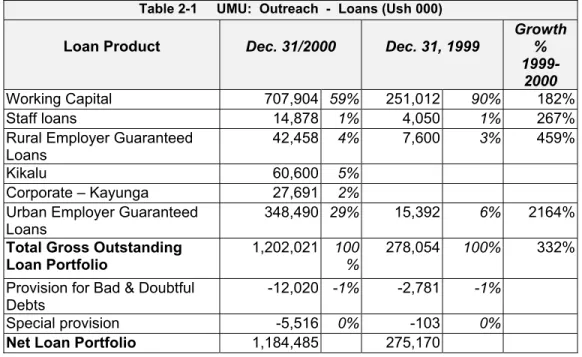
UMU has diversified its loan portfolio by adding new products. Between 1999 and 2000, the Working Capital Loan product dropped from 90% of the volume of the total loan portfolio to 59%. New loan products include the Kikalu (individual loan to reward good group borrowers) and Corporate Kayunga loans (wage earners loans). Diversification has taken place during a time of
impressive growth. All products grew 200% or more during 2000. During the first six months of 2001, UMU’s outstanding gross loan portfolio increased from USh 1.2 billion (US$689,000) to USh 1.7 billion (US$ 935,700), or 36%.
Table 2-1 UMU: Outreach - Loans (Ush 000)
Loan Product Dec. 31/2000 Dec. 31, 1999 Growth %
1999-2000
Working Capital 707,904 59% 251,012 90% 182%
Staff loans 14,878 1% 4,050 1% 267%
Rural Employer Guaranteed
Loans 42,458 4% 7,600 3% 459%
Kikalu 60,600 5%
Corporate – Kayunga 27,691 2%
Urban Employer Guaranteed
Loans 348,490 29% 15,392 6% 2164%
Total Gross Outstanding
Loan Portfolio 1,202,021 100% 278,054 100% 332%
Provision for Bad & Doubtful
Debts -12,020 -1% -2,781 -1%
Special provision -5,516 0% -103 0%
Net Loan Portfolio 1,184,485 275,170
• Solidarity-group lending with individual repayment: As in other sound MFI group- lending methodologies, each new member has access to an initial loan of USh 50,000 (US$30). Group size varies from 5 to 10 members. The applicant must make a deposit of 20% (or USh 10,000, equivalent to less than US$5). When the loan is repaid, clients move to a second "loan cycle" of USh 100,000. The term of the loan is for up to 6 months and the nominal interest rate is 3.5% per month on declining balance. Loans continue to increase by
increments of USh 50,000, with access to higher amounts contingent upon timely repayment of previous loans. While performance of other group members does not affect the possibility of an individual to move to a higher loan amount, late payment by one group member does have an effect on the timing of loan disbursements for other group members. What is different from other lending methodologies is that each individual in the group can have a different loan amount. Furthermore, the repayment schedule is also chosen individually. This flexibility responds to the need to differentiate clients. The first loan to a solidarity group continues to serve as a screening device.
• Kikalu-Capital-asset loans: this product, Kikalu, was introduced to reward perfect on- time-repayment record borrowers who graduate from solidarity groups and want to invest in capital assets and improve their business operations. It was also a response to complaints from clients that the size of micro-loans was insufficient to invest in productive assets. Capital-asset loans with terms of up to a year and a monthly nominal interest rate of 3% can be combined with working capital loans for up to USh 1 million (about US$600).
• Kyunga-Employer-guaranteed loans to individuals: UMU offers loans to low-income workers based on a guarantee from their employer. The monthly interest rate is 4% on declining basis. Generally, banks do not give loans of less than USh 5 million (equivalent to US$ 3,000). This loan helps the working poor to diversify income capacities and acquire
• Corporate lending program for employees of selected companies: These loans increase the numbers of different types of borrowers and diversify risk. Monthly interest rate is 4% on declining basis.
5. Savings Products
UMU shows that it is possible to mobilize rural savings. The main type of savings product is a passbook. Ninety seven percent of the total volume of savings is in passbooks, reflecting the preference of clients for liquidity. Saving products compare competitively with those offered by banks. As in the case of loans, savings grew over 200% during 2000. During the first six months of 2001, savings grew from USh 471 million (US$274,000) to USh 648 million (US$376,965), an increase of 37.5%.
Table 2-2 UMU: Outreach – Savings Products (USh 000)
Type of Account Dec. 31, 2000 Dec. 31, 1999 Growth
Savings Accounts 458,734 97% 134,044 93% 242%
Fixed Savings Accounts 12,478 3% 10,430 7% 20%
Total Ush 471,212 100% 144,474 100% 226%
Total US$ $273,960
• Savings Passbooks: Unlike with most semi-formal MFIs, clients can access UMU’s savings services without necessarily having to borrow. Thus, clients can save or borrow and build a long-term relationship with UMU either way. Borrowers are required to maintain 20% of the loan in savings. Interest paid on savings, as of August 2001, averaged 3.5% p.a.
• Fixed-term deposits: This service is again tailored to customer needs and offered at a variety of terms (up to a year) and at competitive interest rates, similar to those offered by banks. Interest rates vary according to term (e.g., a 3-month deposit earns 8% p.a, interest, 6-month 9% p.a., 12-month, 10% p.a.).
6. Incentives and Monitoring Loan-Portfolio Quality
• Daily reporting system: UMU monitors loans daily. Using a card system, officials collect information every day about borrowers who need to pay that day. At the end of the day UMU knows who did not pay. Immediately, the branch notifies borrowers of their delinquency.
• Collective effort between UMU and Client: UMU conceptualizes its relationship with clients from the viewpoint of mutual benefit and shared responsibilities between the institution and its customers. When clients are introduced to UMU, they are made aware of how this type of financial organization differs from others. Incentives are emphasized: “If you pay you qualify to receive a larger loan next time with minimal paperwork and other burdens. If you don’t repay, your records are marked red, which means that you are compromising the incentive for us to lend to you again.” In the case of savings, officials negotiate the length of time of the savings and the amount, and determine the interest rate on that basis. Negotiation and compromise with the client are the "sound" practices that guarantee UMU’s success.
• Progression: For the solidarity-group methodology, the critical issue is progression. Loans can eventually becomes as large as USh1 million. Then clients graduate to being qualified for capital-asset loans.
• Selective lending: For loans larger than USh1 million, UMU is very selective. Those who can borrow this amount have built up a perfect record of repayment.
III. PERFORMANCE
1. Outreach a. Scope of Outreach
UMU has 16,577 clients (June 30, 2001). Over 90% of them are in rural and peri-urban areas. These clients are all savers and 50% are borrowers (ratio of savers to borrowers, 2:1). The volume of savings (June 2001) amounted to USh 648 million (US$376,695). The outstanding loan portfolio reached USh 1.6 billion (US$ 935,697). Savings are about 50% of loans, indicating UMU’s capacity to provide savings services and mobilize local resources.
One of the significant lessons UMU learned from other MFIs is that to minimize overhead costs, financial intermediaries in rural areas need to provide both credit and savings products to a broad market clientele. If an institution only serves one segment, such as women or farmers, or only lends for agriculture, operational costs are too high.2 UMU offers services that are attractive to the entire community.
Table 3-1 Level of Loan Outreach by Branch June 30, 2001 (USh)
Branches Busika Kasangati BMB KYG Kampala TOTAL
Ush TOTAL US$
New Members 114 90 285 83 121 693 693 Membership 3,812 6,209 2,991 2,562 1,003 16,577 16,577 Savings Portfolio 133,177,525 254,358,100 103,517,390 145,862,364 11,465,100 648,380,479 376,695 Loan Portfolio 237,783,390 457,670,160 179,366,850 194,948,600 539,630,217 1,609,399,2 17 935,697 No. of loans outstanding 1,352 3,070 1,831 1,350 827 8,430 8,430 Value of loans disbursed 75,500,000 139,550,000 59,200,000 65,750,000 199,300,000 539,300,000 313,547 Source: UMU.
UMU believes that it is not simply the poorest of the poor who benefit from microfinance. UMU reaches out to a broader clientele of poor and not so poor, the larger group of "the working poor" both self-employed and employed. For the employed (e.g., rural teachers), some are not poor enough to qualify for most assistance programs (including microlending). However, they don't earn enough to plan for their future or to set aside reserves to tide them over during
unemployment, sickness or other unexpected events. b. Depth of Outreach
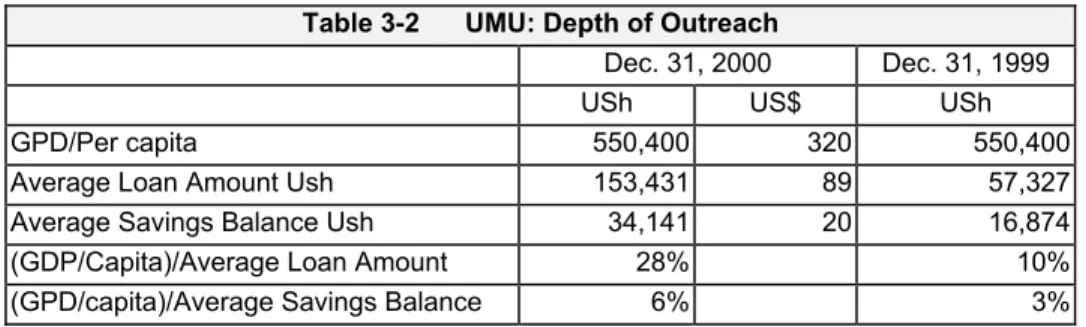
UMU’s clients begin by borrowing USh 50,000 (approximately US$30). The average loan size has grown from USh 57,327 in 1999 to USh153,431 in 2000, demonstrating the increase in the average loan of the borrowers as they continue to repay and acquire larger loans. Using the ratio of GDP/per capita to average loan sum as a proxy for depth of outreach, UMU’s loan size is low, at 28%.
Table 3-2 UMU: Depth of Outreach
Dec. 31, 2000 Dec. 31, 1999
USh US$ USh
GPD/Per capita 550,400 320 550,400
Average Loan Amount Ush 153,431 89 57,327
Average Savings Balance Ush 34,141 20 16,874
(GDP/Capita)/Average Loan Amount 28% 10%
(GPD/capita)/Average Savings Balance 6% 3%
2. Financial Performance
a. Towards Sustainability
At the end of 2000, three years after opening, UMU was close to reaching financial sustainability. UMU has grown while maintaining a repayment record of 98%. Outstanding loans more than tripled during 2000 and increased by 36% during the first semester of 2001. Savings also doubled during 2000 and have grown by 37% from January to June 2001. Key factors in this growth have been the ability of UMU to access both donor loan funds as well as additional grant funds for capacity building. At the end of 2000, UMU’s total assets amounted to USh 1.9 billion (US$ 1.1 million).
At the end of 2000, UMU reached a 92% level of financial sustainability. Again, this is one of the few cases of an MFI reaching this level in four years. Growth has been achieved in both the loan portfolio and the savings portfolio. Based on its capacity to mobilize savings and expand the loan portfolio with a high repayment rate, UMU has acquired a track record for borrowing from banks. UMU’s total assets are invested 61% in loan portfolio and 32% in liquid assets. This liquidity can be a safety cushion to cover savings withdrawals (the savings portfolio is equivalent to 24% of total assets). In 2000, equity grew to 61% of total assets, building the capital required for UMU to become a deposit-taking institution. The return on assets of 0.01% and on equity of .02% is low but improving with expansion as UMU reaches higher economies of scale.
UMU’s main operational expenses are 32% of total assets. Grants covered only 8% of the total expenses during 2000, reflecting a major decrease from 1999 when grants covered 40%. The total operational cost per number of borrowers, as of December 31, 2000, is estimated to be USh 76,383 (US$44). Compared to other Ugandan MFIs, this is a lower cost per dollar lent.
Furthermore, UMU benefits from economies of scope since it also mobilizes savings. Estimates of the cost per saver are similar to CRDB, about USh 42,274 (CRDB is estimated at USh 41773). Another factor which contributes to UMU's cheaper lending cost is its lending methodology that generates no social intermediation cost, as do methods used by other Ugandan MFIs.
Table 2-3
UMU: Balance Sheet 1999 and 2000 (Million Ush)
Dec. 31, 2000 Dec. 31, 1999 Variation 1999-2000 ASSETS Liquid Assets 621 32% 314 48% 98% Outstanding Loans 1,184 61% 275 42% 330% (Loan-Loss Reserve) Other Assets 131 7% 67 10% 95% Total Assets 1,936 100% 656 100% 195% LIABILITIES Total Deposits 471 24% 144 22% 226% External Loans 240 12% 140 21% 71% Provisions for Bad Deb
Other Liabilities 35 2% 18 3% 89%
Total Liabilities 746 39% 303 46% 146%
EQUITY
Paid-up Capital (or Grants) 1,175 61% 339 52% 247% Other capital related
Reserves
Retained Profit/Loss 15 1% 15 2% 1%
Total Equity 1,190 61% 354 54% 237%
Total Liabilities & Equity 1,936 100% 656 100% 195%
Table 3-4
Profil and Loss Statement 1999 and 2000 (Million Ush)
REVENUES Dec. 31, 2000 Dec. 31, 1999 Variation %
Interest Income 286 46% 61 35% 373% Other Interest Income 44 7% 3 2% 1166% Other Income 238 38% 38 22% 526% Total Income from Operations 568 92% 102 59% 457% Revenue Grants 50 8% 70 41% -28% Total income 619 100% 172 100% 260%
EXPENSES
Interest Paid (on Deposits and/or
Debt) 29 5% 11 6% 168% Provisions for Bad Debts 33 5% 3 2% 1044% Staff Costs 354 57% 96 56% 269% Training
Other Expenses (overhead) 202 33% 65 38% 214% Total Expenses 619 100% 174 101% 255%
Table 3-5
UMU: Financial Performance Indicators
SUSTAINABILITY Dec. 31, 2000 Dec. 31, 1999
Operational Sustainability 96% 62% Financial Sustainability 92% 59% Return on Assets 0.01% -0.36% Return on Equity 0.02% -0.67%
OPERATING EXPENSES & PORTFOLIO MANAGEMENT
Operating Exp/Total Assets 32.0% 26.5% Grants/Total Expenses 8.2% 40.1% Grants/Adm. Expenses 8.2% 40.1% Total Cost/Outstanding Loans 52.2% 63.3% Interest Inc Loans/Outstanding Loans 24.2% 22.0% Personnel Exp/Total Assets 18.3% 14.6%
EFFICIENCY AND PRODUCTIVITY
Total Adm Exp/Loan Portfolio 49.8% 59.4% Salary Exp/Loan Portfolio 29.9% 34.9% Other Adm Exp/Loan Portfolio 17.1% 23.5% Number of Active Borrowers 7,720 4,800 Number of Clients (savers) 13,802 Estimated 8,562 Total Staff 78 78 No Active Borrowers/Total Staff 99 62 Cost per borrower Ush 76,383 34,037 Cost per borrower US D 1720 $44 $20 Cost per client (saver) Ush 42,724 19,082
FINANCIAL STRUCTURE
Total Capital / Total Assets 61% 54% Total Savings / Total Assets 24% 22% Borrowing Comml/Total Assets 12% 21% Borrowing Comml/Loan Portfolio 20% 51% Total Deposits/ Total Assets 24% 22% Total Loans/ Total Deposits 251% 190%
b. Financial Structure
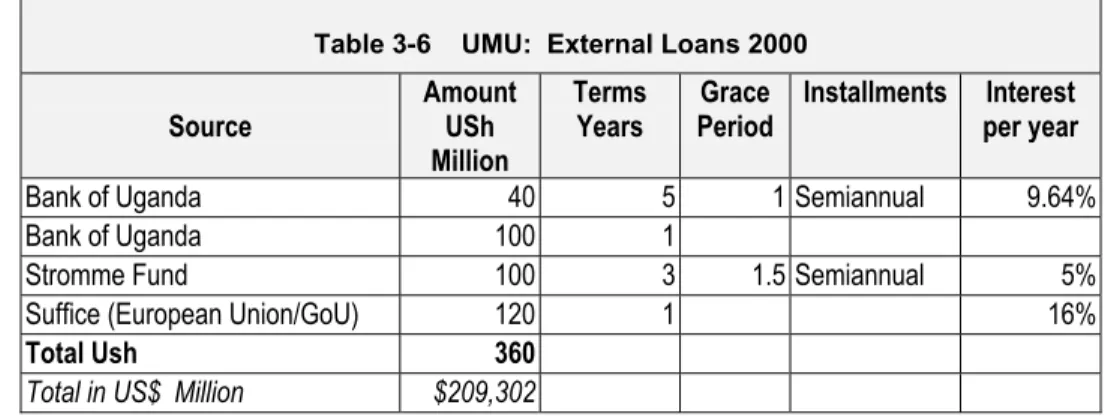
In the last two years, UMU has improved its financial structure, increasing its equity from USh 354 million (US$0.205 million, December 31, 1999) to USh 1.2 billion (US$0.692 million, December 31, 2000). The ratio of external loans to total assets has decreased from 21% in 1999 to 12% in 2000, although the amount of borrowed funds has increased by 71%. Increases in equity grants and external borrowing have been crucial to UMU’s expansion: the loan portfolio tripled and the savings portfolio doubled.
Table 3-6 UMU: External Loans 2000
Source Amount USh Million
Terms
Years Period Grace Installments Interest per year
Bank of Uganda 40 5 1 Semiannual 9.64% Bank of Uganda 100 1
Stromme Fund 100 3 1.5 Semiannual 5% Suffice (European Union/GoU) 120 1 16%
Total Ush 360
Total in US$ Million $209,302
During 2000, loans were received from the Bank of Uganda (20 million), the Stromme
Foundation (100 million), and Suffice (120 million). The BoU has provided UMU with loans in the past two years; in late 1999, a one-year loan at 8.82% interest and a second loan, with interest rates of 9.64% per annum, repayable in 5 years and including a one-year grace period. The principal and interest are repayable in equal semi-annual installments. The loan from the Stromme Foundation was received at an interest rate of 5%, on a reducing-balance basis for a term of 3 years and paid in 4 installments (month 18, 24, 30, 36). Suffice provided a one-year loan at 16%, secured with a fixed deposit of 200 million at the DFCU Bank.
Table 3-7 Capital Grants
CAPITAL GRANTS Yr 2000 NOVIB % USAID % TOTAL %
Loan Funds 277,905 50% 670,524 90% 948,429 73%
Operations Cost 112,899 20% 30,505 4% 143,404 11%
Fees for Staff 36,097 7% 0% 36,097 3%
Property equipment 0% 41,675 6% 41,675 3%
Computerization and training 125,490 23% 0% 125,490 10%
Total 552,391 100% 742,704 100% 1,295,095 100%
Mde up:
Accumulated capital grant 439,492 80% 735,336 99% 1,174,828 91% Accumulated grant income 112,899 20% 7,369 1% 120,268 9%
Total Ush 552,391 100% 742,705 100% 1,295,096 100%
IV. CONCLUSIONS AND RECOMMENDATIONS
Rapid growth towards sustainability. The Uganda Microfinance Union Ltd. (UMU) began its operations in late 1997. UMU has become a successful example of a “Ugandanized" MFI. It provides the Ugandan and international microfinance industry with lessons on how to build institutional capacity in microfinance in an African country committed to eradicating poverty. It has reached financial sustainability in four years. Total assets by December 2000 reached US$1.1 million and an equity of US$692,000 . By mid 2001, the organization's characteristics include:
16,577 clients who are also savers; Savers are low-income rural Ugandans; Seventy per cent are low-income women;
Fifty percent borrow for income-generating activities;
Diversified loan portfolio, invested in: 50% commerce, 35% agriculture; 12% services and 3% manufacturing;
Maintenance of repayment rate at 98%;
Financial sustainability of 100% in 2001, after only four years of operation;
Return on assets of 0.01% and on equity of .02% (low but improving with expansion) What are some of the lessons? UMU provides an example for the transformation of an NGO into a deposit-taking institution. This evolution has resulted from:
A focused vision of board members and top management on becoming a financial
intermediary (rather than a social intermediary) profitably serving low-income rural Ugandans. Minimal overhead costs. It does not target a specific market segment in rural communities, serving women and men, rural microentrepreneurs, farmers; and lending for a variety of income-generating activities.
Access to credit on a regular basis, a distinction that the organization considers more important than low-interest rates. It has created a range of products that allow borrowers to grow with the institution.
Appropriate use of international agencies' equity grants and loans resulting from solid financial and operational performance standards.
Commitments to include poor people while serving a broad clientele of the “working poor” in order to achieve economies of scale that contribute to institutional profitability.
Responses to clients’ demand as highlighted by UMU's participation in gender evaluations with women’s NGO that have expertise on gender. These evaluations have helped to generate new loan products tailored to women’s lack of productive assets.
What are some of the limitations and challenges? As with other Uganda MFIs:
Lack of appropriate infrastructure in the country to grow rapidly at low cost. The growth of any type of organization takes time in Uganda, so the ability to manage solid growth in microfinance while confronting problems such as the lack of electricity, roads and communications further complicates the process.
Access to adequate loans to finance growth until UMU receives authorization to become a deposit-taking institution. Growth and increased profitability depend on the mobilization of savings.
Increasing equity capital to finance long-term growth. Major investments in opening or enhancing operations, equipment, training require capital. This capital may come from private or public investors (international donors and the Ugandan government). It also involves institutional capacity and resources.
Political and macroeconomic risks still loom large in Uganda. UMU has benefited from four years of relative economic and political stability.
International development agencies and local policymakers should consider:
Financing Expansion: Currently the Bill to authorize microfinance deposit-taking is still pending. Once the bill is passed, the BoU must establish appropriate regulation, which will most likely be a slow process. Meanwhile, MFIs such as UMU, which are not authorized to mobilize savings, need continued access to loans (or other forms of funds, such as equity investments) to finance current operations as well as expansion.
Collaboration/Synergies with Women Advocacy NGOs: Kikalu, a loan product, was the result of collaboration between UMU and CEEWA's research. CEEWA provides expertise about gender issues that can benefit the microfinance industry. CEEWA needs to mobilize grants to continue to conduct pioneering research and advocacy for poor women participating in microfinance.