By
Ulyana Korotkova
RECOMMENDED:
Dr. Terrence M. Cole
RARE BOOKS AS HISTORICAL OBJECTS: A CASE STUDY OF
THE ELMER E. RASMUSON LIBRARY RARE BOOKS COLLECTION
Dr. Katherine L. Arndt
Dr. M ary^R ^hrlander Advisory Committee Chair
Dr. Mary^E/Ehrlander
R A R E BO OK S AS H ISTO R IC A L OBJECTS: A CA SE STUDY OF TH E E L M E R E. R A SM U SO N LIB R A R Y R A R E BO OK S C O LLEC TIO N
A THESIS
Presented to the Faculty o f the U niversity o f A laska Fairbanks
in Partial Fulfillm ent o f the Requirem ents for the D egree o f
M A ST E R OF ARTS
By
U lyana K orotkova
Fairbanks, AK
A bstract
Once upon a tim e all the books in the A rctic w ere rare books, incom parable treasures to the m en and w om en w ho carried them around the world. Few o f these tangible rem nants o f the past have m anaged to survive the ravages o f time, preserved in libraries and special collections. This thesis analyzes the over 22,000-item rare book collection o f the E lm er E. R asm uson Library at the U niversity o f A laska Fairbanks, the largest collection o f rare books in the State o f A laska and one o f the largest polar regions collections in the world. Content, chronology, authorship, design, and relevance to northern and polar history w ere a few o f the criteria used to evaluate the collection. Tw enty item s o f particular value to the study o f A laskan history w ere selected and studied in depth. The collection not only reflects the social, political and econom ic developm ent o f Alaska, but also the interests, personalities and expertise o f collectors and authors, including w orks owned or w ritten by key individuals in A laska history, such as H ierom onk Gideon, Ivan V eniam inov, Ivan P an ’kov, Iakov N etsvietov, Kiril K hlebnikov, H ubert H ow e Bancroft, G eorge D avidson, H udson Stuck, Sheldon Jackson, Jam es W ickersham , Charles Bunnell, A lfred H. Brooks and others. A ccident and happenstance also played a role in filling the shelves. There are m ore m ysteries than answ ers— w hy some o f these particular w orks resisted hundreds o f years o f neglect, cold, flood, and fire can never be known. W hile some books have no marks, no
identifiable ow ners or traceable past, the provenance o f others m akes them unique. Som etim es the story behind the story is the story.
Table o f Contents
Signature P a g e ... i
Title P a g e ... iii
A bstract ... v
Table o f C o n ten ts...vii
List o f F ig u re s...xi
List o f T a b le s ... xiii
List o f A p p en d ices...xv
A cknow ledgm ents... xvii
Introduction ... 1
Literature R eview ... 4
Chapter 1 R are B ooks Studies: M ethodological D isc u ssio n ... 11
1.1 H istorical R esearch B ased on L ib raries... 11
1.2 R esearch S tatem ent... 13
1.3 D escription o f the D ata - The E lm er E. R asm uson Library R are B ooks C ollection... 16
1.4 D efining Rare Books and Their Roles in Library C ollections...23
1.5 Structure o f a B o o k ...27
1.6 B ook M aterials...30
1.7 M ethodological C o n clu sio n ...32
Chapter 2 The B ook in A lask a... 33
2.1 A rctic and A ntarctic B ooks as T ra v e le rs...33
2.2 A rctic and A ntarctic Libraries as Travelers: Ship Publishing, Ship L ib raries... 34
2.3 F irst B ooks in A lask a... 36
2.4 N ikolai R ezanov’s V iew o f the E n lig h ten m en t... 39
2.5 The K odiak L ibrary...42
2.6 The Sitka L ib ra ry ... 44
2.7 The Sitka M u se u m ...46
2.8 Ivan Veniam inov: Language Studies and the Sitka S em inary... 48 Page
2.9 Educated “A m ericans” : The Case o f Ivan P an ’k o v ... 58
2.10 RA C Officials and M issionaries: The N ecessity o f Bilingual C om m u nicatio n...59
2.11 The Educational Backgrounds o f R ussian A m erican G o v e rn o rs ...63
2.12 C o n clu sio n ... 64
Chapter 3 M issionaries, Prospectors, and C ollectors...65
3.1 Early A m erican Era: The B attle o f School B o o k s ... 65
3.2 A m erican-Era M issionaries: Books, Reading, L ite ra c y ... 69
3.3 Gold R ushes in A laska and the Yukon: Illusion and E p h em era... 74
3.4 M issionary Periodicals at the Time o f the A laska Gold R u sh es... 78
3.5 Periodicals Exchanges, R eading R oom s and Libraries during the Late N ineteenth - Early Tw entieth C e n tu ry ... 80
3.6 Collectors o f A laskana and A laskan Collectors o f R arities... 83
3.6.1 The Challenges o f R are B ook Collecting in A lask a...83
3.6.2 The B ancroft L ib ra ry ...84
3.6.3 The G eorge D avidson L ib ra ry ...87
3.6.4 The Jam es W ickersham L ib ra ry ... 88
3.6.5 The Clarence L. A ndrew s L ib ra ry ...90
3.6.6 V alerian Lada-M ocarski L ib ra ry ...92
3.6.7 W om en in B ook Collecting: Laura K. L ad a -M o c arsk i...94
3.7 C o n clu sio n ...95
Chapter 4 R are B ooks as H istorical Objects, E lm er E. Rasm uson L ibrary Rare Books C o llectio n ...97
4.1 H istory o f the Elm er E. R asm uson Library and Its Rare B ooks C o llectio n ... 97
4.2 Study o f the R are B ooks Sample, Elm er E. Rasm uson Library R are B ook C o lle c tio n 109 4.2.1 B ooks in R ussian Published before 1 8 6 7 ... 110
4.2.2 B ooks in English Published before 1867... 112
4.2.3 B ooks in English Published after 1867... 114
4.2.4 B ooks in A laska N ative Languages Published after 1867... 119 Page
4.2.5 N ineteenth-C entury M issionary L iterature...122
4.2.6 N ineteenth-C entury W ritings by U.S. G overnm ent O ffic ia ls ... 126
4.2.7 N ineteenth-C entury U.S. Exploration L iterature... 127
4.2.8 Tw entieth-Century U.S. Exploration L iteratu re ... 130
4.2.9 Gold R ush L ite ra tu re ...131
4.2.10 Tw entieth-Century B usiness L iteratu re... 133
4.2.11 Late N ineteenth-E arly Tw entieth Century P erio dicals...135
4.2.12 W orld W ar II L iteratu re...137
4.2.13 Rare Books Sample: S um m ary... 139
C o n clu sio n ...141
Literature C ite d ...145 Page
List o f Figures
Frontispiece: The Elm er E. Rasm uson Library, U niversity o f A laska F a irb a n k s ...xix
Figure 1.1: E lm er Edw in R asm u so n ...22
Figure 2.1: B e n e fits to the E u ro p ea n N a tio n s by Semyon B a s h ilo v ... 45
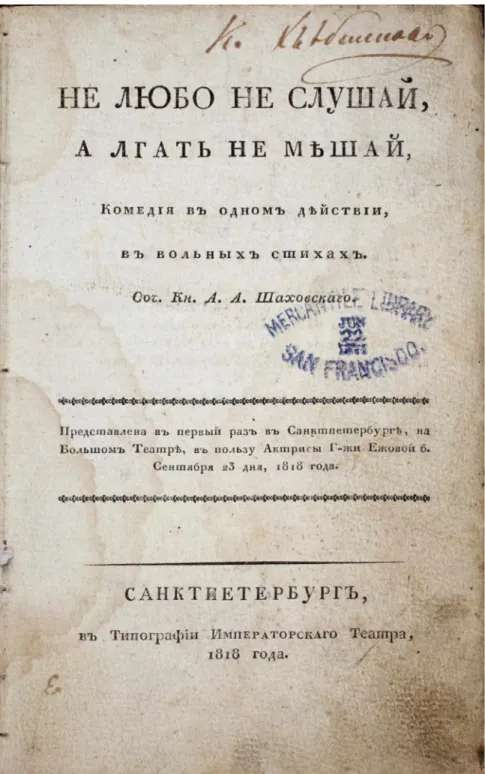
Figure 2.2: Title page o f D o N o t L iste n i f I t B o th e rs You by A. S h ak ho vsk oi...47
Figure 2.3: M etropolitan o f M oscow Innokentii... 50
Figure 3.1: Rev. Sheldon Jackso n... 68
Figure 3.2: P resident and Judge - Dr. Charles E. Bunnell and Judge Jam es W ic k e rsh a m ... 91
Figure 3.3: C larence Leroy A n d rew s... 93
Figure 4.1: The first donation to the A laska A gricultural College and School o f M ines Library m ade by W. F. T h o m p so n ...98
Figure 4.2: Photo used in Leslie A. M archand’s arcticle, “A m ong the Five Thousand” 100 Figure 4.3: U niversity o f A laska Library, 2nd floor G y m ...102
Figure 4.4: Bound volum es at the U niversity o f A laska library, 1922-1965... 104
Figure 4.5: Bunnell Building, U niversity o f A la sk a ... 106
Figure B-1: V ariants o f the Elm er E. Rasm uson Library sta m p s ... 167 Page
L ist o f Tables
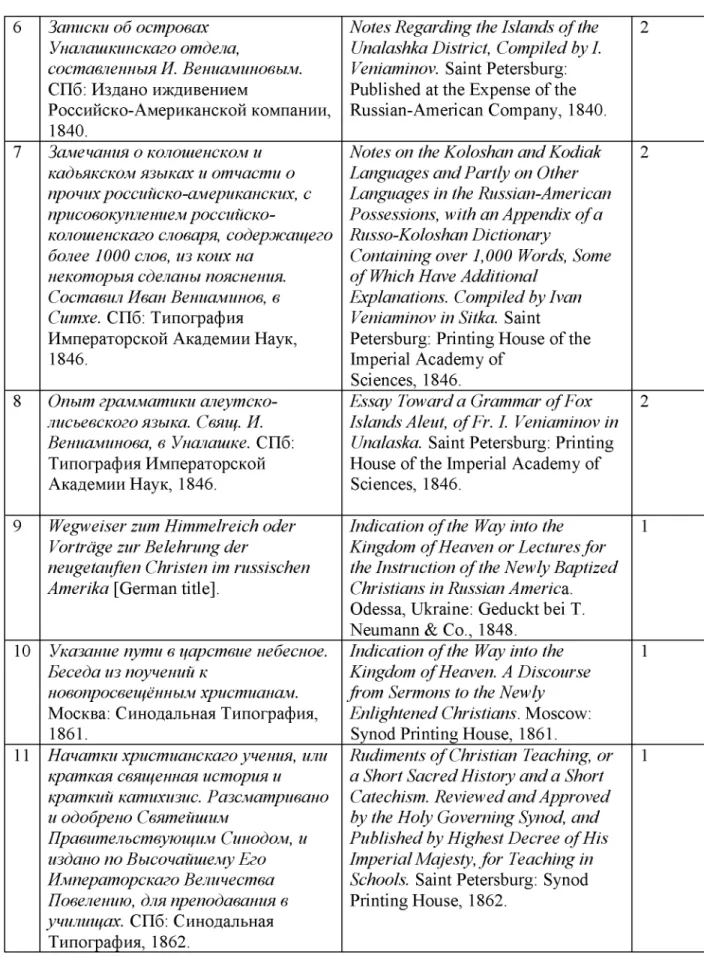
Table 2.1: The E lm er E. R asm uson Library rare books by Ioann (Ivan) V eniam inov... 55 Table 4.1: Com parison o f tw o copies o f the same edition o f B ancroft’s
H isto ry o f A la s k a... 118 Table 4.2: D ust jack et advertisem ents: The S p e ll o f the Y ukon by R obert S e rv ic e ... 132 Table D-1: College books listed by Leslie M archand in 1925 ... 171 Page
List o f A ppendices
A ppendix A. B ook Structure, A ccording to the P ublishers’ Tem plate...165 A ppendix B. The Elm er E. R asm uson Library S ta m p s... 167 A ppendix C. “A m ong the Five Thousand” by Leslie A. M arch an d ... 168 A ppendix D. A laska A gricultural College and School o f M ines Library Books
Listed in Leslie A. M archand’s Article, “A m ong the Five Thousand” ... 171 A ppendix E. The Elm er E. Rasm uson Library R are Books Reviewed,
in A lphabetical O rd er... 175 A ppendix F. The Elm er E. R asm uson L ibrary Rare B ooks Reviewed,
in C hronological O rd e r...177 Page
A cknow ledgm ents
This thesis w ould not have been possible w ithout access to the E lm er E. R asm uson Library rare book collection. I am grateful to R ose Speranza, Charles H ilton, and L isa M orris for their assistance, and to archivist Rachel Seale and Dr. K atherine A rndt for their guidance and tips on rare books. I could never offer enough thanks to Dr. M ary E hrlander for her acting as an editor and m entor and to Dr. Terrence Cole w hose enthusiasm about polar exploration and the history o f A laska is contagious. A bove all, I am thankful to the rare books for revealing their m ysteries to me.
Introduction
Just like the explorers w ho cam e to A laska from all over the map, the E lm er E. Rasm uson Library special collection reflects diversity. W ritten in over tw enty languages, w ith English,
German, French, Russian, and D anish topping the list, the collection spans from 2100-2000 B.C. to the tw enty-first century.
The total size o f the Elm er E. R asm uson Library rare books collection fluctuates because o f changing library policies and adm inistration - for instance, in the past, the library had a category o f sem i-rare books, item s m ore accessible for public use than rare items. Since that time, the sem i-rare volum es have been m erged w ith the rare books. “There is no easy w ay to count the num ber o f item s,” curator o f rare books K atherine L. A rndt explains. A tw o-volum e book counts as one title, but tw o items if bound separately. Tw elve issues o f a periodical could be counted as one item if bound together or boxed in a single container.1 The special collection belongs to three w orlds - library, archives, and museum. Today, the rare m aterials in the clim ate-controlled vault o f the Rasm uson Library am ount to alm ost 6,500 books, pam phlets, and periodicals, as well as about 1,200 maps. The library’s special-collection holdings include an additional 11,000 books and m ore than 4,000 m anuscript m aps housed in other secured areas. All library rare books com bined w ould fill four and h alf lengths o f a football field, or 1342 linear feet.
The sm allest and oldest item in the collection is a tiny clay tablet in cuneiform 2 cm. thick and 4 cm. square, dating 2100-2000 B .C .2 It is a record o f a large barley transaction at a local mill in U m m a (m odern day Iraq). A t that time, cuneiform records w ere evolving into a m ore com plex
1 Personal communication with Katherine L. Arndt, Elmer E. Rasmuson Library rare books curator.
2 [Ur III text] [realia]. Elmer E. Rasmuson Library call number is A2438 RARE; “CDLI Cuneiform Digital Library Initiative/the Elmer E. Rasmuson Library cuneiform,” accessed November 17, 2015, http://cdli.ucla.edu/P491488 .
system o f legal contracts, letters, and narrative accounts. The only clue about the tablet’s provenance is the box in w hich it arrived at the library either directly or through a donor. The box w as sent from Philip C. D uschnes, a N ew Y ork rare book dealer, som etim e betw een 1943 and 1967. Libraries that carry sim ilar tablets, gathered during the closing days o f the O ttom an Em pire, nam e Edgar Jam es Banks (1866-1945) as a collector.3
One o f the largest item s is the 977-page G e o g ra p h y o f Strabo, printed ca. 1571, during the second century o f m ovable type.4 Strabo’s G eo g ra p h y was first published in about 7 B.C. John Sterrett, w ho translated portions o f a 1917 English edition o f G eography, described it as one o f the great w orks o f ancient times: “The G eography o f Strabo is far m ore than a m ere geography. It is an encyclopaedia o f inform ation concerning the various countries o f the Inhabited W orld as know n at the beginning o f the Christian era; it is an historical geography; and. . . a philosophy o f geography.” 5 W ritten by a G reek geographer and historian w hose inherited w ealth allow ed for his life-tim e scholarly pursuits, this colossal w ork drew on the sources o f the A lexandrian library and Strabo’s travels that, he claimed, w ere the m ost extensive for his tim e.6 H e had a broad and holistic view o f geography and its utility that included political history, astronom y, animals, and plants. A ccording to Strabo, geography w as concerned w ith “the activities o f statesm en and com m anders but also. . . knowledge. . . o f the heavens and o f things on land and sea, animals,
3 Personal communication with Katherine L. Arndt; Cuneiform, the writing system that became fully functional by about 2400 B.C., culminated in the Epic o f Gilgamesh (Eleanor Robson, “The Clay Tablet Book in Sumer, Assyria, and Babylonia,” in A Companion to the History o f the Book, eds. Simon Eliot and Jonathan Rose (Oxford: John Wiley & Sons, 2008), 165-195).
4 Strabo, Strabonos geografikon bibloi egta kai deka = Strabonis rervm geographicarvm libri septemdecim (Ex Officina Henricpetrina, [1571?]). The Elmer E. Rasmuson Library call number for this item is B0287 RARE; The Rasmuson Library volume belongs to the 1571 Xylander edition that was printed in Basel. Geography's original translation into classic Latin was commissioned by Pope Nicolaus V (Brill’s New Pauly: Supplements. Dictionary o f Greek and Latin’s Authors and Texts, edited by Mangred Landfester, translated and edited by Tina Jerke and Volker Dallman (Leiden, Netherlands: Brill, 2009), 598).
5 John Sterrett, introduction to The Geography o f Strabo (Cambridge: Harvard University Press, William Heinemann, 1959-61), 1:xxviii.
plants, fruits, and everything else to be seen in various regions.”7 Incorporating at least 252 citations o f poetry into his m anuscript,8 Strabo described the habitable w orld as an island that could be circum navigated by the sea.9 The R asm uson Library volum e o f G eo g ra p h y features parallel texts in G reek and Latin, com plex tables, and m aps and engravings that required the best available w orkm anship. The 1571 edition appeared only a hundred years after G uarino V eronese had translated Strabo into Latin in 1469.10
The tablet and the G eo g ra p h y exem plify the w ide range o f the m aterials kept in the Elm er E. R asm uson Library special collection. B ecause the collection grew som ew hat haphazardly from its beginnings in 1921, it includes a potpourri o f other unusual items, such as a personally inscribed copy o f President W oodrow W ilso n’s H isto ry o f the A m e ric a n P e o p le,11 an 1868 M cG uffey’s N ew E c lec tic P r im e r ,12 a first edition o f the P ic k w ic k P a p e rs by Charles D ickens,13 and Jam es W eston’s 1740 S ten o g ra p h y C om pleated, o r the A r t o f S h o rt-H a n d B r o u g h t to
P erfectio n ; B e in g the M o s t E asy, E xact, Speedy, a n d L e g ib le M e th o d E x ta n t.14 However, the vast m ajority o f the collection encom passes A laska and northern and polar themes. G eographically, A laska m aterials are m ost num erous, but there are also significant holdings on the Arctic, Siberia, Scandinavia, and Greenland, w ith only a small num ber on the Antarctic.
7 Strabo, The Geography o f Strabo, 1:3-4.
8 Daniela Dueck, “Strabo’s Use of Poetry,” in Strabo’s Cultural Geography: The Making o f a Kolossourgia, eds. Daniela Dueck, Hugh Lindsay, and Sarah Pothecary (Cambridge, UK: Cambridge University Press, 2005), 87. 9 Strabo, The Geography o f Strabo, 1:17.
10 Francesca Fiorani, The Marvel o f Maps: Art, Cartography and Politics in Renaissance Italy (New Haven, Connecticut: Yale University Press, 2005), 101.
11 Woodrow Wilson, A History o f the American People (New York: Harper & Brothers, 1918). EERL call number for this item is A0335 RARE V. 1.
12 William Homes McGuffey, Leigh’s McGuffey’s New Eclectic Primer: In Pronouncing Orthography (Cincinnati, Ohio: Van Antwerp, Bragg & Co., 1868). EERL call number for this item is A1512 RARE.
13 Charles Dickens, The Posthumous Papers o f the Pickwick Club (London: Chapman and Hall, 1837). EERL call number is A1608 RARE.
14 James Weston, Stenography Compleated, or the Art o f Short-Hand Brought to Perfection; Being the Most Easy, Exact, Speedy, and Legible Method Extant (London: Printed for the author, 1740). EERL call number is A1875 RARE.
This thesis focuses on A laska-related materials. It is a case study that seeks to evaluate and com pare the E lm er E. R asm uson rare books based on their role in N orthern and P olar history, content, chronology, authorship, and design. Consequently, the study provides an overview o f historical trends in A laska book collecting, as well as analyzing literacy in A laska and surveying the R asm uson Library rare books collection.
O f the m ore than tw enty-tw o thousand rare books and maps, tw enty books w ere selected for in-depth study. This tiny portion o f the collection, less than 0.1 per cent, gives only a partial view o f the whole. However, even this small sample dem onstrates some o f the broader them es o f the history o f the book in Alaska, in English, Russian, and A laska N ative languages, including works by m issionaries, governm ent officials, explorers, businessm en, gold stam peders, and soldiers. The books dem onstrate that the R asm uson L ibrary collection parallels the m ulti-national exploration and developm ent efforts that drew people from around the w orld into the Arctic.
L iterature R eview
Literature on rare books as historical objects can be divided into tw o basic categories:
literature that includes a broad overview o f the m any aspects o f books as objects, such as D avid P earson’s B o o k s a s H is to r y,15 and special focus literature that evaluates a particular group o f book traits, such as M irjam F o o t’s H isto ry o f B o o k b in d in g a s a M ir r o r o f S o c ie ty .16 Published by the B ritish Library, P earson’s B o o k s a s H is to r y appeals to special collections historians and rare books enthusiasts, highlighting rare books as artifacts and stressing their im portance beyond text. Pearson com pares owners, annotations and other physical features. M irjam Foot evaluates fine
15 David Pearson, Books as History (London: British Library/Oak Knoll, 2012).
bindings in the British Library, focusing on interactions betw een w ealthy library patrons and craftsmen. Both Pearson and Foot owe the success o f their books to com bining special collections w ith history. F ro m the H a n d to the M a c h in e by Cathleen B aker17 provides
descriptions o f a variety o f com m on papers based on the author’s extensive experience as a paper conservator.
A C o m p a n io n to the H isto ry o f the B ook,18 edited by Simon Eliot and Jonathan Rose, reviews the entire history o f the textual and non-textual elem ents o f book culture, such as reading lights, library furniture, and bookm arks. “The Im portance o f Ephem era” by M artin A ndrew s proved to be a useful theoretical background on non-book printed m aterials.19 The 2009 IFLA publication, E a r ly P r in te d B o o k s a s M a te r ia l O b jects,20 features a chapter on fictitious volum es reconstructed from parts o f originals, a topic seldom discussed in literature.21 D ard H u nter’s classic,
P a p erm a kin g , addresses the evolution o f paper, and K urt W eidem ann’s B o o k J a c k e ts a n d R e c o r d C o vers highlights the history o f these ephem era valuable to collectors, but discarded by
libraries.22
In addition to seeing books as either physical objects or cultural artifacts, the third (em erging) trend in historical literature, as exem plified by the m ulti-volum e H isto ry o f the B o o k in
A m e ric a,23 view s the book industry at the nexus o f authors, publishers, policym akers, collecting bodies, and readers.
17 Cathleen A. Baker, From the Hand to the Machine (Ann Arbor: The Legacy Press, 2010).
18 Simon Eliot and Jonathan Rose, eds, A Companion to the History o f the Book (Oxford: John Wiley & Sons, 2008). 19 Martin Andrews, “The Importance of Ephemera,” in A Companion to the History o f the Book, edited by Simon Eliot and Jonathan Rose (Oxford: John Wiley & Sons, 2008), 904-930.
20 Bettina Wagner and Marcia Reed, eds, Early Printed Books as Material Objects (Munich: De Gruyter, 2010). 21 Undorf Wolfgang, “The Idea(l) of the Ideal Copy: Some Thoughts on Books with Multiple Identities,” in Early Printed Books as Material Objects, ed. Bettina Wagner and Marcia Reed (Munich: De Gruyter, 2010), 307-319. 22 Dard Hunter, Papermaking: The History and Technique o f an Ancient Craft (New York: Dover Publications, 1978); Kurt Weidemann, Book Jackets and Record Covers (New York: Frederick A. Praeger, Publishers, 1969). 23 David D. Hall, ed., History o f the Book in America (Chapel Hill: University of North Carolina Press, 2007-2010).
Published in 1891, H ubert H ow e B ancroft’s L ite ra ry In d u strie s24 offers a rare view into the m ind o f an author, publisher, collector, and librarian. B ancroft m eticulously described the founding and grow th o f his library, its purpose, its collections and their size, as well as the library buildings and their locations. B iographies o f polar explorers and scientists m ay include inform ation on their collecting activities - O scar L ew is’ G eorge D a v id so n 25 and W illiam H u n t’s Steff: A B io g ra p h y o f V ilhjalm ur S tefa n sso n 26 provide insight into this little-know n aspect o f the explorers’ life and work.
A know ledge o f books as travelers can be gleaned from various accounts o f A rctic
expeditions, but it consists o f bits and pieces dispersed w ithin the travelogue. Catalogs o f A rctic exhibits som ew hat com pensate for this deficiency, but few exist. The one indispensable book that focuses on the history o f books in the A rctic and A ntarctic is D avid and D eirdre Stam ’s B o o k s on Ic e ,27 w hich provides entertaining descriptions o f m ore than a hundred items. The relatively recent P ro c e ed in g s o f the P o la r L ib ra rie s C o llo q u y provide a space for discussion on collection, preservation, and dissem ination o f inform ation on the A rctic and A ntarctic regions. Published since 1971 in book form at and m ore recently online, the P ro c e e d in g s discuss principal circum polar libraries new s and events, offering a fram ew ork for unique northern librarianship.28
24 Hubert Howe Bancroft, Literary Industries: Chasing a Vanishing West (Berkeley: Heyday, 2013); The Friends of the Bancroft Library, as well, publicizes special collections catalogs, such as Some Treasures o f the Bancroft Library (Berkeley: Friends of the Bancroft Library, University of California, 1973).
25 Oscar Lewis, George Davidson: Pioneer West Coast Scientist (Berkeley: University of California Press, 1954). 26 William R. Hunt, Steff: A Biography o f Vilhjalmur Stefansson, Canadian Arctic Explorer (Vancouver: University of British Columbia Press, 1986).
27 David Stam and Deirdre Stam, Books on Ice (New York: The Grolier Club, 2005).
28 The most recent proceedings listed on the Polar Libraries Colloquy website are “Cool Libraries in a Melting World: Proceedings o f the 23rd Polar Libraries Colloquy 2010, June 13-18, 2010, Bremerhaven, Germany.
hdl:10013/epic.36296,” accessed September 3, 2015, http://hdl.handle.net/10013/epic.36296; Founded in 1971, the Polar Libraries Colloquy holds biennial meetings that alternate between Europe and North America.
H istorically, the earliest book enthusiasts in A laska w ere Christian m issionaries. They acted as teachers, collectors, librarians and historical w itnesses. W ell educated, even though
indoctrinated into the cultural beliefs o f their era, m issionaries left a body o f correspondence, diaries, m em oirs and books. M ore likely to address m issionary objectives, such as literacy and education, these w ritings did not focus on librarianship. Instead, they bring into view A laska’s changing econom ic and cultural landscape, past and em erging reading audiences, schools, books, reading room s and periodicals.
Books, education and literacy in R ussian A m erica, however, rem ain underrepresented in U.S. historical literature. N either Jam es W ickersham ’s 1927 B ib lio g ra p h y o f A la sk a n L ite ra tu r e ,1 7 2 4 -1924 nor M arvin F alk ’s 2006 A la s k a H isto ry: A n A n n o ta te d B ib lio g ra p h y, contains many items pertaining to education in R ussian A m erica.29 In its “ School B ooks” section, W ickersham ’s bibliography lists tw enty-five study guides used in Russian schools, m ostly after the A laska Purchase. Just as sparse, M arvin F alk ’s bibliography nam es only sixteen titles in a section
devoted to R ussian A m erican education and health. The nineteenth-century R ussian sources treat the topic m ore generously, offering inform ation on the R ussian O rthodox M ission and its
educational endeavors in w ritings by H ierom onk Gideon, Ivan V eniam inov, Kiril K hlebnikov and Ferdinand W rangel. P. A. T ikhm enev’s H isto ry o f the R u ssia n -A m eric a n C om pany, published in R ussian in 1861-63, review ed various activities o f the Company, including its education outreach.30
29 James Wickersham, A Bibliography o f Alaskan Literature, 1724-1924 (Cordova, Alaska: Cordova Daily Times Print, 1927); Marvin W. Falk, Alaska History: An Annotated Bibliography (Westport, Connecticut: Praeger, 2006). 30 P. A. Tikhmenev, A History o f the Russian-American Company, translated and edited by Richard A. Pierce and Alton S. Donnelly (Seattle: University of Washington Press, 1978), vi.
H udson Stuck’s A la sk a n M is sio n s o f the E p is c o p a l C h u rc h31 and Sheldon Jackson’s A laska, a n d M is sio n s on the N o rth P a c ific C o a st,32 provide testim onies to life in early Alaska, its cities and towns, people and activities. M issionary w ritings often suffer from w hat Episcopal
A rchdeacon o f the Y ukon and A laska H udson Stuck term ed “ a certain phraseology,”33 a sanctim onious term inology used by m issionary w orkers - but even then, they remain
indispensable for historical inquiries into conditions and attitudes o f the time. L ester B radner’s 1 9 1 6 A la sk a n D ia ry 34 or A lbin Johnson’s S even teen Y ears in A la s k a35 offer vivid (though, unfortunately, sparse) exam ples o f books and literacy in historical Alaska. Others, like the nineteenth-century Presbyterian m issionary C larence T hw ing’s letters,36 devote m ore tim e and space to gospel books and m issionary periodicals.
B iographers and historians w ho look into aspects o f m issionary w ritings other than
proselytizing functions, such as education, travel observations, or collecting activities, highlight little-know n aspects o f m issionaries’ lives. Jean U sher, in W illiam D u n c a n o f M e tla k a tla 3 discusses the V ictorian era o f school instruction to w hich D uncan adhered, citing specific exam ples o f his teaching methods. Rosem ary Carlton, in S h e ld o n Jackso n : The C o llec to r,38 focuses on Jackson’s connections w ith the collecting bodies o f his tim e and his activities as a m useum and library founder.
31 Hudson Stuck, The Alaskan Missions o f the Episcopal Church (New York: Domestic and Foreign Missionary Society, 1920).
32 Sheldon Jackson, Alaska, and Missions o f the North Pacific Coast (New York: Dodd. Mead & Company, 1880). 33 Stuck, The Alaskan Missions o f the Episcopal Church, 23.
34 Lester Bradner, A 1916 Alaskan Diary ([Saunderstown, R.I.]: Robert Bradner, Helen Bradner Reid, William M. Bradner, Jr., Lawrence H. Bradner, 2008).
35 Albin Johnson, Seventeen Years in Alaska: A Depiction o f Life amount the Indians o f Yakutat, translated and edited by Mary Ehrlander (Fairbanks: University of Alaska Press, 2014).
36 Harry Reid, “American Ethos in 19th Century Alaska: The Letters of Rev. Clarence Thwing, M. D. (1892-1895)” (Master’s thesis, Sonoma State University, 1999).
37 Jean Usher, William Duncan o f Metlakatla: A Victorian Missionary in British Columbia (Ottawa: National Museum of Man, National Museums of Canada, 1974).
W ith the exception o f Jeannette Stew art’s 1957 m aster’s thesis L ib ra ry Service in A la s k a,39 there is no formal history o f libraries in Alaska. Jackie M usgrave’s 1996 L o o k in g B ack: A S h o rt H isto ry o f P u b lic L ib ra rie s in A n c h o ra g e 40 details the origins o f Z. J. Loussac Public Library.
Terrence C ole’s C ornersto n e on C ollege H ill41 and W illiam C ashen’s F a r th e st N o rth C ollege P re sid e n t42 address the origins o f the U niversity o f Alaska. Supplied w ith a thorough index,
striking selection o f photographs and historical highlights, C ole’s illustrated history o f the U niversity o f A laska Fairbanks provides fast access to a w ide variety o f aspects o f the
institution’s history. C ashen’s biography o f Charles B unnell revolves around the personality o f the first university president and de fa c to library curator w ho corresponded extensively on w hat he envisioned as an em erging collection o f Alaskana.
Terrence C ole’s history o f the N ational B ank o f Alaska, B a n k in g on A la ska , expounds on the m ultifarious activities o f N B A that included collecting rarities. Its biographical section relates inform ation on E lm er R asm uson’s life and w ork, his view on libraries in general, and his role in founding the E lm er E. R asm uson Library and its rare books collection in particular. W ell-w ritten and thoroughly researched, B a n k in g on A la s k a details the purchase o f the Lada-M ocarski and G eorge D avidson collections, their content, and the story o f the N B A donating the rare books to the U niversity o f A laska Fairbanks.43
39 Jeannette Stewart, “Library Service in Alaska; A Historical Study” (Master’s thesis, University of Washington, 1957).
40 Jackie Musgrave, Looking Back: A Short History o f Public Libraries in Anchorage (Anchorage: Municipality of Anchorage, 1996).
41 Terrence Cole, The Cornerstone on College Hill: An Illustrated History o f the University o f Alaska Fairbanks (Fairbanks: University of Alaska Press, 1994).
42 William R. Cashen, Farthest North College President (Fairbanks: University of Alaska Press, 1972). 43 Terrence Cole, Banking on Alaska: The Story o f the National Bank o f Alaska (Anchorage: National Bank of Alaska, 2000).
M arvin W. F alk ’s “The A laska and P olar R egions Collection at the Elm er E. Rasm uson Library,” surveys the library’s publications on the circum polar regions. In another article,
“Looking into Old M aps: W ho G enerated A laska’s H istorical M aps Up Through the Gold R ush,” Falk discusses the history o f exploration and expedition m aps in general, devoting only a small part to the Rasm uson Library m aps.44 Similarly, linguist M ichael E. K rauss o f the U niversity o f A laska authored articles, such as “A laska N ative Languages in R ussian A m erica” and “A laska N ative Languages: Past, Present, and Future,”45 w hich analyze rare dictionaries in the context o f his linguistic studies.
All these studies have been useful to varying degrees in this research, but despite the
abundance o f books about books, the history o f the book in A laska is still unwritten. This study attem pts to fill that gap.
44 Marvin W. Falk, “The Alaska and Polar Regions Collection at the Elmer E. Rasmuson Library,” Alaska Journal 9, no. 1 (Winter 1979): 65-70; Marvin W. Falk, “Looking into Old Maps: Who Generated Alaska’s Historical Maps up through the Gold Rush?” in Creativity, Lighting the Poles: Collaborative Solutions to Common Problems:
Proceedings o f the 16th Polar Libraries Colloquy, June 17-22, 1996, Consortium Library, University o f Alaska Anchorage and Partial Proceedings o f the 6th Northern Libraries Colloquy, July 12-15, 1976, Elmer E. Rasmuson Library, University o f Alaska Fairbanks (Anchorage: Consortium Library, University of Alaska Anchorage, 1997): 95-98.
45 Michael E. Krauss, “Alaska Native Languages in Russian America,” in Russian America: The Forgotten Frontier, eds. Barbara Sweetland Smith and Redmond J. Barnett (Tacoma: Washington State Historical Society, 1990): 205 213; Michael E. Krauss, “Alaska Native Languages: Past, Present, and Future,” Alaska Native Language Center Research Papers 4 (1980).
C hapter 1 Rare Books Studies: M ethodological D iscussion
1.1 H istorical R esearch B ased on Libraries
H istorians have always recognized libraries and books as objects, artifacts and databases, as well as art, but they seldom study the libraries and books them selves. Library history is the sub discipline that analyzes collectors and collections. Charles H. B usha and Stephen P. H arter defined library history as the “ system atic recounting o f past events pertaining to the
establishm ent, maintenance, and utilization o f system atically arranged collections o f recorded inform ation or know ledge.” 1
Librarians have been guilty o f ignoring their own history. Carol M cC om bs and Charles H. Busha, in their 1981 assessm ent o f library history stated that “both qualitative and quantitative im provem ents need to be m ade in this im portant area o f library science research.”2 Joan C. D urrance analyzes the lack o f adequate training w ithin library science as w ell.3 A ccording to D urrance, m ost library education program s prepare librarians neither to consum e nor to conduct research.
The causes o f this problem lie, perhaps, in public libraries’ relatively recent developm ent in the U nited States. Even though private libraries began in the early colonies, it w as not until the nineteenth century that free public libraries appeared w ithin the com plex netw ork o f social, parochial, m unicipal, and charitable libraries, m any o f w hich contained only one or tw o book
1 Charles H. Busha, Research Methods in Librarianship: Techniques and Interpretation (New York: Academic Press, 1980), 93.
2 Charles H. Busha and Carol McCombs, “Historical Research and Oral History in Librarianship,” in A Library Science Research Reader and Bibliographic Guide, ed. Charles Busha (Littleton, Colorado: Libraries Unlimited,
1981), 75.
3 Joan C. Durrance, “Research Needs in Public Librarianship,” in Library and Information Science Research, eds. Charles McClure and Peter Hernon (Norwood, New Jersey: Ablex Publishing Corporation, 1991), 280.
cases m anaged by volunteer librarians. “The year 1876 m arked a turning point for A m erican librarianship,” w rites E dw ard H olley.4 Three experienced librarians, Justin W insor, W illiam Poole, and Lloyd Smith, allied w ith the younger M elvil D ew ey to form a com m ittee for a library conference in P hiladelphia.5 Librarians w ho attended the conference founded the Am erican Library A ssociation. The next year, the inventor o f the D ew ey D ecim al System, M elvil Dewey, opened the first U.S. library school. Initially, it operated w ithin N ew Y o rk ’s C olum bia College, w here D ew ey w orked as a librarian, but in 1889 the school m oved from C olum bia to Albany. It trained bibliographers, reference librarians, and library m anagers6 w ho devoted their careers to transform ing the field o f library science from am ateur to professional. W ayne W iegand writes, “By the early 1900s, the evolving public library com m unity w as supported not only by the A m erican Library A ssociation, Library Journal, five library schools, and the U.S. B ureau o f Education, but also by tw enty-five state library associations, eighteen state library com m issions, and tw elve local library clubs.”7 Still, the great U.S. libraries that com pare w ith the w orld’s richest book repositories acquired their im m ense collections only during the tw entieth century.8
The library, by necessity, acted as a m ultidisciplinary repository for the w o rld ’s knowledge, and served diverse audiences. Its content spanned from early religious and m oralistic to popular literature. D uring the course o f the tw entieth century, due to the increased globalization o f know ledge and the internet revolution, library collections becam e m ore accessible than ever before. Virtual libraries, electronic catalogs, databases, and collections provide books, journals,
4 Edward G. Holley, Charles Evans: American Bibliographer (Urbana: University of Illinois Press, 1963), 1. 5 Holley, Charles Evans, 1.
6 Wayne A. Wiegand, “The American Public Library: Construction of a Community Reading Institution,” in A History o f the Book in America, vol. 4, eds. Carl F. Kaestle and Janice A. Radway (Chapel Hill: The University of North Carolina Press, 2009), 434.
7 Wiegand, “The American Public Library,” 4:437-438.
8 Phyllis Dain, “The Great Libraries,” in A History o f the Book in America, eds. Carl F. Kaestle and Janice A. Radway (Chapel Hill: The University of North Carolina Press, 2009), 4:452.
and archival m aterials to anyone w ho is interested. This trend created a public dem and for electronically published facts, statistics, histories, book reviews, and journal abstracts.
1.2 Research Statem ent
This thesis explores the origin and evolution o f the E lm er E. R asm uson Library special collection, highlighting the aspects o f rare book collecting that have had practical value for the collection’s acquisition, developm ent, and m anagem ent.
The library acts as the prim ary database that offers access to the collection. However, w hile the m odern library catalog system atically provides inform ation about books, it does not include all the details necessary for rare books analysis. L ike m any academ ic libraries that began w ith a book drive, the U niversity o f A laska library did not keep consistent records o f transactions involving books. D ispersed in various U niversity o f A laska records and papers o f its alumni and associates, the donor correspondence and other docum ents that m ention books offer only a glim pse into the early library history. The Dr. Charles E. Bunnell Papers that contain m eticulous correspondence files from 1922 to 1956 represent a rare exception. The collection features B unnell’s letters to potential library donors and their replies, as well as item ized book lists.9
The A laska A gricultural College and School o f M ines and its successor, the U niversity o f Alaska, did not collect archival m aterials until 1965, w hen the archives opened its doors. From
1926 to 1962, the university m useum accepted m aterials that had archival value, and recorded their arrival in its register. The first m useum record, item #1, from 1926, listed archaeological and ethnographic m aterial from St. Law rence Island and the B ering Sea area collected by Otto
9 Dr. Charles E. Bunnell Papers, Alaska and Polar Regions Collections and Archives, Elmer E. Rasmuson Library, University of Alaska Fairbanks.
Geist. The m useum acquired it through a loan. The last record in the 1926-1962 ledger, item #2056, referred to a com m em orative coin from Sitka, received in 1962 from Dr. Ivar Skarland as a gift. The archival accession registers that have been kept from 1964 to this day describe
collections, but not individual rare books. R econstructing the history o f each individual item in this study’s rare books sam ple required analyzing books for any signs o f provenance, searching through various bibliographies o f A laskana, surveying archival collections, perusing supporting docum entation, and com piling different bits and pieces o f inform ation found in historical literature into bibliographic descriptions.
In general, previous collectors o f the rare books did not always provide the best clues. If they collected inform ation concerning the objects that they acquired, they seldom passed it along. Perhaps, they relied on their m em ories too heavily - or they treated rare books as a byproduct o f their other activities, w hether it w as research, exploration, or w riting and publishing. M ost collectors had their ow n individual needs w hich diverged from the w orld o f libraries. To satisfy their objectives, early book enthusiasts created their own classification schemes. They did not care to com ply w ith contem porary library standards, and for good reason - the early library systems w ere neither fully standardized nor tailored to the needs o f readers.
For example, Thom as Jefferson’s library that he sold to the Library o f Congress in 1815 was arranged analytically, chronologically, and som etim es both, using his own unique subject
categories. Jefferson m aintained a principal collection catalog, but it contained so m any additions and deletions that he needed a clean copy by 1812.10 D ouglas W ilson w rites, “Classifiers tell us at least as m uch about them selves as about their subjects, and Jefferson is no exception. His
10 Douglas L. Wilson, “Sowerby Revisited: The Unfinished Catalogue of Thomas Jefferson’s Library,” The William and Mary Quarterly 41, no. 4 (October, 1984): 619-620.
m aking R eligion a branch o f Jurisprudence is the best exam ple o f his classifying as to m ake a calculated statem ent.” 11 Jefferson view ed religion and ethics as belonging to history and not philosophy. H e om itted m etaphysics from the catalog because its m eaning w as unclear.12 H ubert H ow e Bancroft, like Jefferson, valued the practical aspects o f collecting, setting him self apart from “bibliom aniacs.” In his opinion, “ . . . to becom e a collector, one should have some object consistent w ith usefulness.” 13 B ancroft arranged books in his library alphabetically by authors. O ther criteria w ere territory and chronology. In addition, he adopted a system o f num bered bookm arks and a catalog that listed location o f books on library shelves. H e subdivided m aterials into four classes - printed books, rare books, m anuscripts, and reference. R are books occupied an im portant place in the library. B ancroft w rote, “It is certain that at the present day no collection o f books is w orthy o f the nam e o f library w ithout a fair share o f these rare and valuable w orks o f m aterial interest and value related to discovery, conquest, settlem ent, and developm ent o f
A m erica, in its m any parts from south to north, and east to west, from the days o f Colum bus to the present tim e - books becom ing every day rarer and m ore costly.” 14
The libraries collected by Jefferson and Bancroft, as well as libraries o f many other nineteenth-century bibliophiles, predated the D ew y D ecim al Classification, first published in
1876, and the Library o f Congress (LC) L is t o f S u b jec t H e a d in g s, first published in 1908.
Tw entieth-century collectors could turn to either system if they wished. A survey o f the first one hundred pages o f Jam es W ickersham ’s B ib lio g ra p h y o f A la sk a n L ite ra tu re shows that m ost o f the headings that he used are LC-com pliant. This is little surprise, given the fact that one o f
11 Wilson, “Sowerby Revisited,” 624. 12 Wilson, “Sowerby Revisited,” 624.
13 Hubert Howe Bancroft, Literary Industries, 77. 14 Bancroft, Literary Industries, 87.
W ickersham ’s assistants, H ugh A. M orrison, w orked as a Library o f Congress assistant librarian.15
N ot all collectors com piled catalogs and bibliographies, however, and the bibliophiles w ho produced them did not always record previous ow nerships or elaborate on processes outside their librarianship. T oday’s book enthusiasts w ant to know far m ore than w hat is available on the surface. “B ook historians today tend to be interested not ju st in the book as a physical artifact, but also in the array o f social processes that intersect through artifacts,” states W endy D u ff in her discussion o f m eaning-m aking and the history o f the bo o k .16 In order to reconstruct the history behind books, historians look for clues. Clues to the bo o k ’s history can include its cover, dust jack et and advertisem ents, unopened pages, trim m ed pages, endpaper, bookplate, stamps,
inventory num bers, erasures, title page, inscriptions, m arginalia, “laid-in” m aterials, boxes and slipcases. R are book analysis also involves studying authorship, year o f edition, copyright, errata, fonts, design, illustrations, photographs, maps, m aterials, wear, and repairs.17
1.3 D escription o f the D ata - The E lm er E. R asm uson Library R are B ooks Collection
A m ong the w orld’s earliest retrieval systems w as the sorting o f clay tablets according to their size and subject matter. However, it w as not until the invention o f m ovable type in 1439 that the increasing flow o f inform ation and the unprecedented scale o f scholarly exchanges fostered the need for classification and standardization o f scientific know ledge. The father o f m odern taxonom y Carl von Linne (Carolus Linnaeus), who, G oerke w rites, “believed that in m aking an
15 James Wickersham, A Bibliography o f Alaskan Literature, 1724-1924 (Cordova, Alaska: Cordova Daily Times Print, 1927), viii.
16 Wendy M. Duff, Emily Monks-Leeson, and Alan Galey, “Contexts Built and Found: a Pilot Study on the Process of Archival Meaning-Making,” Archival Science 12, no. 1 (2012): 73.
17 For glossary of terms, see: “Biblio.com,” accessed November 23, 2015, http://www.biblio.com/book collecting terminology/.
inventory and an orderly arrangem ent o f all the realm s o f nature he w as executing a divine com m ission,” 18 invented the index card in the 1760s. U sing separate 7.5x13 cm index cards allow ed for filling in m issing descriptions, and identifying and rearranging genera.19 L inne’s herbarium specimens, as well, w ere kept unbound in a specially designed cupboard.20 The
Swedish naturalist’s greatness, K oerner argues, rested not “upon his fragm entary natural orders or his econom ic botany, but on his filing cabinet o f nature.”21 In this task, Linne adhered to his own motto, F a m a m extendere f a c tis (fam e is extended by facts).
One o f the earliest library card catalogs appeared in France at the end o f the eighteenth century. In 1789, the French N ational Constituent A ssem bly nationalized ecclesiastical property. In order to evaluate libraries and book collections that fell under this decree, a nation-w ide inventory had to be carried out. This task led to com piling a French N ational B ibliography based on inventories sent from each district. In 1791, the revolutionary governm ent issued a cataloging code that contained cataloging rules for librarians. The new rules perm itted the use o f the blank side o f playing cards for tem porary bibliographic records.22 This choice w as econom ical as well as convenient - playing cards w ere w idely available, relatively standard, and could be handled easily. On the other hand, the 3x2- to 4x2-inch cards w ere too small. The Bureau o f B ibliography chief Bardel, a form er Benedictine, proposed the idea o f specialized tasks perform ed by tw enty- seven clerks, each filing 300-600 cards a day, nine clerks w ho corrected errors, tw o w ho
18 Heinz Goerke, Linnaeus (New York: Charles Schribner’s Sons, 1973), 89. 19 Carl Linnaeus index cards are kept at the Linnean Society of London.
20 Staffan Mulller-Wille and Sara Scharf, “Indexing Nature: Carl Linnaeus (1707-1778) and His Fact-Gathering Strategies,” Working Papers on The Nature o f Evidence: How Well Do ‘Facts’ Travel? 36/08 (January 2009): 4, 14, 18.
21 Lisbet Koerner, Linnaeus: Nature and Nation (Cambridge: Harvard University Press, 1999), 55.
22 Judith Hopkins, “The 1791 French Cataloging Code and the Origins of the Card Catalog,” Libraries & Culture 27, no. 4 (Fall, 1992): 384; In the U.S., the playing cards with bibliographic records on verso are preserved in the Playing Card Museum of the U.S. Playing Card Company in Cincinnati.
transcribed notebook catalogs, one w ho w orked w ith m anuscripts, one distributor, and tw o clerks responsible for correspondence.23 The published catalog consisted o f nineteen volum es that covered 127,000 books from 104 libraries. The French card catalog disappeared in France, but appeared in the U nited States. Judith H opkins w rites, “In France, the nation w here the use o f cards for catalogs w as introduced, public card cataloging did not come into general use until the m id-tw entieth century.”24
In the U nited States, the late nineteenth-century public library m ovem ent and M elvil D ew ey m ade the library card catalog uniform . In 1876, D ew ey copyrighted his decim al classification scheme, w hich he hoped w ould becom e the national standard. W hen the A m erican Library A ssociation first convened in 1876, it sought to becom e the national voice for librarianship. It discussed M elvil D ew ey’s decimal classification system, debated w hat books belonged in the A m erican public library, and set standards for index cards and cataloging cabinets.
D eveloped in 1897 by the U.S. Library o f Congress, the Library o f Congress Classification w as designed in place o f the earlier fixed location system. B ecause the LC Classification was devised to accom m odate Library o f Congress diverse collections, it introduced a w ide range o f subjects. Large academ ic libraries adopted this system, leaving D ew ey to sm aller libraries. W hether the A laska A gricultural College and School o f M ines used LC Classification in its original 1921 library rem ains unclear. H owever, like m ost large academ ic libraries, it uses this system today.
23 Hopkins, “The 1791 French Cataloging Code,” 387-389. 24 Hopkins, “The 1791 French Cataloging Code,” 391.
The Elm er E. R asm uson Library catalog is the gatew ay to both the rare books collection and the entire library.25 The R asm uson Library transferred its card catalog to electronic form at in
1986.26 Today, the catalog features 1,441,997 entries, w ith books com prising 1,098,939 o f the total.27 Exam ples o f rare books num erical data that may interest historians include publishing date, num ber o f editions, num ber o f volum es, pages, book m easurem ents, and price. Q ualitative (nonnum erical) data m ay include language, publishers, inscriptions, bookplates, or structure and content. However, bibliographers and catalogers often om it w hat they view as superfluous. Translations and transcriptions o f foreign titles and authors m ay pose problem s w ith cataloging. Library catalog data therefore suffer from inconsistencies and incom plete descriptions. In spite
o f these shortcom ings, the electronic catalog rem ains an invaluable tool w ithout w hich the entire library m achine cannot function efficiently.
H istorical bibliographies provide the second m ost useful source o f rare books inform ation. Even though the peak o f bibliographies’ popularity has seem ingly passed, due, in part, to the availability o f online databases and catalogs, and, in part, to expanding criteria for library history research that seek to showcase literature in new form ats, this thesis w ould have been seriously com prom ised w ithout several prom inent A laska bibliographies. Bibliographies guide the
researcher through m odern library collections w ith books on w ide varieties o f subjects. Like Jack L ondon’s 1907 S n a rk library that he took w ith him on a sea voyage, w hich A laska historian Terrence Cole referenced in his introduction to The A la s k a 67, bibliographies may help chart a little-know n historical topic.28 The U niversity o f A laska Fairbanks and A laska State Library
25 “The Elmer E. Rasmuson Library catalog,” accessed July 31, 2015, http://library.uaf.edu.
26 Kit Shannon, the Elmer E. Rasmuson Library Acquisitions & Technical Services Department Head, personal communication.
27 The Elmer E. Rasmuson Library electronic report compiled December 10, 2015.
28 Alaska Historical Society, The Alaska 67: A Guide to Alaska’s Best History Books (Walnut Creek, California: Hardscratch Press Book, 2006), 14.
bibliography, A la sk a N e w sp a p e rs on M ic ro film , 1 8 6 6 -1 9 9 8,29 originated w ith the A laska
N ew spaper Project, the goal o f w hich w as to locate and provide access to A laska newspapers. If this A laska library classic left its assigned place in the R asm uson Library, its users likely w ould report it in a m atter o f hours. The Rasm uson Library rare books collection holds the item s listed in tw o other prom inent bibliographies, W ickersham ’s B ib lio g ra p h y o f A la sk a n L iterature, 17 2 4 192430 and V alerian L ada-M ocarski’s B ib lio g ra p h y o f B o o k s on A la s k a P u b lish e d before 1868.31 A lthough neither bibliography can claim to be exhaustive, their com m itm ent to A laskana defines them. Similarly, P arr’s P re lim in a ry L is t o f E a r ly A la sk a n Im p rin ts 1869 th rough 1913
approaches the enquiry into A laska rarities from a chronological viewpoint, giving insight into their place both w ithin a printed m aterials tim eline and in A laska libraries.32 The A la s k a 67 m et bibliographic challenges from an interactive perspective, because the authors chose to lim it the list o f indispensable A laskana to a num ber inspired by the year o f A laska’s purchase. H owever, no bibliography can fulfill every research need that arises, perhaps because no historical object can be captured fully w ith a m ono-dim ensional description.
Published by the A laska A gricultural College and School o f M ines, its B u lle tin and
C a ta lo g u es describe the grow th o f library collections from a hum ble 3,500 bound volum es in 1923/1924 to m ore than 17,000 bound volum es in 1939/1940, as well as later collection increases .33 The school’s publications and reports contain official inform ation on the
29 Mary C. Nicolson and Mary Anne Slemmons, Alaska Newspapers on Microfilm, 1866-1998 (Fairbanks and Juneau: University of Alaska Fairbanks and the Alaska State Library, 1998).
30 Wickersham, A Bibliography o f Alaskan Literature, 1724-1924.
31 Valerian Lada-Mocarski, Bibliography o f Books on Alaska Published before 1868 (New Haven and London: Yale University Press, 1969).
32 Charles H. Parr, Preliminary List o f Early Alaskan Imprints 1869 through 1913 (Fairbanks: Elmer E. Rasmuson Library, University of Alaska, 1974).
33 Alaska Agricultural College and School of Mines, Bulletin - Alaska Agricultural College and School o f Mines (College: Tanana Pub. Co., 1922), 11; Alaska Agricultural College and School of Mines, Catalogue - Alaska Agricultural College and School o f Mines, 1923/1924 - 1932/1933 (College: Alaska Agricultural College and
construction o f the early university library and its collections. U niversity o f A laska Financial R eports include financial inform ation on library construction and building im provem ents, library services, books and periodicals acquisitions, and endow m ent funds and gifts.34 Supporting articles, enclosed w ith some financial reports, provide additional insight into the library facilities and collections. In addition to U niversity o f A laska publications, the E lm er E. R asm uson Library collects archival docum ents pertinent to university history. The A rchives, inaugurated in 1965,35 facilitates collecting university records, ensures appropriate storage, and provides reference service and access to the records.36
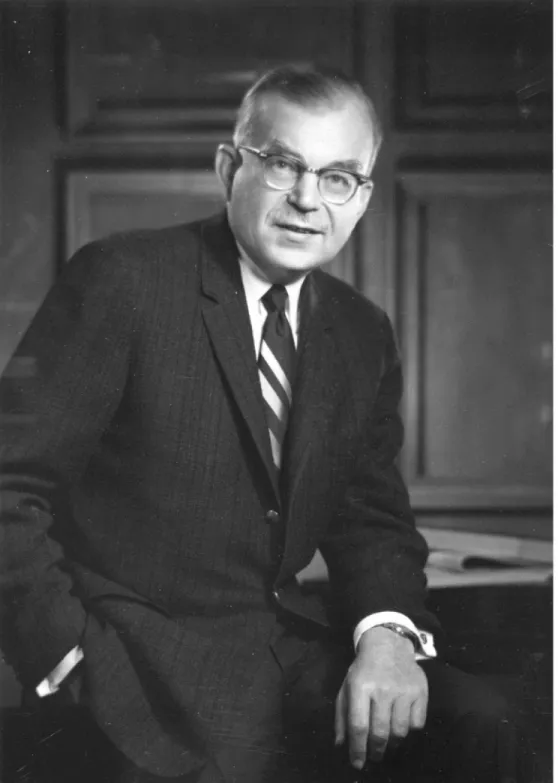
H istorical A laskana collectors, such as H ubert H ow e Bancroft, Jam es W ickersham , Elm er R asm uson (Fig. 1.1), and others, m ade enorm ous contributions to public and private libraries. B esides gathering the rarities, they set forth collecting trends, encouraged literary sensibilities, and established organizations and affiliations that enriched rare books culture. M odern libraries, too, develop rules and policies, or follow standard procedures for collecting, storing, and
curating rare books collections.
School of Mines, 1923-1933); Alaska Agricultural College and School of Mines, Catalog (College: Alaska Agricultural College and School of Mines, 1933-1935); University of Alaska (College), General Catalogue, 1936/1937- 1955/1956 (College: University of Alaska, 1936-1956).
34 University of Alaska (College), Report o f the Comptroller (Fairbanks: University of Alaska, 1950/1951 - 1951/1952); University of Alaska (College), Financial Statement o f the Comptroller (Fairbanks: University of Alaska, 1952/1953-1955/1956); University of Alaska (College), Financial Statements, Comptroller’s Report (Fairbanks: University of Alaska, 1956/1957-1967/1968); University of Alaska (College), Financial Reports (Fairbanks: University of Alaska, 1968/1969-1969/1970); University of Alaska (College), Financial Report (Fairbanks: University of Alaska, 1970/1971-1972/1973).
35 Paul McCarthy, “Paul McCarthy Is Interviewed by Paul Quist in Fairbanks, Alaska in 1967 about the Archives Program at the University of Alaska Fairbanks” (Fairbanks: Elmer E. Rasmuson Library, 1967), Oral History 00-00
155. Sound recording.
36 “Alaska and Polar Regions Collections & Archives/University Records/University Records for University Staff,” accessed September 15, 2015, http://librarv.uaf.edu/universitv-records-for-staff .
V
0* - - ,
Figure 1.1: Elmer Edwin Rasmuson, the man to whom the Elmer E. Rasmuson Library was dedicated in 1970. Elmer. E. Rasmuson Papers, Accession Number UAF-2001-
128-19, Alaska and Polar Regions Collections & Archives, Rasmuson Library, University of Alaska Fairbanks.
1.4 D efining R are Books and Their R oles in Library Collections
The library definition o f a rare book appears to be relatively simple. M arjorie Gray W ynne, in “The N ature and Im portance o f Rare B ooks,” in R a re B o o k C ollections, writes: “A rare book, then, is one that needs special handling.”37 Beyond that, categories o f printed m aterials can be identified as appropriate for special collections. All item s in rare books collections are old, scarce, valuable, and have unique characteristics. N ot all books that reside in separate storage qualify as rare, however. B ooks w ith a high m arket value m ay be housed in special collections. B ooks that belonged to fam ous people, books w ith elaborate binding, books o f uncom m on sizes (such as m iniature or oversized books), and lim ited editions may all be housed w ith the special collections.38
A book can also becom e rare because o f the loss o f a language. D uring early contact w ith N orth A m erican N ative peoples, their languages flourished. Explorers, m issionaries, and travelers com piled dictionaries and w ord lists to aid com m unication betw een the cultures. As N ative A m erican languages lost speakers, and as their cultures evolved follow ing intense contact, books retained inform ation that could not be found elsewhere. N orthern library
collections house rare books w ritten in northern languages that have becom e m ore appreciated in recent tim es because o f increased interest in N orth A m erican indigenous cultures. Libraries o f northern nations, such as the N ational Library o f Canada, collect and preserve rare books in N ative languages. In 1985, the N ational Library o f Canada published a list o f 500 titles in 58 languages or dialects.39 The revival o f interest in books in N ative languages coincides w ith their
37 Richard H., Archer, ed. Rare Book Collections (Chicago: American Library Association, 1965), 4. 38 Archer, Rare Book Collections, 5-7.
39 National Library of Canada. Rare Books and Manuscripts Division, preface to Books in Native Languages in the Rare Book Collections o f the National Library o f Canada (Ottawa, 1985).
being studied and taught, as well as w ith a gradual rise in societal appreciation for cultural preservation.
The early books in N ative languages produced by m issionaries, not surprisingly, belonged to the category o f devotional books. The Introduction to B o o k s in N a tiv e L a n g u a g e s describes Canadian native language literature up to the m id-tw entieth century as m ainly evangelical: “Until then, w ith few exceptions books for the use o f the native peoples o f Canada w ere w ritten and translated by m issionaries and printed or published by religious orders or societies. M ost are Bible translations or devotional w orks; some include music. Others w ere printed to encourage support for m issions.”40
In Alaska, Ioann V eniam inov, a prom inent R ussian O rthodox m issionary w ho arrived from R ussia in 1824, encouraged the use o f A laska N ative languages. In collaboration w ith Ivan P an ’kov, he designed and introduced an A leut w riting system and published the first book translated to Aleut, A le u t C atechism , in 1834.41 Ilia Tyzhnov, G erasim Zyrianov, and K osm a U chilishchev published other devotional books in A laska N ative languages. M ichael K rauss, in his article, “A laska N ative Languages: Past, Present, and Future,” writes: “V eniam inov’s
orthography for A leut and its adaptations to A lutiiq and Central Y upik w ere quite rem arkable for their tim e,”42 because the bilingual educational system during Ioann V eniam inov’s tenure in
40 National Library of Canada. Rare books and Manuscripts Division, introduction to Books in Native Languages in the Rare Book Collections o f the National Library o f Canada (Ottawa, 1985).
41 BeHHaMHHOB, HoaHH. HanamKU xpucmuaHCKa^o ynenux, urn Kpammx cex^em ax ucmopux u KpamKuu Kamuxu3uc. Ha pyccKOM u aneymcm-mcbeecKOM %3hiKax. nepeeen Cex^. HoaHH BeHuaMUHoe c noMo^bm To^Ha HoaHHa naHbKoea, 1830 ^o^a, e YHanarnKe. Cn6: Tnnorpa^Ha H. Tpena, 1834 (Saint Innokentii, Metropolitan of Moscow and Kolomna, 1797-1879, Rudiments o f Christian Teaching, or a Short Sacred History and a Short Catechism, in Russian and Fox Islands Aleut. Translated by Ioann Veniaminov, with Help from Toion Ioann Pan ’kov, in the Year 1830, in Unalaska (Saint Petersburg: N. Grech Printing House, 1834)); This title and its description can be found on: “Alaska Native Language Archive website,” http ://www.uaf. edu/anla/. accessed July
31,2015. ’
42 Michael E. Krauss, “Alaska Native Languages: Past, Present, and Future,” Alaska Native Language Center Research Papers 4 (1980) : 15-16
R ussian A m erica supported learning A laska N ative languages and encouraged literacy am ong A laska N ative peoples in the Russian language, as well. Early books in N ative languages published by Ioann V eniam inov testify to early A laskan history, and belong to the rare books category. Collectors also value the later books, published by R ussian m issionaries in A laska N ative languages after 1867, because they reflect existing w riting systems and contem porary languages.
Terence Cole, in his article “Fifty Thousand B ooks on the W all,” clearly articulated the value o f V eniam inov’s w orks in the A leut language, leaving no doubt as to their classification as both rare and valuable books: “V eniam inov helped to establish the first A laska N ative literary
tradition by creating a system o f A leut orthography, codifying the rules o f A leut gram m ar, and translating the catechism and the Gospel o f St. M atthew into the A leut language. These w ere the first books printed in any A laska N ative language. V eniam inov also w rote the first book in an A laskan N ative language, a small tract that he actually com posed in A leut called In d ic a tio n o f the W ay to the K in g d o m o f H ea ven , w hich has been translated into all the m ajor languages o f the world, including m ost recently Chinese, and is still universally used as a text for orthodox
religious instruction.”43
O ther approaches to defining rare books (and to collecting rare books) include early printing. This distinction rests on the concept that books, like other historical objects, have a life o f their own. They exist w ithin private and public collections and libraries, but they m ay be w orn out, discarded, lost, and devalued. Though the use o f new technology m akes it possible to preserve,
43 Terrence Cole, “Fifty Thousand Books on the Wall,” in The Alaska 67: A Guide to Alaska’s Best History Books (Walnut Creek, California: Hardscratch Press Book, 2006), 19.
publicize and share the texts o f the rare books, the num ber o f original copies cannot increase and is likely to decrease.
Rare books docum ent their contem porary environm ents. Even w hen they use dull or superficial language, they shed light on political, econom ic, scientific, artistic, and literary concepts o f their time. They reflect beliefs, fashions, trends, income, and tastes. “W hen one puts books side by side, century against century, nothing seems m ore evident than that the physical contrasts are full o f significance, the artifacts em blem atic each o f its tim e and place,” w rites B ertrand B ronson in P rin tin g a s a n In d e x o f Taste in E ig h te e n th C en tu ry E n g la n d 44 Throughout their existence, books have fulfilled a variety o f purposes, some decorative, and other utilitarian.
Rare books analysis therefore extends beyond com piling bibliographies for public use, and reaches into m ulti-disciplinary study o f books as objects, largely because books in them selves are ephem eral. As U n d o rf W olfgang w rites in his article, The Id ea (l) o f the Id e a l C opy: Som e T houghts on B o o k s w ith M u ltip le Id en tities, “N either the identity nor the physical form o f an individual book is a given, nor is it a constant in each stage o f its history. Books m ight lose, alter or accum ulate identities due to changes in their physical structures or com positions. The physical form o f books and the changes that they undergo are far m ore com prehensive than
bibliographical descriptions reveal.”45
W hile no one definition o f rare books fulfills all objectives and accounts for all uses, various definitions and theories em erge from the special traits o f a particular collection, an exhibit, an auction, or a book event. For a rare books exhibit viewer, the books evoke im ages o f the epoch
-44 Bertrand H. Bronson, Printing as an Index o f Taste in Eighteenth Century England (New York: The New York Public Library, 1958), 5.
45 Undorf Wolfgang, “The Ideal of the Ideal Copy: Some Thoughts on Books with Multiple Identities,” in Early Printed Books as Material Objects, eds. Bettina Wagner and Marcia Reed (Munich: De Gruyter, 2010), 308.
a study, a draw ing room, a desk o f a writer, or perhaps a ship plying the A rctic seas. W ithout such artifacts, historians, librarians, collectors, artists, writers, and m any others could not recreate the sense o f the past, the em otional bond to antiquity that is so necessary to creativity and intuition. R are books curators store rare books as historical artifacts, in secured tem perature- and hum idity-controlled room s to preserve them for future generations. Professional practices require copying them on m icrofilm and m icrofiche, digital scanning, or publishing them as reprints and later editions. These high-quality copies becom e available for public use, allow ing for preservation o f the rare book collections w ithin the libraries.
1.5 Structure o f a Book
A book looks like a single item, but as a result o f collaboration am ong several people, it consists o f a num ber o f elements. B ertrand B ronson writes, “In its finest essence, a book may truly be ‘the precious life-blood o f a m aster-spirit, em balm ed and treasured up on purpose to a life beyond life’; but, physically, it is the collaborative product o f many m inds and m any hands: hands trained to habitual skills and set in traditional ways, and m inds predisposed by knowledge, judgm ent, and taste.”46
The assem bly chain includes com posing, editing, inserting supplem entary materials,
typesetting, binding, and shipping. Furtherm ore, the book m ight be signed, inscribed, dedicated, and sent from person to person, from collection to collection. It m ay evolve or regress through later editions, or becom e banned, famous, forgotten, disappear and reappear. It can w ear a new cover and lose its own. It m ight deteriorate and require restoration. It m ay undergo study,