LDC BORROWING WITH DEFAULT RISK
Jeffrey Sachs
Daniel Cohen
Working
Paper No. 925NATIONAL BUREAU OF ECONOMIC RESEARCH
1050 Massachusetts Avenue
Cambridge MA 02138
July
1982
The research reported here is .rt of the NBERts research program in International Studies. Any
opinions
expressed are those of theLDC Borrowing with Default Risk
Abstract
This
paper presents a theoretical model to describe the effects of default risk on international lending to LDC sovereign borrowers. The threat ofdefaults in international lending is shown to give rise to many
characteristics
of the syndicated loan market: (1) quantity rationing of loans; (2) LDC policiesdesigned to enhance creditworthiness; (3) prevalence of short maturities on
international loans; and (4) a
prevalence of
bank lending relative to bond—market lending.Daniel Cohen Jeffrey Sachs
Visiting
Fellow Department of EconomicsDepartment
of Economics
Harvard University
Harvard University
Cambridge, MA 02138
for example, it is postulated that individuals may borrow and lend in unlimited
amounts at a fixed market interest rate. The implausibility of this assumption
has long been granted for the loan market, and economists have generally
accepted "the imperfection of capital markets." Because of the difficulties of
contract enforcement, and moral hazards in the behavior of debtors, it is
recognized that individuals and firms are often constrained in borrowing.
Indeed, certain "paradoxes of borrowing" seem to rule out, a priori, the logical
possibility of purely competitive borrowing without quantity constraints.
Numerous authors have now shown how certain legal and economic
institu-tions may serve to overcome incentive problems in the loan market. Problems of
moral hazard in corporate borrowing, for example, may often be reduced through
the use of bond covenants, seniority of debt, bankruptcy provisions, etc. The
capital structure of the firm may itself be designed to counteract certain
incentive effects of loans. The losses in firm valuation that attach to the
irreducible moral hazards in the loan market have been termed the "agency cost
of debt."
The efficiency problems of loan markets are dramatically magnified in
the international setting, where problems of contract enforcement become
ende-mic. With international loans, there is no uniform commercial code governing
the design and interpretation of contracts, and no international policing power
available for contract enforcement. Civil remedies for breach of contract will
typically be different under the distinct legal systems of the creditor and
deb-tor, and there may be acute difficulties for a creditor to obtain and enforce a
For many international loans, repayment depends on the enlightened
self—interest of the debtor rather than on legal compulsion. Debtors may have
strong incentives to maintain reputation if they make repeated trips to the loan
market, and so may have incentives to repay loans even if each individual loan
agreement is not directly enforceable. In cases where self—interest for
repayment is not strong the loan market may simply collapse, with mutually
advantageous opportunities for trade left unexploited.
The problems of sustaining international loans are compounded further
in the case of LDC debtors. Though the value of borrowing for many LDCs may be high the incentives for defaulting on international debt may be higher still.
In many developing countries, in addition, the legal systems are relatively
undeveloped and often not independent of other political institutions, so that
legal remedies against default are very weak. The doctrine of sovereign
immu-nity, in addition to political realities, may bar any legal remedies against
defaults by the LDC government itself. Even though defaults by LDC borrowers
may be rare, the threat of default hangs over lending to LDCs and importantly
conditions the behavior of banks and LDC borrowers.
Default risk is probably in large part responsible for four
charac-teristics of LDC borrowing in the international markets. First, most borrowing
from LDCs is either (a) by the central government; (b) by private firms and
parastatals with a central government guarantee; or (c) by large, creditworthy
multinational firms operating within the LDC. There is little unguaranteed
cre-dit undertaken by indigenous, private LDC borrowers beyond very short—term trade
financing. The IMF estimates that of the $359.5
billion
of medium— and long— term debt of LDC borrowers in 1979, only $71.6 billion (20 percent) wasnon-public or nonguaranteed debt, and much of this was borrowing by multinational
Second, by the report of the banking community and the evidence of
actual borrowing in recent years, many countries are simply shut—out from
medium-term commercial loans. Country-risk analysts often rank countries
according to "creditworthiness," i.e. their ability to attract capital inflows,
and suggest that different loan markets require different standards of
credit-worthiness. For example, the Eurobond market is supposedly reserved for the
very best credit risks, with only 15—20 countries able to float long—term debt
in the market, and with Mexico and Brazil accounting for over 50 percent of
non—OPEC LDC Eurobond flotations in recent years. The syndicated loan market of
the Euro—banking community is less restrictive, and export—import credits that
are guaranteed by the governments of creditor nations are less restrictive yet.
Most low—income LDCs continue to rely almost entirely on non—commercial con—
cessionary loans from international agencies and other official creditors for
their balance of payments financing.
Third, most non—concessionary financing by the LDCs is through banks
rather than publicly held bonds. According to the IMF, bond flotations supplied
only percent of gross foreign financing for 94 LDCs countries during 1973-1979.
Far and away the most popular financing vehicle is the syndicated roll—over
credit, offered by banks in the Euro—loan market. This is a short-maturity
instrument (almost always seven years or less) with a variable interest rate
tied to fluctuations in LIBOR, or to the U.S. prime rate or other interest rate
indicator. Before 1931, most LDC borrowing was instead raised in bond markets.
We will suggest that the capacity of banks and LDC governments to negotiate when
the country enters a debt crisis (and the inability of bond—holders to do so
A fourth characteristic of international lending that is tied to
default risk is the heavy reliance on short-term instruments for long-term
financing. On theoretical grounds, we argue, there is a presumption against
long—term borrowing in a situation where bond covenants or debt seniority
privi-leges do not exist.
This paper presents a theoretical model to describe the effects of
default risk on international lending to LDC sovereign borrowers. It extends
the important work of Eaton and Gersovitz [i 980,1981], which provides the only
formal analysis in recent years of international lending in the presence of default risk. Two major extensions of their analysis are made. First, we
indi-cate how the presence of default risk will induce countries to persue policies
designed to enhance creditworthiness. Second, we show that certain
institu-tional arrangements, such as debt rescheduling (often under IMF auspices), are
vehicles for reducing the social costs of default risk. The threat of default
will be shown to give rise to characteristics of international lending to LDCs
that we noted above:
1. Quantity rationing of loans;
2. LDC policies to enhance creditworthiness;
3.
Shortening
of the maturity structure of international lending; 4. IIVIFpolicies
restricting loans to LDCborrowers
The model will also help to explain another important phenomenon in
international lending: the very low frequency of debt repudiation since 1945,
compared with the frequency during the period from 1820 to World War II. As
shown in Sachs [1982], post—1945 debt crises are resolved by debt rescheduling
rather than default. We show that such an outcome is related to the
aforemen-tioned shift from bond—financing of international loans in the earlier period to
bank—financing in the current era.
The paper will develop these themes in two stages. The first section
reviews the standard theory of international lending with perfect capital
markets, and introduces the simplest two—period model of lending with default
risk. A role for the IMF in the simple model is adduced, as is an explanation
for the boom in LDC borrowing in the 19'TOs. A three—period model is then
presented, within which we may investigate the problems of debt rescheduling,
and the differing strategic interests of a country, its existing creditors, and
potential new creditors, when a rescheduling occurs. Also, the model enables us
to make statements about the use of short-term versus long—term debt in
inter-national lending.
I. The Basic Model
(a) The Competitive Framework
To highlight the role of default risk, it is worthwhile to begin with
the competitive-market view of international borrowing and lending. In that
model, domestic and world loan markets are fully integrated, so that home
resi-dents may borrow and lend freely at the world interest rate. If the home
raise world interest rates, but will not
drive
a wedge between home and foreign rates of return. A "small" country, of course, can borrow and lend withoutaffecting the world interest rate.
Even in the pure model we assume that borrowing is rationed according
to a country's intertemporal budget constraint. Without this assumption,
borrowers can borrow large amounts, and then borrow to pay off the debt, and
then borrow again ad infinitum. Even though the borrower never defaults in such
a Ponzi scheme, the lenders as a whole never get paid back. Consider the market
value, for example, of a credit line in which D(t) is lent in each period and
(1+t)D(t) is repaid in the next, where r is the safe rate of interest. The
stream of loans to time t net of repayments has present value —(1+r)—tD(t), so
that the value of the infinite sequence of loans is urn (1+r)—tD(t). In a
t +
competitive
loan market, the credit line must have a value of zero, a conditionthat sets the country's interternporal budget constraint.
To see this, let Q be national output, C be private consumption, be investment, G be government spending, and Dt be the level of international
indebtedness at the end of period t, so that
(1)
Dt =
Dt_i
+(Ct+It+Gt)
—(Qt—rDt_i)
Of course, Q is GDP and Q—rD is GNP, so that Dt—Dt_1, the current account
deficit, is the difference of total absorption and GNP. Defining national
savings as GNP
net
of private plus public consumption expenditure, St =(Qt.-rDt—1) —
(Ct+Gt),
we have the identity Dt_Dt_1 =It—St
. Now, assume thatcondition
(1) implies(2) (1+)-i(c+G÷I)i =
(i+)-i
Qj-D(O)i=1 i=1
or
(3)
(1+)-i[Qi_(c+I+G)]= : (i+p)-i(TB) = D(O)
1=1
i=1
TB signifies the trade balance, Q-C—I—G. Borrowing, D(O), cannot
exceed the
discounted
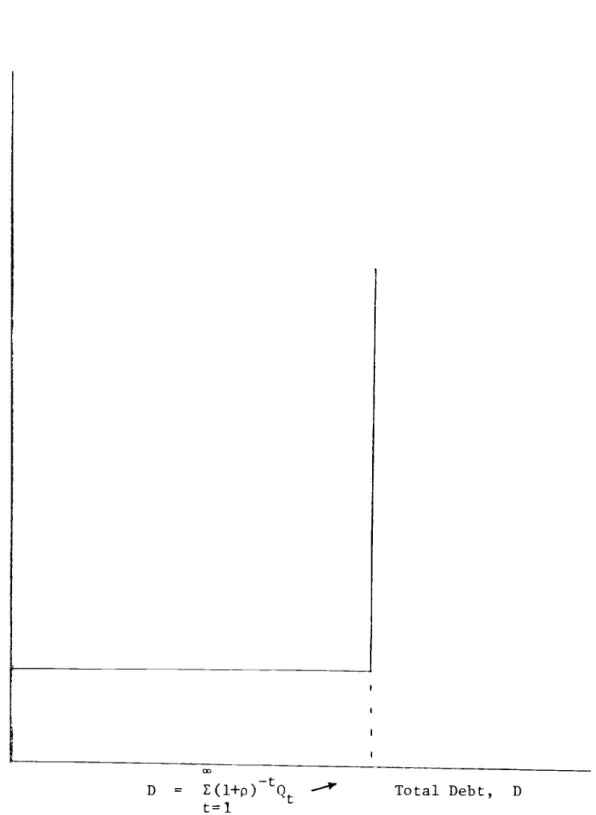
value of future output. The country's loan supply curve is therefore as shownin Figure 1.
These expressions,
then, describe the conditions for sustainable domestic spending. According to (2), the discounted present value of totalfuture expenditures must equal the discounted present value of national output,
less initial international indebtedness. Equation (3) puts this constraint in a
slightly different perspective by recording that the discounted sum of future
trade surpluses must equal the initial indebtedness of the economy. In other
word$, trade surpluses and deficits must balance over time; the question for an
economy is not whether to run deficits, but rather when to run
them.
It is by no means clear how (and whether) well—functioning financial
markets impose the limiting condition on Dt. After all, the condition is a
constraint on aggregate lending, not on a single lender at a particular moment.
Individual lenders might be willing to offer short—term loans to a borrower
pursuing an "infeasible" consumption policy, on the assumption that new lenders
will make loans in the following period that will allow the first loan to be
re-paid. Of course such a strater immediately unravels if: (1) there is a ceiling
On
Dt
(say because of prudential limits on bank loans), or (2) if the timehori-zon for re—payment is finite. Foley and Helliwig [1975] consider the more
dif-ficult, infinite—horizon case without credit limits, and propose a formulation
Interest rate on Loan, (l+r) (l+p) ______________________________ D =
Z(i+p)_tQt
TotalDebt,
Dstrategies of competitive financial institutions. In effect, they argue that
lenders will extend credit lines, not simple loans, in the case when all other
lenders are behaving in that manner. If all other lenders make loans only when
the whole borrowing profile is feasible, then a single bank will adopt the same
criterion.
Assuming that (3)
holds,
the optimal timing of deficits is in general a complex function of current and future economic variables and characteristics ofthe economy. Speaking broadly, three considerations dominate with a perfect
loan market. First, households (or governments on their behalf) seek to smooth
consumption over time. A temporary drop in real income, say because of a crop
failure or an adverse shift in the terms of trade, will result in a smaller fall
in consumption, with the more steady level of consumption being supported by
foreign borrowing. Second, if the market rate of interest exceeds the social
rate of time preference, the country will tend to save today (i.e., run trade
surpluses) to enjoy higher consumption expenditures in the future. Finally, if
there are favorable investment opportunities given the world cost of capital,
countries will tend to run deficits today to finanace the investment
expenditure. There will be a tendency to equalize the marginal product of
capi-tal and the world interest rate.
When a country's trade deficit rises because of a fall in a current
income or a drop in the world interest rate, the rise in indebtedness signals a
fall in future consumption levels, as the debt must eventually be serviced. But
when a deficit emerges because of an investment boom, no future consumption
sacrifice is implied. The economy is merely trading one asset, the debt instru—
ment, for another, the claim to physical capital. Assuming that the latter
asset has a yield as high as the former (which is presumably the motive for the
diminished. For this obvious reason, measures of debt per se tell us little
about the burdens of future debt service. We must focus separately on national
savings and investment rates to determine the sustainable future paths of
con-suinption.
In a recent paper, (Sachs[1981b]), an equation for the current account
was derived under the assumption of optimizing household savings
behavior
and perfect foresight. In Appendix A, we extend that equation to allow forinvestment, and find that:*
(4)
CA =
u (Qt—Qt)
—(Gt—Gt)
+[(r_ô)/(1+)]Wt
(the equation assumes that households maximize L(1+ )—tlog(c) subject to the
1
intertemporal budget constraint). Thus we see that the desired current account
surplus is an increasing function of a transitory boom in incon Qt—Qt, a
decreasing function of a temporary fiscal expansion t-Gt, a decreasing
func-tion of desired investment It, and
an increasing function of the gap between the
rate of return to lending and the rate of time preference.
In the case of perfect mobility, all domestic investments are
under-taken that have a positive present value at the prevailing world interest rate.
Importantly, and in sharp contrast to the case with potential default, a rise in
the domestic propensity to save (i.e. a fall in )
has
no
effect on domestic investmentrates, and therefore results, one—for-one, in a corresponding
impro-vement in the trade balance. We shall see that under conditions of potential
debt
repudiation, a rise in
savings can actually raise domestic investhent so much that the trade balance worsens, rather than improves.*
is the share of labor in GNP; Qt is "permanent" income, defined as
r . (l+r)-tQt. ct is defined analogously. W is household wealth, which
To highlight the implausibility of this pure model, suppose that r < O.
We show in the Appendix that Wt+i =
[(1+r)/(1+o)]Wt,
where Wt is householdwealth, defined as.1+p)(i_t)[Qi_Ii_Gi]_D(t). Thus at t ,
WtO,
so thatdebt grows until it reaches the discounted value of future GDP! Consumption,
which is a linear function of wealth, falls to zero. Obviously, almost
regardless of the penalties for default, there will be very strong incentives to
repudiate the debt at some date in the future. Knowing this, creditors will
restrict new loans well before the Wt = 0 level is reached.
(b) Introducing Default Risk
While the limitations of the preceeding model are evident, there is no satisfactory approach in the literature to account for default risk or credit
ceilings in the international setting. A typical theoretical approach has been
to assume that a country faces an upward sloping supply schedule for total
borrowing, with r =
pff(D),
f'(D)>O, where is the "safe" interest rate on the world capital market. In an important article, Bardhan [1967] consideredoptimal borrowing for a country facing such a credit supply. The country is
a monopsonist in its capital market, and thus has an incentive to pursue
par-ticular current account policies. The marginal cost of funds is r +
or
r(1+.), where c is the elasticity of total lending with respect to rOptimal policy requires that the marginal rate substitution MRS over time in
consumption, given by Ut/Ut+i and the marginal rate of transformation (MRT) in
production, given by 1 +
—v— should
be equated with the marginal cost offunds:
1
(5) Ut/Ut+i = 1 +
A tax on foreign borrowing, equal to t ,
will
achieve (5) if the capital markets are otherwise competitive.Because f(D) is arbitrarily specified rather than derived, it is likely
to be a misleading guide to loan supply. Much of the rest of this section shows
the extent to which r =
pl-f(D)
might provide a useful formulation. There are at least three shortcomings with the Bardhan model. First, default risk willdepend in general on factors other than D itself, e.g. the level of investment,
so that r =
PFf(D,Zi,...,Zn).
Policymakers will have incentives to take actionsthat enhance creditworthiness, and these actions should be studied as part of an
optimal investment policy. Second, default risk will induce an absolute credit
ceiling D, at which ôf/ cO .
Higher
interest rates alone cannot stop adefault (if an incentive to default is there with r =
.05
it will be there withr =
.10!).
Third, since interest payments are not made when default occurs, the marginal cost of funds is not r(1+.i-_) but (1—u) r(1+-—) where i'is
theprobabi-lity that default occurs.
In a series of very insightful articles, Eaton and Gersovitz (E—G)
introduce default risk in a model of international borrowing, and show how
cre-dit ceilings may be derived. In their model, crecre-ditors respond to a default
with the permanent exclusion of the borrower from any future loans. The
inabi-lity to borrow imposes different costs on different borrowers. If the borrowing
country has (1) extensive investment opportunities; or (2) a widely fluctuating
output stream; or (3) a high rate of time preference, the costs of default will
be high. And importantly, the higher are those costs, the safer are the loans
to the borrowing country, for the smaller is the chance of default. In this
view, if the threat of exclusion from future loans imposes no costs on a
The E—G assumptions are overly restrictive in a number of ways. First,
actual costs of default will include more than exclusion from net borrowing.
Since much of trade itself is financed with short—term credit, a defaulting
country wi.1l find it difficult to trade, much less borrow. Moreover, any
merchandise shipped abroad may be subject to confiscation or attachment by the
defaulted creditors. Second, there is no guarantee (and much evidence to the
contrary) that a defaulting country will face permanent exclusion from the loan
market. Creditors will have an incentive to make settlements for the partial
re-payment of debt after a default occurs, and to then resume lending. New
len-ders may be undetered from entering into loans with a defaulting country under
some circumstances. Third, even when the incentives to default are strong,
borrowers and lenders may negotiate more efficient forms of debt relief for
over—extended borrowers, such as debt rescheduling. Fourth, E—G do not
distinguish between the investment versus consumption behavior of the borrowing
country. We shall see that the borrower's propensity to invest is a fundamental
determinant of its ability to attract international capital.
To introduce these new features, let us begin with a two—period model
of international borrowing, in which loans are made to a sovereign borrower in
one period that may or may not be paid back in the next. Credit market
equilibrium requires that the expected return of lending equal the safe rate
of interest. If the loan is defaulted the creditors can retaliate, with a cost
to the debtor country of a fraction A of national product. This fraction A
summarizes all of the possible costs of retaliation: trade disruption, seizure
of assets, exclusion from future borrowing, etc. Importantly, we assume that
the retaliation yields no utility to the creditors (or that the costs and
With these assumptions, the two—period budget constraint for the country is: (6)
Cj=Q1+D1—11
C2 = Max (C21),C2N) where C2D =(1—A)Q2(Il,E2)
=Q2(11,E2)
—(1+r)D1
E2 is a random shock affecting second—period income; C2D is the second—period
consumption if default occurs, and C2N is the amount if default does not occur.
Actual consumption in the second period is the maximum of C2D and C2N.
To determine loan supply to the country, we must first specify how C1,
C2, and Ii are determined. In the present version, a social planner maximizes
EU(C1,C2) subject to (6). More realistically we might separate the public and
private sectors, and allow the government to choose 11G, D1 , T1 , T2 and the pri-vate sector to select C1 , C2, I1 subject to the public—sector actions, (11G is
government investment, and T are taxes). This alternative formulation will be
pursued in future work.
Finally, there are two choices with respect to the timing of the loans:
that Dj is set before or after Ii is chosen. We will term the latter case a
precommitment equilibrium, since the country can pre—commit itself to an
invest-ment policy in the first period, (and will have a strong incentive to do so if
it can).
An illustration will motivate the general solution of this simple
model. Suppose u(c1,c2) = C1 +
, Q2
=Qi+(1+)1i
, and p <
< ô
,(where
are limited by I
3so let C2 =
max (C2D,C2N) .In
a model without default risk (denoted by superscript S ),the
equilibrium is:('i)
C1S = Qi + Q2S/(l+P)
c2s = o
D1S = (Qi —
— 11S)All
investment opportunities are exploited since > p ,and
all consumption is shifted forward in time, since ó > P .This
equilibrium is clearly notsustainable if default risk is present, since a second—period default would
allow consumption in the amount C2D =
(1.A)Q2
which is greater than zero (i.e. default dominates repayment for any A < 1 ).Allowing
for default risk, we first examine the case where no invest-ment precommitrnent is possible. The creditors lend the amount Dj , and thenthe social planner chooses optimal C1,11 for the given D1 .
Hence,
there is an implicit relationship Ii =Ii(Di)
.Since
the creditors know this, theceiling on loans is given by another implicit relationship:
(8) D1 (i + ) [Q2(Il (D1))] = 1IQi +
(i
+)Ii
(D1 )]We solve first the planner's problem:
C2 (9).
maxCi +___
C1 =
Qi + Di
—Ii
C2 = Q2 —
(i+p)D1
Clearly Ii = 0 ,
since
-1 + < 0 .Therefore,
by (8), the creditceiling is Dj '
i/(1+p)
and the full equilibrium (with superscript N )is:
(10) C1N = Qi +
i/(1+p)
11N = 0
C2N = (1—A)Q1
Q2N Qi
Utility is reduced below the level of the no—default case, since profitable Ii
is not undertaken and consumption is not optimally shifted over time. Since the
8conomy is rationed, the net shadow price on loans is 6 , and not r ,
and
since 6 > i.i
, the
investment projects cannot meet the more stringent standard.The situation may be quite different with investment precommitments.
Now the planner solves (9) plus the added constraint D1 A[Q2(11)] . By
manipulating Ij ,
the
debt ceiling may be raised. Thus, from (9) we see: (i+L')(1+p) dD1
(ii) dU/dI = —1 +
(io)
+ (1 —(1+61J
j--The incremental investment serves two purposes: raising second—period output and
(1 +p)
raising the nation's borrowing capacity. [i
-(i+o)]
measures the welfare gainof an added unit of debt. From the borrowing constraint, dD1/d11 =
______
Thus,
dU
= + 6—p A(1÷.i)
'
'
The pre—commitment equilibrium is therefore (signified by superscript P ):
(12)
I1P = 0 (ö.-p)A(1+i)< (ô_)(i+p)
= T
(ó-p).(1+)
> (Ô-i)(i+p) C1P = Qi +Dl
—ll
C2 =
(1—A)Q2P = Qi +(1+)11P
Di =)Q2P/(l+p)
It should be clear that US > UN 1S 1P )
N
(with at least one equality binding), and C1S > 01PTable 1 shows the first—order conditions for the general two—period
model under certainty, in the three cases under study. In the two cases with
default risk we find:
(a) The MRS, U1/J2 ,
exceeds
the world interest rate, as does themarginal product of capital;
(b) Utility is a strictly increasing function of A ,
the
default penalty, until the point where the debt constraint is no longerbinding;
(c) Investment rates are ordered 1S ? 1P
Thus, under certainty, borrowing countries would prefer large default penalties,
as the way to free up the loan constraint. Note importantly that with an invest—
U1
ment precommitment, ---
should
be reduced below —
, since
the shadow returnsdli
UC2
to investment include not only the direct gain but also the indirect gains
from relaxation of the borrowing limit. This optimal divergence of MRS and MRT
Table 1
uilibrium Conditions in the Two-Period Model
No Default Risk C1 =
Qi + Dl
—Ii
C2= Q2 — (l+p)D1
Uci--=
(i+p)
; —=
(i+p)
C1Q ; C2 O
Default Risk with Pre_Colnxnitment*
C1 =
Qi + Dl
—Ii
C2Q2 — (1+p)Di
—= (i+e)
> (l+p) C2 dQ2 dD1--—= (i+u) — (U-p)
r
dD1 dA-—-/ (1+)
C1O ; C2 O
Default Risk without Pre_Colnmitment*
C1 = Qi + D1 =
Ii
C2 = — (1+p)D1D1 =
)Q2/(1+P)
Ui
———=
(i+e) ;
— (i+U) ; (1+e) > (i+)
Ci
O ; C2 O
*
The conditions shown are for the case in which the borrowing constraint
Di Q2/(1+P) is binding. If the constraint is not binding, the solution is identical to the case of no default risk.
Consider,
now, two extensions to this basic framework: initial indeb-tedness, and bargaining between the debtor and creditors. Suppose that thecountry enters period 1 "endowed" with long—term debt (1+p)D0 due in the second
period (presumably from a past history of borrowing). It is possible that
(1+p)D0 is so high that default is ensured in the second period for any
non-negative
level of new debt commitments D1 .
Evenmore importantly, it is
possible that (1+p)D0 is high enough to generate default in the case without
pre—commitment,
but not in the case with pre—commitment. If a mechanism can then be found to allow precominitment, the default can be avoided.In the linear case without pre—conunitment, for example, default will
occur if (1+p)D0 > Qi No new loans will be available in the first period,
and the country will renege on its debt in the second. With pre—cornmitrnent, and
assuming that the investment criterion --"
is
satisfied, default will occur onlywhen(1+p)D0exceeds[(2+p)/(1+p)]1 +(1+)l(1+p)l[A(1÷)(à_p)+
which is itself greater than
.
Ahigh—conditionality IMF loan
may be a mechanism to allow the country to precommit to the appropriate
invest-ment strategy.
A second extension involves the treatment of default. In the present
formulation, the borrower compares the second-period interest payment
(1+p)D1 with the penalty , and defaults if and only if (1+p) D1 > 1Qi
This representation may be faulty from two points of view. When the debt repayment
is high, but less than X , we might suppose that the borrower has bargaining
power vie-a-vis the creditors, and can achieve some partial debt relief. After
all, the net cost of default is —
(1+p)Di
for the debtor, but (1-f-P)D1 for the creditor; as long as (1+p)D1 a threat of default by the debtorshould be credible. On the other side, when (1+P)D1 exceeds )Q.j , we might
clearly pareto inefficient (due to the creditors' retaliation). For example,
the country is indifferent between defaulting (and suffering retaliation 2 ),
and paying back Q2 of debt with no penalty or retaliation imposed. The
cre-ditor would clearly prefer this option, (i.e. a partial debt moratorium of the
amount (l+p)D1 —
2
),than
total default.The actual equilibrium that is reached will depend importantly on the
feasibility of post bargaining between the borrower and creditors. And this
feasibility will depend, in turn, on the degree of market concentration of the
borrowers. Bulow and Shoven [1978] among others have differentiated between a
"bond" market and a "bank" market, with bargaining over debt relief feasible
only in the latter case. We will follow Bulow and Shoven in assuming that "the
bondholders are a non—cohesive group of investors who have a fixed time pattern
of claims.... Their non—cohesive nature implies that they cannot negotiate to
alter the terms of their loan when bankruptcy becomes a possibility". (pp.
438—439). Banks, contrariwise, are able to renegotiate. The problem with
bond-holder negotiations is more than logistical. There are also free—rider
problems which give each borrower the incentive to demand full repayment,
knowing that the remaining creditors will still have a strong incentive to
pre-vent default. In Sacha [1982] it is shown that the bank vs. bond market
dicho-tomy is historically relevant. Pre—1930 borrowing was principally through bond
flotation, with little negotiation between creditors and debtors during a debt
crisis; the post—1945 lending is mainly via syndicated bank loans, with
signifi-cant creditor—debtor negotiation.
We will suppose that D1(1+p) > Q2 will lead to default cuni retaliation
with bond lending. In a bank market, we might suppose that the banks and
such
bargaining is anticipated in the first period). In the simplest extension, we might suppose that banks offer partial debt relief, by demanding repayment ofQ2, and agreeing to no further retaliation against the debtor. If this offer
can be made credibly on a "take—it—or—leave—it" basis, then the country will
accept it, and the bank will extract the maximum feasible payment from the
country. As an alternative we might suppose that the outcome is the Nash
bargaining solution, where full default and full retaliation are the threat
points of the country and creditors respectively.
Under the Nash model, the actual repayment R will be derived as:
(13) max u(Q2—R) —
u[
(i —A)Q2]J• R—O)R
(i +
Using
(13) we can derive R as a function of (1+P)Di .For
small levels of debt, all is repaid. At a critical point, a maximum repayment is reached.For (1+p)Di greater than this level, only RM is repaid, and the rest is
forgiven by the creditor without further penalty to country. As is well known
from bargaining theory, the more risk—averse is the country, according to u(s),
the larger will be the critical point.
In the linear case, we have H = max
[(2-R)R] ,
with
the solution:H '(1 +p)D
(14)
R = (1+p)D1 for (1+p)D12/2
1i
= 2/2
for (1+p)D1 > 2/2Now, if banks understand that the second-period repayments will be determined by
(14), they will lend up to the point D1 =
)2/[2(1+P)]
,rather
than to thehigher level Q2/(1+p) as posited earlier. Thus, the Nash model allows us to
derive a loan schedule that is similar to the more rudimentary schedule derived
(c) A Digression on Corporate Default
There are a number of important similarities and differences between
the cases of corporate default and sovereign default. Most importantly, the
decision to default is based on differing criteria in the two cases, and the
income streams of the creditors and debtors following a default are different.
But in many ways, the problems of time-inconsistency of investment plans, and
the value of investment pre-commitments carry over to corporate borrowing.
Broadly speaking, a corporate default brings about bankruptcy, in which
the claim to the future income of the firm is transferred from the debtor to its
creditors. The equity—holders of the firm will only choose bankruptcy when the indebtedness exceeds the value of the future income stream, i.e. when the net
worth is negative (this is a necessary but not sufficient condition; see Bulow
and Shoven). When backruptcy occurs, the creditors receive the value of that
income stream net of any bankruptcy costs (denoted B). In the two period
set-up, bankruptcy will only occur if (1+r) D1 > Q2. The creditors receive Q2—B,
and the debtors receive nothing. In analor to the case of debt relief with
sovereign borrowers, the creditors may have an incentive to renegotiate credit
terms to avoid bankruptcy if B is large relative to renegotiation costs.
A corporate default decision is typically less volitional than a
sovereign default. A government is rarely constrained to default. The
resour-ces are typically available to pay off the creditors, though the government
deems the costs of repayment greater than the penalties of default. A
cor-poration may well be insolvent as well as having negative net worth, so that it
is simply unable to discharge its obligations. But at a
deeper level, a
default more or less likely. And as with a sovereign borrower, a firm can often
raise Its market value if it can pre—commit itself to certain policies that
reduce the probability of future bankruptcy.
The corporate finance literature has indentified a number of ways that
a firm may behave to transfer income from bondholders to equityholders by
raising the likelihood of default (see for example Jensen and Meckling [1976],
Smith and Warner [1979], Grossman and Hart [1980]). Like the government
borrower, a firm may use the proceeds of loans to pay dividends, rather to
invest. In the limit it may liquidate its assets to pay dividends, leaving the
creditors with claims to an empty shell. (Later, we describe other actions that
both firms and sovereign borrowers may undertake to reduce the value of the
creditor's claim, including "claim dilutiontt, and over—risky investment). In
the two—period example, a firm might distribute (1+r)D1+Q1 in first—period
divi-dends, and default in the second period (assuming (1+r)D1 > Q2), rather than
undertake investment projects with internal rate of return greater than r. If
creditors expect such behavior, they will restrict lending. As with the LDC
debtor the firm is best off ex ante if it can guarantee that it won't pursue
such strategies.
In the case of corporate borrowing bond covenants are available to
restrict the borrower from undertaking specified actions after a debt is
incurred. Smith and Warner [1979] provide an excellent survey of such
covenants, which indicates how they directly and indirectly enforce an efficient
borrowing and investment plan by corporate borrowers. These covenants often
directly restrict dividend payments, which may be tantamount to requiring the
include: restrictions on new debt issues, maintenance of the firm's existing
assets, financial disclosure requirements, and restrictions on merger activity.
Sucb provisions are unenforceable with foreign sovereign borrowers, and
thus are not a part of the typical international syndicated loan agreements. It
is the absence of such provisions, as much as the inability to seize assets in
the event of default that makes rationing a far more prevalent feature of the
international capital markets.
(d) Default Risk under Uncertainty
The introduction of uncertainty adds importantly to the conclusions of
the previous section. In the previous model, the threat of default generated
credit ceilings but no actual default or debt moratorium. Also the loan
sche-dule was kinked, but nowhere upward sloping. Moreover, a rise in the penalty
for default was necessarily welfare improving for the debtor. All of these
conclusions are now modified. With uncertainty, defaults (or debt relief in the
renegotiation case) will occur; the supply schedule of loans will slope upward,
with rising risk premia measuring the risk of default; and rising penalties for
default can now actually make the debtor worse off.
Again, it is useful to begin with an illustration. Suppose that we
remain in the linear case, with Q2 = Q +
(1+i)I
,where
Q is distributeduniformalLy over [°,Qi] . We consider two outcomes for debt repayment, depending on whether or not there is ex post renegotiation (i.e. whether the
loans are "bank" loans or "bond" loans). In either case, the creditor is fully
paid off when (1+r)D1 < AQ2. Without renegotiation, the creditor receives zero
when (1 +r)Di > A Q2; with renegotiation, we assume that the creditor extracts the
payment AQ2. In both cases, the country consumes Q2-(1+r)D1 when (1+r)Di
Let i
be the probability of (partial or total) default, so that " =pr[AQ2
< (1+r)D1] =pr[ç<
(1+r)D1/A— (1+Ii)11]. We denote Q* as the default threshold; when Q2 < Qt the debtor defaults. Clearly, Q* =(1+r)D1/A,
and=
Pr[Q
< Q]. Also,
for
all variables X, we will use E(X I D) and E(X I ND) tosignify the expectation of X conditional on default (D) and no default (ND)
respectively. With risk neutral creditors, the expected return on D1 must equal
the safe rate of return, p. With no renegotiation this requires
—Di +
(1—r)(1+r)D1/(l+p)
=0;
with renegotiation, market equilibrium requires —Dl +(i—Tr)(1+r)D1/(l+p)
+lrE(AQ2
D)/(1+p) =0.
Specifically:
(15) (1+r) =
(1+p)/(1—ir)
without renegotiation(i+r) =
(1+p)/(1—n)
—ir E(A
Q2 I
D)/[(1_11)Dl]
with renegotiationCombining (is) with the definition of r and the production function
for Q2, we may derive supply schedules for loans, in which (1+r) is an
increasing function of D1/Q1 and a decreasing function of 11/Q1. Under the two
cases. of bond and bank loans we find:
(16) (a) without renegotiation:
(1+r) =
(l+p)
0 < D1/Q1 < dmifl(1+r) =
F(D1/Qi,Ii/Qi)
dmiflDi/Qi
( umax—
[i+
(1+1)I1/Q1] _1.(1+p)(dmax_ D1/Q1)/AF
2(D1/AQ1)
dmifl = A (1+)(I1/Q1)/(1+p)
(b) With renegotiation
(1+r) =
(1+p)
0 < Di/Qi <(1+r)
=G(Dl/Ql,Il/Ql)
DininDl/Ql
cmax
G 1 +
\!2(1+p)/A(dmax
-Di/Qi)
2(D1/ AQ1) Ixnifl = A2112
ax
2(1 +[i
+ (1+) () ]
Graphs of these functions F and G are shown in Figure 2 (drawn for a given
'l/Qi). In each case the supply of funds is initially perfectly elastic, then
upward
sloping, and finally perfectly inelastic once a maximum is reached. Note
that
G < F for all Dj, and that max > dmax. Thus, the possibility ofre-negotiation shifts the loan supply schedule outward and as we will see, raises
the expected utility of the debtor. Note also that a rise in Ii shifts the loan
schedule to the right, as illustrated.
Now let us consider the optimal borrowing strate of the country.
Expected utility, or C1 +
E(C2)/(l+
o) is maximized subject to: (17) (a) Cl = Qi —+ D
(b) C2 = max(C2D,02N)
(c) C2D =(1—)Q2
(d) C2N Q2 —
(1+r)Di
(e) Q2 =Q+
(1+i)I1
(f)Q is
uniform on [o,Ql] (g)(1+r) as in (16)
(h) n Pr [ Q2< (i +r)D1]
U)
<
< o
Interest
Rate on
Loan, (l+r)
(l+p)
Loan Supply with Default Risk
LR — With
RenegotiationLN —
With
No Renegotiation LR LNA
Figure 2. max Total Debt, DSince EU =
Ci + (i+ô)—1 E(C2 jD) •+ (1+6)—i
E(c2 NT)) .(i—),
we can write, after some manipulation:
(18) EU = (Qi —
+ Di)
+(i+ó)—i
[E(Q2) —(i+p)D1
—A 1TE(Q2 ID)] with no renegotiationEU (Qi —
Ii
+Dl)
+ (i+o)—1 [E(Q2) —(1+P)Di]
with renegotiation
Since renegotiation allows the creditors and debtors to reach an efficient
outcome, EU is higher in that case. The country pays a lower risk premium on
its loans, which yields the welfare benefit (i +
—1
A ii E(Q2I
D).
Let
us
now study how the optimal borrowing differs between thebank-loan
and bond-loan models. In both cases, a loan yields D1with expected re-payment to the bank of (1+p)D1 in the next
loan (i.e. no renegotiation) the country may also suffer an _____
that
is not received by the bank.Since
the probability ofthe expected value of the penalty is —IT AE(Q2
I
D).
In thepayment AQ2 is made to the bank
instead
of default, and sobank's
expected
yield (1+p)D1 (and not something additionala bank
loan,
EU D1 —(i+p)(i+à)—l D1 +(other
terms), and the country chooses to maximize D1. With a bond loan, EU D1 —(i + (1+ a)—i Di —A irE(Q2 D)(i+ ô)—1 ,
and
it is optimal to borrow Dj < dmax.country borrows Dj = Dmax, we have (1 +r) 2(1 +
Q/[i
+(i +Thus, borrowing is shown as point A in Figure 2.
in the first period,
period. With a bond
extra penalty AQ2
this penalty is iT
bank-loan
model, the
is part of theto it). Thus, with
Note that when the
Let us turn next to the bond—market equilibrium, in which no
renego-tiation occurs. As usual we must distinguish the cases with and without an
investment precommitment. Assuming no preconunitment it is obvious that no
investment will be undertaken, as long as 11 <
Thus, EU becomes
lii +
1j(i+)JQ1
+[(6-.p)/(1+ó)]D1
— An2[Q1/2(i+ä)],
where we make use of the fact that E(Q2 ID) equals _!_+ (i+i.)Ii.
The optimum borrowing is setaccording to the condition (-p)/(1+) =
[Aii/(i+6)]
.With
a littlemanipulation we find that this condition can also be written as
(19) (1+6)—i (1—it)
[(i+r)Di]
= 1The analor of (19) with the monopsonists' condition under certainty, in
equation (5), is obvious. With default risk, the borrower equates the expected
marginal cost of funds with the marginal benefit. The expected marginal cost is
j-_ [(i+r)D] multiplied by the probability that interest will in fact be paid,
(i—it)
.
The expected benefit is simply U01/U2 ,which
in the linear case is(i+6) . As we show shortly, the condition (i—n) ----
[(i+r)Di]
=U1/E(U2
I ND) will hold in a more general setting.To complete the solution, we find
—
.Since
(i—ir)(1+r) =(i+p)
and it =(i+r)D1/)1
, we see that dlT/dD =
(i+p)/[
)1(i—2u)] ,so
that theoptimum borrowing rule implies:
(20) iT =
(6..p)/(1+26_p)
(i+r) =
(i+26_p)(l+p)/(l+6)
= i( o_p)(i-i-o)/[(i+p)(1-i-26_p)2]
Optimal
borrowing is shown as point B in Figure 2. Note that the optimaliT is
not affected by A ,the
penalty for default! This is because higher A raises the costs of default but also the limits for borrowing. Since D1 is linear inA
,
iT(
= i:!:: (D1/A)
In
the case with investment pre-commitment, it may pay to invest inI through
li, since
higher I raises borrowing limits and lowersborrowing costs. Consider the case without renegotiation. The borrower's
problem is: (21) max C1 +
E(C2)/(1+)
C2 = max (C2D,C2N) C2D = (1—A)Q2 C2N = Q2 —(1+r)D1
Q2 =Q+ (li-p)I1
(1+r)(1—ir)
=(1+p)
=pr[
> Di(1+r)]By earlier methods we find that the gains to investment are:
dEU dD1
(22) --j—— = —1 +
(1+p)(1+ä)l —
A (1+i)(1--i)i
+i+S
Again,
as in (ii), the borrower compares the costs of investment, —1, with the benefits, discounted at the rate of time preference. The benefits are: theexpected marginal product, which is ii
(1+i) + (1—IT)
(1—A) (1+i)
[
= (in.') — Arr(i+i.')]
,plus
the increase in borrowing due to higher investmentdD1
times the welfare gain of borrowing
(i
.With
some tedious cal—dD 1
An expression for the optimal default probability in terms of
dEU
Ii is easily derived, by setting = 0
for given /Q1 . The resulting expression is: (2
)
-
- (i+)(1+à)(Ii/Qi)
(1 + 26-p)Higher
pre-commitments of I reduce the optimal default probability for theborrower.
It is easy to extend these results to a more general setting. Consider
the choice of C1 ,D1, and in the non—linear case with no renegotiation,
ignoring investment for expositional ease. Expected utility EU is given by
Q*
(24)
EU =
u(c1)
+ (1+6)—iu[(1—A)Q2] f(Q2)dQ2
+ (1+6)—i
JQ* U[Q2—(l+r)Dl] f(Q2)dQ2
Q* is the cutoff point for default, which occurs when Q2 < Q*. EU is maximized
over D1 and Q*1 subject to the constraint that C1 Q1 +
D1 .
At
the optimum, dEU—
= 0,
implying: dD1 a[ (i +r)D1] (25)(i—)
dD1 =Ucl/E(UC2
I ND)ihere E(UC2 I ND) =
(1+6)-i
(1w)
)Q* U'[Q2-(i+r)D1] f(Q2)dQ2,and (1TT) =
.)Q*
f(Q2)dQ2
Equation (25) is the modified Bardhan equationII. The Three—Period Model
(a) Introduction
Adding a third period to the previous model allows for a large number
of further considerations. First, the three—period model helps to emphasize the
relationship between investment and credit ceilings. We saw in the two—period
model that only a strong pre—cominitment may lead the bank to make a loan related
to an investment program that a country would be a jriori, but not a osteriori,
ready to make. In a multiperiod model the situation is modified because the
renewal of credit is now a function of investments undertaken by the country.
Thus, the multiperiod horizon makes an efficient investment program more likely.
This feature is akin to the game—theoretic conclusion that repeated gaines allow
non—cooperative agents to reach cooperative outcomes.
Second, in a three-period model we may study the determination of loan
maturities, i.e., the relative use of short—term and long—term debt. The
problem of debt maturity is significantly different in the cases of corporate
and government borrowing. As is well known from finance theory, long—term
cre-ditors always stand at risk that the borrower will float additional debt, thus
raising the probability of default and in effect diluting the original
creditors' claim on the firm. Without protection against this additional debt,
the original creditors will demand an interest rate premium that capitalizes the
future risks of more borrowing. In a domestic capital market, these extra costs
can be avoided and the firm's market value raised by two devices, bond covenants
proscribing future borrowing or seniority provisions. These do not exist in the
international setting, because in the event of default they would be difficult
Thus,
we come up against a second example of time inconsistency. We shall note that the sovereign borrower will choose to over—borrow in the secondperiod relative to the level that would
be
specified in an optimal bond cove-narit.Part
of this over—borrowing will be avoided at the expense of a differentcost: an excess reliance on short—term loans, at variable interest rates.
A third issue that is raised in the three-period model is the question
of debt rescheduling. When the second—period results make default profitable to
the borrowing country, the existing lenders have an incentive to propose a
rescheduling of debt that will delay the default (and possibly, if third—period
results are good enough, prevent it). In a bond market it may be impossible to
arrange this rescheduling, but in a bank market the outcome is feasible and is
in fact observed. We shall see that, unless the old lenders stand ready to
offer explicit debt cancellation, some monitoring of the rescheduling will help
the lenders to minimize their losses. We shall see, in effect, that by
pre-venting free entry to new lenders, the older lenders can optimize their pay-off.
From a first—period point of view, the borrowing countries will prefer to pre—
commit themselves to such monitoring; this is why they will desire, in general,
to belong to such institutions as the IMP that will stand ready to monitor the
rescheduling. Once it has been granted, the borrowing country will be prevented
by the IMF from borrowing freely, even though the desired borrowing would be
forthcoming from new creditors. Once the possibility of rescheduling in lieu of
default is taken into account, the expected value of lending is raised, with a
consequent shift in the supply curves of credit. In such circumstances, we
shall see that a risk—neutral borrow will be enabled to raise its borrowing up
to a point where the probability that such rescheduling will occur is also
Once
again,
we turn first to the linear case under certainty, but now in three periods. The planner maximizes C1 +C2/(i+o)
+C3/(1+ó)2
,subject
to: C1 = Qi + D12 + D13 — 112 — 113 (26) c2 = Q2 +D23 — 123 — D12(l+p) + 112(1+ LI12)
C3 = Q3 —D13(1+p)2
—D13(1+p)
+ 113(1+LA13) +I23(1+I.3)
—D12 is the short—term loan made at period 1 (and due at period 2) —
D13 is the long—term loan made at period 1 (and due at period 3), —
D23 is the short—term loan made at period 2.
112 , 113 and 123 are the investments, with the indexes having the same meaning as for the loans. (
i ,
, L3 ) are
the net rates of return.(
Cj
,Q
)i
=1,2,3
represent consumption and production.The planner's solution requires a backward optimization: if we seek
a time—consistent solution (as we shall), we must ask: once
and D13
have been lent, what will be the maximum loan D23 the second—period lenders will be
ready to offer? Knowing this as a function of D12 and D13 ,
one
may look for the optimal choice of D12 and D13 . D23 will be determined so that(27) 4Q3 +
113(1+LI,3)
+I23(1+L3)]
=D13(1+p)2+
D23(1+p)if the banking system, at period 2, can be guaranteed that 123 will be
under-taken. Assuming L3 < ô ,
and
without monitoring, we know from the two—periodmodel that 123 = 0 .
Therefore
Now D12 will be determined in such way as to prevent default at beginning of
period two. That is
(29) A
[Q2 + 112(1
+ 2)]
[ + 113(1
+ 3)]
2(1+- D23]
+4- [(i+ + D13(1+p)2]
From equation (28),
this
becomes:(30) D12(1+p) — D23 A +
I12(1+2)]
That is
(31) D12 + D13
1+P
EQ2+I12(1+2)] +
(i+)2
+ I13(1+3)]
The utility level of the borrowing country is
(32) U = (Qi + D12 + D13 - 112 - 113) +
U2a
where U2a is the autarky (i.e. post—default) utility level over period 2 and 3,
( U2a =
(1-A)[Q2
+(1+2)I12]
++ (1+3)I13]
). The countryoptimi-zes by borrowing until the constraint in (31) is reached. From (31) and (32) we
see that the country is indifferent between short— and long-term debt in this
case.
From earlier arguments we know that 112 will only be undertaken
if 112 > 6 . On the other hand 113 will raise D23 , and therefore
=
(i
+)2
113(1 + 3) - 113 +(1+
)2
(1- A) 113(1 +3)
+
c
where C is a constant that does not depend on 113 •
Therefore,
the conditionfor 113 to be undertaken is
(i+)2 - 1
[1+1p)2 -
1+3)
Therefore, even if (1+3) < (1+12)(1+3)
, 113 may be undertaken while 112and 123 are set to zero.
Thus, 113 is undertaken if the enhancement in creditworthiness is
suf-ficient to warrant postponement of consumption. Since long-term investments but
not short—term investments raise creditworthiness, the country will not
necessarily undertake the most efficient set of investment programs.
(b) Uncertainty in the Three—Period Model
Once uncertainty is introduced into the three—period model, so that the
possibility of default is present, we may arrive at a much richer theory of debt
maturity and debt re-scheduling. Under certainty, the borrower is indifferent
between short and long—term bonds, while with uncertainty an optimal portfolio
must be selected with the two assets. In a default—free world, there are fun—
damental diversification motives that guide the choice of borrowing maturity.
If future short—term rates are uncertain, long-term borrowing
may provide a
hedge against adverse shifts in borrowing costs. Alternatively, unexpected
changes in short—term rates in the future might be correlated with other shifts,
such as terms—of--trade or output fluctuations, so that a sequence of short—term loans (rather than a long—term loan) might provide a useful hedge.
Once
default risk is introduced, though, another consideration raises the cost of long—term borrowing: the threat to the long-term creditors offurther borrowing by the debtor while the long—term loan is in effect. From an
ex ante point of view, the borrower would choose to limit further borrowing,
ex post; once the long—term interest rates are sealed, he will have a strong
incentive to borrow again.
In the following example, we display a situation in which expected
uti-lity can be maximized by a continuum of choices of short—term versus long-term
borrowing, but in which D13 must be set equal to zero to reach the optimum in a
time—consistent way. In other words, borrowing strategies (D12*, D13* (>0)
D23*) and (D12, D13, =
0,
D23) might both be optimal, but only the latter is time consistent. If the country borrows D12*, D13* in the first period it willchoose D23 1 D23* in the second period, unless it can be forced (e.g. by a bond covenant, or bank rationing, or the IMF) to choose D23*. The problem is that
the country will always find it opportune to over—borrow in the second period,
and thus dilute the long—term creditors' claim.
Consider the following illustration. Let U(C1,c2,c3) =
u(c1)
+U(C2)/(1+'5)
+U(C3)/(1+o)2,
with output Qi and Q2 known, and Q3 randomly distri-buted with p.d.f. f(Q3)dQ3. As in the previous sections:'(.)
= Qi
+ D12 +Di3
C2 =
Q2 —(1+p)D12
—r13
D13 + D23C3 =
max(C3D,
C3N) C3D= (1—X)Q3 ;
3N =
Q3 —(1+r13)D13
—(1+r23)D23
(1+r13) =(1+p)(2+P)/(2+P _ir) ; (1+r23) = (i+p)/(l—n)
iT= Pr
[
)Q3 < (1+rl 3)Di 3 +
(1 +r23)D23]Now we maximize EU subject to D12,
D13, and D23.
One fact is readily apparent: The optimum is defined only up to a
linear combination of the debt levels. To see this, consider an optimum at
D12*, D13*, and D23*. If D12* is now reduced by C, D13* raised by C,
and
D23* reduced by c (l+p —r13),
it is easy to check that:(1) consumption levels remain unchanged; and
(2) the bond-market equilibrium conditions on r13 and r3 continue
to hold.I
In particular, the country may reach the optimum without using any long—term debt, and the optimal is independent of the level of D13 that is in
fact selected.
To find the global optimum, we differentiate EU with respect to
D23, and D13. The first-order conditions for D12 and D23 are:
(35)
(a)
U1 =
U2
.[(1+p)/(1+à)]
(b) U2 =
U3
[(1+p)/(1+)] (1-1r) where (c)(1+p)
dD23 [(1+113)113 +(1+r23)D23]
To evaluate (37)(c), note that ii
F[(1+r13)D13
+(1+r23)D23]
where F
is the cumulative density function of .
Since
r13 and r3 depend on it,higher
D23 raises both r13 and r3. Specifics are left to a footnote.IUNow, consider the time—consistent policy in which D23 is selected con-ditional on a pre—determined (1+r13)D13. In the second period the first—order
condition is: (36) = U03 [(1+p)/(1+ó)] •(l—lt) where (1+p) = dD23 [(1+r23)D23]
Since (1+r13) is given, the borrower does not consider the effect of
D23 on r13 as in (35)(c). Of course the original lender is aware of (35), and
so sets r13 according to the time—consistent borrowing rule.
Clearly (36) is optimal only if (i+p) =
(i+),
or precisely, if D13 =0.
Otherwise, (1+p) < (i+), so that U02 is too low relative to UC3 and over— borrowing occurs.In this simple illustration there are no incentives to set D13 greater
than zero, since the first—best option can be reached with no long—term debt.
If the model were slightly expanded, however, the first—best option might well
require D13 > 0. Such a case will arise, for example, if a risk-averse borrower
faces an uncertain safe interest rate P23 in the second period. Then, the gains
from D13 must be balanced against the costs of overborrowing in the second
period in deciding upon the level of long—term indebtedness.
Corporate borrowing in a domestic capital market is subject to similar
incentive problems, though the corporation's incentive to finance with short
provisions and bond covenants with restrictions on new borrowing may be
suf-ficient to overcome the time—inconsistency problem. Smith and Warner [1979,p.
136] discuss a number of forms
that
the covenants may take, including: (1) no restrictions on the stockholders' rights to issue new debt; (2) dollarlimitations on new debt issues; (3) minimum prescribed ratios between assets
and debt.
(c) Debt Rescheduling
We remarked earlier that bond-holders and bank creditors are likely to
behave differently as the threat of default rises, with the latter offering terms for renegotiation to avoid the inefficiencies of default cum retaliation.
In a three—period framework it is easy to discuss the renegotiation process, and to introduce a theory of debt re—scheduling. For this purpose we introduce
technological uncertainty in the second, as well as the last period. If the
second—period outcome is sufficiently poor, the country will reach the point
where the benefits from default exceed the expected costs. In a bond—market,
the country will simply default on its debt; we will assume that it cannot
sub-sequently borrow D23 > 0 in the event of default in the second period. With
bank
creditors,
the options are greater. The banks may partially cancel the debt, or they may reschedule the debt, or they may stop loaning, and face theconsequences of default. We now explore this set of options.
The motivation to reschedule is clear. Suppose that second-period
income is so low that default has higher expected
utility than repayment cum
optimal new borrowing. If the country defaults, it will
consume C2 = (1_A)Q2
receive
nothing. Alternatively, the banks could demand at least partialrepayment of the debt, that would leave the country at least as well off as in
default. Clearly the banks could demand at least A Q2 in repayment, in return
for not retaliating against the debtor country. And indeed they may be able to
demand more. We will see that the process can work in one of two ways: simple
cancellation of part of the outstanding debt, or rescheduling, in which the
country is "loaned" much of the money to re—pay the debt coming due. These
loans are necessarily at below market interest rates, and thus would only be
offered by existing creditors trying to retrieve part of their original
invest-ment by keeping the country afloat.
To formalize, suppose that (1+r12)Dl2 is due in the second period. And
suppose further that debt repayment plus new borrowing has lower expected
uti-lity than default. In a bond market, the country defaults, and the bondholders
receive nothing. Banks have two options. First, they may simply cancel part of
the debt, C2, so that the country repays (1+r12)D12 — C2, and then borrows
freely for the third period, with no strings attached. Alternatively, the banks
may "loan" L2, demanding repayment (1+r3)L2 in the next period (superscript R
denotes "with rescheduling"). In the third period the banks will actually
receive mm [AQ3,(1+r3)L2]. Using this rescheduling approach, the bank does
not write—off any of the debt in the second period, as it does if it cancels C2.
Note that the loan L2 must be made at a rate below the market rate. We know
this because we have assumed that the country would rather default than repay
loans and borrow again at the market rate. Only existing creditors, therefore,
will offer L2 at rate (1+r3).
The re-scheduling scheme has a potential problem, however, if new
len-ders enter in the second period. A marginal lender, not part of the original
creditors
will have an incentive to prevent a default on the new loans, if the new lender can "spoil" the re—scheduling by triggering a default if not fullyrepaid. Thus, if new loans at rate (1+p) are made, the repayments on the
rescheduled debt will be reduced to mm [ A Q3 —
L(i+),
L2(1+r3)]. The newborrower will extract part of the repayment stream from the old creditors. This
is an extreme version of the dilution problem of the previous section. Here,
the different classes of lenders recognize their different strategic
positions.
As in the earlier section, the country itself would choose, ex ante, to forego
such dilution if it can. In actual reschedulings, small borrowers often use
such power against the large creditors. Banks with small claims often demand full repayment of debt, forcing the large banks to buy out the debt in order to
forestall a default.
One mechanism for reducing the dilution problem has been for the
rescheduling country to commit itself to external borrowing limits via IMF
conditionality. In almost all reschedulings, the country is required to
under-take an upper—tranche, high conditionality loan from the IMF. Such loans
typi-cally restrict public sector borrowing from the international capital markets.
We conclude this discussion with a simple illustration of the
resche-duling process. We plan to present a complete formal analysis of rescheresche-duling
in a later work. We assume the following technological uncertainty:
(37) Qi Q
Qi = Q with probability 1-"
= €Q
( e < 1) with probability ',