a public service of the RAND Corporation.
6
Jump down to document
Purchase this document
Browse Books & Publications
Make a charitable contribution
Visit RAND at
www.rand.org
Explore
RAND Institute for Civil Justice
View
document details
This document and trademark(s) contained herein are protected by law as indicated in a notice appearing later in this work. This electronic representation of RAND intellectual property is provided for non-commercial use only. Permission is required from RAND to reproduce, or reuse in another form, any of our research documents.
Limited Electronic Distribution Rights
For More Information
Support RAND
The RAND Corporation is a nonprofit research
organization providing objective analysis and
effective solutions that address the challenges facing
the public and private sectors around the world.
EDUCATION ENERGY AND ENVIRONMENT HEALTH AND HEALTH CARE INTERNATIONAL AFFAIRS NATIONAL SECURITY POPULATION AND AGING PUBLIC SAFETY SCIENCE AND TECHNOLOGY SUBSTANCE ABUSE TERRORISM AND HOMELAND SECURITY TRANSPORTATION AND INFRASTRUCTURE
monographs present major research findings that address the challenges facing
the public and private sectors. All RAND monographs undergo rigorous peer
review to ensure high standards for research quality and objectivity.
Asbestos Litigation
Stephen J. Carroll, Deborah Hensler, Jennifer Gross, Elizabeth M. Sloss, Matthias Schonlau, Allan Abrahamse, J. Scott Ashwood
The RAND Corporation is a nonprofit research organization providing objective analysis and effective solutions that address the challenges facing the public and private sectors around the world. RAND’s publications do not necessarily reflect the opinions of its research clients and sponsors.
R
®
is a registered trademark.© Copyright 2005 RAND Corporation
All rights reserved. No part of this book may be reproduced in any form by any electronic or mechanical means (including photocopying, recording, or information storage and retrieval) without permission in writing from RAND.
Published 2005 by the RAND Corporation
1776 Main Street, P.O. Box 2138, Santa Monica, CA 90407-2138 1200 South Hayes Street, Arlington, VA 22202-5050 201 North Craig Street, Suite 202, Pittsburgh, PA 15213-1516
RAND URL: http://www.rand.org/
To order RAND documents or to obtain additional information, contact Distribution Services: Telephone: (310) 451-7002;
Fax: (310) 451-6915; Email: [email protected]
Library of Congress Cataloging-in-Publication Data Asbestos litigation / Stephen J. Carroll ... [et al.].
p. cm. “MG-162.”
Includes bibliographical references. ISBN 0-8330-3078-7 (pbk.)
1. Products liability—Asbestos—United States. 2. Asbestos industry—Law and legislation—United States. 3. Actions and defenses—United States. I. Carroll, Stephen J., 1940–
KF1297.A73A82 2005 344.7304'6335—dc22
2005012235 Institute for Civil Justice, a unit of the RAND Corporation.
iii
The mission of the RAND Institute for Civil Justice (ICJ), a division of the RAND Corporation, is to improve private and public decisionmaking on civil legal issues by supplying policymakers and the public with the results of objective, empirically based, analytic research. The ICJ facilitates change in the civil justice system by ana-lyzing trends and outcomes, identifying and evaluating policy options, and bringing together representatives of different interests to debate alternative solutions to policy problems. The Institute builds on a long tradition of RAND research characterized by an interdisciplinary, empirical approach to public policy issues and rigorous stan-dards of quality, objectivity, and independence.
ICJ research is supported by pooled grants from corporations, trade and profes-sional associations, and individuals; by government grants and contracts; and by pri-vate foundations. The Institute disseminates its work widely to the legal, business, and research communities, and to the general public. In accordance with RAND policy, all Institute research products are subject to peer review before publication. ICJ publications do not necessarily reflect the opinions or policies of the research sponsors or of the ICJ Board of Overseers. For additional information about the RAND Institute for Civil Justice, contact:
Robert T. Reville, Director RAND Institute for Civil Justice 1776 Main Street, P.O. Box 2138 Santa Monica, CA 90407-2138
Phone: (310) 393-0411 x6786; Fax: (310) 451-6979 E-mail: [email protected]
v
Raymond I. Skilling (Chair), Senior Advisor, Aon Corporation
Sheila L. Birnbaum (Vice-Chair), Partner, Skadden, Arps, Slate, Meagher & Flom
Richard E. Anderson, Chairman and Chief Executive Officer, The Doctors Company
Steven A. Bennett,General Counsel, United Services Automobile Association
James L. Brown,Director, Center for Consumer Affairs, University of Wisconsin, Milwaukee
Kim M. Brunner,Executive Vice President and General Counsel, State Farm Insurance
Alan F. Charles
Robert A. Clifford,Partner, Clifford Law Offices, P.C.
John J. Degnan,Vice Chairman and Chief Administrative Officer, The Chubb Corporation
Markus U. Diethelm,Group Chief Legal Officer, Swiss Reinsurance Company
Kenneth R. Feinberg,Managing Partner, The Feinberg Group, LLP
Paul G. Flynn,Superior Court Judge, Los Angeles Superior Court
Kenneth C. Frazier,Senior Vice President and General Counsel, Merck & Co., Inc.
James A. Greer, II
Patricia R. Hatler, Executive Vice President, General Counsel and Secretary, Nationwide Mutual Insurance Company
Terry J. Hatter, Jr.,Chief U.S. District Judge, United States Courthouse
Deborah R. Hensler,Judge John W. Ford Professor of Dispute Resolution, Stanford Law School
Patrick E. Higginbotham,Circuit Judge, U.S. Court of Appeals, Fifth Circuit
Jeffrey B. Kindler,Vice Chairman and General Counsel, Pfizer Inc.
Steven J. Kumble,Chairman of the Board and Chief Executive Officer, Lincolnshire Management, Inc.
Ann F. Lomeli,Senior Vice President, Co-General Counsel and Secretary, MassMutual Financial Group
James W. Macdonald,Executive Vice President and Chief Underwriting Officer, ACE USA
Joseph D. Mandel,Vice Chancellor, Legal Affairs, University of California, Los Angeles
Christopher C. Mansfield,Senior Vice President and General Counsel, Liberty Mutual Insurance Company
Charles W. Matthews, Jr.,Vice President and General Counsel, ExxonMobil Corporation
M. Margaret McKeown,Circuit Judge, U.S. Court of Appeals, Ninth Circuit
Robert S. Peck,President, Center for Constitutional Litigation, ATLA
Robert W. Pike,Executive Vice President and Secretary, Allstate Insurance Company
Paul M. Pohl,Partner, Jones Day
Thomas E. Rankin,Retired President, California Labor Federation, AFL-CIO
Charles R. Schader,Senior Vice President—Worldwide, American International Group, Inc.
Dan I. Schlessinger,Managing Partner, Chief Executive Officer and Chairman of the Executive Committee, Lord, Bissell & Brook LLP
Dov L. Seidman,Chairman and Chief Executive Officer, LRN
Hemant H. Shah,President and Chief Executive Officer, Risk Management Solutions, Inc.
Larry S. Stewart,Partner, Stewart Tilghman Fox & Bianchi, P.A.
Wayne D. Wilson,Vice President, Legislative and Regulatory Affairs, Farmers Insurance Group
Neal S. Wolin,Executive Vice President and General Counsel, Hartford Financial Services Group, Inc.
vii
The RAND Institute for Civil Justice began analyzing asbestos litigation with an ini-tial study in the early 1980s. That study was the first to examine the costs of and compensation for asbestos personal injury claims. It was followed by other research that addressed the courts’ responses to asbestos litigation and a number of studies of mass tort litigation in general.
In spring 2001, the ICJ initiated a new study that would provide the most comprehensive description of what is now the longest-running mass tort litigation in U.S. history. In this study, we revisited the issues raised in the initial ICJ studies: How many claims have been filed and for what injuries? How are the cases litigated, and what are the consequences of court management strategies and lawyers’ practices? How much is being spent on the litigation, and what is the balance between the compensation paid to claimants and the costs to deliver it? What are the economic effects of the litigation? Are there alternative strategies for resolving asbestos injury claims that would deliver adequate and fair compensation more efficiently?
We provided preliminary answers to these questions to the staff of the Senate Judiciary Committee and the House Judiciary Committee of the U.S. Congress in briefings on August 13 and 14, 2001. That briefing was documented in Asbestos Liti-gation in the U.S.: A New Look at an Old Issue (RAND Corporation, DB-362.0-ICJ, August 2001). We subsequently conducted extensive analyses of data, including con-fidential data provided by various participants in the litigation as well as published data and information gathered from interviews with plaintiff and defense attorneys, insurance-company claims managers, financial analysts, and court-appointed neu-trals. We presented the preliminary results in a briefing to numerous audiences. That briefing was documented in Asbestos Litigation Costs and Compensation: An Interim Report (RAND Corporation, DB-397-ICJ, September 2002).
This monograph is the final report on the project. It builds on the previous briefings, includes results of more detailed analyses, and updates some of the data and results to summer 2004.
This monograph should be of interest to state and federal policymakers con-cerned with asbestos litigation. It should also be of interest to those involved in that litigation.
ix Preface ...vii Figures...xiii Tables...xv Summary...xvii Acknowledgments...xxxiii Acronyms...xxxv CHAPTER ONE Introduction...1 Research Objectives...2
Scope of This Study...2
Research Approach...3
Differences Between This Report and an Earlier Interim Report on Asbestos Litigation...5
Terminology...6 Defendants...6 Defense Costs...7 Claim...7 Unimpaired...7 Injury/Disease...8
Organization of This Report...8
CHAPTER TWO Injuries from Asbestos Exposure...11
Asbestos Use in the Workplace...11
Injuries Resulting from Asbestos Exposure...12
Mesothelioma...12
Other Cancers...13
Asbestosis...13
Pleural Plaques, Pleural Thickening, and Pleural Effusion...14
Predicting Asbestos-Related Cancers...15
Evaluating the Predictions...18
CHAPTER THREE Asbestos Litigation Dynamics...21
Background...21
The Early Years...22
Growth of Mass Litigation...23
Concentration of Plaintiff Representation...23
Adapting Legal Doctrine to Long-Latency Torts...24
Statutes of Limitation and Definitions of Compensable Injury...25
Inactive and Expedited Dockets...26
Judicial Case Management...28
Aggregation Across Jurisdictions...28
Consolidation...30
Settlement...45
The “Futures” Problem...45
The Search for Global Settlement...47
Asbestos Litigation After Amchem and Ortiz...48
Jury Verdicts...49
Trends in Numbers and Types of Claims Tried to Verdict...49
Trends in Plaintiff Success and Award Sizes...51
Outcomes of Consolidated Trials...56
Choice of Forum and Venue...59
Shift from Federal to State Courts...61
Distribution of Claims by Jurisdiction and Venue...61
Distribution of Jury Trials...63
Bankruptcy Litigation...66
CHAPTER FOUR Claimants and Defendants...69
Asbestos Claimants...69
Approach to Estimating Total Number...69
Results...70
Asbestos Defendants...78
Approach to Estimating Total Number...78
Results...79
Approach to Analyzing Distribution of Defendants Across Industries...79
CHAPTER FIVE
Costs and Compensation...87
Total Spending...87
Approach to Estimation...87
Results...92
Defense Transaction Costs...95
Approach to Estimation...95
Results...95
Gross Compensation...98
Approach to Estimation...98
Results...98
Claimants’ Transaction Costs...102
Approach to Estimation...102
Results...103
Claimants’ Net Compensation...104
Approach to Estimation...104
Results...104
Future Compensation and Costs...105
CHAPTER SIX Bankruptcies...107
Approach to Identifying Asbestos-Related Bankruptcies...107
Trends in Bankruptcy Filings...109
Personal Injury Trusts...110
The Trusts’ Experience...112
Disputed Reorganizations: Raymark Industries and Celotex...115
Recent Bankruptcies...117
Economic Effects of Bankruptcies...117
Transaction Costs...117
Time to Resolution...118
Prepackaged Bankruptcy...119
Costs to Workers...121
Broader Economic Effects...122
CHAPTER SEVEN Implications for the Future...125
Evaluating the Tort System’s Performance in Asbestos Litigation...126
Tort Objectives...127
How Does Asbestos Litigation Measure Up? ...128
Is There a Better Way? ...130
Congressional Efforts: (2) A Trust Fund...131
State Reform Efforts...132
Bankruptcy and Personal Injury Trusts...133
APPENDIX A. Comparison of Projections of Asbestos-Related Diseases...135
B. Estimated Cases of Mesothelioma in the United States, 1985–2009...141
C. Constructing the Jury Verdict Database...147
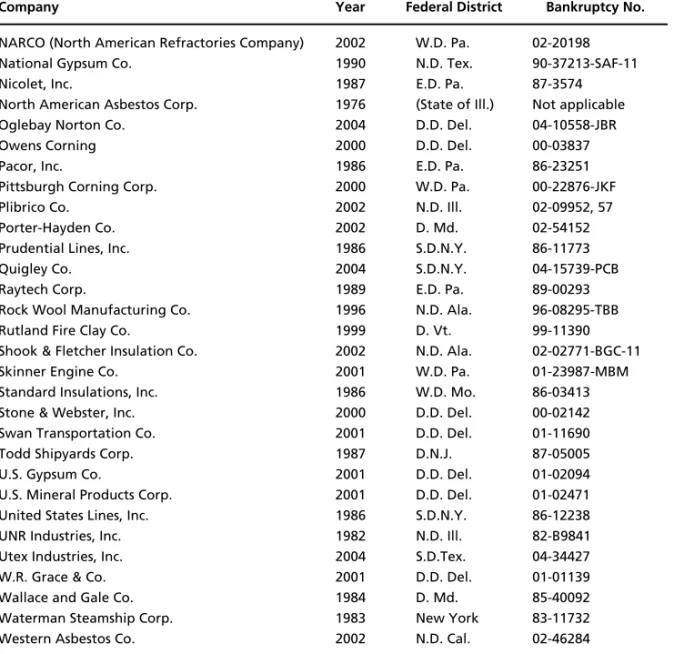
D. Major Asbestos Bankruptcies...151
xiii
S.1. Components of Asbestos Litigation Cost and Compensation...xxvii
3.1. Distribution of Trials by Number of Claims Tried Together (Claims Tried to Verdict, 1993–2001) ...35
3.2. Distribution of Claims by Number Tried Together (Claims Tried to Verdict, 1993–2001) ... 36
3.3. Percentage of Claims Tried Singly and in Groups over Time (Claims Tried to Verdict, 1993–2001) ...36
3.4. Number of Claims Reaching a Jury Verdict...50
3.5. Distribution of Claims Tried to Verdict by Injury Type...50
3.6. Distribution of Claims Tried to Verdict by Injury Type over Time...51
3.7. Probability of Plaintiff Award by Injury Type...52
3.8. Changes in the Probability of Plaintiff Award by Injury Type, 1993–2001...53
3.9. Average Jury Awards by Injury Type...53
3.10. Trends in Average Jury Awards by Injury Type...54
3.11. Distribution of Dollars Awarded in Plaintiff Verdicts by Injury Type...55
3.12. Distribution of Total Dollars Awarded by Juries over Time by Injury Type...55
3.13. Probability of Plaintiff Success by Injury Type and Trial Organization...57
3.14. Average Jury Awards by Injury Type and Trial Organization...57
3.15. Distribution of Claims by Single Plaintiff Versus Homogeneous and Heterogeneous Injury Groups, 1993–2001...58
3.16. Probability of Plaintiff Success by Injury Type and by Single Plaintiff Versus Homogeneous and Heterogeneous Injury Groups...59
3.17. Average Jury Verdicts by Injury Type and by Single Plaintiff Versus Homogeneous and Heterogeneous Injury Groups...60
3.18. Percentage of New Cases Filed in Federal Courts...62
3.19. Distribution of Trials and Claims by State...65
3.20. Distribution of Claims Tried to Verdict by State and Year...65
4.1. Annual Number of Claims Against Five Major Defendants, 1991–2000...73
4.2. Trends in the Number of Claims by Type of Injury...74
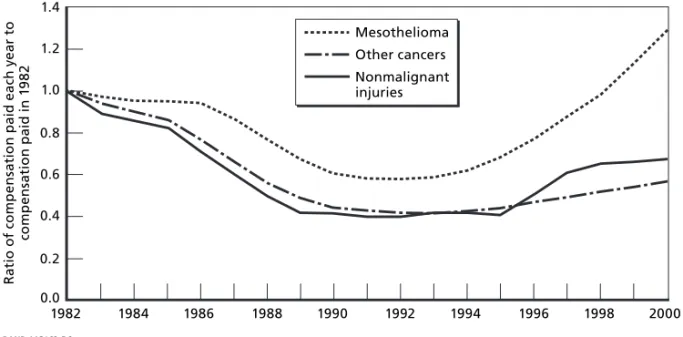
5.1. Components of Asbestos Litigation Costs and Compensation...88 5.2. Average Compensation Paid by Major Defendants by Claimed Injury, Relative
to 1982...101 A.1. Projections of Mesothelioma in the United States, 1982–2047...136 A.2. Projections of Asbestos-Related Lung Cancer in the United States,
1982–2047...137 B.1. Estimated Incident Cases of Mesothelioma in the United States, 1973–1998...143
xv
2.1. Projected Excess Deaths from All Asbestos-Related Cancers in Selected Occupations and Industries, United States, 1965–2029, Based on Study by
Nicholson et al. (1982)...16
2.2. Projections of Asbestos-Related Cancers Among Asbestos Workers, 1985–2009...17
2.3. Projected Cases of Mesothelioma, United States, 1990–2049, Based on a Study by Price and Ware (2004)...18
2.4. Estimated Cases of Mesothelioma in the United States, 1977–1997, Based on Nicholson et al. (1982) Study and SEER Incidence Rates...19
3.1. Data on Law Firms with Large Asbestos Caseloads...24
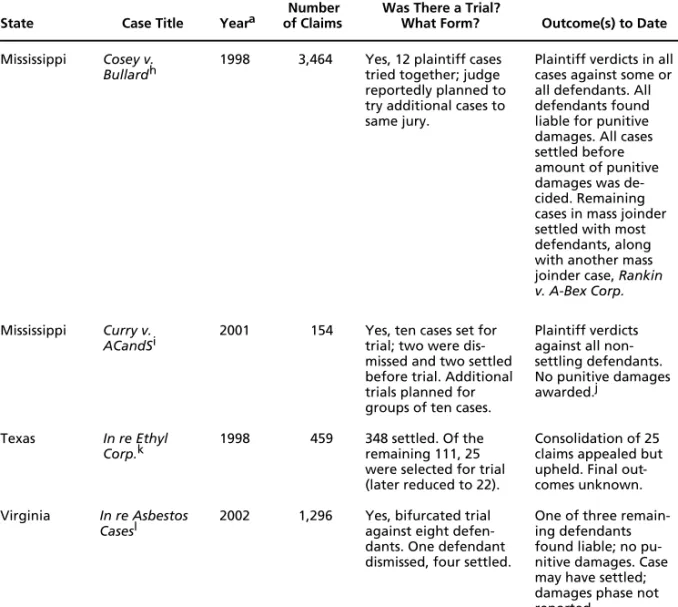
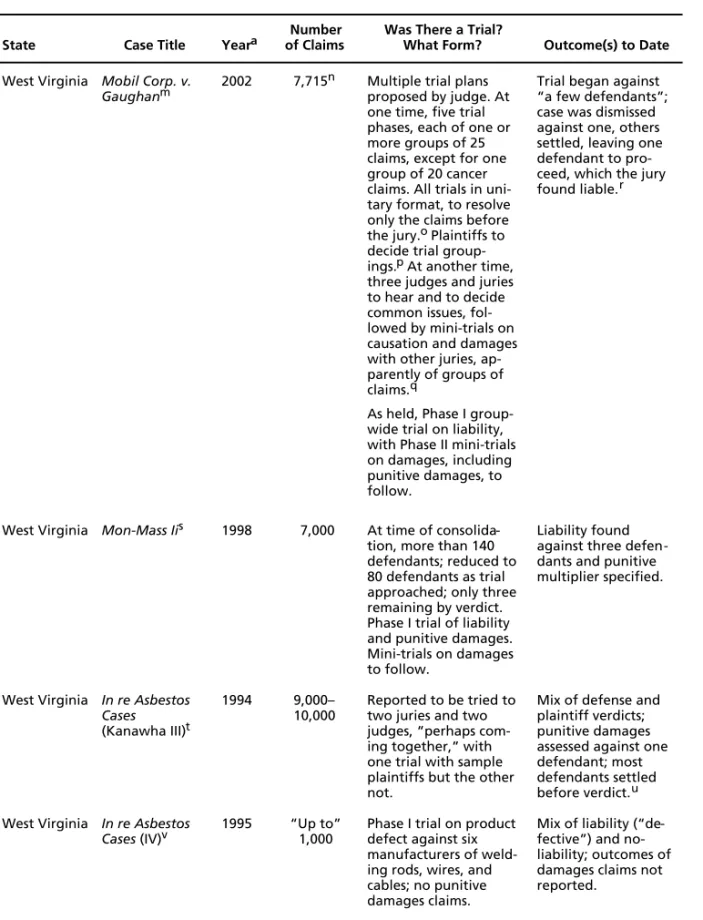
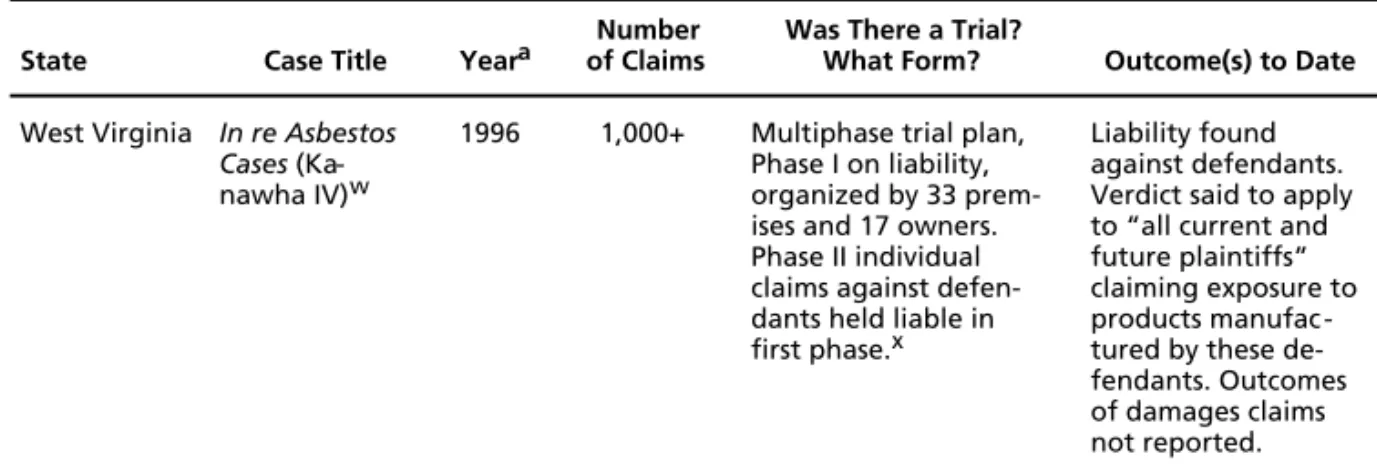
3.2. Large-Scale Trial Consolidations, 1993–2003...38
3.3. Percentage of Claims Filed in State Courts by State...62
3.4. Distribution of State Court Filings by Venue...64
4.1. Number of Claimants by Claimed Injury...71
4.2. Claims from Workers in Nontraditional Versus Traditional Industries...77
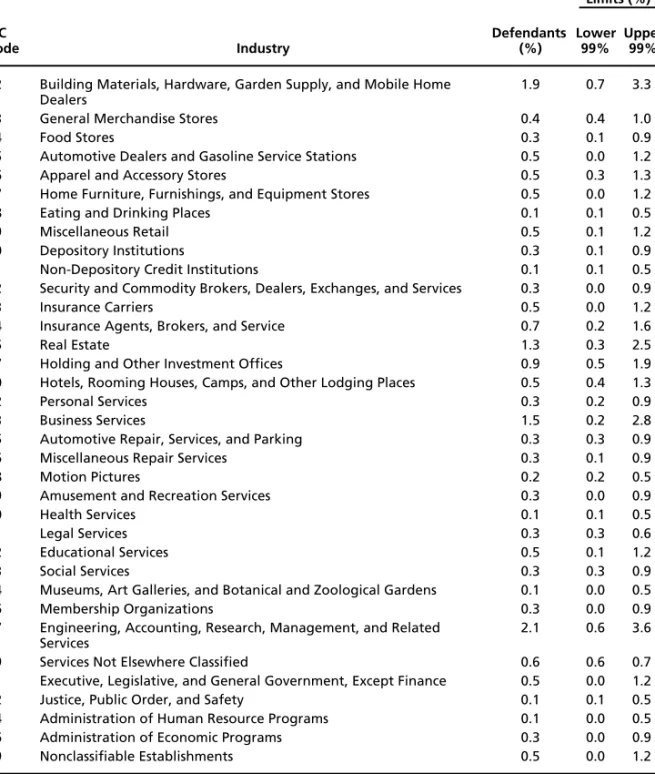
4.3. Distribution of Defendants by SIC Two-Digit Industry Code...82
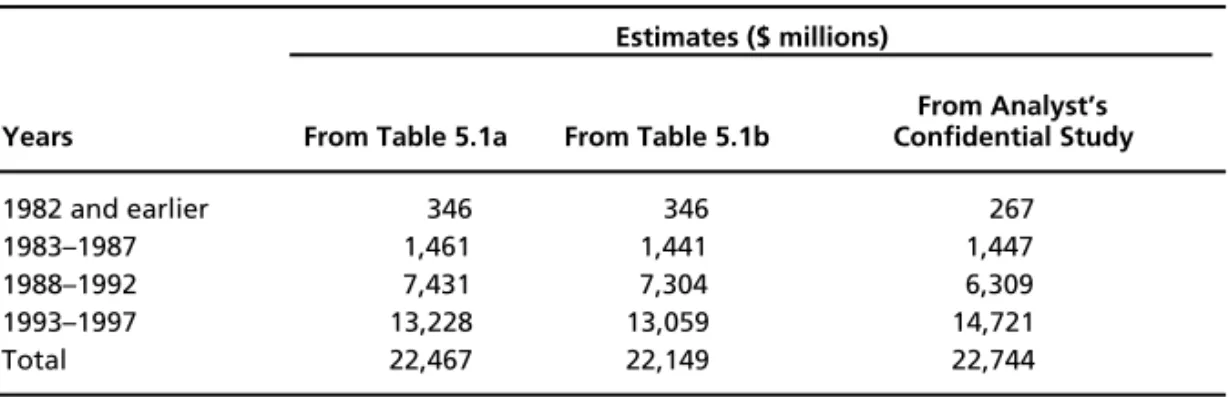
5.1a. Estimates of Asbestos Litigation Compensation ($ millions) Through 2002 (Using Tillinghast-Towers Perrin Estimates of Year-2000 Claim Values)...92
5.1b. Estimates of Asbestos Litigation Compensation ($ millions) Through 2002 (Using an Independent Research Firm’s Estimates of Year-2000 Claim Values in 1998–1999)...93
5.2. Distribution of Total Spending on Asbestos Litigation Through 2000...94
5.3. Defense Costs as a Percentage of Total Spending, 1983–2001...96
5.4. Gross Compensation Paid on Asbestos Personal Injury Claims...98
5.5. Estimated Distribution of Claimants and Gross Compensation by Type of Claim...99
5.6. Modified Estimates of Claimants’ Transaction Costs and Net Compensation ($ millions), Assuming Other Legal Expenses Declined to Zero in 2000...104
6.1. Asbestos-Related Bankruptcy Filings, 1976–2004...110
6.3. Estimated Numbers and Values of Claims Submitted by Defendant Debtors
in Support of a Petition for a Channeling Injunction...113 6.4. Value of Trusts and Sources of Funds...113 6.5. Financial Data for Bankruptcies Exceeding $1 Billion (dollar amounts in
$ millions) ...118 6.6. Prepackaged Bankruptcy Filings...120 A.1. Projections of Asbestos-Related Cancers Among Asbestos Workers,
1985–2009...135 A.2. Deaths Due to Asbestosis Among U.S. Residents 15 Years of Age and Older,
1968–1999...138 B.1. Estimated Cases of Mesothelioma in the United States, 1973–1998...142 B.2. Cases of Mesothelioma in the United States Based on SEER Incidence Rates and
xvii
Asbestos litigation is the longest-running mass tort litigation in the United States. The litigation arose as a result of individuals’ long-term and widespread exposure to asbestos, which can cause serious and sometimes fatal injuries, and as a result of many asbestos product manufacturers’ failure to protect workers against exposure and failure to warn their workers to take adequate precautions against exposure. Over time, the history of the litigation has been shaped by changes in substantive and pro-cedural law, the rise of a sophisticated and well-capitalized plaintiff bar, heightened media attention to litigation in general and toxic tort litigation in particular, and the information science revolution. In turn, asbestos litigation has made a significant contribution to the evolution of mass civil litigation.
Within the past few years, there have been sharp and unanticipated increases in the number of asbestos claims filed annually and the number and types of firms named as defendants. Some plaintiff attorneys have expressed concern about whether compensation is being divided fairly among claimants with varying degrees of injury severity, and many defendants claim that responsibility for paying compensation is not being allocated among defendants in proportion to culpability. Moreover, there are growing concerns on all sides that the cost of settling masses of claims filed in re-cent years will deplete funds needed to compensate claimants whose symptoms have not yet surfaced but who will eventually become seriously ill.
Study Purpose and Approach
This monograph describes asbestos litigation up through summer 2004. It addresses the following questions: What have been the patterns of past exposure to asbestos, and what are the current best epidemiological estimates of future asbestos disease? How has asbestos litigation progressed over time? How many claims were filed through 2002? What were the injuries and diseases asserted in those claims? How many defendants have been named in the litigation and how are they distributed among industries? How much have defendants spent on asbestos litigation? How much of the funds spent on asbestos litigation has been consumed by transaction
costs and how much has gone to claimants? How many defendants have filed for bankruptcy? How has the current litigation system performed to date and are there alternative strategies that might deliver adequate and fair compensation more effi-ciently?
The key to addressing the study questions was gaining access to information that is widely dispersed and often highly confidential. There is no national registry of asbestos claimants. Federal courts collect data on asbestos cases, but most claims are not filed in federal courts but rather in state courts, which do not report such infor-mation. Most of the data on asbestos litigation are gathered by individual defendants and insurers with a stake in the litigation. RAND researchers gained access to a good deal of these data, as well as to some proprietary studies, from participants on both sides of the litigation—access that was granted under conditions of utmost confiden-tiality. The study team also conducted more than 60 interviews with key participants in the litigation, including plaintiff attorneys, corporate counsel, outside defense counsel, insurance company claims managers, investment analysts, and court-appointed “neutrals.” Drawing upon RAND’s previous research on asbestos litigation and other analyses that are publicly available, we synthesized information from all these sources, while acknowledging that we are providing only best estimates because the data are still far from complete.
Scope of Study
Our research focused on how the litigation system has been performing in resolving asbestos claims. Tens of millions of Americans were exposed to asbestos in the work-place over the past several decades. Given the available resources for this study, we could not examine the circumstances of those who were injured by asbestos or what employers, product manufacturers, and others did or failed to do to protect worker health and safety. Of those exposed to asbestos in the United States, more than 700,000 had brought claims through 2002 and almost as many more are likely to bring claims in the future. We focus on what happened to those who claimed injury from asbestos, what happened to the defendants in those cases, and how lawyers and judges have managed the cases.
Asbestos-Related Injuries
Millions of American workers have been exposed to asbestos. Although the dangers of asbestos were known well before World War II, many asbestos product manufac-turers did not warn their employees of the risks of exposure or provide adequate
protection for them. It was these failures that precipitated what has been called the worst occupational health disaster in U.S. history.
The injuries caused by asbestos exposure are mesothelioma, other cancers, as-bestosis, and pleural abnormalities. Mesothelioma is a deadly cancer of the lining of the chest or abdomen for which asbestos is the only known cause. Lung cancer is the other frequently claimed malignant disease that can be caused by asbestos, although many other forms of cancer have been related to asbestos exposure, including leuke-mia, and cancers of the bladder, breast, colon, pancreas, and prostate. Of course, lung cancer has other causes as well. Asbestosis, a chronic lung disease resulting from inhalation of asbestos fibers, can be debilitating and even fatal. Pleural plaques, pleu-ral thickening, and pleupleu-ral effusion are abnormalities of the pleura, the membrane that lines the inside of the chest wall and covers the outside of the lung.
Estimating the incidence of these injuries is very difficult because so few data on them exist. Mesothelioma, for example, was not recorded as a cause of death on death certificates until 1999. Since that date, it is reported as a cause of death in only nine geographic areas (five states and four metropolitan areas) that may not be repre-sentative of the rest of the country. Lung cancer, on the other hand, is recorded on death certificates across the country, but we have no way of knowing how many of those deaths were caused by asbestos exposure. As for asbestosis, the National Insti-tute for Occupational Safety and Health publishes limited data on deaths from this disease, but there is no record of the prevalence of nonfatal cases, which are far more common.
It is very difficult to estimate the number of asbestos-related injuries in the fu-ture because there is such a scant record of injuries that have already occurred. The long latency period before any symptoms are manifested—about 40 years, according to the Manville Personal Injury Settlement Trust (2001)—further complicates pro-jections. It is therefore not surprising that published accounts of asbestos injuries make vastly different predictions of the numbers of people who will manifest asbestos injuries in the future. Litigators rely heavily on a study by Nicholson et al. (1982), which claimed that 228,795 deaths would occur from 1985 to 2009 as a result of cancer caused by extensive asbestos exposure from 1940 through 1979. But other studies have predicted far fewer cancer cases (one study estimates 39,385 to 41,985 during the same period).
Because Nicholson et al. (1982) and other studies used complicated models and required voluminous input—such as extensive labor-force data to estimate the num-ber of asbestos workers—replication of their studies would be time-consuming and expensive. We did, however, conduct a limited test of Nicholson et al.’s projections as part of this study. Our approach was to compare Nicholson et al.’s mesothelioma predictions to the actual incidence rates for mesothelioma in the five years between 1977 and 1997 for which data exist from both the Nicholson et al. study and the National Cancer Institute’s Surveillance, Epidemiology, and End Results (SEER)
Program. We found that Nicholson et al.’s projections are very close to the actual rates observed during those years. One implication of this finding is that the unan-ticipated increases in claims filings in recent years are more likely to be a result of changes in claiming behavior than differences between projected and actual rates of asbestos-related illness.
Litigation Dynamics
In most mass torts, once the dimensions of claimed injuries are understood, the par-ties in the litigation (with the courts’ assistance) negotiate a settlement that resolves all or most claims, usually using some type of administrative scheme. The profile of asbestos litigation contrasts sharply with this conventional pattern. To date, notwith-standing extensive efforts over time, neither the parties nor the courts have arrived at a comprehensive settlement of asbestos claims. The litigation has not only persisted over a long period of time but also continually reshaped itself, in the process pre-senting new challenges to parties and courts. Law firms that played leading roles in the litigation in the 1980s have left the field and been replaced by new firms with new litigation strategies and business models. Trial judges developed innovative pro-cedures in the 1980s to manage large asbestos caseloads. Some other judges subse-quently emulated those procedures; others have substituted different procedures of their own. The focus of the litigation has shifted from federal to state courts, and now, increasingly, to bankruptcy courts. Corporations that initially were perceived to have little or no exposure to asbestos-related liability now find themselves at the cen-ter of the litigation. We analyzed the key dimensions of these litigation dynamics so that policymakers seeking to understand how best to address asbestos-related injuries could understand why the litigation has evolved as it has and its key features today.
In the past several years, the most significant developments in asbestos case processing have been the failure of global class action settlements, the reemergence of deferred dockets as a popular court management tool, the increased frequency and scale of consolidated trials, and the increased use of bankruptcy reorganization to de-velop administrative processes for resolving current and future claims.
The Failure of Global Settlement Efforts
When federal asbestos cases were transferred to Judge Charles Weiner by the Judicial Panel on Multidistrict Litigation (JPMDL) in 1991, many asbestos lawyers antici-pated that Judge Weiner would help parties negotiate a global settlement of all fed-eral cases against all defendants that would in turn provide a model for resolving state cases. Ultimately, the search for a single overarching settlement failed. Instead, a con-sortium of about 20 major asbestos defendants negotiated two settlements with leading asbestos plaintiff attorneys under the aegis of the transferee court, one a
“pri-vate” (not judicially supervised) settlement of all claims those attorneys then had pending against the defense consortium and the second, a class action settlement of all claims that might be brought in the future by any plaintiff (and plaintiff attorney) against the consortium. The class action settlement provoked sharp attack from law-yers who were not part of the negotiated agreements, public interest attorneys, and legal ethicists. When the settlement was rejected by the U.S. Supreme Court in Am-chem Products v. Windsor (521 U.S. 591 [1997]), and when the Court subsequently rejected a similar class settlement of asbestos claims against another major defendant in Ortiz v. Fibreboard Corp. (527 U.S. 815 [1999]), efforts to achieve a global reso-lution of asbestos litigation through class action litigation collapsed.
After the failure of the Amchem and Ortiz settlements, the landscape of asbestos litigation began to change. Filings surged, and many of the asbestos product manu-facturers that plaintiff attorneys had traditionally targeted as lead defendants filed for bankruptcy. Plaintiff attorneys sought out new defendants and pressed defendants that they had heretofore treated as peripheral to the litigation for more money. With new firms engaged in litigating on the plaintiffs’ behalf, and new corporations drawn into the litigation or assuming a more central role, old understandings about how to deal with asbestos cases began to unravel.
Deferred and Expedited Dockets
Courts are faced with large asbestos caseloads that include a large fraction of cases involving claimants who are not currently functionally impaired but who do have a legally cognizable injury and, hence, face a statute of limitations bar in many juris-dictions if they fail to file a claim within a specified time period. In response to this situation, some courts have established deferred dockets (sometimes called “inactive dockets” or “pleural registries”), which enable unimpaired asbestos plaintiffs to satisfy statutes of limitation by filing their lawsuits but delay processing and resolving those lawsuits until the plaintiffs’ injuries have progressed further. Nonmalignant claims are removable from the deferred docket only if they meet prespecified clinical criteria (e.g., diagnosis of malignancy, certain radiological exam results, and certain pulmo-nary function test ratings) or if a claimant’s lawyer is otherwise able to persuade the court that a claim should be activated. State courts in Massachusetts, Cook County, Illinois, and Baltimore established deferred dockets in the late 1980s and early 1990s. Courts that have established inactive dockets in recent years include New York City, Seattle, and Madison County, Illinois, all of which now have substantial numbers of asbestos cases on their inactive dockets. In a variation on this policy, some courts have established “expedited dockets” that give priority to cancer claims, placing the claims of those without functional impairment at the back of the queue.
Although pleural registries preserve plaintiffs’ right to pursue compensation in the future, they do not provide compensation for whatever losses the plaintiffs might already have suffered or for monitoring their health going forward. In courts in
which discovery does not begin until a case is transferred from the deferred to the regular (active) docket, attorneys who have agreed to represent plaintiffs who are not currently functionally impaired do not have to invest time and money to investigate the case. But the plaintiff lawyers who represent non-impaired plaintiffs also cannot secure fees immediately, making it harder for them to spread the risks of litigating more serious cases and perhaps making it less financially attractive for them to repre-sent asbestos plaintiffs generally. From the defendants’ perspective, pleural registries are attractive because they reduce the number of claims paid out annually by elimi-nating payments for those who are not functionally impaired. In jurisdictions in which placement on pleural registries is mandated, if nondisabled plaintiffs never de-velop injuries that meet the criteria necessary to be removed from the registry, defen-dants will pay fewer claims in total over time and likely less in total compensation to all those who have been exposed to asbestos.
Trial Consolidation
Federal and state courts have struggled to manage asbestos caseloads more efficiently to reduce private and public transaction costs. Over the years, judges have come to believe that the key to managing asbestos litigation is aggregation. Aggregative tech-niques in asbestos litigation have included informal group settlement processes, multidistrict litigation under 28 U.S.C. §1407, and state multidistrict rules, class ac-tions (which have only rarely been sustained), and consolidation under F.R.C.P. 42 and its state counterparts.
In recent years, mass trial consolidations in asbestos litigation have been the subject of great controversy. According to Mealey’s Litigation Report: Asbestos, from 1993 to 2001 there were 526 jury trials that reached verdicts on 1,570 plaintiffs’ claims. About 60 percent of the trials involved a single claim; most of the remainder involved fewer than ten claims. But the proportion of all claims that were tried indi-vidually was only about one-quarter; about half were tried in groups of six or more. In comparing claims tried individually with claims tried in small groups, we found little difference in outcomes.
In some instances, judges have consolidated hundreds or thousands of asbestos claims for trial. There is little or no case law regarding the selection of representative parties for nonclass consolidated trials, and judges appear to make the selection on an ad hoc basis. In large-scale consolidations, some judges select a few representative cases for trial of liability and other crosscutting issues. The jury decides those issues and then decides damages (if necessary) in the representative cases. The jury’s deci-sions on the crosscutting issues are applied to all cases in the consolidation, and other juries then hear damages issues in the other cases that are part of the consolidation. From 1993 to 2001, we identified 14 large-scale consolidated trials involving 100 claims or more. Each of these large-scale consolidated trials was complex; some were extraordinarily complex.
Trying thousands of cases together raises due process questions for plaintiffs and defendants alike. If, as is common, the liability phase is tried first with representative plaintiffs, and the jury decides in favor of the defendant, all of the plaintiffs lose. Defendants, however, believe that large-scale consolidation tilts the playing field against them. Many judges have also expressed doubts about the appropriateness of mass consolidations. We were able to determine at least some trial outcomes for 13 of the 14 large-scale consolidation trials we identified. Six resulted in a mix of plain-tiff and defense verdicts, six resulted in plainplain-tiffs’ verdicts in all cases against some or all defendants, and one resulted in defense verdicts.
Bankruptcy Litigation
Since the early 1980s, asbestos litigation in federal and state courts has played out against a background of parallel litigation in the bankruptcy courts, which has influ-enced the primary litigation against non-bankrupt defendants and, in turn, has been shaped by that litigation. When the Manville Corporation filed for bankruptcy in 1982, it temporarily disrupted asbestos litigation patterns, as plaintiffs and non-bankrupt defendants alike sought to prevent the stay of litigation against Manville, which had until then been the lead defendant in the litigation. The difficulties atten-dant in estimating Manville’s liability exposure highlighted for non-bankrupt defen-dants the difficulties of estimating their own future liabilities. The Manville bank-ruptcy reorganization at first provided cautionary lessons on the use of bankbank-ruptcy to resolve asbestos claims. But after Congress amended the bankruptcy statute to facili-tate the creation of post-bankruptcy trusts to resolve claims, many looked to the Manville Trust as a model for aggregating claims and capping corporate liability ex-posure due to asbestos even for those corporations that were not at the time facing bankruptcy themselves.
When increasing asbestos claims rates encouraged scores of defendants to file Chapter 11 petitions in the late 1990s, the resulting stays in litigation against those defendants drove plaintiff attorneys to press peripheral non-bankrupt defendants to shoulder a larger share of the value of asbestos claims and to widen their search for other corporations that might be held liable for the costs of asbestos exposure and disease. In turn, the surge of filings for reorganization under Chapter 11 of the bank-ruptcy code may have provided an additional incentive for some asbestos plaintiff law firms to file large numbers of claims: Under Section 524(g) of the bankruptcy code, a proposed reorganization plan must obtain support from 75 percent of current asbes-tos claimants to win court approval, meaning that law firms that represent large numbers of claimants will wield the most power over the reorganization negotiations. As bankruptcy proceedings have expanded to include most of the original lead defendants in asbestos litigation and scores of other companies besides, bankruptcy litigation has come increasingly to mirror the primary litigation in federal and state courts. Borrowing from case management practices in trial courts, district courts have
consolidated multiple bankruptcy reorganizations and assigned mass tort “specialist” judges to preside over them. Parties have sought to transfer related claims to bank-ruptcy courts in the hope of achieving an attractive global resolution of those claims. One judge ordered that claimants with cancer would have their claims processed be-fore claimants with non-cancer claims, essentially establishing an expedited docket. And seemingly borrowing a page from the controversial “futures” settlements that were rejected by the U.S. Supreme Court in Amchem and Ortiz, lawyers have sought to fashion resolutions of bankruptcy claims against a number of major corporations that offer attractive settlements of current claims in exchange for support for reor-ganization plans that will determine payments of other claimants far into the future.
Claimants
We used data from a number of sources, with much of the data provided to us on a confidential basis, to estimate the numbers of people who filed asbestos personal in-jury claims through 2002. Our primary findings are as follows:
• Approximately 730,000 people had filed an asbestos claim through 2002.
• The number of claims filed annually has increased sharply in the past few years. Annual claims against major defendants have increased sharply over 1990s. For example, defendants who were receiving 10,000 to 20,000 claims per year in the early 1990s were receiving three to five times as many claims per year by the year 2000. Increasing numbers of claimants primarily reflect rising awareness of asbestos-related injury and of the availability of legal remedies, most likely resulting from increasing access to information (e.g., from the Inter-net) and lawyer advertising.
• Claimants with nonmalignant injuries account for most of the growth in claims. Throughout the 1980s, claims of all types grew at approximately the same rate. But beginning in the early 1990s, the number of people asserting a nonmalignant injury, including those with little or no current functional im-pairment, grew much faster than the annual number of new claimants asserting some form of cancer. Nonmalignant claims accounted for roughly 80 percent of all claims entering the system through the 1980s. The fraction of claims that as-serted nonmalignant conditions began to grow in the early 1990s, rising to more than 90 percent of annual claims in the late 1990s and early 2000s.
• The number of claimants with mesothelioma has been increasing in recent years. Although the absolute numbers of claims for mesothelioma—a virulent form of cancer for which asbestos exposure is the only known cause—are very small, they have been growing. Since 1994, more of such claims have been filed
each year, resulting in a doubling of mesothelioma claims in the eight-year pe-riod to 2002.
• Some evidence suggests that most nonmalignant claimants are currently un-impaired.Based on the available data, it appears that a large and growing pro-portion of the claims entering the system in recent years were submitted by in-dividuals who at the time of filing had not suffered an injury that had as yet affected their ability to perform the activities of daily living, although they had suffered a legally cognizable injury.
• Claims filed by workers in “nontraditional” industries who were exposed to asbestos are increasing. Early in asbestos litigation (the decade or so following Borel v. Fibreboard [493 F.2d 1076 (5th Cir.)] in 1973), most claims came from workers who were exposed to asbestos in industries such as asbestos mining and manufacturing, shipyards, railroads, and construction, where they worked in enclosed tight quarters in an atmosphere thick with asbestos fibers. Participants in the litigation call these the “traditional” industries. Now many claims come from workers who were exposed to asbestos while working in other industries, such as textiles, paper, glass, and food and beverage, where they typically did not handle asbestos but asbestos was present in the atmosphere.
Defendants
This study produced the following findings regarding asbestos litigation defendants: • At least 8,400 entities have been named as asbestos defendants through 2002.
This number is probably an underestimate, because the sources we used to ver-ify the names of defendants do not list firms that did not exist in 2002, even though they may have existed at some prior date. Thus, this number does not include firms that were named as defendants at some time before 2002 but then subsequently ceased doing business under the names they had when they were named as defendants.
• Defendants are distributed across most U.S. industries. Using the U.S. De-partment of Commerce Standard Industrial Classification (SIC) system, we found that 75 out of 83 different industries listed at the 2-digit level in the SIC system included at least one entity that had been named as an asbestos litigation defendant.
• But the litigation is concentrated in eight industries.Although asbestos litiga-tion is widespread throughout the U.S. economy, only eight industries indi-vidually account for 4 percent or more of the firms that have been named as defendants. Many industries include only a few firms that have been named as
defendants. Each of 49 industries includes fewer than 1 percent of the firms named as defendants.
Costs and Compensation
We estimated the amount of money spent on asbestos litigation from its inception in the 1960s through the end of 2002, including the total amount spent on personal injury claims and the proportion of those costs that ended up in claimants’ pockets. The components of those costs are as follows (see Figure S.1).
• Total Spending. Total spending on asbestos litigation through 2002 was about $70 billion. This sum is the amount defendants spent after being reimbursed from insurers plus the amount insurers spent after being reimbursed by reinsurers.
• Defense Transaction Costs. Total spending is broken down into defense trans-action costs and the gross compensation paid to claimants. Defense transtrans-action costs include the costs defendants and insurers incurred in all asbestos-related litigation, including litigation with other defendants and insurers. These costs amounted to more than $21 billion by the end of 2002, or about 31 percent of total spending.
• Gross Compensation. Gross compensation equaled about $49 billion, or about 69 percent of total spending. Average compensation for mesothelioma claims has increased sharply since the early 1990s.
• Claimants’ Transaction Costs. Claimants’ transaction costs added up to about $19 billion, or 27 percent of total spending through 2002.
• Claimants’ Net Compensation. We estimate that claimants’ net compensation through 2002 equaled about $30 billion, which is about 42 percent of total spending.
Estimates of the number of people who will file claims in the future—and the costs of those claims—vary widely. However, all accounts agree that, at most, only about three-quarters of the final number of claimants have come forward.
Figure S.1
Components of Asbestos Litigation Cost and Compensation
Defense transaction costs ($21 billion) Gross compensation ($49 billion) Claimants’ transaction costs ($19 billion) Net compensation ($30 billion) Total spending ($70 billion) RAND MG162-S.1
NOTE: Dollar figures are approximate.
Bankruptcies
The costs of asbestos litigation to date and the prospect of future costs have led many firms to file for bankruptcy. This study produced the following findings regarding asbestos-related bankruptcies:
• Bankruptcies are becoming more frequent. Following 1976, the year of the first bankruptcy attributed to asbestos litigation, 19 bankruptcies were filed in the 1980s and 17 in the 1990s. Between 2000 and mid-2004, there were 36 bankruptcy filings, more than in either of the prior two decades. At least 73 firms that had been named on a substantial number of asbestos claims had filed for bankruptcy through mid-2004.
• Bankruptcy reorganization can be a major drain on defendants’ resources. The academic literature on bankruptcy shows that the cost of reorganization is equal to about 3 percent of the average firm’s book value or about 6 percent of a firm’s market value.
• Bankruptcy can impose costs on the filing firm’s labor force.An analysis by Stiglitz et al. (2002) of the effects of asbestos-related bankruptcy filings through September 2002 estimated that the bankruptcy filings resulted in the loss of 52,000 to 60,000 jobs and that the workers displaced by these bankruptcies will lose, on average, an estimated $25,000 to $50,000 over their lifetimes. The
Stiglitz study also estimated that workers at bankrupt firms with 401(k) plans lost, on average, about 25 percent of the value of those plans.
• The economic effect of asbestos litigation extends well beyond the bankruptcy of a number of firms. Defendants that have not filed for bankruptcy have nonetheless incurred asbestos litigation costs. As a result, these firms may reduce their investment levels. Reductions in investments, in turn, can lead to reduc-tions in the creation of new jobs.
Is There a Better Way?
Efforts to improve the resolution of asbestos litigation implicate strongly held views about the tort system, which has traditionally been the primary vehicle in the United States for compensating victims of injurious behavior by others and an important tool for regulating corporate behavior. Traditionally, the tort system in the United States has been viewed as having three objectives: compensation, deterrence, and in-dividualized corrective justice.
In theory, the system properly compensates injury victims for their losses, prop-erly calibrates defendants’ incentives to avoid injuring others, and provides a sense that “justice has been done” through individualized consideration of each plaintiff’s and defendant’s situation. Moreover, as a common law (rather than statutory) sys-tem, tort liability has proved remarkably adaptable to changing social, cultural, and technological trends. The commitment of tort law to “make victims whole,” deter injurious behavior, and provide individuals with their “day in court,” as well as its adaptability to change, is generally seen as the justification for the tort system’s trans-action costs, which are understood to be considerably higher than the costs associated with delivering benefits through administrative systems, such as workers’ compensa-tion and social insurance schemes.
How Well Is the Tort System Working for Asbestos Litigation?
Most of the factual data that are reported in this monograph are not disputed by participants in asbestos litigation. The sharp differences between and among plaintiff attorneys, defense counsel, defendant corporations, and insurers derive primarily from differences in assessments of the performance of the tort system among various parties who have stakes in the litigation.
Compensation
Typically, the high costs of tort litigation screen out of the system the majority of claims for minor injuries and modest losses. In asbestos litigation, however, mass
liti-gation strategies have effectively opened the courts to everyone who can prove expo-sure to asbestos and demonstrate a legally cognizable injury. As asbestos litigation has continued, an increasingly large fraction of those who have come forward and found representation are not currently functionally impaired, although they do meet the legal standard for a compensable injury.
Some participants in asbestos litigation, and some observers also, view asbestos claimants’ increased access to the courts (in comparison with other tort victims) as a positive achievement, fulfilling—at least in this instance—the promise of tort law. Others argue that opening the system so widely jeopardizes the ability of the tort system to compensate claimants who will come forward in the future, some of whom will have serious or fatal injuries.
To our knowledge, there is no published research comparing the total compen-sation received by asbestos plaintiffs with their economic loss, nor were we able to obtain such data for our study. It is certain that many of the asbestos personal injury trusts established as a result of Chapter 11 bankruptcy reorganizations pay only a small fraction of the agreed-upon value of plaintiffs’ claims; there is no reason to be-lieve that the reorganizations currently in process will yield vastly different outcomes. However, how these diminished payments resulting from bankruptcy will affect ade-quacy of compensation is uncertain, as shortfalls in compensation from bankrupt defendants may be compensated by increased compensation from corporations that are newly drawn into the litigation.
Deterrence
It is indisputable that the asbestos manufacturers that were the prime targets of liti-gation through the 1980s were responsible for widespread asbestos exposure. As the litigation spread to companies outside the asbestos and building products industries, however, the culpability of the defendants called upon to pay asbestos victims is more in dispute. From a deterrence perspective, the issue is not whether asbestos victims should be able to receive compensation from some entity, but rather what entity should fairly be called upon to shoulder the financial burden. Requiring companies that played a relatively small role in exposing workers to asbestos to bear substantial costs of compensating for asbestos injuries not only raises fundamental questions of fairness but undercuts the deterrence objectives of the tort system. If business leaders believe that tort outcomes have little to do with their own behavior, then there is no reason for them to shape their behavior so as to minimize tort exposure.
Individualized Treatment
In asbestos litigation, individualized justice is a myth. Most cases are settled rather than tried, and many are settled according to standardized agreements negotiated by defendants and plaintiff attorneys. (In fact, many plaintiff attorneys conventionally refer to their “inventories” of cases.) Under such agreements, all cases against some
defendants may be settled for a flat fee, while cases against other defendants will be sorted into a “matrix” of claims, according to a few distinguishing characteristics, and paid the value associated with that matrix cell. Bankruptcy personal injury trusts, which will pay an increasing share of asbestos compensation in the future, institu-tionalize this administrative compensation process for asbestos claims.
Among the small numbers of asbestos claims that reach trial, a majority is tried in group form, along with a few or more like or unlike claims. Sometimes, more than a hundred claims may be tried together; sometimes, the trial of a few claims will de-cide critical outcomes for thousands more. Claims against multiple defendants, in arguably quite different circumstances, may also be tried together. Although consoli-dated trials are not unique to asbestos litigation, they do appear to be more prevalent, of a larger scale, and more complex in asbestos litigation.
Alternative Strategies
Any effort to devise an alternative to tort for resolving asbestos claims must address the very same questions that have complicated resolution of the claims through tort: How many claims will come forward in the future? What will be the distribution of claims by severity of injury? What are the proper standards for allocating compensa-tion among those with diverse injuries, ranging from nondisabling pleural scarring to fatal mesothelioma? How should the responsibility for paying for these injuries be allocated among those who manufactured or distributed asbestos products or oper-ated workplaces in which asbestos was present?
For the past several years, plaintiff and defense attorneys, defendant corpora-tions and insurers, labor unions, and the allies of all these groups have worked in different combinations and contexts to consider alternative strategies for resolving future asbestos claims. Two competing strategies emerged from these reform efforts, neither of which was able to secure sufficient support for passage in the 108th Congress (2003–2004). Both strategies have been put forward again in the 109th Congress. In lieu of federal reform, critics of current asbestos litigation processes look either to state legislatures and courts or to bankruptcy proceedings and personal in-jury trusts to improve the resolution of asbestos claims in the future.
Congressional Reforms
Medical Criteria. One reform strategy, supported by the American Bar Asso-ciation, seeks to limit compensation for asbestos disease to plaintiffs whose injuries met certain specified medical criteria. In essence, this proposal would prevent people who are not currently functionally impaired and do not have an asbestos-related can-cer from claiming compensation in the tort liability system, even if they have clinical evidence of asbestos exposure—e.g., pleural scarring—that under current state law in
many jurisdictions would allow them to seek compensation. To its supporters, the medical criteria approach has the benefit of making arguably minimal changes in the tort liability system, leaving questions of how to deal with all those claims that meet the medical criteria and remain within the litigation system to state tort doctrine and procedural rules.
Because it would prevent many asbestos-exposed workers who are currently eli-gible for compensation from claiming compensation in the future unless and until they met the specified criteria, this reform strategy has been opposed by those who represent these workers, including many asbestos plaintiff attorneys and labor union leaders. Some defendant corporations and insurers also are reluctant to support the medical criteria proposal because they fear that the costs of compensating mesothe-lioma claimants and other seriously injured claimants might be so high in the future as to offset any economic benefits to them that might accrue from eliminating unim-paired claims from the liability system.
Trust Fund. With the success of the medical criteria proposal in doubt, many defendant corporations and insurers began to pursue an alternative strategy that would eliminate tort liability for asbestos claimants entirely and substitute an admin-istrative compensation program, funded by defendant corporations and insurers (i.e., a trust fund). Unlike the medical criteria approach, which would leave each defen-dant to respond to the suits that remain within the tort system as the defendefen-dant sees fit, the administrative compensation program strategy requires that defendant corpo-rations and insurers agree on a funding formula. To achieve consensus, defendant corporations and insurers have had to grapple with the same questions that have challenged designers of asbestos personal injury trusts in Chapter 11 proceedings and those who have sought to negotiate long-term settlements of asbestos litigation out-side of bankruptcy: How many claimants will appear in the future? How much should each defendant and potential defendant pay?
With the federal government unwilling to act as guarantor of the compensation program, payors’ and claimants’ representatives need to consider what might happen if the amount originally negotiated proves to be inadequate. Some defendants also worried that eligibility was too broadly defined. Unlike previous trust fund proposals, the one debated in the 108th Congress did not limit compensation to cancer victims and those with a severe respiratory impairment. As negotiations continued, the price tag for the proposed fund mounted to a level that some were unwilling to support, and the parties were not able to reach agreement on a formula before the time for congressional action expired. Now the 109th Congress has taken up the trust fund proposal again.
State Reforms
With the success of congressional initiatives in doubt, by the end of 2004, asbestos litigation reformers were turning their attention to the states. Medical criteria statutes
were introduced into state legislatures in Louisiana, Ohio, and Texas. Legislation limiting successor liability, adopted previously in Pennsylvania, was adopted in Texas as well. Venue rules that had invited large-scale consolidations in Mississippi were amended, and stricter venue rules were also adopted in Texas. Together, these changes may temper the rise in frequency of claiming for asbestos diseases. But such efforts are likely to leave in place a patchwork of tort doctrine and mass litigation procedural rules that promises continuing variation in asbestos outcomes for plain-tiffs and defendants and would do little to mitigate the high transaction costs of as-bestos litigation.
Bankruptcy Proceedings and Personal Injury Trusts
With an increasing number of corporations in Chapter 11 bankruptcy proceedings, some observers have suggested that the personal injury trusts that usually result from reorganization offer the most promising means of resolving asbestos claims quickly and with lower transaction costs, particularly if the debtors and tort creditors negoti-ate “prepackaged bankruptcies” before a formal petition for Chapter 11 is filed. “Pre-packs” have the potential to substantially shorten the Chapter 11 process, which historically has averaged about six years for asbestos defendants. But some plans that have emerged from pre-pack processes have proved to be controversial, resulting in lengthy appellate processes and ancillary litigation. Moreover, some of these plans have been challenged on grounds of unfairness to certain classes of asbestos plaintiffs. Whether bankruptcy proceedings and personal injury trusts will significantly im-prove the resolution of asbestos claims is uncertain.
xxxiii
We owe thanks to many people for an enormous amount of help. We are particularly indebted to RAND colleagues John Adams and David Kanouse, who reviewed drafts of both this report and our earlier studies and provided numerous helpful comments. We also benefited from comments and suggestions offered by the members of the ICJ Board of Overseers and by many participants in asbestos litigation who reviewed this report and our earlier studies.
We also received valuable advice at various stages of the research from experts and analysts who have studied asbestos litigation. We particularly thank David Austern of the Manville Personal Injury Settlement Trust, Jennifer Biggs and Mi-chael Angelina of Tillinghast-Towers Perrin, Raji Bhagavatula of Milliman USA, and Frederick Dunbar of NERA for their help.
A great many people have contributed to our understanding of the workings of asbestos litigation. We cannot name every person who spent time with us; the list would be very long, and several of our conversations were on a non-attribution basis. We thank the many plaintiff and defense attorneys and representatives of public and private organizations who shared their perspectives and concerns with us. And we thank the people involved in the day-to-day activities of asbestos litigation who de-voted many hours of their time to helping us understand how asbestos litigation works in practice.
For some analyses, we used confidential data provided to us by participants in the litigation. Because we agreed not to disclose the identities of those who provided data to us, we cannot explicitly acknowledge their assistance here. But we could not have conducted this analysis without the data they provided.
Finally, at RAND, we thank Laura Zakaras for helping us with the structure and clarity of this report, Christopher Dirks for his technical help on earlier versions of this document, and Nancy DelFavero, whose editorial expertise greatly improved the overall quality of this report.
xxxv
ABA American Bar Association AMA American Medical Association
ATSDR Agency for Toxic Substances and Disease Registry CCR Center for Claims Resolution
EPA Environmental Protection Agency JNOV judgment notwithstanding the verdict JPMDL Judicial Panel on Multidistrict Litigation KBR Kellogg, Brown & Root
MDL multidistrict litigation
NIOSH National Institute for Occupational Safety and Health NSP National Settlement Program
NYSE New York Stock Exchange
OSHA Occupational Safety and Health Administration; Occupational Safety and Health Act
SEC Securities and Exchange Commission
SEER Surveillance, Epidemiology, and End Results Program (National Cancer Institute)
SIC Standard Industrial Classification (U.S. Department of Commerce)
UNR Union Asbestos and Rubber USG U.S. Gypsum Company
1
In 1973, asbestos manufacturers were found strictly liable to workers injured as a re-sult of exposure to their products (Borel v. Fibreboard, Fifth Circuit, U.S. Court of Appeals, 1973). Following that decision, increasing numbers of product liability claims against asbestos manufacturers flowed into the courts. By the early 1980s, more than 20,000 claimants had initiated lawsuits alleging injuries from exposure to asbestos. The growing volume of this type of litigation began to attract the attention of public policymakers.
Many of those involved in asbestos litigation devised procedures to streamline the litigation process and reduce the burdens and costs they faced. Courts developed formal and informal approaches to managing asbestos litigation. A series of court de-cisions resolved most of the coverage disputes between defendants and insurers. Many defendants chose not to aggressively contest liability and instead negotiated settlements of large numbers of cases with leading plaintiff attorney firms. These agreements typically called for settling hundreds or thousands of cases per year at amounts specified in administrative “schedules” that reflected differences in injury severity and other characteristics deemed to affect the value of cases. Asbestos litiga-tion continued to be a critical concern for the firms frequently named as defendants, but at the time there were only a few dozen firms in this position. Most observers tended to view asbestos litigation as “manageable” in the sense that the effects of the litigation were largely limited to those few dozen or so defendants. Asbestos litigation became a lower priority on the national political agenda.
In the past decade, however, and particularly in the past few years, the situation has changed dramatically. Sharp increases in the number of asbestos claims filed an-nually, the number and types of firms named as defendants, the costs of the litigation to these defendants and their insurers, and the number of firms filing for bankruptcy have reawakened policy concerns. In particular, there are growing concerns that these trends put at risk the compensation of future claimants who suffer from serious inju-ries. Asbestos litigation poses challenges for asbestos-injury victims seeking compen-sation, plaintiff attorneys representing those claimants, defendants who must respond to the litigation while protecting shareholders’ interests, insurers who must cover the
losses, and financial institutions attempting to accurately assess the magnitude of cur-rent losses and future liabilities. Because of the number of people exposed to asbestos in the United States, the injuries those people have incurred, the financial losses at-tendant to those injuries and the ensuing litigation, and the potential economic im-pact of that litigation, asbestos litigation also poses unique challenges for the civil jus-tice system.
This RAND Institute for Civil Justice (ICJ) study is intended to provide objec-tive data and analysis to stakeholders and policymakers so that they can address the key policy questions: How well is the current process working? Can it be improved?
Research Objectives
A clear understanding of the dimensions of asbestos litigation is essential to the de-sign of an effective policy response to the litigation. What do past patterns of asbestos exposure tell us about the number of future claims that can be anticipated? How has the litigation evolved over time? How many claims are being filed? By whom? Against whom? For what injuries? How much are claimants recovering? How many defendants have been charged with responsibility, and what industries do they repre-sent? How many bankruptcies have been attributed to asbestos litigation, and what are the overall economic effects of the litigation? More generally, what does the fu-ture hold? This study set out to answer those questions to the extent possible given the limitations in the data available.
Scope of This Study
As the questions posed in the previous section suggest, this study focuses on how the litigation system is performing in resolving asbestos claims. Within the available time and given the available resources, we could not examine the circumstances of those who were injured by asbestos exposure, nor could we investigate what companies that have been defendants in the litigation did or did not do to protect the health and safety of workers. Tens of millions of Americans were exposed to asbestos in the workplace over the past several decades. Of those, more than 700,000 have brought claims, and just as many, and possibly even more, claimants may come forward with claims in the future. We focus on what happened to those who claimed injury and what happened to the defendants in those cases.
Research Approach
The critical challenge to conducting research on asbestos litigation is that so little data are publicly available. There is no national registry of asbestos claimants. Some claims are not filed formally in court as lawsuits. Federal courts report the number of asbestos lawsuits filed, but in recent years most lawsuits have been filed in state courts, which do not routinely identify and report annual asbestos lawsuit filings.
The typical asbestos claimant brings a claim against many defendants. In recent years, defendants have typically named several dozen defendants, and each of those defendants generally settles claims separately and keeps its own records. Any one de-fendant knows about the claims against it and its settlements, but it usually does not know how much other defendants are paying on a claim. Claimants may receive money from settlements over a long period of time. They may settle with some de-fendants today and other dede-fendants next year and still others later on down the line.
Further, because there are so many conflicting interests, and because so much money is involved, even the limited data possessed by those involved in the litigation are viewed as highly sensitive and confidential. So, answers to simple questions such as how many claims are there? and what does the litigation cost? are not readily available.
We approached this problem in a number of ways. First, we drew on data and knowledge gained in previous RAND Corporation research on asbestos and other mass toxic tort litigation (Kakalik et al., 1983; Kakalik et al., 1984; Hensler et al., 1985; Peterson and Selvin, 1991; Hensler, 1992; Hensler and Peterson, 1993; Hensler, 1995; Hensler et al., 2000). We drew on the knowledge we acquired in these studies to establish historical and interpretative contexts for new information.
Second, we collected publicly available data from a variety of sources, ranging from asbestos litigation reporters to corporations’ Securities and Exchange Commis-sion (SEC) filings. Where we found inconsistencies, we either note them or did not make use of the data. When corporations attribute their filing for bankruptcy to as-bestos litigation, they often report the number of asas-bestos claims filed against them in their bankruptcy petitions. We obtained these data as well. Asbestos bankruptcy trusts (entities that are formed to pay asbestos claims after Chapter 11 reorganiza-tion) typically report the number of claims filed against them to the court that has jurisdiction over the bankruptcy. All of these records are public, although they are not always easy to locate.
Third, we obtained both public and confidential analyses from many of the financial analysts and insurance analysts who have conducted their own studies of asbestos litigation. If they used proprietary data in their studies, we asked the analysts to review their analytic methods with us. Most of the analysts we interviewed were willing to discuss their approach with us and show us how they arrived at their