Wage Determination in High-tech Start-ups –
Does it Differ for Academic Spin-offs?
11th CAED & COST Conference 2012
Nuremberg, 26/04/2012
Udo Brixy
Institute for Employment Research (IAB), Nuremberg Helmut Fryges, Kathrin Müller
Motivation and research question
High-tech start-ups play an important role in the commercialisation of new technologies and services.
Academic spin-offs are a vehicle to commercialise research results generated at universities and other scientific institutions.
Academic spin-offs exhibit better innovation performance than otherwise created firms.
Academic spin-offs are frequently not found to perform better in terms employment growth.
Academic spin-offs require a high-skilled labour force to commercialise research results from academia.Research question
Do spin-offs pay higher wages than other high-tech start-ups in order to attract high-skilled employees?
Literature review
Wage differentials between newly-founded and established firms.Brown and Medoff 2003, Brixy et al. 2007
Wage differentials and innovation activitiesBogliacino 2008, Walewski 2009, Pianta and Tancioni 2006
Innovation output of academic spin-offsToole and Czarnitzki 2006
Employment growth of academic spin-offsColombo and Piva 2005, Cantner and Goethner 2011, Egeln et al. 2007
Survival of academic spin-offsLinked Employer-Employee Data Set (I)
Employer data: ZEW High-tech Start-up Survey
High-tech firms founded in the period from 1998 to 2005
Random sample stratified by start-up year and high-tech sector (manufacturing, technology-intensive services, software)
Computer-aided telephone interviews (CATI) conducted in 2007
Net sample: 3,017 firms
Average length of an interview: 30 minutesEmployee data: Employment Statistics of the Fed. Employment Agency
Person-specific data on all employees subject to social insurance contributions reported by the employing establishment
Data on socio-demographic characteristics (age, gender, professional qualification) and employment related characteristics (start and end date of employment, gross earnings)Linked Employer-Employee Data Set (II)
Match of high-tech start-ups founded in the period from 2003 to 2005
Record matching via firm names and addresses
947 of the firms surveyed could be matched to one or more establishments.
In case of more than one establishment, establishment data are aggregated to firm level.
From 2003 to 2008, a total of 11,861 employees subject to social insurance contributions worked in these 947 firms.
Data on part time and full time employees
Employment spells of an entire year and shorter periodsIdentification of academic spin-offs
1. Did the entrepreneur study at a university or does she/he currently study?
2. After finishing her/his education, did the entrepreneur work at a university or at another scientific institution?
3. I will read out several factors that might have been relevant for the formation of your firm. Please tell me whether these factors were “indispensible”, “of great importance”, “of minor or no importance.” - Specific skills that the entrepreneur has acquired during her/his activities at the scientific institution.
- New scientific methods or techniques which the entrepreneur has acquired during her/his activities at the scientific institution.
- Results of the entrepreneur‘s own research activities at the scientific institutions, for instance, the development of a new product or services.
(The wording of questions was adapted to start-up established by scientists, graduates or students.)
Definition of academic spin-offs
Transfer spin-off
At least one of the founders was involved in producing new research
results or scientific methods that were indispensable to the creation of the firm.
Competence spin-off
Specific skills, which at least one of the founders acquired during the time at the public research institute, must have been indispensable to the
Table 1: Number and share of academic spin-offs
no spin-off transfer spin-offs competence spin-offs # % a # % a # % a
All high-tech start-ups 1,324 86.1 102 6.8 121 7.1
Matched firms in LEE data 719 87.5 59 6.3 66 6.3
a
Population-weighted shares.
Table 2: Employees in academic spin-offs in 2006
No spin-offs spin-offs Number of employees (at the end of 2006)
Mean 9.33 9.09
Median 5 6
Level of education (mean share of person days in %)
Employees with university degree 20.9 32.1 Employees with vocational training 57.4 38.8
Trainees 5.3 5.5
Employees without a degree 11.6 18.9 Employment status (mean share of person days in %)
Trainees 5.1 5.0
Full time employees 54.4 55.2
Part time employees 4.2 6.8
“Mini jobs” 36.3 33.0
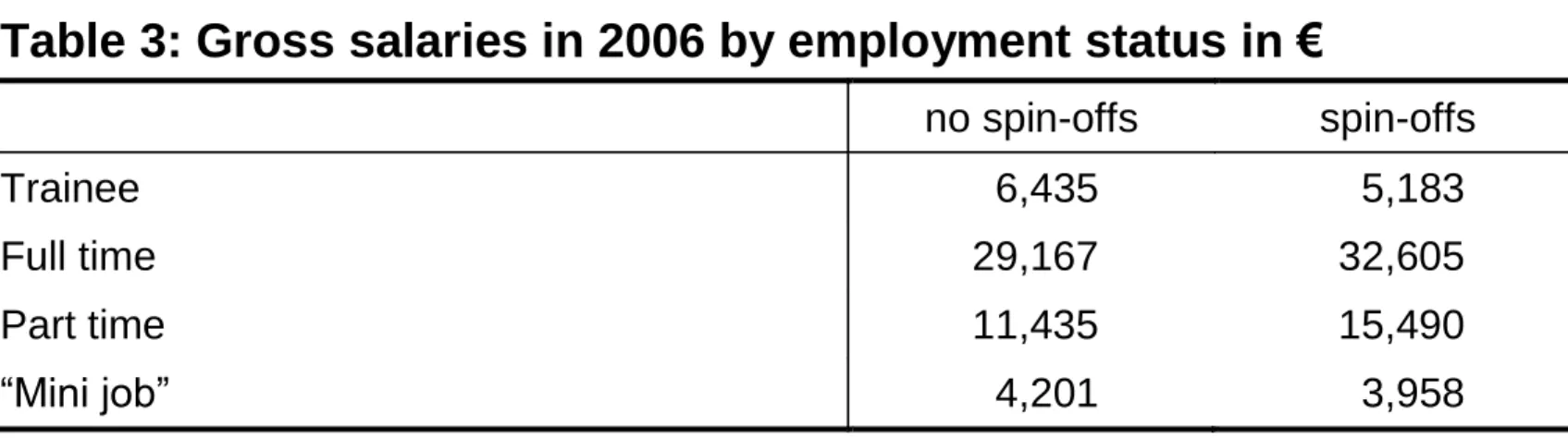
Table 3: Gross salaries in 2006 by employment status in € no spin-offs spin-offs Trainee 6,435 5,183 Full time 29,167 32,605 Part time 11,435 15,490 “Mini job” 4,201 3,958
Source: Employment statistic.
Table 4: Gross salaries in 2006 by level of education in € (full time employees only)
no spin-offs spin-offs
No degree 24,999 26,780
Vocational training 27,408 27,809
University degree 38,126 43,654
Econometric approach
Unit of analysis: person-year, calculated by aggregating allemployment spells of an employee in the start-up examined in year t
Endogenous variable: mean daily wages employee i earned in year t
Estimation method: random-effects GLS regression pooled OLS regressionVector of exogenous variables (I)
Employee data
Age, age squared
Gender (1 = male)
Citizenship (1 = German, 0 = foreigner)
Level of education (no degree, vocational training, university degree)
Long-term unemployment before entering the start-up (1/0)
Employment status (full time, part time, trainee, “mini job”)
Job tenure (in days)Vector of exogenous variables (II)
Employer data
Transfer spin-off, competence spin-off
Interaction terms between spin-off categories and level of education
Firm size (in person-days)
Team foundation (1/0)
Firm age (in years)
R&D activities (none, occasionally, continuously)
Share of employees with university degree (in person-days)
Share of trainees in workforce (in person-days)
Entrepreneur with university degree (1/0)
Entrepreneur with industry experience in the sector of start-up (1/0)
Start-up from Eastern Germany (1/0)
Sector (cutting-edge manufacturing, high-tech manufacturing, software, technology-oriented services)Table 5: Estimation results of random effects GLS regression Coefficient Robust stand. error Age 0.508 0.003 *** Age squared -0.001 0.000 *** Gender (1 = male) -0.269 0.012 ***
Citizenship (1 = German, 0 = Foreigner) -0.015 0.017
Level of education
University degree 0.102 0.017 ***
Vocational training 0.049 0.015 ***
Reference: no degree
Former long-term unemployment -0.265 0.025 ***
Employment status
“Mini job” -1.758 0.187 ***
Part time -0.670 0.044 ***
Trainee -0.974 0.034 ***
Reference: Full time
Job tenure 0.028 0.003 ***
Occupation in start-up (21 occupational
categories) included
Continued from Table 5. Coefficient Robust stand. error Transfer spin-off 0.098 0.043 ** Competence spin-off -0.039 0.051 Interaction terms
Transfer s-o * vocational training -0.088 0.050 *
Transfer s-o * university degree -0.015 0.052
Competence s-o * vocational training 0.042 0.059
Competence s-o * university degree -0.004 0.070
Firm size (in person-days) 0.045 0.004 ***
Team foundation (1/0) 0.046 0.010 ***
Firm age (in years) 0.005 0.002 **
R&D activities
Continuously 0.058 0.012 ***
Occasionally 0.037 0.011 ***
Reference: no R&D activities
Share of employees with university degree 0.180 0.019 ***
Share of trainees in workforce -0.132 0.041 ***
Entrepreneur with university degree (1/0) 0.132 0.012 ***
Entrepreneur with industry experience (1/0) 0.063 0.012 ***
Start-up from Eastern Germany -0.249 0.011 ***
Sector
High-tech manufacturing 0.090 0.012 ***
Software 0.052 0.019 ***
Technology-oriented services 0.032 0.015 **
Reference. Cutting-edge manufacturing
Integer 2.746 0.069 ***
u 0.440
e 0.236
Number of observations 29,456
Number of groups (employees) 11,861
R² within 0.435
between 0.808
Table 6: Average marginal effects of spin-off variables on daily wages
Marginal
effect Stand. error
Transfer spin-offs 0.044 0.019 ** Competence spin-offs -0.016 0.022 Transfer spin-offs No degree 0.098 0.043 ** Vocational training 0.010 0.027 University degree 0.083 0.027 *** Competence spin-offs No degree -0.039 0.051 Vocational training 0.003 0.029 University degree -0.043 0.046