The K4D helpdesk service provides brief summaries of current research, evidence, and lessons learned. Helpdesk reports are not rigorous or systematic reviews; they are intended to provide an introduction to the most important evidence related to a research question. They draw on a rapid desk-based review of published literature and consultation with subject specialists.
Helpdesk reports are commissioned by the UK Department for International Development and other
Helpdesk Report
The Global Financial System and
Developing Countries
Hannah Timmis
Institute of Development Studies 27 April 2018
Question
What are the key issues with the global financial system for developing countries?
Contents
1. Overview 2. Key trends3. Challenges and risks for developing countries 4. References
1.
Overview
The global financial system has changed significantly since the 2007-08 financial crisis. Developing countries have seen a decline in their net financial flows due to the collapse of the international banking sector. This was further exacerbated by weak growth prospects in key emerging markets and low commodity prices from 2014-15. The decline was somewhat offset by higher non-resident portfolio inflows, which resulted from prolonged ultra-low interest rates in advanced economies and the ensuing “search or yield”. While countries in East and South Asia continue to be major recipients of global financial flows, they have also become major providers, particularly for other developing countries. Hence, South-South finance is a growing trend. Additionally, public financial flows, namely overseas development assistance and multilateral lending, have exhibited strong growth since 2007 further mitigating the decline in private flows.
Against this backdrop, the report identifies six key challenges facing developing countries.
Medium-term challenges
1. Monetary policy normalisation in rich countries. Ongoing monetary policy transition in rich economies represents a key risk for developing countries. As central banks raise short-term interest rates in response to higher growth and inflation, there is a risk that institutional investors will rebalance their portfolios resulting in a sharp reversal of flows to developing countries.
2. Debt sustainability. The collapse in cross-border bank lending that followed the financial crisis means that developing country borrowers have increasingly turned to international bond markets. This poses several challenges. Most bonds are denominated in foreign currencies, leaving borrowers exposed to exchange rate risk. The markets tend to be volatile and prone to destabilising sudden surges and exits. Finally, as weaker issuers have entered these markets, there are concerns that asset valuations do not reflect fundamentals.
3. Commodity price fluctuations. The collapse in international commodity prices in 2014-15 created winners and losers among developing countries with implications for financial flows. Net commodity exporters have seen reduced consumption, investment and external positions, which has exacerbated fiscal vulnerabilities and complicated macroeconomic policy.
Long-term challenges
4. Non-traditional financial services. As the international banking sector has strengthened following implementation of the Basel III Accord, there are concerns that risk is shifting to non-traditional financial services. In particular, shadow banking and financial technology (“fintech”) services have grown dramatically in developing countries in recent years. While these services offer opportunities in terms of financial development and financial inclusion, they also introduce new vulnerabilities.
5. South-South finance. While increased South–South connectivity has many theoretical benefits, it also poses challenges going forward. Since financial institutions in the South tend to be less tightly regulated than those in the North, the rise of the South as a provider of finance could increase risk within the global system.
6. Misaligned incentives. The most fundamental long-term challenge for developing countries is aligning incentives in the global financial system with sustainable development. This will involve shifting the focus away from short-term profit maximisation and towards long-term value creation. However, there is no obvious policy solution for this problem.
2.
Key trends
Global financial flows
Private flows
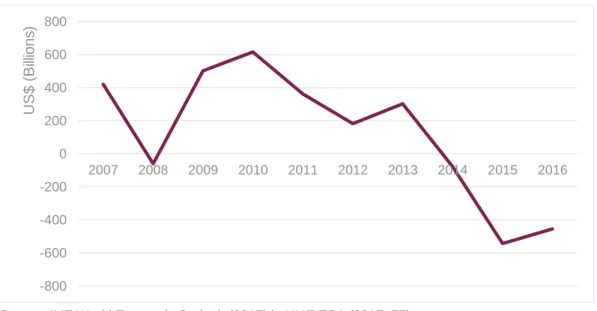
Net private finance to developing countries has declined since the financial crisis.1 While net private flows to developing countries initially rebounded in 2008, they peaked at $615 billion in 2010 and slowed thereafter, turning negative from 2014 to 2016 (Figure 1). Such a prolonged reversal in the direction of global finance has not been seen since 1990 and was driven by weaker growth prospects in key emerging markets such as China, Russia and Brazil, low commodity prices and expectations of monetary tightening in advanced economies (UN/DESA, 2017: 76). The year 2017 saw some alleviation in these conditions and a recovery in developing country inflows, according to the latest projections from the Institute of International Finance (IIF). Net financial inflows are estimated to have been $770 billion for 25 large emerging economies due to the somewhat improved global macroeconomic outlook (UN/DESA, 2018: 38).
Figure 1: Net private financial flows to developing countries, 2007-16
Source: IMF World Economic Outlook (2017) in UN/DESA (2017: 77)
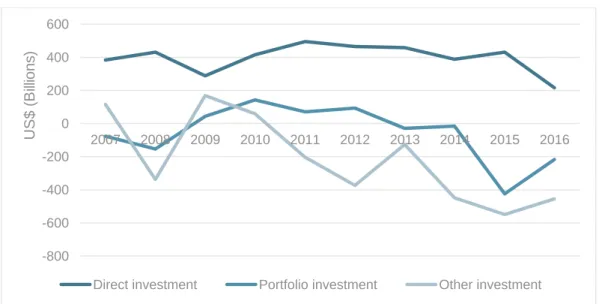
The composition of private flows to developing countries has shifted away from cross-border bank finance and towards portfolio flows, particularly debt flows. Private financial flows have three main components: foreign direct investment (FDI), portfolio flows and other investment, which is primarily cross-border bank lending. Net FDI to developing countries has remained relatively stable since 2007 (Figure 2). However, bank finance (captured by “other investment”) has declined steeply and was the main contributor to the overall slump in private flows to developing countries. International banks, particularly in Europe, reduced their cross-border lending significantly after the financial crisis due to deleveraging pressures (IBRD/ World Bank, 2018: 7). By contrast, net portfolio flows to developing countries increased between 2008 and 2014 in response to the
1 “Developing countries” refers to all developing economies and economies in transition in the UN’s country
classification, unless otherwise stated. Regional country groupings reference in the report are also based on the UN classification. -800 -600 -400 -200 0 200 400 600 800 2007 2008 2009 2010 2011 2012 2013 2014 2015 2016 U S $ ( B ill io n s )
unconventional monetary policies adopted by rich countries. Ultra-low interest rates and extensive asset purchasing programmes (quantitative easing) depressed yields in advanced economies prompting investors to adjust their portfolios to include more “high-risk high-yield” assets, particularly emerging market bonds (UN/DESA, 2017: 89). Following a dip in 2015-16, portfolio inflows to developing countries rebounded strongly last year as loose monetary policies in rich countries persisted and growth projections in key emerging economies improved (UN/DESA, 2017: 41).2 Thus, the post-crisis period has been characterised by a change in the external debt composition of developing countries, with bond markets replacing bank loans as a key source of finance (IBRD/ World Bank, 2018: 16).
Figure 2: Net private financial flows to developing countries by type, 2007-16
Source: IMF World Economic Outlook (2017) Retrieved: UN/DESA (2017: 77)
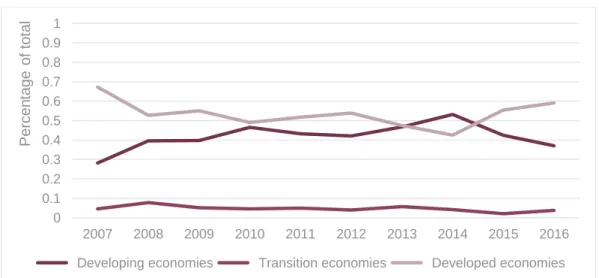
The major recipients of international private finance have changed little. Data on gross financial inflows by geography is only readily available for FDI. The proportion of global FDI channelled to developing countries (excluding transition economies) grew moderately between 2007 and 2016, increasing by 9 percentage points (Figure 3). This trend was driven by East and South Asia, which continued to rival Europe as the largest destination for global FDI inflows and increased its share over the period (Figure 4). FDI inflows to Latin America were approximately one-third of those to East and South Asia and declined slightly in recent years due to lower commodity prices and weak economic activity in the largest economies (UN/DESA, 2018: 42). Africa remained the least popular destination for FDI, consistently attracting less than 5.5 percent of global inflows.
2 The steep decline in net portfolio flows to developing countries in 2015-16 was driven by record high capital
outflows from China. The outflows were caused by China’s weakening growth prospects and an expected interest rate rise in the US (Reuters, 2015). In fact, the overall trend in net private financial flows to developing countries depicted in Figure 2 is driven by dynamics in East and South Asia, which is both the largest recipient and provider of finance among developing regions. Other regions experienced positive net financial flows in 2016 (UN/DESA, 2017: 78). -800 -600 -400 -200 0 200 400 600 2007 2008 2009 2010 2011 2012 2013 2014 2015 2016 U S $ ( B ill io n s )
Figure 3: Gross FDI inflows to developing, transition and developed economies, 2007-16
Source: UNCTAD (2018)
Figure 4: Gross FDI inflows by region, 2007-16
Source: UNCTAD (2018)
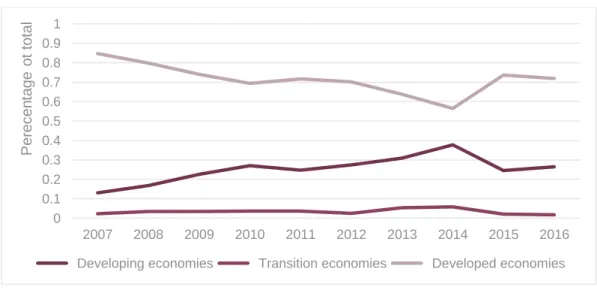
By contrast, the major providers of international private finance have shifted as South-South finance has increased. While the distribution of global FDI inflows has remained relatively unchanged, the distribution of outflows has shifted dramatically. Developing countries (excluding transition economies) contributed just 13 percent of FDI in 2007 (Figure 5). This figure more than doubled in the decade following the financial crisis, peaking at 40 percent in 2014. East and South Asia drove this trend due to a surge in outward investment from China, which became the second largest source of FDI in 2016 after the US (UNCTAD, 2017: 14) (Figure 6). Hong Kong, South Korea, Singapore and Taiwan were also among the top 20 providers of FDI in 2016 (UNCTAD, 2017: 14). Much of this developing country investment is directed towards South-South ventures, such as China’s One Belt One Road initiative (UNCTAD, 2017: 89). In particular, developing economies are an increasingly important source of capital for least developed countries (LDCs), which have traditionally been excluded from global financial markets:
In recent years, an upswing has been recorded in investment to LDCs from other developing economies, including China, South Africa and Turkey… In 2015 (the latest year for which complete data were available), multinational enterprises from developing
0 0.1 0.2 0.3 0.4 0.5 0.6 0.7 0.8 0.9 1 2007 2008 2009 2010 2011 2012 2013 2014 2015 2016 P e rce n ta g e o f to ta l
Developing economies Transition economies Developed economies
0 0.1 0.2 0.3 0.4 0.5 2007 2008 2009 2010 2011 2012 2013 2014 2015 2016 P e rce n ta g e o f to ta l
Africa Latin America North America Europe
economies, especially from Asia (including, in addition to the traditional top ones, Thailand) and from countries in transition (especially the Russian Federation) accounted for the bulk of the inward FDI stock in LDCs. In terms of stock, China has widened its lead as the number one investor in these countries (UNCTAD, 2017: 89).
The rise of the South-South FDI is part of a broader trend involving different types of cross-border finance. In an unpublished paper, Broner and others (2017) use bilateral data on international investments to show that the South has captured an increasingly sizable share of global portfolio and bank lending flows, as well as FDI (IBRD/ World Bank, 2018: 93). Between 2001 and 2012-14 the share of South-South flows increased from 8 to 12 percent for FDI, 0.9 to 3.3 percent for portfolio investment and 5 to 8 percent for cross-border bank claims (IBRD/ World Bank, 2018: 87-93).
Figure 5: Gross FDI outflows from developing, transition and developed economies, 2007-16
Source: UNCTAD (2018)
Figure 6: Gross FDI outflows by region, 2007-16
Source: UNCTAD (2018)
Public flows
International public finance to developing countries has grown since the financial crisis, continuing a long-term trend that began with the adoption of the Millennium Declaration in 2000. There are
0 0.1 0.2 0.3 0.4 0.5 0.6 0.7 0.8 0.9 1 2007 2008 2009 2010 2011 2012 2013 2014 2015 2016 P e re ce n ta g e o t to ta l
Developing economies Transition economies Developed economies
0 0.1 0.2 0.3 0.4 0.5 0.6 0.7 2007 2008 2009 2010 2011 2012 2013 2014 2015 2016 P e rce n ta g e o f to ta l
Africa Latin America North America Europe
two main types of international public finance: overseas development assistance (ODA) and lending by multilateral development banks (MDBs). Total ODA disbursements have increased by 51 percent in real terms since 2007, reaching $177.6 billion in 2017 (OECD, 2018). While the large majority of this aid is provided by members of the OECD Development Assistance Committee (DAC), ODA disbursements by non-DAC reporting countries nearly doubled during the period, reaching $15.2 billion (OECD, 2018). The OECD estimates that non-DAC, non-reporting countries disburse a further $6.9 billion annually, suggesting that South-South development cooperation surpassed $20 billion in 2017 (OECD, 2018). Annual disbursements of non-grant subsidised finance by seven key MDBs reached $65.8 billion in 2016, a real increase of 73 percent since 2007 (UN/DESA, 2018: 46). MDBs’ commitments in 2016 were significantly higher at $84.9 billion, suggesting that a further increase in disbursements is likely in 2017 (UN/DESA, 2018: 46). However, international public flows remain insufficient to fill the financing gap for public investment in developing countries, particularly LDCs. UN/DESA (2018: 45) highlights three concerns about the sufficiency of ODA flows. First, as a share of gross national income of donor countries, ODA is 0.32 percent, significantly below the UN target of 0.7 percent. Second, the share of ODA received by LDCs has fallen since the financial crisis from 30 to 24 percent. This is a problem because LDCs rely on ODA (which makes up two thirds of their external finance on average) to fund public expenditure. Despite a commitment to halt the decline in the 2015 Addis Ababa Action Agenda (AAAA), the share of aid to LDCs fell year-on-year in 2016. Finally, much of the increase in ODA disbursements in recent years was driven by higher expenditure on in-donor refugees and humanitarian aid, rather than long-term development programming. Regarding MDBs, the AAAA placed significant emphasis on their role in funding the 2030 Agenda/ Sustainable Development Goals (SDGs). However, the Center for Global Development’s High Level Panel on the Future of Multilateral Banking highlighted a number of concerns about the adequacy of MDB finance:
[MDBs’] portfolio of cross-border loans is tiny in relation to needs, particularly for regional infrastructure where there is greater complexity in negotiating an allocation of debt service among borrowers. And they rarely exploit the full range of instruments they have—grants, equity, guarantees, and policy leverage—to crowd in sustainable private investment, [but] rely predominantly on lending to sovereigns. (Birdsall & Morris, 2016: 3)
Moreover, most MDBs are leveraged at close to their operational limits, meaning their capacity to increase lending is constrained (UN/DESA, 2017: 94).
Global financial architecture
Efforts to reform the global financial architecture have centred on strengthening the banking sector (UN/DESA, 2018: 79). International standards for baking regulation are established by the Basel Committee on Banking Supervision (BCBS), with guidance from the Financial Stability Board (FSB) (UN, 2017: 9).3 BCSB’s response to the financial crisis was to agree a new framework for banking regulation in 2010-11, Basel III. Key elements of the Basel III framework include strengthened minimum capital requirements, the introduction of liquidity requirements and improved risk management standards (UN/DESA, 2018: 79; Danielsson, 2013: 348). Additionally, the framework
3 The BCBS is a committee of banking supervisory authorities that was established by the central bank governors
of the G-10 countries in the late 1960s. The Financial Stability Board is an international body established by the G20 summit in 2009 with a mandate to monitor the global financial system and work with standard setting bodies to design and implement reform (Danielsson, 2013).
aims to address the “too-big-to-fail” problem by requiring jurisdictions to establish viable resolution frameworks for global systemically important banks (G-SIBs). Most national jurisdictions have now adopted the core Basel III elements (UN, 2017: 9). Consequently, capital ratios and liquidity indicators in G-SIBs and other banks have risen considerably and most economists agree that their balance sheets are much improved (UN/DESA, 2018: 79). However, progress has been slower in implementing policies designed to solve “too-big-to-fail”, undermining supervisors’ ability to wind-up failing large banks rather than bail them out (UN, 2017: 9).
Other important changes to the global financial architecture include the expansion of safety nets, regulation of derivatives trading and reform of credit rating agencies. An agreed international approach to sovereign debt distress remains a gap. The international financial safety net is a network of institutions that provide liquidity to countries in times of financial stress. It comprises multilateral lending facilities operated by the IMF at a global level, along with regional facilities and bilateral lines of credit. The safety net has grown significantly since 2007. The three largest regional facilities (the Chiang Mai Initiative Multilateralization for ASEAN+3 countries, the North American Framework Agreement and the European Stability Mechanism) were valued at $1.22 trillion in 2015, while the volume of IMF resources was expanded in January 2016 (UN, 2017: 5-6). Other important reforms agreed by the FSB relate to the previously unregulated derivatives trade, which dramatically increased leverage in the financial system before 2007. These include trade reporting requirements, central clearing and platform trading arrangements and new margin rules for non-centrally cleared derivatives (UN, 2017: 10). Finally, the FSB set out a roadmap to reduce mechanistic reliance on credit rating agencies in 2012. The purpose of the roadmap was to reduce the agencies’ disproportional influence on financial flows and it has largely been successful in this regard (UN, 2017: 13). One area in which there has been insufficient international cooperation, however, is responding to debt distress. While the importance of providing “breathing space” to a sovereign entering debt distress has been highlighted in the international policy debate, progress in developing global consensus on guidelines for debtor and creditor responsibilities has been limited (UN, 2017: 8).
Reform of international public financial institutions has focused on increasing collaboration with the private sector to mobilise funding for the SDGs. More recently, some MDBs have also called for capital increases. In 2016, the World Bank Group conducted a “forward look” exercise in order to identify which changes to its current practice were required to best support the 2030 agenda. A key outcome of this exercise was the “Cascade” approach to targeting resources. Under this approach, the World Bank Group will seek to mobilize commercial finance wherever possible during its programming. Only where market solutions are not possible will official and public resources be applied (UN, 2017: 13). Other MDBs are also working together to engage the private sector in their projects. In 2016, nine MDBs produced a set of principles for crowding-in commercial finance for sustainable development with the aim of increasing overall private sector mobilization by 25-35 percent within three years (UN, 2017: 14). However, some MDBs have argued that progress on the 2030 Agenda will require significant capital increases. The World Bank Group, which last had a capital increase in 2010, has warned that the International Bank for Reconstruction and Development and the International Finance Corporation will have to shrink their operations unless an increase is agreed. The African Development Bank has also called for more capital (UN, 2017: 14).
3.
Challenges and risks for developing countries
Medium-term
Monetary policy normalisation in rich countries
Ongoing monetary policy transition in the US and the expectation of similar adjustment in other major economies represent a key risk for developing countries. As central banks raise short-term interest rates and shrink their balance sheets, there is a risk that institutional investors will rebalance their portfolios, pushing up risk and term premia and lowering the value of risky assets (IMF, 2018: 5). This could lead to rising financing costs and sharp reversals of portfolio flows in developing countries, particularly the most vulnerable ones. As discussed in Section 2, portfolio flows have become an increasingly important source of external finance for the Global South following the collapse in cross-border bank lending after the financial crisis. Their withdrawal could lead to significant financial instability, including currency depreciation and increased balance sheet fragilities, which usually accompany large capital outflows (UN/DESA, 2018: 70). Moreover, a change in investors’ expectations of future monetary policy, triggered for example by increased uncertainty about inflation, could also lead to heighted volatility in portfolio flows with the same result (UN/DESA, 2018: 40).
However, the likelihood of monetary policy normalisation triggering financial turmoil has declined somewhat, according to analysis by the IMF (IMF, 2018: 5-8). Financial markets have adjusted relatively smoothly to monetary tightening thus far, attributable to central banks’ gradual pace of change and clear communications, which have prevented sudden portfolio adjustments. Additionally, the majority of large emerging economies are better placed to manage tighter international funding conditions. They have greater exchange rate flexibility, higher levels of international reserves and, in some cases, improved macroeconomic management than before the crisis (UN/DESA: 79). Nevertheless, the IMF recommends that developing countries adopt the following mitigating measures to build resilience and reduce the likelihood of outflows during monetary policy normalisation (IMF, 2018: 29-30):
• Maintain sound macroeconomic, structural, financial and macroprudential policies, taking into account the country’s individual cyclical position, balance sheet vulnerabilities and policy space.
• Build appropriate buffers that can be used during stress. In particular, increase international reserves to support exchange rate regimes during periods of outflow pressure or take steps toward making the exchange rate regime more flexible where appropriate.
• Monitor firms’ foreign exchange exposures and ensure their capacity to absorb exchange rate risks.
• If external financial conditions deteriorate sharply, implement an appropriate macroeconomic and financial policy response to combat outflow pressures before considering capital controls. Capital controls should only be implemented in crisis situations or when a crisis is considered imminent, and should be transparent, temporary, and non-discriminatory and should be lifted once crisis conditions abate.
Debt sustainability
Facilitated by large search-for-yield flows, developing country borrowers have increasingly been able to access international financial markets, particularly bond markets (see Section 2). Cumulative bond issuance increased from 4.3 percent of GDP in the six pre-crisis years to 6.7 percent of GDP in the six post-crisis years for the median developing country. At the same time, bond-fund allocations from developed markets to developing countries almost quadrupled between 2009 and 2015, reaching $385 billion (Feyen, 2015). The changing composition of external debt in developing countries poses several challenges.
First, most sovereign and corporate bonds are denominated in foreign currencies, leaving borrowers exposed to exchange rate risk (UN/DESA, 2018: 33). For example, if a country has significant levels of dollar-denominated debt, a real appreciation in the dollar (perhaps resulting from further monetary policy normalisation in the US) would raise the cost of servicing and repaying that debt.
Second, portfolio debt flows have shorter maturities and tend to be more volatile than cross-border bank lending, leading to interest rate and rollover risk (UN/DESA, 2017: 102). The increase in portfolio lending to developing countries has coincided with a rise in their stock of short-term debt. The share of short-term debt in countries’ total external debt rose from 25 percent in 2007 to 33 percent in 2014 (UN/DESA, 2017: 102). At the same time, analysis of high frequency data on capital flows in selected developing countries since 2005 has shown that portfolio flows are particularly vulnerable to periodic episodes of high volatility (UN, 2017: 2). Borrowing short to finance ventures in which the return is often realised in the long-term is risky, particularly when the credit flow is unpredictable (Danielsson, 2013). A sudden withdrawal of credit (perhaps due to a risk aversion episode) means borrowers cannot rollover their debt by borrowing more. This can lead to liquidity problems if they are also unable to monetise their assets to repay what they owe. Finally, there are concerns that portfolio investors, while seeking higher yields, have extended too much credit to risky, unproductive ventures (IMF, 2018: xii). In particular, there has been a significant rise in lending to corporations in emerging economies, including China, which does not appear to be based on fundamentals. Corporate debt in these countries rose from $7.6 trillion in 2008 to $24.5 trillion in the first quarter of 2016 (UN/DESA, 2017: 89). Much of this was channelled to sectors with an ambiguous impact on long-term productivity and growth, such as real estate companies. If corporate profitability deteriorates in conjunction with the accumulation of debt, balance sheets become increasingly fragile. Indeed, there has been a rise in default rates among firms in some emerging markets, notably in Latin America, due to these dynamics (UN/DESA, 2017: 33). Balance sheet fragility could result in a disorderly deleveraging process with adverse spillovers on banks and real private sector activity.
The likelihood of developing country debt becoming unsustainable is increasing. The IMF’s Global Financial Stability Report (2018: 28) finds:
Gross issuance of foreign currency corporate and sovereign debt securities rose to new highs in 2017, allowing even weaker issuers to access markets. The share of non-investment-grade issuance has risen to more than 40 percent, boosted by the return to bond markets of issuers such as Egypt and smaller issuers in Sub-Saharan Africa. Furthermore, exposure to less committed, potentially “flighty,” investors is growing, which makes countries susceptible to a reversal in capital flows… and rollover risks.
To ensure a sustainable debt burden, the IMF (2018: 32) recommends that policymakers in developing countries reduce vulnerabilities related to the structure of their debt and attract a stable investor base. Developing local bond markets is one mechanism by which to do this, since domestic portfolio investors tend to exhibit less volatile behaviour than foreign ones (UN/DESA, 2017: 84). However, creditors must also play a role. Official creditors should emphasise timely resolution of external debt distress cases to avoid potential spillovers and minimise costs for both the issuer and creditors. This may require facilitating institutional coordination when the set of lenders is diverse. New official creditors should consider adopting sustainable lending rules, such as those endorsed by the G20 (IMF, 2018: 32).
Commodity price fluctuations
International commodity price movements pose a risk to financial stability in many developing countries. In late 2014 and in 2015, most commodity prices dropped sharply form the high levels reached in the boom period of 2011 to 2013. The year 2016 saw some recovery in certain sectors, but this upward trend largely came to a halt in 2017 and commodity prices remain significantly lower than at the peak of the last commodity boom (UN/DESA, 2018: 34-5). The decline has created winners and losers among developing countries with implications for financial flows. Net commodity importers have seen increased consumption, investment and external positions, while the opposite holds true for net exporters (Feyen, 2015). This has complicated macroeconomic policy in the latter group of countries. Many commodity exporters have introduced pro-cyclical interest rate rises to stem capital outflows and mitigate currency depreciation, at the expense of higher borrowing costs that weigh on domestic activity (UN/DESA: 2017: 34). A renewed downturn in commodity prices could exacerbate vulnerabilities in these countries, restrict their policy space further and ultimately impact their capacity for stable growth (UN/DESA, 2018: 71-4).
Commodity prices are likely to remain low and volatile in the medium-term, according to analysis by UN/DESA (2018: 34-5). The key policy implication for countries that remain heavily dependent on a few basic commodities is to pursue economic diversification (UN/DESA, 2018: 74). Expanding less volatile sectors of the economy should also be accompanied by fiscal reforms to restructure and broaden the revenue base in order to reduce fiscal dependency on short-term commodity revenue. The planned introduction of a 5 percent value-added tax in the Cooperation Council for the Arab States of the Gulf (GCC) countries is a recent example of such fiscal reforms. The tax was implemented in Saudi Arabia and the United Arab Emirates in January 2018 and will be rolled out to other GCC states in order to reduce their fiscal dependency on oil revenue (UN/DESA, 2018: 128).
Long-term
Non-traditional financial services
Economists largely agree that the international banking sector has strengthened since the financial crisis due to widespread implementation of the Basel III framework (see Section 2). However, there are concerns that financial stability risk has now shifted from the banking sector to non-traditional financial institutions, which typically face fewer regulations. Two types of non-traditional finance have received particular attention in the context of developing countries: shadow banking and fintech.
Shadow banking is a loose term that generally refers to bank-like institutions and practices that exist outside the regulated banking sector (Danielsson, 2013: 332). There are many ways to provide financing outside of traditional banking channels. Structured finance and securitisation, for example, raise financing indirectly through the capital markets using special purpose entities such as asset-backed commercial paper conduits and structured investment vehicles (Schwarcz, 2016: 2). Shadow banking has grown rapidly in several emerging economies in recent years. According to some estimates, it represents up to 35-40 percent of the financial sector in some East Asian countries (UN/DESA, 2018: 79). In China, the shadow banking sector is estimated to be worth RMB 75 trillion (90 percent of GDP) and to have played a critical role in the country’s historic credit boom (IMF, 2018: 32). While the types of risk that shadow banking institutions face are similar to those faced by traditional banks, the level of risk they can take on is greater because they are subject to less regulatory oversight. The FSB estimates that the growth of shadow banking has been accompanied by a relatively high degree of credit risk, as well as liquidity and maturity transformation and, in some countries, relatively high levels of leverage (UN, 2017: 10). To the extent that domestic and foreign firms, both financial and non-financial, are exposed to the shadow-banking sector, this heightened risk has the potential to spill over into traditional shadow-banking and the real economy.
Fintech refers to technology-driven new companies that provide financial services outside the traditional financial sector (IBRD/ World Bank, 2018: 17). These services include, inter alia, alternative online lending platforms (so called peer-to-peer platforms), digital payment and transfer services and mobile banking. Global investment in fintech companies has expanded rapidly worldwide and there were at least 4000 active fintech firms in 2015 (IBRD/ World Bank, 2018: 17). Fintech has received considerable interest from developing country policymakers since it holds the promise of increasing access to finance for market segments that have traditionally been underserved, particularly low-income individuals and small and medium-sized enterprises. Despite this potential, fintech also brings new vulnerabilities to the financial sector. Providers tend to have fewer safety nets in their business models. For example, peer-to-peer online lending platforms, which match borrowers and investors for a fee, do not hold the loans originated in their balance sheets. Therefore, although they do not bear the default risk, the profitability of their businesses is highly dependent on the number of loans they intermediate and may evaporate during an economic downturn, whereas banks covered by implicit and explicit deposit insurance schemes are better equipped to cope (IBRD/ World Bank, 2018: 114-5). Other risks associated with fintech include misuse of personal data, discriminatory customer profiling systems, electronic fraud and the potential of new technology to support illegal activities such as illicit transfers (IBRD/ World Bank, 2018: 18).
South-South finance
Southern economies have increased their role as providers of finance since the financial crisis (see Section 2). This trend has various theoretical benefits. First, South–South connectivity is likely to promote Southern economies’ financial development through increased funding source diversification, improved access to a wider range of investment projects, technology spillovers and more competition (IBRD/ World Bank, 2018: 96). Second, it may enhance financial inclusion at the country, firm and individual level. There is evidence that South-South FDI is frequently channelled to LDCs, which have traditionally been excluded from Northern financial markets (see Section 2). Equally, South-South banking may improve access to financial services for SMEs and households in developing countries:
Relative to an [international] bank from the North, Southern [international] banks invest in countries within their region and tend to be more familiar with the cultural, linguistic, legal, and institutional environment of the host country and may be better at collecting and processing soft information that allows them to overcome the common challenges that foreign banks face when lending downmarket to smaller and more informationally opaque segments, especially SMEs and households. (IBRD/ World Bank, 2018: 14-5)
However, South-South finance also poses new challenges in the longer term, particularly in the banking sector. Increasing regionalisation of banking in the South may limit risk-sharing, which would increase developing countries’ exposure to regional shocks and cause foreign shocks to spread more quickly through a region (IBRD/World Bank, 2018: 96). Moreover, since financial institutions in the South tend to be less tightly regulated than those in the North, the rise of the South as a provider of cross-border lending could negatively affect the stability of the overall financial system. For example, research has found that foreign banks based in countries with relatively lax regulatory requirements can amplify credit booms in borrower countries with destabilising effects, since policymakers in the latter have little power to regulate their activities (IBRD/World Bank, 2018: 15). Regarding South-South FDI, there are concerns about the quality of this investment and thus its developmental impact. In particular, FDI to LDCs remains highly concentrated in extractive industries and the number of greenfield projects has fallen in recent years (UN/DESA, 2017: 79).
Misaligned incentives
Closing the investment gap to meet the SDGs by 2030 requires the mobilisation of significant financial resources. The AAAA recognises that the global financial system is critical for achieving this. However, the system currently does not allocate enough resources towards long-term sustainable development, with significant gaps in areas such as infrastructure, healthcare, education and renewable energies (UN/DESA, 2018: 80). Therefore, aligning the international financial system’s incentives towards long-term investments that are consistent with sustainable development is a key issue moving forward. This will require a fundamental shift away from the current focus on short-term profits, which is reflected in volatile financial flows and reinforced by numerous practices such as quarterly financial reporting by firms, monthly benchmarks for performance and mark-to-market accounting (UN/DESA, 2018: 80). Achieving such a shift is extremely challenging with no obvious policy solution.
The ongoing reforms of the global financial architecture represent a significant opportunity to adjust incentives within the system. One promising effort is the Task Force on Climate-related Financial Disclosures, which was set up in April 2015 under the FSB with the objective of promoting environmental sustainability through financial governance. However, efforts to integrate sustainable development into the reform agenda are still in their infancy (UN, 2017: 11). Moreover, data and evidence on the impacts of financial regulatory reform on developing countries is lacking (UN, 2017: 11).
4.
References
Birdsall, N. & Morris, S. (2016). Multilateral Development Banking for this Century's Development Challenges: Five Recommendations to Shareholders of the Old and New Multilateral
https://www.cgdev.org/publication/multilateral-development-banking-for-this-centurys-development-challenges?callout=1-1
Danielsson, J. (2013). Global Financial Systems: Stability and Risk. Harlow: Pearson Education Limited.
Feyen, E. (2015, May 27). Six Financial Sector Challenges for Emerging and Developing Economies. World Bank Blog. http://blogs.worldbank.org/psd/six-financial-sector-challenges-emerging-and-developing-economies#comments
International Bank for Reconstruction and Development/ World Bank (IBRD/ World Bank). (2018) Global Financial Development Report 2017/2018: Bankers without Borders. Washington DC: World Bank Group.
https://openknowledge.worldbank.org/bitstream/handle/10986/28482/9781464811487.pdf
International Monetary Fund (IMF). (2018). Global Financial Stability Report April 2018: A Bumpy Road Ahead. http://www.imf.org/en/Publications/GFSR/Issues/2018/04/02/Global-Financial-Stability-Report-April-2018
International Monetary Fund. (2017). World Economic Outlook database.
Organisation for Economic Co-operation and Development (OECD). (2018). Development finance data database.
http://www.oecd.org/dac/financing-sustainable-development/development-finance-data/
Reuters Staff. (2015, December 12). China capital outflows to top $500 billion in 2015: IIF. Thomson Reuters. https://www.reuters.com/article/us-china-flows-iif/china-capital-outflows-to-top-500-billion-in-2015-iif-idUSKBN0TV0R620151212
Schwarz, S. (2012). Regulating Shadow Banking. Review of Banking and Financial Law (31: 619-41).
https://scholarship.law.duke.edu/cgi/viewcontent.cgi?article=3121&context=faculty_scholarship
United Nations (UN). (2017). Report of the Secretary General on “International financial system and development” (A/72/150). New York: United Nations.
http://www.un.org/ga/search/view_doc.asp?symbol=A/72/306
United Nations Conference on Trade and Development (UNCTAD). (2018). FDI Statistics database. http://unctad.org/en/Pages/DIAE/FDI%20Statistics/FDI-Statistics.aspx
United Nations Conference on Trade and Development (UNCTAD). (2017). World Investment Report 2017: Investment and the Digital Economy. Geneva: United Nations.
http://unctad.org/en/PublicationsLibrary/wir2017_en.pdf
United Nations Department of Economic and Social Affairs (UN/DESA). (2018). World Economic Situation and Prospects 2018. New York: United Nations.
United Nations Department of Economic and Social Affairs (UN/DESA). (2017). World Economic Situation and Prospects 2017. New York: United Nations.
Suggested citation
Timmis, H. (2018). The global financial system and developing countries. K4D Helpdesk Report. Brighton, UK: Institute of Development Studies.
About this report
This report is based on five days of desk-based research. The K4D research helpdesk provides rapid syntheses of a selection of recent relevant literature and international expert thinking in response to specific questions relating to international development. For any enquiries, contact [email protected].
K4D services are provided by a consortium of leading organisations working in international development, led by the Institute of Development Studies (IDS), with Education Development Trust, Itad, University of Leeds Nuffield Centre for International Health and Development, Liverpool School of Tropical Medicine (LSTM), University of Birmingham International Development Department (IDD) and the University of Manchester Humanitarian and Conflict Response Institute (HCRI).
This report was prepared for the UK Government’s Department for International
Development (DFID) and its partners in support of pro-poor programmes. It is licensed for non-commercial purposes only. K4D cannot be held responsible for errors or any
consequences arising from the use of information contained in this report. Any views and opinions expressed do not necessarily reflect those of DFID, K4D or any other contributing organisation. © DFID - Crown copyright 2018.