TEENS IN TRANSITION: EVALUATING A YOUTH VIOLENCE INTERVENTION PROGRAM
A THESIS IN
Criminal Justice and Criminology Presented to the Faculty of the University of Missouri-Kansas City in partial fulfillment of
the requirements for the degree MASTER OF SCIENCE
by
OLIVIA ROSE ALLEN
B.A., University of Missouri-Kansas City, 2014 Kansas City, Missouri
© 2016
OLIVIA ROSE ALLEN ALL RIGHTS RESERVED
iii
TEENS IN TRANSITION: EVALUATING A YOUTH VIOLENCE INTERVENTION PROGRAM
Olivia Rose Allen, Candidate for the Master of Science Degree University of Missouri-Kansas City, 2016
ABSTRACT
In the summer of 2015, the Teens in Transition program was implemented. It was a summer jobs and life-skills program designed for 40 gang-affiliated youths identified as being high risk for violence through the local focused deterrence implementation. This research paper will provide a brief overview of the programs implementation and a short-term impact analysis. To assess implementation, 120 hours of observations were conducted and fieldnotes were collected. Using official police contact data, the analysis will assess whether youth who completed the program were less likely to engage in crime and delinquency while in the program compared to similar youth.
The results of the initial participant eligibility analysis indicate that more than half of those who participated in TNT were not on the original eligibility list for program selection. The results indicate that police involvement in the 65 months before the program, the
participants had less police contacts and arrests than the non-participants and those dismissed from the program. The analysis of police involvement during the program similarly indicates that TNT participants had less police contacts and arrests than the non-participants and the dismissed youth. Therefore, Teens in Transition seemingly decreased criminal involvement,
iv
as measured by police contact, in the participants for the duration of the program. This finding must be considered in the context of lower numbers of police contact for program participants in the time period before TNT began.
v
APPROVAL PAGE
The faculty listed below, appointed by the Dean of the College of Arts and Sciences have examined a thesis titled “Teens in Transition: Evaluating a Youth Violence Intervention Program,” presented by Olivia R. Allen, a candidate for the Master of Science degree, and certify that in their opinion is worthy of acceptance.
Supervisory Committee
Andrew M. Fox, Ph.D., Committee Chair Department of Criminal Justice and Criminology
Ken J. Novak, Ph.D.
Department of Criminal Justice and Criminology Lori Sexton, Ph.D.
vi
CONTENTS
ABSTRACT ... iii
LIST OF ILLUSTRATIONS ... viii
LIST OF TABLES ... ix
Chapter 1. INTRODUCTION ...1
2. REVIEW OF LITERATURE ...2
Youth Gangs and Violence ...2
Risk Factors for Gang Membership ...4
Prior Gang Prevention Programs ...6
Gang Prevention Models... 6
Gang Prevention Evaluation Literature ... 8
3. METHODOLOGY ...10
Program Participants and Design ...10
Measures ...10
Reliability and Validity ...12
Analytic Strategy ...13
4. FINDINGS ...14
Teens in Transition Program Description ...14
TNT Activities ...15
TNT Demographics ...18
TNT Eligibility ...19
vii
Police Involvement During TNT ...23
5. DISCUSSION ...27
Summary of Findings ... 27
Implications for the Literature and Importance ... 28
6. RECOMMENDATIONS FOR PRACTICE... 32
APPENDIX...35
REFERENCES ...37
viii
LIST OF ILLUSTRATIONS
Figure Page
1. Random Selection Plan vs. Actual Program Selection ...20
2. Mean Number of Police Contacts and Arrests Prior to TNT...23
3. Mean Number of Police Contacts and Arrests During TNT ...25
ix
TABLES
Table Page
1. TNT Activities ... 18
2. TNT Demographics ... 19
3. Random Selection Plan vs. Actual Program Selection ... 20
4. Mean Number of Police Contacts and Arrests Prior to TNT……….. 23
5. Mean Number of Police Contacts and Arrests During TNT ...24
1
CHAPTER 1 INTRODUCTION
Teens in Transition (TNT) is a summer jobs and life-skills program designed for gang-affiliated youth identified as being high risk for violence through a local focused deterrence initiative in Kansas City, Missouri. TNT was first implemented in the summer of 2014, and after some initial success (Fox et al., 2014), funds were dedicated to expand TNT in the summer of 2015. This evaluation will provide a brief overview of the program’s implementation and a short-term impact analysis. To assess implementation, 120 hours of observations were conducted and field notes were collected. Using official police contact data, the impact analysis will assess whether youth who completed the program were less likely to engage in crime and delinquency while in the program, compared to similar youth. Before giving an overview of the methods and findings of the evaluation, the literature of gangs, violence, and prevention will be covered.
2
CHAPTER 2
REVIEW OF LITERATURE Youth Gangs and Violence
In 2012, juveniles accounted for approximately 1 in 5 arrests for robbery, motor vehicle theft, and burglary combined, and approximately 1 in 14 arrests for murder
(Puzzanchera, 2014). Research on the age-crime curve has suggested that the prevalence of youth violence increases in early adolescence, peaks during the late teens, and decreases more slowly as individuals “age out” of crime. Additionally, the age-crime curve has demonstrated that boys who live in more disadvantaged neighborhoods during early adolescence are significantly different than boys of the same age who live in advantaged neighborhoods (Fabio, Tu, Loeber, & Cohen, 2011). Thus, the effects of living in a disadvantaged neighborhood during early adolescence may contribute to high prevalence rates of violence throughout an individual’s life (Farrington, 1986; Fabio, Tu, Loeber, & Cohen, 2011). Shaw and McKay (1942) support this notion by looking at how the breakdown of social institutions (i.e. family) in neighborhoods due to poverty leads to the cultural
transmission of delinquent values which in turn allows for delinquency. Merton (1938) theorized that high crime rates are due to a disconnect between the goals of a culture and the structure by which allows for the means to be obtained. Therefore, decisions made at a macro, city-level in turn create disadvantaged neighborhoods where African Americans are relegated to a lifestyle that does not allow for the common goal of success within this society to be easily obtained (Merton, 1938). Furthermore, African American youth have been found to be overrepresented in juvenile arrests, comprising more than half (52%) of all juvenile arrests for violent crimes, while only accounting for 17% of the juvenile population
3
(Puzzanchera, 2014). Juveniles are also at high risk for gang involvement. Law enforcement has estimated that two out of five gang members are under 18 (National Gang Center, 2012). Furthermore, the National Youth Gang Survey (NYGS) has reported an overall 15% increase in youth gang problems from 2002-2008 (Egley, Howell, & Moore, 2010). The issues of youth violence and gang involvement deserve considerable attention, and require prevention and intervention programming to disrupt the factors that contribute to a youth becoming involved in violence and gangs.
The current research aims evaluate the TNT program that occurred during the
summer of 2015. The researchers sought to determine whether a paid-incentive for juveniles who were identified as high-risk for experiencing violence (either as perpetrators or victims) to participate in an art-based program would decrease the juveniles’ involvement in crime. Specifically, police contact was used as a measure of crime involvement and compared to the criminal involvement of youth who were eligible to participate in TNT, but did not.
Most of the high-risk juveniles in the TNT program were also known gang members. These individuals were targeted for services through the No Violence Alliance (NoVA) – a larger initiative to combat violent crime. NoVA uses focused deterrence techniques to try and lower Kansas City’s homicide rate, targeting violent groups of gang members who contribute largely to violent crime and homicide rates. In short, TNT aimed to deter juveniles from participating in criminal and/or violent activity through legitimate monetary opportunities and life skills development. Anderson (2011) discusses that much of the inclination for the poor inner-city black community to use violence is due to the circumstances of their lives (i.e. the stigma of race, the lack of jobs that pay a living wage, the aftermath of widespread drug trafficking and drug use, and the subsequent detachment and lack of hope for the
4
future). Young people are placed at a special risk of being perpetrators or victims of aggressive behavior just for simply living in such an environment (Anderson, 2011).
Risk Factors for Gang Membership
Juveniles’ attraction to gangs and the risk factors they experience may help explain their high rates of gang involvement. Decker and Van Winkle (1996) described reasons for joining youth gangs as push and pull factors. Pull factors relate to aspects that make a gang attractive and the personal advantages associated with gang membership (e.g., fun, respect, money, and friendships) (Howell, 2010; Esbensen, Deschenes, & Winfree, 1999). Push factors involve circumstances that push a youth into the direction of gangs, such as economic, social, and cultural forces. For example, wanting protection from other gangs, feeling marginalized and seeking a sense of identity, and traditional gang ties throughout one’s neighborhood or family (Baccaglini, 1993; Decker & Van Winkle, 1996; Vigil & Long, 1990; Moore, 1978; Johnstone, 1983). Thornberry and his colleagues (2003) found that more than half of the gang youth they surveyed specified friends or family in the gang as the main reason for joining, while fewer than one in five gang youths specified the need for protection or the attraction to fun as the primary reason for joining (Klein and Maxson, 2006).
Research on gang membership has revealed risk factors that help explain why some individuals have an elevated risk of joining a gang. Typically, gang risk factors are placed into five domains of individual, peer, family, neighborhood, and school (Egley, Maxson, Miller, & Klein, 2006; Howell, 2010). Individual risk factors include nondelinquent problem behaviors (e.g. aggressiveness, impulsivity), negative life events, and youth attitudes toward delinquent behavior (Klein and Maxson, 2006; Whitlock, 2004; Maxson & Whitlock, 2002).
5
Peer risk factors for gang membership include peer networks and associations with
delinquent peers (Warr, 2002; Thornberry, Lizotte, et al., 2003). Family risk factors include parental supervision and circumstances that may hinder child development, while
neighborhood risk factors involve community conditions such as high crime and
economically disadvantaged neighborhoods (Howell, 2010; Pyrooz, Fox, & Decker, 2010; Thornberry, Krohn, et al., 2003; Valdez, 2007; Vigil, 1988). Lastly, school risk factors include academic achievement and attachment to school (Hill et al., 1999; Thornberry et al., 2003; Whitlock, 2004; Maxson & Whitlock, 2002; Maxson, Whitlock & Klein, 1997a; Maxson, Whitlock & Klein, 1997b).
Lack of employment opportunities and monetary resources may also contribute to gang membership. Cloward and Ohlin (1960) theorize that the inability to obtain monetary success causes delinquency and in turn creates subcultures among not only the working class, but any youth within the lower, middle, and upper class. This inability to achieve monetary success is a product of neighborhood structures and the legitimate and illegitimate
opportunities they provide. Such neighborhood structures influence deviant opportunities used to respond to strain. Three types of subcultures/gangs were theorized to be produced from such neighborhood structures: criminal, conflict, and retreatist subcultures/gangs. Cloward and Ohlin (1960) defined criminal gangs as those seeking money through the use of crime, meaning that in order to achieve the goal of monetary success one would have to commit crime to do so. Additionally, researchers have found that there is a racial gap in employment due, in part, to the demand for soft skills (e.g., behavior, attitude, and
personality characteristics) over technical or formal knowledge (Moss & Tilly, 1996; Sum, Trubskyy, & McHugh, 2013; Heinrich & Holzer, 2011). Moss and Tilly (1996) found that
6
employers required more soft skills from African American men applying for entry-level jobs, even when hiring for low-skill jobs, due to heightened competitive pressure. Further, employers tended to view African American men as lacking in soft skills (Moss & Tilly, 1996). Therefore, increases in competitive pressure in the workforce is widening the racial gap in the labor market and must be addressed when considering how to impact youth who face similar obstacles in the workforce.
If researched and used correctly, risk factors allow researchers to determine the likelihood that youth may be going down a path that will lead to gang involvement.
Therefore, it is imperative to understand why youth are attracted to gangs and the risk factors that make them vulnerable to gang membership. Effective gang prevention programs require a strong grasp of push and pull factors in order ensure maximum impact, and to steer at-risk youth from the path of gang involvement.
Prior Gang Prevention Programs Gang Prevention Models
Klein and Maxson, (2006) discussed four considerations for developing a prevention program for gang members, including targeting, group processes, group structures, and community context. Targeting involves specifying the types of youth the program hopes to impact. Knowledge of gang-joining predictors, as previously discussed, are essential to targeting the most at-risk individuals for either prevention, intervention, or suppression. The group processes consideration involves using what is known about the peculiarities of gang groups (e.g., formation of “oppositional” culture) to ensure the program strategy is not weakened (Moore & Vigil, 1989). Group structures refers to using the gang typologies (i.e., traditional, neotraditional, compressed, collective, and specialty gangs) to better understand
7
the gangs. Community context refers to structural conditions/processes and their direct influences on gang development.
One program that incorporates many of these considerations is Operation Ceasefire, a deterrence-based program that aimed to reduce gun crimes through warning and
demonstrating to gangs that firearms can lead to severe penalties (Braga, Hureau & Papachristos, 2014). The program focuses on both group and individual level change by targeting gangs as well as gang members – all while using information on group processes in gangs to inform their program. Braga, Hureau, and Papachristos (2014) found that the total number shootings were reduced by a statistically-significant 31% when compared to the total shootings involving matched comparison Boston gangs and that gun violence reductions for Boston gangs exposed to the treatment were subsequent to the implementation of the
Ceasefire treatment. This evaluation suggests the application of focused deterrence strategies by police jurisdictions could be used to control street gang violence problems (Braga, Hureau & Papachristos, 2014).
The Spergel Model, later renamed to the OJJDP Comprehensive Gang Model1, also offers strategies for dealing with gang-involved youth and their families (Howell, 2010). These strategies include community mobilization, as well as the development of training, education, and employment opportunities for gang affiliated youth. This model also outlines the importance of using youth-serving agencies (e.g., schools, faith-based organizations, criminal justice organizations) to reach out and connect gang-involved youth and their families to provide needed social services. This model also promotes organizational change to implement the most effective use of resources to better address the gang problem. While
8
many of these strategies have been utilized to provide a framework for building an effective youth gang prevention program, there is still a continual need for evidence-based practices to build upon what is already known.
Gang Prevention Evaluation Literature
Gang Resistance Education and Training (G.R.E.A.T. II) and Juvenile Intervention and Prevention Program (JIPP) are two school-based prevention programs that attempt to target youth who are at risk for joining gangs. G.R.E.A.T. II utilizes law enforcement officers to help youth develop positive relations with police and avoid violence, criminal activity, and gang membership. JIPP focuses on a whole-child approach, using youth-serving agencies to treat and support prosocial development. While the two programs use different Spergel strategies (training/teaching vs. service provision), both have found promising results (Howell, 2010). Esbensen et al. (2011) evaluated the effectiveness of G.R.E.A.T. and found that participants were more likely to report less positive attitudes about gangs, more positive attitudes about police, greater resistance to peer pressure, more frequent use of refusal skills, and lower rates of gang membership than non-participants. Koffman, Ray, Berg, Covington, Albarran, and Vasquez (2009) evaluated JIPP and found improved outcomes on all measures after the interventions, including reduced depression and increased mental health, suggesting that whole-child approaches to intervention may be an effective way to target youth with multiple risk factors. The outcomes of these programs have indicated that gang membership is preventable, but that prevention programs require significant resources to implement. Thus, alternative short-term program models are necessary for policymakers to consider when implementing an efficient program to prevent gang affiliation and violence.
9
The implementation of a summer jobs program can target youth gang violence, while also addressing the aforementioned racial gap in employment. Two summer jobs programs, the Youth Violence Prevention (YVP) employment program and One Summer Plus (OSP), utilized local community organizations to place juveniles in government and nonprofit job positions. Sum, Trubskyy, and McHugh (2013) tracked participants in the YVP program and found behavioral improvements of the program participants in 19 of the 22 areas examined, which included risky, delinquent, deviant, and violent behaviors and social isolation.
Additionally, administrative arrest record data was used to conduct a 16-month follow up on the OSP program, and revealed that the participants’ violent-crime arrests decreased by 43 percent. Moreover, the bulk of the drop in violence accumulated between the fifth and eleventh month after the program had ended, suggesting that the summer jobs program reduced the violence of disadvantaged youth who lived in violent neighborhoods when offered prior to school exit (Heller, 2014). The coupled results suggest that meaningful employment experiences not only had important implications on reducing violent behaviors, but also prepared youth for future academic and employment experiences that were necessary to succeed in society.
In sum, summer intervention programs for at-risk juveniles can impact behavior while functioning at lower costs due to the relatively short program time period.
10
CHAPTER 3 METHODOLOGY
Program Participants and Design
The current study used a quasi-experimental design to examine whether Teens in Transition (TNT) reduced juvenile involvement in general or violent crime. The initial study aimed to implement a true experimental design with use of an eligible population of 100 high-risk juveniles. These juveniles were identified through the NoVA group audit – a data collection process where line-level police officers reported on groups and individuals that were known or strongly suspected of being involved in violent crime. This list of high-risk juveniles, ages 12-18, served as a sampling frame from which the eligible youth were randomized to ensure that program participants and control group are not inherently different. The actual recruitment and selection process, however, was performed by TNT staff and not UMKC researchers. These TNT staff deviated from the randomized list of participants in effort to fill positions within the program when it was difficult to locate the juveniles on the original selection list in time for program implementation. This resulted in the study design becoming quasi-experimental in nature.
A total of 45 juveniles were chosen from the TNT selection list to participate in the program, leaving a comparison group of 55 who were eligible for TNT but were not selected for participation. Of the 45 juveniles selected to participate, 32 completed the program and 13 were dismissed for disciplinary reasons or for violation of the code of conduct.
Measures
The main independent variable in this study is juvenile participation in the program. The dependent variables included the number of unique arrests, unique police contacts per
11
person, and the prevalence of the arrests and police contacts between June 1 and August 31, 2015. Unique arrests were operationalized as each arrest of the youth. Only one arrest per day was counted, unless the case number and address of the arrest were different. Unique police contacts were measured by any police contact with the youth (including arrest, suspect, victim, investigation, witness, subject, juvenile booking, etc.). Again, only police contact was counted per day, unless the case number and address of the contact were different, indicating two different situations. The control variables included sex, age at start of the program, prior number of unique police contacts, and prior number of unique arrests between January 1, 2010 and June 1, 2015. These control variables allowed us to control for treatment and comparison group differences prior to the start of TNT. The impact of TNT was measured using incident report data from the Kansas City Police Department (KCPD). These data included all incidents reported by the police from January 1, 2010 through August 31, 2015 (68 months) for the treatment and comparison groups. The data were then compared before and after the start of the program to determine whether the participants demonstrated significantly less police contact throughout the duration of TNT.
Routine observations of TNT programming and activities were also conducted to allow me to track treatment stimuli and monitor program fidelity. Approximately 114 hours of observations were conducted out of 120 hours possible, yielding 35 pages of typed field notes. Field notes were gleaned from the activities and interactions that were held each day I attended Teens in Transition. The strategy included looking for when the activities began, title of each activity and time spent on that specific activity, transmission of curriculum, ways data was collected for TNT, and engagement of teens in activities. I also looked at
12
and the guest speakers. In The first week of TNT, I attempted multiple notetaking strategies the first to see which would be more appropriate for the setting, such as free writing
completely unstructured jottings of interactions (what I saw and how I interpreted), fill in the blank method, and observed by time blocks and jotting about everything I observed within time barriers. Observation by time blocks seemed to be the best way to organize the data given the structure of the program. Notes were written during TNT and after the program each day. The week after Teens and Transition had ended, TNT processing notes were written to better understand how the program impacted me as the researcher. I took notes over what I thought went well and what did not seem to go well, how I felt about the youth when I first met them compared to how I felt about the youth after TNT ended, how I had changed because of the experience and in what ways, and lastly how and what were the challenges and benefits of becoming embedded in the project I was evaluating. This allowed for the feelings that developed for the youth, staff, and crime prevention in general to be processed in an organized way before starting to put together this report.
Reliability and Validity
The use of a quasi-experimental design to evaluate the impact of TNT strengthened the design’s internal validity in our attempts to control for outside variables that may have affected the change in our dependent variables. There were aspects of our design, however, that raised possible threats to the internal validity and are worth mentioning. Selection bias is of concern due to the relatively small sample size of 100 eligible youth as well as the fact that the program participants were not chosen entirely at random. Therefore, I cannot be entirely sure that characteristics of the subjects did not affect the outcome. Another potential concern is the maturation of the participants in this sample and the possibility that their criminal
13
behavior changed, regardless of the TNT treatment (Frankfort-Nachmias and Nachmias, 2007). Lastly, our use of police data to measure indicators weakened our claims of reliability, as not all crimes are reported to the police. In fact, the National Crime Victimization Survey (NCVS) revealed that 52% of all violent victimizations (out of an annual average of
3,382,200 violent victimizations) between 2006 and 2010 went unreported to the police (Langton, Krebs, and Smiley-McDonald, 2012). Therefore, it is possible this may have a skewed picture of how much these juveniles were involved in crime, as any unreported criminal activity would not have been captured by the KCPD.
Analytic Strategy
Official police contact data from the KCPD were used to analyze whether youth who completed the program were less likely to engage in crime and delinquency while in the program compared to similar youth who were eligible for TNT. The treatment and
comparison groups were compared by an examination of 1) whether the number of police contacts by treatment participants is significantly different from those in the comparison group, and 2) whether the proportion of those with police contacts in the treatment group are significantly different from the comparison. I began with a univariate analysis of descriptive statistics, followed by a bivariate analysis via a difference of means test (t-test) to examine significance across the two groups. Finally2, a multivariate analysis was conducted with all variables considered while controlling for sex, age at start of the program, prior number of unique police contacts, and prior number of unique arrests.
2 Independent t-tests were utilized in controlling for sex, age at the start of the program, prior number of unique police contacts, and prior number of unique arrests. No significant differences were found except when controlling for age. Significant differences were found between groups as prior number of arrests, prior number of police contacts, and police contacts during TNT were compared when controlling for age. No significant differences were found between groups for arrests during TNT when controlling for age.
14
CHAPTER 4 FINDINGS
Teens In Transition Program Description
Teens in Transition (TNT) is an arts-based summer jobs program that provided at-risk juveniles a legitimate opportunity to make money over the summer, while being exposed to pro-social adults from which to learn life skills. Participating youth were between the ages of 13 and 18 and many of them were known gang members. These
individuals were targeted for services through Kansas City’s No Violence Alliance (NoVA). NoVA uses focused deterrence techniques to try and decrease Kansas City’s homicide rate by targeting violent groups of gang members who contribute largely to the violent crime and homicide rate. Four School Resource Officers (SROs) were present each day of the program to promote safety and build positive relations between the youth and the officers. TNT aimed to deter participating juveniles from wanting to engage in criminal and/or violent activity through legitimate money-making and life skills learning opportunities. A code of conduct was created by the TNT participants at the start of the program to ensure a set of rules that would be designed and followed by the teens (see Appendix). Each TNT participant signed to Code of Conduct to ensure they would comply with the rules they created.
The program was held between 3:00pm and 6:30pm at the Arts Tech Building in Kansas City for ten weeks (June 2 through August 7, 2015). Participants were paid an hourly wage of $7.35 for up to 14 hours per week for time spent producing murals and participating in TNT activities. The life skills portion of the program was taught by an interactive
community-based artist, Michael Toombs, and his staff. They were introduced to time management skills, anger management skills, education through tutoring, coping skills,
15
community involvement, and team building abilities. Intensive case management was also provided and conducted by KC NoVA client advocates. The advocates further aided the youth with education, housing, job training, mediation, and any family assistance they may have needed. Each day began by providing the teens a meal and giving them a little bit of time to socialize and interact with each other. Once the mealtime was over, the programming would officially begin, which involved art time, guest speakers, girls programming, life skills programming, team builders, or the job. During many of the activities, especially the job, the SROs were activity engaged in working with the youth on many projects and facilitated discussion. The following section will explain the different TNT activities in greater detail.
TNT Activities
Teens in Transition incorporated an array of activities centered on providing youth with the tools, experience, and knowledge to feel better prepared for the workforce and paid them for their participation. TNT also provided youth with a daily meal, a safe place to interact and make a legitimate wage, and the guidance of pro-social adults who cared for the wellbeing of each participant.
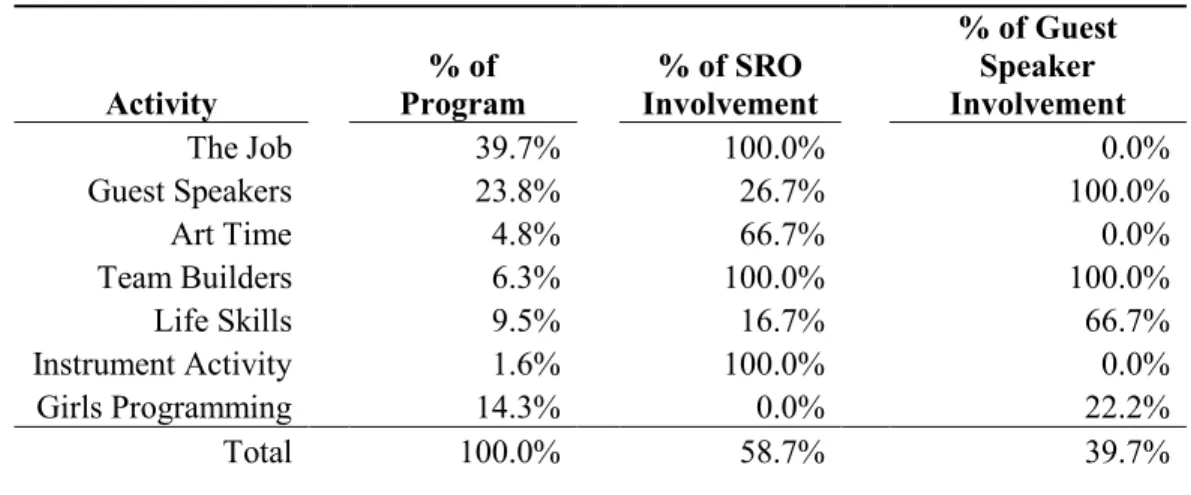
Observation of the program’s implementation allowed for a measure of TNT’s activities (see Table 1). The majority of the youth’s time was spent working on the job activity (39.7%). The job involved designing and producing murals made from denim
material and presenting it at the end of the program. Program staff wanted the youth to create a piece of art that exhibited positivity in the community. This activity began with the youth coming up with what they wanted the images on the murals to be and then deciding who would be in the photo that would provide the mural’s image outline. The youth had many different ideas for the murals, some of which included a police officer and youth playing
16
basketball together, African Americans playing chess to show intelligence, parents with their children, and successful single parents. The youth ultimately decided on two different
images, which consisted of (1) a police officer and a gangster (young African American male to represent this) shaking hands with the words “Step Forward” and (2) a diverse group of females with their hands together to show solidarity with the words “Unity and Community.”
Program staff divided the youth into six teams of participants that would be in charge of completing an entire mural together and would work together week after week. The job entailed cutting and ripping the many different colors of denim that would make up the color and texture of the murals. Teamwork was emphasized throughout the job, as one person would start ripping the fabric into strips while another person would cut the strips into quarter-sized pieces. They would also take turns so no one got stuck only cutting or ripping the denim. The next part of the job entailed gluing the pieces of denim to the mural. The team had to work together to decide which colors they wanted on their mural and where those colors would be placed. The teams completed their murals by the end of the program, and an unveiling ceremony was held to reveal the teens’ artwork to the community.
Guest speaking activities comprised 23.8% of the youth’s time in the TNT program. Guest speakers included local entrepreneurs (professional artists, professional DJs), agencies or companies to teach work skills (Connections to Success, Foot Locker Managers), and agencies to teach life skills (MOSCA, FDIC, Mothers in Charge, Jackson County Family Court, FBI, ATF). The youth participated in interactive sessions that covered money-management, reflective listening, healthy relationships and the cycle of relationship abuse, writing poems, and learning how to use DJ equipment. The youth heard from many federal law enforcement agents on what it means to be criminal at a young age and how to avoid that
17
life path into adulthood. The guest speakers provided an array of expertise and experience to share with the youth, which taught the youth how to interact with others in a respectful way and learn from what they have to say.
The girls in the program spent about 14.3% of their time in separate girls
programming sessions from the boys. Approximately nine sessions were held, where the girls would leave the main room where TNT was held and go to a different room while the boys continued to work on the job or hear from other guest speakers. The girls programming was implemented to give them time to work on things that pertained to them specifically and did not get discussed with the overall group. Girls’ programming involved making inspiration boards for their futures, hearing from Mothers in Charge, making crafts, and hearing from Connections for Success on how to dress for success. Arts Tech staff and the NoVA client advocates facilitated the girls’ programming and enforced the code of conduct.
The youth spent 9.5% of their time participating in life skills activities and 6.3% in teambuilding activities. The life skills percentage takes into account specific TNT activities that involved life skills and an FDIC guest speaker who came to discuss money management. The TNT life skills activities involved the youth learning how to accurately fill out a W-4 form for employment, watching documentaries (Merchants of Cool and History of Hip Hop), participating in mock job interviews, and learning money management skills. Teambuilding activities were designed to enhance teamwork skills amongst the teens and instill trust in their relationships with each other to make TNT feel like a safe place for them to work. There were four teambuilding activities throughout TNT that generated interaction amongst teens and the production of group work.
18
Additional activities the juveniles participated in included art time (4.8%) and an instrument activity (1.6%). The art time involved the teens making masquerade masks on two separate occasions, once at the beginning of the program and once at the end. The masks made at the end of the program were given to the guests who attended the TNT unveiling event as a thank you. Each youth decorated a masquerade mask and then wrote a thank you note on the inside. The instrument activity only happened on one occasion, and involved the youth sitting in a circle and playing African-style drums and small instruments.
Table 1: TNT Activities
Activity Program % of Involvement % of SRO
% of Guest Speaker Involvement The Job 39.7% 100.0% 0.0% Guest Speakers 23.8% 26.7% 100.0% Art Time 4.8% 66.7% 0.0% Team Builders 6.3% 100.0% 100.0% Life Skills 9.5% 16.7% 66.7% Instrument Activity 1.6% 100.0% 0.0% Girls Programming 14.3% 0.0% 22.2% Total 100.0% 58.7% 39.7% TNT Demographics
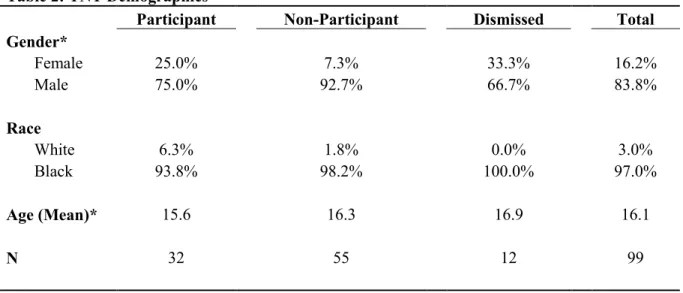
The sample population consists of 99 youth in total. Table 2 shows the demographic information for youth who participated, youth who did not, and youth who were dismissed from the TNT program. There were significant differences found in gender between groups. Of the participants, 25% were female whereas only 7.3% of the non-participants were female. Furthermore, 33.3% of those dismissed from TNT were female. Therefore, the comparison group of non-participants was significantly more male than the group that
19
participated. There were no significant differences between race found with 3.0% of the youth being white and 97% being black. Significant differences in age between groups was also found with the group that participated, on average, being 15.6 years old at the beginning of the program. The comparison group was found to be slightly older with an average age of 16.3 and the group that was dismissed TNT was 16.9 years old (see Table 2).
Table 2: TNT Demographics
Participant Non-Participant Dismissed Total
Gender* Female 25.0% 7.3% 33.3% 16.2% Male 75.0% 92.7% 66.7% 83.8% Race White 6.3% 1.8% 0.0% 3.0% Black 93.8% 98.2% 100.0% 97.0% Age (Mean)* 15.6 16.3 16.9 16.1 N 32 55 12 99 * p<. 05 TNT Eligibility
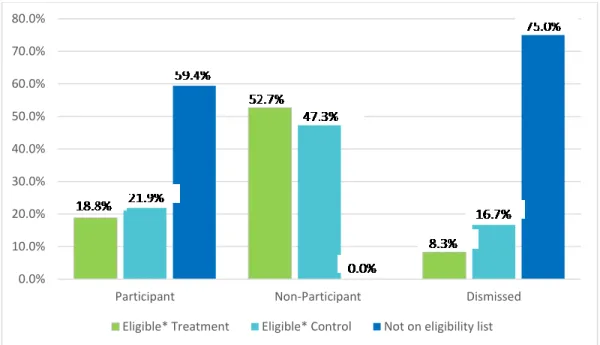
The next step in the analysis is to compare the random selection plan that was set up prior to TNT to the youth who actually participated in the program to see if a relationship exists between the two groups. Table 3 shows the difference between the randomized
selection plan and the actual selection into TNT. Figure 1 displays the same information, but in bar graph form.
20
Table 3: Random Selection Plan vs. Actual Program Selection
Participant Non-Participant Dismissed Total
Eligible* Treatment 18.8% 52.7% 8.3% 36.4% Control 21.9% 47.3% 16.7% 35.4% Not on eligibility list 59.4% 0.0% 75.0% 28.3% N 32 55 12 99 * p<. 05
Table three reveals that of the 32 youth who participated in TNT, 18.8% of the youth were on the eligibility list to be selected for the program, 21.9% were on the eligibility list for the control group and 59.4% of the participants were not on the eligibility list. Of the 55 youth who were non-participants of TNT, 52.7% were on the eligibility list to be selected for the program, 47.3% were on the eligibility list for the control group and 0.0% were not on the eligibility list. Of the 12 youth who were dismissed from TNT, 8.3% were on the eligibility list to be selected for the program, 16.7% were on the eligibility list for the control group and 75% were not on the eligibility list.
21
Figure 1: Random Selection Plan vs. Actual Program Selection
This analysis indicates that the program did not follow the randomization selection plan that was set up prior to TNT. Furthermore, this analysis sheds an interesting light onto the group of TNT participants that were dismissed from the program. Nine of the 12 dismissed youth were not on the eligibility list to participate in TNT prior to the program. Client staff indicated that they did not have the resources to locate all of the youth eligible for treatment and instead took referrals for available youth to participate in the program. With regard to the evaluation of TNT, the absence of randomization limits the conclusions that can be drawn about the effectiveness of the summer jobs program. Further, researchers cannot be certain that any of the differences found between those who participated in the program and those who did not were a result of the program itself. It is possible that any of the differences found were due to the selection process utilized in recruiting the youth for TNT. Therefore, I cannot ascertain whether those who participated in the TNT were fundamentally different than those who did not participate.
0.0% 10.0% 20.0% 30.0% 40.0% 50.0% 60.0% 70.0% 80.0%
Participant Non-Participant Dismissed
22
Prior Police Involvement
Table 4 and Figure 2 present the mean number of police contacts and arrests for the TNT participants, non-participants, and youth dismissed prior to the program. Police contacts and arrests were analyzed for these youth for the time period of January 2010 through May 2015, whereas TNT began in June 2015. In the 65 months prior to TNT, the participants, on average, had 6.2 police contacts and 1.7 arrests. The non-participant comparison group, on average, had 9.9 police contacts and 2.2 arrests. Those dismissed from the program, on average, experienced 12.7 police contacts and 2.7 arrests. The differences in police contact were found to be significant while the differences in arrests were not significant. The youth who participated and completed the program were less likely to be contacted by the police in the time period before the 2015 TNT program. The youth with the most prior police contacts were those dismissed from the program.
Prior criminal involvement of the youth is important to consider when determining the effectiveness of a program. If the group that participated in TNT were less likely to be contacted by the police before the program, then it is to be expected that the same group would also be less likely to be contacted by the police during the program. In addition, it appears that the group dismissed were the most criminally involved prior to the program. This finding must be considered when interpreting the next analysis.
23
Table 4: Mean Number of Police Contacts and Arrests Prior to TNT (January 2010 through May 2015)
Participant Non-Participant Dismissed Total
Prior Police Contact* 6.2 9.9 12.7 9.0
Prior Arrest 1.7 2.2 2.7 2.1
N 32 55 12 99
* p<. 05
Figure 2: Mean Number of Police Contact and Arrests Prior to TNT
Police Involvement During TNT
The next analysis presents the mean number of police contacts and arrests for the TNT participants, non-participants, and youth dismissed during the program. Table 5 and Figure 3 display the same information in different forms. One thing to keep in mind is the analysis for the time period during the program is much shorter (3 months June 2015 through August 2015) than the time period before TNT and therefore merit much lower numbers
0.0 2.0 4.0 6.0 8.0 10.0 12.0 14.0
Participant Non-Participant Dismissed Total
Prior Police Contact* Prior Arrest 6.2 1.7 9.9 2.2 12.7 2.7 9.0 2.1
24
when compared to the time period before TNT3. During the three months of the summer program, participants had, on average, .22 police contacts and .00 arrests. The
non-participants had, on average, .75 police contacts and .07 arrests. Those dismissed from the program, on average, experienced 1.92 police contacts and .25 arrests during TNT.
Significant differences were found between the groups in regard to police contacts during the program’s implementation, yet the differences between the groups in regard to arrests during TNT were not found to be significant. The high number of police contacts among the youth who were dismissed could be an indication of more criminal activity and possibly be one of reasons for their dismissal from the program.
Table 5: Mean Number of Police Contact and Arrests During TNT (June 2015 through August 2015)
Participant Non-Participant Dismissed Total
Police Contact During TNT* 0.22 0.75 1.92 0.72
Arrest During TNT 0.00 0.07 0.25 0.07
N 32 55 12 99
* p<. 05
3 Police contacts and arrests were calculated by dividing the total number of contacts and arrests per month by the number of months in the contact period. 53 months were considered in the prior period.
25
Figure 3: Mean Number of Police Contact and Arrests During TNT
Lastly, Table 6 and Figure 4 display the likelihood of police contact and arrest between the groups during the program’s implementation. Table 9 shows the percentage of youth in that group who were contacted or arrested by the police and Graph 10 shows the same information in bar graph form. During TNT, 21.9% of the participants were contacted by the police and 0.0% were arrested. Of the non-participants, 27.3% were contacted by the police and 5.5% were arrested. Of the youth who were dismissed, 50.0% were contacted by the police and 8.3% were arrested during the program.
0.00 0.20 0.40 0.60 0.80 1.00 1.20 1.40 1.60 1.80 2.00
Participant Non-Participant Dismissed Total
Police Contact During TNT* Arrest During TNT 0.75 0.00 0.07 1.92 0.25 0.72 0.07 0.22
26
Table 6: Likelihood of Police Contacts and Arrests During TNT (June 2015 through August 2015)
Participant Non-Participant Dismissed Total
Police Contact During TNT 21.9% 27.3% 50.0% 28.3%
Arrest During TNT 0.0% 5.5% 8.3% 4.0%
N 32 55 12 99
* p<. 05
Figure 4: Likelihood of Police Contacts and Arrests During TNT
0.0% 10.0% 20.0% 30.0% 40.0% 50.0% 60.0%
Participant Non-Participant Dismissed Total
27
CHAPTER 5 DISCUSSION Summary of Findings
The purpose of this study was to assess the effectiveness of a summer jobs program aimed at reducing the participants’ criminal involvement and violent activity specifically. Kansas City Police Department data were used to evaluate the program to determine whether the participants had less police contacts and arrests during the implementation of the program in comparison to the eligible youth that did not participate in Teens in Transition. The results of the initial participant eligibility analysis indicate that more than half of those who
participated in TNT were not on the original eligibility list for program selection. The results indicate that police involvement in the 65 months before the program, the participants had less police contacts and arrests than the non-participants and those dismissed from the
program. The analysis of police involvement during the program similarly indicates that TNT participants had less police contacts and arrests than the non-participants and the dismissed youth. Therefore, Teens in Transition seemingly decreased criminal involvement, as
measured by police contact, in the participants for the duration of the program. This finding must be considered in the context of lower numbers of police contact for program
participants in the time period before TNT began. Specifically, the prior criminal involvement data of the participants indicates that they would have had lesser criminal involvement than that of the non-participants and the youth dismissed from TNT, even without the TNT intervention.
28
Implications for the Literature and Importance
An unanticipated finding from this evaluation was the police contacts and arrests of the twelve youth who were dismissed from the program. These youth were contacted by the police, on average, 12.7 times and had 2.7 arrests during the 65 months prior to TNT.
Program participants who completed TNT were only contacted by the police, on average, 6.2 times and had 1.7 arrests in the 65 months prior. During the three months of TNT
implementation, the dismissed youth were contacted by the police, on average, 1.92 times and had .25 arrests in comparison to the participates who completed the program with .22 average police contacts and .00 arrests. This finding requires inquiry considering that the dismissed participants were let go due to their negative attitudes, disciplinary reasons and violations of the code of conduct. Decisions of dismissals seemed to be made in a group effort. Mr. Toombs, ArtsTech staff and TNT stakeholders made dismissal decisions. Ultimately, the dismissal decision was carried out by Mr. Toombs but he would discuss options and consult the ArtsTech staff and TNT stakeholders if necessary regarding the dismissal of a youth. Youth violence intervention programs are very specifically designed to decrease the violence of youth, yet TNT dismissed from the program the very participants struggling with negative behaviors that the program targeted. While letting such youth go seems understandable when considering the need for TNT staff to make sure those who wanted to get the most out of the program could without being distracted or hindered by those with a different attitude, such programs must find solutions to disruptive and negative behavior because these are the very participants who need the most intervention. This is apparent when the results show that the dismissed group of youth are the ones with the most prior and during TNT police contact and arrests.
29
One alternative to dismissal would be to exhaust every possible option before letting youth with behavioral issues go. Many of the issues that cause the youth to act or refuse to follow the TNT code of conduct could be due to mental or emotional issues related to trauma since these youth were specifically identified for TNT eligibility due to their increased likelihood of violent victimization or perpetration. Maschi and Bradley (2008) found that youth who report a higher amount of exposure to anger, delinquent peers trauma were at an increased risk for violent and anger offending. Therefore, youth violence intervention
programs may want to consider utilizing the client advocates to identify whether a youth with behavior issues is suffering from negative impacts due to stressful life events that require treatment. Guiding a youth with behavioral issues to treatment in conjunction with TNT programming could effectively decrease the youth's violent and anger offending instead of throwing them back on the streets and being dismissed from a prosocial program specifically aimed to help the youth with violent tendencies.
The results do indicate significant differences between the groups with regard to police contacts during the program's implementation, indicating possible effectiveness of the program in changing the police involvement of the youth during TNT. However, as
mentioned previously, this finding must be considered with the groups’ prior criminal behavior in mind. Nagin and Paternoster (1991-1992) utilized a three-wave panel study that consisted of a sample of 1,163 tenth grade students who had complete questionnaire data over all three waves. The researchers found that prior involvement in illegal activity had a real behavioral impact on future illegal involvement even when controlling for unobserved heterogeneity. Therefore, the prior criminal involvement of the youth must be considered when selecting participants for violence intervention programs. Said simply, past violence is
30
going to be a good indicator of future violent behavior. While police contacts and arrests decreased while the youth participated in TNT (participant prior average police contacts = 6.2 and participant average police contacts during TNT = .22), it can be assumed they would have less criminal involvement than those who did not participate since they had less
criminal involvement prior to the program (non-participant prior average police contacts = 9.9 and non-participant average police contacts during TNT = .75). It appears as though the less criminally involved group of teens comprised the participants while the non-participants and dismissed participants had the higher amounts of police contacts and arrests.
Programming aimed at decreasing criminal involvement for disadvantaged youth is very important considering African American youth are overrepresented in juvenile arrests, comprising more than half (52%) of all juvenile arrests for violent crimes, while only
accounting for 17% of the juvenile population (Puzzanchera, 2014). Unfortunately, juveniles are at a high risk for gang involvement as the National Youth Gang Survey (NYGS) has reported an overall 15% increase in youth gang problems from 2002-2008 (Egley, Howell, Harris, 2010). The literature provides many examples of successful youth intervention programs to decrease youth violence and gang involvement, but feasible innovative programming is still imperative to reducing youth gang violence (Esbensen et al., 2011; Koffman et al., 2009; Sum, Trubskyy, & McHugh, 2013; Heller, 2014; Heller, Pollack, Ander, & Ludwig 2013). Heller (2014) and Sum, Trubskyy, and McHugh (2013) each evaluated a summer jobs programs suggesting that valuable employment experiences were able to prepare youth for academic and employment experiences while having important implications on decreasing violent behaviors.
31
Furthermore, over half of those who participated in TNT were not selected from the randomized list of eligible youth provided by the researchers and were selected by other means. This disparity in the selection of the youth compromises the researchers' ability to ensure that some variable outside of program participation did not impact the findings. Adherence to the randomization plan would remove this likelihood by ensuring that those who participated were not inherently different than those who did not. Unfortunately, the lack of randomization detracts from what can be said about the effectiveness of this summer jobs based program since I cannot be certain the program itself caused the differences in the youth's criminal activity.
32
CHAPTER 6
RECOMMENDATIONS FOR PRACTICE
First, it is important to determine a consistent way to discipline behavior. There seemed to be an uncertainty as to who should be disciplining the youth, and when. At times, the school resource officers (SROs) seemed unsure whether they, the TNT staff, or the NoVA social service advocates should be disciplining the youth in the program. When all staff are not on the same page as to how or when to discipline, it undermines the instances when the youth are disciplined. A dedicated training or meeting of all TNT staff, prior to the beginning of the program, to make sure everyone understands how the disciplining will be carried out could be beneficial. Further, program staff should do everything possible to keep youth in the program. Dismissing youth should be the last resort. Program staff need to be innovative and find ways to hold youth accountable without preventing them from coming back. For many of these youth, this program might be the last stop before they end up in the criminal justice system.
Second, I recommend developing a curriculum with set learning outcomes that can be used and updated from year to year. After the second year of TNT, it was not clear how all of the activities worked together. For example, how the guest speakers were selected and when they spoke did not seem to directly support the other program activities. Moreover, it often appeared as though activities were put together at the last minute, hindering the program’s structure and potentially causing the many behavioral issues that the staff battled with the youth over the whole program (e.g., the teens not taking the program as seriously). Providing more program structure by connecting the types of activities that TNT will offer to the goals of the program will assist in measuring the outcomes of the activities. An established and
33
developed curriculum with identified learning outcomes will allow staff to improve from one year to the next.
Furthermore, if TNT is going to continue implementing different programming for males and females, they need to ground the girls’ programming in literature or research that relates to the goals of the programming. The girls in the program expressed disappointment with the separate programming for a number of reasons. For example, they felt they were unfairly missing out on guest speakers and activities to do “girly” things they were not interested in. Further, the girls programming had very little coordination. While the boys and girls were disadvantaged and at-risk for similar reasons, the manifestation of what it meant to be at-risk for violence was likely different between the two genders. Because of this, separate programming might in fact be warranted, however, the curriculum and objectives should be clearly defined and communicated.
With regard to the development of the program’s curriculum, such development would also allow for the identifiable learning outcomes and goals for the program to be measured by self-report of the youth who participate via survey methodology. For example, TNT similarity promoted positive relationships between the youth and law enforcement as did G.R.E.A.T. II (Esbensen et al., 2011). One main goal of the evaluation of G.R.E.A.T. II was to help youth develop a positive relationship with law enforcement and the evaluation revealed that when G.R.E.A.T. students compared to non-G.R.E.A.T. students, participants more likely to report positive attitudes about police. The G.R.E.A.T. researchers utilized pretests, posttests, and four annual follow up surveys to measure the effectiveness of the program, including positive attitudes towards police. This added measure in combination of utilizing KCPD data would allow for a well-rounded evaluation of Teens in Transition. The
34
KCPD data would shed light on the officially reported criminal involvement and arrests of the sample, while the surveys could aim to measure much more about the program’s impact than just its influence on criminal and violent involvement. TNT encouraged positive change by providing a safe space to build relationships among youth from different gangs, taught interactive arts education through the creation of denim murals, and promoted positive relationships with law enforcement. Many of these goals or objectives could be measured by directly asking the youth if and how TNT has facilitated such change.
Finally, the best way to determine effectiveness of a program like TNT, which has serious implication for violence prevention in Kansas City, is to commit to a randomized control trial. This type of design will allow evaluators to confidently determine the effect the program is having on the youth. Future evaluations should also be conducted examining alternative outcomes. For example, survey research could track the changes in pro-social activity, attitudes and thoughts about criminal behavior, and self-reported criminal behavior. If the curriculum is more clearly defined with set learning outcomes, evaluators can measure these outcomes to show what the youth are learning over the course of the program.
Teens in Transition provided a productive space for disadvantaged youth to come together and send a message to strengthen and inspire the Kansas City community through one-of-a-kind denim murals over the course of a short 10-week program. The TNT program continues to be a step in the right direction for violence prevention. Through NoVA, TNT has access to the names of some of the most high-risk youth in Kansas City – an invaluable resource to drive violence prevention programming. Refining the effort to reach out to these youth and provide them with life skills training and a work opportunity and is essential and can lead to the type of violence prevention everyone is working toward.
[35] APPENDIX
37
REFERENCES
Anderson, E. (2011). Code of the street. In Cullen, F. T., & Agnew, R (Eds.), Criminological theory: Past to present : Essential readings (143-154). New York: Oxford University Press.
Baccaglini, W. F. (1993). Project youth gang-drug prevention: A statewide research study. Rensselaer, NY: New York State Division for Youth.
Braga, A., Hureau, D., & Papachristos, A. (2014). Deterring gang-involved gun violence: Measuring the impact of Boston's Operation Ceasefire on street gang behavior.
Journal of Quantitative Criminology, 30(1), 113-139. doi:10.1007/s10940-013-9198-x
Cloward, R. A., & Ohlin, L. E. (1960). Delinquency and opportunity: A theory of delinquent gangs. New York, NY, US: Free Press.
Decker, S. H., & Van Winkle, B. (1996). Life in the gang: Family, friends, and violence. Cambridge University Press.
Egley Jr, A., Howell, J. C., & Moore, J. P. (2010). Highlights of the 2008 National Youth Gang Survey. Washington, DC: US Department of Justice, Office of Justice Programs, Office of Juvenile Justice and Delinquency Prevention.
Egley Jr, A., Maxson, C. L., Miller, J., & Klein, M. W. (2006). The modern gang reader. Oxford University Press.
Esbensen, F. A., Deschenes, E. P., & Winfree, L. T. (1999). Differences between gang girls and gang boys results from a multisite survey. Youth & Society, 31(1), 27-53. Esbensen, F. A., Peterson, D., Taylor, T. J., Freng, A., Osgood, D. W., Carson, D. C., &
Matsuda, K. N. (2011). Evaluation and evolution of the Gang Resistance Education and Training (GREAT) program. Journal of School Violence, 10(1), 53-70.
Fabio, A., Tu, L. C., Loeber, R., & Cohen, J. (2011). Neighborhood socioeconomic disadvantage and the shape of the age–crime curve. American Journal of Public Health, 101(S1), S325-S332.
Farrington, D. (1986). Age and Crime. Crime and Justice, 7, 189-250. Retrieved from http://www.jstor.org/stable/1147518
Federal Bureau of Investigation. Crime in the United States 2010. Uniform Crime Reports. Washington, DC: U.S. Department of Justice, 2011. Available from
www.fbi.gov/about-us/cjis/ucr/crime-in-the-u.s/2010/ crime-in-the-u.s.-2010/index-page
38
Fox, A. M., Allen, O. R., Stuewe-Portnoff, C., and Novak, K. (2014). Research in brief: Teens in transition, a report for the Kansas City No Violence Alliance. Kansas City: Department of Criminal Justice and Criminology, University of Missouri-Kansas City.
Frankfort-Nachmias, C. & Nachmias, D. (2007). Research methods in the social sciences (7th ed.). New York: Worth.
Heinrich, C. J., & Holzer, H. J. (2011). Improving education and employment for disadvantaged young men: Proven and promising strategies. The Annals of the American Academy of Political and Social Science, 635(1), 163-191.
Heller, S. B. (2014). Summer jobs reduce violence among disadvantaged youth. Science, 346(6214), 1219-1223.
Heller, S., Pollack, H. A., Ander, R., & Ludwig, J. (2013). Preventing youth violence and dropout: A randomized field experiment (No. w19014). National Bureau of Economic Research.
Hill, K. G., Howell, J. C., Hawkins, J. D., & Battin-Pearson, S. R. (1999). Childhood risk factors for adolescent gang membership: Results from the Seattle Social Development Project. Journal of Research in Crime and Delinquency, 36(3), 300-322.
Howell, J. C. (2010). Gang prevention: An overview of research and programs. Juvenile Justice Bulletin. Office of Juvenile Justice and Delinquency Prevention.
Johnstone, J. W. (1983). Recruitment to a youth gang. Youth and Society, 14(3), 281-300. Klein, M. W., & Maxson, C. L. (2006). Street gang patterns and policies. New York: Oxford
University Press.
Koffman, S., Ray, A., Berg, S., Covington, L., Albarran, N. M., & Vasquez, M. (2009). Impact of a comprehensive whole child intervention and prevention program among youths at risk of gang involvement and other forms of delinquency. Children & Schools, 31(4), 239-245.
Langton, L., Berzofsky, M., Krebs, C. P., & Smiley-McDonald, H. (2012).Victimizations not reported to the police, 2006-2010. US Department of Justice, Office of Justice Programs, Bureau of Justice Statistics.
Maschi, T., & Bradley, C. (2008). Exploring the moderating influence of delinquent peers on the link between trauma, anger, and violence among male youth: Implications for social work practice. Child & Adolescent Social Work Journal, 25(2), 125-138. doi:10.1007/s10560-008-0116-2
39
Maxson, C. L., & Whitlock, M. L. (2002). Joining the gang: Gender differences in risk factors for gang membership. In C. R. Huff (Ed.), Gangs in America, III (pp. 19-35). Thousand Oaks, CA: Sage.
Maxson, C. L., Whitlock, M. L., & Klein, M. W. (1997)a. Exploring youth violence risk and protective factors. Proposal submitted to the National Institute of Justice, U.S. Department of Justice. Los Angeles: University of Southern California.
Maxson, C. L., Whitlock, M. L., & Klein, M. W. (1997)b. Gang joining and resistance: Who can "just say no" to gangs. Final report submitted to Administration of Children and Families, US Department of Health and Human Services. Los Angeles: University of Southern California.
Maxson, C. L., Whitlock, M. L., & Klein, M. W. (1998). Vulnerability to street gang membership: Implications for practice. Social Service Review, 72(1), 70-91. Merton, R. (1938). Social structure and anomie. American Sociological Review, 3(5), 672
682. Retrieved from http://www.jstor.org/stable/2084686
Moore, J. W. (1978). Homeboys: Gangs, drugs, and prison in the barrios of Los Angeles. Philadelphia: Temple University Press.
Moore, J. W., & Vigil, J. D. (1989). Chicano gangs: Group norms and individual factors related to adult criminality. Aztlan, 18(2), 27-44.
Moss, P., & Tilly, C. (1996). “Soft” skills and race: An investigation of black men's employment problems. Work and Occupations, 23(3), 252-276.
Nagin, D., & Paternoster, R. (1991-1992). On the relationship of past to future participation in delinquency. Criminology, 29(2), 163-190.
National Gang Center. (2012). National youth gang survey analysis. Retrieved from http://www.nationalgangcenter.gov/Survey-Analysis
Puzzanchera, C. (2014). Juvenile arrests 2012. Washington, DC: US Department of Justice, Office of Justice Programs, Office of Juvenile Justice and Delinquency Prevention, 3. Pyrooz, D. C., Fox, A. M., & Decker, S. H. (2010). Racial and ethnic heterogeneity,
economic disadvantage, and gangs: A macro‐level study of gang membership in urban America. Justice Quarterly, 27(6), 867-892.
Sellers, C. S., Taylor, T. J., & Esbensen, F. A. (1998). Reality check evaluating a school based gang prevention model. Evaluation Review, 22(5), 590-608.
Shaw, C. R. & McKay, H. D. (1942). Juvenile delinquency and urban areas. Chicago, IL: University of Chicago Press.
40
Sum, A., Trubskyy, M., & McHugh, W. (2013). The summer employment experiences and the personal/social behaviors of youth violence prevention employment program participants and those of a comparison group. Center for Labor Market Studies.
Boston: Northeastern University.
Thornberry, T. P., Krohn, M. D., Lizotte, A. J., Smith, C. A., & Tobin, K. (2003). Gangs and delinquency in developmental perspective. Cambridge University Press.
Thornberry, T. P., Lizotte, A. J., Krohn, M. D., Smith, C. A., & Porter, P. K. (2003). Causes and consequences of delinquency: An overview of findings from contemporary longitudinal studies. In Taking stock of delinquency (pp. 11-46). Springer.
doi="10.1007/0-306-47945-1_2",url="http://dx.doi.org/10.1007/0-306-47945-1_2 Valdez, A. (2007). Mexican American girls and gang violence: Beyond risk. New York:
Palgrave Macmillan.
Vigil, J. D. (1988). Group processes and street identity: Adolescent Chicano gang members.
Ethos, 16(4), 421-445.
Vigil, J. D. (2010). Barrio gangs: Street life and identity in Southern California. Austin: University of Texas Press.
Vigil, J. D., & Long, J. M. (1990). C. R. Huff (Ed.). Emic and etic perspectives on gang culture: The Chicano case. Gangs in America, 55-68. SAGE Publications.
Warr, M. (2002). Companions in crime: The social aspects of criminal conduct. Cambridge University Press.
Whitlock, M. L. (2004). Family-based risk and protective mechanisms for youth at-risk o of gang joining. Ph.D. dissertation. Los Angeles: University of Southern California, Department of Sociology.
41
VITA
Olivia Rose Allen was born on September 3, 1992, in Liberty, Missouri. She was educated in a local public school and graduated from Penney High school as class
salutatorian in 2011. She received a Chancellor’s Scholarship to the University of Missouri-Kansas City in Missouri-Kansas City, Missouri, from which she graduated magna cum laude, in 2014. Her degree was a Bachelor of Arts in Criminal Justice and Criminology with a minor in Sociology.
After working as a research clerk with the Jackson County Family Court for two years in Kansas City, Missouri, Ms. Allen accepted a research assistant position and began a master’s program in criminal justice and criminology at the University of Missouri-Kansas City. She was awarded the Master of Science degree in Criminal Justice and Criminology in December, 2016.
In 2016, Ms. Allen assumed a full-time position as a Pretrial Supervision Officer at Court Services with the Johnson County, KS government.