Chapter V
Improving E-Learning
Support and
Infrastructure:
An Evidence-Based
Approach
Carmel McNaught, The Chinese University of Hong Kong, China Paul Lam, The Chinese University of Hong Kong, China Christina Keing, The Chinese University of Hong Kong, China
Kin Fai Cheng, The Chinese University of Hong Kong, China
Abstract
This chapter reports a study conducted in 2004 at The Chinese University of Hong Kong (CUHK) aimed at obtaining a much clearer picture about the use of e-learning at the university so as to develop new strategic directions on a firm evidence base. Multiple sources of data were collected, including: site logs, experts’ review of selected active Web sites, and interviews with 26 teachers. The data illustrate that e-learning at CUHK is still largely in the “innovators” and “early adopters” stages (Rogers, 2003). There lies a “chasm” ahead inhibiting moving further into the “mainstream” area. The analysis of the data revealed that what the teachers want from the technology, what they actually do, and what they can have access to for support are not totally aligned. The focus of the chapter is on how to improve this alignment so as to bridge the chasm. The study has been successful in eliciting university support for changes to the e-learning support system.
Tel: 717/533-8845; Fax 717/533-8661; URL-http://www.idea-group.com ITB12955 This chapter appears in the book, Technology Supported Learning and Teaching: A Staff Perspective
Background
There is a growing worldwide trend in the use of Web technology for the support of learning and teaching in universities. While e-learning can mean any use of computer technology to support learning, in the context of this chapter, we are referring to materials and activities involving Web-based environments. The emphasis of this chapter is on institutional decision-making about e-learning support; however, it is relevant to set the scene by briefly commenting on why e-learning strategies are believed to have the potential to enhance student learning environments. [These comments are based on pedagogical considerations and not on technical matters of connectivity such as access to networked computers with sufficient bandwidth. In Hong Kong, the technical infrastructure is largely reliable and the vast majority of students have good access.]
Interactivity and Engagement
One key aspect of e-learning design is interactivity — how students interact with learning materials, with the teacher and with peer learners (Swan, 2003). Broadly, interactivity can be thought of as interactions with either the content which might be text, audio visual resources, graphics and static visual representations, scenarios, simulations, and/or quizzes; or with people via asynchronous online communication (threaded discussions/ newsgroups) and/or synchronous communication (chat) (Kearsley, 2000). Interactivity is thought to enhance learning because feedback and reflections effectively help the construction of meaning and give structure to knowledge and information (Taylor & Maor, 2000; O’Connor, 1998).
Other writers emphasize the social aspects of Web-assisted learning. Both Laurillard (2001) and Wenger (1998) discussed how “communities of practice” can emerge through the use of Web technology. In these communities, learners can pursue shared enterprises through discussion and collaboration in a highly active form of learning. Similarly, Preece (2000) suggested that the Web has allowed learners to form into “online communities” that enable ongoing interactions in an “anytime, anywhere” format that can support the development of autonomy in learners.
One of the purposes of this study was to see to what extent the views of teachers at The Chinese University of Hong Kong (CUHK) echo the enthusiasm about the potential of e-learning that can be found in the literature.
Evaluation of E-Learning Designs
There is a growing literature on how educationally effective various e-learning designs and projects are. Some studies have focused on the potential of generic learning designs; for example, a recent Australian project (Learning designs, 2003; Hedberg, Wills, Oliver, Harper, & Agostinho, 2002) identified 52 technology-based learning design exemplars of which 28 were selected for evaluation. An international evaluation team of 64 members
studied these 28 cases, using two evaluators for each learning design exemplar. The results of the evaluation phase assisted the project team to select a number of exemplars suitable for redevelopment in a more generic form. The project concluded that the following learning designs have high potential for facilitating learning, and the project Web site provides suggestions and examples about how to use these designs success-fully: collaborative activities, a focus on conceptual or procedure development, problem-based learning, the use of practical projects or case studies, and role-play. In this study, we will look to see what designs are used by CUHK teachers.
Many reported evaluation studies are done by teachers or teacher-designer teams reporting on specific e-learning projects in which they have been involved. This type of evaluation can be generally described as action research studies and the reports provide rich descriptions of what works well in particular contexts (e.g., McPherson, 2004; Levy, 2003). Reading across these accounts tends to strongly confirm the principles of interactivity and engagement. There are several useful edited collections (e.g., Eisenstadt & Vincent, 1998, and, indeed, this volume) that look across several individual studies so as to provide more generalisable principles.
Evaluation data about e-learning is occasionally provided by an “evaluation service” such as that provided by the e3-learning (enrich, extend, evaluate learning) project in Hong Kong. Project staff work with teachers to design, develop, and evaluate educa-tional Web sites. As this project has been involved with over 100 Web sites, a more systematic meta-analysis across projects is possible (McNaught & Lam, 2005). In this study, we attempt to look across the online courses of several CUHK teachers so as to provide insights that will assist future planning for e-learning support at CUHK.
Evaluation of E-Learning at Institutional Level
However, in addition to studies on individual course e-learning experiences, it is increasingly clear that institutional policy relating to e-learning is an essential factor in maximizing the potential benefits of Web-enhanced teaching and learning.
McNaught, Phillips, Rossiter, and Winn (2000), in an Australia-wide study involving 25 universities in all states of Australia, found that the issues surrounding the adoption of e-learning at universities are complex, and no single factor will result in adoption. Instead, there is a range of policy, culture, and support factors that need to be addressed. Several universal factors in relation to widespread use of e-learning were identified:
• coherence of policy across all levels of institutional operations and clear specific policies which impact on e-learning within the institution;
• clear intellectual property policy, particularly with respect to the role of copyright in emerging online environments;
• strong leadership and institutional culture;
• support for staff issues and attitudes: namely, professional development and training, staff recognition and rewards, and motivation for individuals to use e-learning;
• specific resourcing issues related to funding for maintenance or updating of e-learning materials and approaches, staff time release, and support staff.
In deciding how technology should be used in any university, e-learning policy makers need to decide how the technology should be used, and the deliberations should be on the basis of educational needs rather technological fixes. The case of RMIT University in Australia is often cited in Australia as a university that invested heavily in techno-logical systems that failed with far-reaching consequences (McNaught, 2005). As the first author was witness to the RMIT saga, there is a clear commitment to decision-making at CUHK being based on an understanding of the nature of the learning designs being used in the programmes and courses here at CUHK, and on the perceived needs of teachers.
Current Context of E-Learning @ CUHK
In Hong Kong, there are eight government-funded higher education institutions (Uni-versity Grants Committee, 2005), each with a distinctive character. None of the Hong Kong universities are large; all have undergraduate populations of less than 15,000 students, most of whom are full-time students, straight from an education in local Hong Kong schools. The Hong Kong undergraduate population is thus quite homogeneous — much more so than in many other countries. The Chinese University of Hong Kong (CUHK) is an essentially collegial university. There are three research-intensive univer-sities in Hong Kong, with CUHK being the one with the strongest Chinese cultural ethos. The combination of the maintenance of Chinese cultural values with an active outreach to the world is an intriguing challenge. Much of the work in understanding East-West distinctions (e.g., Bond, 1991; Nisbet, 2003) involves looking at how value hierarchies and priorities for action differ across cultural boundaries. For example, the primacy of family and respect for elders and associated groups norms in Chinese culture have implications for students’ perceptions of Western curricula and classroom behaviour (McNaught, 2003a). However, the differences between Chinese and Western universi-ties are not the focus of this chapter. It will suffice to comment that these differences are subtle. Our research evidence (Kember et al., in press) is that there are few differences globally between teachers’ conceptions of what constitutes good teaching; however, the enactment of educational principles may well need somewhat different strategies, in that conflict in groupwork is not acceptable to Chinese students (McNaught et al., 2005). While the West views talkative students as being praiseworthy, active and talkative students in many Chinese classrooms are deemed to be showing off (Schoenhals, 1994). E-learning may allow students to bring up their concerns and ideas in a less “intimidating” but more student-centred environment, and this could well be a very good supplement to classrooms in a Chinese context. The same need to avoid public conflict can be seen at institutional level in the value system that guides the policy decision-making process. One reason why this study was carried out was to establish what we, as e-learning support staff, already knew and to present it as a formal written report. It is not that Western universities do not work from an evidence base, but there are subtle differences
in the negotiation strategies that occur in the two contexts. As De Freitas and Oliver (2005) emphasized, the fact that policy is not value free and is heavily reliant on the value system of those who develop it is pertinent.
Five years have passed since CUHK first introduced e-learning at an institutional level. As will be described later in the chapter, a steady and significant growth in the user base and application areas has been recorded. During 2004, a study was carried out at CUHK with two main purposes in mind: to enable us to have a much clearer picture about the current e-learning situation at the university, and thus be able to develop new strategic directions on a firm evidence base. The two academic units involved in this study were the Centre for Learning Enhancement And Research (CLEAR) and the Information Technology Services Centre (ITSC). CLEAR is a small education development unit offering a range of teaching and learning services across the university. Evaluation research is an integral part of CLEAR’s role. ITSC provides systems hosting and maintenance, and technical support to teachers and students at the university. CUHK is a devolved university, with significant decision-making occurring at depart-ment and faculty levels. The e-learning system reflects the diversity of this devolved culture. Centrally, two main platforms are supported — WebCT and a home-grown platform, CUForum (CUHK, Web-based Teaching and Learning Project, 2002). The main difference between WebCT and CUForum is that CUForum does not support online quizzes. At present, both are supported because of the significant number of WebCT users; as CUForum is further developed it may become the only platform. There is support provided for other Web-based teaching, including a real-time virtual classroom (iClass) and on-demand lectures. However, the majority of CUHK teachers who use ITSC’s services use only WebCT or CUForum. In addition, there are a large number of educational Web sites hosted on faculty or departmental servers. A more corporate university might have a “cleaner” e-learning infrastructure; however, it is important that the devolved nature of the university be understood and taken into account. Any forced migrations or mandatory tools just would not be accepted here.
Methodology of This Study
and Quantitative Data
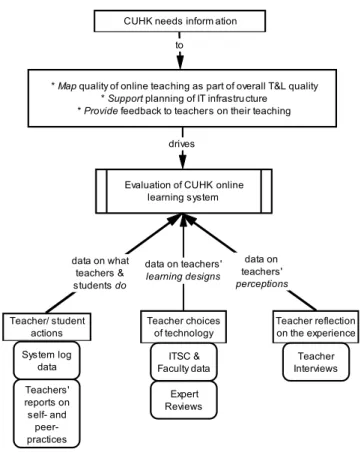
The study (eL@CU) was composed of three phases. A number of methods were used to collect data so as to: (1) understand the general use of the Web technology in teaching and learning across the university as a whole; (2) understand more about e-learning processes by inspecting selected active course Web sites; and (3) get a deeper understanding of e-learning from the teachers’ points of view by interviewing a group of selected teachers who have been actively engaged in e-learning. Our evaluation design is summarized in Figure 1; the data collected for the study are listed in the boxes at the bottom of Figure 1.
Phase 1 of the Study: General Use Over the University
In this first phase of the study, multiple sources of data were used to reveal the current status of e-learning at the university. The data sources about the abundance and nature of the educational Web sites at the university were:• the system log records of the two learning management platforms WebCT and CUForum;
• the feedback received from a university-wide e-mail survey conducted in the beginning of May 2004;
• the information obtained informally from colleagues in the university’s seven faculties concerning the use of the Web by teachers in their faculties; and • a description of a number of Web sites not hosted by ITSC, shortlisted by going
through information contained in departmental Web sites; from data provided by the Faculty of Engineering, the largest user of such sites (216 in the 2003-2004 year); and by checking the validity of a self-reporting course Web site list which has been developed during the past three years ago (CUHK WBT Links, 2003-2004).
Figure 1. Evaluation design for the eL@CU study
data on teachers' perceptions data on what teachers & students do data on teachers' learning designs to drives
Evaluation of CUHK online learning system Teacher reflection on the experience Expert Reviews Teacher/ student actions System log data Teacher choices of technology ITSC & Faculty data
* Map quality of online teaching as part of overall T&L quality * Support planning of IT infrastructure
* Provide feedback to teachers on their teaching CUHK needs inform ation
Teacher Interviews Teachers' reports on self- and peer-practices
During the 2003-2004 academic year, there were 877 WebCT sites serving 1,113 courses (some teachers use the same WebCT site to teach several courses), 708 forum sites in the home-grown CUForum platform, and 291 course sites on non-ITSC-supported servers based in departments and faculties. In 2003-2004, WebCT and CUForum attained an average annual growth rate of 30% and 23%, respectively, in the number of courses and forums hosted. Site log records also showed that 70% of the entire student population were WebCT or CUForum users. Within a short period of time, the growth in the number of students will approach saturation; however, the intensity of e-learning use also needs to be considered and is continuing to rise. At present, during semester time, there are more than 4,000 accesses to course Web sites each day, and this is about two and a half times the number two years ago.
However, despite this increasing trend in e-learning use, e-learning is far from a popular teaching and learning strategy at the university. Among the 4,637 (undergraduate and postgraduate) courses offered at CUHK in the 2003-2004 year where the enrolments were greater than 10 students, only about 45% had a supplementary online course site. So, while most students have some online experience, this is usually not in all the courses they study. This percentage shows that e-learning at CUHK is still largely in the “innovators” and “early adopters” stages of Rogers’ (2003) phases of technology take-up; we cannot comfortably claim that e-learning is a “mainstream” trend. The “chasm” (Moore, 1991) between the early adoption and mainstream use is one we now need to bridge.
Generally speaking, as shown in Figure 2, content provision and discussion are the most widely used functions, and quizzes are rarely used. To what extent, the content is “static” or “interactive” could not be determined at this overall level. This was one of the reasons we looked at a number of individual sites, as will be described later.
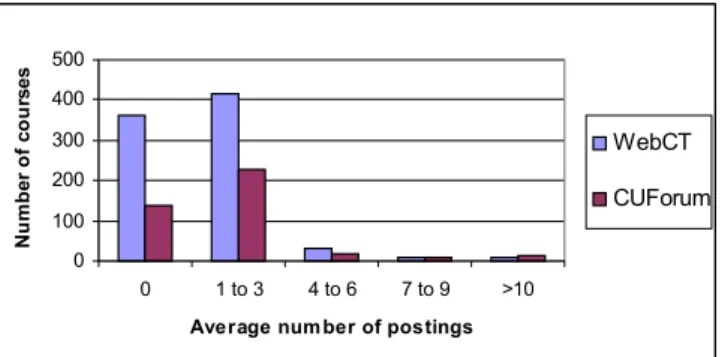
Regarding the discussion function, the records show that there were 10 courses that had more than 1,000 discussion messages. However, most of the forums in general were not very active; Figure 3 indicates that most of the forums in courses in both the WebCT and CUForum platforms have less than three postings. CUHK is a relatively small university
Figure 2. Web functions in the Web sites hosted in WebCT and CUForum
Percentages of investigated courses 100 80 60 40 20 0
Quiz Content Discussion Content Discussion CUForum WebCT
Functions used Functions not used
and all undergraduate, and most postgraduate, courses have strong face-to-face com-ponents. Therefore, it is not surprising that online communication is not used to a great extent. However, we consider that this very low level represents some lost opportunities for students to articulate and explore ideas in a reflective manner and to practice written communication skills in both English and Chinese.
Usage of non-core functions like “assignment drop-box” and “online quizzes” has been growing, but in 2003-2004, they were still rarely utilized. For example, less than 10% of the WebCT course site owners made use of the quiz function (Figure 2). Most Hong Kong universities are still exam-oriented with the focus of assessment being of a summative nature with formal tests and examinations. The importance of formative assessment for learning is not as strong as in the UK or Australia. This is one possible explanation for the lack of interest in online quizzes. The other is that at a research-intensive university such as CUHK, there are few rewards for activities such as writing and Web-mounting quizzes, an activity that can be time-consuming.
Phase 2 of the Study: Evaluation of Selected Active Sites
Broadly, the Web enables communication and also provides access to information and tasks. Across these two broad areas there are four main teaching and learning functions that the Web usually enables (McNaught, 2002). These are:1. Discussion/ communication: The use of forums is the primary form.
2. Assessment and feedback to learners: Here quizzes and peer review activities can be used.
3. Study management and skills support: In this grouping is a range of “static” information and resources, including lecture notes.
4. Content enrichment: In this grouping, the resources are intended to be more interactive or task-oriented.
Figure 3. Number of postings made by students in WebCT and CUForum forums (counts are for whole courses running in 2003-2004)
0 100 200 300 400 500 0 1 to 3 4 to 6 7 to 9 >10 Average number of postings
N um be r of c our se s WebCT CUForum
In order to select “active” WebCT, CUForum, or “non-ITSC” Web sites, we used a rough quantitative measure. Essentially, we looked at the logs in order to find courses with active use of the main four teaching and learning functions described. In this way, a set of 30 “active” sites was selected. These were examined by the first three authors who, together, have developed a rich set of technical and educational experience in advising and assisting teachers in learning enhancement through e-learning. They reviewed these course-related Web sites at the university in three expert-review meetings. These sites were classified using a “matrix”; each Web site was listed as “high,” “medium,” or “low” on a refined list of 22 Web functions, which were an elaboration of the four main functions
Table 1. Categories used in examining active Web sites and the experts’ ratings
No.
inst.1 High (3) Med. (2) Low (1)
Wt. mean 2 A. Communication Asynchronous 1. Forum 13 2 3 8 1.5 2. Chat-room 0* 3. Graphic-enabled Chat 0 4. eLecturing 0 Synchronous (can be reviewed when the exchanges
are archived) 5. Video-Conferencing 0
B. Assessment & feedback to learners
6. Quizzes 7 6 0 1 2.7
7. Online feedback of
assignments 3 0 1 2 1.3
8. Peer review 1 1 0 0 3.0
C. Study management & skills support
9. Course information 24 8 6 10 1.9 10. Teacher’s information 11 5 1 5 2.0 11. Lecture notes and/or PPTs 27 21 3 3 2.7 12. Lab notes/ Lab handbooks/
Tutorial questions/ 9 7 2 0 2.8 13. Learning skills (tips, links,
inventories) 0
D. Content enrichment
14. Online learning resources 3 1 2 0 2.3 15. Past papers and
assignments 5 3 1 1 2.4
16. Glossary 3 3 0 0 3.0
17. FAQ on content 0
18. Cases and scenarios 1 1 0 0 3.0 19. Students’ work/
presentations as resources 3 3 0 0 3.0 20. Role-related games 1 0 1 0 2.0
21. Tools 1 0 1 0 2.0
22. Student websites 0
* The zero entries have still been included because we do have cases at CUHK where these Web functions are used, though not in this sample of 30 sites. 1 Number of instances 2 Weighted mean
mentioned. Table 1 shows the number of cases where each of the functions were found to be in use and how the “experts” rated them according to both the quality and quantity of the materials presented. For example, a “high” rating on a forum was given when there were several postings per student and the quality of the postings was substantive. This involved, of course, looking at the forum statistics and reading through the postings. A “low” forum had few postings, mostly about procedural matters such as due dates and so forth. The ratings were done by an iterative process, which was time-consuming and intensive, as most processes involving qualitative judgements are. The final rankings were independently confirmed by the fourth author.
The functions in order of popularity were content related to study management (71 instances), content enrichment (17 instances), discussion forums (13 instances), and feedback to learners (11 instances). This is a content-focused picture. It is heartening that while the number of cases listed under “content enrichment” is low at 17, it does, however, indicate that more than half of these active e-teachers had designed and developed opportunities for learners to interact and work with online content resources.
If we compare our list with the learning designs mentioned in the background section (Learning designs, 2003; Hedberg et al., 2002), we can see that some, but not the majority, of our CUHK active teachers use the Web to carry out the following learning designs: • Collaborative activities: The two “high” forums are examples here.
• Focus on conceptual or procedure development: Examples are the six “high” quizzes, the one “high” peer review, and the several “high” examples in “study management and skills support” and “content enrichment.”
• Problem-based learning: Sadly, there are zero in this sample.
• Use of practical projects or case studies: There is one “high” example. • Role-play: There is one “medium” example.
Of course, this is not to say that these learning designs are not used by other teachers in this group, and across the university, in paper-based and face-to-face forms. Indeed, we know that this occurs. However, currently, there is little use of the Web to support these learning designs. It is another “chasm” we feel needs to be bridged.
Phase 3 of the Study: Experiences of Selected Active
E-Teachers
Twenty-six teachers who were actively engaged in e-learning were interviewed about their stories of using the Web and their reflections on their experiences. They were either the site owners of the selected sites described or were selected based on responses made to a university-wide teacher e-mail survey in May 2004 which revealed several enthusi-astic and committed e-teachers. The teachers were interviewed from July to September 2004 in the third phase of the study. The group of 26 teachers included representatives from all of the seven faculties at CUHK (arts, business administration, education, engineering, medicine, science, and social science). The sample is not a representative
sample of CUHK teachers. We were not trying to find out why some teachers are not interested in e-learning. The purpose of these interviews was to find out the perspectives and priorities of teachers who are already engaged in learning. How can future e-learning support services improve the better course Web sites so that they become effective exemplars for others? It has been our experience in the past that working with keen teachers who become models for their peers is more effective than trying to persuade reluctant teachers to set up a course Web site (McNaught, 2003b; Inglis, Ling, & Joosten, 2002, chapter 8). In other words, we are focusing on our more experienced e-teachers in considering how best to cross the chasm toward mainstream use of e-learning at CUHK. During the interviews, several areas of interests were discussed. Questions asked included:
Q1: What was the rationale behind your setting up this Web site? Or using the resources you have selected for your course?
Q2: What was the story of how you used the site (how, what, when, etc.)?
Q3: Were the original purposes of using the Web achieved? How do you know?
Q4: What do you feel about the experience of teaching online (i.e., workload, changes in teaching methods, strengths and weaknesses)?
Q5: What is your next plan for using the Web in teaching (if any)?
The interviews were each about an hour long. They were recorded and a summary of each interview was made the same day as the interview and approved by the teachers. Most of the interviews were conducted in Cantonese. Direct quotes are not given in the discussion, as the time involved in producing accurate translations did not seem to be warranted in this study.
The Current E-Learning Situation at
CUHK: The Qualitative Focus
The more quantitative data from phases 1 and 2 were already described to some extent previously, alongside the description of how the data were extracted. The third phase of the study (interviews with 26 teachers) was especially revealing about current e-learning needs at the university. The summary reports from all 26 interviews were then analyzed by classifying the teachers’ comments into three groups:
• What teachers generally want from e-learning (teachers’ needs). Why do teachers use learning technologies? What do they hope to achieve?
• What teachers actually do toward achieving their “wants” (teachers’ practices). What is actually on their course Web sites? What are the tasks they set students to do online?
• What resources teachers have as support (teachers’ context). What financial support do they have for building or obtaining content resources? What technical help do they have access to?
Any individual point made by a teacher was recorded as one count in the frequencies reported. The resulting pattern of responses was examined in order to suggest some clear strategic directions.
Teachers’ Needs: What They
Want
One of the key question sets asked in the teacher interviews was “What was the rationale behind your setting up this Web site? Or using the resources you have selected for your course?” The teachers’ replies were multifaceted and yet could be grouped into two main themes — “teaching efficiency” and “learning enhancement.”
Teaching efficiency is not a surprising finding in that the use of the Web to assist with large class management, giving out announcements, arranging logistics for activities, distributing notes, course material and information, is quite common with these teachers. For example, a teacher from the English Language Teaching Unit said that the Web could ease her marking load by the use of the automatically generated online quiz scores produced by WebCT. A computer science and engineering teacher said that the Web could let him disseminate a higher quality of information more easily.
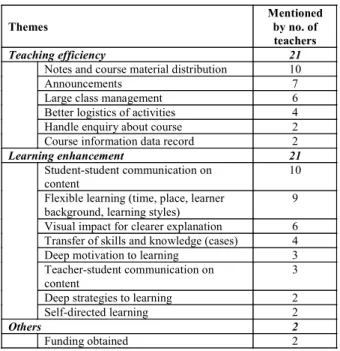
It is pleasing that learning enhancement was the other main objective that the teachers clearly wanted to achieve through the Web. This was mentioned as frequently as teaching efficiency, each 21 times (Table 2). Student learning was expected to be enhanced in various ways, such as: introducing flexible learning so that students with different backgrounds and learning styles could engage in online learning at varied times and places; and improving students’ motivation. For example, a teacher from management said that accessibility and flexibility particularly benefited the part-time MBA students.
Some hoped that their interactive Web materials would provide better explanations of different concepts; some were hoping for enhanced cognitive skills such as problem-solving; and some wanted students to engage in meaningful online discussions to enhance their capacity for critical thinking. A psychology teacher, for example, regarded the Web forum as a place for idea exchange and sharing about a number of different perspectives.
While teachers spoke about wanting to support their students’ learning, they did not do this from any theoretical standpoint. For example, the language of constructivism is just not part of the vocabulary of CUHK teachers. Course outlines here are still often described in terms of lists of content topics, and, while there is an increasing focus on the development of intellectual and communicative capabilities, teachers still largely think of learning in terms of becoming knowledgeable about the concepts and processes of particular disciplines.
Teachers’ Practice: What Teachers
Do
What the teachers said about what actually happened on their course Web sites on the whole seemed to fall short of effectively achieving what they want described above. Teachers were asked what Web functions were actually used in their teaching. Each teacher mentioned one or more functions used. Their mentioned Web functions were compiled together. Two rounds of classification and categorization were worked out and five main categories of Web functions resulted:
• Content delivery: uploading files — mentioned 25 times.
• Communication: the use of forums for communication and interaction among class members — mentioned 19 times.
• Assignment and grading management: the use of the virtual learning environment as a platform for assignment distribution, assignment submission and assignment grading distribution — mentioned 11 times.
• Information dissemination: the dissemination of course-related information to students — mentioned nine times.
• Engagement: the allocation of some marks for online participation — mentioned six times.
Table 2. Main themes of what the 26 teachers want
Themes Mentioned by no. of
teachers
Teaching efficiency 21
Notes and course material distribution 10
Announcements 7 Large class management 6
Better logistics of activities 4 Handle enquiry about course 2 Course information data record 2
Learning enhancement 21
Student-student communication on
content 10
Flexible learning (time, place, learner
background, learning styles) 9 Visual impact for clearer explanation 6 Transfer of skills and knowledge (cases) 4 Deep motivation to learning 3 Teacher-student communication on
content 3
Deep strategies to learning 2 Self-directed learning 2
Others 2
The main way the teachers used the content delivery function was to put up notes and PowerPoint slides (15 of the 26 cases). The next common use was for content on the Web as course and reading materials (13 of the 26 cases). Multimedia and interactive learning resources were comparatively rare (three cases); these few teachers included many videos and animations in their course sites to provide visual support for students’ learning and understanding of the course topics. For this small minority of teachers, the Web was clearly more than a convenient storage house for easy distribution of course materials to students.
Most communications were done through online forums and the design was simple: mostly teacher-student communication about course and course content, and some student-student communication concerning discussion topics assigned by the teachers. However, some more sophisticated online activities were mentioned by a few teachers, such as “online debates” and peer-review activities. As noted, the teachers interviewed were the more experienced teachers in e-learning. If we look again at the overall CUHK picture, we can see that participation in most of the forums in the sites was low, with students, on average, posting one to three messages (Figure 3).
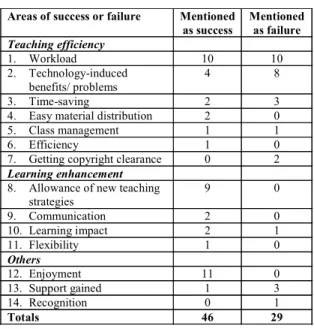
During the interview, teachers were invited to talk about their feelings about their success or failure in achieving what they wanted in using the Web in their teaching. More positive feelings than negative feelings were mentioned (46 versus 29). However, these related to the learning enhancement area, and to matters such as students’ enjoyment; there are more negative comments than positive comments in the teaching efficiency area. Table 3 is a summary of these feelings. The comments received concerning the teaching efficiency theme are mixed: for example, 10 felt positive about workload, while 10 felt
Table 3. Successes and failures mentioned by the 26 teachers
Areas of success or failure Mentioned
as success Mentioned as failure
Teaching efficiency
1. Workload 10 10
2. Technology-induced
benefits/ problems 4 8
3. Time-saving 2 3
4. Easy material distribution 2 0 5. Class management 1 1
6. Efficiency 1 0
7. Getting copyright clearance 0 2 Learning enhancement
8. Allowance of new teaching
strategies 9 0 9. Communication 2 0 10. Learning impact 2 1 11. Flexibility 1 0 Others 12. Enjoyment 11 0 13. Support gained 1 3 14. Recognition 0 1 Totals 46 29
negative; four mentioned technical benefits, while eight mentioned technical problems; and two mentioned that e-learning actually saved time, while the other three said the opposite. Teachers mentioned that putting materials online raises the concern of violating copyright laws. They also were concerned about dealing with plagiarism problems as the use of the Web as an information source is increasing. Especially in an English-as-second-language environment, the “temptation” to plagiarize is high. The teachers seemed to be more positive about using the Web for learning enhancement. As shown in Table 3, a few teachers mentioned the success of the Web in gaining “flexibility,” “efficiency,” “learning impact,” “communication,” and “allowance of new teaching strategies.” A teacher from sports science and physical education said that he had used the Web in his courses for several years, and he had the impression that the students scored higher in their skill-related assessments. An experienced teacher of Japanese studies said that some students had attained better language skills than he originally expected.
The teachers, however, also remarked that these impressions of success or failure are the result of mostly subjective and non-systematic observations on each teacher’s part, usually by talking to one or few of the students. For example, one teacher realized the students in his science course had benefited from the animations that showed molecular motions. Another teacher talked about his students in his architecture class enjoying three-dimensional visual impacts from computer graphics. Few systematic evaluations on the effect of e-learning on students’ learning have been carried out at CUHK. To date, these teachers had been putting effort into designing and developing Web materials and activities, but not into evaluating their effectiveness. So, while they wanted learning enhancement as much as teaching efficiency, they had only anecdotal evidence about how successful they were in this regard.
Teachers’ Context: What Teachers Have for
Support
The teachers told us that most of them (11 out of the 26) rely on their teaching or research assistants (mostly postgraduate students) to build and maintain the Web sites for them. Some technical services are available in some departments, but this is by no means ubiquitous. Some teachers were fortunate to receive CDG or other funding so they could develop their courses in one condensed time period. However, most of them said they no longer have resources for further development and even have difficulties in maintain-ing their course sites.
Teachers generally felt that support from their departments and from their peers was insufficient. They would like departments to have a clearer policy about encouraging and supporting e-learning. Also, teachers felt disappointed that their effort on building a Web site was not recognized by their peers and their department heads. The university does have “innovative pedagogy” as a criterion for promotion, but, at this research-intensive university, research grants and publications still hold sway. A teacher from management said that though she was a pioneer of e-learning five years ago, she did not use the Web extensively now because the workload was too heavy.
A Diagrammatic Summary
and Interpretation of the
CUHK Teachers’ Perceptions
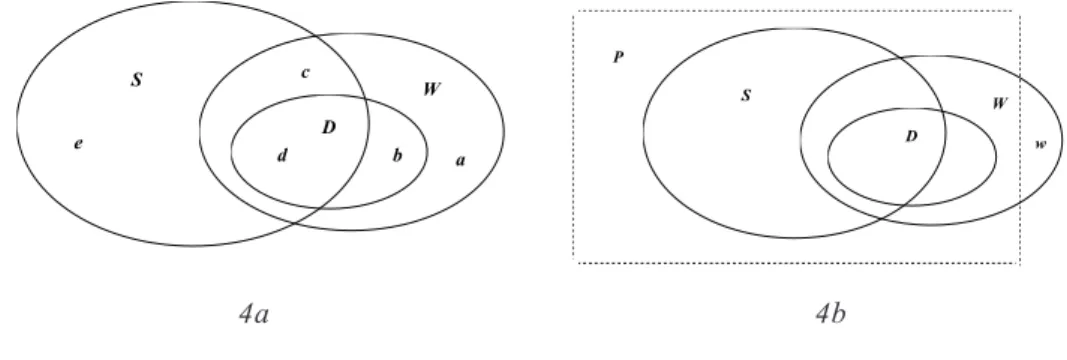
The situation at CUHK is illustrated in Figure 4. We have used this diagrammatic form to try to get an overview of the multiple factors operating in our own situation. The size of ellipses is not to scale but the purpose of the diagram is to show relationships and positioning. W represents what the teachers want. S is the set of e-learning-related services teachers have for support. D is what the teachers at the end actually do as we explained previously. It is an interpretative diagram that we then use to see what needs to change in the CUHK context in order for better alignment to occur. We have found this form of visual “mapping” to be a useful strategy in supporting decision-making. In Figure 4a, area a represents what the teachers want to achieve but in the end fail to realize, probably because of lack of support. This area includes technical difficulties (e.g., complex material development), time issues (e.g., getting assistance to quickly and easily build and maintain the Web sites), educational advice on design and evaluation, and recognition and departmental support. There is an area b where teachers still manage to work out something on their own without much support from the institution. This area includes: spending time and effort on preparing materials; maintaining personal servers; and doing limited evaluations. Area c includes the needs of the teachers that they cannot currently realize; instead they relegate them into their future plans. Materials with more interactivity and richer coverage are examples. In area d are the needs realized with institution’s support. Area e includes existing services that seem to be neglected, at least by the 26 teachers interviewed. These services include the assignment drop-box function, online quizzes, multimedia possibilities, and videoconferencing.
Figure 4b has an additional area P to represent the other learning and teaching possibilities that the Web can support, but which are now not actively supported at our university. Teachers may not be aware of this “potentials” territory. One example is mobile technology; while there are a number of mobile projects in Hong Kong (e.g., Csete, Wong, & Vogel, 2004), this is not a feature of e-learning support at CUHK. P is portrayed
Figure 4. What teachers want, do, and have as support (see text for key)
4b 4a S D e d c W a b S D W w P
in a dotted line because the margins of the possibilities are not clearly known yet, and indeed the boundaries are constantly shifting. We have also included an area w that relates to unrealistic requests that some teachers have; for example, a quest for convenience to the extent that teachers are waived all the workload of building and maintaining the site is not reasonable.
Future Directions for
E-Learning at CUHK
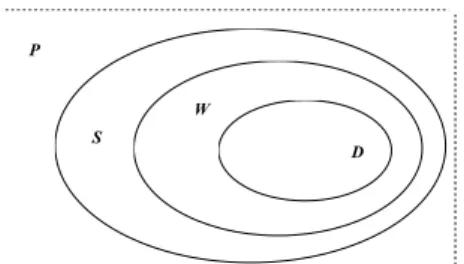
The idealized situation of the e-learning situation is portrayed in Figure 5. It is a situation where there is a closer match between the potential of the Web, the support given to the teachers, what the teachers want, and what they do.
Contrasting Figures 4 and 5, there seem to be indications of how the improvement of the whole e-learning situation can be achieved:
• building awareness in teachers about a wider range of strengths, weaknesses, potentials, and strategies of e-learning through professional development (to enlarge the W area and shift W to fall within P);
• provision of concrete commitments and long-term resources to teachers (extension of S to cover W) to support teachers through all the stages of planning, develop-ment, implementation, and post-implementation;
• enabling teachers to design better e-learning environments (extension of D); • researching and evaluating the various e-learning strategies (extension of W, D and
S to cover more of P). Some examples are Web-enabled cultural interactions between students in different countries, peer and group assessments, self-directed learning, and so forth. We do have a few “pioneering” teachers in these areas who can help to explore the limits of the potential.
Figure 5. Idealized e-learning situation
S
D W
In order to do this, changes in the three areas of policy, culture, and support (McNaught et al., 2000) are needed. Policy changes are needed to provide the resources to give more effective support that might produce better exemplars as models. These exemplars can support the process of changing the culture of teaching and learning so that innovation, including in e-learning, is adequately rewarded, but that also requires policy changes , and so the interactions continue.
Final Comment
In this chapter, we have outlined the ways in which we have tried to get a clear picture of e-learning at a highly devolved university. We have tried to articulate the educational value system of our CUHK teachers. We have found some excellent e-teachers and some good examples of e-learning. However, it is clear that e-learning at CUHK is still largely in the “innovators” and “early adopters” stages and we are facing a “chasm” before we can enter the “mainstream” area. This chasm is currently causing an under-utilization of the potential of the Web in supporting teaching and learning. Re-design and extension of our services can provide better matches between what teachers want from the technology, what they actually do, and what they have access to as support; this is critical in overcoming the chasm. A report on this study has been presented to the university who has agreed that this study provides sufficient evidence to justify the establishment of an e-learning centre; through this centre we will be able to provide consultancy support to each department of the university. Without the evidence of the study, we would not have been successful. We are hopeful that this study that has been of value to our own university may be of interest to others.
References
Bond, M.H. (1991). Beyond the Chinese face: Insights from psychology. Oxford: Oxford University Press.
The Chinese University of Hong Kong, Web-based Teaching and Learning Project (2002). Retrieved September 14, 2005, from www.cuhk.edu.hk/wbt
The Chinese University of Hong Kong. (2003-2004). Web-based teaching links. Re-trieved September 14, 2005, from http://www.cuhk.edu.hk/wbt/wbtlinks/
Csete, J., Wong, Y.H., W. & Vogel, D. (2004, June 21-26). Mobile devices in and out of the classroom. In L. Cantoni & C. McLoughlin (Eds.), ED-MEDIA 2004 (pp. 4729
-4736). Proceedings of the 16th annual World Conference on Educational
Multi-media, Hypermedia & Telecommunications, Lugano, Switzerland. Norfolk, VA: Association for the Advancement of Computers in Education.
De Freitas, S., & Oliver, M. (2005). Does e-learning policy drive change in higher education? A case study relating models of organisational change to e-learning implementation.Journal of Higher Education Policy and Management, 27(1), 81-96.
e3Learning (enrich, extend, evaluate learning) project. Retrieved September 14, 2005, from http://e3learning.edc.polyu.edu.hk/
Eisenstadt, M., & Vincent, T. (Eds.) (1998). The knowledge Web: Learning and collabo-rating on the net. London: Kogan Page.
Hedberg, J., Wills, S., Oliver, R., Harper, B., & Agostinho, S. (2002, June 24-29). Developing evaluation frameworks for assessing quality ICT-based learning in higher education. In P. Barker & S. Rebelsky (Eds.), ED-MEDIA 2002 (pp. 729-735).
Proceedings of the 14th annual World Conference on Educational Multimedia,
Hypermedia & Telecommunications, Denver, CO. Norfolk, VA: Association for the Advancement of Computers in Education.
Inglis, A., Ling, P., & Joosten, V. (2002). Delivering digitally: Managing the transition to the knowledge media. London: Kogan Page.
Kearsley, G. (2000). Online education: Learning and teaching in cyber-space. Belmont, CA: Wadsworth/Thomson Learning.
Kember, D., Ma, R., McNaught, C., & 18 exemplary teachers (in press). Excellent university teaching. Hong Kong: Chinese University Press.
Laurillard, D. (2001). Rethinking university teaching: A framework for the effective use of educational technology (2nd ed.). London: Routledge.
Learning designs (2003). Retrieved September 14, 2005, from www.learningdesigns.uow.edu.au/index.html
Levy, P. (2003). A methodological framework for practice-based research in networked learning. Instructional Science, 31, 787-109.
McNaught, C. (2002). Adopting technology should mean adapting it to meet learning needs. On The Horizon, 10(4), 14-18.
McNaught, C. (2003a). Supporting the global eTeacher. International Journal of Training and Development, 7(4), 1-16.
McNaught, C. (2003b). The effectiveness of an institution-wide mentoring program for improving online teaching and learning. Journal of Computing in Higher Educa-tion. 15(1), 27-45.
McNaught, C. (2005). Integrating teaching and learning principles with IT infrastructure and policy. In K. Fraser (Ed.), Education development and leadership in higher education. Developing an effective institutional strategy (pp. 108-128). London: Routledge Falmer.
McNaught, C., & Lam, P. (2005). Building an evaluation culture and evidence base for e-learning in three Hong Kong universities. British Journal of Educational Technology, 36(4), 599-614.
McNaught, C., Lau, W.M., Lam, P., Hui, M.Y.Y., & Au, P.C.T. (2005). The dilemma of case-based teaching and learning in science in Hong Kong: Students need it, want it, but may not value it. International Journal of Science Education, 27(9), 1017-1036.
McNaught, C., Phillips, P., Rossiter, D., & Winn, J. (2000). Developing a framework for a usable and useful inventory of computer-facilitated learning and support materials in Australian universities. Evaluations and Investigations Program report 99/11. Canberra: Higher Education Division Department of Employment, Education, Training and Youth Affairs. Retrieved September 14, 2005, from www.dest.gov.au/highered/eippubs1999.htm
McPherson, M. (2004). Developing innovation in online learning: An action research framework. London: Routledge Falmer.
Moore, G.A. (1991). Crossing the chasm. New York: Harper Business Essentials. Nisbet, R.E. (2003). The geography of thought. New York: The Free Press.
O’Connor, M.C. (1998). Can we trace the efficacy of social constructivism? Review of Educational Research, 23, 25-71.
Preece, J. (2000). Online communities: Designing usability, supporting sociability. Chichester: Wiley.
Rogers, E.M. (2003). Diffusion of innovations (5th ed). New York: Free Press.
Schoenhals, M. (1994). Encouraging talk in Chinese classrooms. Anthropology & Education Quarterly, 25(4), 399-412.
Swan, K. (2003). Learning effectiveness: What the research tells us. In J. Bourne & J.C. Moore (Eds.), Elements of quality online education (vol. 4). Olin and Babson Colleges: Sloan Center for Online Education.
Taylor, P., & Maor, D. (2000). Assessing the efficacy of online teaching with the Constructivist On-Line Learning Environment Survey. Teaching and Learning Forum 2000. Retrieved September 14, 2005, from http://lsn.curtin.edu.au/tlf/tlf2000/ taylor.html
University Grants Committee (2005). www.ugc.edu.hk/eng/ugc/site/fund_inst.htm Wenger, E. (1998). Communities of practice: Learning, meaning, and identity.