University of Pennsylvania
ScholarlyCommons
All Penn AHEAD Papers Penn AHEAD
9-13-2018
Government Models for Financing Higher
Education in a Global Context: Lessons from the
US and UK
Pedro Villarreal III Alan Ruby
Follow this and additional works at:https://repository.upenn.edu/ahead_papers
Government Models for Financing Higher Education in a Global Context:
Lessons from the US and UK
Abstract
This paper reviews common funding approaches/models found in the US and UK as well as the
philosophical, political, and economic rationales underpinning their use, and the policy environments that contributed to their adoption in the hope of informing substantive policy discussion, decision-making, and implementation. It finds that different funding approaches/models may be appropriate based on the contextual realities and current circumstances of a country. Thus, incremental approaches might reflect government interests, but may not serve the public good. Enrollment based approaches (per capita and per credit) have advantages and remain viable options for adoption for nations seeking to expand access to higher education. Performance funding options may be appropriate when a robust system of higher education exists, and government seeks performance outcomes as a tool in promoting special projects or government priorities. However, those nations considering based models may need a fair warning. The performance-based approach has yet to be proven to be the panacea it was purported to be, at least in the US and UK.
Keywords
higher education funding, financing models
Copyright/Permission Statement
This work is licensed under aCreative Commons Attribution-Noncommercial-No Derivative Works 4.0 License.
Government Models for
Financing Higher Education
in a Global Context:
Government Models for Financing Higher Education in a Global Context: Lessons from the US and UK
Pedro Villarreal III and Alan Ruby
Acknowledgements
This paper is the result of Penn AHEAD’s continued engagement with the development of higher education in post-soviet Kazakhstan, and is a part of a larger project on Academic Credits Based Per Capita Higher Education Funding for Kazakhstan: Possible Models and Impact on National
Higher Education Student Mobility, Institutional Budget Sustainability, and Institutional Development led by faculty of Nazarbayev University’s Graduate School of Education and funded by the Ministry of Education
and Science of Kazakhstan.
Suggested Citation
Villarreal, P., & Ruby, A. (2018). Government Models for Financing Higher Education in a Global Context: Lessons from the US and UK. Philadelphia,
PA: Alliance for Higher Education and Democracy (Penn AHEAD), University of Pennsylvania Graduate School of Education.
Contents
Preface ... iv
Executive Summary ... 1
Introduction ... 2
Economic Context of a Higher Education ... 2
Political Movements and Student Unrest ... 2
Financial Austerity and the Public Funding of Higher Education ... 3
Cost Containment ... 3
Funding Models ... 3
Purposes of Higher Education ... 4
Beneficiaries of Higher Education ... 4
Structures of Higher Education ... 5
Financial Oversight and Governance Structures ... 5
Public Tuition Models ... 6
Cost-Sharing in Higher Education ... 7
Cost-Sharing by Students/Parents: Tuition and Fees ... 8
Cost-Sharing by Student/Parent: Out-of-State or Country Tuition Rates ... 9
Cost-Sharing by Students/Parents: Loans ... 10
Models/Approaches of Public Funding ... 10
Incremental-based Approaches to Funding ... 10
Per capita-based Approaches to Funding ... 11
Per credit-based Approaches to Funding ... 12
Performance-based Approaches to Funding ... 12
Synopsis of Funding Approaches/Models ... 14
General Summary ... 15
References ... 17
Appendix 1 ... 22
iv
Preface
The philosophical, political, and economic rationales driving national and international higher education policies are critical in understanding the models, structures, and systems of higher education finance employed in the US and UK. As demand for higher education—whether from domestic or international students—waxes and wanes, governments reconsider the public and other financing structures used in their higher and postsecondary education systems.
Two economic rationales are associated with the development of higher education: demand-side and supply-side perspectives. In a supply-side rationale, government invests in the physical infrastructure (land, building costs, etc.) and may provide the incentives (e.g., financial aid programs) for citizen participation in higher education. In a demand-side higher education framework, the government responds to increased public interests in a higher education by providing and promoting institutional support, typically on a temporary basis, until institutions can manage using their institutional resources to meet demand.
Under the demand-side rationale, the government lets market forces direct the formation and expansion of higher education, intervening only when necessary to fill a gap or sudden rise in demand. In a supply-side rationale, the government actively participates in policy formation that increases citizen interest in and motivation to acquire a university credential.
A balance in both demand-side and supply-side rationales is assumed to be the undergirding philosophical approach needed in any developed or emerging economy to ensure a robust higher education system that contributes to the economic and social well-being of a state or country. It allows some measure on individual choice and market forces while preserving a role for the state in shaping the system to address national priorities or aspirations.
Early in the development of a national or state system of higher education, governments tend to create environmental conditions supportive of higher education. Using supply-side rationales, they enact federal or state legislation or increase their taxes to aid in establishing institutions of higher education like the US (e.g., Morrill Land Grant Act of 1862).
In more developed systems of higher education, governments promote policies concurrently with the employment sector. The government and employment sectors increase the demand-side of the equation by enacting policies or legislation that restrict the practice of certain professions or occupations to people with specific degrees or credentials. Additionally, employers use directives or hiring practices that promote the acquisition of specific credentials for the purpose of occupational promotion or salary increases. In tandem, these two serve to increase interest in and use of higher education over time.
We agree that the development of higher education is critical to the vitality of a nation. Furthermore, the vitality of a domestic system of higher education is predicated on the financial structures or systems used. In this report, we explore the lessons learned in the US and UK financing structures. Pedro Villarreal III
Executive
Summary
Creating and maintaining a higher education system, and the financial structures needed to sustain it, is an important step in the development of a robust and diversified national economy. Stimulated by conditions their governments encouraged, the US and UK systems of higher education emerged through centuries of public and private investments.
The purpose of this report is to identify aspects of the higher education funding models employed in the US and UK that could be useful in developing economies, particularly as government priroities may shift and the policies change in higher education. An ancillary purpose is to describe the principles and rationales that help to structure the funding models leading to more supportive structures for higher education.
This report reviews and critiques common funding approaches/models found in the US and UK as well as the philosophical, political, and economic rationales underpinning their use, and the policy environments that contributed to their adoption. It presents the arguments and counterarguments useful in substantive policy discussion, decision-making, and implementation. The following represent some important lessons learned in the US and UK about the four common funding models used in higher education.
Incremental-based Approaches
Incremental funding models are easy to implement and lead to low volatility in funding but are often viewed as inequitable by institutional leaders.
Per Capita-based Approaches
These funding models are viewed more favorably but often fail to account for differences in the type of student enrolled and the variable costs of different academic programs.
Per Credit-based Approaches
Per credit funding models are viewed as more equitable and less complicated than performance-based models, but they tend to have more reporting requirements than per capita approaches.
Performance-based Approaches
Performance funding models are politically appealing to governments and the public but tend to be complex, needing constant review, and are still susceptible to manipulation by institutions. The report finds that different funding approaches/models may be more appropriate to adopt and implement given the contextual realities and current circumstances of a country. Incremental
approaches might serve government interest, but it may not serve the public good. Enrollment based approaches (per capita and per credit) have advantages and remain viable options for adoption as a nation continues to expand its higher education. Performance funding options may be more appropriate once a robust system of higher education exists, and government seeks performance outcomes as a tool in promoting special projects or government priorities. However, those nations considering performance-based models may need to heed a fair warning. The performance-based approach has yet to be proven to be the panacea it was purported to be, at least not in the US and UK.
2
Introduction
Even as national youth population levels stagnate, the demand for higher education continues rising in the US, UK, and elsewhere—particularly in developing countries. Given the increase in demand, Johnstone and Marcucci (2010) argue that it is ever more critical to consider the costs associated with the expansion and delivery of higher education required to fill this need. Today, the finance of higher education serves as a focal point driving concerns about higher education’s relevance and importance in society. These concerns are shared by students, families, employers, and policymakers (Kelly & Goldrick-Rab, 2014) as well as the professional associations which often regulate admission to fields like medicine, law, and engineering. Consequently, governments struggle to fund their systems of higher education sustainably and to do so with the continued political support of their constituents.
Whether warranted or not, the higher education degree or certificate is the credential that employers look to as a signal of the skills and knowledge needed (signaling theory) to hire productive employees (Spence, 1973). A reliance on higher education credentials in employment is common in advanced economies such as the US and UK and is also found in developing countries. Research has found positive associations between the average level of education in a populace and the level of productivity (typically measured as Gross Domestic Product [GDP]) within those countries. The OECD (2012) reports that over half of the growth in GDP from one year to the next is attributable to an increase in the proportion of the national population who earn a higher education credential.
Economic
Context
of
a
Higher
Education
Political Movements and Student Unrest
Examining the effects of the shift in the US toward privatization of higher education, and a shift in the UK toward a lack of equity in access to higher education, Murphy, Scott-Clayton, and Wyness (2017) found a rise in criticism of the fiscal policies enacted and funding models employed to underpin these shifts. From opposite ends of the political spectrum, voices have been challenging and pressing for changes to the current models of practice in finance of higher education. For example, in England, higher education was mostly publicly funded until 1989. But the confluence of financial austerity policies by government and a deepening concern that it was largely children from the wealthiest families who were enrolling in and benefitting from higher education stimulated demands for policy change.
In the US, the evolution in higher education finance policies has shifted toward a more privately funded system raising debates about a lack of affordable higher education for students from lower-income and poverty backgrounds. The challenge has been to find a model that will provide financial access (college affordability) but do so with a focus on equity in who benefits from the financing models that governments employ.
Consequently, in both the US and the UK, governments have begun experimenting with financing models in their higher and postsecondary education systems. Reviewing current financing models used in the US and UK higher education contexts, the report offers some observations from the experiences in both settings that can be informative to developing economies.
Financial Austerity and the Public Funding of Higher Education
In 2007, the industrialized and knowledge-based economies experienced the start of an economic crisis led by a subprime mortgage bubble and the near collapse of the federal banking system in the US. These events and their spill-over effects reached the UK, European Union (EU), and many developing countries that relied on these international markets as importers of their goods. The economic crisis caused national and regional financial and revenue shortages that in turn constrained the public revenues available for government priorities particularly in the social sectors like education. In the US, many public higher education institutions have been able to generate a significant share of their own revenues dampening the impact of reductions in state government contributions during periods of economic recessions. The most recent period of financial austerity touched many nations, and few, if any, were countries immune to the political philosophy that followed the crisis. The key lesson from this wave of austerity is that developed and developing higher education systems must be prepared to address the political philosophy of financial austerity as it persists and returns periodically.
Cost Containment
One response to financial austerity and reduced support from government is greater attention to institutional efficiency. In any given economy, whether promulgated by tax payers or political factions, there are increased calls for cost containment in higher education. In the US, cost containment has become a priority, especially for the consumer (or student), as the average total price of attendance has risen considerably. More than doubling, the average total costs of attendance at public four-year universities increased from $12,052 in 1986 to $26,120 in 2016 even after adjusting for inflation (NCES, 2016). In the previous 10 years alone, the average costs of a university increased 24%. Similarly, there has been a rapid and sudden increase in the associated price students are obligated to pay for attending a university in England. One contrary view comes from Archibald and Feldman (2014) who argue that cost containment is relatively unnecessary as cost increases in higher education are similar to those in the services industries and should not be compared with prices of consumer goods. According to the authors, increases in higher education costs are consistent with fee increases in the professional occupations such as those charged by attorneys, doctors, and dentist and are not associated with the price of milk, eggs, and vegetables at retail stores. Whether you agree with Archibald and Feldman or believe that the costs of higher education have risen without merit, there has been an interest, at least among policymakers and the public, in ways to control or contain prices. As an emerging economy considers the development of a robust higher education system, a common question in funding conversations will be and should be “are institutions doing enough to contain its costs?”
Funding
Models
Models for funding higher education are many and vary considerably. In the US each of the 50 states seems to operate distinct higher educational finance structures. Similarly, within the UK, each country seems to operate distinct systems of higher education, each with their own finance structures. Funding models differ based on characteristics like the historical context, economic conditions, and political forces. One way to compare different public funding models in higher education is to look at three core components: Purposes, Beneficiaries, and Structures.
4
Purposes of Higher Education
The purposes of higher education are many, varied, and debatable (Newman, 1852; Robbins, 1963; Kerr, 1963). But inherent in this debate is the groundwork for better understanding the willingness of a society to invest in higher education. Becker (1964) argued that an investment in human capital, particularly the education and training of a workforce, nets a significant return on said investment (referred to as productivity gains). This proposition has been used to justify government policies that support participation in higher education and the allocation of public funds to institutions and students in the US. But it is predicated on the assumption that higher education serves largely a public purpose: providing the resources (intellectual, skills-based, or workforce centered) needed to encourage or maintain a national or state economy and supporting the growth of knowledge which will address social and cultural needs.
Additionally, higher education is seen as beneficial in creating and maintaining social cohesion, even within a large and diverse populace (Institute for Higher Education Policy, 1999). But another factor that will affect funding priorities, within a system or nation, is whether the purpose of an institution is largely teaching oriented, research focused, or community development/service oriented. This discussion goes to the heart of the purposes of higher education and whether publicly funding these institutional missions is valued. Indeed, how a society or its leaders view the purpose of higher education will influence the choice of mechanisms to distribute and deliver public funds for higher education.
Beneficiaries of Higher Education
Most theorists assert that private and public benefits to a higher education exist. For example, they argue that given the positive externalities (or public and social benefits) of a higher education, everyone in a given society indirectly benefits from a public investment in their system of higher education. Additionally, the private benefits of a higher education are well documented both in the two-year sector (Kane & Rouse, 1999; Grubb, 2002) and the four-year level (Jaeger & Page, 1996; Thomas & Zhang 2005). Less documented but similarly vital to a society are the social or public benefits attributable to higher education such as reduced crime rates, increased charitable giving, community service, increased quality of civic life, social cohesion, improved use of technology, and a greater appreciation of diversity (Kezar, Chamber, & Burkhardt, 2005). Public investments in higher education generate public returns. However, a conversation of who benefits, often, neglects the issues associated with the members of low-income populations who are less likely to participate in and benefit from a higher education. Friedman and Friedman (1980) argued that publicly investing in higher education is relatively inefficient because those who are most likely to benefit from publicly funded higher education are not typically those from low income households even though these families contribute taxes that support publicly funded systems of higher education. Finding a system that balances Becker’s (1964) argument of a public benefit against Friedman and Friedman’s (1980) counterargument of an inequitably distributed system is a challenge for policymakers in developed and developing economies.
Only recently have alternative voices received national/international attention arguing against a benefit to attending higher education. These critics assert that the costs to the students have become so significant that higher education is less financially viable for the average student. Sometimes these critics argue that individuals and the state would be better served by expanding vocational training and apprenticeship programs. These arguments tend to overlook the social returns to higher education and to dismiss or discount the benefits of knowledge creation and cultural preservation.
Structures of Higher Education
There are two perspectives in the structures for financing of higher education: public or private. If key public (government) or private sector structures do not exist, the sustainability of higher education within any given society is at risk. For example, a country with a limited tax collection infrastructure, or a culture of tax evasion, is unlikely to have the financial resources to publicly finance their higher education systems at reasonable levels for a sustained period. Similarly, without policies that encourage active participation from the private sector, a commercial loan system is unlikely to generate sufficient liquidity in the marketplace to finance a national higher education system because the risk-reward scenario would be too “risk-heavy”.
Either a robust private sector or a well-funded public government structure is needed to ensure that societies have the financial means to support an equitable, efficient, and effective higher education system. But Williams (2016) argues that by themselves neither a public monopoly nor unrestricted market competition can sustain a robust system of higher education in any given economy. Therefore, developing countries should use both public and private structures to finance higher education.
Financial
Oversight
and
Governance
Structures
Most institutions in the US are managed and governed at three levels: federal, state, and local (institution-level). At the federal level, government provides a general framework of funding that aims to make higher education affordable for students from low-income backgrounds. In the UK, each country (England, Scotland, Wales, and Northern Ireland) maintain independent national departments of education or councils of higher education responsible for setting general education policies and performance funding priorities and regulations. For example, the Higher Education Funding Council (HEFC) for Wales regulates fees at Welsh universities, ensures a framework for assessing quality, and evaluates the performance of universities (HEFC for Wales, nd). In England, the department of education manages similar higher education policies and institutional performance priorities (England Department of Education, nd) but has less authority than that found at a typical US state system.
In the US, state governments have oversight structures which can include state departments of education and state commissions of higher education. There is considerable variation in the level of authority and oversight responsibilities these structures provide. Often these agencies are responsible for coordinating curricular offerings throughout the state’s public system of higher education; this typically includes planning and organizing responsibilities as well as approval of degree offerings and managing competing institutional interests within the state’s public institutions. In other states, these agencies do not have any meaningful oversight authority outside the discretion provided by the state’s legislature. The varying state oversight governance structures are manifestations of history and the political inclinations of legislatures or governors.
For example, in states with significant conservative political influence, the states maintain a more market-based system of higher education whereas in more politically liberal states these governance structures tend to have more oversight responsibilities and control. These government oversight structures are important in understanding how and what types of finance structures are established. For example, in performance-based funding models, state government entities take a proactive role
6 in the appropriations processes by establishing specific goals or institutional expectations. In contrast, under incremental approaches to funding higher education, legislatures and/or their governors play defining roles in the amount of funding appropriated.
In the UK, institutions are mostly self-governed by institution-level boards that approve policies and budgets. While institutions in the UK, typically, receive funding from government, there is no distinctive public versus private system of higher education as found in the US. Overall, UK government funds account for approximately 10% to teaching and 16% to research; government support is targeted at research where it provides 66% of research expenditures while government funding supports less than 1/5 of teaching expenditures (Universities UK, 2016). While some private universities in the US receive limited funding from government, direct federal government appropriations typically go to research purposes or special category institutions (like Minority-serving Institutions, Hispanic Serving Institutions, Historically Black Colleges and Universities). More commonly, federal government funds flow to institutions through students in the form of a voucher called a student Pell Grant. The regulatory and management infrastructure required to accommodate this system is heavy in comparison to a model of simple direct appropriations. However, due to the history and political philosophy in America, it is unlikely that government appropriations of public funds would directly go to private institutions of higher education as it does in the public higher education sector.
In the US, appropriations and budgets are the purview of the level at which they originate. For example, state budgets are under the control of the state level government entity in charge of appropriating these funds while federal funds are controlled by a federal regulatory framework that involves the US Department of Education and, to a lesser extent, congressional committees and the Congress. Local funding is the purview of the authority providing the funds. As such, institutions use the revenues appropriated consistent with the laws and regulations of the controlling authority providing the funds. Indeed, oversight and governance structures affect the financing mechanisms that are employed within a robust higher education system.
Public
Tuition
Models
In the US, state tuition models focus on two approaches: Low Tuition-Low Aid (LL) and High Tuition-High Aid (HH) models. Both are sustainable under specific federal, state, and institutional environmental conditions. In the LL model, states maintain significant oversight and control over tuition setting of its public institutions of higher education. Under the LL model, institutions and state governments operate a higher education system where institutions keep tuition and fees relatively low in exchange for sizable government appropriations and governments may provide modest financial aid programs. Under the HH model, institutions increase their tuition and fees considerably while federal and state governments and institutions maintain sizable means-tested, financial aid programs designed to assist individual students who otherwise might not afford the higher reported tuition and fee (asking) prices.
These two models arguably serve the same purpose but under different scenarios: they provide a higher education to its citizenry at a cost affordable to each individual such that low-income students can afford college under either model. Under an LL model, this goal is achieved by directly constraining the price an individual student is required to pay for their degrees which reduces the need for significant financial aid programs. Under the HH model, redistribution policies largely at
Government Entities Private Entities Individual Students and Families Universities
the state and federal levels ensure that students who could afford to pay the higher total costs of attendance do so. Students who come from marginal means are subsidized by those from middle to higher income backgrounds through the financial assistance programs provided through a combination of federal, state, and institutional aid programs. The HH model is predicated on active, annual oversight through government regulations and requires all (federal, state, and local) levels of policymaking to work in harmony to maintain a system of higher education that remains accessible to students from all backgrounds. One drawback for the HH model is that should federal, state, or local revenue streams diminish suddenly, or should government priorities shift unexpectedly (e.g., moving from the funding of need-based to merit-based aid programs), college affordability is likely to decrease. Under the LL model, only the state government is required for the model to function (by directly controlling tuition setting at public institutions). One concern with the LL model is the absence of incentives designed to promote access of individuals from underrepresented groups which might lead to lower enrollment levels overall.
Cost
‐
Sharing
in
Higher
Education
In a cost-sharing system several entities bear the resourcing and maintenance of higher education. Figure 1 is a visual representation of the four sources or entities usually responsible: government entities, individual students and families, private entities, and the universities. It is unlikely that the four entities will carry an equal funding
burden even though this distribution might, in theory, be possible in wealthy economies. It is unlikely in a less developed economy where wealth is poorly distributed, and the capacity to pay is out of the reach of many families and individuals.
The distribution of funding between the four sources is not fixed or immutable for any nation or system. It will change as economies evolve, as the distribution of national wealth shifts and as political philosophies vary. We have found no empirical research about which distribution would better serve an emerging economy or a developed nation.
But given history, countries with developing higher education systems might best focus on government and private entities as the primary sources of finance until most citizens have the means (e.g., disposable earnings/wages and savings) and universities have the resources (e.g., endowments) to bear a share of the costs of a national higher education system. In the interim state support can be targeted at qualified students from low income families and research activities which have a wider public purpose.
The different mechanisms or instruments typically used to finance a higher education differ by the entity and source responsible (see Table 1). They include tuition and fees, student loans, employer-based financial programs, repayment as a graduate tax system, repayment as a share of earnings and tax codes, among others. We will briefly comment on a few of the cost-sharing mechanisms commonly employed related to students/parents.
8
Table 1: Entities and Mechanisms for Sharing the Costs of Higher Education Financially Responsible
Entities Mechanisms and Instruments Used to Finance Universities Federal Government Financial Aid Programs to Students, Direct Appropriations to
Universities, Research Grants, Project Contracts, etc.
State Government Direction Appropriations to Universities, Financial Aid Programs, Direct Research Grants, Project Contracts, etc.
Local Government Rare in a University context; Local Governments May Contract with nearby Universities for Specialized Services, etc.
Institutions Tuition Discounts, Emergency Loan Programs, Institution-based Employment, Alumni Support, Endowment Support, etc.
Students/Parents Tuition, Assortment of Institutional Fees, Student Loan Programs, Parent Loan Programs, etc.
Private/Foundation/Other Private Scholarships, Foundation/Organization Support, Project Contracts, Employer programs, Peer-to-Peer Lending, etc.
One benefit of a cost-sharing system is that it reduces the risk of dependency on a single source or entity for revenues needed to operate a large, public system of higher education. It can soften the impact of sharp and sudden reductions in support from one source or level of government. In the US, the federal government was able to increase its funding during the period states were reducing appropriations to higher education. However, drawbacks to a cost-sharing system include: multiple levels of regulatory frameworks and reporting requirements, the time and cost of collaborating with multiple agencies at different government levels, diversity of programs and services can lead to confusion particularly with students and their families, and confusion between government levels can lead to redundancies and inefficiencies with overlapping programs and services.
Cost‐Sharing by Students/Parents: Tuition and Fees
In the UK, the conservative governments of the 1980s raised concerns about the value of a publicly funded system of higher education claiming that most students who benefit from higher education come from middle and upper income backgrounds. This led to increased use of tuition and fees. In the US, similarly, public systems of higher education experienced increased privatization, particularly at the state level (Heller, 2011) as government priorities shifted to health care, prisons, and K-12 education which consume larger portions of state budgets. Substituting government funding with student tuition and fees, higher education institutions sought to replace the losses. This shift toward a greater reliance on tuition and fees paid by students and their parents rather than government subsidies coincided with increasing demand for higher education in the US (Callan, Finney, Bracco, Doyle, & Breneman, 1997; Ehrenberg, 2006; Heller, 2011). Despite increases in the price students were charged and paying for higher education, enrollment demand continued (Heller, 2011; Mumper & Freeman, 2011) and the proportion of revenues coming from individuals kept increasing. By 2017, for the first time, tuition and fees represented a larger share of revenues than the public subsidies provided by state government in a majority of states (The State Higher Education
Executive Officers [SHEEO]). While a portion of the increases in tuition and fees is paid by government (federal, state, and local grants) most of these increases is paid by students (federal, state, and local loan and work-study programs).
Under the Labour government, the UK passed the Teaching and Higher Education Act of 1998 that introduced tuition and fees for those pursuing undergraduate degree programs and a limited number of postgraduate certificates. Initially, students began paying up to £1,000 per academic year at university. The UK would establish a devolved administration where Scotland, Wales, and Northern Ireland developed their own national higher education policies distinct from the UK government. Tuition rates have since continued to increase. In the Higher Education Act of 2004, the English government allowed universities to charge variable tuition and fee rates up to £3,000. Wales and Scotland later enacted their national caps replacing student maintenance grants with maintenance loans. In 2010, controversy erupted over a change in government policy that increase tuition and fees up to £9,000 which sparked wide-spread student protests in London. Increased tuition and fees led to increased funding per head, raised enrollments, and narrowed the participation gaps albeit slightly (Robbins, 2016).
This brief review of recent developments in cost sharing underscores the increasing reliance on tuition and fees to finance public higher education in the US and the UK. It also points to the need to better understand the consequences of this policy shift on student demand, enrollments, and participation gaps between wealthy and less fortunate student populations.
Cost‐Sharing by Student/Parent: Out‐of‐State or Country Tuition Rates
Charging nonresident students higher tuition and fee rates is a common practice in US and UK public institutions of higher education (Rizzo & Ehrenberg, 2004). Students who do not reside in (are citizens of) the state are charged a higher fee than local (residential) students. The rationale for this policy is that out-of-state students, or their parents, have not paid into the given state’s tax system. Therefore, these students should not benefit from the government’s subsidy provided by the state to public institutions of higher education through the revenues generated from the pool of citizen’s tax contributions.
In England, the struggle for recruiting more diverse student populations increased after 2012 when the competition for international students intensified rapidly, particularly once tuition and fees were instituted and tuition rates increased both domestically and internationally (Williams, 2016). During this period, even competition between the UK and EU institutions also intensified as institutions were recruiting a larger share of students from abroad than previously. This competition has led to a highly competitive market for out-of-country enrollments. There are some anomalies as a few member EU countries (e.g., Spain) enrolled international students at a full discounted rate, charging nothing, particularly at the graduate (master’s degree) level. But these fully discounted tuition programs have been met with some political resistance even as market competition for highly talented students pervaded EU higher education institutions. Despite the low incidence of tuition discounting of international student populations, recruitment of international students does not appear to be a powerful tool to generate institutional revenues. These examples, particularly within Spain, are suggestive against this type of cost-sharing practice. Unless a national system of higher education has an international reputation of high quality coupled with the government structures (e.g., systems for international student visa programs are well-developed), this type of cost-sharing
10 mechanism is unlikely to be a source of revenue generation within a developing system of higher education.
Cost‐Sharing by Students/Parents: Loans
One common policy response to questions of affordability and capacity to pay has been student loan schemes. Student loans allow students to defer payments on the costs of education for a specified period of time while studying. While the principle balance is typically deferred, the interest portions of payments may not be deferred under most student loan schemes, whether privately funded or government sponsored. In 2008, Shen and Ziderman reported that more than 70 countries used one or several student loan schemes to finance their systems of higher education. They found that in over 40% of the loan schemes investigated, repayments (or recovery rates) were substantially low (approximately 40% or less of the original loan amounts). Student loan schemes are a weak financing structure if nearly half of the students pay less than half of the original loan values. Without specific protections (such as government guarantees as in the US) designed to improve recovery and repayment ratios, this finding marks a deepening concern for the long-term liquidity of student loan markets abroad.
In the US and UK, the growth in student loan programs occurred at a time of rapid increases in tuition and fees. While student loans might address access by decreasing the delaying of enrollment, the liquidity of loan markets, however, do not address the affordability of higher education because students who participate in loans must repay them shortly after completing their degree programs or once they disenroll altogether. Current evidence hints at possible short- and long-term effects associated with student loan debt including higher incidence of debt delinquency, debt default, and bankruptcy (Hershbein & Hollenbeck, 2015). Many developing countries provide student loan schemes that have high interest rates because they are unsecured forms of debt where private banks are not likely to receive payments until three or four years later. As nations consider the use of student loans as a means to finance their higher education systems, governments may need to assure domestic private banks with either a loan guarantee system, payments of interest portions while students are in school, and/or protections against inflationary risks, particularly if the number of students defaulting on these loans is high or increasing. Indeed, student loan markets as a means of financing higher education systems are more feasible in countries where a culture of loan and credit repayment is high or in nations where disposable income, whether in current or future earnings, is likely to be higher. Developing economies with intermittent or weak private employment opportunities with reasonable salaries/compensation are likely to experience issues with an overreliance on loans as a cost-sharing mechanism.
Models/Approaches
of
Public
Funding
Models for the public finance of higher education are many and reflect the differences in national and economic conditions, changing with the prevailing political philosophies and economic priorities of a nation. Approaches vary but can be organized into four: incremental-based approaches, per capita-based approaches, per credit-based approaches, and performance-based approaches.
Incremental‐based Approaches to Funding
Incremental approaches to financing higher education were the prevailing funding model in the early phases of the development of state or national higher education systems (Layzell, 2007). Usually
referred to as “baseline funding”, allocations from one year are used during the ensuing year as a starting point for negotiations between institutions and the public funding agency. Adjustments are made based on changes in the activities institutions will make in the ensuing academic year. This type of allocation tends to rely on historical trends. Benefits of this model include ease of preparation and the high consistency (or low variability) between fiscal years. Institutional leaders can easily prepare budget proposals and the process, may, depend on transparent funding formulas and guidelines. However, the use of formulas and guidelines are more common attributes of the per capita-based, per credit-based, and performance-based approaches.
The incremental approach is less suitable in a well-developed system of higher education, particularly if the system has either a sizable number of institutions or institutions that serve a wide variety of institutional missions. Appropriations to each institution are debated and decided, typically, by a legislative body after hearing from each institutional leader or an institutional representative. This makes the funding process susceptible to politicization ignoring the value or contribution of an institution. Additionally, institutions with alumni well-represented on the deciding legislative body are likely to have greater access to the appropriations processes than other institutions leading to better budget appropriations. If operated well, incremental approaches can lessen the potential of wide swings in annual appropriations that is common in other funding approaches. While the volatility of budgets annually is lower, all approaches including the incremental approach are not immune to government revenue shortfalls that lead to competing government priorities where higher education is often one budget item that experiences significant cuts. One defect to the incremental model is the perceived arbitrary nature of funding decisions.
Per capita‐based Approaches to Funding
To move away from political decision-making and improve institutional leaders’ perceptions of fairness in government funding, a formula model based on enrollment became common. The per capita-based approach to funding model is considered one of two enrollment-based funding models historically employed. In this model, the amount of funding is determined through a census of students, typically full-time equivalent (FTE), enrolled. The date of the census is agreed to before the year begins and the amount of funding is provided based on the number of FTE enrolled students. Its simplicity masks several fundamental difficulties: how much should the government invest in any single individual? What should be the value of the per capita allocation? How does it reflect differences in the number of credit hours a student takes, or differences in the costs of specific programs leading towards a degree at the same level? The real costs of educating a student shift based on the level (undergraduate, graduate, or professional) and the year in schooling (freshman, sophomore, junior, senior, first graduate, dissertation year). The level of institutional commitment of resources shifts depending on these characteristics. Consequently, the use of per-capita funding models may require nuance.
Some important considerations of the per capita-based model include using the various formulas with institutions of various types (i.e., two-year institutions, four-year institutions) as well as other institutions that might serve different missions. Many per capita funding models also may consider part-time enrolled student populations as well. While politics might play a lesser role, the choice in specific formulas still rests with legislative or other government bodies/authorities. Politics, even in this model is inescapable. Therefore, care should be taken by gathering institutional leaders’ perceptions and perspectives on the chosen census dates and amounts appropriated per FTE formulas; this ensures a greater likelihood for institutional leadership buy-in. Few per capita models
12 have used part-time enrollments in their funding models, but this deficiency positively affects higher education institutions that serve primarily traditional full-time student populations at the expense of regional public institutions that may serve many part-time and nontraditional age student populations. Even if the model provides for funding of part-time enrolled students, formulas are likely to be poorly structured, at least during initial periods of implementation.
Per credit‐based Approaches to Funding
Per credit-based funding models are an extension of the per capita-based model of funding. Per credit-based funding model appropriates funds based on the number of credit hours attempted or completed at an institution. It represents one way to offset the limitations of a simple per capita formula. The typical per credit-based approach works well at institutions that focus less on costly academic majors and more on typical social sciences and humanities degree programs. Technology institutions of the likes of MIT, Georgia Tech, or Cal Tech are likely to be poorly funded under a model that looks at number of credits earned without correcting for the more expensive institutional activities and academic majors these institutions offer. Other institutions that focus on the hard sciences can experience similar disadvantages as technology focused institutions. For example, Rice University, if it were a publicly funded institution, which focuses largely on the sciences and mathematics degrees can have its institutional resources stretched without accommodating for its specialized degree programs under this funding model. There is no known empirical evidence in the US or UK regarding the relationship between per credit approaches to funding and student outcomes such as retention and completion.
A benefit of this model is that funding is prioritized for institutions that focus on credit bearing programs over other noncredit bearing programs. However, this model might persuade institutions to move students into degree granting programs, even if these students are not suitable or interested in a degree granting, credit bearing academic program. One drawback to this model is that some credit hours are costlier to deliver than others. For example, credit hours in chemistry and biology may require additional laboratory space with expensive equipment in addition to traditional classrooms. Recouping these costs may require the use of laboratory fees in addition to the tuitions students are charged. But most initial costs are assumed by the institution’s direct subsidies. The same cannot be said about a social sciences class which require little costly, physical infrastructure. The basic problem with both the per capita and per credit funding models is the assumption that all students and all credits have the same cost to the institution. They both overlook differences within and between institutions.
Performance‐based Approaches to Funding
In performance-based models, governments align accountability measures with outcomes to ensure government oversight of the appropriations institutions receive. Under this funding model, governments task public institutions to meet specific institutional goals or objectives set by either government or an associated oversight agency. There are two types of performance models in use: the carrot (incentive or add-on) model and stick (punishment) model. In a stick model, institutions are provided baseline appropriations in exchange for meeting the institutional objectives set by government. In a carrot model, institutions are provided additional set aside revenues (or are offered another incentive such as the authority to raise tuition and fees within specified caps without review of the tuition increase). Under the carrot model, the incentives—whether additional public appropriations or the authority to set its tuition—are provided in addition to the government subsidy that public institutions receive as a baseline.
In most applications, the institutional objectives or goals on assigned metrics are set, typically, by government. But in the case of Louisiana, institutions were able to define their institutional goals as part of an agreement with the state’s higher education oversight board (Hu & Villarreal, 2018). These and other design characteristics of performance models are likely to be the reason for the variations in the effectiveness of these models in the research literature. Evidence on the effectiveness of performance-based funding (PBF) models is mixed. For example, in the 1990s, PBF was found to be ineffective at increasing retention rates in Tennessee but were reported to increase retention in Ohio (Dougherty & Reddy, 2011). While some research (Dougherty, Natow, & Vega, 2012; Hillman, Fryar, & Crespin-Trujillo, 2016; Shin, 2010) has found PBF to be ineffective or negatively associated to graduation, other researchers (Conklin, Snyder, Stanley, & Boelscher, 2016; Callahan, Meehan, & Shaw, 2017) have reported PBF having positive effects on graduation and completion outcomes.
There are a few things to consider when implementing a performance model. First, institutions and the oversight entity responsible for developing the institutional targets on specific metrics should work together to ensure fairness in the choice of the metrics and targets. For example, institutions that serve mostly part-time and non-traditional going students are often disadvantaged by schemes that set institutional targets using metrics based on the performance norms expected of elite institutions. Second, performance funding models typically require recurring modifications as institutional leaders and the government deepen their understanding of the expectations and structures needed for an effective and fair scheme. Sometimes, these changes occur between years of implementation (e.g., Florida) while in other cases changes have occurred after a specified period of implementation, five years in the case of Louisiana.
Third, government and institutions should be concerned about potential unintended consequences that may emerge. For example, Hu and Villarreal (2018) found that PBF institutions had significantly faster tuition increases—vis-a-vis non-PBF funded institutions—when institutions were given tuition setting authority as part of performance funding incentive agreements. Additionally, institutions often change recruitment or admissions practices to enroll those students who are more likely to succeed, typically at the expense of diversity and access (Dougherty et al., 2016; Kelchen, 2018; McKinney & Hagedorn, 2015). Furthermore, Jenkins, Wachen, Moore, and Shulock (2012) found that an institution responded to a performance funding model by eliminating and reducing some of the educational requirements and expectations needed to complete a certificate. These changes were designed to ensure higher reported outcomes on the government endorsed performance measures. But as the net effect is to reduce educational standards, the model seems flawed in either design or implementation.
Governments that are able to make policy changes relatively quickly are better situated to implement an effective performance funding model. However, governments that do not meet regularly such as in Texas (the Texas Legislature conducts business every other year during a three-month legislative session) may need to delegate the authority to make changes to policy as needed.
An important final lesson to be drawn from these examples is that governments planning to adopt performance funding models should use an add-on (carrot model) during initial iterations of PBF implementation to identify defects in the model and minimize the impact of errors on institutional budgets. This beta testing approach helps both institutions and governments adjust to new funding models and to improve their budgetary practices as they transition to performance funding models.
14
Synopsis of Funding Approaches/Models
England, Scotland, and Wales operate a per capita funding model with weighting based on academic and professional disciplines taught at the institutions (Higher Education Authority, nd). Scotland also operates a performance funding mechanism as part of their overall per capita funding model. Similar to the US, all four countries in the UK operate models where the government directly appropriates funds for research purposes. However, only England’s model accounts for student fees in the allocation of appropriations. Performance funding has not been a predominate model used in the UK.
As in the UK, different models of funding operate within each state in the US. States operate per capita, per credit, performance funding, or a combination of these approaches. More common is the performance funding model which operates in one of several forms in at least 32 of the states. There are wide variations, or different ongoing performance funding experiments, occurring throughout state systems of higher education. Policy adoption and the diffusion across states of these models (Gandara, Rippner, & Ness, 2015) indicate that performance funding models tend to garner the support of the public and government leaders.
Performance funding is viewed as a model leading to greater efficiency and usually accounts for the type of students that typically enroll at an institution. However, these models can be quite complicated to implement well and require ongoing adjustments to ensure the model is addressing the needs of the state or nation. It can lead to unintended consequences such as faster rising tuitions. Additionally, institutions may enact curricular changes designed to meet the short-term performance targets resulting in manipulation of a new performance funding model.
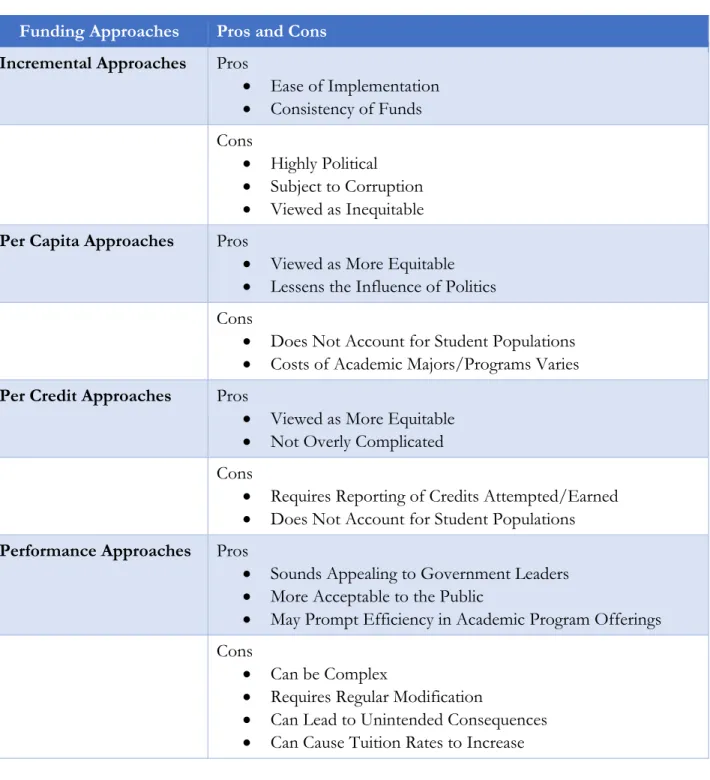
The variety of models and approaches to the funding of higher education indicates that even within the highly developed systems found in the US and UK, there is much to be learned from how these models were implemented. See Table 2 for a synopsis of the pros and cons of these funding models. Incremental approaches are easy to implement and lead to low volatility in funding, but the model is highly political, subject to corruption, and is often viewed as inequitable by institutional leaders. Per capita approaches are viewed more favorably and tend to lessen political influence. But these models typically fail to account for the type of student educated at a given institution and for the variable costs of different academic programs. Per credit-based approaches are viewed as more equitable and are not as complicated as performance-based models, but they tend to have more reporting requirements than per capita approaches and typically do not account for the quality of students that enroll at an institution. Performance-based approaches are politically more appealing to government and the public; however, they are typically based on extensive and complicated formulas, need constant review for regulatory change, and are still susceptible to manipulation by institutions.
As each state or national government implements a specific type or corrects for the mishaps of previous iterations of funding models, higher education policymakers and analysts continue to learn more about these approaches or models, and their applicability in different national or state contexts. Whereas developing systems of higher education can learn much from the US and UK, they should institute those structures that are most likely to build a robust, domestic system of higher education which will promote a vibrant national economy and a more cohesive society.
Table 2: Pros and Cons of Funding Approaches/Models Funding Approaches Pros and Cons
Incremental Approaches Pros
Ease of Implementation Consistency of Funds Cons Highly Political Subject to Corruption Viewed as Inequitable
Per Capita Approaches Pros
Viewed as More Equitable
Lessens the Influence of Politics Cons
Does Not Account for Student Populations
Costs of Academic Majors/Programs Varies
Per Credit Approaches Pros
Viewed as More Equitable
Not Overly Complicated
Cons
Requires Reporting of Credits Attempted/Earned
Does Not Account for Student Populations
Performance Approaches Pros
Sounds Appealing to Government Leaders
More Acceptable to the Public
May Prompt Efficiency in Academic Program Offerings
Cons
Can be Complex
Requires Regular Modification
Can Lead to Unintended Consequences
Can Cause Tuition Rates to Increase
General
Summary
Developing countries are adapting and adopting financing structures and models used by many OECD member nations. There are lessons to be learned from the successes, errors, and risks taken as developed economies have struggled to find a way to finance the growth of participation in higher education and respond to changes in political philosophy. Fulfilling the mission of a developing
16 higher education finance structure requires an investment in understanding the philosophical, political, and economic rationales of a sustainable model of higher education finance. Some of the key considerations that might inform policy development are set out in Table 3 in appendix one.
The US and UK experiences of recent years suggest that cost sharing – shifting some or much of the cost from the state to the individual – is one way to finance growth in participation. In both contexts, there has been an increased interest in allocating at least some proportion of public funds on the basis of institutional performance. The complexities of designing and implementing performance based funding were underestimated in many cases. This led to frequent modifications and created uncertainty for institutional leaders and academic planners.
While politically attractive performance-based funding has yet to be proven to be as effective in strengthening educational outcomes or constraining costs as its advocates hoped. Its benefits maybe realized as schemes become more robust and stable; however, the challenges of implementation and the mixed evidence about effectiveness suggest that those nations considering the introduction of performance-based models use an iterative approach and assume that it will take time to develop and fully implement.
References
Archibald, R. B., & Feldman, D. H. (2011). Why does college cost so much? New York, NY: Oxford University Press.
Arum, R., & Roksa, J. (2010). Academically adrift. Limited learning on college campuses. Chicago, IL: The University of Chicago Press.
Becker, G. S. (1964). Human capital: A theoretical and empirical analysis, with special reference to education. New York, NY: Columbia University Press.
Birnbaum, R. (2001). Management fads in higher education: Where they come form, what they do, why they fail. San Francisco, CA: Jossey-Bass.
Brewer, D., Eide, E., & Ehrenberg, R. (1999). Does it pay to attend an elite private college? Cross cohort evidence on the effect of college quality on earnings. Journal of Human Resources, 34(1), 104-123.
Callahan, K., Meehan, K., & Shaw, K. (2017). “Summary of OBF Impact on Student Outcomes in Tennessee and Indiana.” Philadelphia, PA: Research for Action.
Conklin, K., Snyder, M., Stanley, J., & Boelscher, S. (2016). “Rowing Together: Aligning state and federal investments in talent to common outcomes.” Denver, CO: Education
Commission of the States.
Dale, S. B., & Krueger, A. B. (2002). Estimating the payoff to attending a more selective college: An application of selection on observables and unobservables. Quarterly Journal of Economics, 117(4), 1491-1528.
Delaney, J., & Doyle, W. (2011). State spending on higher education: Testing the balance wheel over time. Journal of Education Finance, 36(4), 343-368.
Dougherty, K. J., Jones, S. M., Lahr, H., Natow, R. S., Pheatt, L., & Reddy, V. (2016). Performance funding for higher education. Baltimore, MD: Johns Hopkins University Press.
Dougherty, K. J., & Reddy, V. (2011). The impacts of state performance funding systems on higher education institutions: Research literature review and policy recommendations. CCRC Working Paper Number 37. New York, NY: Teachers College, Columbia University.
Dougherty, K. J., Natow, R. S., & Vega, B. E. (2012). Popular but unstable: Explaining why state performance funding systems in the United States often don’t persist. Teachers College Record, 114(3), 1–41.
Fabricant, M., & Brier, S. (2016). Austerity blues: Fighting for the soul of public higher education. Baltimore, MD: The Johns Hopkins University Press.
18 Friedman, M., & Friedman, R. (1980). Free to choose: A personal statement. New York, NY: Mariner Books.
Gandara, D., Rippner, J. A., & Ness, E. (2017). Exploring the ‘how’ in policy diffusion: National intermediary organizations’ roles in facilitating the spread of performance-based funding policies in states. The Journal of Higher Education, 88(5), 701-725.
Grubb, (2002). Learning and earning in the middle, part I: National studies of pre-baccalaureate education. Economics of Education Review, 21(4), 299-321.
Hacker, A., & Dreifus, C. (2010). Higher education? How colleges are wasting our money and failing our kids and what we can do about it. New York, NY: St. Martin’s Griffin Press.
Herbein, B., & Hollenbeck, K. M. (Eds.). (2015). Student loans and the dynamics of debt. Kalamazoo, MI: W.E. Upjohn Institute for Employment Research Press.
Higher Education Authority. (n.d.). “Review of the Allocation for Funding Higher Education institutions.” Working Paper 4: International Funding Allocation Approaches. Downloaded from
http://hea.ie/assets/uploads/2017/06/hea_rfam_working_paper_4_international_funding_allocati on_approaches_022.pdf
Hillman, N., Fryar, A. H., & Crespin-Trujillo, V. (2018). Evaluating the impact of performance funding in Ohio and Tennessee. American Educational Research Journal, 55(1), 144-170.
Hu, X., & Villarreal, P. (2018). Public tuition on the rise: Estimating the effects of Louisiana’s performance-based funding policy on institutional tuition levels. Research in Higher Education. Published online at https://doi.org/10.1007/s11162-018-9526-y
Institute for Higher Education Policy. (1998). Reaping the benefits: Defining the public and private value of going to college. Washington, DC: IHEP.
Jaeger, D. A., & Page, M.E. (1996). Degrees matter: New evidence on sheepskin effects in the returns to education. Review of Economics and Statistics, 78(4), 733-740.
Jenkins, D., Wachen, J., Moore, C., & Shulock, N. (2012). Washington State Student Achievement Initiative Policy Study: Final Report. Sacramento, CA.
Johnstone, D. B., & Marcucci, P. M. (2010). Financing higher education worldwide: Wo pays? Who should pay? Baltimore, MD: The Johns Hopkins University Press.
Kane, T. J., & Rouse, C.E. (1999). The community college: Educating students at the margin between college and work. Journal of Economic Perspectives, 13(1), 63-84.
Kelchen, R. (2016). An analysis of student fees: The roles of states and institutions. The Review of Higher Education, 39(4), 597–619.
Kelly, A. P., & Goldrick-Rab, S. (2014). Reinventing financial aid: Charting a new course to college affordability. Cambridge, MA: Harvard Education Press.
Kerr, C. (1963/2001). The uses of a university. Cambridge, MA: Harvard University Press.
Kezar, A. J., Chambers, T. C., Burkhardt, J. C. (eds.). (2005). Higher Education for the public good: Emerging voices from a national movement. San Francisco, CA: Jossey-Bass.
Layzell, D. T. (2007). State higher education funding models: An assessment of current and emerging approaches. Journal of Education Finance, 33(1), 1-19.
Mixon, F. G., & Hsing, Y. (1994). The determinants of out-of-state enrollments in higher education: A tobit analysis. Economics of Education Review, 13, 329–335
Monks, J. (1999). The returns to individual and college characteristics: Evidence from the National Longitudinal Survey of Youth. Economics of Education Review, 19(3), 279-289.
Newman, C. (1873). The idea of a university. New Haven, CT: New Yale University.
McKinney, L., & Hagedorn, L. S. (2015). “Performance-based funding for community colleges in Texas: Are colleges disadvantaged by serving the most disadvantaged students?” Bryan, TX: The Greater Texas Foundation.
Murphy, R. J., Scott-Clayton, J., & Wyness, G. (2017, April 27). Lessons from the end of free college in England. Evidence Speaks Reports, 2(13), 1-10.
OECD. (2012). “How does education affect the economy?”, In Education at a Glance 2012: Highlights. Paris, FR: OECD Publishing. https://doi.org/10.1787/eag_highlights-2012-15-en Rizzo, M., & Ehrenberg, R. G. (2004). Resident and Nonresident Tuition and Enrollment at Flagship State Universities. In Caroline M. Hoxby (Ed.), College choices: The economics of where to go, when to go, and how to pay for it. Chicago, IL: University of Chicago Press.
Robbins, L. (1963). Committee on Higher Education: Higher Education. Report of the Committee appointed by the Prime Minister under the Chairmanship of Lord Robbins.
Robbins, M. (2016, January). “The evidence suggests I was completely wrong about tuition fees.” The Guardian. https://www.theguardian.com/science/the-lay-scientist/2016/jan/28/the-evidence-suggests-i-was-completely-wrong-about-tuition-fees
Shen, H., & Ziderman, A. (2008). Student loan repayment and recovery: International comparisons.
Higher Education, 57(3), 315-333.
Shin, J. C. (2010). Impacts of performance-based accountability on institutional performance in the U.S. Higher Education, 60(1), 47-68.
Spence, M. (1973). Job market signalling. Quarterly Journals of Economics, 87(3), 355-374.
Thomas, S. L., & Zhang, L. (2005). Post-baccalaureate wage growth within 4 years of graduation: The effects of college quality and college major. Research in Higher Education, 46(4), 437-459.
20 Universities UK. (2016). University funding explained. Report published by Universities UK
available for download from the web at
https://www.universitiesuk.ac.uk/policy-and-analysis/reports/Documents/2016/university-funding-explained.pdf
Williams, G. (2016). Higher education: Public good or private commodity. London Review of Education, 14(1), 131-142.
Website Resources https://www.brookings.edu/research/lessons-from-the-end-of-free-college-in-england/ https://www.universitiesuk.ac.uk/ http://www.highered.nysed.gov/ocue/he/structureofhe.html http://www.passhe.edu/Pages/default.aspx https://regents.la.gov/assets/LAHigherEdLandscapePowerPointDeck2016Updated6.2.pdf https://www.gov.uk/ https://beta.gov.scot/policies/universities/ https://www.hefcw.ac.uk/home/home.aspx/
22
Appendix
1
Table 3: Considerations and their Descriptions
CONSIDERATIONS DESCRIPTIONS
Demand-side Economic
Perspective A system where governments provide resources to aid in the development of higher education systems typically as a response to market forces.
Supply-side Economic Perspective
A system where governments take proactive steps in providing resources to higher education stimulating interest and demand for higher education.
Philosophy of Financial
Austerity Austerity is a political philosophy where governments struggle to support all government priorities. Thus, governments push fiscal policy changes to government priorities that typically affect social programs and higher education.
Principle of Cost
Containment Cost containment is a philosophical principle that institutions of higher education need to take contain its expenses ensuring that the costs to educate students remains reasonably low. Policymakers and people within a country will demand institutional changes that drive efficiencies in operations and functions.
Purposes/Philosophy of
Higher Education The purposes of higher education are the philosophical underpinning rationales for publicly funding a higher education system. There are many purposes of higher education, but these are typically shaped by history, politics, government, societal perceptions, etc.
Institutional Missions The missions served by the institutions of higher education are likely to be an important consideration in policymaking related to funding structures. What institutional missions are served by the public funding provided is a critical consideration in policy discussions and debates.
Beneficiaries of Higher Education
The beneficiaries are one critical consideration in any given higher education funding model that needs attention. Whether students from particular income backgrounds are likely to be assisted in a given system is a recurring theme in policy decisions.
Public versus Private
Structures Public structures include government supports while private structures include students, parents, institutions, private businesses, private foundations, etc. which may work collectively to finance a system of higher education. Some higher education systems operate entirely from a privately funded structures whereas other systems are heavily dependent on governments.
Management/Governance
following: state boards of education, state commissions of higher education, state boards of regents, national commissions of higher education finance, among others. These structures are heavily responsible for providing oversight, financial monitoring, development and implementation of regulations, distribution of resources, among other important functions.
Low Tuition-Low Aid
Models Low tuition-low aid models are models where government intervenes by providing significant institutional subsidies and where institutions therefore keep tuition and fees low. The low tuition rates represent low barriers of affordability. Government may provide additional though modest levels of support in the form of government financial aid programs.
High Tuitio