Claremont Colleges
Scholarship @ Claremont
Scripps Senior Theses Scripps Student Scholarship
2015
Successfully Financing Classical Music Kickstarter
Projects
Sarah Chung Scripps College
This Open Access Senior Thesis is brought to you for free and open access by the Scripps Student Scholarship at Scholarship @ Claremont. It has been accepted for inclusion in Scripps Senior Theses by an authorized administrator of Scholarship @ Claremont. For more information, please contact
Recommended Citation
Chung, Sarah, "Successfully Financing Classical Music Kickstarter Projects" (2015).Scripps Senior Theses.Paper 606. http://scholarship.claremont.edu/scripps_theses/606
SUCCESSFULLY FINANCING CLASSICAL MUSIC KICKSTARTER PROJECTS
by
SARAH H. CHUNG
SUBMITTED TO SCRIPPS COLLEGE IN PARTIAL FULFILLMENT OF THE DEGREE OF BACHELOR OF ARTS
PROFESSOR ROSETT PROFESSOR PEDACE
Abstract
With the rise of technology and finance, crowdfunding has been uprising as a popular method of financing projects. Kickstarter provides an online platform in which anyone with Internet access can upload their own project “pitch” to gain funding for their idea on an all-or-nothing model. My thesis explores financial trends and factors that potentially contribute to a successful
Kickstarter campaign within the classical music projects subcategory. I use a logistic regression and the Ordinary Least Squares model to examine a dataset of already successfully funded projects and a second dataset that contains both successfully and unsuccessfully funded projects that were tracked over a period of time. Additionally, I collected text files of the word content on all projects to identify most frequently utilized words for the successful and unsuccessful files. Controlling for other characteristics, the key findings are that projects with higher target funding levels are both less likely to fund and fund at a lower percentage of the target, projects receiving more comments are more likely to fund, and projects proposed by those that fund other projects are more likely to fund. In addition, certain words are correlated with success or failure.
However, since the method of identifying important words used data mining rather than just testing, we cannot predict that these words would increase the likelihood of success in future projects. Due to limited sample size and high correlations among the variables in specifications including both the project characteristics and words, the main results for each set of explanatory variables used separately tend to become statistically insignificant.
Additionally, the funding pattern over time appears not to exhibit the herding behavior found in some asset pricing markets. This is an interesting finding given the highly social nature of funding via Kickstarter.
Acknowledgements
Thank you to my primary thesis reader, Professor Rosett, for his unconditional academic
guidance and support in completing my academic career through what was undeniably the most difficult semester of my college career. I wouldn’t be where I am now without your words of wisdom, encouragement, and faith.
Thank you to my secondary thesis reader and academic advisor, Professor Pedace, for your support throughout my economics experience at Scripps College. Your dedication and passion for your work in the field of economics is an inspiration to me.
Thank you to Aviv Caspi (CMC ’16) for all of his help on the textual analysis aspect of my thesis. This really provided a valuable asset of my research, and I admire your incredible work ethic and success in everything that you do on campus in addition to the work that you will do in the future.
Thank you to my mom who has allowed me to start this undergraduate journey in the first place. You worked tirelessly to support me and achieve the American Dream for our family and you are the strongest woman I know. Your love is greater than this universe, and I couldn’t have asked for a better mother.
Table of Contents
1. Introduction 2. Literature Review
2.1 Crowdfunding of Small Entrepreneurial Ventures
2.2 Are the Life and Death of an Early Stage Venture Indeed in the Power of the Tongue? Lessons from Online Crowdfunding Pitches
2.3 An Empirical Examination of the Antecedents and Consequences of Contribution Patterns in Crowd-Funded Markets
2.4 Crowdfunding Creative Ideas: The Dynamics of Project Backers in Kickstarter 2.5 Herd Behaviour and Cascading in Capital Markets: a Review and Synthesis 2.6 The Reg A+ Bombshell: $50M Unaccredited Equity Crowdfunding Title IV takes
Center Stage 3. Empirical Methods 4. Data
5. Main Results
6. Discussion and Conclusions 7. Appendix
7.1 Tracked Projects
7.2 Already Successfully Funded Projects
7.3 Textual Analysis 8. References
1. Introduction
With the recent rise of crowdfunding, more people have turned to the Internet to bring projects and ideas to life. Home of projects like “COOLEST COOLER: 21st Century Cooler that’s Actually Cooler” and “Pebble: E-Paper Watch for iPhone and Android,” the Kickstarter crowdfunding website has risen to become the world’s largest funding platform for creative projects. With over a billion dollars pledged and 70,000 successfully funded projects, Kickstarter prides itself on its vibrant community of people working together. This has become an important alternative to conventional bank loans, other forms of debt, and equity financing for small projects to obtain financing. In essence, it removes the typical intermediaries between those providing financing and those receiving it. But what makes a successful campaign?
This research is based on a sample of 108 Kickstarter projects from campaigns specifically in the music category. 42 of these projects were tracked on a daily basis over the course of their campaigns during December 2014 – March 2015, while the rest are a sample of closed, successful projects. I focus on campaigns related to classical music overall and also subcategories for group type, music period, media type, and audio recording. I identify a set of descriptive variables related to the projects with the aim of explaining whether projects
successfully fund and the level of funding relative to the target amount set in the project description.
The subsample of projects tracked daily is especially useful for two reasons. First, we are unable to observe unsuccessful, closed projects on the Kickstarter website, as these projects are removed when they fail. Hence to procure a sample of failed projects, it is necessary to observe them during the funding period. This includes recording the funding level on the last day of the period and observing that the projects are removed if they are removed. Overall, 12 of the 42
tracked projects, or roughly 29%, failed. Second, tracking the funding on a daily basis allows analysis of the pattern of funding over the campaign period. We can hypothesize that the
beginning of the campaign starts with a burst of energy as it kicks off and then enters a period of stagnation in the middle but finishes off as the panic sets in to the finish line. How are the successful campaigns’ trends different from unsuccessful campaigns, if at all?
Due to the limited time frame for data collection and the number of projects entering Kickstarter during that period, we were limited in the number of live projects that could be tracked. Hence, we supplement the tracked data with an additional sample of 66 closed projects.
For both the tracked and closed samples that we collected in addition to the descriptive variables, we looked at the text of the projects to find key words associated with success or failure and the level of funding. To do this, we captured all text in each project description and processed these to determine word counts within each project for each word used across all projects.
This textual analysis was done using the Python programming language.1 The result is a dictionary of potentially important terms that may be associated with the success and funding level of the project.
With this, we should lastly consider: are there measurable traits of a successful campaign that can predict the success of a new campaign? My hope is that this research can offer some advice and strategy for achieving your own successfully funded Kickstarter campaign.
Controlling for other characteristics, the key results include that projects with higher target funding levels are both less likely to fund and fund at a lower percentage of the target, projects receiving more comments are more likely to fund, and projects proposed by those that
fund other projects are more likely to fund. In addition, certain words are correlated with success or failure. However, since the method of identifying important words used data mining rather than just testing, we cannot predict that these words would increase the likelihood of success in future projects. Due to limited sample size and high correlations among the variables in
specifications including both the project characteristics and words, the main results for each set of explanatory variables used separately tend to become statistically insignificant.
Another finding is that the funding pattern over time appears not to exhibit the herding behavior found in some asset pricing markets. This is an interesting finding given the highly social nature of funding via Kickstarter.
The remainder of this thesis is organized as follows: Section 2 summarizes the literature relevant to this study, Section 3 shows the empirical methods utilized in this study, Section 4 includes an explanation of the data in this research, Section 5 presents the main results, Section 6 delves into a discussion of the findings along with the conclusions, Section 7 represents the appendix, and Section 8 concludes the study with the references used in this study.
2. Literature Review
Founded in 2009, Kickstarter has recently gained traction in literature and research to uncover the science of entrepreneurship. With the explosion of the technology industry in Silicon Valley, people are seeking opportunities to bring their ideas to life and profit from them. This has spurred research in many business schools around the world to understand Kickstarter under the lens of finance, innovation, entrepreneurship, strategy, marketing, investments, crowdfunding, and venture capitalism.
2.1 Crowdfunding of Small Entrepreneurial Ventures
In this study by Larralde & Schwienbacher (2010), a general overview of the mechanics behind crowdfunding small entrepreneurial ventures is portrayed. Defining crowdfunding as “the financing of a project or a venture by a group of individuals instead of professional parties”, this research does not limit itself to Kickstarter in particular but the science of crowdfunding
applicable to any small business. The research extends the definition to “an open call, essentially through the internet, for the provision of financial resources either in form of donation or in exchange for some form of reward and/or voting rights in order to support initiatives for specific purposes” and provides business models of crowdfunded ventures and crowdfunding platforms to include donations, passive investments by the crowd, and active investments by the crowd.
Focusing on giving insight into the different pain points and considerations of the crowdfunding process, the research presents a case study of a small business called “Media No Mad” which successfully completed acquiring initial funding through their crowdfunding efforts. This case study confirms several reasons how crowdfunding strategy would be useful to a small entrepreneurial ventures, which are attributed to a few key factors that make crowdfunding unique. Among these factors, the funding goal must be a reasonably low amount of capital, the
project itself must be interesting and innovative, the project must be willing to extend their skill set as an advantage to anybody and the creators must know how to handle the website.
2.2 Are the Life and Death of an Early Stage Venture Indeed in the Power of the Tongue? Lessons from Online Crowdfunding Pitches
In this more recent study, Maron & Sade (2013) placed the emphasis on the power of the online crowdfunding pitches. Using a text mining quantification method, the dataset was
collected by custom software that included over 20,000 online business pitches with their
crowdfunding results. In addition to these methods, a random survey was distributed to conduct a human coding technique of what the human perception of a project’s success would be. There was a strong correlation found between human coding and text mining techniques. Their research broadly concluded that entrepreneurs’ descriptions do have importance.
Because Kickstarter recently opened project creation to non-US residents at the time of their research, the research provided additional information than previous literature. The research was generally limited because unlike platforms such as “Prosper” and “Kiva”, Kickstarter does not provide data directly to researchers. Analyzing the means of presentation included the basics of the project title, location and funding goal, video or photo, “About” section, perks, and
entrepreneur’s section. While the research included all categories, it was found that entrepreneurs of technology projects focus more on the business idea whereas entrepreneurs of artistic projects focus more on the entrepreneur. With this, name mentions are positively and statistically
significant with the success of the art projects success. Furthermore, this finding is consistent with projects that have both the lowest and highest goal amounts, which suggests that it is not the entrepreneur’s outside reputation that drives results.
2.3 An Empirical Examination of the Antecedents and Consequences of Contribution Patterns in Crowd-Funded Markets
In this empirical study by Burtch, Ghose, & Wattal (2013), patterns in crowd-funded markets are examined by looking at a consumer’s decision-making process for crowdfunding. As contributions are subject to crowding-out, the primary motivation is found to be altruism. The study found the length of the campaign indirectly impacting consumption of the output, as longer funding durations are linked to higher performance. This shows the importance of the role of marketing in the funding stage, as it is a direct determinant of success. In terms of data, web traffic statistics were obtained via a Google Analytics account and one of the authors developed a software to programmatically retrieve time-series data of Web traffic statistics for each URL on a daily basis, leveraging the Google Analytics Data Export file. In addition, another software application was developed to retrieve all available public information regarding the campaign such as the story characteristics, and amount of each contribution. Lastly, one of the authors manually retrieved time-series data on Google search trends for two to five key words relating to each pitch.
2.4 Crowdfunding Creative Ideas: The Dynamics of Project Backers in Kickstarter
This research by Bayus & Kuppuswamy (2014) examines the dynamics of project backers in Kickstarter in an empirical manner. The dataset is comprised of two years of data compiled on a daily basis on 14,704 projects beginning on January 1, 2010 to December 31, 2011. Projects started in 2009 were not included in the study since the web design went under several revisions, affecting the presentation of the campaign. Additionally, the dataset is
restricted to projects with a duration of at least 21 days and includes time-varying variables that account for possible effects due to uncontrolled factors such as the following:
PostFunded: one for each day a project has already been funded and zero otherwise
ActiveProjects: number of Kickstarter projects across all categories that are accepting pledges per day
MaxCompetingBackers: maximum number of cumulative backers across all competing
projects accepting pledges per day
There were separate dummy variables created for day of week and month-year to account for any other unobserved time-varying effects. This showed that projects are more likely to receive funding on weekdays compared to weekends as activity increases from Sunday to its peak on Wednesday and activity decreases thereafter to the lowest point on Saturday.
In congruence with existing research, projects are less likely to add backers from the beginning of the sample period to the end. The coefficient estimate for KickstarterTraffic is positive and significantly related to project support. This research also touches on the “Blockbuster Effect”, where a project with large number of backers steals potential backers from other projects. The model shows backer support drops dramatically once a project surpasses its goal as shown by the negative and significant coefficient estimate for PostFunded. Additionally, binary variables Day
and LastDay strongly affirm the U-shaped pattern of backer support across all project types in art, product design, film and video, games, music and technology. This pattern is pervasive in both successfully and unsuccessfully funded projects across all goal targets of different amounts.
2.5 Herd Behaviour and Cascading in Capital Markets: a Review and Synthesis
To examine the behavioral aspect of finance, this paper follows capital markets to explain how investors, firms and analysts behave in a herding manner. Herding is defined as a
convergence in behavior and can be seen even with little knowledge and justification. Investors may also cascade and choose to ignore a source of information that could have been useful to
them in making a market decision. On the analysts’ level, they could also exhibit herding behavior in the forecasts. This paper addresses why different phenomena of unexplainable sudden rushes in large groups occur.
Even with the rational human mind, the decisions we make are fragile and unpredictable. This is mainly due to the mixture of many different theories: reputational effects, informational effects, direct payoff interactions, preference effects, and imperfect rationality. Although reputational effects would not be comparable to the fragile nature of rational observational theories, it provides the explanation of dispersion and herding behaviors with the additional aspect of timing that rational observational theories would not provide.
2.6 The Reg A+ Bombshell: $50M Unaccredited Equity Crowdfunding Title IV takes Center Stage
In surprising changes, the SEC has released an update on the regulatory rules that now allows growing companies to raise up to $50 million with the support of anyone that can give an offering. This “mini-IPO style” change will allow for an alternative method of financing and expand the horizons of financing beyond venture capitalism or institutional capitalism. This is a direct parallel to how Kickstarter projects are funded: through individuals.
With the new exemption, there are key changes that will impact financing practices. First, the high maximum raise will impact how much issuers can raise. Anyone is now free to invest and investment limits will not exist. Additionally, self-certification of income or net worth of investors will eliminate additional required documentation, and you can now advertise your offering. Offering circular approval will be required in addition to audited financials. Issuers will now have opportunities to test the waters and continue ongoing disclosure requirements for Tier two. Most importantly, the new regulation preempts the state law, which will be a testing ground.
Shareholder limits will no longer apply, maximizing potential for small investments. The securities will be unrestricted and no funds will be raised through the prior ruling.
---
From the survey of literature out there today specifically on Kickstarter in addition to financing through crowdfunding, there are several gaps I wish to address through my research. The first recognizable consideration is that there has not been any research on a specific category of Kickstarter. Current literature includes a random survey of all-encompassing categories and does not consider one specific field. Maron & Sade includes comparative research on technology and art as two binaries, but does not provide conclusions specific to one category. With my research, I am focusing on the subcategory of classical music within the music category, furthering specificity in my results.
With the generational gap we see in classical music participants today, the Internet has been transforming classical music as an industry. My research will add to the recent additions in marketing strategy for classical music that has risen from Kickstarter in addition to addressing the use of leveraging social media through the Facebook share feature on the project page. Lastly, my research will further the text mining efforts found in Maron & Sade to uncover an extensive list of terms or phrases that could be use to future project creators. While it is important to recognize the importance of the name mention, my goal is to uncover the
significance behind certain words and provide a dictionary compilation as a resource to help fund more successful projects in classical music in the future.
3. Empirical Methods
Kickstarter is a crowdfunding platform that is on a mission to “help bring creative projects to life”. Project categories include the following: art, comics, crafts, dance, design, fashion, film & video, food, games, journalism, music, photography, publishing, technology, and theater. The main purpose in this thesis is to determine factors that lead to success or failure of the projects in terms of financing. Though it seems likely that there are factors common across all categories, it also seems likely that some factors are specific to certain categories as the type, technology, audience, and other attributes might vary across project categories. Hence, I chose to focus on classical music, as my expertise in this area is useful in identifying likely important success drivers.
Within classical music, I identified three types of success drivers. First, I define project type subcategories, as it seems likely that demand for the project’s product might vary with these. First, I divide the product type into album, performance, and recording. In the classical music category, groups of musicians or soloists are looking to fund their first album. This includes the recording session in a professional studio, album artwork, and album distribution. Creators are also looking to have the costs of performances funded to cover their transportation, tours, and stage costs. Additionally, not all musicians are necessarily looking to produce a full album but rather focus on one piece or production, which is categorized as the “recording” category.
Second, I separated the type of musical group into three main categories, defined as the following: chamber, orchestra, and solo. Within the solo category, it is further broken down into solo stringed instruments, solo band instruments, and solo voice for vocalists. The piano has been categorized under the stringed instruments.
Third, I identified a set of variables common across all the groups defined above and likely related to project success and funding level. The variables were all coded by hand from the Kickstarter project description. These include the following:
Duration: number of days campaign will run
Start Date: day the campaign opens
End Date: day the campaign closes
Cancel Date: day the campaign is cancelled, if applicable
Canceled: campaigns cancelled before end of funding period
Target Amount: amount of funding goal
Pledged: amount pledged by supporters (tracked daily for tracked sample, and overall for closed sample)
Backers: number of supporters backing the project (tracked daily for tracked sample, and overall for closed sample)
Updates: number of updates by the creator
Comments: number of comments on the project’s comments section
Website: external other websites on the project page
Video: video on the project page
Value: my personal evaluation of the project
FB: number of the creator’s friends on Facebook
Projects Backed: number of projects supported by the creator themselves
Projects Funded: number of previously successful campaigns
Rewards: number of reward categories
Degree of Rewards: quality of the rewards
Fake Day: for variables with different lengths of projects, this variable normalizes the differences to a scale of 100 days
Pledged Ratio: current amount pledged divided by the total amount pledged
(tracked daily for tracked sample, and overall for closed sample)
Pledged to Backer Ratio: current amount pledged divided by the number of backers
(tracked daily for tracked sample, and overall for closed sample)
Each of the variables was selected based on the value it adds to the campaign. For the variable
Value, I personally evaluated the project based on the quality of the video on the campaign page, creative content of the project, and the overall quality of the campaign as a whole. This is by no means a scientific evaluation but rather a qualitative evaluation from my personal expertise in music and experience in having seen many Kickstarter campaigns. As for the dummy variables, I assigned numeric values as the following to quantify the descriptive data:
Performance Type: 1=Album, 2=Performance, 3=Recording
Group Type: 1=Solo, 2=Chamber, 3=Orchestra
Video: 0=No, 1=Yes
Value: 0=Not a quality project, 1=Quality project
Website: 0=No, 1=Yes
Degree of Rewards: 0=First degree interactions (such as a signature),
1=physical interaction with backer (such as a private concert or lunch with the artist)
Failed: 1=Project failed to fund
Because a creator of a campaign is able to set the total number of days that the campaign should run, I hypothesize there will be significance in this variable for a project that has a campaign length too short or too long. This will also be correlated with the amount of funding goal that a project creator will set for the campaign. Kickstarter is funded on an all-or-nothing model where if the project is not funded by the self-set expiration date of the self-set amount, all the funds are returned to the campaign supporters and the project is marked as an unsuccessful campaign. Some individuals will then choose to remove their campaign from the platform but most will allow it to be left in the domain where it is only discoverable by utilizing the
platform’s search bar.
On the campaign support’s side, the page provides information on how many supporters, also known as “backers”, have invested in the project as well as the total amount that had been collected for the project, known as “pledged”. If the project is successfully funded, it remains open and available to receive additional funds above the set-funding goal.
The creator of the project is able to provide updates throughout the campaign to the Kickstarter community. People in the Kickstarter community are then able to engage by providing comments on these updates or for the project in general. I hypothesize the higher levels of engagement with the audience would be significant in running a successful campaign. A Kickstarter profile of the creator is also required to create a campaign, which gives visibility to the engagement of the individuals themselves. The profile of creators gives information on how
many other projects the creators have invested in themselves in addition to their past
performance of previously successful campaigns, if any. There is also a Facebook feature that connects the creators’ personal Facebook profiles to their Kickstarter profiles, which highlights the importance of social media in a campaign. I hypothesize a significance of strong community engagement between the investors and the creators for a successful campaign.
2
As exemplified in the project above, the project page also provides an option to add a short video that illustrates the nature of the project. This is optional, but I hypothesize captivating media engagement to be significant for a successful project, as it is the first item that appears on a campaign’s page. To incentivize supporters, creators have the option of creating rewards tied to each amount that a supporter invests. As the amount of support increases, the quality of rewards increases. To measure the quality of the rewards, I created a binary measurement of what the creators offered. If the reward included a mere signature, free items, and no direct engagement
with the backer, this would qualify as a low quality reward. If the reward included a private performance at your home, a private lesson on an instrument, or a home cooked dinner celebration, this would qualify as a high quality reward.
This study will utilize a methodology of two theories. First, a logit regression will be tested to estimate the effects of the independent variables on the probability of a project being funded. This will project the importance of certain variables being crucial to the success of a campaign. Second, the Ordinary Least Squares (OLS) method will then help us understand the different levels of funding that take place. The logit regression uses a dummy variable, Funded, as the dependent variable. This has value of 1 for projects that successfully reach the funding threshold, and a value of 0 otherwise. The OLS regressions aim to explain the level of funding, or Funding Ratio, defined as the actual amount of funding received divided by the minimum target amount stated in the project in order for the project to succeed. In both types of
regressions, we ran separate regressions for the main project characteristics, the important words identified through the textual analysis, and the two groups of explanatory variables together.
4. Data
There are three primary compilations of data that are initially collected. First, the projects that were observed on a daily basis from the start of the campaign were monitored to the end of the campaign. A database of 42 observations included the project’s name, start date, end date, total days, target amount, cancel date (if applicable), daily amount of dollars pledged, and the number of backers supporting the project. Before starting to collect the data for the projects being monitored on a daily basis, I realized that there needed to be a supplement dataset that can track failures, which would also be useful in observing the funding pattern over a funding period for a sample of projects. Projects vanish from the Kickstarter search results page when they are unsuccessfully funded, so this dataset of tracked projects proved to be valuable in analyzing funding patterns over time.
Second, I complied a database of projects that had already closed and created a larger list of 66 observations that included the variables described in the previous section, which includes the project’s name, target amount, amount funded, backers, duration, category, type of group, video, value, website, comments, updates, reward categories, degree of rewards, previously created, projects backed, and Facebook connected. Lastly, a text file was created for all projects by copying and pasting the project description on the campaign website. These text files were placed in the respective resulting folder of successful projects and unsuccessful projects. Because the projects that were already closed are all successful projects, there are only 15 projects that I was able to track to their failures with 4 projects that cancelled their campaign. This sample size is much smaller and presents an obstacle for this study, which could be further researched.
From Table 1 (below), a general overview of the range of data can be seen. On average, the projects set their target amount to be at $5,587.43 with a standard deviation of $9,336.94.
The largest funding goal is $90,000 and the smallest funding goal is $100.00. In terms of securing the actual funding, most projects have been successful in receiving an average of $4,819.60. With the failure to receive any funding, the minimum amount is $0.00 and the maximum that a project has received is $30,613.00. Aside from receiving no amounts of investment funds from having 0 backers, projects receive an average of 60 backers investing in their projects with one single project having a maximum of 384 investors in this dataset. As the project creators are also allowed to set the duration of their project’s campaigning period, the average number of days a campaign would run is about 41 days. The shortest project in this sample is 7 days and the longest project in this sample is 90 days.
To incentivize potential investors, project creators can provide different rewards for different amounts of investments. Having more levels of rewards does not necessary equate to success, as the quality of these rewards play an important role. On average, projects provide 8 different levels of rewards but ranges from as little as none to as many as 22 different levels of rewards based on the amount you invest. To account for the experience some project creators may have over others from their previously created Kickstarter projects, the sample shows most project creators do not have previous experience with a mean of less than 1 full project. Most of the project creators are running a Kickstarter campaign for the first time, and the most that a project creator has had in previous experience is 11 previous projects.
Weighing in the Kickstarter community engagement, the project creator’s profile also exhibits other project creators’ projects he or she may have invested in. This sample shows an average of 6 projects that the project creators have supported in the Kickstarter community and show that a project creator has invested in as many as 98 projects in the Kickstarter community. As for engagement outside of the Kickstarter community and in the larger realm of social media such as Facebook, project creators have the option of linking their Facebook accounts to their Kickstarter profiles. This allows for a larger marketing scope as updates on the project are visible to your Facebook friends, whom may not be familiar with the Kickstarter website or be aware of the project in general. Although not everyone necessarily has a Facebook account to begin with, this sample exhibits an average of 149 people that a creator would be Facebook friends with. The most a single project creator has for a Facebook audience is 3,818 people, which is clearly an outlier.
Table 2 (below) presents the same summary statistics, but is limited to the 42 projects in the tracked subsample. In this dataset, the average target amount is $8,571.31 with a median of
$5,000.00. Aside from the actual goals of the project, the actually financing amounts averaged out to $5,219.79 with a median of $3,590.00. There is an average of 67 supporters with the median being 46, which is larger than the sample that was not tracked and the projects lasted for an average of 36 days, which is shorter than the sample above. As for the reward categories, there is an average of 8 different reward options with a median of 7, which is very close to the general sample. This subsample shows little past experience of the project creators along with very little support of other projects in the Kickstarter community. On the other hand, there is an average of 89 Facebook connections with a median of 23, which contains less outlier than the general sample. Because this sample includes the projects that would cancel during the period that they were tracked, the variable Canceled represents the average of 0.09 projects that disappeared before completion.
The represented variables include measurements in days for duration and U.S. dollar amounts for all currency variables. There are apparent differences between this subsample and the closed subsample of 66 projects. For example, the Target Amount is statistically significantly higher in the tracked sample. As seen below, this might be due to the fact that higher target amount projects are more likely to fail, and the closed sample contains no failure. The opposite results could explain the variable of Duration. For this variable, it is beneficial to have more time in completing the project campaign
Since we use this subsample to show the funding pattern over the funding period, and duration ranges widely over the projects, we normalized all project durations to show the funding amounts for each “day” expressed as a percentage of the full funding period. This was
accomplished by creating a Fake Day variable. Using the nearest day to the percentile rank when available, a percentage is created by having variables 1 through 100 while interpolating the missing values to produce the variable. Note that values in Table 2 are calculated for each variable on the last day of the funding period (or when they were terminated if this occurred before the end of the funding period), rather than showing the average across all days of the funding period.
In Table 3 (below), we summarize the values the two ratios created from the existing variables. These are the Funding Ratio (Funded Amount divided by the Target Amount), which is used as the dependent variable in the OLS regression in Table 6 (below), and the ratio of Funded Amount to Number of Backers, showing the average contribution for project backers for each project.
Table 4 (below) presents the correlations among the main variables. Each cell in the tables shows the pairwise correlation, p-value for the significance, and number of observations for the pair. This is useful partly to show where high correlations among the variables might cause multicollinearity problems in regression specifications, but it also provides some evidence on the drivers of funding. For example, the negative (and nearly significant at the 11% level) correlation between the funding ratio and the target amount indicate that higher target amounts make success less likely. One important aspect of raising funds is to set a goal that is practical and attainable. Hence, projects that did not follow this model and had too high of an expectation or too large of a project tended not to succeed.
5. Main Results.
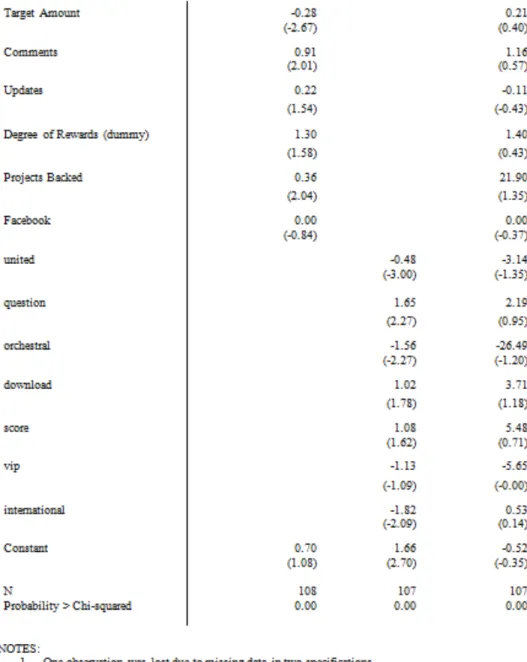
Table 5 (below) presents logit regression results predicting whether the project funds or not. The dependent variable is Funded, which is represented by 1 if the project funds and a 0 otherwise. We provide three specifications: one based on the non-text variables, one based on the text variables, and one with the two sets of explanatory variables used in the same specification. Key results suggest that the likelihood of a project being successfully funded declines as the target funding level increases. This shows that larger projects are not as appropriate for the type of crowdfunding offered by Kickstarter, as smaller projects are more appropriate. Apparently, the larger numbers of required participants and/or higher individual contribution levels are prohibitive. Additionally, the study suggests that projects that draw more comments are more likely to succeed. This could be due to the fact that high level of engagement from the
Kickstarter community creates higher levels of interest in the project as well as an indication of how others view the project. Lastly, the study shows that projects proposed by those who themselves back other projects are more likely to succeed. Increased levels of community
engagement certainly seem to indicate higher levels of success. In a sense, a creator broadens his or her network and visibility as an individual by supporting others in the Kickstarter community and giving an opportunity for other creators to return the favor.
The second specification in Table 5 shows the likelihood of funding as a function of the words emerging from the textual analysis. Several words, including “united,” “question,”
“orchestral,” and “international” are statistically significantly associated with the outcome. Since we identified these words via a combination of subjective choice and data mining, we do not claim any causal relationship and caution that use of these words in future projects does not predict success as noted elsewhere. These results merely show a correlation. In addition, when
the project characteristics in the first specification and words in the second specification are combined in the third specification, many of the formerly statistically significant variables lose their significance. From the results, it seems that either set of explanatory variables works, but when they are combined it appears the multicollinearity between the two sets reduces the significance on all explanatory variables to be insignificant. It seems likely that both the small number of failures identified in the tracked sample and the small overall size of the sample contribute to this outcome.
Table 6 (below) presents OLS regression results explaining the level of funding across all projects using the Funding Ratio (Funded Amount divided by the Target Amount) as the
dependent variable. Note that in these regressions we exclude two projects with extremely high outlier funding ratios, as they dramatically alter the regression results. With this limitation, we
then run three specifications: one based on the non-text variables, one based on the text
variables, and one with the two sets of explanatory variables used in the same specification. The first specification includes the project characteristics, while the second is based on the textual analysis, and the third combines the two sets of variables.
Similar to the logit results, the coefficient on Target Amount shows that the Funding Ratio declines with the Target Amount. To an extent, this is not surprising as the Funding Ratio
denominator is the also the Target Amount. We also see that Funding Ratio increases with both the number of backers and the amount contributed per backer. Interestingly, the Funding Ratio
also increases with the previous number of projects proposed by the same project proposer. This seems consistent with the idea that individuals learn through doing on Kickstarter.
Also similar to the results for the logit regression, several of the words are predictive of the Funding Ratio. However, all of the variables included in the first two specifications become insignificant again when the two groups of variables are combined. As previously shown, it appears likely that the sample size and multicollinearity eliminate the statistical significance of the effects found in the first two specifications.
Finally, we examine graphs of the funding patterns for the tracked sample (below). Several interesting observations can be made from the effects of the Pledged to Target Ratio on the Percentage of Duration. From the literature review, I hypothesized a herding behavior in the trend that would be seen over time. I expected a last minute pull to the finish as the deadline of the projects approaches and a lull in the beginning to the middle of the campaign. Contrary to my belief, most of the projects appear to fund in a very smooth path from the beginning to the end. This shows first, a lack of herding behavior, which might be expected in a market where funding levels are visible to all participants. If a project receives early funding, others might be expected to join the herd, yielding rapid funding. Second, the all-or-nothing funding model pushes for a crunch time at the end of the campaign, and one might expect to see a large number of projects with a significant amount of funding in the last few days as friends and family put the project over the top. However, this does not appear to be the case.
Additionally, it is rare for projects to fund at a ratio that is much greater than one, which seems curious. It suggests that the demand for the projects output is nearly always just at the level which would minimally allow the project to fund. From this, it seems that there could be many projects, which would fund at a level much lower than the ultimate demand for the project output. This result might be expected if many of the projects received a large boost at the end, but as noted above, this is not the case. Therefore, there is not an obvious explanation for the clustering of the final Funding Ratio just above 1. This suggests an important direction for additional research.
0 .5 1 1.5 2 Pl e d g e d t o T a rg e t R a ti o 0 20 40 60 80 100 Percentage of Duration 0 .5 1 1.5 2 0 50 100 0 50 100 0 1 Pl e d g e d t o t a rg e t ra ti o fake_day
6. Discussion and Conclusions
Based on the regression results, several variables appear to drive both successful funding and funding ratios for Kickstarter projects. These include the Target Amount, Comments on the campaign, Backers, Projects Backed and Previous Projects, along with several words identified through the textual analysis. However, when using just the main attribute variables, some variables were relevant yet when using the words, some words were relevant. However, when the two sets of data were combined, the elements that were found to be relevant generally become insignificant which is likely due to the limited sample size and high level of correlation across the two groups of variables.
For further study, a greater scope can be covered with the limited nature of the data source by a more advanced method of data gathering. More data would provide further details that this study did not cover. Due to the high collinearity of the results, no strong significance of a variable was found, but there is room for further research with a larger dataset. Overall,
markets operate differently and the herding behavior that I had hypothesized was not the case with the Kickstarter community. This can be attributed to the fact that Kickstarter “brings creative projects to life” and this study focused on the classical music subcategory, which is not focused on a product. Understanding how this model works with the nature of financing the intangible has proved to be a challenging yet interest study that my study did not necessarily answers the questions to, but rather suggested additional research that can be done.
7. Appendix
7.1 Tracked Projects
7.3 Textual Analysis
phrase all_n totwords_all rank_all successful_n totwords_su rank_su unsuccessful_ntotwords_unrank_un rankdif_su_un
program 135 85925 0.001571 121 76978 0.0015719 14 8946 0.001565 0.6932416 tickets 76 85925 0.000885 68 76978 0.0008834 8 8946 0.000894 1.088512 performance 133 85925 0.001548 119 76978 0.0015459 14 8946 0.001565 1.904892 website 104 85925 0.00121 93 76978 0.0012081 11 8946 0.00123 2.146245 musical 63 85925 0.000733 56 76978 0.0007275 7 8946 0.000783 5.499204 edition 53 85925 0.000617 48 76978 0.0006236 5 8946 0.000559 6.464578 chamber 81 85925 0.000943 72 76978 0.0009353 9 8946 0.001006 7.070403 original 57 85925 0.000663 52 76978 0.0006755 5 8946 0.000559 11.66086 season 67 85925 0.00078 61 76978 0.0007924 6 8946 0.000671 12.17434 name 135 85925 0.001571 122 76978 0.0015849 13 8946 0.001453 13.1705 home 65 85925 0.000757 57 76978 0.0007405 8 8946 0.000894 15.37831 invitation 45 85925 0.000524 39 76978 0.0005066 6 8946 0.000671 16.40525 video 167 85925 0.001944 151 76978 0.0019616 16 8946 0.001789 17.30905 years 63 85925 0.000733 58 76978 0.0007535 5 8946 0.000559 19.4553 perform 52 85925 0.000605 45 76978 0.0005846 7 8946 0.000783 19.789 international 23 85925 0.000268 19 76978 0.0002468 4 8946 0.000447 20.03034 thank 174 85925 0.002025 154 76978 0.0020006 20 8946 0.002236 23.50644 love 48 85925 0.000559 41 76978 0.0005326 7 8946 0.000783 24.98529 travel 28 85925 0.000326 23 76978 0.0002988 5 8946 0.000559 26.01224 ensemble 59 85925 0.000687 55 76978 0.0007145 4 8946 0.000447 26.73626 dinner 27 85925 0.000314 22 76978 0.0002858 5 8946 0.000559 27.31131 works 128 85925 0.00149 117 76978 0.0015199 11 8946 0.00123 29.0315 hall 61 85925 0.00071 57 76978 0.0007405 4 8946 0.000447 29.33441 personalized 25 85925 0.000291 20 76978 0.0002598 5 8946 0.000559 29.90945 pieces 62 85925 0.000722 58 76978 0.0007535 4 8946 0.000447 30.63348 premiere 72 85925 0.000838 62 76978 0.0008054 10 8946 0.001118 31.23931 song 73 85925 0.00085 68 76978 0.0008834 5 8946 0.000559 32.44603 cover 54 85925 0.000629 51 76978 0.0006625 3 8946 0.000335 32.71815 quartet 55 85925 0.00064 52 76978 0.0006755 3 8946 0.000335 34.01723 release 105 85925 0.001222 97 76978 0.0012601 8 8946 0.000894 36.58459 vip 10 85925 0.000116 6 76978 0.0000779 4 8946 0.000447 36.91829 audio 27 85925 0.000314 21 76978 0.0002728 6 8946 0.000671 39.78856 solo 89 85925 0.001036 83 76978 0.0010782 6 8946 0.000671 40.75393 studio 80 85925 0.000931 75 76978 0.0009743 5 8946 0.000559 41.53953 private 72 85925 0.000838 61 76978 0.0007924 11 8946 0.00123 43.71656 percussion 53 85925 0.000617 51 76978 0.0006625 2 8946 0.000224 43.89633 recordings 43 85925 0.0005 35 76978 0.0004547 8 8946 0.000894 43.95791 vocal 23 85925 0.000268 17 76978 0.0002208 6 8946 0.000671 44.98485 songs 55 85925 0.00064 53 76978 0.0006885 2 8946 0.000224 46.49448 thanking 7 85925 8.15E-‐05 2 76978 0.000026 5 8946 0.000559 53.29276 concerts 64 85925 0.000745 53 76978 0.0006885 11 8946 0.00123 54.10914 patrons 6 85925 6.98E-‐05 1 76978 0.000013 5 8946 0.000559 54.59183 poster 130 85925 0.001513 112 76978 0.001455 18 8946 0.002012 55.71112 please 73 85925 0.00085 70 76978 0.0009094 3 8946 0.000335 57.40053 festival 54 85925 0.000629 53 76978 0.0006885 1 8946 0.000112 57.67266 directly 65 85925 0.000757 63 76978 0.0008184 2 8946 0.000224 59.4852 friends 58 85925 0.000675 57 76978 0.0007405 1 8946 0.000112 62.86895 record 88 85925 0.001024 84 76978 0.0010912 4 8946 0.000447 64.40937 exclusive 36 85925 0.000419 27 76978 0.0003507 9 8946 0.001006 65.52866 shout 15 85925 0.000175 8 76978 0.0001039 7 8946 0.000783 67.85468 paintings 8 85925 9.31E-‐05 1 76978 0.000013 7 8946 0.000783 76.94819 postcard 36 85925 0.000419 26 76978 0.0003378 10 8946 0.001118 78.00593 sticker 26 85925 0.000303 17 76978 0.0002208 9 8946 0.001006 78.51939 production 64 85925 0.000745 51 76978 0.0006625 13 8946 0.001453 79.06365 painting 14 85925 0.000163 6 76978 0.0000779 8 8946 0.000894 81.631 professional 42 85925 0.000489 31 76978 0.0004027 11 8946 0.00123 82.68873 copy 211 85925 0.002456 196 76978 0.0025462 15 8946 0.001677 86.9455 send 64 85925 0.000745 50 76978 0.0006495 14 8946 0.001565 91.5409 score 91 85925 0.001059 74 76978 0.0009613 17 8946 0.0019 93.8977
With support from Aviv Caspi (CMC ’16), we counted the number of times each word appearing in any project was used across all projects, the successfully funded project, and the unsuccessful projects. We then chose a list of words for further analysis based on subjective judgment and by maximizing the relative frequency of appearance between the successful and
phrase all_n totwords_all rank_all successful_n totwords_su rank_su unsuccessful_ntotwords_unrank_un rankdif_su_un
composer 81 85925 0.000943 65 76978 0.0008444 16 8946 0.001789 94.41117 first 148 85925 0.001722 125 76978 0.0016238 23 8946 0.002571 94.71409 copies 61 85925 0.00071 47 76978 0.0006106 14 8946 0.001565 95.43811 special 79 85925 0.000919 63 76978 0.0008184 16 8946 0.001789 97.00932 recording 271 85925 0.003154 235 76978 0.0030528 36 8946 0.004024 97.13245 sketches 11 85925 0.000128 2 76978 0.000026 9 8946 0.001006 98.00547 photo 36 85925 0.000419 24 76978 0.0003118 12 8946 0.001341 102.9604 anywhere 151 85925 0.001757 127 76978 0.0016498 24 8946 0.002683 103.2941 album 262 85925 0.003049 226 76978 0.0029359 36 8946 0.004024 108.8241 opera 78 85925 0.000908 61 76978 0.0007924 17 8946 0.0019 110.7856 debut 27 85925 0.000314 15 76978 0.0001949 12 8946 0.001341 114.6521 free 91 85925 0.001059 72 76978 0.0009353 19 8946 0.002124 118.8522 composers 91 85925 0.001059 72 76978 0.0009353 19 8946 0.002124 118.8522 framed 31 85925 0.000361 18 76978 0.0002338 13 8946 0.001453 121.933 mail 27 85925 0.000314 14 76978 0.0001819 13 8946 0.001453 127.1293 physical 80 85925 0.000931 61 76978 0.0007924 19 8946 0.002124 133.142 mention 47 85925 0.000547 31 76978 0.0004027 16 8946 0.001789 138.5796 signed 239 85925 0.002782 203 76978 0.0026371 36 8946 0.004024 138.7028 band 46 85925 0.000535 30 76978 0.0003897 16 8946 0.001789 139.8787 sneak 17 85925 0.000198 4 76978 0.000052 13 8946 0.001453 140.1201 download 161 85925 0.001874 156 76978 0.0020266 5 8946 0.000559 146.7644 world 203 85925 0.002363 170 76978 0.0022084 33 8946 0.003689 148.0376 piece 172 85925 0.002002 166 76978 0.0021565 6 8946 0.000671 148.5769 preview 16 85925 0.000186 2 76978 0.000026 14 8946 0.001565 153.8964 limited 203 85925 0.002363 169 76978 0.0021954 34 8946 0.003801 160.5149 choir 21 85925 0.000244 5 76978 0.000065 16 8946 0.001789 172.3555 orchestral 23 85925 0.000268 6 76978 0.0000779 17 8946 0.0019 182.2346 symphony 63 85925 0.000733 41 76978 0.0005326 22 8946 0.002459 192.658 choral 24 85925 0.000279 5 76978 0.000065 19 8946 0.002124 205.89 dvd 78 85925 0.000908 53 76978 0.0006885 25 8946 0.002795 210.6037 orchestra 110 85925 0.00128 78 76978 0.0010133 32 8946 0.003577 256.3741 concert 397 85925 0.00462 333 76978 0.0043259 64 8946 0.007154 282.8124 digital 195 85925 0.002269 152 76978 0.0019746 43 8946 0.004807 283.2027 art 85 85925 0.000989 52 76978 0.0006755 33 8946 0.003689 301.3282 states 91 85925 0.001059 56 76978 0.0007275 35 8946 0.003912 318.4883 cd 449 85925 0.005226 428 76978 0.00556 21 8946 0.002347 321.2612 musicians 120 85925 0.001397 81 76978 0.0010522 39 8946 0.00436 330.7242 united 95 85925 0.001106 58 76978 0.0007535 37 8946 0.004136 338.2465 ships 227 85925 0.002642 167 76978 0.0021695 60 8946 0.006707 453.7458 pledged 65 85925 0.000757 65 76978 0.0008444 consortium 21 85925 0.000244 21 76978 0.0002728 creator 57 85925 0.000663 57 76978 0.0007405 downloads 22 85925 0.000256 22 76978 0.0002858 carnegie 33 85925 0.000384 33 76978 0.0004287 cello 42 85925 0.000489 42 76978 0.0005456 soloist 16 85925 0.000186 16 76978 0.0002079 deductible 21 85925 0.000244 21 76978 0.0002728 autographed 51 85925 0.000594 51 76978 0.0006625 donations 25 85925 0.000291 25 76978 0.0003248 sponsor 18 85925 0.00021 18 76978 0.0002338 piano 109 85925 0.001269 109 76978 0.001416 question 111 85925 0.001292 111 76978 0.001442 commissioning 18 85925 0.00021 18 76978 0.0002338 variations 21 85925 0.000244 21 76978 0.0002728 violin 25 85925 0.000291 25 76978 0.0003248 shirt 64 85925 0.000745 64 76978 0.0008314 student 23 85925 0.000268 23 76978 0.0002988
unsuccessful categories. In the tables above, the far right column represents the absolute value of this difference times 10,000 (for each of browsing). Hence those with higher values are most likely to be correlated success as measured by the Funded variable in the main data set. Words at the bottom of the list represent cases where the word did not appear in the unsuccessful projects. We then used a series of stepwise regressions to identify words with the greatest explanatory power.
We note that this procedure implies that the chosen words represent data mining rather than testing any hypothesis, so that we cannot infer that use of these words would lead to successful future projects.
8. References*
Burtch, Gordon, Anindya Ghose, and Sunil Wattal. "An Empirical Examination of the Antecedents and Consequences of Contribution Patterns in Crowd-Funded Markets." (2013): 499-519.
Hirshleifer, David A. and Teoh, Siew Hong, Herd Behavior and Cascading in Capital Markets: A Review and Synthesis (December 19, 2001). Dice Center Working Paper No. 2001-20. Available at SSRN: http://ssrn.com/abstract=296081 or http://dx.doi.org/10.2139/ssrn.296081.
Lingam, Kiran. "The Reg A Bombshell: $50M Unaccredited Equity Crowdfunding Title IV Takes Center Stage." Crowdfund Insider. Crowded Media Group, 25 Mar. 2015. Web. 20 Apr. 2015.
<http://www.crowdfundinsider.com/2015/03/65007-the-reg-a-bombshell-50m-unaccredited-equity-crowdfunding-title-iv-takes-center-stage/>.
Marom, Dan, and Orly Sade. "Are the Life and Death of an Early Stage Venture Indeed in the Power of the Tongue? Lessons from Online Crowdfunding Pitches." (2013).
Kuppuswamy, Venkat, and Barry Bayus. "CROWDFUNDING CREATIVE IDEAS: THE DYNAMICS OF PROJECT BACKERS IN KICKSTARTER." (2014).
Schwienbacher, Armin, and Benjamin Larralde. "CROWDFUNDING OF SMALL ENTREPRENEURIAL VENTURES." (2010).
Thank you to the Carlotta Welles Financial Education Fund at Scripps College for inviting the creator, chairman, and former CEO of Kickstarter, Perry Chen, to campus.