Customer Perception of Trust towards Virtual Banking Adoption
in Malaysia
Jacquline Tham*
Faculty of Business Management and Professional Studies, Management and Science University (MSU), Section 13, 40100 Shah Alam, Selangor, Malaysia
Mohd Shukri Ab Yazid; Abdol Ali Khatibi; S. M. Ferdous Azam
Faculty of Business Management and Professional Studies, Management and Science University (MSU), Section 13, 40100 Shah Alam, Selangor, Malaysia
Abstract
Trust is one of the factors in many studies was tested and does significantly affects the adoption of virtual banking. However, studies with regards to customer perceive trust in relation to virtual banking adoption in Malaysia is limited. Due to low customers’ adoption in internet and mobile banking in Malaysia, this Study was conducted to evaluate customers’ perception on trust in adopting virtual banking. 402 samples from local and foreign banks customers in Malaysia was selected. Sample selection was based on convenience sampling technique and quantitative method has been applied to evaluate the study objectives. Through the descriptive analysis and research findings, it has been evaluated that only integrity affects customer perceived trust in virtual banking in Malaysian context. The research represents future implications for local banks in Malaysia to attract virtual banking customers by strengthening its’ measure with regards to security and reliability and benevolence. However, the results obtained in this study are limited to questionnaires distributed within the Klang Valley. Future researchers may expand its boundary by taking a diverse sample and including qualitative approach. Keywords: Customer Perception; trust; virtual banking adoption
1.0 Introduction
Perceived trust has been a topic which has gained growing interest in recent years. The importance of trust in the context of understanding consumers’ level of acceptance and adoption in a rapidly changing digital and virtual environment can no longer be denied. Chang et. al. (2006) and Lee & Turban (2001) indicate that in determining a sustainable internet usage among individuals, perceived trust and the liableness of technical environment and its structure, as well as fairness of other internet users, forms an important factors in maintaining the use of technology.
In general, trust forms one of the important factors in customer and bank relationships. High level of trust facilitated between customers and bankers will buffer against a level of negative experiences which in a certain occasion exist between banks and customers. With a certain degree of trust established among customers and their banks, customers tend to forgive negative experience encounter and perceive it as an exception between them and their banks (Raaij, 2017).
Technology has been evolving tremendously in the recent years and brought marvellous changes to every industry and have resulted in a paradigm shift in the banking sectors around the globe. Technology innovation such as Radio Frequency Identification (RFID), Artificial Intelligence, Internet of things (IoT) and Fintech has gained attention in the area of banking and business practices. Innovation of virtual banking is motivated by the force in technology development, as such, banks have to reinvent their approaches to effectively reach out to their customers.
Virtual banking consists of internet banking, mobile banking, Automated Teller Machines (ATM), desktop banking and phone banking which enables customers to perform their banking transactions without the need to visit a physical bank. As banks compete in maintaining their customers and as customers’ demands and needs evolve, virtual banking services have becoming cost effective, efficient as more effective products and services introduced to meet multiple commitments from customers in the digital age.
Today, the convenience of virtual banking provides new avenues for business around the world to expand their business. However, due to evolution in business environment and financial crisis, trusting a banking system and the financial institution itself has declined in many countries (Hurley, Gong & Wagar, 2014; Jarvinen, 2014) and the effect of financial crisis has significantly brought trust as an essential role between customers and the banks (Serido and Tang, 2013).
Dixit (2010) stated that, though users of mobile banking has significantly increase over the years, customers trust in e-commerce remain low (Norudin, Mansur and Faisal, 2010). Adoption of virtual banking in Malaysia remain low (Bank Negara report, 2016) despite many studies being carried out in Malaysia to understand factors affecting customers adoption in virtual banking. Limited study to understand and to deeply investigate customers’ perception on trust in virtual banking services among local banks in Malaysia, and, this
set forth the need for this study to be carried out. By critically understanding customers perceived trust will assist banks in providing solution as part of its’ strategy in meeting customers’ expectation.
Against this backdrop, this study will examine and evaluate customers trust in using virtual banking platform, to understand perceived trust among virtual banking users in Malaysia. This study is designed to critically refute or confirm the previous study on its’ application in Malaysian context, and will suggest an in-depth understanding to local banks in Malaysia mainly, to redesign their approaches to increase customers trust in virtual banking adoption.
2.0 Literature Reviews
Trust is defined as individual’s willingness to accept the vulnerability of a situation, products and services, a positive expectation with regards to their intention to engage in a situation characterised by interdependence and risk (Ennew & Sekhon, 2007). Thus, in this study, trust is situated at the interdependence of virtual banking offerings, customers and perceived risk. Customers’ with a certain level of trust, trust their banks to behave in good intentions and will not behave opportunistically at the banks’ expense even when the opportunity exist to do so (Nooteboom, 1996; Gambetta, 2000). System trust, which may be defined as expectation by customers on the companies in a business, is dependable, hold on to their promises and can be relied on (Sirdeshmukh, Singh & Sabol 2002).
Trust is particularly well-known for its importance in the financial services (Becket & Hewer 2000, Ennew et al 2011, Hauff 2014, Sekhon et al 2013) and it is multidimensional phenomenon and complex (Amin et. al. 2013; Dimitriadis et al, 2011; Flavian et al, 2005; Triyuwono 2004; Lewicki & Bunker, 1996). Trust is defined with different viewpoints in various disciplines including economics, finance, marketing, psychology and religion. Reliability, benevolence, honesty, credibility and competence have been considered as an important factors of trust (Kantsperger & Kunz, 2010).
According to Muawanah (2010), trust is an eagerness to act on the basis of beliefs about the intension or motives of other party and the associated level of risk involved. However, trust is usually used interchangeably with reliability, confidence or credibility. Regardless of whether interpersonal or business, trust is a substantial component in relationships. Sekhon et. al. (2013) defines trust as one of the dynamic factors for customers and organization to create long-term relationship (Amin et. al. 2013; Triyuwono 2004; Al-hawari, Mouakket 2012).
Trust is a factor and forms one of the most noteworthy elements which enables businesses regulates future development and in which, its establishment decreases transaction costs in banking relationships (Moro, Fink 2013; Fernandez-Olmos 2011). In an economy which is rapidly evolving, trust in using technology relates to individual’s vulnerability, expectation on the liableness of the technology and their willingness to use technology. However, trust in technology is built upon customers’ repeated interaction using a technology. Therefore, customers need to engage in using a said technology repeatedly over a period of time to develop trust. Empirically, cognitive trust is known as the building of trust through the first impression of using a technology rather than repeated encounter (Masrek, Uzir and Khairuddin, 2012). Trust is one of the most noteworthy elements that regulates the future development of business relationships (Jucaitytė & Maščinskienė , 2011). Most often, trust is defined as a factor, it ensures the quality of relationships and the main features of trust, is safety (Laeequddin & Sardana 2010; Simpson 2007). Laksamana et. al. (2013) portray trust as the bank’s inclination to act as promised. Hauff (2014) stated trust as customers’ level of reliance and dependencies on organization.
There have been many studies conducted in Malaysia and other countries acknowledging the growing trend of virtual banking adoption and its importance to the banking industries in Malaysia. However, security and personal preference have slowed down the virtual banking growth in Malaysia (Suganthi & balachandran, 2001). Khalil & Pearson (2007) stated in their findings that trust has been suggested as one of the obstacle hindering individuals to adopt technology. The perceived nature of internet and the activities of hackers have further affected customers’ trust in virtual banking. According to Yousafzai, Pallister, & Foxall (2003), the importance of risk to understand trust is recognised in numerous researchers; however, these researches emphasised that the relationship between risk and trust is complex, where, if action is taken to a complete certainty and exclude risk, trust would not be needed. Rouibah, Ramayah, & Oh (2009) in their study found that there is a direct relationship between perceived usefulness, attitude, perceived ease of use, subjective norms and perceived behavioural control and behavioural intention to use. Therefore, Theory of Planned Behaviour (TPB), Technology Acceptance Model (TAM) and Theory of Reasoned Action (TRA) revealed to have the best explanation for this study.
Ennew & Sekhon (2007) differentiate five determinants of trusts in service providers as competence and expertise; communications; integrity and consistency; shared values; concern and benevolence respectively. Schumann et. al., (2010) on the other, distinguish four determinants of trusts in service providers as competence; benevolence; predictability and integrity. Hurley (2006, 2012) identifies trustworthiness in six dimensions; shared values or beliefs; benevolent intentions; aligned interest; predictability and integrity as well as capability. Jarvinen (2014) stated that trust as in consumer context is very much dependable on consumers dependant and
experience on the bank’s ability to prove their credibility and being reliable, observe regulations as well as meeting customers’ interest.
Transparency, Integrity and competence were distinguished by Pirson and Malhotra (2008) in determinants of customer Trust. Managerial and technical competencies of a bank to innovate in providing relevant information as well as financial services, handling inquiries, complaints and helping customers in their decision making is said to be competent (Pauline and Esterik, 2017). However, Pauline and Esterik (2017) state that, being competent is not sufficient for a bank to be trusted. Honesty, benevolence, fair treatment (integrity), regulations are important factors to gain customers trust in banking services. In a study by Sekhon, Enner, Khairul and Devlin (2014), five determinants of trust were distinguished; competence; integrity; communication; shared values and benevolence. Sekhon (2014) in his earlier study stated the distinction between trust and trustworthiness.
Reliability of a new technology is consistently being identified as one the most critical adoption factors (Kuan and Chow, 2010). Based on a study by Khraim and Al-Shoubaki (2011), it was found that incorporating innovative mobile banking solutions will provide a positive competitive advantage and differentiation strategy for banks to differentiate themselves from their rival.
The advancement in technology has given rise to the need for a secured virtual banking platform to ensure customers’ personal financial information is secured. According to Nyeko (2014), security challenges forms one of the main issue and concern when using public network to perform transactions.
2.1 Research model and hypotheses
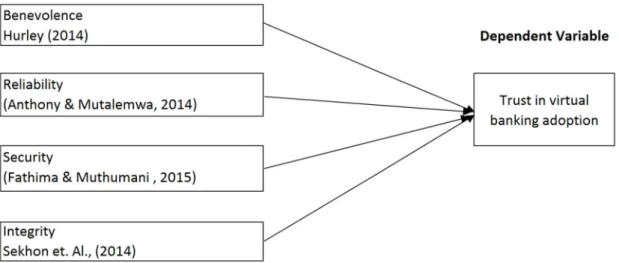
Based on literature reviews, four determinants of trust as previously being investigated, forms the framework in this study. This study have included benevolence, reliability, security and integrity in conceptual model to understand customers perceived trust in virtual banking services in Malaysia. These variables were validated from the literature mentioned above.
2.1.1 Benevolence
Benevolence, the desire to do good and in good will has been one of an important factors in influencing customers trust perception in using virtual banking (Ennew & Sekhon, 2007; Schumann et. al., 2010; Schumann et. al., 2010; Pauline and Esterik, 2017; Sekhon, Enner, Khairul and Devlin 2014). The absence of benevolence in virtual banking applications will affect customer’s evaluation on the credibility of virtual banking services. A bank is characterised as honest and truthful if they are able to portray sincerity, genuinely when dealing with customers, and, capable in attending customers request with regards to virtual banking services, and thus, will increase the level of trust among customers. Customers who trust that their banks will use their personal information only for their own benefit will influence customer’s intention to constantly use the bank’s virtual banking services. Therefore, hypothesis 1 is formed.
H1: There is a relationship between benevolence and perception trust in virtual banking to achieve customers loyalty.
2.1.2 Reliability
Reliability means the degree to which the outcome of a calculation, measurement or a speculation is accurate and can be depended on, and, it refers to being trustworthy or for consistently performing well. Reliability has been investigated in many studies and is an important factor in influencing customers trust in using virtual banking services (Kuan and Chow, 2010; Khraim & Al-Shoubaki, 2011). Customers who do not encounter system interruption while performing online or mobile banking transactions will find virtual banking services reliable. The banks’ ability of providing accurate and relevant information as well as the ability to perform online or mobile banking transaction at the customer’s convenience will increase customer’s level of trust in the bank’s virtual banking platform for its liableness. Therefore, hypothesis 2 is formed.
H2: There is a relationship between reliability and perception trust in virtual banking to achieve customers loyalty.
2.1.3 Security
In an emerging economy, advancement in technology can no longer be ignored. However, security issues have been a concern in virtual banking as it has been raised in many studies as it affects customer’s trust in using virtual banking platform (Nyeko, 2014). With public wifi offered by network provider and outlets in Malaysia as an example, may have an effect in customers in virtual banking adoption if accessing the bank’s online or mobile banking security is not convincing in creating trust in virtual banking services. Constantly updating the bank’s security function and the ability to assure customers’ confidential information protected may increase the level of perceived trust in continuously using virtual banking services. As such, hypothesis 3 is formed.
H3: There is a relationship between security and perception trust in virtual banking to achieve customers loyalty. 2.1.4 Integrity
Integrity is the quality of having strong moral principles and moral uprightness, honest, and being whole and undivided. Offering good customers support and promptly follows-up customer’s queries, protecting customer’s
banking information, and being transparent in terms of virtual banking transactions may increase customers trust in using the virtual banking services offered by their banks. Ennew & Sekhon (2007); Schumann et. al. (2010); Pauline & Esterik (2017) and Sekhon, Enner, Khairul & Devlin (2014) in their study stated that integrity is an important factor influencing customers trust in using virtual banking platform and this formed hypothesis 4 for this study.
H4: There is a relationship between integrity and perception trust in virtual banking to achieve customers loyalty. Moreover, the next section will be describing the research methodology, research resign, conceptual model of this study, findings and lastly, the summary and implication of this study
3.0 Research design and conceptual model
In this study, a conceptual model consist of four variables were developed which were adapted based on the findings in prior studies discussed above. The conceptual model developed for this study consists of four hypotheses as shown in Table 1.
Table 1. Conceptual framework of antecedents and determinants of customers’ trust in virtual banking adoption in Malaysia
This study uses random sampling method. Data was collected within a time frame of three months from August to October 2016 in Selangor and the Federal Territory of Kuala Lumpur, where the highest level of mobile users available (MCMC Report, 2012) and meeting the criteria for this study is found. Therefore, with the demographic and personal information required in the survey, it ensures that the selected samples are representative of the population by matching the respondents’ demographic characteristics and customers’ behaviour characteristics based on the observation. The given justifications ensure the sample representation and the main criticism of convenience sampling can be avoided in this study. In total, 700 questionnaires were distributed, 448 questionnaires were returned and only 402 questionnaires were good for analysis. There were 46 responses were found incomplete and thus, deleted for further analysis.
According to Sekaran and Bouge (2013) if the aggregate quantities of missing data are generally insignificant compared to the total sample size, then, straight forward approach would be most appropriate compared to some other method for taking care of missing data. Subsequently, for this study, 46 missing responses were irrelevant as aggregate example size was 384 (Sekaran and Bouge, 2013). Therefore, these 46 missing responses were deleted, the aggregate number of respondents for this review was 402, which is adequate for applying any sorts of statistical analysis. Pair-wise deletion could be considered in connection with missing value.
A survey instrument with 24 items were developed based on 4 independent variables: Benevolence (Be1 to Be5), Reliability (Re1 to Re5), Security (Se1 to Se5), Integrity (In1 to In5) and 1 dependent variable: Trust (Tr1 to Tr4). Validity and reliability test were performed on the instrument. Reliability refers to the ability of the instrument tested in providing consistent results in repeated users. Validity refers to the degree to which the concept of the instrument a researcher wants to measure. Reliability testing performed on all 24 items in the constructs with Cronbach’s Alpha of 0.964, indicates that all items in this constructs are reliable and further analysis can be performed.
The data collected for this study is analyzed using SPSS and AMOS version 16. Testing of reliability were performed on all items in the constructs. After ensuring the reliability of each items, descriptive statistic to distinguish the peak of the weighted mean is obtained. Confirmatory Factor Analysis using AMOS version 16
were then performed to ensure goodness of fit for each construct in the model as well as the overall model is met before Structural Equation Modelling (SEM) was performed to measure interrelationship among variables (Zainudin, 2012), purpose of measuring interrelationship among variables is to effectively test the main construct of a hypothesized model (Schumacker and Lomax, 2004; Kline, 2010). In this study, SEM is used as it is able to test different types of theoretical models such as regression, confirmatory factor models and path at the same time (Schumacker and Lomax, 2004).
4.0 Findings
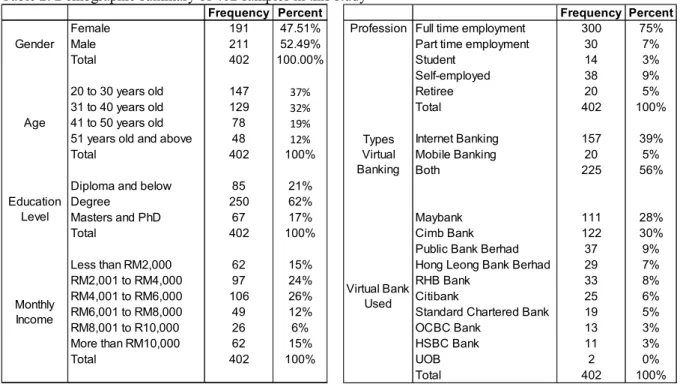
Table 2. Demographic summary of 402 samples in this study
Table 2 indicates the demographic summary of respondents in this study. It was found in this study that female and male respondents were proportionately split where, 52.49% of the respondents are males whereas 47.51% are females aged between 20 to 40 years old. However, in this study, it was found that younger customers forms the highest percentage of virtual banking users in Malaysia. IN terms of breakdown in education among the 402 respondents, 62% of the respondents are degree holders with full time employment (75%), earning between RM2,001 to RM6,000 per month; 56% of the respondents performs both internet and mobile banking where only 5% of the total respondents performs only mobile banking. Most of the respondents in this study are using Maybank and CIMB bank’s virtual banking platform (28% and 30% respectively) and only 17% of total respondents using virtual banking platform offered by foreign banks in this study.
4.1 Structural Equation Modelling (SEM)
Structural equation modelling (SEM) were used to investigate the relationship of the hypotheses between several constructs in this research model. The SEM is statistical-based method which involves integration of path and factor analysis, thus, enables the researcher to investigate various relationships in a research model at the same time (Burne, 2009).
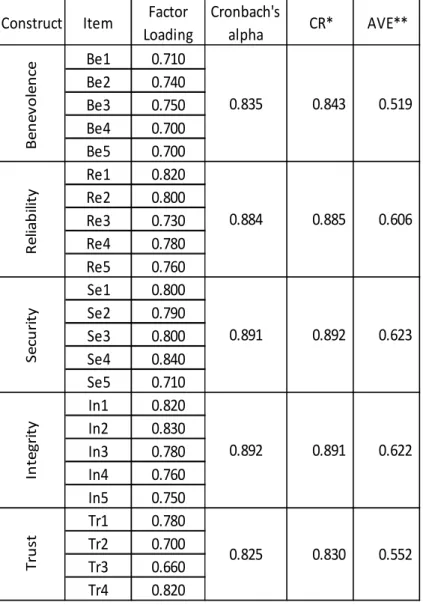
Confirmatory factor analysis (CFA) was performed to test the validity for all individual measurement of the independent and the dependent constructs, before examining the structural model for research hypotheses and its model fit. Table 3 summarises the Confirmatory Factor Analysis (CFA) in this study which show factor loading for each item in this study, Cronbach’s Alpha, Composite Reliability (CR) and Average Variance Extracted (AVE) values are measured. The items loading were basically larger than 0.7. The AVE for every item in this construct exceed 0.5 and all CRs is above 0.7. Thus, it is observed that all scale in this study has good convergent validity (Bagozzi and Yi, 1988); Gelen at. al.,2000). Additionally, all cronbach’s alpha are above 0.7, thus, the composite reliability for all variables in this study were in the range of good and excellent. Therefore, further analysis can be performed for this study.
Fornell and Larcker (1981) suggested that satisfactory discriminant validity is established when the AVE of a particular construct is greater than the correlation shared by that particular construct in a model. A study by Ramayah, Lee and Mohamad (2010) stated that convergent discriminant is established when the square root of the variance extracted are greater than the correlation among the constructs as referred to Table 3, which
Frequency Percent Frequency Percent
Female 191 47.51% Profession Full time employment 300 75%
Male 211 52.49% Part time employment 30 7%
Total 402 100.00% Student 14 3%
Self-employed 38 9%
20 to 30 years old 147 37% Retiree 20 5%
31 to 40 years old 129 32% Total 402 100%
41 to 50 years old 78 19%
51 years old and above 48 12% Internet Banking 157 39%
Total 402 100% Mobile Banking 20 5%
Both 225 56%
Diploma and below 85 21%
Degree 250 62%
Masters and PhD 67 17% Maybank 111 28%
Total 402 100% Cimb Bank 122 30%
Public Bank Berhad 37 9%
Less than RM2,000 62 15% Hong Leong Bank Berhad 29 7%
RM2,001 to RM4,000 97 24% RHB Bank 33 8%
RM4,001 to RM6,000 106 26% Citibank 25 6%
RM6,001 to RM8,000 49 12% Standard Chartered Bank 19 5%
RM8,001 to R10,000 26 6% OCBC Bank 13 3%
More than RM10,000 62 15% HSBC Bank 11 3%
Total 402 100% UOB 2 0% Total 402 100% Gender Age Types Virtual Banking Education Level Virtual Bank Used Monthly Income
it can be concluded that the construct validity of the scale is good.
Table 3. Standardized item loadings
Construct
Item
Factor
Loading
Cronbach's
alpha
CR*
AVE**
Be1
0.710
Be2
0.740
Be3
0.750
Be4
0.700
Be5
0.700
Re1
0.820
Re2
0.800
Re3
0.730
Re4
0.780
Re5
0.760
Se1
0.800
Se2
0.790
Se3
0.800
Se4
0.840
Se5
0.710
In1
0.820
In2
0.830
In3
0.780
In4
0.760
In5
0.750
Tr1
0.780
Tr2
0.700
Tr3
0.660
Tr4
0.820
0.835
0.884
0.891
0.892
0.825
B en ev o le n ce R el ia b ili ty Se cu ri ty In te gr it y Tr u st0.891
0.622
0.830
0.552
0.843
0.519
0.885
0.606
0.892
0.623
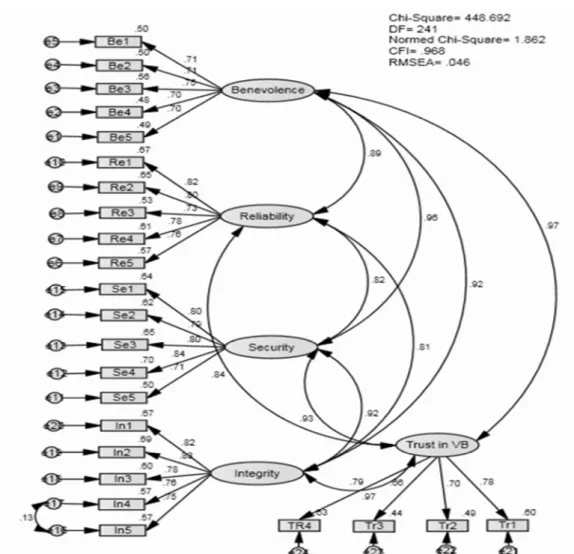
Figure 1. Confirmatory factor analysis (CFA) of overall measurement model Table 4. CFA results for the measurement models
Table 4 summarizes the overall Confirmatory Factor Analysis (CFA) results of the measurement model in this study. A model is said to have good fit if it has a Normed Chi Square of not exceeding 5, CFI of more
Name of Category Required Value Comments
Unidimensionality Factor loading for each item ≥0.50 The required level is achieved (See Table 6)
Average Variance Extracted (AVE)≥0.50
The required level is achieved (See Table 5) Discriminant Validity Correlation Between exogenous contruct is ≤
0.85 The required level is achieved
The required level is achieved (See Table 6) The required level is achieved
(See Table 6) The required level is achieved
(See Table 6) Average Variance
Explained (AVE) AVE ≥ 0.50
Validity
Convergent Validity The required level is achieved
(See Table 6)
Construct Validity All fitnes indexes for the models meets the required level
Reliability Internal Reliability Cronbach alpha ≥ 0.70 Construct Reliability CR ≥ 0.60
than 0.9 and RMSEA of less than 0.08. In this study, the overall initial model shows a good fit with Normed Chi Square of 1.862 which is less than 5, CFI of 0.968 which is more than 0.9 and RMSEA of 0.046 which is less than 0.08 which suggest a model fit.
4.2 Testing of hypotheses
Table 5, which, the standardized path co-efficient among all latent constructs of the hypothesized conceptual model were being illustrated.
The fit indexes and parameter estimates of hypothesized model as shown in Figure 9 indicates that there is reciprocal relationship among constructs in this study. However, Normed Chi Square is 1.862 which is less than 5.0, CFI of 0.968 which is above 0.9 and RMSEA of 0.046 which lesser than 0.08 indicates that goodness of fit for the structural model is met.
Table 5. Maximum likelihood estimates and standardized regression weight estimates
Maximum likelihood estimates of hypotheses testing in Table 5 signifies few parameters in this study. Table 5 also illustrate the standardized regression weights indicates the relationships of variables with the estimate values in the default with path coefficient among variables in the “Estimate” column as fit indexes and parameter estimates of the hypothesized model.
Testing of the hypotheses as shown in Maximum Likelihood Estimates in table 8 show that Integrity is the only construct in this study which is significant in affecting trust perceived in virtual banking in the Malaysian context. Security, reliability and benevolence are not significant with a p value of >0.05. This is being supported by the Standardized Regression Weights as shown in Table 5 where the estimates between Security- -> Trust in VB, Reliability - - > Trust in VB gives a standardized Regression Weights Estimates of < 0.30.
To ascertain the objective of this study is met, four primary hypotheses had been developed in to test the relationship among variables. Results as tabled out in Table 6 summarises the hypotheses set previously. Summary testing of four primary hypotheses developed in this study were presented in the following sections in this research.
Table 6: Summary of Hypotheses
Therefore, this study finds that in the Malaysian context, integrity is the only construct which will significantly affect the perception on trust which does not support the findings of previous work mentioned earlier in the literature study.
5.0 Conclusion and Managerial Implications
The purpose of this study is to provide a conceptual review of literature to understand how virtual banking users
Estimate S.E C.R P
Trust in VB < - - - Integrity 0.559 0.152 3.684 *** 0.562 Significant
Trust in VB < - - - Security -0.324 0.322 -1.006 0.314 -0.324 Not significant Trust in VB < - - - Reliability -0.149 0.154 -0.972 0.331 -0.159 Not significant Trust in VB < - - - Benevolence 0.996 0.533 1.867 0.062 0.903 Not significant
Maximum Likelihood Estimates Standardized
Regression Weight Estimates
Result
H(x) Hypothesis Finding Reference and/or Justification*
H1
There is a relationship between benevolence and perception trust in virtual banking to achieve customers
loyalty.
Not Supported Table 5
H2
There is a relationship between reliability and perception trust in virtual banking to
achieve customers loyalty.
Not Supported Table 5
H3
There is a relationship between security and perception trust in virtual banking to
achieve customers loyalty.
Not Supported Table 5
H4
There is a relationship between integrity and perception trust in virtual banking to
achieve customers loyalty.
Supported Table 5
* Some related figures can also provide evidences for the hypotheses. To avoid redundancy, this, the author has (only) reffered to the various tables for justification
perceive trust, which is found in many literatures to be important. This study evaluates customers perception on trust in Malaysia and is designed to critically refute or confirm the previous study on its’ application in Malaysian context. Through the study of literature, four independent variables were identified and tested in this study. Namely; benevolence, reliability, security and integrity which have been tested in few studies and have significantly affect trust. This study uses random sampling method and data was collected within Selangor and the Federal Territory of Kuala Lumpur, where the highest level of mobile users available and meeting the criteria for this study is found.
52.49% of the respondents are males whereas 47.51% are females in this study with most of the respondents aged between 20 to 40 years old with majority hold a degree and with full time employment. Most of the respondents in this study earn between RM2,001 to RM6,000 per month. 56% of the respondents performs both internet and mobile banking where only 5% of the total respondents performs only mobile banking. Most of the respondents in this study are using Maybank and CIMB bank’s virtual banking platform (28% and 30% respectively) and only 17% of total respondents using virtual banking platform offered by foreign banks in this study.
From the confirmatory factor analysis of the overall measurement model and through the goodness of fit indexes, the overall initial model shows a good fit with Normed Chi Square of 1.862 which is less than 5, CFI of 0.968 which is more than 0.9 and RMSEA of 0.046 which is less than 0.08.
The fit indexes and parameter estimates of hypothesized model indicates that there is reciprocal relationship among constructs in this study. However, Normed Chi Square is 1.862 which is less than 5.0, CFI of 0.968 which is above 0.9 and RMSEA of 0.046 which lesser than 0.08 indicates that goodness of fit for the structural model is met.
Testing of the hypotheses as shown in Maximum Likelihood Estimates show that Integrity is the only construct in this study which is significant in affecting trust perceived in virtual banking in the Malaysian context. Security, reliability and benevolence are not significant with a p value of >0.05. This is being supported by the Standardized Regression Weights where the estimates between Security- -> Trust in VB, Reliability - - > Trust in VB gives a standardized Regression Weights Estimates of < 0.30.
As summarised through the findings in this study, in the Malaysian context, integrity is the only construct which will significantly affect the perception of trust in performing virtual banking transactions, whereas, reliability, security and integrity does not support the findings of previous work mentioned earlier in the literature study. This forms a significant contribution for Malaysian local banks in understanding customers’ perceived trust in using virtual banking in Malaysia and how Malaysian local banks should form their strategy to increase virtual banking adoption.
A number of important limitations is found in this study and need to be considered. Considering a bigger sample size with a stratified sampling method and considering both quantitative and qualitative method may provide a better understanding of what customers really want. Clustering around customer segmentation will assist Malaysian local banks in increasing customers’ level of trust in performing virtual banking transactions in achieving customer loyalty.
References
Chang, E., Dillon,T. and F. Hussain, Trust and reputation for service-oriented environments: Technologies for building business intelligence and consumer confidence. Chichester: Wiley, 2006
Ennew, Christine and Harjit S. (2007), Measuring Trust in Financial Services: The Trust Index. Consumer Policy Review, 17, 62-68
Gambetta, D. (2000), Can We Trust Trust? (pp.213-237). Chapter 13 in: Diego Gambetta (Ed.), Trust: Making and Breaking Cooperative Relations. Oxford, UK: University of Oxford.
Hurley, R.F. (2006), The Decision to Trust, Harvard business Review 84(9), 55-62
Hurley, R.F. (2012), A systems Approach in Restoring Trust in The Financial Markets. EIASM (European Institute for Advanced Studies in Management), 5th Workshop on Trust within and between Organizations. Madrid, May 28-29
Jarvinen, R. A. (2014), Consumer Trust in banking Relationship in Europe. International Journal of Bank Marketing, 32, 551-566
Khalil, Md Nor and Pearson, J. Michael. 2007. The influence of trust on Internet banking acceptance. Journal of Internet Banking and Commerce, Vol. 12, No. 2, pp. 1-10.
Khraim, H.S., AL-Shoubaki, Y.E., & Khraim, A.S. (2011). Factors Affecting Jordanian Consumers‟ Adoption of Mobile Banking Services. International Journal of Business and Social Science, 2(20), 96-105. Accessed May 21, 2013 http://www.ijbssnet.com /journals/Vol_2_No_20 _November_ 2011/10.pdf Lee, K.C and Chung, N. (2009), Understanding Factors Affecting Trust and Satisfaction in Mobile Banking in
Korea: A Modified DeLone and McLean’s
Electronic Commerce, vol. 6, no. 1, pp. 75-91, 2001.
Masrek, M. N., Uzir, N. A. and Khairuddin, I. I. (2012), Trust in Mobile banking adoption in Malaysia : A conceptual Framework, Journal of Mobile Technologies, Knowledge & Society, Vol. 2012 (2012). Article ID 281953.
Nootaboom, B. (1996), Trust, Opportunism and Governance: A Process and Control Model. Organization Studies, 17, 985-1010
Nyeko, J. S., Moya, M., Kabaale, E. and Odongo, J. (2014), Factors Influencing the Short Message Service (SMS) Mobile Banking adoption: A Users Perspective in the West Nile Region in Uganda
Pirson M., & Malhotra D. K (2008), Unconventional Insights for Managing Stakeholder Trust. MIT Sloan Management Review, 49 (4), 43-50
Rouibah, K., Ramayah, T. and Oh, S.M. 2009. User Acceptance of internet banking in Malaysia: Test of three competing models. The International Journal of E-Adoption, Vol. 1, No. 1, pp. 1-19.
Raaij, E. (2017); Bank System Trust, Bank Trust and Bank Loyalty; International Journal of Bank Marketing; ISSN:0265-2323
Schumann et. al., 2010, Drivers in Trust in Relational Service Exchange: Understanding the Importance of Cross Cultural differences. Journal of Service Research, 13,453-468
Sekhon, Harjit, Ennew C., Kharouf H. and Devlin J. (2014), Trustworthiness and trust: Influences and Implication. Journal of Marketing Management, 30, 409-430
Sindeshmukh D., Singh J., and Sabol B. (2002). Consumer Trust, Value and Loyalty in Relational Exchanges. Journal of Marketing. 66, 16-37
Shim, S., Serido, J. and Tang, J.Y.(2013); After the global financial crash: Individual factors differentiating young adult consumers’ trust in banks and financial institutions; Journal of Retailing and Consumer Services; Volume 20, Issue 1, January 2013, Pages 26–33
Suganthi, B. and Balachandran. 2001. Internet banking patronage: An empirical investigation of Malaysia. Journal of Internet Banking and Commerce, 6(1): www.arraydev.com/commerce/JIBC/0103_01.htm. Yousafzai, S.Y., Pallister, J. G. and Foxall, G.R. 2003. A proposed model of e-trust for electronic banking.