AIS Electronic Library (AISeL)
AIS Electronic Library (AISeL)
AMCIS 2020 TREOs
TREO Papers
8-10-2020
Impact of consumer trust online on purchasing intentions of
Impact of consumer trust online on purchasing intentions of
young consumer in e-commerce
young consumer in e-commerce
Feilcjan Bylok
Czestochowa University of Technology, [email protected]
Follow this and additional works at: https://aisel.aisnet.org/treos_amcis2020
Recommended Citation
Recommended Citation
Bylok, Feilcjan, "Impact of consumer trust online on purchasing intentions of young consumer in e-commerce" (2020). AMCIS 2020 TREOs. 6.
https://aisel.aisnet.org/treos_amcis2020/6
This material is brought to you by the TREO Papers at AIS Electronic Library (AISeL). It has been accepted for inclusion in AMCIS 2020 TREOs by an authorized administrator of AIS Electronic Library (AISeL). For more information, please contact [email protected].
Impact of consumer trust online on
purchasing intentions of young consumer in
e-commerce
Indicate Submission Type:
Completed Research
Key words: trust, consumer trust online, e-consumer, e-commerce, purchasing intentions.Introduction
The Internet has become an essential tool in conducting business as it ensures access to both domestic markets and international markets. Thanks to the ease of creating a commercial website and its relatively reasonable price, the number of online shops has grown dramatically. The dynamic growth of e-commerce in Poland has been noted. According to the forecasts in Poland, in 2018 the value of the e-commerce market achieved approximately 45 bn zlotys, while in 2020 it may exceed 60 bn zlotys. The share of trade conducted online with relation to retail trade as a whole constitutes approximately 5% and is constantly rising (PwC 2018). One of the most active groups of consumers that make purchases online is that of young people. In 2018, young people aged 15-24 years constituted 17.9%, while 22.9% at the age of 25-34 years in terms of making purchases online. Most frequently, they purchased clothing, accessories and supplements, footwear, books, CDs, or films (Gemius 2018). The future of e-commerce to a large extent depends on the attitudes and behaviour of young people with regard to business on the Internet. Becoming familiar with the purchasing intentions of young consumers would enable the definition of its further growth. One of the significant factors determining the purchasing intentions is that of consumer trust, which may be defined as the reliability of the Internet provider of goods or services. The aim of the herein paper is to search for the answers to the following three questions: What is the level of consumer trust online among young people? What factors have an impact on the level of consumer trust of young people? How does consumer trust have an impact on the intention to continue further relations with a website?
Consumer trust online - theoretical background
Trust constitutes a very important element in terms of interpersonal relations, which has an impact on their shape and process. Mayer et al., conceptualised trust as “the willingness of a party to be vulnerable
to the actions of another party based on the expectation that the other will perform a particular action important to the trustor, irrespective of the ability to monitor or control that other party” (1995: 712).
However, according to B. Noteboom “Real trust, or trust in the strong sense, is an expectation that things or people will not fail us, or the neglect or lack of awareness of the possibility of failure, even if there are
perceived opportunities and incentives for it” (2002:48). The majority of researchers agree on one or both of the following elements of trust: behavioural intention (or willingness) or behaviour and expectation (or confidence, belief) (Bozic 2017). The source of trust in human actions may be that of familiarity, which is the result of the repetitiveness of interactions between parties, or calculativeness which is associated with the estimation of the advantage of benefits over costs associated with relations or values referring to honesty and good will.
Trust prevails in various economic areas, one of which is e-commerce. Trust in the new economy was the subject matter of a multitude of research, among others in mobile payments (Lu et al, 2011), group purchases via the Internet (Wang et al, 2016), mobile trade and mobile banking (Crabbe et al, 2009). In e-commerce, trust online signifies “an attitude of confident expectation in an online situation of risk that one’s vulnerabilities will not be exploited” (Beldad et al, 2010). Entities of this form of trust are e -consumers, online shops and the Internet itself as an intermediary between the e-consumer and the online shop.
By conducting a review of the literature devoted to consumer trust online, it is possible to distinguish psychological factors, as well as social, marketing and technical factors in determining its range. The social factors include the familiarity with the online seller. Gefen and Straub (2000), in analysing the users of e-commerce by availing of the portal of Amazon.com, indicated that the familiarity with the online seller increases the level of trust on the part of the consumer towards the portal, which subsequently translates to the intention to purchase a particular product. A further factor is the level of uncertainty in terms of the results of interaction with the online shop and personal damage as a possible result of these interactions (Petermann 1996). The greater the level of uncertainty, the lower the tendency to make purchases on the Internet. Another social factor is that of the credibility of the online seller and the credibility of the Internet as a purchasing medium (Matthew et al, 2001). The level of trust online is also influenced by the competences of the online seller based on ensuring good quality of products and services; the honesty of the online seller which involves the adherence to specified principles and keeping promises, while also the goodwill of the seller that is associated with the conviction that apart from the desire to gain the justified profits, it also has the aim of the good of the client (Chen and Dhillon, 2003). These factors are connected and lead to the general level of consumer trust.
The psychological factors of trust online encompass the psychological distance relating to the spatial distance, the time distance and social distance of the online seller (Cui et al, 2020). Compared to the traditional shop, the online shop is more distant in a physical sense, while also social and time-wise. With the aim of reducing this distance, building trust between consumers and the online shop may be helpful. Another psychological factor is that of the attitude to purchases online which is associated with the acknowledgement of them as a good experience (Crespo and Bosque, 2010). The more positive approach to purchases online, the greater the probability of making purchases via the Internet.
One of the important factors that has an impact on consumer trust is the reputation of the online seller perceived as an indication of credibility that is the result of the comparison with what the online shop promised and what it actually fulfilled (Casalo et al, 2007). The research of Li and Yeh (2010), indicates that the reputation of the online seller is changeable in terms of the level of trust of clients towards the online seller. Reputation may be built by means of utilizing the positive reviews of consumers and their opinions in terms of cooperation with the particular online shop. For instance, the relation between the attributes of reviewers on the websites of hotels and the trust of consumers was indicated, namely trust aroused in this manner creates the psychological sense of comfort, which in turn leads to positive purchasing decisions (Akhtar 2019). Trust shown towards the online seller that is based on reputation strengthens the basis of loyalty and purchasing intentions on the electronic markets of B2C (Hong and Cho, 2011). Other marketing factors are as follows: the ability of the online seller to offer a product or service that fulfils the expectations of a client; the readiness of the online seller to make corrections if the purchase fails to fulfil the expectations of a client, while also the presence of the policies of privacy on the website (Bojang 2017). The technological factors that have an impact on consumer trust online includes the Internet as an electronic medium. The level of trust in it influences the scope of trust in the website (Shankar et al, 2002). The greater the level of trust in this medium, the greater the level of trust in websites. Another factor is the usefulness of the online shop perceived as the ease and simplicity of its use. The evaluation of the usefulness of the online shop by the consumers has an impact on the growth of trust online (Roy, Dewit and Aubert, 2001). Consumer trust online is influenced by the security of purchasing transactions (Matthew et al, 2001). In order to protect their privacy, consumers assess the scope of security on the basis of information sent online and the tools online that facilitate the control of purchasing transactions. With the aim of ensuring the feeling of security among consumers, the websites inform clients of the possession of certificates issued by organizations authorized to do so. These are presented with the aim of banishing the fears of consumers relating to security and privacy, while simultaneously increasing the level of trust online (Aiken, Boush, 2006).
Another factor of trust is the level of acceptance of IT technologies. According to the theory of reasoned action (TRA), the technology acceptance model (TAM) applied in an environment based on technology, namely the perceived usefulness and ease of use are acknowledged to be key factors in driving the acceptance of e-commerce (Pavlou, 2003). According to Metzger (2006), the level of adeptness in terms of using the Internet has an impact on the growth of trust in technology and to e-commerce.
Another factor that has an impact on the level of consumer trust is that of the tools utilized in e-commerce. Apart from stationary computers and laptops with access to the Internet, the tool which is increasingly used
for communication with an online shop is that of a smartphone or tablet. The Alizila report (2014) indicates that e-consumers want to make their purchases fast and conveniently “at any moment of time”. This
facilitates availing of commerce based on the utilization of telephones and tablets. The advantage of m-commerce is that of convenience and the possibility of faster development than the constant e-m-commerce (Chen and Yang, 2017).
The literary review presented indicates a multi-dimensionality of consumer trust online. With regard to the importance of consumer trust in terms of the development of e-commerce, it is worth undertaking research on the factors that have an impact on its level. On the basis of research on the level of consumer trust among young consumers in Poland, the authors shall undertake an attempt to identify these factors in question.
Methods
The survey method with the questionnaire technique was applied in the herein research. The survey questionnaire was built from research constructs that consisted of scales for research on the following aspects: consumer trust, perceived personalization, communication, the intention of pursuing further ties with the online shop, connections with other clients of the online shop, evaluation of satisfaction, uncertainty and the evaluation of the quality of service. All research constructs were gauged with the aid of the seven degree Likert scale, where 1 signifies “I definitely do not agree” and 7 “I definitely agree”. The unit for analysis was that of the website of an online shop. The website of e-commerce was defined in the questionnaire as a website that conducted business transactions (Li et al, 2006).
The respondents were students of courses of management and finance and accountancy at a public university. The choice of students resulted from the fact that they are the most innovative users of websites and the most active segment in terms of purchasing online (Gefen et al, 2003). The respondents who did not make purchases in the online shop within the last three months were excluded from the research. The questionnaire was ultimately completed by 276 students. The sample consisted of 64.8% women and 35.2 % men. In the sample there were 68, 9 % of respondents of between 18-22 years of age, 21.3 % of people aged 22-25 and 9,8 % aged 26-30. Online shopping declared at least once a week 7,5%, at least once a month 48,6%, at least once in the last six months 35,2% and at least once a year 7,1%. The average time of availing from the Internet during the day amounted to 140 minutes.
Findings
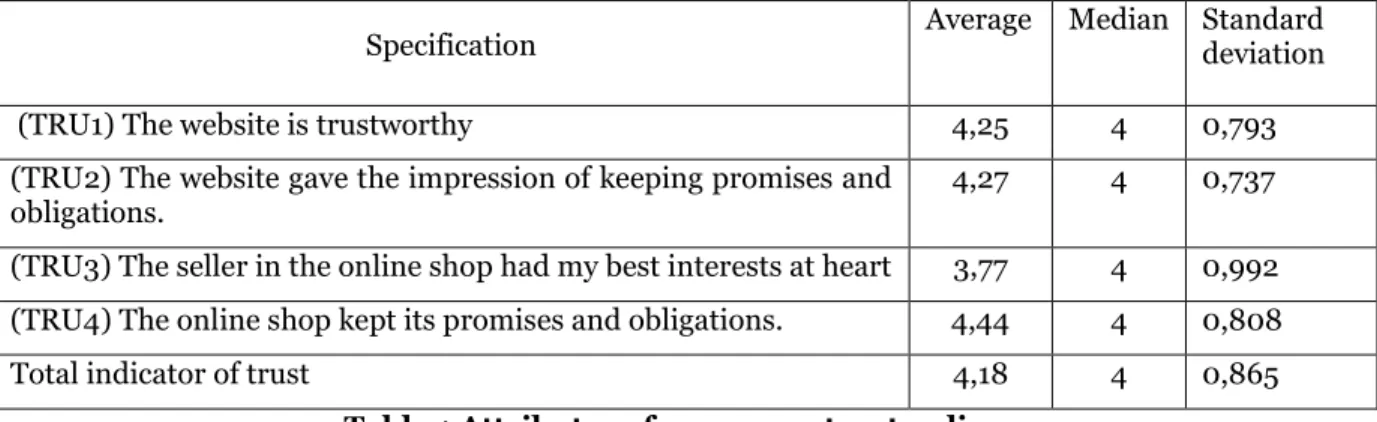
In Internet transactions conducted by consumers, a significant role is played by the consumer trust in websites. The authors of the herein paper decided to analyse the impact of trust on the purchasing intentions in websites. In the preliminary step, they assessed the level of consumer trust online. On the basis of the scale of trust proposed by Lee (2005), a research construct was built which facilitated the definition of the level of trust of young consumers towards websites. Analysis of Table 1 reveals that the general level of consumer trust is at an average level (average of 4,18).
Specification Average Median Standard deviation (TRU1) The website is trustworthy 4,25 4 0,793 (TRU2) The website gave the impression of keeping promises and
obligations. 4,27 4 0,737
(TRU3) The seller in the online shop had my best interests at heart 3,77 4 0,992 (TRU4) The online shop kept its promises and obligations. 4,44 4 0,808
Total indicator of trust 4,18 4 0,865
Table 1 Attributes of consumer trust online Source: Self-analysis.
In the second step, the chosen factors determining trust online towards websites were analysed (Table 2). One of the significant factors is that of perceived personalization, which results from the paradigm of
individualism that is characteristic of a consumer society. The scale of Srinivasan et al, (2002) was adapted for this research. Self-research reveals that it is at the level of 3,57, which signifies that online shops in Poland offer the possibility of satisfying the individualized needs of consumers to a limited degree. The possibility of ordering a product or service which are adjusted to the individual needs of a consumer was rated the highest.
In terms of choosing a website as a place to purchase products, the quality of communication is important with regard to the timely provision of significant information to the consumer with the aid of formal channels, e.g. chat rooms, instant messages, e-mail, audio, and video. The scale of Li et al, (2006) was utilized for the purpose of analysing communication with websites. Research indicates that respondents do not assess the communication with websites very highly (3.48), while simultaneously they gave the highest rating to the provision of valid information and provision of information on the new possibilities of the website, whereas the lowest rating to the search advice with regard to marketing actions.
The quality of goods and services has an impact on maintaining the long-term relations between a website and a consumer. The respondents analysed assess the quality of the services offered by the websites at an average level (3,98), while fulfilling promises that are proposed to clients are the most highly rated, albeit the intentions of sellers to ensure the optimal good of clients were rated the lowest.
The level of satisfaction with the commercial offer has an impact on the level of trust shown by consumers towards the website. The level of satisfaction from availing of the website was analysed by means of the scale of Li et al, (2006). Self-analysis reveals that fulfilling the needs of consumers in a satisfactory way and experiencing pleasure associated with making purchases have first and foremost influence on the level of satisfaction (4,07).
A factor which strengthens the level of trust towards the website is that of the benefits associated with the relations with it. For the purpose of their analysis, the scale created by Cui et al, (2020) was adopted. Analysis of Table 2 reveals that the respondents generally gain benefits from their relations with websites (3,72), while the greatest benefit is that of the possibility of returning or exchanging a purchased product, while the smallest one is the lack of assurance of a personal response to the complaints of clients.
To a large extent trust online is dependent on the level of uncertainty in the partner and the online transaction. The scale of Hong, Cha (2013) was adopted for the purpose of analysing the uncertainty. Self-analysis reveals that the respondents do not have a complete sense of security in terms of their relations with the website (3.37). Simultaneously, they are anxious about the possibility of being cheated by the seller and the lack of information about a secure process of logging into the website. Likewise, they are anxious about the lack of information about the tools for monitoring the security of payments.
Specification Average Median SD
Perceived personalization (PP) (PP1) This website enabled me to order products or services which are
adjusted to my needs 4,36 4 0,757
(PP2) Advertising and promotion sent to me from the website are
adjusted to my needs 4,35 4 1.092
(PP3) This website makes me feel that I am an exceptional client 3.04 3 0,989 Quality of communication (QC)
(QC1) The website of the online shop informs me of the new functions. 3,64 4 0,978 (QC2) The website provides me with current information 3,82 4 0,894 (QC3) The website often informs me about new possibilities. 3,81 4 1.202 (QC4) The website searches for my advice with regard to marketing
actions 3,07 3 1.164
(QC5) The website informs me about the possession of certificates issued
3,37 3 1,091 Quality of service (QS)
(QS1) The website in which I made the purchase actually fulfilled what it
promised on its website 4,22 4 0,827
(QS2) Apart from the desire to gain justified profits, the seller in the
online shop had the interests of the client in mind 3,77 4 0,910 (QS3) An online shop bases its activities on ensuring good quality goods
and services, 3,94 4 0,898
Satisfaction (SA)
(SA1) I am satisfied with the website 4,29 4 0,760 (SA2) My experience with the shop in which I made the last purchases
was very pleasant. 4,20 4 0,796
(SA3) This website satisfies me 3,72 4 1.034
(SA4) The website where I made a purchase fulfils my needs in a
satisfactory way 4,06 4 0,828
Benefits from relations with website (BR)
(BR1) The website offers special offers for regular clients. 3,49 4 1,089 (BR2) The website provides the possibility of returning or replacing the
products purchased. 4,23 4 0,882
(BR3) The website ensures information for the user in accordance with
the needs of the client. 3,97 4 0,787
(BR4) The online shop ensures a personal reaction to the complaints of
clients. 3,40 4 0,974
(BR5) Advertisements and offers received by clients are in accordance
with their tastes and preferences. 3,52 3 1.018 Level of uncertainty (UN)
(UN1) I am worried about the fact that if I buy a product in an online
shop, I may be cheated by a seller 3,41 3 1,147 (UN2) I am worried about the fact that I do not know if the online shop is
equipped with the tools for monitoring the security of my payments 3,40 3 1,161 (UN3) I am worried about the fact that I don’t know if the website is
equipped with a safe process of logging in. 3,26 3 1,205 (UN4) I am worried about the fact that I don’t know if a website is
appropriate for managing the private information of clients 3,41 3 1,177 Table 2 Factors influencing consumer trust online
Source: Self-analysis.
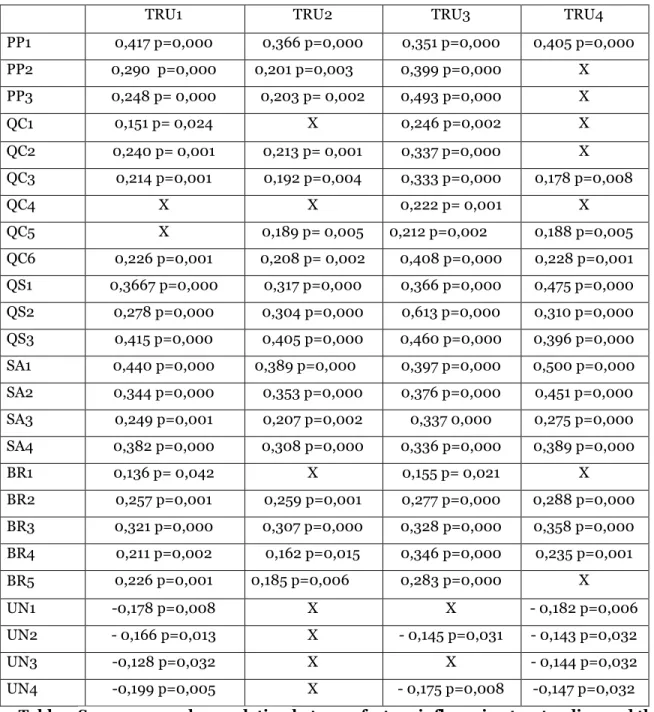
In the subsequent stage, the authors analysed the impact of the chosen factors on trust online (Table 3). The research conducted reveals that the greatest positive impact on the attribute of trust in the website is that of reliability (TRU1), which had items PP1, QS1, QS3, SA1, SA2, SA4, BR3, whereas a negative impact was exerted by the items UN1, UN2 I UN4, while in turn, the attribute-website gave the impression that the shop keeps its word and obligations (TRU2), whereas a positive impact was illustrated by first and foremost PP1, QS1, QS3, SA1,SA2, BR3. However, the attribute-seller in an online shop had my best interests at heart (TRU3) and the strongest impact was with the items PP2, PP3, QC6, QS2, QS3, SA1,SA2,
BR1, whereas a negative impact was exerted by the items UN2,UN4. The attribute-online shop kept its promises and obligations (TRU4) and the strongest impact was with the items PP1, QS1, QS3, SA1,SA2, SA4, BR3, whereas a negative impact was exerted by the items UN1, UN2, UN3, UN4. By way of conclusion, consumer trust online is most strongly influenced by the level of satisfaction. The greater the level of satisfaction in terms of the relations with the online shop, the greater the trust of consumers towards it. Likewise, quality of service have a strong positive impact on the level of trust. However, UN2 and UN4 have the strongest negative impact.
TRU1 TRU2 TRU3 TRU4
PP1 0,417 p=0,000 0,366 p=0,000 0,351 p=0,000 0,405 p=0,000 PP2 0,290 p=0,000 0,201 p=0,003 0,399 p=0,000 X PP3 0,248 p= 0,000 0,203 p= 0,002 0,493 p=0,000 X QC1 0,151 p= 0,024 X 0,246 p=0,002 X QC2 0,240 p= 0,001 0,213 p= 0,001 0,337 p=0,000 X QC3 0,214 p=0,001 0,192 p=0,004 0,333 p=0,000 0,178 p=0,008 QC4 X X 0,222 p= 0,001 X QC5 X 0,189 p= 0,005 0,212 p=0,002 0,188 p=0,005 QC6 0,226 p=0,001 0,208 p= 0,002 0,408 p=0,000 0,228 p=0,001 QS1 0,3667 p=0,000 0,317 p=0,000 0,366 p=0,000 0,475 p=0,000 QS2 0,278 p=0,000 0,304 p=0,000 0,613 p=0,000 0,310 p=0,000 QS3 0,415 p=0,000 0,405 p=0,000 0,460 p=0,000 0,396 p=0,000 SA1 0,440 p=0,000 0,389 p=0,000 0,397 p=0,000 0,500 p=0,000 SA2 0,344 p=0,000 0,353 p=0,000 0,376 p=0,000 0,451 p=0,000 SA3 0,249 p=0,001 0,207 p=0,002 0,337 0,000 0,275 p=0,000 SA4 0,382 p=0,000 0,308 p=0,000 0,336 p=0,000 0,389 p=0,000 BR1 0,136 p= 0,042 X 0,155 p= 0,021 X BR2 0,257 p=0,001 0,259 p=0,001 0,277 p=0,000 0,288 p=0,000 BR3 0,321 p=0,000 0,307 p=0,000 0,328 p=0,000 0,358 p=0,000 BR4 0,211 p=0,002 0,162 p=0,015 0,346 p=0,000 0,235 p=0,001 BR5 0,226 p=0,001 0,185 p=0,006 0,283 p=0,000 X UN1 -0,178 p=0,008 X X - 0,182 p=0,006 UN2 - 0,166 p=0,013 X - 0,145 p=0,031 - 0,143 p=0,032 UN3 -0,128 p=0,032 X X - 0,144 p=0,032 UN4 -0,199 p=0,005 X - 0,175 p=0,008 -0,147 p=0,032 Table 3 Spearman rank correlation between factors influencing trust online and the
attributes of consumer trust
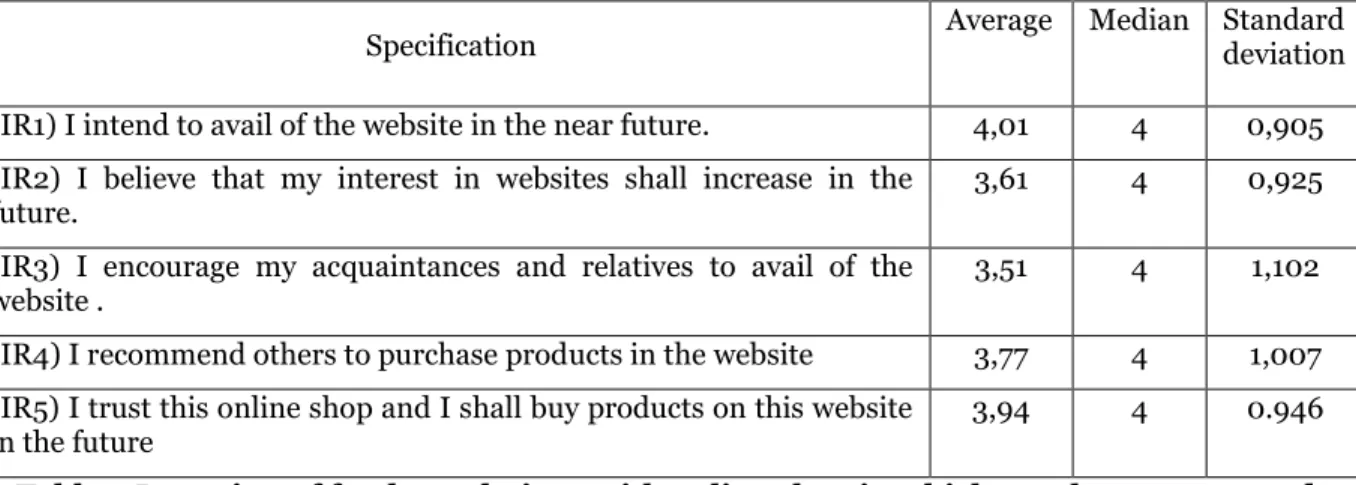
The final stage was to identify the impact of trust online on the intention of further relations with the website. In the analysis on the intention of making a purchase, this was defined as the inclination of the consumer to pursue further purchases via the Internet. With this aim in mind, a research construct was prepared on the basis of the scale proposed by Cui et al, (2020).Self-analysisreveals that the majority of
the respondents declare undertaking further relations with the website in which they have made a purchase recently (Table 4).
Specification Average Median Standard deviation (IR1) I intend to avail of the website in the near future. 4,01 4 0,905 (IR2) I believe that my interest in websites shall increase in the
future. 3,61 4 0,925
(IR3) I encourage my acquaintances and relatives to avail of the
website . 3,51 4 1,102
(IR4) I recommend others to purchase products in the website 3,77 4 1,007 (IR5) I trust this online shop and I shall buy products on this website
in the future 3,94 4 0.946
Table 4 Intention of further relations with online shop in which purchases were made recently
Source: Self-analysis.
The intention to continue relations by the consumer is influenced by consumer trust. Analysis of the research indicates that the strength of the impact of the particular attributes of trust in terms of continuing relations with the online shop where a purchase had been made recently was differentiated (Table 5). The intention to avail of the website in the near future was most strongly influenced by TRU3 and TRU4, while also trust in the online shop and the declaration that he/she would purchase products on this website in the future was most strongly influenced by TRU3 and TRU4. Apart from the attributes of trust, a relatively strong impact was exerted on the conviction that the interest of the consumer in the website would increase in the future relating to TRU2 and TRU4.
IR1 IR2 IR3 IR4 IR5
TRU1 0,199 p=0,003 0,212 p=0,001 0,295 p=0,000 0,190 p=0,004 0,141 p=0,035 TRU2 0,115 p=0,052 0,316 p=0,000 0,134 p=0,046 0,239 p=0,000 0,243 p=0,000 TRU3 0,358 p=0,000 0,214 p=0,001 0,282 p=0,000 0,269 p=0,000 0,348 p=0,000 TRU4 0,289 p=0,000 0,399 p=0,000 0,357 p=0,000 0,407 p=0,000 0,272 p=0,000 Table 5. Spearman rank correlation between the intention of further relations with the
online shop, in which a purchase was has been made recently and the attributes of consumer trust online
Summary
The results of the research conducted facilitated the acquisition of the answers to the research questions formulated. The research results relating to the degree of occurrence of the attributes of consumer trust online among young consumers indicate their average level of occurrence. The attributes of trust online occur to the greatest extent in terms of keeping promises and obligations, while also the impression that a shop keeps its promises and obligations. They create favourable conditions for undertaking further relations with the website. Gefen and Straub (2000) suggested that trust in the online seller has a positive impact on the intention to avail of the website. One of the fundamental factors that have an impact on the level of trust online is that of the perceived personalization, particularly the possibility of purchasing products or services adjusted to the individual needs of consumers. Another important factor in terms of building trust online is that of the quality of service associated with fulfilling promises with regard to the quality of the products or services offered, while also ensuring the good quality of the products and services. The level of consumer trust is also influenced by benefits from the relations with the website. One of the most significant ones is that of the possibility of returning or exchanging the products acquired. Other benefits are special offers for regular clients and the provision of information for the
consumer in accordance with his needs. During analysis of the dependencies between the factors influencing trust online and consumer trust, it was indicated that consumer trust online is most strongly influenced by the level of satisfaction. Likewise, the perceived uncertainty associated with transactions on the website has a strong impact on consumer trust. This refers to the tools for monitoring the security of payments and the secure process of logging on, while also the feeling of being cheated by the seller. In the case of websites, trust may become an important mechanism in order to reduce the uncertainty of clients, by influencing their transaction intentions (Lee 2005).
As indicated in the analysis of the research results, the attributes of consumer trust online have varying impact on the intention to continue relations with the website at which products and services had been purchased recently. The strongest impact on the declaration to continue relations was exerted by the conviction that the website keeps its promises and obligations, while the hitherto positive experience associated with this is the fact that the online shop kept to its obligations.
The authors of the herein paper wish to indicate the limitation in terms of the utilization of the research results on consumer trust online among young consumers. The analysis was conducted with the survey method, which was aimed at outlining the intricate problematic issues of consumer trust online and constitutes a starting point for further research on its role in the development of e-commerce.
REFERENCES
Aiken D., Boush, D. 2006. “Trustmarks, Objective-Source Ratings, and Implied Investments in Advertising: Investigating Online Trust and the Context-Specific Nature of Internet Signals”, Journal of the Academy of Marketing Science, Volume 34, 3, pp. 308-323. DOI: 10.1177/0092070304271004
Akhtar N., Kim W.G. Ahmad W. Akhtar M.N., Siddiqi U.I., and Riaz M. 2019. “Mechanisms of consumers'
trust development in reviewers' supplementary reviews: A reviewer-reader similarity perspective”, Tourism Management Perspectives, Volume 31, pp. 95-108. DOI: 10.1016/j.tmp.2019.03.001
Alizila, 2014. What’s driving China’s m-commerce boom. https://www.alizila.com/whats-driving-chinas-m-commerce-boom-charts/.
Beldad A., de Jong M., and Steehouder M. 2010. “How shall I trust the faceless and the intangible? A
literature review on the antecedents of online trust”, Computers in Human Behavior, Volume 26, 5, pp. 857-869. DOI:https:10.1016/j.chb.2010.03.013
Bojang I. 2017. “Determinants of Trust in B2C E-commerce and Their Relationship with Consumer Online Trust: a Case of Ekaterinburg, Russian Federation”, Journal of Internet Banking and Commerce, Volume 22 , S8, pp.1-59. DOI:10.9756/IAJBM/V6I1/1910007
Bozic B. 2017. “Consumer trust repair: A critical literature review”, European Management Journal, Volume 35, 4, pp. 538-547. DOI: 10.1016/j.emj.2017.02.007
Casalo L. V., Flavian C. and Guinaliu M. 2007. “The influence of satisfaction, perceived reputation and
trust on a consumer’s commitment to a website”, Journal of Marketing Communications, Volume 13, 1, pp. 1–17. DOI: 10.1080/13527260600951633
Chen N., Yang Y. 2017. “Mechanism of government policies in cross-border e-commerce on firm performance and implications on m-commerce”, International Journal of Mobile Communications, Volume 15, 1, pp. 69-84. DOI: 10.1504/IJMC.2017.080578
Chen S. C., Dhillon G.S. 2003. “Interpreting Dimensions of Consumer Trust in E-Commerce”,
Information Technology and Management,Volume 4, 2-3, pp. 303–318. DOI:
10.1023/A:1022962631249
Crabbe M., Standing C., Standing S. and Karjaluoto H. 2009. „An adoption model for mobile banking in Ghana”, International Journal of Mobile Communications, Volume 7, 5, pp. 515-543. DOI: 10.1504/IJMC.2009.024391
Crespo A. H., Bosque, I. R. D. 2010. “The influence of the commercial features of the Internet on the
adoption of e-commerce by consumers”, Electronic Commerce Research and Applications, Volume 9, 6, 562 -575. DOI: 10.1016/j.elerap.2010.04.006
Cui Y., Mou J., Cohen J., Liu Y., and Kurcz K. 2020. “Understanding consumer intentions toward cross-border m-commerce usage: A psychological distance and commitment-trust perspective”, Electronic Commerce Research and Applications, Volume 39, 1-2, DOI: 10.1016/j.elerap.2019.100920
Gefen D., Karahanna E., and Straub D.W. 2003, “Trust and TAM in online shopping: An integrated
Gefen D., Straub D. 2000. “The relative importance of perceived ease of use in IS adoption: A study of E-commerce adoption”, Journal of the Associations for Information Systems, Volume 1, pp. 1-28. DOI: 10.17705/1jais.00008.
Gemius dla e-Commerce Polska, E-commerce w Polsce 2018. Raport z badań, Gemius 2018 from
http://ginter.pro/wp-content/uploads/2018/07/E-commerce_w_Polsce_2018.pdf
Hong I. B., Cho H. 2011. “The impact of consumer trust on attitudinal loyalty and purchase intentions in B2C e-marketplaces: Intermediary trust vs. seller trust” International Journal of Information Management, Volume 31, pp. 469 - 479. DOI: 10.1016/j.ijinfomgt.2011.02.001
Hong I.B., Cha H.S. 2013. “The mediating role of consumer trust in an online merchant in predicting
purchase intention”, International Journal of Information Management, Volume 33, pp. 927– 939. DOI: 10.1016/j.ijinfomgt.2013.08.007
Lee T.M. 2005. “The impact of perceptions of interactivity on customer trust and transaction intentions in
mobile commerce”, Journal of Electronic Commerce Research, Volume 6, 3,pp.165-180.
Li D., Browne G.J., and Wetherbe J.C. 2006. “Why Do Internet Users Stick with a Specific Web Site? A Relationship Perspective”, International Journal of Electronic Commerce, Volume 10, 4, pp. 105–
141. DOI:10.2753/JEC1086-4415100404
Li Y.M., Yeh Y.S. 2010. “Increasing trust in mobile commerce through design aesthetics”, Computers in Human Behavior , Volume 26, 4, pp. 673-684, DOI: 10.1016/j.chb.2010.01.004
Lu Y., Yang S., Chau P.Y.K., and Cao Y. 2011. “Dynamics between the trust transfer process and intention to use mobile payment services: a cross-environment perspective”, Information and Management, Volume 48, 8, pp. 393-403. DOI: 10.1016/j.im.2011.09.006
Matthew K., Lee O., and Turban E. 2001. “A Trust Model for Consumer Internet Shopping”, International Journal of Electronic Commerce, Volume 6, 1, pp. 75-91. DOI: 10.1080/10864415.2001.11044227 Mayer, R.C.; Davis, J.H.; and Schoorman, F.D. 1995. “An integrative model of organizational trust”,
Academy of Management Review, Volume 20, 3, pp. 709–734 DOI: 10.5465/amr.1995.9508080335
Metzger M. J. 2006. “Effects of site, vendor, and consumer characteristics on web site trust and disclosure”, Communication Research, Volume 33, 3, pp. 155–179. DOI:10.1177%2F0093650206287076
Nooteboom B., 2002. Trust: forms, foundations, functions, failures and figures, Edward Elgar, Cheltenham. ISBN 1781950881, 9781781950883
Pavlou P.A. 2003. „Consumer Acceptance of Electronic Commerce: Integrating Trust and Risk with the Technology Acceptance Model”, International Journal of Electronic Commerce, Volume 7, 3, pp.101-134. DOI: 10.1080/10864415.2003.11044275
Petermann F. 1996. Psychologie des Vertrauens, Hogrefe Verlag, Gottingen. ISBN: 978-3-8017-2415-3 PwC 2018, Polacy na zakupach, 5 filarów nowoczesnego handle,
https://www.pwc.pl/pl/pdf/polacy-na-zakupach-raport-pwc-2018.pdf
Roy M. C., Dewit O. and Aubert B. A. 2001. “The impact of interface usability on trust in web retailers”
Internet Research Electronic Networking Applications and Policy, Volume 11, 5, pp. 388-398. DOI: 10.1108/10662240110410165
Shankar V., Urban G. L. and Sultan F. 2002. “:Online trust: A stakeholder perspective, concepts, implications, and future directions”, Journal of Strategic Information Systems, Volume 11, 3-4, pp. 325–344. DOI: 10.1016/S0963-8687(02)00022-7
Srinivasan S.S., R. Anderson and, K. Ponnavolu 2002. “Customer loyalty in e-commerce: an exploration of its antecedents and consequences”, Journal of Retailing, Volume 78, 1, pp. 41-50 DOI:10.1016/s0022-4359(01)00065-3 .
Wang W.T., Wang Y.S., and Liu E.R. 2016. “The stickiness intention of group-buying websites: the integration of the commitment-trust theory and e-commerce success model”, Information and Management, Volume 53, 5, pp. 625-642. DOI:10.1016/j.im.2016.01.006