No. 2006/12
Why Do Contracts Differ between VC Types?
Market Segmentation versus Corporate Governance VarietiesCenter for Financial Studies
The Center for Financial Studies is a nonprofit research organization, supported by an association of more than 120 banks, insurance companies, industrial corporations and public institutions. Established in 1968 and closely affiliated with the University of Frankfurt, it provides a strong link between the financial community and academia. The CFS Working Paper Series presents the result of scientific research on selected topics in the field of money, banking and finance. The authors were either participants in the Center´s Research Fellow Program or members of one of the Center´s Research Projects.
If you would like to know more about the Center for Financial Studies, please let us know of your interest.
* This paper is part of a larger research cooperation between the Center for Financial Studies and KfW. We would like to thank Carsten Bienz and Volker Zimmermann for valuable comments, all KfW employees at KI for their support and especially Andreas Weber (KfW) for his help. All errors remain ours. We gratefully acknowledge financial support by German Research Foundation (DFG).
1 Goethe University Frankfurt, Schumannstraße 60, 60325 Frankfurt am Main, Germany. Tel : +49 (0) 69 79822702.
Email: [email protected]
CFS Working Paper No. 2006/12
Why Do Contracts Differ between VC Types?
Market Segmentation versus Corporate Governance Varieties*Julia Hirsch
1and Uwe Walz
2March 2006
Abstract:
The main objective of the present paper is to disentangle observed differences in the design of contracts across VC types into firm selection effects and corporate governance differences between VC types (different contracts). Based on a theoretical approach developed in the first part of the paper, we investigate in the second part these issues empirically by using a unique, hand-collected German data set consisting of all contractual details of VC investments into 290 entrepreneurial firms in the period 1990-2004. By employing various matching procedures, we show that VC types differ in both firm choice and corporate governance approach.
JEL Classification: G24, G32, G34
1
Introduction
In recent years, the relationship between venture capitalists (VCs) and their portfolio firms has attracted significantly increasing attention in the popular press but also in academic research. One of the major questions in that respect is whether there exists, after controlling for firm characteristics, an optimal corporate governance design between the portfolio firm and its investor (the VC) or, whether we observe significant differences most notably across countries but as well across VC firms and types which prevail over time. By focusing on the contractual design between VCs and portfolio firms, we address the latter issue in detail and the former issue indirectly.
We concentrate on two main, specific questions. First, do different types of VCs (i.e. bank-dependent, public or independent VCs) negotiate different types of contracts when financing the same type of firms or are observed differences in contractual design across different VCs only due to the fact that different VCs select different firms? That is, we want to disentangle observed differences in the design of contracts between VCs and their portfolio firms into firm selection effects and actual differences in the corporate governance approaches between VC types. Second, depending on the answer of the first question we ask how precisely the differences across VC types (of either contractual design and/or selected firms) look like.
In a first step, we address these questions by building up a stylized theoretical model which allows for separation and pooling of firms financed by different VCs. This modelling approach enables us to derive testable hypotheses concerning the equilibrium behavior of VC firms. In a second step, we use a hand-collected German data set to respond to our main research questions. This data set consists of all the contractual details of VC investments into 290 entrepreneurial firms and covers the period from 1990 to 2004. We make use of various matching procedures to separate the selection effect from the pure VC type effect.
The fact that our data sample stems from the German VC market turns out to be very beneficial for our purpose. This particular market is, due to institutional reasons, populated by a rich variety of VC types with each type having a significant market share. This enables us to analyze firm selection and contract choice of different VC types properly on a broad enough data base with sufficient observations for most VC types. Moreover, it has the indirect effect that we are able to take a closer look on the differences in contractual design between the US – a fully developed VC market – and Germany – a yet immature but fast developing market – (see e.g. Bascha and Walz (2002) and Kaplan et al. (2003)) by asking to what degree the observed aggregate differences are due to a different structure of the respective VC markets as to their VC type composition.
account a potential VC type effect (regarding contract design, investment behavior, ac-tive engagement as well as performance) by using different (often quite rough) dummy variables. Moreover, there also exist some papers which partially analyze the market segmentation between different types of VCs (see section 2 for details). Our matching approach points in the same direction, but goes one significant step beyond. Rather than only testing for the significance of such a VC type dummy, we are able to elaborate much further the details of such differences. We are able to explore in detail the very nature of these differences by identifying simultaneously the differences with respect to contract choice (which VC types use which particular aspect of the contract to what extent?) or the choice of firms (what type of firm with which characteristics is selected?). Thus we are able to give a comprehensive view about the differences between the VC types.
Our main findings are as follows. We find a crucial market segmentation between the different VC types (public VCs, bank-dependent VCs and independent VCs) which is mainly driven by the innovativeness of the project: the more innovative the entrepreneurial venture, the more probable is financing by an independent VC with respect to the other two VC types. This market segmentation seems to be influenced by potential strategic considerations of the VCs as well as the need of the VC’s expertise by the entrepreneurial firm. Moreover, we find that for similar firms, the VC’s corporate governance approaches differ significantly: independent VCs use significantly more contract mechanisms which induce active intervention than do bank-dependent VCs. They, in turn, use significantly more of these mechanisms than do public VCs. As concerns control mechanisms, these differences are less pronounced. This last result has important implications for cross-country comparisons as it shows that observed differences in contract design may be rather due to differences in the market composition of the respective VC industries than to actual differences in the behavior of specific VC types.
The paper is organized as follows. In the next section, we provide a detailed literature review on (theoretical as well as empirical) research focusing in particular on the behavior of different VC types as well as on their differing objectives. In the third section, we develop a stylized model. We analyze the equilibrium behavior of three different VC types and derive testable hypotheses which form the basis for our subsequent empirical analysis. The data set which we use in our empirical investigation is described in the fourth section. The empirical method applied in our paper is discussed in the fifth section. The sixth section contains our empirical analysis in which we aim to address our leading questions. In the last section, we conclude.
2
Literature Review
Our analysis is closely related to two branches of the literature: first, the literature which examines the different modes of venture capital financing focusing on the objectives and characteristics of different financiers and the matching between them and different types of firms; and second, the rather recent literature which empirically analyzes venture capital and private equity contracts. In what follows, we want to review these two strands of the literature.
Before looking into the main differences between VC types and the consequences on the governance of the financed ventures, it definitively helps to survey the main pros and cons of VC financing per se relative to other sources of financing for young firms – most notably banks. Studies analyzing this relationship typically start from the perception of VCs as being active (hands-on) investors which provide risk capital for entrepreneurial firms (see e.g. Landier (2004)). The more active involvement of VCs compared to e.g. bank financing is considered to be not only restricted to a more active engagement during the investment phase of the VC but also during the selection process. In this spirit, Berkovitch and Levy (2004) show within the framework of a search model that in market equilibrium, matching is partially mixed: venture capitalists may finance high and low added value projects while other financiers receive only low value added ones. Alike, Ueda (2004) develops a model of entrepreneurial finance where there exist two types of financiers: venture capitalists and banks. While venture capitalists are well informed, banks are not. But venture capitalists may appropriate the firm’s idea while banks can not do that. Within this framework, she shows that projects financed through venture capitalists are larger and exhibit higher returns, higher growth and higher risk. In a similar way, Chemmanur and Chen (2003) investigate the choice between VC financing and angel financing. In their framework, VCs distinguish themselves not only by adding value to firms but also by possessing private information. They find that a separation of firms between angel and VC financing may occur only if neither of the two financing modes is very scarce. If this is not the case, however, i.e. if one source of financing is in very short supply, different types of firms seek and receive the respective alternative source of financing. In addition, they show that a particular firm may receive capital from different sources (angel and VC) over its life time. In all these studies, venture capitalists are to be considered independent venture capi-talists which only aim to maximize their monetary returns net of costs. There are, however, VC types which – with respect to their governance as well as with regard to their objec-tives – differ from this prototype of an independent VC. We can differentiate three types of VCs other than independent VCs: corporate VCs (or sometimes referred to as captive VCs (see Hellmann (2002)), i.e. VC firms owned by a strategic investor), bank-dependent VCs (owned by a bank), and public VCs (financed mainly with public money). For our
analysis, two questions are especially important when looking at these different types of VCs: What are the main motives of each specific type and when is it selected as source of financing?
Besides independent VCs, corporate VCs have attracted the most attention. They are considered to be significantly different from independent VCs with respect to their objectives. Indeed, despite the often highlighted differences in corporate VCs’ objectives (see e.g. Birkinshaw et al. (2002)), there is a general agreement that these objectives fall into two categories, namely strategic and financial objectives (see Chesbrough (2002) and Siegel et al. (1988)). Gompers and Lerner (2000) – who have been among the first who have studied corporate VCs by comparing them to independent VCs – show that the strategic interest of corporate VCs in their portfolio firm has some advantages but also some costs. They find in their empirical analysis that corporate venture investments in entrepreneurial firms appear to be at least as successful as those backed by independent venture organizations. Their data further indicates that corporate investments are made at a premium reflecting the indirect benefits of the strategic complementarities between the strategic investor and the portfolio firm. Building on the idea of complementarities between the entrepreneurial firm and the corporation backing the VC, Hellmann (2002) shows in his model that if the new venture is a complement (substitute) the entrepreneur
selects the corporate (independent) VC1. He also points out that the choice of the VC
type has a significant effect on the relationship and the general design of the contract between the new venture and the VC. The same finding emerges from De Bettignies and Chemla (2003) who show that entrepreneurs end up with fewer shares and less control under corporate VC than under independent VC financing. In our theoretical model in the next section, we will use these insights as a starting point to analyze the relation between the choice of a specific VC type and the contractual design in more detail.
In contrast to this rather large body of literature, bank-dependent VCs have attracted only limited attention. The major exception is Hellmann et al. (2004). Their empirical analysis suggests that banking organizations use their VC subsidiary to build relationships which are in the long run beneficial for their lending activities. Therefore, bank-dependent VCs aim at financing those firms which are most likely to generate credit demand in the future. They show that bank-dependent VCs behave in a significantly different way than independent VCs. Bank-dependent VCs invest less often in early rounds and they engage more in larger deals what reflects their desire to invest in firms which are more close to a situation where they may demand loans.
Public VCs are typically closely related to promotional programs of governments to foster the development of young start-up companies. They play a significant role in the 1Riyanto and Schwienbacher (2001) argue that the corporation can increase the complementarities by financing the venture via the corporate VC.
overall VC market (see e.g. OECD (1996)). Not only in Continental European countries,
such as France, Belgium, Italy and Germany, but also in the US2 and in particular in
Canada3, the share of public VCs is significant. Secrieru and Vigneault (2004) display an
exception to the general neglect of public VCs in the literature. They investigate the role of public VCs and ask for the optimal level of advice which should be provided by the public VC. Thereby, they also highlight potential motives for public engagement in this market: internalization of externalities arising from innovations, liquidity constraints of entrepreneurial firms, and the certification role of public venture capital programs (see also Lerner (2002) on this point). In similar spirit, Hirsch (2005) investigates the effects of public policy programs which aim at internalizing the external effects stemming from entrepreneurial innovations on contract design. She shows that the design of the public intervention scheme may have serious effects on contracting mechanisms between private agents and may even worsen the resulting allocation.
Rather than looking at the differences among the various forms of VC types, Tykvova and Walz (2005) take the differences for granted and examine the consequences of these differences on the portfolio firms and their performance. In an overall compa-rison of different VCs and the performance of their portfolio firms in the aftermath of the IPO, they show that there is indeed a significant difference in the post-IPO performance of firms backed by different VC types. With data from the newly emerging IPO market in Germany, they reveal that firms backed by independent VCs do significantly better in the post-IPO performance thereby indicating the possibility that in the young German VC market investors did not take the value-added effects of independent VCs fully into account4.
Finally, as mentioned, our paper is also related to the line of literature which empir-ically analyzes the design of VC contracts. By looking at the link between the organi-zational structure of VCs and the design of the contracts between a specific type of VC and its portfolio firms, our analysis can be seen as a further piece in this rather recent
literature. Starting with the seminal paper of Kaplan and Str¨omberg (2003) who looked
into the main structural elements of US VC contracts against the background of models of corporate finance, a number of papers have emerged which have extended this approach
to specific aspects of VC contracts (see Kaplan and Str¨omberg (2004)) and with respect
to international data sets (see e.g. Kaplan et al. (2003) and Lerner and Schoar (2005)). In two companion papers, we have analyzed specific elements of VC contracts on the basis of 2See Lerner (2002) for a comprehensive analysis of various public programs aiming at the venture capital markets and a discussion of their design.
3Vaillancourt (1997) shows that more than 40 percent of venture capital in Canada in 1994 was managed by public VCs.
4In a related study, Rindermann (2005) analyzes the performance of firms before and around the IPO with a European data sample.
a detailed and highly representative data sample from Germany (which is also used in this paper). Bienz and Hirsch (2005) look into the structure and determinants of staged VC contracts by – among other things – contrasting round financing with milestone financing. Bienz and Walz (2005) analyze the determinants of control and decision rights in VC con-tracts. In all these papers, however, VC types enter, if at all, at most as a dummy on the right-hand-side of the regression. In contrast, we take a much more elaborate look on the choice of VC types by firms and its implications on contract design, thereby representing a complementary view to the above papers.
3
A Theoretical Analysis
The aim of this section is to develop a stylized model which allows us to discuss the selection of VCs by portfolio firms as well as the resulting contractual designs in the respective relationships. We build our model on the stylized facts from the mentioned literature, i.e. the differences in the objectives and characteristics between VC types. This procedure allows us to explain the observed market segmentation and derive, at the same time, the determinants of the resulting contractual designs.
We allow for three different types of VCs endowed with funds to finance the projects of three different types of firms. As to the VCs, we distinguish – with regard to our empirical analysis – independent VCs (IVCs), bank-dependent VCs (BVCs) and public VCs (PVCs). The VC types differ with respect to their ability to provide advice for the firms and to
monitor them. We model both activities as a dichotomous variable. That is, controlcmay
take two realizations, either c = 0 (no control) or c = ¯c (control). The same holds true
for advicea, i.e.a∈ {0,¯a}. PVCs do not have a technology to provide neither advice nor
monitoring. Their respective costs are CP V C(¯c) = CP V C(¯a) = ∞. Independent VCs are
specialized in both activities with cost functions CIV C(¯c) = k and CIV C(¯a) = e. BVCs
have prohibitive costs for providing advice (CBV C(¯a) = ∞) and their control technology
is inferior to the one of IVCs but superior to the one of PVCs: CBV C(¯c) = αk (α >1).
There are three types of firms (or projects) which differ in their riskiness and the degree of innovation. We will refer to them as (in order of declining innovative- and riskiness)
θ1, θ2, and θ3. All projects require funds I in order to get started. In case of failure, all
projects earn Π (Π < I). Whereas profits are the same across projects in the case of
failure, profits differ in the case of success. The more innovative the project is, the higher profits are in case of success: ¯Π(θ1) > Π(¯ θ2) > Π(¯ θ3). The probabilities of success differ
across projects, but are also dependent on the degree of monitoring and advice. Overall, we delineate the order of riskiness by assuming for the respective probabilities:
For θ1-projects, advice is essential and control has, if advice is given to the firm, a
pos-itive impact, i.e. p(θ1,¯a,¯c) > p(θ1,¯a,0) > p(θ1,0, c) = 0 ∀c. Moreover, we assume that
the influence of additional control is limited: p(θ1,¯a,¯c)−p(θ1,¯a,0) ≤ p(θ1,¯a,0). For θ2
-projects control is essential and advice has, if the firm is monitored, a positive impact, i.e.
p(θ2,¯a,¯c) > p(θ2,0,¯c) > p(θ2, a,0) = 0 ∀a. This additional impact is, however, smaller
than for θ1-projects: p(θ1,¯a,¯c)−p(θ1,¯a,0) > p(θ2,¯a,¯c)−p(θ2,0,¯c). For θ3-projects
nei-ther advice nor control increase the probability of success, i.e. p(θ3,0,0) = p(θ3, a, c) >
0 ∀a, c.
PVCs and BVCs are able to extract additional indirect benefits from their engagement in the portfolio firms. While the BVCs are geared towards future credit business for their mother companies (see on this motivation Hellmann et al. (2004)), PVCs – due to their public mandate – aim at nonmonetary benefits from the venture (e.g. their ability to create jobs or to allow for (technology) spill-overs into other segments of the economy). In a nutshell, this implies that the total payoffs of the different VCs from their engagement
in a particular firm i can be written as:
(2) ΠIV C =piw¯i+ (1−pi)wi−k−e−I
(in case the IVC monitors and provides advice) and
(3) ΠBV C =pi( ¯wi+B) + (1−pi)wi−αk−I
(in case the BVC monitors but does not provide advice) and (4) ΠP V C =piw¯i+ (1−pi)wi+P −I
(in case the PVC does not provide neither advice nor monitoring)
whereby wi and ¯wi denote the monetary payoffs of the VC in the case of failure and
success of the venture. We restrict these payoffs to positive levels. The indirect payoffs of the BVC only arise in the case of success (in which subsequent bank-financing is feasible)
while the spill-over effect in the PVCs’ objective function denoted by P occurs in any
case. We assume that forθ1- andθ2-projects joint advice and control (even at the higher
BVC costs of control) is socially beneficial, i.e.:
(5) [p(θ1,¯a,¯c)−p(θ1,¯a,0)] [Π(θ1)−Π]≥k (6) p(θ1,¯a,0) ¯ Π(θ1)−Π ≥e (7) [p(θ2,¯a,¯c)−p(θ2,0,c¯)] ¯ Π(θ2)−Π ≥e (8) p(θ2,0,¯c) ¯ Π(θ2)−Π ≥αk
Obviously, given our above assumptions, it is optimal to neither exert control nor to
provide advice for θ3-projects.
All projects, given optimal advice and monitoring activities (denoted by stars), are
at least profitable. In addition we assume that θ1- and θ2-projects are so profitable that
their net social payoffs exceed Π. That is:
[1−p(θ1,a,¯ c¯)] Π +p(θ1,a,¯ c¯) ¯Π(θ1)−I−e∗−k∗ ≥ Π (9) [1−p(θ2,a,¯ c¯)] Π +p(θ2,a,¯ c¯) ¯Π(θ2)−I−e∗−k∗ ≥ Π (10) [1−p(θ3,0,0)] Π +p(θ3,0,0) ¯Π(θ3)−I ≥ 0 (11)
In addition, we impose two technical assumptions (12) p(θ1,¯a,0) [p(θ1,¯a,¯c)−p(θ1,¯a,0)] [p(θ2,¯a,¯c)−p(θ2,0,¯c)]p(θ2,0,c¯)−p(θ1,a,¯ 0) [p(θ1,¯a,¯c)−p(θ1,¯a,0)] [I−Π]≤k ≤ [p(θ1,¯a,¯c)−p(θ1,¯a,0)]2 p(θ2,0,¯c) ¯ Π(θ1)−Π (13) Π(θ1)−Π ≥ p(θ1,¯a,0)p(θ2,0,¯c) [(p(θ2,¯a,¯c)−(p(θ2,0,¯c)](p(θ2,0,c¯)−[p(θ1,¯a,c¯)−p(θ1,a,¯ 0)]p(θ1,¯a,0)] 1 [(p(θ1,¯a,c¯)−p(θ1,¯a,0)] [I−Π] The sequence of decisions is as follows.
- In the first stage, nature decides on the project type and the entrepreneur finds out about the type of his own project.
- In the second stage, the different VC types simultaneously offer contracts to the entrepreneur. In each group of VCs, perfect competition prevails.
- The third stage is characterized by the entrepreneurs’ choices of the VC types and the contracts as well as by the VCs investing I.
- In stage 4, the VCs learn about the project type. - Afterwards, in stage 5, they choose their effort levels.
- And, in stage 6, the projects pay off a certain level of cash flow and the contracts will be realized.
We will focus in the following on contracts which emerge from a separating set-up (i.e. firms never choose contracts designed for other firms) in which the VCs earn zero profits
(due to competition). We concentrate on first-best results and ask whether these contracts actually do form a separating equilibrium. In addition, we investigate – in cases where these optimal contracts do not result – whether another separating perfect Bayesian equi-librium may arise and how it looks like. Throughout our entire discussion we concentrate only on contracts which lead to zero-profits for VCs. Given competition in the second stage of the game (and given that we do not want to derive the entire universe of poten-tial equilibria, but rather want to focus on whether particular contracts are equilibrium contracts), this is rather straightforward. To be more precise, using the profit functions of the VCs (see eqs. (2), (3), and (4)) we get the following payoff structures:
(14) w(θi)IV C = k∗+e∗+I−[1−p(θi, a∗i, c ∗ i)]w(θi)ICV p(θi, a∗i, c ∗ i) (15) w(θi)BV C = α·k∗+I−[1−p(θi,0, c∗i)]w(θi)BV C p(θi,0, cαi) −B (16) w(θi)P V C = I−[1−p(θi0,0)]w(θi)P V C−P p(θi,0,0)
whereby the stars denote the efficient levels of advice and control efforts and costs. Against the background of this focus, we find the following for the fifth stage of our
game (in stage six only nature moves). Note that w(θi)IV C is the return the IVC has
demanded in the case of contracts designed for θi-projects.
Lemma 1 ...
1) For θ1-projects:
i) BVCs and PVCs will always choose a= 0 =c independent of contract design. ii) For an IVC choosing c = ¯c and a = 0 for θ1-projects never pays off. IVCs will provide advice (even without monitoring) for θ1-projects having chosen
θm-contracts (m ∈[1,2]) ifw(θm)IV C ≤I+k+e−
p(θm,a,c)
p(θ1,a,0)e prevails . The IVC monitors the firm (in the presence of the provision of advice) if w(θm)IV C ≤
I + k +e − p(θm,a,¯¯c)
p(θ1,a,c)−p(θ1,a,0)k. If monitoring pays, providing advice is always worthwhile.
2) For θ2-projects
i) BVCs always choose a = 0 and c=c. PVCs always opt for a= 0 = c.
ii) IVCs will monitor (in the absence of advice) ifw(θ2)IV C ≤I+k+e−pp((θθ22,a,c,0,c))kin
a contract designed for θ1-projects, the IVC will always monitor. The IVC will provide advice (in the presence of control activities) for θ2-projects having cho-sen θm-contracts if w(θm)IV C ≤I+k+e−p(θ2,a,cp(θ)m−,a,cp(θ)2,0,c)e.If providing advice
pays for θ2-projects with θm-contracts monitoring is always pay-off increasing
for the IVC.
3) For θ3-projects all VC types will always choose a = 0 = c independent of contract design.
Proof 1 See Appendix.
With the help of Lemma 1, we can now address the main part of the model, namely
the selection of VCs and contracts by the entrepreneurs. As already mentioned, we focus on the existence of a separating equilibrium and derive conditions under which such a separating equilibrium emerges and show how it precisely looks like. We state for the equilibrium of stage three of the game:
Proposition 1 ...
1) θ1-projects will always choose to be financed by an IVC anticipating active advice and control.
2) i) θ2-projects may either select an IVC or a BVC.
ii) With e≤e1 and α≤α1, θ2-projects are financed by a BVC anticipating active control but no advice.
iii) With e ≤ e1 and α > α1, θ2-projects select an IVC anticipating active control and advice.
iv) With e > e1 andα ≤α2, θ2-projects select an BVC anticipating control but no advice.
v) With e > e1 and α > α2, θ2-entrepreneurs select an IVC anticipating control but no advice.
3) θ3-projects will always select a PVC for their financing needs anticipating neither advice nor control.
whereby α1 ≡1 +p(θ2,0k,c)·B+ke−p(θ2,a,c)−kp(θ2,0,c)
Π(θ2)−Π
; e1 ≡ pp((θθ2,a,c)−p(θ2,0,c)
1,a,c)−p(θ1,a,0)k, and
α2 = 1 +
p(θ2,0,c¯)
k B.
That is, we have a clear separation of θ1- and θ3-projects which are financed by IVCs and
PVCs. Only with θ2-projects, we have two outcomes: these projects are either financed
by an IVC or a BVC. In the latter case, it may happen that the contracts offered to θ2
-projects are structurally (with respect to the implied provision of advice and monitoring)
different (see Proposition 1, 2ii) and iii)) or the same (see Proposition 1, 2iv) and v)) .
Given this result, we can now turn to the contract design stage of the game. Perfect competition among the VCs in each group implies undercutting and leads to zero profits for the VC. Due to the binary nature of the cashflows stemming from the different projects, and the fact that there are no other contractable variables besides realized cashflows, the optimal contract(s) will entail potentially two different pay-off levels which are contingent on the realized cashflows. Let us delineate these cashflows in case of success (failure) of the projects byw(θi)j (w(θi)j) whereby θi denotes the project type for which the contract
is designed for while j (IVC, PVC, BVC) stands for the VC type offering the contract.
Using Proposition 1 we can state (and thereby justify our initial assumption): Proposition 2 ...
The different VC types will offer contracts which just break even. The wage structure (each implying potentially a continuum of contracts) is depicted in (14), (15), and (16).
Proposition 4.2 basically describes the zero-profit nature of the equilibrium contracts. The absolute values are determined by the need to create incentive-compatibility and to ensure that a separating equilibrium actually emerges. Since they are by and large irrelevant for our purposes, we have decided to shift this analysis and the related discussion
in the Appendix (i.e. in the proof of Proposition 1).
Using our above results enables us to deduce general hypotheses (mainly by using
Proposition 1) concerning the selection of VC firms by entrepreneurs and the design of
the respective contracts. First of all, we have to note that PVCs will finance only θ3
-projects and that these -projects always choose PVCs. Second, we find that BVCs finance,
if at all, θ2-projects. IVCs in contrast, may finance θ1- as well asθ2-projects.
Therefore we can state our first hypothesis: Hypothesis 1 ...
We expect a selection effect in the sense that there exists a correlation between the in-novativeness of the project and the financing by means of different VC types. The least innovative projects are financed by PVCs. BVCs finance projects with an intermediate level of innovation. Finally, we expect that the higher the degree of innovation the more likely it is that these projects are financed by IVCs.
Furthermore, if we let control costs k to stay constant across time (i.e. different stages of
maturity of the VC market) and assume advice costs to vary with market maturity (the
Hypothesis 2 ...
In mature markets (i.e. with lower e) different VC types financing the same type of firms design different contracts for these firms (see Proposition 1, 2ii) and 2iii)).
Hypothesis 3 ...
In less mature markets (i.e. with a higher e) different VC types financing potentially the same type of firms design the same type of contracts for these firms (see Proposition 1, 2iv) and 2v)).
4
The Data Set
4.1
Sample and Sample Selection Issues
Our analysis uses a proprietary, hand-collected data set from KfW based on contracts between VCs and their portfolio firms. KfW has a unique position in Germany’s venture capital market: being Germany’s largest promotional bank, it supports innovative firms by promoting the investment of the VCs. Although, in our sample, KfW never directly invests in any of the portfolio firms, it becomes indirectly involved in the venture capital deals in Germany. In order to obtain support from KfW, VCs have to apply by submitting the key details of their relationship with the portfolio firm, most notably, the term sheets, the business plans and the shareholder’s agreements. By providing us with access to these documents, KfW gave us the unique opportunity to collect detailed information on the relationship between the VC and its portfolio firm based on actual contract data.
In order to reduce the very time-intensive task of collecting detailed information from the numerous documents to a manageable size, we drew a random sample of 300 portfolio
firms5. We categorized each portfolio company into one of three classes with respect to
their investment date (before 1998, between 1998 and 2000, and after 2000) and eight classes with respect to the program or program combination through which their VC investor was supported by KfW. This categorization was undertaken with the objective to achieve a balanced representation of the population. Table 1 gives an overview about our sample and the support programs considered. Unfortunately, the data for 10 portfolio companies could not be evaluated. Therefore, our random sample finally consists of 290 portfolio companies that were financed in 464 investment rounds between 1990 and 2004. In this study, we will limit to first rounds in order to focus on the choice of a specific VC type and the initial contract design and blind out temporal effects in contract design.
We are confident that we do not have any major bias in the selection of our sample 5We drew this sample out of the population of all portfolio firms that were financed by venture capitalists which, in turn, were supported by KfW via one of the programmes mentioned in table 1.
for two reasons. Firstly, as we were responsible for the sample selection process ourselves, we ensured that no selection bias occurred via the provider of all our documents (KfW) by drawing a random sample of all VC financed portfolio companies supported by KfW. Secondly, KfW supported a large proportion of the population of all investments realized
by the German venture capital industry in the time period under consideration6. This
means that we have a representative sample of the German VC industry. One obvious selection bias which we were not able to circumvent is the fact that we are concentrating on one particular geographic region (Germany) and the associated venture capital market. To a lesser degree this is true for the time period. We take all this into consideration by interpreting our data sample as the description of a situation of a young and evolving venture capital market.
As concerns the process of data collection, for each investment round, we evaluated the company’s balance sheet data and its business plan to get information with respect to the market position of the company and details about the financed project. Moreover, we took from the term sheet and the shareholder’s agreement detailed information about the security design, the timing and conditions of the investment, the syndication of the investment, control and information rights of the venture capitalists and exit covenants. We translated this information into quantifiable variables. Finally, we complemented the data set with information about the venture capitalist supported by KfW. Overall, we gained a detailed picture of the control and information rights embedded in these contracts as well as of the characteristics of the entrepreneurial firm, the founder(s) and the venture capitalists involved.
As usual in this type of studies, we were confronted with the problem that not al-ways all data were available. Thus the number of observations may vary depending on the variable studied. Typically, the amount invested and valuations were the most reli-able varireli-ables whereas information on staging or investment memoranda were sometimes missing. Still, we do not see a systematic selection bias problem because there are several reasons for missing data. On the one hand, data may be missing for very young firms but, on the other hand, we often had also the most exhaustive term sheets for these firms.
4.2
Variable Descriptions
In what follows, we describe the data set in more detail and introduce the variables necessary for our regressions. Please note that all balance sheet data as well as exogenous factors such as the state of product development is information that is known to the VC and the entrepreneur before they sign the contract.
6According to BVK (2003a) and (2003b), there were 11854 seed, start-up and expansion deals by its members in the relevant time period; KfW supported almost 7100 deals of potential members. This implies a market coverage of approximately 60%.
Firm Characteristics
We have information about the project and the respective portfolio company. We
ob-serve the firm’s industry and create a dummy variable GROWTH INDUSTRIES which
takes value one if the firm is active in the life-science area, the internet industry or the IT/telecommunication branch. If the firm belongs to a traditional industry or another industry the dummy takes value zero.
Furthermore, we observe the firm’s development stage in each financing round. First, we have information about the firm’s development stage as defined by the German Ven-ture Capital Association. We distinguish seed and start-up firms on the one hand, and
expansion and later stage firms on the other hand: the dummy EARLY STAGEindicates
whether the firm belongs to the first group or not. Second, we have balance sheet infor-mation from the year preceding the closing date of the corresponding financing round.
We know whether the firm has an audited balance sheet (in this case the dummy
AU-DITED BALANCE SHEET takes value one); we observe the fixed asset ratio (FAR) that
indicates the ratio of fixed assets to balance sheet total7; and we know whether the firm
has reached its break-even point what is captured by the dummy BREAK EVEN. Third,
we have information about the firm’s achievements. We know whether the firm has fin-ished its product tests; whether it already has a finfin-ished product; whether the firm holds
any patents or if it even has reference customers. We create a dummy variable FINISHED
PRODUCT which signals the existence of a product and gives us concrete information
about the development stage of the firm.
Finally, we observe whether the firm already received financing from banks or other
VCs prior to the observed investment round. More concretely, we define a dummy
PRE-VIOUS OUTSIDE FINANCE that takes value one if the portfolio company has received
bank, angel or other VC finance before the first round of VC financing we are looking at. VC, Entrepreneur and Investment Characteristics
Second, we have information about the VC, the entrepreneur and the investment
charac-teristics. We classify each VC according to his type into four categories named
INTER-NATIONAL INDEPENDENT VC, LOCAL INDEPENDENT VC, BANK-DEPENDENT VC
and PUBLIC VC.
Moreover, we have information about the entrepreneurs running the portfolio firm. We 7As we have many missing values in our sample, we adopt the following procedure. For all firms in a first financing round, with an age of less than one year at the date of contracting, and an investment phase of seed or early, we set the fixed asset ratio to zero. If we lack information for higher rounds, we use the same ratio as in the round before. If this ratio is not available, we code both as missing values. Additionally, we do not resort to the preceding round in the case of second rounds where we coded the first round data to be zero.
know if any of the founders has a PhD or higher degree of education, we observe whether any of the founders has a background in engineering or natural sciences and we know whether we face a repeat entrepreneur, i.e. someone who has already run a firm. This last
aspect is captured by the dummy variable REPEAT ENTREPRENEUR.
Finally, we have information about the investment itself. We observe the year when the
financing round is closed and define three time dummies. PERIOD1 takes value one if the
financing round is closed during the early period of relatively low venture capital activity,
namely before 1998,PERIOD 2 if it is closed during the boom, i.e. between 1998 and 2000
and PERIOD 3 if it is closed after 2000 – a period of relative decline and reorganization of the venture capital industry. In addition, we observe the total amount invested, the financing instrument used and the timing of the investment.
Contract Elements
Most importantly, we were able to evaluate the contracts between the VC which was sup-ported by KfW and its portfolio company. We focus on five major contracting elements
which we quantify by creating the following variables. First, we create the variable
IN-CENTIVE MECHANISM DEGREE. This variable measures the extent of incentives which
the VC gets by means of the design of his cash-flow rights. Based on the theoretical liter-ature on optimal security design in venture capital frameworks with a double-sided moral hazard problem (see, for example Casamatta (2003) or Schmidt (2003)), we define this variable in the following way: it takes value zero with nonstandard debt and pure debt, value 1 with debt-equity mixes where the debt component is larger than the equity com-ponent, value two with debt-equity mixes where the debt component is smaller than the equity component, value three with pure equity and equity with a liquidation preference,
and value four with convertibles8.
Second, we observe the percentage of voting rights which are hold by the VC9. We
create a further categorial variable VOTING RIGHTS which takes value zero if the VC
does not hold any voting rights, value one for the interval (0,25%), value two for [25%, 50%) and value three for [50%, 100%]. The intervals were formed on the basis of the specific thresholds which are necessary to be able to decide about different categories of firm affairs.
Third, we observe whether the VC holds veto rights or not. We distinguish operational
and structural veto rights. OPERATIONAL VETO RIGHTS is a categorial variable which
represents the sum of the veto rights that govern the entrepreneur’s actions in the firm: 8For the rules of classification of the mentioned securities see table 3.
9In case that the VC supported by KfW syndicates, the data for the following contract elements refer to the whole syndicate. We adopt this procedure because due to our understanding of the data set, we conjecture that he is the decisive VC.
the veto right against changes in the firm’s line of business, the veto against certain financial decisions such as capital expenditures or the use of derivative instruments, the veto against changes in the firm’s head count and veto rights against other decisions, i.e.
against lawsuits on behalf of the firm. STRUCTURAL VETO RIGHTS is the sum of the
veto rights that secure the VC’s position in the firm: the veto right against changes in the shareholder’s agreement, the veto that forbids the firm’s dissolution and the veto against changes in the firm’s capital structure such as giving out new shares.
Finally, we define a dummy variable LIQUIDATION RIGHTS which takes value one if
one of the following elements which gives the VC an exit option is observed: pure debt or non-standard debt, a put option or staging.
5
Matching: A Discussion of Methodological Issues
5.1
Foundations
We aim at analyzing whether different VC types pursue distinct corporate governance approaches. We cannot attribute, however, the observed differences in contract design directly to differences in the corporate governance approaches. This would only be the case if the group of firms which is financed by one VC type or another would be random. Though, throughout this paper, we assume that the choice of a specific VC type is the result of underlying utility maximization by the respective firm and thus the group of firms is rather actively selected. Consequently, econometric methods which allow identifying the real differences in the VC approaches are necessary. One such method is matching which we will apply in this study.
Our problem can be stated as follows (see Lechner (2002)): We consider a world with 4 different VC types (PVC, BVC, LIVC and IIVC) and we will refer to the financing by
each VC type as one specific treatment D with D ∈ {P V C, BV C, LIV C, IIV C}. The
potential outcomes in each treatment (in our case the contract design with financing by
each specific VC type) are denoted by {YP V C, YBV C, YLIV C, YIIV C}10. In order to answer
our research question, we want to identify the differences in contract design between VC type i and VC type j for all firms financed by VC type i. These pairwise average treatment effects on the treated are given by
(17) AT T =E[Yi−Yj|D=i] =E[Yi|D=i]−E[Yj|D=i] fori, j ∈D, i6=j
However, as every firm is financed by only one VC type, only the first term is observed in the data. The second term is unobservable - we are confronted with a problem of missing 10This notation already assumes that the treatment choice of one firm does not have an influence on the outcome of the other firms (stable-unit-treatment-assumption). When we assume that the supply of funds by one specific VC type is not scarce, this assumption holds in our context.
data. In order to overcome this problem, identifying assumptions are necessary. In the evaluation literature, different assumptions and therefore different econometric methods
are used11. One assumption is the unconfoundness assumption which requires that all
confounding variables X, i.e. all variables which jointly determine both the choice of a specific VC type and the contract design, are available in the data set. Formally, the unconfoundness assumption states that all potential treatment outcomes are independent
of the VC choice for any given vector of confounding variables X12:
(18) D⊥(YP V C, YBV C, YLIV C, YIIV C)|X
This means that for firms which are equal with respect to all confounding variables the choice of a specific VC type is random and thus, the differences in contract design between different VC types can be attributed to their different corporate governance approaches. In our context, contracts between the VC and the portfolio firm are written on the basis of the information available before contracting. This information certainly includes the market situation, but also firm characteristics such as the development stage, the financial situation or the industry of the firm. Finally, it may comprise information about the entrepreneur(s) of the firm. The same information should guide the firm when choosing a specific VC type. As our data set contains a large set of variables which describe these aspects, we think that it is rich enough to identify all confounding variables and thus to allow for the identification of possible differences in the corporate governance approaches
of the VC types13. Given unconfoundness and using the law of iterated expectations, the
average treatment effect on the treated can then be written as
(19) AT T =E[Yi|D=i]−E[E[Yj|D=j, X]|D=i]
It is obvious that the main challenge continues to be the estimation of the second term. One possible estimation procedure is matching whose central idea is to simply compare the contract design between VC type i and VC type j for firms which are identical with respect to all confounding variables. Classifying the firms in different cells according to all characteristics which are reflected by the confounding variables may be infeasible, however: the larger the number of variables in X and the more values each variable can take, the more cells must be taken into account. Furthermore, if the sample is small, there may not be sufficient firms financed by VC type i or VC type j in each cell (see e.g. Ichino (2002)).
11See Fr¨olich (2004) for a survey with respect to multiple treatments and Blundell and Costa Dias (2002) as concerns binary treatments.
12As we are interested in the pairwise comparison of the treatments, it even suffices if this condition holds only for the respective subsamples which receive financing either by VC type i or by VC type j.
Rosenbaum and Rubin (1983) offer a possible solution to this dimensionality problem. They show (for the case of a binary treatment) that it is equivalent to condition on the propensity score instead of on all confounding variables. The propensity score is thereby defined as the conditional probability of receiving the treatment given X:
(20) p(X) =P r{D= 1|X}=E[D|X]
This is true because the propensity score has two important properties. First, it balances
the attributes X, i.e. D⊥X|p(X). This means that firms with the same propensity score
have the same distribution of X independently of the choice of a specific VC type, and as the choice of a specific VC type is random, they are on average observationally equal. In turn, this implies that balancing may be achieved without controlling for all interactions of the single variables in X when estimating the propensity score. Second, if unconfoundness given X holds, then unconfoundness given p(X) holds as well. Imbens (2000) and Lechner (2001) generalize these results for the case of multiple treatments.
5.2
Implementation
Before being able to implement matching, some further steps are necessary. In a first step, the propensity scores have to be estimated provided that they are not already given in the data set. Lechner (2002) shows that in a multiple treatments framework, there
exist two potential estimation strategies. First, binary conditional probabilities (pi|ij(X))
can be estimated for every subsample of firms financed by VC types i and j by using standard econometric methods as for example probit models. This procedure is relatively time-consuming because, for example in our case, already 6 different models have to be estimated. On the other hand, the pairwise estimation allows a flexible specification of the different models. The second estimation strategy consists in estimating a multinomial
discrete-choice model in order to obtain pi(X)∀i∈D and compute afterwards the
condi-tional probabilitiespi|ij(X) = pi(Xp)+i(Xp)j(X). As Lechner (2002) shows that the results do not
differ systematically between the two strategies, we will adopt both estimation strategies in order to check our results for robustness.
In a second step, each treated observation has to be matched with untreated obser-vations with the same propensity score and the conditional treatment effects need to be computed. In a last step, the average of these conditional effects must be determined with respect to the distribution of the propensity score for firms financed by VC type i (see Ichino (2002)). Though, in practice, this procedure may reveal two important problems.
First, it is quite improbable to find a treated and an untreated firm with exactly
the same propensity score14. One possible solution may be to simply choose the nearest
propensity score. In fact, this procedure is widespread and thus, we will use an adapted version in this paper, namely tied nearest neighbor matching with replacement. This method matches each treated observation with the nearest untreated observation in terms of propensity score and all further untreated observations with identical propensity score. Thereby, all matched observations are weighted equally. As nearest neighbor matching
is implemented with replacement, each untreated observation may be used repeatedly15.
However, nearest neighbor matching does not approach the trade-off between bias and variance inherent in matching: it minimizes the bias, but addresses the variance issue only afterwards by tied matching.
Therefore, in order to address this trade-off explicitly, we will also implement Gaussian kernel matching. With Gaussian kernel matching, the untreated observations are weighted inversely proportional to their distance from the respective treated observation in terms of the propensity score. This means that the second term of equation 17 is given by
(21) 1 NT X i∈T P j∈CY C j G( pj−pi h ) P k∈CG( pk−pi h )
whereG(·) is the Gaussian kernel function,h represents the chosen bandwidth and C (T)
refers to all the untreated (treated) observations. As can be seen in the equation, it is
actually the choice of the bandwidth h which aims at balancing bias and variance. There
exist many methods to determine the optimal bandwidth. Silverman (1996), for example,
derives a rule-of-thumb (h = 0.9min[ standard deviation; interquartile range/1.34]n−15)
and shows that for a broad variety of underlying distributions, the so chosen bandwidth yields an integrated mean squared error which lies within 10% of the optimal one. As this result is convincing and the method can be easily implemented, we will use his rule to compute the bandwidths for the respective pairwise comparisons.
The second potential problem is the necessity of sufficient overlap between the propen-sity scores of firms financed by VC type i and j. If this is not guaranteed, there may not exist adequate matches for some treated observations. One possible solution, which we will apply in our analysis, is to limit matching to the common support area. This means that all treated observations whose propensity score is higher than the maximum or lower than the minimum propensity score of the untreated observations are not considered. In this case, it is important to take into account that the ATT can be interpreted only as the average effect for those treated observations which fall in the common support area.
15This has the negative effect of inflating the variance, though it is necessary when handling multiple treatments with large differences in the number of observations for the particular treatments as it is the case in our data set (see Lechner (2002)).
6
Empirical Analysis
When looking at table 4, we can observe crucial differences in contract design between the different VC types. There is a steady increase in the use of all analyzed contractual elements except liquidation rights when going from public VCs to bank-dependent VCs and further to independent VCs with an additional difference between local and
interna-tional independent VCs16. As to liquidation rights, this order is slightly modified as public
VCs hold in average more often some kind of liquidation right than bank-dependent VCs. Moreover, in this case, the differences are not always significant.
These descriptive statistics must be handled with precaution, however, as the differ-ences cannot be directly ascribed to a different behavior of the various VC types. Thus it is necessary to have a closer look in order to disentangle the potential selection effect and the differences in the corporate governance approaches of the different VC types. There-fore, in a first step, we aim at identifying the determinants which influence the choice of a specific VC type, and in a second step, we will use different matching procedures in order to obtain the actual differences in contract design between the VC types.
6.1
Do Different VCs Select Different Firms?
As pointed out in section 5, it is necessary to estimate conditional probabilities for the choice of each specific VC type (propensity scores) in order to be able to implement matching in a second step. At the same time, this procedure allows us to shed light on the selection issue. Hypothesis 1 states that there should exist a correlation between the innovativeness of the project and the financing by means of different VC types. This is expected to be the case due to the different needs of VC support by the entrepreneurs.
The specification of our regression models is driven by the search for the determinants which jointly influence VC choice and contract design. As remarked in section 5, we conjecture that these determinants should limit to information which is available to the entrepreneur or the VC before contracting. We classify this information into three groups: market situation, firm characteristics and track record. In order to control for the market situation, we will introduce the dummies for the early development of the industry (before 1998) and for the consolidation period (after 2001). With respect to firm characteristics, we think that we get a precise image by controlling for the development stage of the firm, its asset structure as well as its industry. And finally, as concerns the track record, we consider important to know if we are confronted with a repeat entrepreneur or if the firm 16The difference between public and bank-dependent VCs is, however, only significant in the case of the strength of the incentive mechanism, and the difference between local and international independent VCs is only significant in the case of the level of voting and veto rights. Moreover, with respect to operational veto rights, bank-dependent and local independent VCs do not show a significant difference.
has already obtained outside financing before.
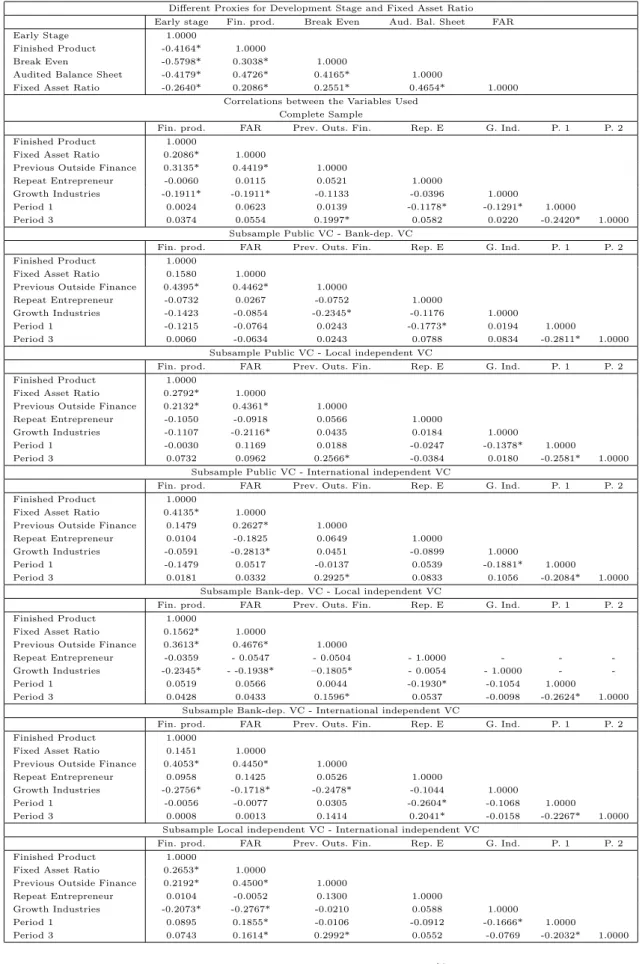
When specifying the different models, we have to balance the number of explanatory variables and the loss of observations due to missing values. This is especially true for our track record variables which show a relatively high amount of missing values. Therefore, we will only include them when the descriptive statistics suggest us to do so. Moreover, we have to avoid multicollinearity problems due to the use of highly correlated explanatory variables. This aspect is also important when deciding about the inclusion of our track record variables, especially the previous outside financing dummy. Finally, for the same reasons, we will use the finished product dummy as proxy for the development stage
of the firm17. The estimation of the propensity scores by pairwise probit models gives
us the flexibility to address these trade-offs for each model separately whereas with the multinomial model, we have to opt for one single specification – a reason why we exclude the track record variables.
Interpreting our descriptive statistics and our regression results (see tables 5, 7 and 8) gives us the following insights into market segmentation between the different VC types. Between the firms which are financed by public VCs are especially few firms which have obtained previous outside financing compared to all other VC types. For these firms, it may be especially difficult to get funding and thus, public VCs may prevent underinvestment. However, this seems to be the case only when no special expertise is necessary. In fact,
public VCs finance significantly less firms in growth industries than do independent VCs18.
These firms can be characterized by exhibiting a higher degree of uncertainty but also a higher innovation potential and therefore, a key role of strategic decisions which can be supported by the VC. The need for support is especially crucial if the entrepreneur has no expertise (i.e. is not repeat entrepreneur). Indeed, public VCs finance significantly less firms whose entrepreneur is not a repeat entrepreneur than international independent
VCs19. So hypothesis 1 which states that less innovative projects should be financed by
public VCs is confirmed. Moreover, the impact of the need of VC expertise on the choice of a specific VC type – as it is modelled in our framework in section 3 – is also confirmed. The same is true with respect to the importance of strategic objectives, such as the consideration of the spill-over effect to the rest of the economy by public VCs.
Bank-dependent VCs differ from the other VC types mainly in the fact that their firms present a significantly higher fixed asset ratio than the firms financed by all other
VC types20. The fixed asset ratio can be interpreted as signal for the risk related to
17Other proxies would induce a higher loss of observations or a higher and therefore potentially prob-lematic correlation with the fixed asset ratio (see table 6).
18With respect to international independent VCs, this difference is only significant in our descriptive statistics, however.
19This difference is, however, not robustly significant in our regressions.
com-a specific investment: if the tcom-angibility of com-assets is high com-and the VC hcom-as com-a liquidcom-ation preference, the probability of getting back his investment is relatively high. Moreover, bank-dependent VCs finance significantly less firms in growth industries than do
indepen-dent VCs21. Analogously to the case of public VCs, we can again interpret this result as
underlining the fact that bank-dependent VCs rather finance firms with a lower degree of uncertainty and a lower innovation potential and therefore a less pronounced need for VC support. Finally, the percentage of firms which have previously obtained outside financing is the highest with bank-dependent VCs – although the difference is only significant in our descriptive statistics in comparison with public and local independent VCs. Thus to sum up, we can say that hypothesis 1 is again broadly confirmed.
It is also interesting to look at the differences between local and international inde-pendent VCs. The only characteristic which differs significantly in both our descriptive statistics and our regression results is the fixed asset ratio – it is significantly lower for in-ternational independent VCs. But the descriptive statistics underline further – especially through the different means (though not significant) as well as through the comparison to public and bank-dependent VCs – that international independent VCs finance rather firms with a higher degree of uncertainty and a higher innovation potential, in earlier development stages and for whom their expertise is crucial.
Finally, there exist time effects of market segmentation which are shown in table 2: the percentage of firms financed by public and bank-dependent VCs drops approximately 50% from period 1 to period 3 whereas the percentage of local and international independent VCs almost reduplicated. As we include the period 1 and period 3 dummies in our regres-sion, only the period 1 dummy is significant when comparing international independent VCs with public and bank-dependent VCs respectively. This is due to the fact that the percentage of international independent VCs quadruplicated from period 1 to the boom and then decreased again 50% whereas the evolution of the percentage of all other VC types was continuous. Our model predicts that the higher the expertise of independent VCs (and therefore, the lower their costs), the higher should be the percentage of firms financed by independent VCs and the lower the percentage financed by bank-dependent VCs. This is just what we observe in table 2. Our model does not explain, however, the decrease in firms financed by public VCs. Nevertheless, when we proceed on the assump-tion that in period 1, the financing of certain firms was not profitable without considering the spill-over effect to the rest of the economy due to the low level of expertise of the VCs but became profitable with the subsequent increase in expertise, this phenomenon can also be explained.
Thus to conclude, we can say that we observe a pronounced market segmentation
parison with local independent VCs.
between the different VC types which depends crucially on the innovativeness of the projects. Hypothesis 1 is broadly confirmed: public VCs and bank-dependent VCs rather finance less innovative projects whereas the most innovative projects are financed by independent VCs. Moreover, we are able to identify the underlying driving factors for this kind of segmentation. Firstly, as in our model, the segmentation seems to be due to the differences in the objective functions (especially for public VCs) as well as the VC’s capacity of providing the expertise needed by different firm types; and secondly, it is due to the maturation of the market.
6.2
Do Different VCs Differ with Respect to Their Corporate
Governance Approach?
In order to be able to answer this question and test hypotheses 2 and 3, we have to disentangle the selection and the treatment effect. To do so, we will run two different matching procedures, namely tied nearest neighbor matching as well as Gaussian kernel
matching – both with the common support restriction22. We base both methods on the
two specifications of the propensity scores respectively: the propensity scores based on the pairwise probit models as well as the propensity scores based on the multinomial probit model. Thus, we will check our results for robustness with respect to the estimation strategy as well as the implemented matching method.
In order to give the most detailed description of the different corporate governance approaches, we will look at the key contract elements which can be classified – as in our model – into two groups : contract elements which allow/incentivize the VC to actively in-tervene in the firm – such as the strength of the incentive mechanism and the voting rights – and control rights, namely operational and structural veto rights as well as liquidation rights.
Before interpreting the matching results, it is important to assess the matching quality in order to justify the approach. Suitable indicators for the matching quality are the
following. First, we should observe a substantial decrease in the pseudo-R2 values from
the unmatched to the matched sample, the pseudo-R2 values resulting from a probit
model for each of the two samples with the pairwise VC dummies as endogenous variables and the identified covariates (see, for example, Sianesi (2003)). In the same way, a sharp increase in the p-value of the likelihood ratio test testing for joint insignificance of all the covariates should be observed between the unmatched and matched sample in order to guarantee a good matching quality. And finally, a reduction of the median of the standardized bias following Rosenbaum and Rubin (1983) can also serve as a signal for the validity of the unconfoundness assumption. Tables 10 and 11 report these different
measures for all the possible treatment and comparison group combinations which are indicated in column two. Moreover, they are reported for both matching methods (tied nearest neighbor matching (NN) and Gaussian kernel matching (GK), see column one). Finally, table 10 refers to the matching quality when using the propensity scores based on the pairwise probit models whereas table 11 refers to the matching quality when using the propensity scores based on the multinomial probit model.
When looking at these tables, we can observe that we generally achieve a substantial
balancing of the confounding variables: the pseudo-R2 diminishes considerably, the
p-value of the likelihood ratio test increases drastically and the median of the standardized bias following Rosenbaum and Rubin (1983) reduces sharply. When we look at table 10 at the category incentive mechanism degree, for example, we see that for local independent
VCs as treatment group and bank-dependent VCs as control group, the pseudo-R2 before
matching amounts to 0.105 and after matching it decreases to 0.005 with both matching methods; the p-value of the likelihood ratio test increases from 0.000 to 0.955 or 0.939 depending on the matching method. This means that the confounding variables are not able anymore to jointly explain the choice of a specific VC type what was, indeed, the objective of the matching procedure. Finally, the median of the standardized bias drops from 29.3 to 2.5 and 5.5 respectively. The last column indicates the loss of observations due to the common support restriction which is quite low in this case as only 1.73% of the observations are lost. Only in some cases, the achieved balancing is limited. This is especially the case when the percentage of observations lost due to the common support assumption is too high or the comparison group is substantially smaller than the treatment group (BVC vs. IIVC, LIVC vs. IIVC) or when the total number of observations in the pairwise comparison is relatively small (PVC vs. IIVC and BVC). In these cases, it is less probable to find adequate controls for the treated observations. As we interchange the treated and control units for each pairwise comparison in order to compare the corporate governance approaches for the two portfolios of firms financed by each VC respectively, in the majority of cases with limited balancing, we are anyhow able to get some insights
– though only for one respective portfolio23.
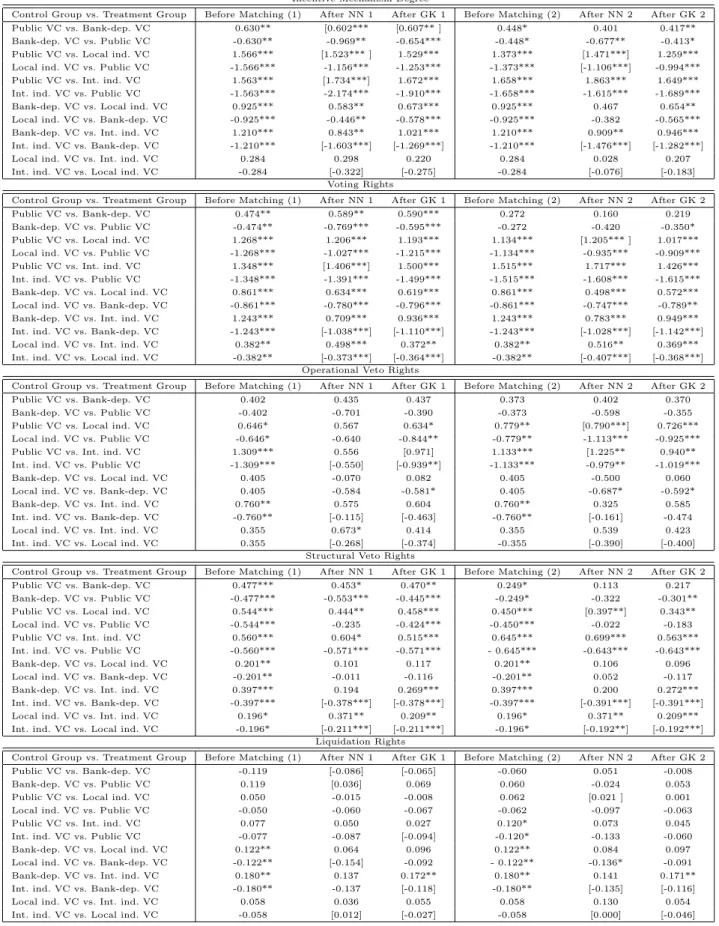
Table 9 indicates the differences in the means of the single contracting elements before matching, i.e. before disentangling the selection and the treatment effect, and after match-ing which corresponds to the actual treatment effect. The change indicates the selection effect. As can be noted in the table, the differences in the corporate governance approaches often diminish significantly when controlling for the selection effect. However, they con-tinue to be still substantial in various cases. When we look, for example, at voting rights and take international independent VCs as the treatment group and bank-dependent VCs 23As the results are broadly the same for both subgroups when balancing is achieved, we will not make this further distinction in what follows. Details about the differences can be seen in table 9.
as the control group, then we observe a significant difference in the mean of the categorial variable voting rights of 1.243. After matching, this difference reduces while remaining significant. To be more precise, it drops to 0.709 with tied nearest neighbor matching with the propensity scores based on the pairwise probit model, to 0.936 with Gaussian kernel matching and the mentioned propensity scores, to 0.783 with tied nearest neighbor matching with the propensity scores based on the multinomial probit model and finally, to 0.949 with Gaussian kernel matching and these last mentioned propensity scores. This means that the results are very robust indicating that for firms which are financed by in-ternational independent VCs, these VCs have significantly more voting rights than would have bank-dependent VCs financing these firms. Without controlling for the selection ef-fect, this difference is even more pronounced what shows us that part of the observed difference in the behavior between these two VC types has to be attributed to selection effects whereas a substantial part actually ascribes to differences in the corporate gover-nance approach. In what follows, we will therefore have a closer look at these differences for all the key contracting elements as well as the comparison of all VC types.
First, we will analyze the differences between public VCs and the other VC types. With respect to active intervention mechanisms as well as structural veto rights, we ob-serve significant differences in the corporate governance approaches between public VCs and the other VC types whereby the latter one is less pronounced. On the contrary, for liquidation rights, these differences are not significant. As concerns operational veto rights, significance is only given for the differences between public VCs and independent VCs. Interestingly the differences between public and bank-dependent VCs tend to grow for intervention mechanisms after controlling for selection effects whereas there is hardly any
change as concerns structural veto rights24. When comparing the contracts of public VCs
with the contracts of local independent VCs, we remark a slight decline after matching with respect to active intervention mechanisms as well as to structural veto rights. As concerns operational veto rights, we get mixed results: for the firms financed by public VCs the differences tend to grow whereas for the firms financed by local independent VCs the differences tend to decrease. These results should be handled with precaution, how-ever. Finally, when comparing the contracts of public VCs and international independent VCs, we get mixed results and so we are not able to evaluate the impact of the selection effect.
Second, we will analyze the differences between bank-dependent VCs and independent VCs. Here, we get very robust results: the differences between the different contract ele-24It is important to take into account that the results based on the propensity scores of the multinomial probit model should be excluded because the propensity score has quite limited power in explaining the selection of a specific VC type. Moreover, due to the big loss of observations because of the common support restriction, the achievement of balancing is not convincing for the incentive mechanism degree for the comparison PVC vs. BVC when matching is based on the pairwise propensity scores.