Developing in-service TVET
Courses for Developing
countries : exploratory
study
Peter van Deursen
OVDK2
September 2009
Constituent : CINOP Global (’s-Hertogenbosch)
Work Placement Supervisor: Jan van den Hoogen
Content
Preface 31
Introduction ... 4
1.1
Objectives ... 4
1.2
Methodology ... 4
1.3
Constituent ... 5
2
Situation of TVET in Sub-Saharan countries ... 5
2.1
Introduction ... 5
2.2
The importance of TVET ... 6
2.3
Background ... 6
2.4
Current Status of TVET in Africa ... 7
2.5
Best practices and strategies ... 8
2.6
Priority TVET areas ... 8
2.7
Strategic Policy Framework ... 9
2.7.1
Key strategic issues ... 9
2.7.2
Guiding principles ... 9
2.7.3
Main goal and vision of strategy... 9
2.7.4
Strategic objectives ... 9
2.8
Implications for training offer ... 10
3
Training offer of other organizations ... 10
3.1
Introduction ... 10
3.2
Implications for training offer ... 11
4
Questionnaire ... 11
4.1
Introduction ... 11
4.2
Results ... 11
4.2.1
National level ... 12
4.2.2
Institutional level ... 15
4.2.3
Curriculum level ... 17
4.2.4
Boundary conditions ... 19
4.2.5
Personal and general questions ... 22
5
Discussion ... 22
6
Recommendations ... 23
Literature ... 25
Appendix A. Themes in questionnaire ... 26
Appendix C . Definitions ... 34
Appendix D. Planning ... 36
Preface
This study is part of the Bachelors study ‘Opleidingskunde’ at the HAN University of Applied Sciences. The opleidingskunde study consists of three main elements : education and training policy, instructional design and development, and training and coaching.
I would like to thank all employees of CINOP Global for their help, especially Jan van den Hoogen, Annemieke Kikstra, Leonoor Akkermans, Eva van Vliet.
1
Introduction
1.1
Objectives
This report is an exploratory study on (short) courses on TVET in Sub-Saharan countries. The project result consists of this report containing recommendations on establishing these kind of courses. The report gives recommendations on the content of these courses as well as on boundary conditions.
Target group of these courses are decision makers and managers from organizations active in TVET development.
The problem definition is : “Is is feasible for CINOP to develop in-service courses for Sub-Saharan African countries? ”
Key question addresses are:
• Is there a need in developing countries for an offer on in-service courses on TVET? • Which need is there regarding the content of these courses?
• Which boundary conditions have to be taken into account?
It should be stressed that this study in not an extensive feasibility study. In such a study
implication for a marketing and sales strategy should be provided as well as financial implications, break even analysis etc. This would have been far beyond the scope of this study. In this sense this study should be regarded more as an explorative feasibility study : is it worth the effort for CINOP to investigate further development of in-service courses?
CINOP Global has experience in TVET projects in some Sub-Saharan countries.
CINOP Global experiences in project they run that there is a huge lack of understanding of how successful TVET programmes can be implemented in developing countries, both on national, institutional and curriculum level. With in-service TVET courses some of these gaps could be filled. This requires thorough needs analysis however.
In instructional terms the needs analysis research is the first step in proper instructional design. Most experts consider this step as the most critical step in this process. This would certainly hold for delivering TVET courses in developing countries , because there is no clear insight yet on target group and their needs.
1.2
Methodology
To identify the feasibility of developing in-service courses three research methods were chosen • Literature study on current state and developments of TVET in Africa (chapter 2). These
developments could be important indicators on the importance of TVET and which themes should be addressed. This way it can be ensured that course development would fit into a broader policy context.
• Literature study on training offer of other organizations. This way it could be identified if there are competitors on the market, and thus give extra information on feasibility of developing courses for the African market
• A online questionnaire was developed to identify the need for in-service courses from stakeholders in the concerning countries, as well as which themes and background
conditions they would rate as most important. With the questionnaire potentially a number of stakeholders from different countries could be addresses. Thus a more general view could be made visible on the feasibility on developing in-service courses, and which themes and conditions would emerge.
With the questionnaire data on three different levels were collected: macro (policy), meso (school management) and micro (curriculum) level.
On every level a set of questions was developed concerning themes (see appendix A for an overview of the themes on the different levels). Also boundary conditions for these kind of courses were explored.
An online questionnaire has the advantage of fast response Many respondents can be addressed in a short time. Respondents can fill in the questionnaire in a time and space independent way. An online questionnaire allows for routing. In a structured interview more in depth information could have been generated but this would have required the availability (face to face or by telephone) of a number of experts. The explorative character of this study did not need this in depth information yet.
1.3
Constituent
As part of CINOP, the unit Global is working for (national) governments, educational institutions and sector organizations worldwide. In the capacity of National Centre for the Innovation of Education and Training, CINOP Global offers information to all key actors in the field of vocational education and training (VET) and adult education.
Working with a core team of consultants, an advisory board and associates, the unit is offering the following specific services:
• Establishment of national qualification Framework • Programme management
• Strategic policy development • Capacity building
• Curriculum development • Management development • Training of teachers
CINOP Global is working with Governmental authorities, European commission, United Nations, World Bank, Schools, colleges and Polytechnics, Sector committees and branch associations CINOP Global is working in European countries, as well as in a number of other countries in Sub Saharan Africa (Zambia, South Africa, Kenya, Tanzania, Mozambique, Ethiopia, Ghana, Rwanda), Northern Africa (Libya) and the South East Asia Region (Indonesia).
2
Situation of TVET in Sub-Saharan countries
2.1
Introduction
This chapter is mainly based on key reports of the African Union (2007) and the World Bank 2004) on TVET and skills development strategy in (Sub-Saharan) Africa.
The background and strategy of African countries with respect to TVET is outlined. TVET is emerging in most –if not all- African countries. The importance of TVET (2.2), the background (2.3), the current status of TVET (2.4), best practices (2.5), priority areas (2.6) and the strategic framework (2.7) support the themes used in the questionnaire. In 2.8 implications for developing in-service courses are discussed.
2.2
The importance of TVET
Bah Diallo (2005), King and Palmer (2007), and UNESCO-Unevoc (2008) conclude that there appears to be renewed interest in vocational education and training in development countries the last years. The African Union (2007) also concludes that there is a fresh awareness among policy makers in many African countries and the international donor community of the critical role that TVET can play in national development.
Bah Diallo (2005) takes Ethiopia as an example for this. In countries with a clear and long-standing policy commitment to technical and vocational skills development, the provision of skills is in a much stronger situation than countries whose policies have been substantially influenced by shifts in donor policies and priorities (King and Palmer, 2007).
Many nations are still struggling however to create those indispensable bridges between education and the world of work. Johanson and Adams (2004) point out the essential role of skills
development in Sub-Saharan countries and the essential role of TVET in this.
2.3
Background
The principal challenge for African economies over the next decade is to find productive employment for the 7 to 10 million annual new entrants to the labor force—a consequence of historical rapid population growth and a swelling of the labor force by today’s school-leavers. While real wages have fallen in many countries, wage employment in the
modern sector has been largely stagnant. Most entrants to the labor market have no alternative but to seek work in the informal economy. Employment in the
informal sector has risen sharply since the 1970s. The informal sector today absorbs most of those unable to find wage employment. In a typical African country as much as 85 percent of total employment is engaged in the informal economy, with most of this in smallholder agriculture. Up to one-third of the total is employed off the farm in rural and urban areas in the informal economy. Crowding-in of employment in traditional trade, retail, and personal services in the informal sector is cutting into individual market share and serving to redistribute poverty. A small number of new entrants who have more education are seeking manufacturing and high-end service opportunities in the informal sector as a preferred choice.
Against this background, Sub-Saharan Africa’s stock of human capital is exceedingly low—as evidenced by low enrollment ratios, literacy rates, and educational attainment. Women are active labor force participants, but their full absorption into labor markets is hindered by a lack of education and skills and by cultural impediments.
The African Union (AU) has drafted a strategy to revitalize technical and vocational education in Africa. There is a fresh awareness among policy makers in many African countries and the
international donor community of the critical role that TVET can play in national development. The increasing importance that African governments now attach to TVET is reflected in the various
Poverty Reduction Strategy Papers that governments have developed in collaboration with The World Bank. One of the most important features of TVET is its orientation towards the world of work and the emphasis of the curriculum on the acquisition of employable skills. TVET delivery systems are therefore well placed to train the skilled and entrepreneurial workforce that Africa needs to create wealth and emerge out of poverty. Another important characteristic of TVET is that it can be delivered at different levels of sophistication. This means that TVET institutions can respond to the different training needs of learners from different socio-economic and academic backgrounds, and prepare them for gainful employment and sustainable livelihoods. The youth, the poor and the vulnerable of society can therefore benefit from TVET.
The African Union (AU) has a vision of “an integrated, peaceful, prosperous Africa, driven by its own people to take its rightful place in the global community and the knowledge economy.” The AU recognizes the importance of TVET as a means of empowering individuals to take control of their lives and recommends therefore the integration of vocational training into the general education system. The AU also recognizes the fact that vast numbers of young people are outside the formal school system, and consequently recommends the integration of non-formal learning
methodologies and literacy programmes into national TVET programmes.
It is within this framework that the African Union Commission is spearheading the development of a new strategy to revitalize TVET in Africa. The objectives of the strategy are:
• To revitalize, modernize and harmonize TVET in Africa in order to transform it into a
mainstream activity for African youth development, youth employment and human capacity building in Africa;
• To position TVET programmes and TVET institutions in Africa as vehicles for regional cooperation and integration as well as socio-economic development as it relates to
improvements in infrastructure, technological progress, energy, trade, tourism, agriculture and good governance;
• To mobilize all stakeholders in a concerted effort to create synergies and share responsibilities for the renewal and harmonization of TVET policies, programmes and strategies in Africa.
The World Bank gives the background for policy on skills development: • Economies are weak.
• Wage employment in the modern sector is largely stagnant
• Unemployment among educated youth is substantial and increasing
• The impact of HIV/AIDS on the work force, although yet to be documented, is huge, with much of the impact falling on the ranks of the educated and skilled work force.
2.4
Current Status of TVET in Africa
TVET systems in Africa differ from country to country and are delivered at different levels in different types of institutions, including technical and vocational schools (both public and private), polytechnics, enterprises, and apprenticeship training centres. In West Africa in particular,
traditional apprenticeship offers the largest opportunity for the acquisition of employable skills in the informal sector. In Ghana, the informal sector accounts for more than 90 percent of all skills training in the country.
In all of Sub-Saharan Africa, formal TVET programmes are school-based.
With a few exceptions, the socio-economic environment and the contextual framework in which TVET delivery systems currently operate on the continent is characterized, in general, by:
• Weak national economies, high population growth, and a growing labor force;
• Shrinking or stagnant wage employment opportunities especially in the industrial sector; • Huge numbers of poorly educated, unskilled and unemployed youth;
• Uncoordinated, unregulated and fragmented delivery systems; • Low quality;
• Geographical, gender and economic inequities; • Poor public perception;
• Weak monitoring and evaluation mechanisms, and
• Inadequate financing, poor management and ill-adapted organizational structures. TVET in Africa is delivered by both government and private providers, which include for-profit institutions and profit, NGO and Church-based institutions. In almost all countries, non-government provision of TVET is on the increase both in terms of number of institutions and student numbers. This trend is linked to the fact that private providers train for the informal sector (which is an expanding job market all over Africa) while public institutions train mostly for the more or less stagnant industrial sector. Private providers also target “soft” business and service sector skills like secretarial practice, cookery, and dressmaking that do not require huge capital outlays to deliver. A limited amount of in-company or enterprise-based training also takes place in some countries; however, this type of training is often dedicated to the sharpening of specific skills of company employees.
2.5
Best practices and strategies
The current status of TVET in Africa is not all about weaknesses. TVET systems in a growing number of countries are undergoing or have undergone promising reforms that are designed to build on the inherent strengths of the system. The major reforms concern the setting up of national training bodies, and the enactment of laws to strengthen national vocational training programmes. The need to link training to employment (either self or paid employment) is at the root of all the best practices and strategies observed world-wide.
2.6
Priority TVET areas
A recent survey conducted by the AU on the state of TVET in 18 African countries points to a number of priority areas for vocational training in Africa. The agricultural sector receives the highest priority, followed by public health and water resources, energy and environmental management, information and communication technologies, construction and maintenance, and good governance. The general recommendations from the member states include the development of appropriate competency-based curriculum in these areas and compulsory implementation of TVET programmes for students in strategic fields such as entrepreneurship, computer literacy, agriculture, and building construction. The promotion of handicrafts and other indigenous technologies was also rated as important for Africa’s development
.
2.7
Strategic Policy Framework
2.7.1
Key strategic issues
The key issues that the proposed TVET strategy seeks to address are the following:
• Poor perception of TVET
• Gender stereotyping
• Instructor training
• Linkage between vocational and general education
• Linkage between formal and non-formal TVET
• Linkage of TVET to the labor market
• Traditional skills, business management and entrepreneurial training
• Harmonization of TVET programmes and qualifications
2.7.2
Guiding principles
The guiding principles that are considered the major drivers of a TVET strategy for Africa are: access and equity, quality, proficiency, and relevance. The others are employability,
entrepreneurship, efficiency, and sustainability. The strategy should also promote linkages and partnerships, responsible citizenship, conservation of resources and respect for the environment, and articulation pathways throughout the system.
2.7.3
Main goal and vision of strategy
Taking into account the key strategic issues and guiding principles, the main goal of the strategy may be stated as follows:
Promote skills acquisition through competency-based training with proficiency testing for employment, sustainable livelihoods and responsible citizenship
The vision of the strategy is to position TVET as a tool for empowering the peoples of Africa, especially the youth, for sustainable livelihoods and the socio-economic development of the continent.
2.7.4
Strategic objectives
The broad objectives of the strategy are • to deliver quality TVET,
• assure employability of trainees,
• improve coherence and management of training provision,
• promote life-long learning, and v) enhance status and attractiveness of TVET. The strategy of the AU is in line with the recommendations of the World bank:
• Rationalizing the role of the public sector in training • Expanding the role of the private sector
• Diversifying sources of financing for training • Importance of good-quality basic education
Five principal findings emerge from the World Bank Review as guides to future TVET reforms in Sub-Saharan Africa:
1. The reform of skills development in the informal sector is essential to poverty alleviation. 2. The record of TVET reforms over the past decade has been promising.
3. Public training continues to face challenges in reform and will require sustained commitment.
4. Nongovernment training institutions and enterprises account for most of the regional capacity for skills development and should be part of the reform dialogue.
5. Management and finance provide powerful instruments for promoting reforms.
2.8
Implications for training offer
There appears to be renewed interest in skills development and the role of TVET in African countries. The AU is developing a new strategy to revitalize TVET in Africa. In an growing number of countries reforms are(to be) implemented. These are all indications that there is a need for high quality training on TVRT issues.
The priority areas are also pointed out by the AU : The agricultural sector receives the highest priority, followed by public health and water resources, energy and environmental management, information and communication technologies, construction and maintenance. When developing in-service courses these sector priorities should be taken into account.
In developing TVET in-service courses, the key strategic issues stated by the African Union should be considered, as well as the implications mentioned for developing TVET systems : Poor
perception of TVET, gender stereotyping, instructor training, linkage between vocational and general education, linkage between formal and non-formal TVET, linkage of TVET to the labor market, traditional skills, business management and entrepreneurial training, harmonization of TVET programmes and qualifications.
These might be topics to address directly in in-service courses.
3
Training offer of other organizations
3.1
Introduction
There might be many organizations active in organizing (short) training courses in TVET in Sub-Saharan countries. But in this study we did not identify organizations that offer courses on TVET on a large scale for different African countries. Like CINOP, these organizations might offer these kind of courses project based, but not as separate, commercial training courses. There is also an
indication that organizations offer courses on a more sector based approach. For example PTC+ in the Netherlands is active in the agricultural sector.
The ILO/ITC (The International training centre of the international labor organization) does offer training in a way CINOP intends to do. However ILO/ITC course are aimed at topics related to labor market, not specifically on vocational education. In fact the first set up of this project was to cooperate with ILO/ITC with setting up a project for joint offering of these kind of training. ILO/ITC was also interested in this but appeared not to be ready for this on short terms.
The German organization INWENT1 is mentioned by some participants who did a follow an in-service course there. INWENT is known by CINOP.
3.2
Implications for training offer
There seem to be no, or not much international organizations that offer in-service courses for Sub-Saharan countries on the subject of TVET and skills developments. Although not enough data is available there probably some organizations active in specific countries or for specific sectors. This indicates that there is a need for expertise. It seems that the demand for in-service training courses on TVET topics is not covered to a large extend by existing organizations. This is an indication – again with some care- that there is a market for offering these kind of courses by CINOP.
4
Questionnaire
4.1
Introduction
The questionnaire is send to key persons in the dedicated countries. Originally to the key persons known by CINOP Global, but also to experts which were identified by respondents in the
questionnaire themselves. The questionnaire was running from the end of July till the beginning of September. Respondents were send a reminder once. Due to time constraints it was not possible to perform more extensive reminders.
Key persons are persons who are involved in national, institutional or departmental TVET policy.
4.2
Results
12 Respondents filled in the questionnaire completely, 3 respondent filed in part of the
questionnaire, while 5 respondents started the questionnaire but did not answer any questions. The questionnaire was originally send to 70 participants. 37 Additional respondents were identified, mostly recommended by respondents in the questionnaire.
The total response is thus more than10%.
The respondents who completed the questionnaire were from Ethiopia (3), Kenya (4), Tanzania (1), Namibia (1), Zambia (1), South Africa (2). There were no expert identified in Botswana, Mozambique and Eritrea.
In the next session the results of the questionnaire will be presented, with some diagrams added. The complete results including all diagrams are available on request.
There were three main sections in the questionnaire: a section on themes related to TVET, a section on boundary conditions and a section with questions on more personal data. Most questions had an added opportunity for respondents to make remarks.
In the themes section the setup of the questionnaire that first respondents were presented a number of themes and were asked to rate the expertise in their country or institution regarding these themes. After that, they were asked to identify the five major themes which to their opinion
training would be needed. Then they were asked to divide 100 points between these five topics. The themes were split into four main subsections : national policy, national policy (special themes), institutional management and curriculum development.
4.2.1
National level
The expertise on TVET and (un)employment is considered poor by 93% of the respondents (N=15). 80% rate expertise on linkages and cooperation between TVET and industry as poor or very poor. For Funding of TVET systems and Private versus public TVET systems the percentages are 60% and for TVET systems and structures 54%.
The rest of the themes is considered good or very good by more than half of the respondents. Some respondents remark that the TVET system in their country is under reform, and that a poor rating addressed doesn’t necessary mean the situation is poor actually. One respondent remarks that assessment is a hot topic nowadays, bringing up hundreds of problems associated with it.
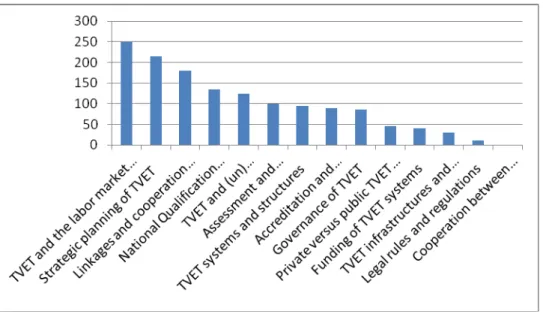
Figure 1.
Expertise on
national
level
Analysis of the top five themes learns that Strategic planning of TVET is considered most important to sending participants to a training to by 73% of respondents (N=15), followed by TVET and the labor market needs and linkages and cooperation between TVET and industry (67%). Cooperation between TVET institutions
scores no points at all here, while legal rules and regulations (7%) and TVET infrastructures and facilities (13%) are not considered important either.
TVET and the labor market needs (total 250 points, N=15), Linkages and cooperation between TVET and industry and National Qualification Framework (180) are rated highest when respondents were asked to divide 100 points between the five most important topics.
Figure 2. point assigned to topics most needed for training on national level
A clear opportunity for in-service training courses seems to be in the linkage between TVET and industry and TVET and labor market needs. This is in line with one of the key strategic issues defined by the African Union : Linkage of TVET to the labor market. Planning courses on strategic planning of TVET is a little more ambiguous because only 40% of the respondents consider the expertise in their country (very) poor on this theme while the theme scores highest regarding training needs. Remarkably *all* respondents consider the expertise on TVET and
(un)employment, technology and industry policies as being poor, but only half of them rates this topic as important to sending participants to a training to.
For most themes the expertise on special topics on national level is considered poor or very poor by more than half of respondents. At the top is Research and development for TVET (92% very poor or poor, N=14), followed by Life long learning and TVET (86%), Assessment of prior learning (79%) and Management information systems (78%).
TVET HRM policies (64%, N=14) and promotion of TVET 57%) are considered as good or very good by more that 50% of the respondents.
Figure 3. Expertise on national level – special topics
Research and development of TVET is also rated highest when participate assign the top five themes most important to sending participants to a training to (93%, N=14), followed by New approaches and models for TVET (86%) and Management information systems at national level (71%). Lowest score here is for Non-formal and informal TVET (36%).
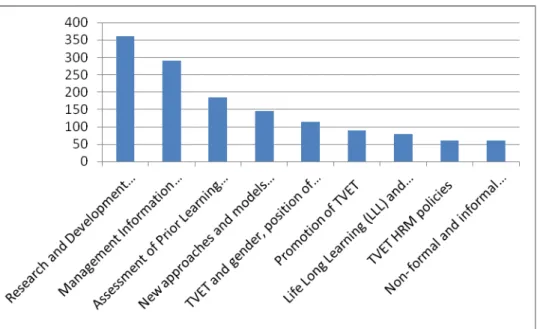
These results are more or less in line when respondents assign 100 point to there five topics : Research and Development (360 points, N=14) and management information systems (290) are also at the top here, followed by Assessment of prior learning (185 points).
Figure 4. point assigned to topics most needed for training on national level –special topics
4.2.2
Institutional level
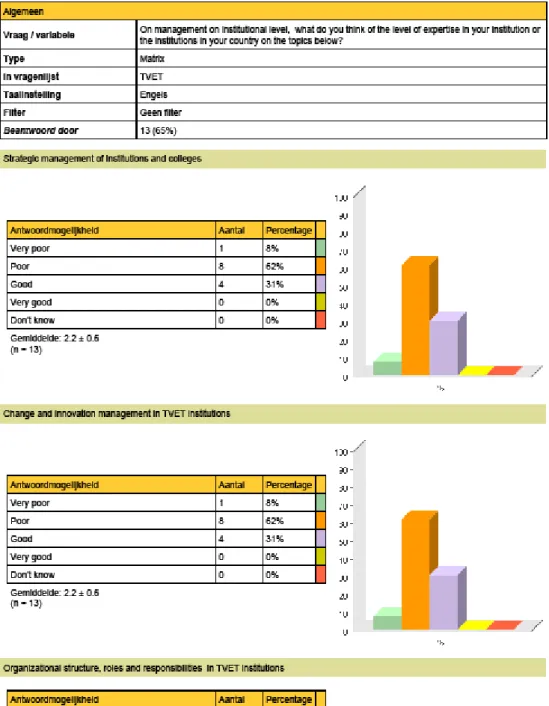
Linking TVET with industry is considered poor or very poor by 92% of the respondents (N=13), Tracer studies of graduates is seen by 85% as poor of very poor. 77% is scored by the themes Quality management and evaluation, Human resource development and IT based management. Organizational structure (77%), Student administration management (69%) are evaluated as being good or very good.
A remark of one participant : “We have been doing lot of things with TVET institutes but the result is not in the expected level. We have evaluated ourselves jointly and agreed that there are three reasons for the cause. They are mind set problem, technical incapability and organizational set up. Therefore, we need a training to help the institute to solve such problems.”
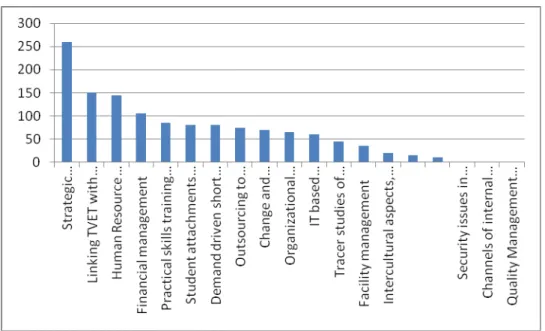
Shared first place for the question on the five most important topics concerning training are strategic management of institutions and linking TVET with industry (62%, N=13). Channels of internal communication, security issues and intercultural aspects receive no scores at all, income generating activities, student administration management and outsourcing are only scored once. Strategic management (260 points, N=13) is clearly on top when points are assigned, followed by linking TVET with industry (150 points) and Human Resource Development (145 points).
The themes which were not selected above or only one time do not receive any points or only some points here.
Figure 6. point assigned to topics most needed for training on institutional level
Analysis of the questions on special topics at national level learns that Research and development for TVET and Management information systems at national level are by far the most needed candidates for an in-service training course. This might be because in some countries TVET institutes have a strong academic orientation where research is considered very important. On institutional level far most wanted seem to be course development on strategic management of institutions and colleges. There are many other topics that are candidates for developing courses here, however. One respondent expresses that there are three issues that need attention (and thus training) : mindset problem, technical incapability and organizational setup.
Channels of internal communication and information exchange, security issues, outsourcing, intercultural aspects, change and innovation management, student administration management are topics that are seen as not urgent at al to send people to a training to, although in some cases the level of expertise is not rated very high on these topics.
4.2.3
Curriculum level
On curriculum level E-learning and TVET are considered poor or very poor by 84% of the
respondents (N=13). Shared second place is for IT facilities and use of IT in training and Special didactics (77%). All topics except assessment of learning (54% good) are rated more than 50% poor or very poor.
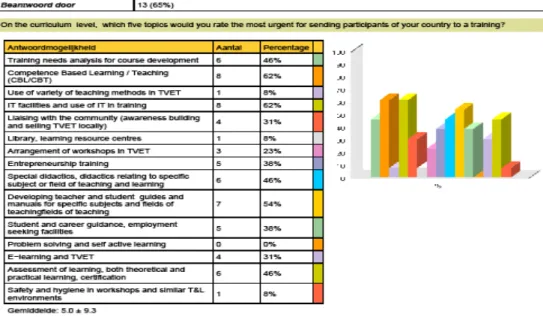
Competency based Learning/Teaching and IT facilities are on top when asked for the five topic most important for training (62%, N=13). Problem solving receives no score at all here, and use of variety of teaching methods, library, learning resource centres, safety and hygiene are only
selected once.
Figure 7. Five most important topics – curriculum level
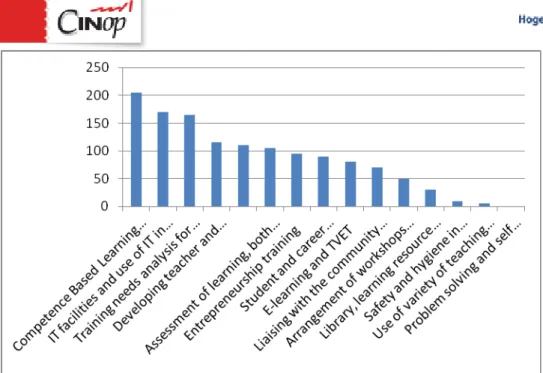
Competence bases learning /teaching (205 points, N=13) and IT facilities (170 points) are also on top when 100 points are assigned. The themes which were not selected above or only one time do not receive any points or only some points here.
Figure 8. point assigned to topics most needed for training on curriculum level
On curriculum level there are no topics that are standing out. IT facilities and use of IT in training, Competence bases learning and teaching and assessment of leaning are seen as most urgent for sending participants to a training to. Remarkably, the current expertise on the topic liaising with the community is rated considerably poor, but no urgency for training seems to exist. The need for courses on problem solving and self active learning, use of variety of teaching methods, safety and hygiene issues and libraries and learning and resources centers seems (almost) absent.
4.2.4
Boundary conditions
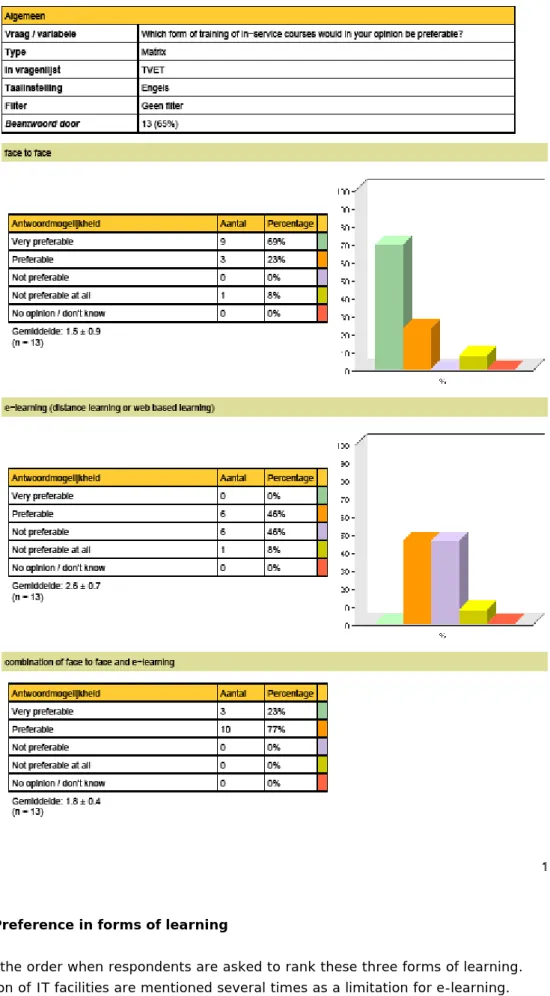
All respondents indicate that they prefer of very much prefer a combination of e-learning and face to face learning (N=13), and all but one also (very) prefer face to face learning. E-learning is not preferable (at all) for more than half of the participants.
Figure 9. Preference in forms of learning
This is also the order when respondents are asked to rank these three forms of learning. The limitation of IT facilities are mentioned several times as a limitation for e-learning.
Only one respondent thinks a modular setup is not (very) much desirable, effective and efficient (N=13). All respondents think a modular setup is also feasible, except one who has no opinion on this.
English language is a problem for only one respondent (N=13), who would like to have courses in local language / mother tongue.
The most suited level of learning for an in-service course is rated in the following order : PHD, Masters, Bachelor, Diploma, Certification level. (N=13) One comment is that for Ethiopian context the levels used in the questionnaire cannot be applied in their context. Another comment is that most important is that courses should integrate with the work. The comments indicate that the question might be not clearly stated and that results should be considered very carefully.
The length of courses most suited is a maximum of three weeks (38%, N=13) or longer than three weeks (38%) preferred above a maximum of one or two weeks. The remarks indicate that the length of courses depends on other circumstances like the training needs and the specific situation. Again, the comments (depends on training needs, cannot be described, forced to answer) indicate that the results should be considered with great care.
As for funding possibilities, most seems available depending on fellowships. National resources or institutional resources might be present, but limited.
7 respondents do not know the Dutch fellowship programme, 6 do.
The importance of validated certification of in-service courses is rated with a mean score of 7.5 (N=13), on a scale from 1 (not important at all) to 10 (very important) with a highest score of 10 and a lowest score of 1.
The rating of in-service courses developed by an institution like CINOP is 8.7 (N=13) on a scale from 1 (not important at all) to 10 (very important) with a highest score of 10 and a lowest score of 6.
All participants (N=12) think there is (very) much added value in to be informed about examples or best practice in other countries.
The importance of validated certification of in-service courses is rated as 7.5 The rating of an organization like CINOP contributing to the level of expertise in one’s country is 8.7. This indicates that there are serious possibilities for an institution like CINOP to develop in-service courses in sub-Saharan courses.
Modular courses of about three weeks seems to be preferred, as well as a mix of face to face and e-learning. It must be considered though that current limitation in IT can give serious problems in developing e-learning courses. It is no problem that courses would be in the English language. Masters of PHD level is preferable as course level.
Encouraging is that all respondents that finished the questionnaire indicate that they are willing to cooperate in further development in these kind of courses.
Respondents seem to have various job backgrounds. Most of them are responsible for at least curriculum budgets and some are responsible for institutional or national budgets.
4.2.5
Personal and general questions
There were 10 male respondents and 2 female respondents. The mean age of the respondents is 43.6 years. Majority of the respondents has a masters level of education.
3 respondents are responsible for budgets on a national level, and also 3 respondents are
responsible for budgets on institutional level. 9 respondents are responsible for curriculum budgets. All respondents that finished the questionnaire would like to be informed on further development of in-service courses and are willing to cooperate in this.
Job positions of the respondents are :
• Teacher At A Technical Training Institution • Occupational Assessment Sub Process Owner • Chief executive officer
• Senior Lecturer In Economics At Polytechnic Of Namibia • Chief technical education officer
• Deputy Director TIVET Kenya Institute Of Education • Director
• Senior lecturer, HOD • Director
• Expert In TVET
• Key Issue Manager For (1) Policy And System Development And (2) Technology Capability Accumulation And Transfer
The job positions are too diverse to identify groups for further analysis. In general, there is no analysis done based on personal characteristics, because the number of respondents was too low to get meaningful distinctions.
5
Discussion
A response of 12 respondents, just more than10% of all participants, is clearly too low to formulate general conclusions. Moreover it seems impossible that with the number of respondents the situation in one single country, let alone all Sub-Saharan countries could be covered. With this number of respondents is was also not very meaningful. Thus no further analysis is done regarding to for example the job positions of respondents.
The themes of the questionnaire are identified after extensive survey and discussion and prepared with much care. We tried to minimize misunderstanding by adding an additional description to the themes. However, because there is no clear and universally used dictionary in this field , there is always a risk of misinterpretation. This should be taken into consideration when interpreting the results of the questionnaire. Encouraging is that the themes identified in the questionnaire are to some extend reinforced by the literature study in developments in TVET. Thus a more or less comprehensive view is extracted.
Especially the questions concerning the boundary conditions seem to be rather ambiguous, as some respondents mentioned. This means that the results on these questions must be considered with great care and need further exploration.
As a whole, the study is an indication of training needs only and must be seen as a first step towards development of in-service courses. It is recommended to develop ideas, themes and boundary conditions with the respondents that expressed to be willing to cooperate in further development. It is encouraging that all respondents that completed the questionnaire expressed that they would like to be informed about and to participate in further developments.
6
Recommendations
Is it feasible for CINOP to develop in-service courses for African countries?
The outcomes of this study can only be considered as indicative, and not as representative. But all parts of the study seem to indicate that there is a need for training in Sub-Saharan countries. Policy developments as formulated by the African Union for example reinforce this impression. It seems worthwhile for CINOP to further explore the development of in-service courses.
Encouraging is that all respondents that finished the questionnaire indicate that they are willing to cooperate in further development in these kind of courses. It is strongly recommended to keep in contact with this group to further explore content and boundary conditions.
One recommendation would be to start one or two pilot projects in which in-service courses are developed. One on national level (this might be on the themes TVET and the labor market needs or Linkages and cooperation between TVET and industry, and one on institutional level (linking TVET with industry). It will be important to take the policy developments of TVET in Africa as a guideline for further development as well as the priority areas stated by the AU (see section 2.8). The respondents expressed a clear preference for face to face training or a combination of e-learning and face to face e-learning. Offering e-e-learning modules might have serious drawbacks however because of technical problems in ICT systems.
Pilot courses could be offered in the CINOP offices or in the office of a partner organization like ILO/ITC or INWENT.
The objective of the pilot project would be to produce a first working version of a structure of in-service courses. The experience acquired in doing so will be valuable for future planning. And will be useful for showing “what (not) to do in future”.
The experts identified in this study should be involved in developing these pilots. Both for stakeholder engagement and user involvement this would be essential. Appendix B contains an overview of the experts who expressed to be willing to be involved in further development of in-service courses.
The report of this study can help to grow common understanding of themes and boundary
conditions to be developed. It can also be send to new experts, for example in countries that were not covered in this study.
The pilot project should meet proper guidelines to set up a training programme. Although CINOP is an organization active in training development, some basic principles are summarized. In
cooperation with the expert the topics and the target group should be defined. From this learning goals and sub learning goals should be identified. Learning goals should describe observable behavior the participant I supposed to show at the end of the course, describe the conditions under which this behavior should be apparent and ways this will be assessed.
From the leaning goals proper training interventions should be derived. Attention should be paid to how much time each intervention would take.
The pilot training should take evaluation strategies into consideration from the start, on reaction level, learning level and on transfer level. Are the newly acquired skills, knowledge, or attitude being used in the everyday environment of the learner?
A cost / benefit analysis should be included. In the pilot phase this should not have to be very extended. A simple cost model matrix giving insight in personnel, equipment, training location and material cost divided into the most important phases of training development : analysis, design, development, performance and evaluation.
The pilot project can also be seen as an innovation process which takes place in three stages: initiation, implementation and the institutionalization. For each of these phases success factors can be identified (Kirschner, Hendricks, Paas, Wopereis, & Cordewener, 2004). In the initiation phase clear project objectives, creation of realistic expectations and good project management are examples of necessary success factors. In the implementation phase insurance of user
involvement, engagement of stakeholders and adequate communication channels are some of the key factors. The institutionalization phase means continuing the newly implemented change or stabilizing the use of an innovation. In the institutionalization phase the innovation needs to be scaled and maintained.
CINOP has extended experience in projects in an international setting. It will be clear that cultural differences can pose critical problems in these kind of projects. Good communications are of paramount importance. It is assumed that CINOP knows how to deal with problems that might occur in culture differences, distance, organization, management and communication, productivity and logistics or local legislation and regulation.
Literature
African Union (2007). Strategy to Revitalize Technical and Vocational Education and Training
(TVET) in Africa. Addis Ababa : Meeting of the Bureau of the Conference of Ministers of Education
of the African Union (COMEDAF II+) 29-31 May 2007
Fien, J., Maclean, R., Park, M-G. (2009). Work, Learning and Sustainable Development.
Opportunities and Challenges. Berlin : Springer
Grierson, J.P. and McKenzie, I. (1996). Training for Self-Employment through Vocational Training
Institutions. Turin : ILO-ITC
Johanson, R.K., Adams, A.V. (2004). Skills Development in Sub-Saharan Africa. Washington, D.C. : World Bank
King, K., Palmer, R. (2007). Technical and Vocational Skills Development. Briefing. London : DFID. Department for International Development
Kirschner, P. A., Hendricks, M., Paas, F., Wopereis, I., Cordewener, B. (2004). Determinants for failure and success of innovation projects. The road to sustainable educational innovation. Heerlen : Open Universiteit. Retrieved 22/9/2009 from
http://www.eric.ed.gov/ERICDocs/data/ericdocs2sql/content_storage_01/0000019b/80/1b/a7/36.p df
Unesco (2005). Vocational education : the come back? Education Today No. 13, p. 4-7
Unesco, ILO (2002). Technical and Vocational Education and Training for the Twenty-First Century. Paris : Unesco; Geneva : ILO
Unesco-Unevoc (2008). Vocational education and training : A Come-Back to the development agenda? Paris : Unesco-Unevoc
UNESCO Institute for Statistics (UIS). (2006). Participation in formal technical and vocational
education and training programmes worldwide. An initial statistical study. Bonn: UNESCO-UNEVOC
Appendix A. Themes in questionnaire
1. National level (strategy and structures)
1 Strategic planning of TVET Strategic planning in line with the major drivers in TVET strategy in Africa: access and equity, quality, proficiency, and relevance
2 TVET systems and structures E.g. centralized or decentralized structures of TVET systems 3 Governance of TVET Power and authority exercised by
public and private agencies. Improvement of coherence of governance and management of TVET
4 Cooperation between TVET institutions Development of associations—of nongovernment providers and trade and sector associations— both to advocate their interests and deliver training relevant to their members.
5 TVET and (un) employment, technology and industry policies
E.g. employment creation, industry development,
technology development, youth issues
6 National Qualification Framework (development) Development of a national qualification system, job and qualification profiles,
international cooperation in developing qualification systems 7 Funding of TVET systems Establishing efficient, effective
and equitable funding
mechanisms; alternative funding mechanisms
8 Legal rules and regulations The scope and set of legal provisions applied to TVET institutions
9 Private versus public TVET systems The role of the private sector in TVET. Also cooperation between the government and private training providers; Development of public-private partnerships 10 Assessment and examination systems and protocols Central versus decentral
examination systems
11 Accreditation and certification of TVET institutions accreditation, registration, and moderation of training providers. Position an role of Inspectorate. Establishing a (National) quality assurance authority
12 TVET and the labor market needs Understanding labor market signals; understanding national, regional and local labor market mechanisms in relation to TVET providers
13 Linkages and cooperation between TVET and industry Employers and unions
14 TVET infrastructures and facilities Buildings, workshops, equipment
2. national level (special subjects)
1 TVET HRM policies Staffing, remuneration of staff 2 Research and Development for TVET Facilitating R&D by universities
or other institutions
3 Assessment of Prior Learning (APL) Establishing systems for the process of identification, assessment and formal
acknowledgement of (informal) prior learning experiences 4 Promotion of TVET Promoting the image of TVET
both nationally / regionally 5 Non- formal and informal TVET Importance of non- and informal
TVET for economy; development of non- and informal TVET 6 TVET and gender, position of girls and women in TVET Institute measures to reduce
gender, economic, and
geographical inequities in TVET provision
7 Management Information Systems (MIS) at national level
Computerized systems of TVET data
8 New approaches and models for TVET Open learning centers, smart classrooms, combining learning and working in school
9 Life Long Learning (LLL) and TVET Concept of LLL, position of TVET, knowledge society
2. Institutional level
1 Strategic management of institutions and colleges Long term planning and management on institutional level
2 Change and innovation management in TVET institutions Awareness building, dealing with resistance , changing mindsets. Leadership, corporate
governance, establishing and managing of a board
3 Organizational structure, roles and responsibilities in TVET institutions
The design of organizational and staffing structures of TVET
institutions 4 Channels of internal communication and information
exchange;
e-mail systems, intranet etc.
5 Human Resource Development, staff development and training, support staff development
Staff composition, teaching and support staff, student-staff ratio in TVET, HRD, planning of staff training, opportunities for long and short term training, financing of HRD, Position and role of support staff,
remuneration, training 6 Financial management Financial planning and management of a TVET institution
7 Facility management Management of institution facilities, campus, buildings, equipment, workshops 8 Income generating activities in TVET institutions Opportunities for IG; using
these incomes for development, staffing and others
9 Student Administration Management; Recording of student enrolment, demographic information, progress against enrolled subjects/modules, student outcomes., compliant with national or state data systems 10 IT based management in TVET institutions Establishing systems to support
the effective governance of the institution and to assist in external reporting and accountability
11 Linking TVET with (local and regional) industry, cooperation with industry;
Also: establishing guidance for supervisors in industry
12 Demand driven short courses for industry Including marketing these activities, income generation 13 Practical skills training (in workshops); Establishing systems/conditions
in which students can have practical work experiences in the school
14 Student attachments and internships; apprenticeships; assessment
Supervising student’s internships, training of supervisors; assessment of companies; staff attachment with industry; The evaluation and assessment of work experiences of students (in companies) 15 Security issues in TVET institutions; Establishing management and
violence etc.
16 Tracer studies of graduates, alumni organizations, Contact with graduates after they graduated to get information to improve programmes
17 Quality Management and Evaluation at TVET institution level
Establishing systems for measuring and evaluation of quality of qualifications, courses and the TVET institution
18 Outsourcing to support agencies Outsourcing of cleaning,
security, financial administration, staff training, curriculum
development
19 Intercultural aspects, cross-cutting issues E.g. gender issues, dealing with urban/rural divide, handicapped people
3. Curriculum development and teaching issues
1 Training needs analysis for course development Developing a course outline. Also: conducting a feasibility study, occupational analysis 2 Competence Based Learning / Teaching (CBL/CBT); Establishing a learning
environment in which integrated learning of knowledge, skills and attitudes is central. Also the role of assessment in such a learning environment
3 Use of variety of teaching methods in TVET; E.g. student centered learning, self directed learning, groupwork 4 IT facilities and use of IT in training; Establishing E-learning systems 5 Liaising with the community (awareness building and
selling TVET locally);
Marketing of TVET activities. Involving industry in educational activities
6 Library, learning resource centers; Establishing efficient and effective library and information centers
7 Arrangement of workshops in TVET Arrangement of workshops as learning environments: lay-out, design, equipment;
8 Entrepreneurship training Student Enterprise Projects, SEP (and similar);
9 Special didactics, didactics relating to specific subject or field of teaching and learning
Mechanical Engineering, Automotive, Health etc; 10 Developing teacher and student guides and manuals for
specific subjects and fields of teaching;
How to develop guides (hand-outs, assignments, tests) and materials or how to acquire them 11 Student and career guidance, employment seeking Establishing a system for make
facilities; students aware of their own qualities and motives and how these relate to demands of the labor market; make them competent to make career choices
12 Problem solving and self active learning Learning to diagnose, analyze and solve practical problems; active student role;
13 E-learning and TVET Using IT for learning in TVET 14 Assessment of learning, both theoretical and practical
learning, certification
Assessment methods and tools;
15 Safety and hygiene in workshops and similar T&L environments;
Establishing procedures and systems for safe and hygienic learning environments; working and studying conditions
Appendix B. Contact persons
One purpose of the questionnaire was to identify additional contact persons concerning TVET in the countries concerned. This was done by explicitly asking respondents if they would be interested in being informed on or involved in further development of TVET courses. Also, we explicitly asked respondents if they could recommend experts in this area. This last option identified experts which were not yet present in the CINOP network. These expert might be very valuable contact persons for further development of in-service TVET courses, and they might be very valuable contact persons for CINOP for future projects in general.
People who are willing to be informed and involved in further development:
M. Fekadu Asrat [email protected] Ethiopia
Mr. Tibebu Tegegne [email protected] Ethiopia Mr. Wondu Demeke [email protected] Ethiopia
Mr. Arthur A. Rateng
Kenya Mr. Francis M. Mwangi [email protected] Kenya
Mr. Edward Kamau [email protected] Kenya
Ms. Mercy Karogo [email protected] Kenya Rena Ravinder [email protected] Namibia
Mr. S. Mommen [email protected] South Africa
Ms. Thembisa Futshane [email protected] South Africa Mr. Richard Kasesela [email protected] Tanzania Mr. Francis Mulimbika [email protected].
zm
Zambia
New experts identified (by experts who originally received the questionnaire):
Amanuel Kalayou
Ethiopia Fekadu AsratMr. Menkir Temesgen
Ethiopia Fekadu AsratMr. Tibebu Tegegne
Ethiopia [email protected] Fekadu Asrat,Wondu Demeke
Wondu Demeke
Ethiopia Fekadu Asrat,Mengistu Admassu
Ethiopia Tibebu BegegneDereje Alemu
Ethiopia Tibebu BegegneAweke misikir
Ethiopia Tibebu BegegneWeldeyes Memrie
Ethiopia Tibebu BegegneMillion Tadesse
EthiopiaWondu Demeke
Awoke Miskir
EthiopiaWondu Demeke
Almaz Minaye
EthiopiaWondu Demeke
Abebaw Maemer
EthiopiaWondu Demeke
Woldeyes Memire
EthiopiaWondu Demeke
Tesfaye Teshome
EthiopiaWondu Demeke
Melaku Mengstu
EthiopiaWondu Demeke
Mr. Dan Baffour
Awoa
Ghana
Peter DarvasEdmund Muthigani Kenya [email protected] Mr. Francis M. Mwangi
Mr. Samson Ikinya Kenya [email protected] Edward Kamau
Mr. Stephen Ogenga
Kenya Ms. MercyKarogo
Mr. Silas M. Muuna
Kenya Ms. MercyKarogo Mr.
kuria gathuru
Kenya
Ms. Mercy Karogo Ms.mary Wamoko
Kenya
Ms. Mercy KarogoMr. Henry Sneh
Johnson
Liberia
Peter DarvasB. Shiva Reddy Namibia [email protected] Rena Ravinder Biniam Kaasu Namibia [email protected] Rena Ravinder David Atchoarena Namibia [email protected] Rena Ravinder
JBG Tilak Namibia [email protected] Rena Ravinder
Kidane Eyob Namibia [email protected] Rena Ravinder Kidane Mengisteab Namibia [email protected] Rena Ravinder
Michael Freudenberg
Namibia [email protected] Rena Ravinder
N.V. Varghese Namibia [email protected] Rena Ravinder R. K. Jain Namibia [email protected] Rena Ravinder Suresh Vadde Namibia [email protected] Rena Ravinder
Véronique Quenehen
NamibiaDavid Atchoarena
Martin O'Hara
RwandaProf. Silas
Lwakabamba
Dr Gatabazi Rwanda [email protected] Deogratias
Harorimana
Ms. Aruna Singh
South Africa ThembisaneFutsane, S. Mommen
Dr Bheki Mahlobo
South Africa ThembisaneFutsane
Ms. Upendo Ndunguru
Tanzania Richard KaseselaDavid Chakonta
Zambia FrancisMulimbika
Experts who expresses interest in further development but were not able to fill in the questionnaire:
Matilda M. Nsemani [email protected] L. Efison Munjanganja [email protected]
Appendix C . Definitions
Technical and Vocational Education and Training (TVET)
For the purposes of this Recommendation “technical and vocational education” is used as a comprehensive term referring to those aspects of the educational process involving, in addition to general education, the study of technologies and related sciences, and the acquisition of practical skills, attitudes, understanding and knowledge relating to occupations in various sectors of economic and social life. Technical and vocational education is further understood to be: (a) an integral part of general education;
(b) a means of preparing for occupational fields and for effective participation in the world of work; (c) an aspect of lifelong learning and a preparation for responsible citizenship;
(d) an instrument for promoting environmentally sound sustainable development; (e) a method of facilitating poverty alleviation (Unesco, ILO, 2002).
Vocational education
The term vocational education can be viewed from a broad range of perspectives. All of these setting might apply to the current study. Where appropriate different perspectives are used according to UNESCO Institute for Statistics, 2006.
• Formal, non-formal and informal learning
Formal education: organized and intentional learning whose outcomes are accredited
Non-formal education: results from organized activities within or outside the workplace which involve significant learning which is not accredited
Informal learning: that which occurs unintentionally or as a by-product of other activities. • General vocational education
Designed mainly to lead pupils to a deeper understanding of a subject or group of subjects, especially, but not necessarily, with a view to preparing pupils for further education at the same or a higher level.
Typically school-based.
• Pre-vocational education
Mainly designed to introduce participants to the world of work and to prepare them for entry into vocational or technical education programs.
Successful completion of such programs does not yet lead to a labor market-relevant vocational or technical qualification.
For a program to be considered as pre-vocational or pre-technical education, at least 25% of its content has to be vocational or technical.
• Vocational education
Designed mainly to lead pupils to acquire the practical skills, know-how and understanding necessary for employment in a particular occupation or trade (or class of occupations or trades). Successful completion of such programs normally leads to a labor-market relevant vocational qualification recognized by the competent authorities
Sub-Saharan countries
In this study we only covered the Sub-Saharan countries in which CINOP is, or wants to be involved.
Originally we targeted the following English oriented countries : Botswana, Ghana, Kenya, Namibia, Rwanda, South Africa, Tanzania, Zambia, added with Ethiopia, Mozambique and Eritrea. In
Botswana, Mozambique and Eritrea we did not identify expert however.
African Union
The AU is Africa's premier institution and principal organization for the promotion of accelerated socio-economic integration of the continent, which will lead to greater unity and solidarity between African countries and peoples.2
In-service courses
In-service courses are courses offered for those already working in the field of TVET. A course could be longing up to about three weeks. But it could also be possible (this should be examined) if courses could be offered on a modular base.
Content of the courses
The content of the course focusses on establishing and managing TVET programs coherent with national developments and in line with international range of ideas. The study should examine in more detail what content is needed by the target group.
Boundary conditions
Boundary conditions that should be taken into account are • Costs of the courses
• Time spend (gross and net time, travel time etc.) • Certification of courses (and national value of this) • Language(s) of courses
• Access to virtual network
• Delivery of courses (face to face, e-learning or blended learning)
Appendix D. Planning
Activity planning (2009) Begin Date
End Date Days spend 1 Construction Action plan Feb 2 Feb 20 2 Days
2 Desk Research Feb 2 March 6 6 Days
3 Research Design March 9 July 7 20 Days
4 Data collection July 10 August 14 8 Days 5 Data processing August 17 September
11 8 Days 6 Reporting September 14 October 2 6 Days 50 Days