interrelationships among operations management
practices, customer perceptions of service quality and
performance of hotels. PhD thesis, University of
Nottingham.
Access from the University of Nottingham repository:
http://eprints.nottingham.ac.uk/14495/1/606225.pdf
Copyright and reuse:
The Nottingham ePrints service makes this work by researchers of the University of Nottingham available open access under the following conditions.
· Copyright and all moral rights to the version of the paper presented here belong to
the individual author(s) and/or other copyright owners.
· To the extent reasonable and practicable the material made available in Nottingham
ePrints has been checked for eligibility before being made available.
· Copies of full items can be used for personal research or study, educational, or
not-for-profit purposes without prior permission or charge provided that the authors, title and full bibliographic details are credited, a hyperlink and/or URL is given for the original metadata page and the content is not changed in any way.
· Quotations or similar reproductions must be sufficiently acknowledged.
Please see our full end user licence at:
http://eprints.nottingham.ac.uk/end_user_agreement.pdf
A note on versions:
The version presented here may differ from the published version or from the version of record. If you wish to cite this item you are advised to consult the publisher’s version. Please see the repository url above for details on accessing the published version and note that access may require a subscription.
Management Practices, Customer Perceptions of Service
Quality, and Performance of Hotels
Asma Nasser Mohammed AI-Zaidi, BSc, MSc.
Thesis Submitted to the University of Nottingham
for the Degree of Doctor of Philosophy
Abstract
Hospitality and tourism are important sectors of any economy. In the service sector, achieving a level of service quality that satisfies customers usually results in a competitive advantage in the market. The concept of service quality in hotels has been the subject of many research studies and there are numerous published works in the field. However, only a few studies have focused on the determinants of service quality for hotels using a set of comprehensive criteria. Thus, conceptualizing a service quality model that identifies the dimensions of service quality that affect customers' satisfaction is needed for hotels. Inaddition, the role of operations management practices in managing service quality cannot be denied. The available literature on the hotel industry in terms of managerial practices is unfortunately poor and needs to be enriched. Logically, better operations management practices in managing hotels' service quality would have a direct positive impact on performance, but there could also be some indirect (mediating) impact on performance through customer satisfaction.
The purpose of this research is to build an effective model for measuring service quality in the hotel industry through critical evaluation of the available literature in service in general and hotels in particular. The built model has aspects of customer's perceptions of service quality, management's perceptions of operations management practices and of performance.
The existing literature has been used to conceptualize a service quality model that meets the purpose of this research. The conceptualized model has eleven dimensions; seven for customer perceptions on service quality and four for management perceptions of operations management practices in managing service and on performance. The dimensions of customer's perceptions are: employee behaviour/attitude, price fairness, non-technological tangibility, technological tangibility, in-consumption positive emotions, in-consumption negative emotions and overall customer satisfaction. The introductions of technology and in-consumption emotions are one of the main contributions of this research. Though previous researchers have supported the use of these two criteria in evaluating service quality of hotels, the researcher is not aware of any quantitative service quality study that used these two dimensions. Of particular note is that emotion is evaluated in terms of its frequency of occurrence during the service experience, unlike previous studies.
The dimensions of operations management practices are managing employees, managing process and customer feedback. Managers' perceptions on hotel performance were also included in the conceptualized model. Linking
\operations management practices to overall customer satisfaction is another contribution of this research. Many previous studies attempted to understand the direct link between service quality and performance; although there is an equally dominant view in the literature that the relationship between service quality and performance could be more complex. Hence, there could also be some indirect (mediating) impact on performance through customer satisfaction. This research tested whether there is a mediating effect by customer satisfaction between operations management practices and performance. This test also contributed to the existing literature on service as a whole and on hotels in particular. Moreover, a moderation test of customers' characteristics; gender, purpose of hotel stay, age and education, is also performed in this research, further strengthening the value of this research. Responses from two independently administered surveys have been used in this research, one for hotel customers and a second for hotel managers. Data has been collected in two international airports and a number of hotels in Oman. A sample size of 689 observations was used to test the relationships developed in the conceptualized model. First, factor analysis was carried out on the data to validate the developed dimensions. Exploratory factor analysis (EF A) was performed to explore the dimensions and then confirmatory factor analysis (CF A) was performed to confirm the validity of the dimensions. The measurement model has been checked for its reliability and validity using criteria developed from the available literature. Then, the developed hypotheses were tested using a structural equation model (SEM) using partial least square approach (PLS-SEM).
The results have generally confirmed the original conceptualizations. All service quality dimensions, namely employee behaviour/attitude, non-technological tangibility, technological tangibility, positive in-consumption emotions and negative in-consumption emotions and operations management practices, namely managing employees, managing process and customer feedback, have been found to have a statistically significant influence on the overall satisfaction of guests. The hypotheses on the moderating effects of customers' characteristics were partially supported. The results proved that management practices have direct and significant effects on performance. In addition, customer satisfaction was found to be partially mediating the relationship between operations management practices and performance.
Knowledge about the dimensions of service quality and operations management practices in hotel industry is valuable for managers in the context of managing and assessing the quality of their service. This research has used the available literature to build a model that has interrelationships between operations management practices, customer perceptions of service quality and performance in the hotel industry. The model has introduced two new
dimensions, technology and emotions, which has enriched the literature of service quality evaluation. There is no doubt that managerial awareness of the dimensions influencing customer satisfaction will help in developing competitive advantages for their hotels. In addition, linking operational management practices to overall customer satisfaction and testing its direct and indirect effect on performance has also contributed to knowledge. Thus, in order for managers to increase the hotels' performance in terms of customer satisfaction, special considerations need to be carried through their practices. Moreover, managers' awareness of the moderating role of the customers' characteristics will help in better managing the quality of service provided. The findings of this study in particular will open new directions for future research in the hotel industry in particular and the service industries as a whole.
Acknowledgment
o
God• •When I'm in pain, I remember Your saying: "Do not despair of the mercy of Allah." (Holy Quran, Surah Zumar, 39:53).
When I complain of difficulties to get through, I remember Your saying: "And whoever fears Allah, He will make for him a way out." (Holy Quran, Surah Talaq, 65:2).
When I need hope, I remember Your saying: "Indeed, with hardship [will come] ease." (Holy Quran, Surah Ash-Shrah, 94:6).
When I confided to you that I have many dreams that I want to come true, I remember Your saying: "Call upon me; I will respond to you." (Holy Quran, Surah Ghafir, 40:60).
First and above all, I praise God, the merciful and the passionate, for providing me with the opportunity to step into the excellent world of research and granting me the capability to proceed successfully in my PhD. thank you so much for giving me more than I could ask for and so God, let the knowledge that you have granted me, be useful for me and others. Let it be an argument for me and not on me.
Working on this PhD has been both a painful and an enjoyable experience. Itis a dream of just climbing a high peak or swimming in rough seas and staying focused to reach the target. I'm indebted to many people who have helped me to reach the top and enjoy the beautiful scenery.
I am deeply grateful to my supervisor Professor Ramanathan Ramakrishnan who has accepted me as his PhD student. I appreciate all your support and assistance with my doctoral research. You challenged me to be a better student. Thank you for your guidance, constructive criticism and countless hours of revisions and advice which have been instrumental in achieving my academic goal of a PhD.
I would like to thank my beloved parents; Nasser and Yamina for giving me a lot of inspiration with love, support and encouragement. I cannot thank you enough for everything you did for me throughout my life. lowe my every achievement to you both and whatever I do I will not to be able to give back. I hope that I can always be a daughter to be proud of.
My deepest gratitude to my brothers and sisters; Ali, Mustafa, Zainab, Malika, Sara and Younis; for their infinite support, their goodwill and kindness. More thanks to my brother Younis who has taken a lot of my
responsibilities during my PhD, I really cannot thank you enough and wish you all success in your life. Thank you God for giving me such a lovely family that forms the backbone of my success and happiness. To be able to step strong and believe in myself, I have also been always supported by my grandfather Mohammed. I learned a lot from you about life.
I feel so very lucky to have my friend; Aseela AI-Harthi who has helped me to continue believing in myself. Your kind hearted personality has always encouraged me to pursue my PhD. You have always motivated me during the most painful periods of my studying and encouraged me to stand and never bend to difficulty. I cannot thank you enough; you are a gifted sister from God.
Special Thanks are also given to my friends; Amila, Aniza, Amal, Kate and Wei in Nottingham University Business School for their support and motivation. I have been very privileged to get to know you all. I am grateful to you Amila for your continuous motivation to work harder and do my best. I cannot thank you enough you are such a wonderful friend. I do appreciate you Aniza for being there and always listen to me. Amal you have been always there sharing with me your experience and listening to me when I needed to be listened to. I am lucky knowing you all during my PhD study.
There are also five friends I need to mention; Bushra Al-Harthi; Marwa Hassan, Nadhira AI-Habsi, Rahma AI-Yahmedi and Sabrina Al-Asmi for their friendship. You have always been as a member of my family in the UK. I cannot thank you enough for the lovely times I have spent with you. You were always there when I needed you.
I would like to convey my thanks to my home university, Sultan Qaboos University for granting me the scholarship for my study. I also express my appreciations to all my colleagues back home in the College of Commerce and Economics for their support. My sincere thanks also go to all the hotels in the Sultanate of Oman who participated in the data collection surveys. I also appreciate the Department of Statistics and the Department of Quality Control in the Ministry of Tourism in Oman for offering me time to meet people and collect the necessary data. Finally, I thank my students who helped me during the data collection.
Asma N M AI-Zaidi.
Table of Contents
Abstract
I
Acknowledgment
IV
Table of Contents
VI
Table of Tables
X
Table of Figures
XII
Chapter 1 Introduction
1
1.1 Research Background 1
1.2 Research Aim and Objective 4
1.3 Research Methodology 5
1.4 Research Main Findings 6
1.5 Research Structure 6
Chapter 2 Literature Review
9
2.1 Introduction 9
2.2 Service and Service Quality 9
2.2.1 Defining Service 9
2.2.2 Service Quality 10
2.2.3 Service Quality Models
13
2.2.4 Evaluating Service Quality
15
2.3
Service Quality in Leisure, Tourism and Hospitality
18
2.3.1 Leisure. Tourism and Hospitality
18
2.3.2 Service Quality in the Leisure. Tourism and Hospitality Industry 20 2.3.3 Measuring Service Quality in Leisure. Tourism and Hospitality
Industry
21
2.4 The Jlotel Industry 23
2.5
Conceptualizing the Service Quality Model
29
2.5.2 Dimensions of Service Quality 31
2.5.3 The Role of Management Practices 45
2.5.4 Performance of Hotels 54
2.5.5 Moderating Customers' Characteristics 56
2.6 Critical Gaps in the Literature 58
2.7 Conclusion 61
Chapter 3 Sultanate of Oman
62
3.1 Introduction 62
3.2 Oman and Tourism 62
3.3 Ministry of Tourism 64
3.4 The
Hotel Industry
in Oman 653.5 Management Practices and Practical Research GAP
67
3.6 Conclusion 69
Chapter 4 Conceptual Framework and Hypotheses
70
4.1 Introduction 70
4.2 Purpose and Research Questions 70
4.3
Developing Research Conceptual Framework
72
4.3.1 Customers' perceptions of service quality 74
4.3.2. Managers' perceptions of operations practices 77
4.3.3. Moderators 78
4.4 llypotheses Development 79
4.4.1 Service Quality Dimensions and Overall Customer's Satisfaction 79 4.4.2 Relationship between Operations Management Practices, Overall
Customer Satisfaction and Performance 83
4.4.3 Relationship between Overall Customer Satisfaction and Performance 85
4.4.4 Model Moderators 86
4.4.5 Mediating Role of Overall Customer Satisfaction
88
4.5 Conclusion 91
Chapter 5 Methodology and Research Plan
92
5.2 Research Philosophy and Paradigm 92 5.2.1 Possible Research Approaches for Social Science
95
5.2.2 PhD Research Design
97
5.3
Justification ofResearch
Methodology100
5.3.1 Survey Development 101
5.3.2 Data Collection , 119
5.3.3 Method of Data Analysis 125
5.4 Conclusion 127
Chapter 6 Data Analyses and Results
128
6.1 Introduction 128
6.2 Data Analysis 128
6.3 Preliminary Examination of Data 130
6.3.1 Data Coding 132
6.3.2 Data Examination 132
6.3.3 Respondent profile 134
6.4 Methods of Data Analysis 140
6.4.1 Exploratory Factor Analysis (EFA) 142
6.4.2 Confirmatory Factor Analysis using SPSS
149
6.4.3 Structural Equation Modelling (SEM) 154
6.4.4 Testing Moderation 173
6.4.5 Testing Mediation
197
6.5 Conclusion 202
Chapter
7
Discussion
203
7.1 Introduction 203
7.2 Discussion of Research Findings 203
7.2.1 Research Overview, Objective and Core Findings 203
7.2.2 Hypotheses Results and Interpretations 208
7.3 Conclusion 225
Chapter 8 Conclusion and Recommendations
226
8.2 Contributions and Implication 226
8.2.1 Managerial1mplications 227
8.2.2 Theoretical Implications and Filling Research Gaps 231 8.2.3 The Omani Context and Filling the Practical Gap 233
8.3 Limitations and Direction for Future Research • • • • • • • • .• .• • • • • • • .• • • • • • • • • • • • • • • .• • • ...•234
8.4 Research Conclusions 238
8.5 Conclusion 239
References
240
Table of Tables
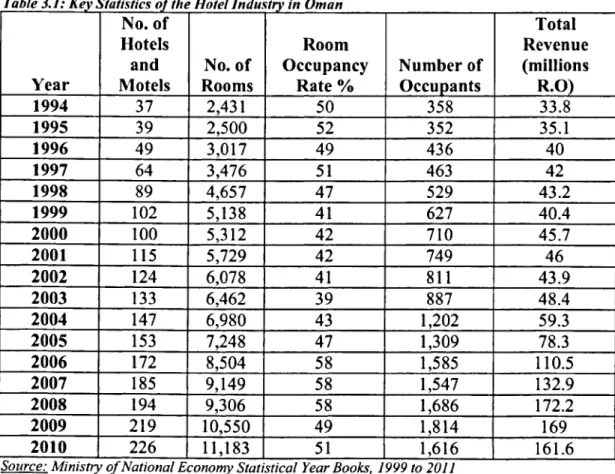
Table 3.1: Key Statistics of the Hotel Industry in Oman 66 Table 5.1: Paradigms of Research in Social Sciences 96
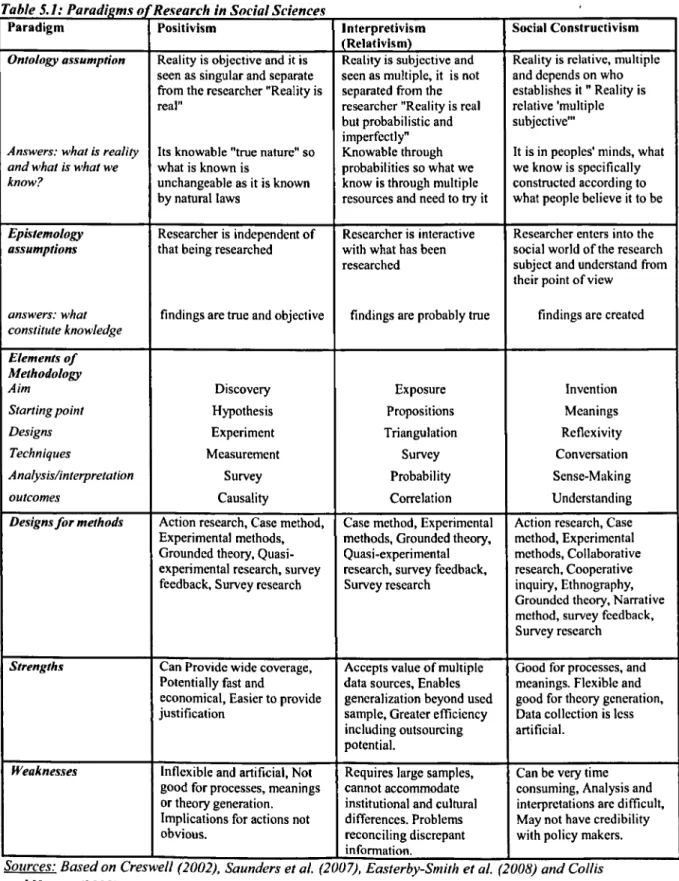
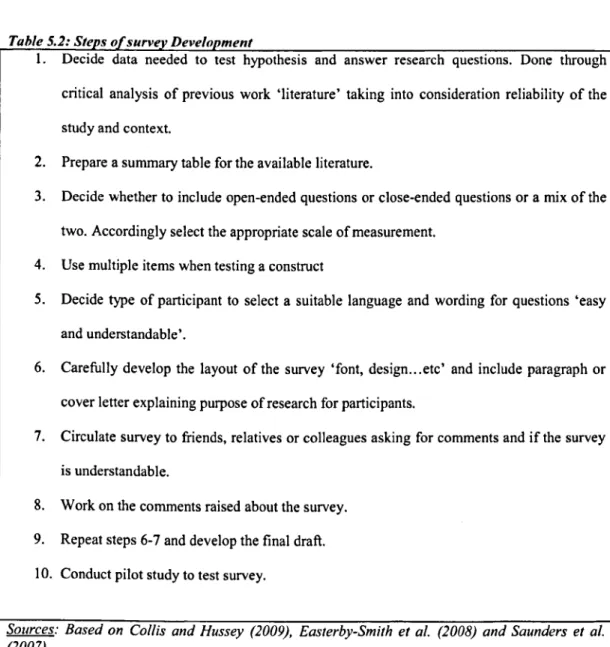
Table 5.2: Steps of survey Development 102
Table 5.3: Service Attributes 104
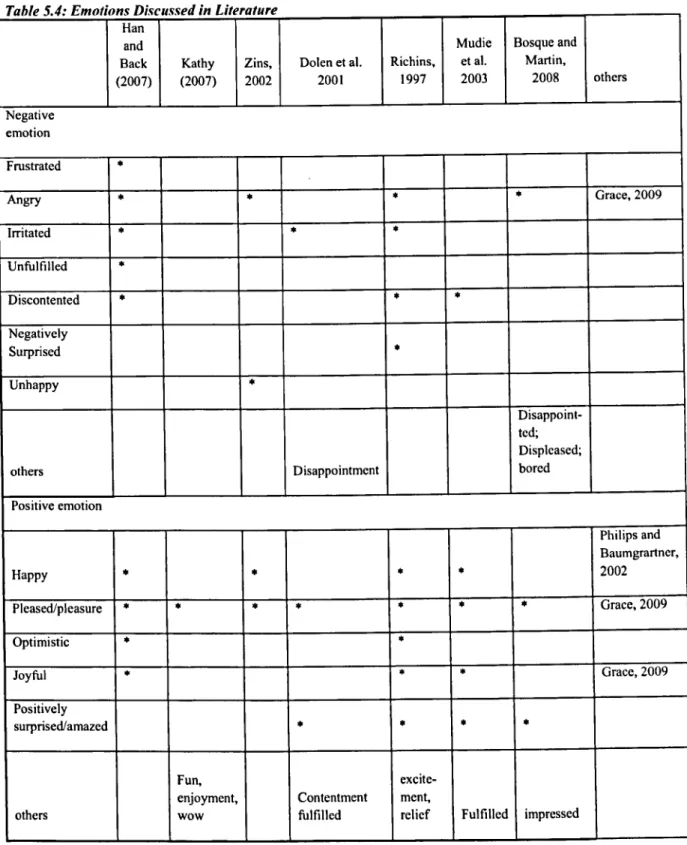
Table 5.4: Emotions Discussed in Literature 105
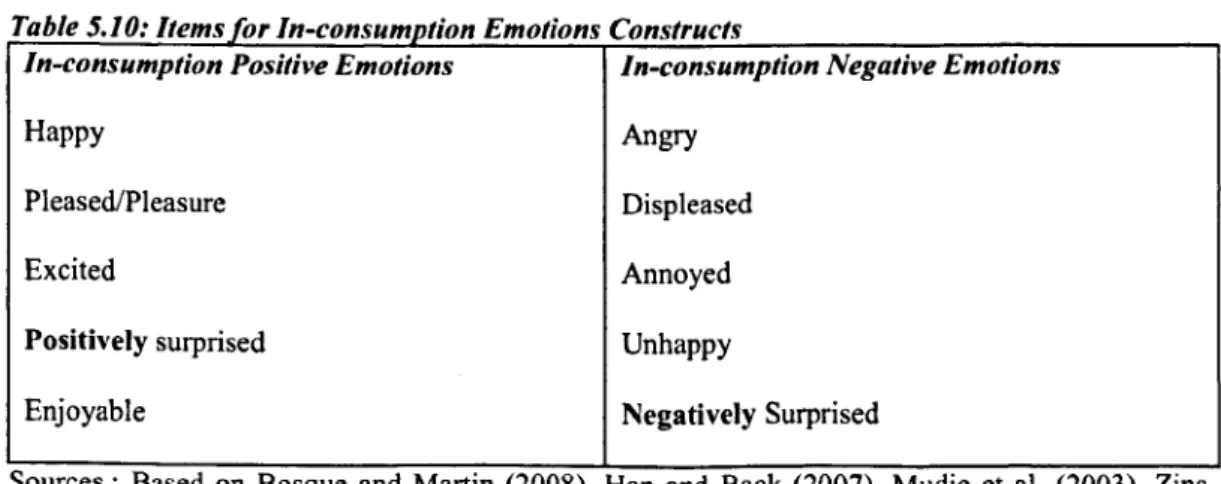
Table 5.5: Items of Employees' Attitude/Behavior Construct.. 108 Table 5.6: Items of Price Fairness Construct 109 Table 5.7: items of Non-Technological Tangibility Construct.. 110 Table 5.8: Items of Technological Tangibility Construct.. 111 Table 5.9: Items of Overall Customer Satisfactions Construct.. 112 Table 5.10: Items for In-consumption Emotions Construct.. 112
Table 5.11: Management Practices 114
Table 5.12: Items to Measure Performance of Hotel 116 Table 5.13: Operations Management Practices of Managing Employees 117 Table 5.14: Operations Management Practices of Managing Process 118 Table 5.15: Operations Management Practices of Considering Customer Feedback
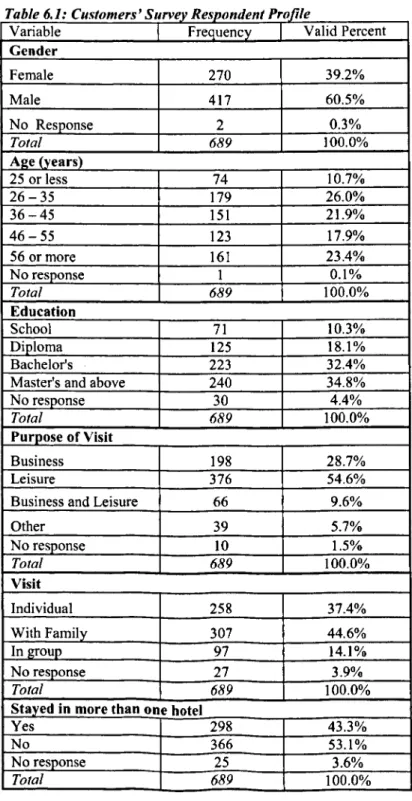
... 119 Table 6.1: Customers' Survey Respondent Profile
135
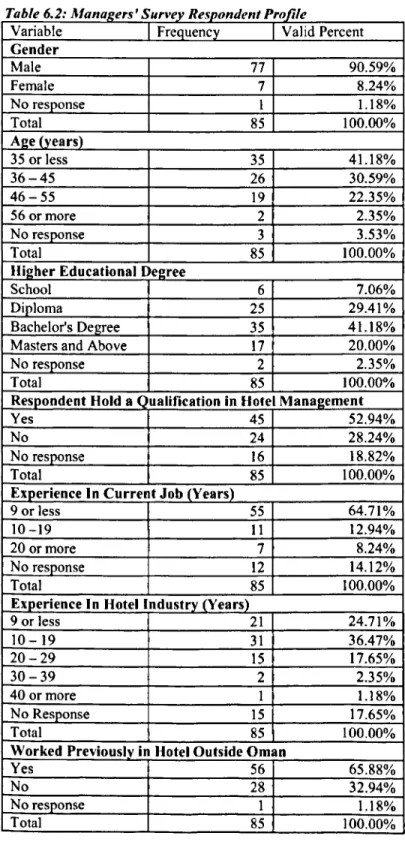
Table 6.2: Managers' Survey Respondent Profile
138
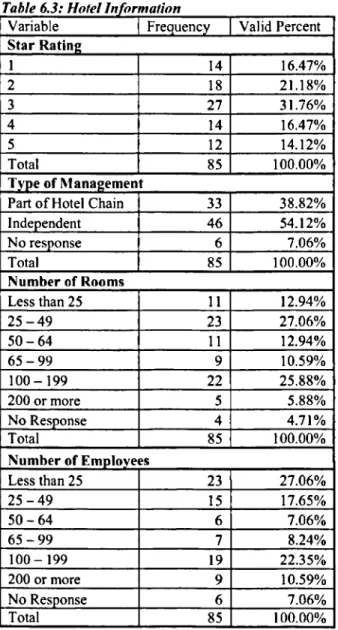
Table 6.3: Hotel Information 139
Table 6.4: Results of Exploratory Factor Analysis 144 Table 6.5: Factor Analysis for each Construct. 150 Table 6.6: SmartPLS outputs of Items Factor Loadings and T-test is and Construct
cronbach's alpha, CR and AVE 165
Table 6.7: Square of Correlations between Constructs and Average Variance
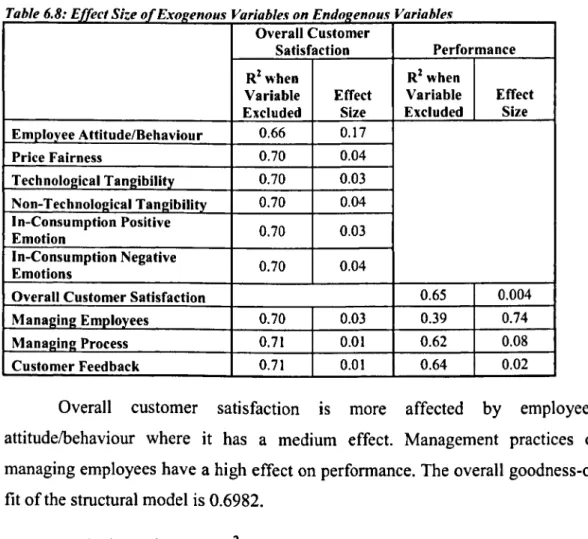
Table 6.8: Effect Size of Exogenous Variables on Endogenous Variables 171 Table 6.9: Relative Impact of Predictive Relevancy 172 Table 6.10: Item's Factor Loadings and T-values of Customers' Characteristics
Groups 176
Table 6.11: Cronbach's Alpha, Composite Reliability and AVE ofthe Groups 179 Table 6.12: Square of Correlations between Constructs and Average Variance
Extracted of each Construct for Females 180
Table 6.13: Square of Correlations between Constructs and Average Variance
Extracted of each Construct for Males 181
Table 6.14: Square of Correlations between Constructs and Average Variance Extracted of each Construct for Customers Staying for Business 182 Table 6.15: Square of Correlations between Constructs and Average Variance Extracted of each Construct for Customers Staying for Leisure 183 Table 6.16: Square of Correlations between Constructs and Average Variance Extracted of each Construct for Young Customers .: 184 Table 6.17: Square of Correlations between Constructs and Average Variance Extracted of each Construct for Old Customers 185 Table 6.18: Square of Correlations between Constructs and Average Variance Extracted of each Construct for Customers with Low Education Certificate 186 Table 6.19: Square of Correlations between Constructs and Average Variance Extracted of each Construct for Customers with High Education Certificate ... 187
Table 6.20: Multiple-Group Results 195
Table 6.21: Results of Mediation for Overall Customer Satisfaction 201 Table 7.1: Service Quality Dimensions and overall Customer' Perceptions
Hypotheses 209
Table 7.2: Operations Management Practices and Overall Customers' Perception
Hypotheses 213
Table 7.3: Operations Management Practices and Performance Hypotheses ... 217 Table 7.4: Customers' Characteristics Moderation Hypothesis 220 Table 7.5: Mediation Hypotheses of the Overall Customers' Satisfaction 223
Table of Figures
Figure 2.1: Service Quality Model 14
Figure 3.1: Map of the Middle East.. 63
Figure 4.1: Research Conceptual Framework 73
Figure 5.1: The Research Onion 94
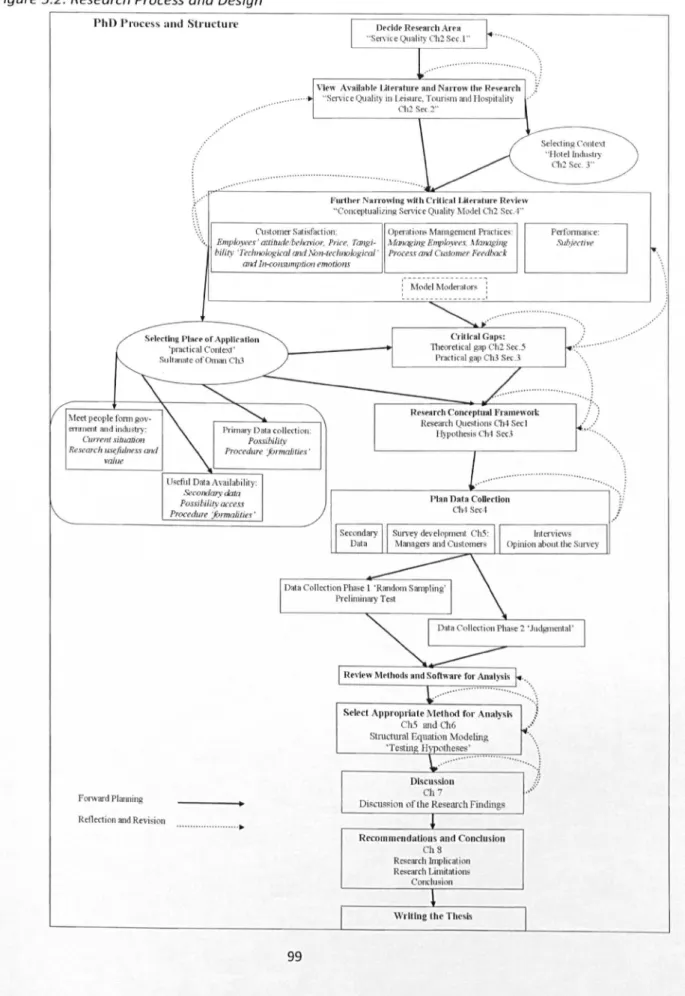
Figure 5.2: Research Process and Design 99
Figure 6.1: Simple SEM Path diagram 156
Figure 6.2: SEM Path Diagram of the Research Conceptualized Model 164 Figure 6.3: SmartPLS Output of Structural Model.. 170
Figure 6.4: A Moderator Model 173
Figure 6.5: SmartPLS Output of Structural Model for Females 190 Figure 6.6: SmartPLS Output of Structural Model for Males 191 Figure 6.7: SmartPLS Output of Structural Model for Business 191 Figure 6.8: SmartPLS Output of Structural Model for Leisure 192 Figure 6.9: SmartPLS Output of Structural Model for Young 192 Figure 6.10: SmartPLS Output of Structural Model for Old 193 Figure 6.11: SmartPLS Output of Structural Model for Low Education 193 Figure 6.12: SmartPLS Output of Structural Model for High Education 194
Chapter 1 Introduction
1.1 Research Background
The number of tourists and travellers is increasing significantly all over the world. As a result, hospitality and tourism is becoming one of the most important industries in the world in terms of its effects on the social and economic development of a region or country (Holjevac, 2003). Researchers have started to conduct large numbers of studies in the field as tourism is booming all over the world. As the hotel industry plays an important role in tourism, the hotel industry has a bright future (Holjevac, 2003).
Despite the considerable number of studies on the hotel industry in terms of evaluating service quality, there is still a paucity of research studies on understanding the influence of customer perceptions of service quality on managerial attitudes. In fact, there is very little literature available on hotels to build a good tool for service quality evaluation (Tseng, 2009; Hsieh et al., 2007). Prior to defining service quality, it is important to define service. Many researchers have defined service as the opposite of goods as service is intangible. Gronroos has defined service comprehensively, saying that: 'A service is an activity or series of activities of more or less intangible nature that normally, but not necessarily, take place in interactions between customers and services employees and/or physical recourses or goods and/or systems of the service provider, which are provided as solutions to customer problems' (Gronroos, 1990, p.27).
What matters to hotels is the customers' perception of service quality (Mohsin and Lockyer, 20 I 0), as the delivery of service quality to customers is the main responsibility of hoteliers (Su, 2004). The available literature in measuring customers' satisfaction of service quality has not provided an agreed single model as different researchers have come up with different models in terms of the dimensions of the service quality (Mohsin, 2007; Ramsaran-Fowdar, 2007; Akbaba, 2006; Juwaheer, 2004; Ekinci et al., 2003; Mei et al.,
there are significant differences in the conceptualization of satisfaction (Martinez and Martinez; 20 I0; Giese and Cote, 2000). Therefore, despite the growing body of literature on the concept of customers' perceived value, calls remains for more sophisticated measures (Lloyd et. aI, 2011).
In comparison to goods, service is said to be intangible. However, when measuring service quality and its influence on customer satisfaction, it is equally important to include both tangibles and intangibles elements (Pandey and Joshi, 2010). Service may involve the interaction between customers and employees; therefore it is important to include employees' attitudelbehaviour as a dimension of service quality as it may affect the customers' perception of service quality (L1yod et al., 2011; Cheung et al., 2009; Kuo, 2009; Lenka et al., 2009; Hennig- Thurau, 2004; Tsaur and Lin, 2004; Chu and Choi, 2000; Dabholkar et al., 2000; Mei et al., 1999; Parasuraman et al., 1985). According to equity theory (Huppertz et al., 1978), customers will evaluate the output (e.g. satisfaction) according to their input (e.g. price), and the price fairness of a hotel. Hence, price fairness is another dimension that should be included in measuring service quality as it also affects customers' perceptions and satisfaction (Martin-Ruiz and Rondan-Cataluna, 2008; Chowdhary and Prakash, 2007; Martin-Consuegra et al., 2007; Kandampully and Suhartanto, 2000; Voss et al., 1998).
Tangibility in service refers to the physical attributes of the service which consists of physical facilities and the appearance of those facilities, (Parasuraman et al., 1985) their condition (eg. cleanliness), and the noise/quietness of the service (Fitzsimmons and Fitzsimmons, 2009, p. 109). When measuring service quality the dimension of tangibility should also be included. Many researchers have stated the importance of tangibility and its affect on the customers' perception of service quality (Liu and Yen, 2010; Akbaba, 2006; Santos, 2002; Choi and Chu, 2001; Parasuraman et al., 1985). Although hotel service is a sensory experience wherein the customer experiences feelings and emotions, the in-consumption emotional aspect that occurs during the service process has not been significantly studied yet in the
literature of the hotel industry. As emotions affect the customers' perception of service quality and satisfaction, it needs to be considered as a dimension of service quality and should be included in the measurement model (Pandey and Joshi. 2010; Zins, 2002; Bosque and Martin, 2008; Briggs et al., 2007; Han and Back, 2007; Yu and Dean, 2001; Wirtz et al., 2000; Oliver, 1993).
From an operational point of View, service quality depends on the managers' practices in the organization. Therefore, including operations management practices and measuring their effect on satisfaction, is unavoidable service quality and performance. In fact, to maximize the relationship between managers and customers which results in customers' satisfaction and repurchase attention, managers should establish practices by integrating people and resources (Drohan et al., 2009). Managers' practices in operations, quality and human resources must be considered, as they are correlated with service quality and customer satisfaction and are important for the success of business such as hotels (Pandey and Joshi, 2010; Kandampully and Huo, 2007; Lagrosen and Lagrosen, 2003; Kandampully and Menguc, 2000). However, operations management practices need to be further explored and researched (Menor et al., 2001). According to Gunawardane (2006), the literature on operations management practices has highlighted dimensions such as managing employees, managing process and customer evaluation of service quality. Applications of management practices in managing their employees affect the hotels' performance and customer satisfaction (Wong et al., 2010; Sit et al., 2009; Merino-Diaz, 2003). Hence, management practices in managing employees are important in satisfying customers, as one of the dimensions affecting customer's satisfaction is employees' attitudelbehaviour. In addition, it is important to consider management practices in managing processes, including process control and process standardization (Tari et al., 2007; Nair, 2006) as they affect the firms' performance and customers' satisfaction (Wong et al., 2010; Tari et al., 2007, Behara et al., 2001; Kandampully and Menguc, 2000). It was stated by Zehrer (2009) that little attention has been paid to understanding the role of customers in managing service. In fact, looking to the service, through and from the customer's perspective, will add to the future of
understanding the service approach. So, managers should establish practices of taking customer's feedback and suggestions on the service provided. In fact, taking into consideration management practices of customer's feedback may also affect satisfaction and performance (Wong et al., 2010; Tari et al., 2007; Sit et al., 2009).
Customers of hotels have different characteristics: gender, age, education etc., and they stay in hotels for different reasons: leisure and business. Accordingly, their perceptions and expectations of service quality may differ. Some researchers found that customers with different characteristics differ in terms of their perceptions, preferences and satisfaction of service quality (Liu and Yen, 2010; Kuo, 2009; Anderson et al., 2008; Mohsin, 2007; Floh and Treiblmaier, 2006; Chu and Choi, 2000), whereas, other researchers failed to prove the difference (Liu and Yen, 2010; Walsh, et at. 2008; Chu and Choi, 2000). So, further investigation is needed that helps in understanding different customers for marketing segmentation.
1.2 Research Aim and Objective
The aim of this research is to build an effective model for service quality measurement that can be used in the hotel industry. The objective of this research is to fill the following gaps:
Research gap 1: In-consumption emotions and its effect on the overall
customer satisfaction.
Research gap 2: Including technological tangibles as a dimension of service
quality and studying their effects on the overall customer satisfaction.
Research gap 3: Linking operations management practices to the customers
experience of service quality.
Research
gap
4:
Understanding the moderating
role of customers'
Research gap 5:
Understanding the mediating role of overall customer
satisfaction.
Research gap 6: Applying the study to a specific location the Sultanate of.
The main question of this research:
What are the interrelationships between customers' perceptions of
service quality, operations management practices and hotel performance in
the hotel industry?
To meet the aims of this research, fill the identified gaps and answer the research question, a model for service quality has been developed through critical evaluation of the available literature. The conceptualized service quality model has included three main aspects: service quality dimensions, operations management practices dimensions and hotel performance. Service quality customers' perception dimensions are: employees' attitude/behaviour, price fairness, technological tangibility, non-technological tangibility, m-consumption positive emotions and in-consumption negative emotions. All dimensions are linked to the overall customers' satisfaction of service quality. Operations management practices dimensions are managing employees, managing process and customer feedback and again, all are linked to the overall customers' satisfaction of service quality. Operations management practices are also linked to performance. Overall customers' satisfaction of service quality is also linked to performance. The moderating role of customer's characteristics is also presented in the conceptualized service quality model.
1.3 Research Methodology
Recalling the objective of the research, primary data was collected through surveys. Two surveys have been developed: One targeted to customers where their perceptions of experiencing the hotel's service quality is measured. The second survey was developed to measure the operations management practices and performance in the hotel through management's perceptions. For the
customers' survey, international airports and hotels in Oman were targeted to collect data. For managers, surveys were sent bye-mail, fax or by hand. For each hotel, the manager's response was linked to their customers' responses.
A multivariate statistical method Structural Equation Modelling (SEM) was selected to test the hypothesized relations, moderation and mediation. Partial Least Square (PLS) was the approach used for SEM (PLS-SEM). Accordingly, factor analyses were used and the measurements of the structural model were tested. Two software have been used for analyses; SPSS and SmartPLS.
1.4 Research Main Findings
The empirical analyses have proved that the service quality dimensions: employee attitudelbehaviour, price fairness, technological tangibility, non-technological tangibility, in-consumption positive emotions and in-consumption negative emotions affect overall customers' satisfaction significantly. In addition,
it
was proved that operations management practices: managing employees, managing process and customer feedback also affect overall customer satisfaction significantly. Itwas also proved that management practices affects performance significantly. In addition, it was proved that the overall customer satisfaction mediates the relationship between quality dimensions and operations management practices and performance, where some are partially mediated and others fully mediated. However, the moderation role of customer's characteristics has been supported only partially.1.5 Research Structure
Chapter 1 provides an introduction to this research starting with the background of service quality and specifically hotels. Then, the research aim, objective and key findings are discussed briefly. Finally, the research structure is provided.
Chapter 2 shows the available literature in service quality which is then narrowed to focus on tourism, leisure and hospitality. The literature has been further narrowed to concentrate on the hotel industry. A critical evaluation of the literature is then used to conceptualize a service quality model that can be used by hotel managers to evaluate the quality of their organizations' services, and enables service evaluators to measure the service quality of the hotel industry as a whole. Finally, the gaps in the literature covered by this research are highlighted.
Chapter 3 discusses the Sultanate of Oman as it is the selected place for data collection. Oman and it's tourist industry is introduced and the importance of including Oman and how it's inclusion will add to practice is discussed.
Chapter 4 presents the purpose of this research and research questions are provided. The conceptual framework which is built through literature is presented. Accordingly, six hypotheses are developed.
Chapter 5 shows the research methodology and the research design plan. Justification of the research methodology is discussed. The development of surveys for both customers and management is then discussed in detail and the plan of the data collection is highlighted.
Chapter 6 presents the data analysis. The methods used for data analyses are discussed in detail and then applied to the data collected. The developed hypotheses are tested and results of analyses are provided.
Chapter 7 discusses the findings of this research. First, an overview of the findings are presented and linked to the objective of the research. Then, the hypotheses tested are interpreted and discussed using the empirical results from the data analysis chapter with supporting literature.
Chapter 8 demonstrates the contribution and the implications of this research. The role of management to stand in the competitive market in the hotel context is discussed in terms of its managerial implications. Then, the theoretical implications are highlighted and how this research will add to the existing knowledge. Then, the research findings are linked to the Omani
context and how it helped in enriching the practical context in the country. Limitations of the study and future research directions are also highlighted. Finally, the conclusions of this research are provided.
Chapter 2 Literature Review
2.1 Introduction
The previous chapter provided an introduction to the research, its purpose and main findings. This chapter reviews the literature of service quality and conceptualizes a measurement model. The chapter starts by highlighting in general the service concept and service quality. Later, the literature is narrowed to service quality in leisure, tourism and hospitality and specifically in the hotel industry. Then, a critical evaluation of the literature is discussed to conceptualize the measurement model of service quality. Interrelationships between customers' perceptions of service quality, managements' perception of practices and performance are developed. At the end of the chapter, the gaps in the literature to be filled by this research are discussed.
2.2 Service and Service Quality
2.2.1 Defining Service
At the beginning it is very important to define the word 'service' in order to help understand the nature of service and how to deal with it. Most people have defined service with reference to goods, saying that goods are tangible, whereas services are intangible products. Goods can be manufactured to meet customers' exact requests, whereas a service can sometimes be said to be provided within an immediate temporal context upon the customer's request. Moreover, services cannot be stored and used later on as goods and manufactured products can, thus managing the availability of services is critical, making the role of managers more important in service provision. Itis obvious that unless there are requests by customers for a service, the available resources will not be utilized effectively and efficiently. Looking to the literature available under service, different definitions of service can be found,
depending either on the field where the service is provided or on how the researchers perceive service.
Gronroos has defined service quality comprehensively, saying that: 'A service is an activity or series of activities of more or less intangible nature that normally, but not necessarily, take place in interactions between customers and services employees and/or physical resources or goods and/or systems of the service provider, which are provided as solutions to customer problems' (Gronroos, 1990, p.27). Service is also further defined by many other researchers to develop a deeper understanding of the concept in order to conduct research to build models for service (Ghobadian et aI., 1994, Seth, 2004) . In addition, to understand how the concept of competition has increased in the service industry, there is a motivation to run research on service quality. To do so, there is a need to understand and highlight the literature on service quality, which is discussed in the following section.
2.2.2
Service Quality
As discussed earlier, early researchers focused on defining and measuring the quality of the manufacturing. Systematic quality efforts in modern manufacturing began in the 1920s, and fifty years later quality of services started to grow as the service industry expanded across the world (Gummesson, 1991). In order to survive in today's competitive environment, the interest in service quality is ever-increasing (Ghobadian et aI., 1994). Research shows that service quality leads to customer loyalty and attracts new customers, due to customer satisfaction generating a positive reputation (such as by word-of-mouth or online reviews) about service (Zabkar et aI., 2010; Stickdorn and Zehrer, 2009; Tseng, 2009; Ingram, 1996). The theoretical concepts of service quality and management percolated slowly into the service industry from manufacturing (Levitt, 1972).
A number of studies showed the importance of increasing the level of the perceived quality, as it affects organizational performance and profitability (Zabkar et aI., 2010; Gupta and Zeithaml, 2006; Bernhardt et aI., 2000;
Harrington and Akehurst, 1996). Thus, there is a need to know the meaning of service quality and how it can be achieved. Service quality is something that an organization needs to be aware of in order to please its customers, which leads to profitability and business success (Zeithaml, 2000; Ittner and Larcker, 1999; Anderson and Fornell, 1994, Koska, 1990). Service quality is said to be meeting customers' expectations (Garcia and Tugores, 2006). An organization needs to serve according to the customers' expectations, while simultaneously maintaining its standards and guiding principles, and compromising between the two. Wyckoff (1992) also defined service quality and stated that service quality is the degree of excellence in meeting the customer's satisfaction. However, that is a big challenge, as measuring service quality is difficult in comparison with measuring the quality of a product. A product's quality can be checked prior to being sent to market. Moreover, quality of products can be physically measured (by weight, height, length etc.), whereas service quality is mainly manifested in the usually internal feelings and emotions of customers. An assessment of quality is difficult to be obtained or to quantified as customer judgements are subjective (Norman, 1991; Anderson and Fomell, 1994).
Managing the service quality successfully and satisfying the customer leads to positive customer perceptions. As a result, the service organization provider will build a good reputation, which means profitability and survival in a competitive world (Peters, 1987). Developing the understanding of service quality, the concept of service management started to be defined and applied as the role of management became more critical. Service quality management was divided into two schools: Scandinavian and American. The main difference between the two schools was in terms of the data collected (Williams and Buswell, 2003). The American school requires numerical data to be generated.
Quality of service was defined as the difference between customer perceptions and their expectations according to the PZB theory or model (Zeithaml et al., 1990). They introduced the GAP theory, which highlighted the gaps in the service organizations. Their theory was, and is still considered to be, reliable enough to be used in service quality evaluation. Moreover, their
concept was the basis for building the SERVQUAL method, which has been adapted to different fields of service like banks and health service providers. In general, it can be said that for a successful service relationship there should be trust between the supplier and the client (Czepiei, 2002). In fact, it was proved by Gounaris (2005) that the higher the perceived quality of the service offered, the greater the degree of trust between the customer and its supplier. Building such relationships necessitates the consideration of lots of parameters, such as physical features, the safety of facilities provided, accessibility and client knowledge (Ban, 2008).
The research on service quality has focused on understanding the service dimensions, and attributes to build models that helped develop measures and tools to evaluate the service quality for the purpose of organizational success. However, it is not sufficient merely to measure service effects at the point of delivery; other factors and aspects need to be taken into consideration, such as management practices. Management practices are important in enhancing the excellence in service and for the success of organization (Lagro sen and Lagrosen, 2003; Haynes and Frayer, 2000; Kandampully and Menguc, 2000). Obviously the role of management is important in increasing the subjective and objective performance factors of an organization, and both need to be measured. Itwas stated by Nair (2006) that managing quality had started many years ago, yet rigorous attempts to measure management practices in managing quality and their effect on quality and performance only started in the late
1990's. In addition, factors that affect the service satisfaction evaluations also need to be highlighted and investigated. Moderating these factors will definitely add to the understanding of service quality perceptions and expectations. There is no doubt that lots of research has been conducted and has taken into consideration what was pointed out. However, there is a need to include factors such as management practices in a model that relates customers' perceptions of service quality, management practices and performance. That is the main objective of this research. The next section discusses the available literature on models and literature of service quality, to help in building the proposed model for the research.
1.1.3
Service Quality Models
Defining service quality has led many researchers to develop models, either original or based on existing ones.
In
fact, there have been many developments and changes in service quality models because of new and emerging factors. Researchers started to know and understand the factors affecting service quality, and how to evaluate those factors, which was followed by the improvements in the service quality models. Currently, models are changing according to the role of new technology, which is introduced continuously, with the proliferation of computers and the internet being key (Seith et al., 2005). Seith et al. (2005) published an interesting and valuable pioneering piece of work which reviews nineteen service quality models. The paper critically examined the differences in the service quality models and highlighted the future direction of research in the field. The paper was used as a key for understanding and knowing the models used in the area of service quality. Inthis section some models will be briefly described and discussed.Gronroos (1984) developed the technical and functional quality model that pointed out the importance of understanding customer's perceptions of quality, and the way that service quality is influencing business performance and help the firm to compete successfully. Two dimensions of quality were introduced at that time: physical and technical. In 1985 the famous GAP model was developed by Parasuraman et al., built on the idea of differences between expectations and perceptions, with a conceptual service quality model that included five gaps see Figure 2.1.
I
Word-of-mouthI
I
Personal NeedsI
Past ExperienceI
J Expected Service L---,
I t GapS I Cl: I ~ I 0 ~ t;; Perceived Service ::> o I---r---
--- ---I I ExtemalCommunica-I
Service Gap4 ti on to Customers Delivery---Cl: ~ ~ ~ Gap 3 I 0 ~ Cl:
Po. Service Quality
Gap 1 Specifications
Gap 2
r
;.
Management Perceptions of
---_.
Customer ExpectationsSource: Parasuraman et a/., 1985)
Using the GAP model, a SERVQUAL measurement tool was developed to evaluate service quality. Later, using three components of service quality, Haywood-Farmer developed the attribute service quality model in
1988 (Seith et aI., 2005). The GAP model was criticized by Taylor and Cronin (1992), who developed a performance only model, arguing that the perceptions of customers are the only valid predictor of service quality, as many customers do not think in terms of expectations and perceptions.
With the boom of technology in the business industry, in production and service, researchers started to take technology into consideration. Case study data was used to develop a model that maps the quality dimension in technology, which helps the managers to know the role of information
technology in improving service quality (Berkley and Gupta, 1994). Other quality service models were developed in accordance with the field in which they were to be applied, such as banking, transportation, healthcare and retailing.
Introducing models for
service
quality is necessary as it helps in pointing out attributes or dimensions of the service, which helps in measuring and evaluating the service quality, especially for practitioners. In addition, the managers' role will be clearer, building the practices that are needed to serve quality that leads to success and gain in the competitive environment of the market. Moreover, an understanding of types of service will also help in evaluating service quality. Therefore, an understanding of how service quality is evaluated through the literature is important, and is discussed in the following section.2.2.4 Evaluating Service Quality
Developing service quality models helped researchers and practitioners to come up with tools to measure service quality satisfaction. The leading tool was SERVQUAL, which developed after the GAP model discussed previously. SERVQUAL was mainly developed to calculate Perceptions-Expectations using ten dimensions of service quality, later condensed to five: tangibility, responsiveness, reliability, assurance and empathy (Parasuraman et al., 1985,
1988, 1991, 1994). SERVQUAL literature was discussed in many research papers and publications (Badri et al., 2005). In fact there has been debate on the tool of the SERVQUAL and lots of criticism raised at the theoretical level and operational level (Grzinic, 2007). As per theoretical criticisms, the introduced tool was more directed to the process of the service quality and the introduced dimensions could not be universalised (O'Neill and Palmer, 2003; Soliman and AIZaid, 2002). Another theoretical criticism pertained to the fact that not all customers think in terms of expectations and perceptions (Qin and Prybutok, 2009). There are also many operational criticisms on the tool as well. At the operational level, the elements introduced under each dimension could
not encompass the variability inside each dimension (Grzinic, 2007). In addition, the moment of truth for a customer may vary from time to time for the same service, so looking just to SERVQUAL will give a limited evaluation of the service quality. It was stated by Qin and Prybutok (2009) that SERVQUAL has issues in the use of gap score, poor predictive, overlap among dimensions and unstable dimensionality. Researchers failed to confirm the five dimensions of SERVQUAL in different industries (Ladhari, 2009a; Quin and Prybutok, 2009; Hudson et al., 2004; Mei et al., 1999). SERVQUAL also has been criticized in terms of convergent, discriminant and predictive validity (Ladhari, 2009a). Thus, when adopting items of SERVQUAL, validation of the instrument in terms of reliability and validity should be performed after data collection (Ladhari, 2009a). So, the developed dimensions are not stable. Therefore, different context industries should replace SERVQUAL with measurements that overcome the criticisms raised by researchers (Ladhari, 2009a).
Nevertheless, the model should be highlighted when building an evaluation model by taking the basics and avoiding the criticisms.
Taking the criticism of SERVQUAL of the measurement of the differences between expectation and perceptions has resulted in introducing SERVPREF as a new tool. The tool uses performance only as a sufficient measurement for service quality (Cronin and Taylor, 1994). Other tools were also developed, introduced, and applied in many service industries. Some merely modified SERVQUAL according to the criticisms discussed earlier. DINSERV was a tool introduced to measure the service quality in restaurants developed by Stevens et a1. in 1995, in response to the criticism that SERVQUAL was inadequate for the 'unique' restaurant environment (Knutson et al., 1995). Tribe and Snaith (1998) introduced the HOLSAT tool for the purpose of evaluating tourist satisfaction with destinations. Another model was also developed for libraries to evaluate their service quality, called LIBQUAL. Strossmayer (2008) applied SERVQUAL in the health sector.
Statistical techniques to control service quality and its delivery process may be used in several areas (Mason and Anotomy, 2000; Wood, 1994). Control charts, Pareto analysis, Histograms and Cause-and-effects diagram can be used in managing service (Murdick et al., 1990). Charts for average and range may be used to control time of service delivery or waiting time for service. P-chart may be used to control proportions. C-chart can be used for controlling the number of customers' complaints. Quality improvement may be carried out through Pareto analysis and Cause-and-effect diagram.
Advanced statistical tools were used to evaluate service quality alongside simple ones. For example, Exploratory Factor Analysis (EF A) was used by many researchers to evaluate the service quality in the shipping industry (Cronin and Taylor, 1992). Structural Equations Models (SEM) and multivariate statistical tools have also been used widely in measuring service quality (Cronin, 2000; Dabholkar, 2000). What was common in most of the developed tools for measuring service quality was that they relied on the customers' determination of satisfaction. There is a positive relation between service quality and customers satisfaction, often using the SERVQUAL model of service quality (Coulthard, 2004), that can be used by managers to improve and make sure that their organizations have service quality that satisfies their customers. In spite of all this, SERVQUAL is still one of the most recommended tools to be used in evaluating service quality (Akababa, 2006; Lam and Woo, 1997; Mittal and Lassar, 1996). However, the limitations of the model must be identified, and a model must be constructed. SO, SERVQUAL items should be the base of building a service quality measurement model.
Recent studies have added dimensions that need to be considered in the evaluation of the process. An example is the addition of fee or price dimension by many researchers as it was stated by Chowdhary & Prakash (2007). Technology was also recommended by Ramsaran-Fowdar (2007), but has not been applied yet. Technology is usually considered as a part of tangibles. That will create an overlapping in the dimensions and which needs to be taken into consideration while building a measurement tool. Many studies in the literature
modified the SERVQUAL model to fit a certain industry, or to develop the concept, with the evaluation itself being accomplished with other tools such as multivariate statistical analysis.
To more focus the concept, the next section will discuss service quality in leisure, tourism and hospitality, with due consideration of the available literature, in order to conceptualize a model for the hotel industry.
2.3 Service Quality in Leisure, Tourism and Hospitality
2.3.1
Leisure, Tourism and Hospitality
Over recent decades the number of tourists and travellers has increased significantly all over the world, and is forecast to increase further over the next few years, from 565 million in 1995 to 1006 million in 2010 and 1561 in 2020 according to the World Tourism Organization WTO (Tourism 2020 Vision). The Middle East is expected to face the largest annual growth with 6.7% average annual growth rate (Tourism 2020 Vision). That has resulted in focussing the attention of many researchers onto this field.
The hospitality and tourism industries are among the most important in the world in terms of their effect on the social and economic development of a region or country (Holjevac, 2003). In fact, tourism has not only become one of the main sources of income for many countries, but also a valuable means to encourage global income development (Hwang and Chang, 2003) especially in developed countries, which creates gain for both investors and governments. That has lead many countries to give special attention to tourism, and some countries have increased the money invested in the sector. Lots of studies have proved that there is a positive relation between the GOP and increased numbers of tourists in the country (Arslanturk and Atan, 2012, Stainslav and Craig, 2007). Although uncontrolled tourism has affected some countries negatively, governments are encouraging it. Thus, politicians and tourism organizations should establish some boundaries and roles to control the effect of tourism on their own countries (Archer et al., 2004).
Tourism was defined by the WTO as 'the activities of persons travelling to and staying in places outside their usual environment for not more than one consecutive year for leisure, business and other purposes' (WTO Technical Manual, 1995). Tourism is a competitive and dynamic industry that requires the ability to constantly adapt to the changing needs and desires of customers. Tourism aims to satisfy customers and provide enjoyment as well as safety and the feeling of security (although not particularly noticeable in long-established Euro-American tourism, in some parts of the world concern over security is the prime consideration of tourists). Tourism consists of different elements and sectors: accommodation, food, beverage services, travel agencies, transportation and entertainment. The tourism process might be viewed as three elements: travel, accommodation and participation in activities and attractions (Williams and Buswell, 2003).
Looking to the tourism and hospitality industry, it can be said that the industry is becoming one of the largest industries in the world (Burkart and Medlik, 1974; Holjevac, 2003; Arslanturk and Atan, 2012). As a result, many businesses and organizations have been developed in the industry. That has led to the appearance of competition, and concern about quality has become a requirement to survive. Quality for tourists, as defined by Holjevac (2003), is everything a tourist requires and expects. He also added that human beings nowadays are not only looking for basic needs, they are also looking to fill their social and spiritual needs, including leisure and travel, and whatever the tourist desires (Holjevac, 2003). Moreover, caring about the emotions of tourists in the service processes is important as it leads to satisfaction (Oliver,
1993; Wirtz et al., 2000; Yu and Dean, 2001; Bosque and Martin, 2008). Itis clear that quality is even more important and essential in the tourism and hospitality industry than is immediately obvious.
As the term 'service quality' is very important, it is necessary to highlight previous studies in the area. The next section discusses the service quality in leisure, tourism, and the hospitality industry as it has been dealt with in the available literature.
2.3.2
Service Quality in tire Leisure, Tourism and Hospitality Industry
Itis difficult to define the concept of service quality, especially in the tourism and leisure industry. As explained by Williams and Buswell (2003), the writers in the field of the service quality concentrate on two approaches: value-based and user-based approaches. The two approaches were discussed critically by Williams and Buswell (2003), and how the interpretations of the two approaches were developed historically by famous researchers in the field of service quality. Service quality is becoming one of the most important attributes for tourists to choose a particular destination, in terms of accommodation or activities and attractions (Weiermair and Fuchs, 1999). That was the reason which researchers intensified their studies on service quality in leisure and tourism. The studies were run to build the dimensions of service quality in the tourism industry and define the importance of each dimension. What is also challenging in the tourism industry is that the expectations of tourists have changed a lot in recent years. In addition, tourists travel from one place to another for many purposes, such as business, leisure and health. Depending on the purpose of the visit the tourists' expectations and interests differ. That obviously makes it more challenging in terms of satisfying customers/tourists with different expectations, and as discussed before, satisfaction means at least meeting customers' expectations.At the early stages of research it was important to know and understand the service quality dimensions in the field of the leisure and tourism industry. That attention has resulted in a rich literature of deciding the service quality dimensions in the industry (Akbab, 2006; Tribe and Snaith, 1998; Akan, 1995; Knutson et al., 1990). The focus of concern in service quality was mainly customer satisfaction. Itwas stated that customer satisfaction was considered in many studies as it is one of the keys for business success in today's competitive environment and for gaining customer loyalty (Morgan and Rego, 2006). That is considered to be challenging, as the customer feedback of the service quality is considered to be subjective. It is also required to have knowledge of the
psychological aspects, as it deals with feelings and emotions. Customers for the tourism industry are people with different characteristics which may affect their perceptions of satisfaction. That must be considered as a moderator and needs to be researched regarding how it affects the perceptions of the service quality.
In considering the effectiveness of service quality it is important in addition to customer satisfaction to take into consideration the management and employees' role (Maxwell et al., 2004). So, looking just to customers gives a limited understanding of service quality in tourism. Managers of tourism organizations and their employees are also important elements to be taken into consideration while understanding the concept of service quality. Although service quality is primarily based on the face-to-face experience of employees, other determinants of service should also be taken into consideration (Kandampully, 2001). The organizational climate plays a big role in satisfying customers/tourists. The communication skills of employees and relations between employees and service managers are examples of the determinants of organizational culture. Itwas also proved that training and special programs for employees in the tourism industry are important as well (Maxwell et aI., 2004). Pandey and Joshi (2010) have highlighted the importance of service quality and management practices in managing quality as it affects customer's satisfaction positively. This is where the role of management practices is important and cannot be denied.
Understanding the idea and the concept of service quality in leisure, tourism, and hospitality has helped in measuring service quality. The next section discusses how service quality was measured in this area.
2.3.3
Measuring Service Quality in Leisure, Tourism and Hospitality
Industry
Various methods to monitor and control service performance are utilized in the tourism and hospitality industry. A number of studies were
conducted to gain a better understanding of the success or failure of service delivery generally, while on the other hand, it was stated by Ross (1994) that there were little attention from researchers to running and conducting studies on the tourism and hospitality industry. From the mid-1990s a rich literature emerged on developing tools and methods to measure service quality (Akababa, 2006; Tribe and Snaith, 1998; Lam and Woo, 1997; Mittal and Lassar, 1996; Stevens et al., 1995; Comin and Taylor, 1994; Knutson et al., 1994). As discussed above, the role of managers and employees are important for what is known as organization culture. Customer satisfaction was the main index in the tools and methods applied. Infact, lots of studies were conducted by researchers to measure customer satisfaction in the tourism industry (Hasegawa, 2009). The studies proved the positive relation between service quality and customer satisfaction (Tribe and Snaith, 1998). However, that should not eliminate the role of including aspects from organization behaviour and management in forming and evaluating service quality.
SERVQUAL has been applied and used in research for evaluating and measuring the service quality of tourism sectors such as hotels, destinations and travel agencies. The criticisms of the tool have motivated lots of researchers to modify the tool or develop new ones. Lots of researchers have also used the structural equation model and included the factor analysis of customer satisfaction in the tourism industry (Silvester et al., 2008; Thompson and Schofield, 2007). Lately, the multivariate ordered point approach was also used in the field of tourism (Hasegawa, 2009). There was also an integration of different models to measure customer satisfaction in tourism, for example, integrating Kano-model and quality, Quality Function Deployment and SERVQUAL (Tan, 2003). He used the tool to evaluate the customer satisfaction and applied it in Singapore.
A
tool named INSQPLUS was also applied to evaluate internal service quality in the industry by Uran (Grizinic, 2007). The HOLSAT tool was also introduced for the purpose of evaluating tourist satisfaction with destinations by Tribe and Snaith (1998). The LODGSERV tool was build for the hotel industry, designed to measure the customer expectation of the service quality of hotels (Knutson et al., 1990).Later on, the role of managers and employees in service quality was included by researchers and the concept of tourism service management was studied and defined. Measuring service quality in the tourism and hospitality industry should include managers and employees (Maxwell et al., 2004). Training and special programs for employees in a tourism industry are also important, and should be considered for organization success (Hope, 2004). Management practices and their effects on quality have been considered in manufacturing by many researchers (Wong et al., 2010; Sit et al., 2009; Tari et al., 2007; Nair, 2006; Kaynak, 2003). Recently researchers have been highlighting the importance of management practices in managing service (Chand, 2010; Pandey and Joshi, 2010; Tari et al., 2010; Zehrer, 2009; Ofir and Simonsons, 2001), but most of those studies were on human resource management only. So, other practices also need to be taken into consideration.
The purpose of this research is to conceptualize a model that can be used to evaluate service quality in the hotel industry. The model is designed to link customers' perception of service quality and management perceptions of operations management practices and performance. To do so, first the literature available on the hotel industry is presented and highlighted in the next section. Then, conceptualization of a measurement model literature is discussed in detail.
2.4 The Hotel Industry
At the beginning it is important to define 'hotel' and understand the nature of the service organization. Hotel is a tourism subsector establishment providing accommodation as well as food and beverages for tourists stay on a paying basis (Cooper et al., 2005). Another definition of hotel in Business Dictionary (2012) is 'a commercial establishment providing lodging, meals and other guest services'. Hotels are said to play an important role in most countries by providing facilities and services for entertainment and business for meetings and conferences (Medlik and Ingram, 2000). Thus, it can be said that
hotel is a mainly a service organization, which also provide tangibles to its customers.
Many studies have been conducted on the hotel industry as one of the most lucrative and fundamental aspects of the boom of tourism. However, most of the studies were just duplicates in terms of concept and methodology, though different in place of application. In order to improve the service quality of the hotel industry, hotel managers need to have a good knowledge of, and critically understand, the customers' expectations, alongside building good organizational behaviour through their management practices. The reason for highlighting management practices is because it is essential to measure their effect on the service quality perception of customers and the performance of organizations. Essentially, the managers should be able to define and identify the service quality and its' dimensions. Inaddition, managers need to know the service quality measurements and evaluations. Itis also important to know the importance of these dimensions to customers (Fick and Ritchie, 1991).
The literature available provided plenty of service quality measurements, and many methods were introduced. The method which attracted most studies was the SERVQUAL (Parasuraman, Zeithaml and Berry, 1998). SERVQUAL is a multiple dimensions of service quality which is based on the idea of service quality gap. Other applications in the hotel industry were by modifying the PZB tools taking into consideration the criticisms of these tools (Akbaba, 2006; Getty and Thompson, 1994; Knutson, 1990). Understanding and building service quality in the hotel industry might be critical as the stakeholders are coming with different needs to be fulfilled.
Understanding the customers' expectations from the hotel service is critical and challenging as hotels have different customers coming with different cultures and backgrounds. It is recommended to employ repertory grid interviews with customers to indentify the key areas of hotels service operations from their point of view (Nightingale, 1983). Interviewing customers or asking them to fill in a survey will give a good understanding of
their needs and what exactly they are looking for from the hotel so that it may be considered as an excellent service provider. Visitors to hotels from different nations and countries differs in terms of their satisfaction, expectations, perceptions and dissatisfaction (Yuksel et al., 2006; Mattila, 1999; Mok and Armstrong, 1998). There was also another tool built for the hotel industry which is LODGSERV that was designed to measure the customer expectation of service quality from a hotel (Knutson et al., 1990). This instrument was also tested in other cultures and it was found that it worked quite well. LODGSERV included the five dimensions of SERVQUAL, and it is distinguished in terms of not calculating the difference of expectations and perceptions. They recommended their instrument to be used by hotels' managers to help them build a good service quality that satisfies their customers. However, the model does not evaluate the perceptions of customers, which is important to evaluate the quality of service.
Later, the use of 'a critical incident technique' was recommended to understand service delivery (Lockwood, 1994). Critical incident technique is a social science qualitative method used to classify observations of human behavior by relying on a set of procedures and content analyze (Germler, 2004, Ekinci, 2002). In service, customers are asked to tell a story about their experience to understand their incident and act using content analysis (GermIer, 2004). In 1995, Martin employed importance/performance analysis. Then, in order to assess the differences between managers and employees, he employed 'service gap methodology'. Later on, the importance of the service quality measurement in the hotel industry and validating the measurement motivated lots of researchers to conduct work and case studies. A study conducted by Oberoi and Hales (1990) developed a scale to measure service quality in conference hotels. A study undertaken by Ekinic and Riley (2000) showed that the most critical issue in service quality research is the validity of the measurement scale.
Other statistical quality tools that are used in the manufacturing sector can be modified and used for services (Johannsen et al., 2011; Murdick et al.,
1990). Statistical techniques to control service quality and its delivery process may be used in several areas(Murdick et al., 1990) . For example, charts for average and range may be used to control time of service delivery or waiting time for service. P-chart may be used to control the proportion of rooms' occupancy in a hotel. C-chart can be used for controlling the number of customers' complaints. Quality improvement may be carried out through Pareto analysis and cause-and-effect diagrams. Those tools are used in continuous evaluation of the service quality of hotels, which helps the managers to make sure that their service quality is under control. Moreover, those tools are easily used and applied with the development of computer software and user-friendly programs. Alongside the basic tools of quality, managers should use a good model of service quality. Accordingly, the quality of service will be measured, controlled and improved.
Studies were conducted on the management of the service quality and their role in providing good service quality (Kandumpully and Huo, 2007; Lagrosen and Lagrosen, 2003; Kandumpully and Menguc, 2000) . There should be a comprehensive understanding of the service quality by managers in order to build a good quality policy for the hotel service. The policy should include the role of customers as well as that of employees (Drohan et at, 2009; Edvardsson et al., 2005; Brotherton, 2004; Geller, 1985).
In
order to provide a high quality service in a hotel there should be an effective internal communication system for understanding the quality policy of the organization (Harrington and Akehurst, 1996). It is known that most hotels have similar features, especially international chain hotels, and this increases the importance of managers' and employees' role, as service quality has to be part of the hotel culture if the service is to stand out from the crowd. Itwas stated that service quality should be part of organization culture (Pal