Volume 1, No. 2, July‐August 2010
International
Journal
of
Advanced
Research
in
Computer
Science
RESEARCH PAPER
Available Online at www.ijarcs.info
High Performance Mobile Checkpointing Algorithm
Surender Kumar*
Dept. of Information Technology (IT), Haryana College of Tech. & Mgmt.(HCTM)
Ambala Road, Kaithal(HRY), INDIA [email protected]
R.K. Chauhan
Dept. of Computer Sc. & App.(DCA) Kurukshetra University, Kurukshetra(HRY), INDIA
Parveen Kumar
Deptt. of Computer Sc. & Engg. Meerut Institute of Engg. & Tech.(MIET)
Meerut(U.P), INDIA
Abstract: A mobile computing system consists of mobile and stationary nodes, connected to each other by communication network. This system raises several requirement and restrictions, such as limited battery life, mobility, disconnection of hosts and lack of stable storage not taken into account by conventional distributed systems. Our checkpointing algorithm forces a minimum number of processes to take checkpoint and re-duces the delay incurred in determining the consistent global state for mobile systems in the comparison of the traditional coordinated check-pointing algorithms. By reducing the checkpoint cost like searching, saving checkpoints, and transmitting data through wireless link we can deal with different checkpointing issues for mobile systems.
Keywords: Mobile Systems, Coordinated checkpointing, Consistent Checkpoints, Global Snapshot, , Non-blocking, orphan message.
I. INTRODUCTION
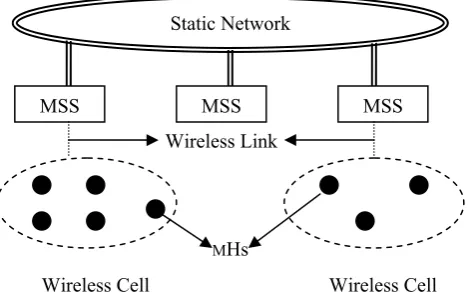
A mobile computing system is a distributed system where some of the nodes are mobile computers (Mobile Hosts (MHs)) [9]. As time passes mobile computers loca-tion gets change. To communicate with MHs, mobile sup-port stations (MSSs) are added. An MSS communicate with other MSS by wired networks and with MHs with wireless network. Each of saved state is called snapshot (check-point). All the processes in the system take their checkpoints periodically.
The checkpointing techniques do not require user inter-action and can be classified into following categories: (a) Uncoordinated checkpointing (b) Coordinated checkpoint-ing (c) Quasi-Synchronous (d) Message – Login based checkpointing [14]. In this paper we concentrate on coordi-nated checkpointing technique which maintains a consistent snapshot of system all the times. A consistent global snap-shot indicates set of N local snapsnap-shots (checkpoints) one from each process forming a consistent system state which can be used to restart process execution upon a failure.
It is desirable to minimize the amount of lost work by restoring the system to most recent consistent global check-point. A good snapshot collection algorithm should be Non-Blocking i.e. which does not force the nodes in the system to stop their computations during snapshot collection. An efficient algorithm keeps minimum effort required for col-lecting a consistent snapshot to a minimum. The snapshot collection algorithm by Chandy and Lamport forces every node to take its local snapshots but the computation is al-lowed to continue while the global snapshot is being col-lected [1]. In Koo and Toueg’s algorithm all the nodes are not forced to take their local snapshots [7]. However, the
underlying computation is suspended during snapshot col-lection.
We propose a new coordinated checkpoint algorithm which is non- blocking and efficient that forces a minimal set of nodes to take their snapshot and underlying computa-tion is not suspended during snapshot colleccomputa-tion.
The rest of the paper is organized as follows: Section 2 presents the system model. Section 3 presents the basic idea, minimal dependency information at each node and the node mobility management of our algorithm. Section 4 presents a Non-Blocking Coordinated checkpoint algorithm with data structure used and an example describing our algorithm. Section 5 presents the related work on which our algorithm is based. Finally, Section 6 presents conclusion.
II. SYSTEMMODEL
The messages generated by underlying distributed appli-cation will be referred to as computation messages. Mes-sages generated by the nodes to advance checkpoints, han-dle failures and for recovery will be referred to as system messages. In this paper the horizontal lines extending to-wards right hand side represent the execution of each proc-ess (MH) and arrows between them represent the mproc-essages. Processes have access to a stable storage device that sur-vives failures. The number of tolerated process failures may vary from 1 to N [14].
III. RELATED WORK
In Chandy-Lamport algorithm [1] control messages are sent to all the nodes for consistent global checkpoint. Hence message send overhead is increased along all the channels of network.
Acharya-Badrinath algorithm [9] proposed an uncoordi-nated checkpointing algorithm for mobile distributed sys-tem because they found the limitations of high cost to re-ceive request messages along every channel in network and absence of local checkpoint of MH during disconnect in-terval in coordinated checkpoint algorithm.
In Koo-Toueg Algorithm [7] the underlying computa-tion is blocked. There is direct dependency approach is used while global snapshot collection. Such algorithm is not suitable for concurrent initiation.
In Venkatessan and Juang’s optimistic failure recovery algorithm [15] no dependency information is send with the computation messages. Hence while recovery process too many rollbacks occur.
In [3] Guohong Cao and Mukesh Singhal had proposed an efficient algorithm that neither forces all the processes to take checkpoints nor blocks the underlying computation during checkpointing and which significantly reduces the number of checkpoints. In this paper it is described that there does not exist a non-blocking algorithm that forces only a minimum number of processes to take checkpoints. Their algorithm requires minimum number of processes to take tentative checkpoints and thus minimizes the workload on stable storage server. Their algorithm has three kinds of checkpoints: tentative, permanent and forced. Tentative and permanent checkpoints are saved on stable storage. Forced checkpoints do not need to be saved on stable storage. They can be saved on any where even in the main memory.
In [4] Guohong Cao and Mukesh Singhalhad introduced the concept of “Mutable Checkpoint” which is neither a
tentative checkpoint nor a permanent checkpoint to design efficient checkpointing algorithms for mobile computing system. Mutable Checkpoint can be saved anywhere e.g. the main memory or local disk of MHs. Taking a mutable checkpoint avoids the overhead of transferring large amount of data to stable storage at MSSs over the wireless network.
MHs
MSS MSS
Wireless Cell Wireless Cell Static Network
[image:2.595.38.273.65.213.2]Wireless Link
Figure 1. Mobile Distributed System MSS
IV. MANAGING CHECKPOINITNG ISSUES
Checkpointing cost in mobile distributed systems have three components: (1) Searching of MHs due to the mobile nature of MHs (2) To save the checkpoints due to the lack of stable storage on MH. (2) Transmit and receive the checkpointing from MH to MSS vice-versa, due to the wireless connectivity between both. Taking into considera-tion of different checkpoint issues and reducing the check-point cost, our new checkcheck-point algorithm mainly focuses on following:
A. Low Power Consumption at MHs Level:
Our proposed checkpointing algorithm uses the follow-ing tricks to save the battery power of an MH:
• Due to the limited power and computation ability of MHs, and unlimited power and computation ability of an MSS, in our approach all the depend-ency information and other MHs related informa-tion are maintained in the corresponding MSS in-stead of itself.
• The checkpoint request are sent to the process in minimum set (which are directly or transitively de-pended on the initiator) to reduces the power con-sumption.
B. Efficiently use of Limited Available Memory of MHs
As the most of the data are stored on the stable storage of the MSS and only needful information are stored on to the MHs.
C. Efficiently use of Limited Wireless Bandwidths
To optimize the wireless bandwidth we use the concept of soft checkpoint, these soft checkpoint are stored on the local memory of MH and stored only if the local checkpoint time expires or any untimely event occurs.
D. Reducing Searching Cost:
Corresponding MSS keeps the record message re-ceived, sent, location and checkpoint record. By main-taining the location information of an MH on MSS, we reduce the searching cost and shorten the checkpoint-ing latency.
E. Handling Mobility
way old MSS sends all the details to the new MSS and update the LOCATION information of the MH on its own level. New MSS store all the necessary on its own storage.
F. Handling Disconnection
Disconnection of an MH is a voluntary operation and it may take arbitrary period of time. At the time of dis-connection from MSS1:
• MHtakes its local checkpoint which is stored at MSS1 as disconnect_checkpointi which serves re-quest messages for MH to take checkpoint • Stores its dependency vector Di at MSS1.
• The Computation messages, for MH arriving at MSS1 during disconnect interval are stored at MSS1 until the end of the interval.
.
Reconnection
At the time of reconnection to MSS2: MH executes a reconnection algorithm. The reconnection algorithm sends a message through MSS2 to MSS1. On receiving the mes-sage MSS1 executes the following steps:
• If MSS1 had processed request message for MH then disconnect_checkpointi and the buffered mes-sages are sent to MH.
• If no checkpoint request for MH was received by MSS1 during disconnect interval only buffered messages are sent.
• After that MSS1 removes the buffered messages, disconnect_checkpointi and MH’s dependency vector.
When the data sent by MSS1 arrives at MH, MH executes the following actions:
• If the received data contains discon-nect_checkpointi, MHstores this checkpoint as its local checkpoint and resets all except the ith com-ponent of dependency vector Ri before processing the messages.
• Process all the received buffered messages. • The dependency vector is updated.
Now this reconnect algorithm ends and MH makes nor-mal communication.MSS1 removes the discon-nect_checkpointi at the end of disconnect interval. In such a way mobility and disconnection of MH get managed.
V. THE CHECKPOINTING ALGORITHM
In this section, we present a mobility based efficient checkpoint algorithm for mobile distributed systems. The algorithm forces a minimum set of nodes to take local checkpoints. Thus overhead of checkpoint collection get minimized. After the coordinated snapshot collection termi-nates, the nodes that did not participate in snapshot collec-tion can take their local checkpoints in lazy phase approach. When a node initiates a request for snapshot collection to another node then that node takes its local snapshot and propagating the request to neighbouring nodes. A global snapshot is collection of all the local nodes which partici-pates for snapshot initiation. The snapshot thus generated is latest than each of the snapshot thus collected independ-ently. Thus amount of lost work during rollback, after the node failure is minimized. The underlying computation need not have to be suspended during snapshot collection.
A. Maintain Minimal Dependency Information:
For maintaining dependency information we here use the same approach as in [2]. The dependency is created by means of messages between nodes. Node Pi maintains a Boolean vector Di of n components. At Pi, the vector initial-ized as follows:
(a) (b)
Figure 2(a, b) Dependency vector forming equation 2(b) Propagation of dependency information via D[i] vector.
When a node Pi sends a message to Pj it then modifies vector Di. This informs Pj about the nodes that have af-fected Pi. While processing a message M Pj extracts Boo-lean vector M.D from the message and uses it to update Dj as follows: Dj[k] ← Dj[k] OR M.D[k], where 1 ≤ k ≤ n. Fig. 2 (b) shows the dependency information through mes-sages: Since P2 was dependent on P1 before sending M2 to P3; P3 becomes transitively dependent on P1 on receiving M2.
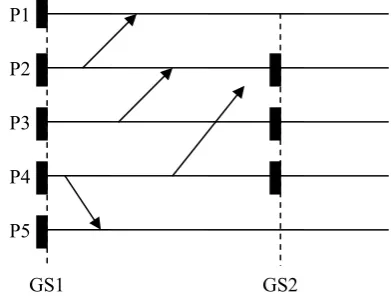
Fig.3 shows the vertical line G1 the global checkpoint at the beginning of the computation. Let Process P2 initiates a new snapshot collection. only P3 and P4 need to take their local snapshot because they depends upon node P2 .But the nodes P1 and P5 need not take their snapshot because they do not have dependencies on to process P2.Dotted line G2 shows the global recovery line or current global checkpoint.
There must be a great need to avoid the orphan message to maintain the global consistent state checkpoint in global checkpoints collection. There are three processes P, Q and R. Let Q initiates checkpoint request to processes P and R. Let P and R take their local checkpoints. If R sends sage M to P before receiving checkpoint request then mes-sage M will become an orphan mesmes-sage which creates a problem during snapshot collection. To avoid such problem
Di[j] =
1 i = j
0 i≠j
P1
P2
P3
P4
P5
[image:3.595.329.555.137.233.2]GS1 GS2
Figure 3. Minimum no. of checkpoints and Consistent Global State (CGS) or consistent cut.
P1 [100]
P2
P3 [001]
[110] [010]
[image:3.595.332.528.395.545.2]a concept of checkpoint sequence number get arise. We call this ckpt_num in our algorithm.
B. Data Structure
Di : a Boolean vector Di of n components. At Pi, the
vector initialized as follows as in [2]:
Di[i] = 1; Di[j] = 0 if i ≠ j; When a node Pi sends a message to Pj it then changes vector Di . This tells Pj about the nodes that are dependent on Pi. While processing a message M Pj extracts Boolean vector M.R from the message and uses it to update Rj as follows: Dj[k] ← Dj[k] OR M.D[k], where 1
≤ k ≤ n.
ckpt_num: when the node takes its local checkpoint then
this integer number is increased.
Weight: A nonnegative real variable with maximum
val-ue 1 used to detect the termination of snapshot collection or checkpointing algorithm.
Transmit: a Boolean array of size n maintained by each
node in its stable storage. This array is initialized to all ze-ros. It is used to keep the trail of those nodes to which checkpoint requests were sent by node. If in this array each element has all 0s then response message is sent to the snap-shot initiator with a weight equal to weight received in the request. If in this array some elements are put to 1 then for all i such that transmit[i] = 1, a request is sent to Pi with a non zero segment of weight received in request message and rest part of weight is sent to initiator with a response mes-sage.
Trigger: A set of 2-tuples (init_id, init_ckptnum)
main-tained by each node, where init_id indicates the identifier of checkpointing initiator. init_ckptnum shows the check-point number of the initiator node when it took its own local snapshot on initiating the snapshot collection. trigger is changed for all system messages and the first computa-tion message that a node sends to every other node after taking a local snapshot.
ckpt_array: This is an array of n integer maintained at
each node, ckpt_array[i] indicates the ckpt_num of the next message expected from node Pi.
self_trigger: The trigger tuple of a node receiving
com-putation message
msg_trigger: Trigger tuple of computation message get_weight: The weight received by dependent nodes
forward_weight: The weight sends by the node which
further spread checkpoint request
C. The Algoritm
To minimize the number of MHs taking checkpoints, the checkpoint initiator has to identigy which MHs must take a checkpoint. The detailed checkpointing algorithm is described as follows:
(a)Checkpoint initiation process: If the checkpoint
initia-tor process, say Pin runs on an MH, it first takes soft check-point and sends the checkcheck-point initiation request to its local MSS, say MSSini and then MSSini become the checkpoint proxy. This proxy MSS handle all the computation and location information regarding the MH and act as follows: (1) Increments its ckpt_num (2) initialized weight to 1 (3) It sets init_id and init_ckptnum in its trigger tuple (4) It sends checkpoint request message to all its dependent nodes. The request message now includes: weight, initia-tor’s trigger and dependency vector Di.
(b)Response of a node receiving of checkpoint request:
Let node Pi receives checkpoint request
if (reqst_msg.trigger ≠ Pi.trigger) then {
Pi takes soft checkpoint;
Pi propagates reqst_msg to all the dependent nodes but not M.Di; /* Explained Checkpoint module */
Send portion of the received weight with its reqst_msg; Update initiator trigger tuple;
Send response_msg to the initiator; }
else if ( transmit[i] = 0 ) then {
Pi send response_msg with weight received with reqst_msg to initiator;
} else {
Pi send reqst_msg to nodes for which transmit[j] =1 with portion of weight;
Pi sends response_msg with remaining weight to initiator; }
}
(c)Response of a node receiving of computational
mes-sage: Let a node Pj receives a computation message M
from other node Pi then following action occurs: If (ckpt_numi≤ ckpt_array[i]) then
{
Pj will not take any checkpoint;
Restart the computation by processing message M; }
else {
Set ckpt_array[i] = ckpt_numi ;
/* Pi has already taken a checkpoint before sending M and this is the first computation message sent from Pi to Pj. So M carries a trigger (init_id, init_ckptnum)*/ }
if (msg_trigger = self_trigger) then Update dependency vector Di[j];
// Pi and Pj has taken checkpoints w.r.t same initiator else (msg_trigger.pid ≠ self_trigger.pid)
{
If (Pj had processed a message from node Pk) then Return;
Pj takes tentative checkpoint; Set msg_trigger=self_trigger;
Propagate snapshot request to dependent processes; }
}
(d)Further Checkpoint request propagation: Let node Pi
take checkpoint request. It propagates checkpoint request to its dependent processes as follows:
Take soft checkpoint;
Update ckpt_numi and transmit[i]; Self_trigger=msg_trigger; transmit[i] = Ri – M.R;
for all k dependent nodes set transmit[k]=1 {
get_weight = get_weight/2 forward_weight = get_weight;
send(Pi ,request_msg,chkpt_num,self_trigger,forward_weig ht);
}
(e) Termination of Checkpointing: After receiving the
checkpoint request message, each MH sends a reply to the MSSini along with weight. When the initiator receives re-ply from all the relevant MHs means the sum of received weight becomes equal to 1. it make a decision whether it commit or abort to all the relevant processes. This is same as any other two –phase checkpointing strategies. On re-ceiving COMMIT or ABORT message from the initiator MSS the process Pi act as follows:
On receiving COMMIT() If(Softi)
{
Discard old permanent checkpoint, if any;
Convert the tentative checkpoint into permament one; }
On receiving ABORT() {
if (softi )
Discard the soft checkpoint; }
If a process receives commit message, if it taken soft checkpoint already The previous permanent local check-points at these nodes are discarded. Now if further recovery is required the nodes will rollback to current checkpoint.
D. Working Example
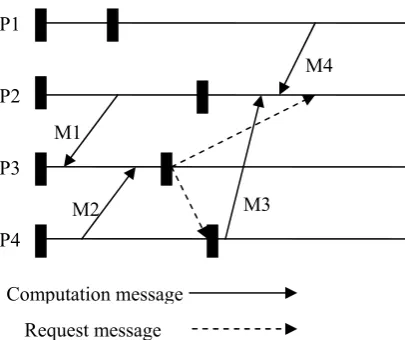
Following example (Fig. 4) clarifies the concepts used in our algorithm with the help of Fig node P3 initiates snap-shot collection by taking its local checkpoint. The node P2 and P4 shows dependencies to P3. The broken arrows shows request messages sent to P2 and P4 to take their snapshots on their timeline. P4 takes first snapshot and then sends a message M3 to P2. When M3 reaches P2 it is the first mes-sage reached at P2 such that msg_trigger.pid ≠ self_trigger.pid. Hence P2 takes its snapshot before process-ing M3. Node P1 takes its local independent snapshot be-fore sending a message M4 to P2. The interval number of M4 is greater than the value expected by P2 from P1.
But when M4 reaches P2 it is not the first computation message received by P2 with a higher interval number than expected whose msg_trigger.pid is different from P2’s self_trigger.pid. So a snapshot is not taken because it will create inconsistency: The reception of M3 will be recorded if P2 takes a snapshot just before it processes M4, but the transmission of M3 will not have been recorded by P4 and now M3 becomes orphan. Also here msg_trigger of M3 = self_trigger of request message to P2 . Hence no need to take further checkpoint.
VI. RESULT AND DISCUSSION
In this algorithm we have described a efficient coordi-nated checkpointing algorithm to survive a failure in mo-bile distributed system which is able to save consistent global states with small overheads by reducing the search-ing cost as well as power and bandwidth requirements. The main feature of our algorithm are: (1) it is non-bocking ;(2) it is orphan free as it takes checkpointing decision on the basis of checkpoint sequence number; (3) it is less power consuming as it is forces to take minimum processes which are directly and transitively dependent on the initiator proc-ess and all the information related to the MHs are handled by there corresponding MSS; (4) it utilize the wireless bandwidth efficiently as the only minimum required infor-mation are transfer through between MHs and MSSs. (5) it minimize the coordinated message as MSS maintain a mi-nimal dependency information related on its own level.
VII. REFERENCES
[1] K.M. Chandy and L.Lamport. “Distributed Snapshots: Determining Global States of Distributed Systems” ACM Transactions Computer systems vol. 3, no.1.pp.63-75, Feb.1985.
[2] Prakash R. and Singhal M., “Low-Cost Checkpointing and Failure Recovery in Mobile Computing Systems” ,IEEE Transaction On Parallel and Distributed Systems, vol. 7, no. 10, pp. 1035-1048, October1996 [3] Guohong Cao and Mukesh Singhal, “On Coordinated
Checkpointing in Distributed Systems” IEEE Transaction On Parallel and Distributed Systems, vol. 9, no. 12, pp. 1213-1224, December 1998.
[4] Guohong Cao and Mukesh Singhal, “Mutable Checkpoints: A New Checkpointing Approach for Mobile Computing Systems”, IEEE Transaction On Parallel and Distributed Systems, vol. 12, no. 2, pp. 157-171, February 2001.
P1
P2
P3
P4 M1
M2 M3
M4
[image:5.595.58.261.564.734.2]Computation message
Figure 4. Global checkpoint collection Request message
[5] Weigang Ni, Susan V. Vrbsky and Sibabrata Ray “Pitfalls in Distributed Non blocking Checkpointing”, University of Alabama
[6] Prakash R. and Singhal M. “Maximal Global Snapshot with concurrent initiators,” Proc. Sixth IEEE Symp. Parallel and Distributed Processing, pp.344-351, Oct.1994.
[7] Koo. R. and S.Toueg. “Checkpointing and Rollback-Recovery for Distributed Systems” .IEEE Transactions on Software Engineering, SE-13(1):23-31, January 1987.
[9] Acharya A. and Badrinath B. R., “Checkpointing Distributed Applications on Mobile Computers,” Proceedings of the 3rd International Conference on Parallel and Distributed Information Systems, pp. 73-80, September 1994.
[10] Ch.D.V. Subba Rao and M.M.Naidu. “A New, Efficient Coordinated Checkpointing Algorithm Combined with Selective Sender-Based Message Logging”
[11] Nuno Neves and W. Kent Fuchs. “Adaptive Recovery for Mobile Environments”,in Proc.IEEE High-Assurance Systems Engineering Workshop,October 21-22,1996,pp.134-141.
[12] Y.Manable. “A Distributed Consistent Global Checkpoint Algorithm With minimum number of
Checkpoints”. Technical Report of IEICE, COMP97-6(April1997)
[13] J.L.Kim and T.Park. “An efficient algorithm for checkpointing recovery in Distributed Systems” IEEE Transaction On Parallel and Distributed Systems,4(8):pp.955-960, Aug 1993.
[14] Elnozahy E.N., Alvisi L., Wang Y.M. and Johnson D.B., “A Survey of Rollback-Recovery Algorithms in Message-Passing Systems,” ACM Computing Surveys, vol. 34, no. 3, pp. 375-408, 2002.